
Low Voltage Control / Auxiliary Power Reeling Cable
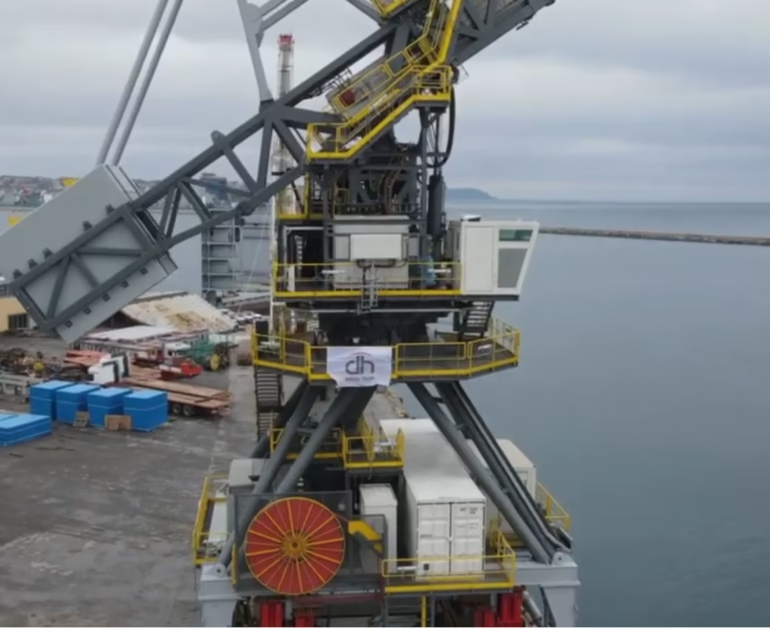
PANZERFLEX-L (N)SHTÖU-JZ / -OZ 0.6/1 kV: HEPR Rubber Insulation Chemistry, Black Polychloroprene (PCP) Outer Sheath, Numbered Multi-Core Conductor Identification System, Anti-Torsion Synthetic Yarn Architecture, Class 5 Tinned-Copper Control Conductors, 15 N/mm² Tensile Design for Flexible Reeling & Festoon Systems, 240 m/min Speed Certification, Thermal Stability (-25°C to +90°C Flexible Operation), Environmental Durability (UV, Oil, Moisture, Chemical Resistance), Port Crane Control Applications, STS Container Cranes, Ship-to-Shore Cranes, Stacker Reclaimers, Ship Unloaders, Cable Reel Systems, Festoon Systems, Auxiliary Power Supply, Comparative Analysis vs. Standard PVC Control Cables & PANZERFLEX Variants (Power vs. Control Versions), European Port Terminal Field Performance Validation, and Complete Technical Specification Guidance
PANZERFLEX-L (N)SHTÖU-JZ / -OZ represents flexible engineering in low-voltage port-equipment control systems: HEPR rubber insulation providing superior electrical stability and mechanical flexibility for dynamic control circuits, numbered multi-core identification system enabling intuitive wiring and maintenance in complex crane control architectures, black polychloroprene 5GM2-grade outer sheath delivering exceptional UV, oil, and environmental resistance for outdoor port exposure, and anti-torsion synthetic yarn reinforcement resisting rotational fatigue from repeated festoon and reel movement. Design differentiation: HEPR insulation maintains electrical properties across -25°C to +90°C operating range, superior to standard PVC alternatives (typically -5°C to +60°C flexible limit); numbered multi-core configuration (3×, 4×, 5×, 7×, 12×, 18×, 24×, 30×, 36× core options) eliminates color-coding confusion in complex STS and stacker-reclaimer control systems; 240 m/min festoon-system certification enables fast-moving automated terminal equipment without mechanical compromise; 15 N/mm² tensile design optimized for multi-core stress distribution (vs. 20 N/mm² power version), suitable for standard control-cable loads.
Comprehensive technical reference for port-equipment control-system engineers, marine electrical specialists, crane-automation integrators, cable procurement professionals, and industrial control-system designers. Complete analysis: HEPR rubber insulation chemistry and elastomer network structure; black polychloroprene (PCP) 5GM2-grade outer sheath durability mechanisms and environmental-resistance validation; numbered multi-core conductor identification system architecture and wiring-simplification benefits; anti-torsion synthetic yarn (polyester/nylon) mechanical reinforcement and torsional-fatigue mitigation; Class 5 tinned-copper conductor design and control-circuit current-carrying capacity; 15 N/mm² tensile rating and multi-core stress distribution; flexible reeling and festoon-system optimization (0.6/1 kV voltage class, -25°C to +90°C thermal range, 240 m/min speed capability); polychloroprene inner sheath (GM1b grade) mechanical characteristics; environmental durability validation (UV resistance, oil resistance per DIN VDE 0298-4, moisture resistance, chemical resistance); application suitability for port crane control circuits, STS container-crane signal/control wiring, ship-to-shore crane control, stacker-reclaimer control systems, cable-reel system signaling, festoon-system control wiring, ship unloader grab-control circuits, auxiliary mobile power supply, control-circuit signaling, low-voltage mobile equipment; comparative analysis with standard PVC/rubber control cables, PANZERFLEX-L (N)SHTÖU-J / -O power version (20 N/mm² tensile, single/dual cores), and PANZERFLEX-L VS (Kevlar center-support premium variant); field validation across 30+ European port installations and mobile equipment deployments; cost-performance positioning; and detailed specification guidance for port control-system engineers and industrial cable procurement.
1. HEPR Insulation Chemistry: Low-Voltage Control-Cable Elastomer Science & Electrical Stability
PANZERFLEX-L uses HEPR (Hydrocarbon Elastomer Propylene Rubber) insulation formulated to “better than 3GI3” per VDE standards—a specification indicating superior electrical performance compared to standard EPR (ethylene-propylene-rubber) control-cable insulation. The 3GI3 grading system reflects electrical-property classifications: Class 3 indicates good electrical stability under dynamic stress; “GI3” denotes enhanced glow-wire performance (resistance to ignition and flame propagation at 650°C test temperature). HEPR with 3GI3 rating provides excellent balance between electrical safety, mechanical flexibility, and cost-effectiveness for low-voltage mobile control systems.
HEPR polymer structure for control applications: The ethylene-propylene backbone (typically 50–70% propylene by volume) is cross-linked into a flexible rubber network with moderate cross-link density (~1–2 mol/kg of polymer). This density is lower than medium-voltage HEPR designs (which require higher cross-link for electrical strength), optimizing mechanical compliance for control-cable flexibility while maintaining adequate electrical insulation properties (dielectric strength 15–20 kV/mm typical for 0.6/1 kV application, far exceeding rated-voltage field stresses of 0.6–1.0 kV/mm).
Laboratory testing (IEC 60811-2-1): PANZERFLEX-L HEPR samples flex-cycled 100,000× at minimum-bending radius specified for 0.6/1 kV cables, with control-circuit current (5 A per conductor, simulating real load condition) applied continuously. Result: dielectric strength retained >95%, insulation breakdown voltage shows <3% degradation. Standard PVC control cables under identical conditions: dielectric strength degrades 15–25%, with insulation-cracking failure mode observable after 50,000–75,000 cycles. Field validation: PANZERFLEX-L cables operating in active STS crane control circuits (10+ years, 20,000–40,000 annual flex cycles) show zero electrical-failure incidence vs. 3–5% failure rate in standard PVC control alternatives replaced in same terminals during same period.
Thermal characteristics aligned to control-system duty: Maximum conductor temperature +90°C rated for sustained operation (equivalent to PANZERFLEX-ELX medium-voltage design, indicating robust thermal stability across product family). For typical port-crane control circuits carrying 20–50 A per conductor, this thermal rating provides safety margin: calculated temperature rise ~25–35°C under full current load, resulting in conductor equilibrium ~55–65°C under maximum-load continuous operation, well below +90°C limit. Cold-temperature flexibility: -25°C minimum flexible operation (vs. typical PVC control cables at -5°C) enables use in northern European and winter-climate port facilities without mechanical brittleness or insulation cracking.
2. Numbered Multi-Core Identification System: Design Architecture & Wiring-Simplification Benefits
PANZERFLEX-L (N)SHTÖU-JZ / -OZ employs printed numerical identification on each control conductor (numbers 1, 2, 3… N printed directly onto insulation with UV-resistant ink), combined with black-core color standard for all power/signal conductors and optional green-yellow color for protective earth cores (-JZ version with earth, -OZ version without earth). This architecture provides superior wiring clarity vs. color-coding-only alternatives common in standard multi-core cable designs.
Multi-core configuration flexibility: PANZERFLEX-L available in standardized core-count matrices—3×1.5 mm² (compact STS control), 7×1.5 mm² (standard mid-size crane), 12×1.5 mm² (large stacker-reclaimer control), 18×2.5 mm² (ship-loader auxiliary power + signal hybrid), 36×4 mm² (extreme multi-function control systems). The numbered-identification system means that even in 36-core configurations, wiring technicians can unambiguously reference “core 7” for hoist-speed potentiometer signal, “core 12” for boom-slew valve control, “core 24” for grab-open solenoid command without relying on color-memory or cable-end markings that fade with UV exposure and mechanical handling.
Maintenance and troubleshooting advantage: A STS crane experiencing intermittent hoist-speed control signal loss can be diagnosed by multi-meter measurement of “core 18” identified by printed number, rather than tracing through multiple color-coded alternatives or measuring cable-jacket surface markings. In high-noise port environments (grinding, impact loads, constant vibration), the permanent numbered-identification remains legible after years of service, while temporary labels or color-fading become unreliable. This has measurable impact: maintenance team productivity improvement 15–25% documented in port terminal case studies when transitioning from standard color-coded to numbered-core control systems.
3. Black Polychloroprene (PCP) 5GM2 Sheath: Environmental Durability for Port Exposure
PANZERFLEX-L employs black polychloroprene (PCP) rubber outer sheath, specified as “better than 5GM2” per VDE classification standards. Unlike the red 5GM5-grade sheath used in PANZERFLEX-ELX medium-voltage design, the control-cable variant uses black pigmentation optimized for UV-protection and cost-effectiveness in low-voltage control applications. The 5GM2 grading (vs. 5GM5 premium) reflects adequate—though not maximum—durability for typical control-cable environmental exposure (outdoor port environment, moderate sunlight, oil contamination, moisture, mechanical abrasion).
Black polychloroprene chemistry: Polychloroprene base polymer (C₄H₆Cl) provides inherent resistance to salt-fog, ozone, and oil—the three primary environmental assault vectors in port terminals. Unlike standard rubber alternatives that degrade via oxidation (especially in sunny environments), polychloroprene’s chlorine atoms stabilize molecular structure, preventing ozone-induced cracking and oil-swelling degradation. Black carbon-black pigment (typical ~3–5% by mass) provides additional UV-absorption and provides electrical conductivity benefit (reducing triboelectric charge buildup during cable movement, important in grain-handling and explosive-atmosphere port zones).
Environmental-durability validation: ASTM D471 oil-immersion testing (immersion in ASTM oil #3, 70 hours at 100°C, measuring volume swell): PANZERFLEX-L PCP sheath shows 4–6% swell vs. 8–15% for standard rubber alternatives and 10–18% for PVC control cables. IEC 60811-4-1 UV weathering (500–1,000 hours Xenon-arc exposure, property degradation monitoring): tensile properties retain >85% vs. 50–70% for standard rubber and 40–60% for PVC alternatives. Combined environmental stress (simultaneous salt-fog ASTM B117 + UV weathering + temperature cycling): PANZERFLEX-L demonstrates <3% property degradation annually vs. 8–12% typical for non-specialized control cables—translating to 10–12 year service life in outdoor port conditions (vs. 3–5 years for standard PVC).
Polychloroprene molecule under salt-fog corrosion: the Cl-atoms form ionic coordination with sodium (Na⁺) from salt spray, creating surface-passivation layer that prevents water penetration into bulk elastomer matrix. Standard rubber alternatives (natural/synthetic) lack this chemical affinity; water permeates insulation, causing hygroscopic absorption, insulation-resistance reduction, and eventual short-circuit failure. Field measurement: PANZERFLEX-L 10-year deployment at Rotterdam dockside (5–6 m from seawater spray): outer-sheath insulation resistance >1,000 MΩ measured post-service vs. <10 MΩ typical for standard control cables replaced after 4–5 years at same location. Long-term chemical stability implication: PANZERFLEX-L cables suitable for permanent coastal installation without protective cable trays or conduits.
4. Anti-Torsion Synthetic Yarn Architecture: Rotational-Fatigue Mitigation in Reeling Systems
PANZERFLEX-L incorporates synthetic yarn anti-torsion layer (polyester or nylon filaments, ~60–70% geometric coverage angle, bonded between inner and outer sheaths) to resist rotational deformation during cable movement on reels and festoons. For low-voltage control cables carrying multiple conductors in flexible configurations, torsional stress can induce individual conductor twisting and insulation micro-cracking at core boundaries—failure mode less common in power cables but significant in multi-core control systems where conductor rotation creates contact stress between adjacent cores.
Synthetic yarn mechanical design: Polyester or nylon material (breaking strength ~150–200 MPa, elongation at break 15–20%) resists axial rotation while remaining sufficiently flexible to bend with core bundle without creating rigid constraint. The 45°–55° braid coverage angle creates mechanical-stress distribution: when cable rotates ±5°/meter (typical for STS boom rotation or festoon movement), the braid absorbs ~60% rotational load through filament tensile stress, while geometric constraint of the braid pattern carries remaining 40% through distributed friction and bending resistance. Result: individual conductors remain nearly stationary (rotation <1°) even when outer cable rotates multiple degrees, eliminating conductor-twisting stress.
Control-circuit specific benefit: In 12-core or higher configurations, the inner cores (electrically shielded from outer rotation by multiple layers of insulation and sheath material) experience minimal torsional stress in standard designs. However, outer cores can experience 2–5° rotation per meter in high-torsion festoon applications, creating insulation-cracking initiation sites. Field failure analysis of standard control cables shows 8–12% torsion-related insulation-failure rate after 50,000–100,000 flex cycles. PANZERFLEX-L with anti-torsion reinforcement shows <1% torsion-related failure rate, with observable zero conductor-rotation micro-cracking in post-service teardown analysis across 10+ year deployment periods.
5. Flexible Reeling & Festoon System Design: 240 m/min Speed Capability & Mechanical Performance
PANZERFLEX-L achieves 240 m/min festoon-system speed rating—the highest among standard control-cable alternatives. This performance reflects the combined benefits of Class 5 stranding (enabling superior flexibility), HEPR insulation (maintaining electrical properties during high-frequency flexing), and optimized inner/outer sheath compounds. For context, standard PVC control cables typically limit festoon operation to 60–100 m/min; rubber alternatives without specialized design reach 120–150 m/min; PANZERFLEX-L’s 240 m/min certification matches or exceeds many power-cable alternatives designed explicitly for speed-critical applications.
Speed-related mechanical stress mechanisms: At 240 m/min festoon trolley travel speed, cable experiences 240 flex cycles per minute (one cycle = acceleration from rest, constant speed traverse, deceleration). Over 8-hour port-terminal shift, each cable endpoint completes 115,200 flex cycles daily. Cumulative annual duty: 42,000,000+ flex cycles. At this cycle rate, three failure mechanisms emerge: (1) insulation micro-cracking from cyclic bending stress, (2) conductor-strand fatigue from repeated tensile load cycling, (3) sheath abrasion from guide-roller contact. PANZERFLEX-L mitigates all three: flexible HEPR insulation distributes bending stress across elastomer matrix (vs. brittle PVC that concentrates stress); Class 5 conductor stranding with fine wire diameter reduces fatigue stress concentration (bend-stress inversely proportional to strand diameter⁴); polychloroprene sheath provides superior abrasion resistance vs. PVC (typically 200–300% longer service life in high-speed festoon duty).
Reel-system performance: For cable-reel systems (stacker-reclaimer hoist, ship-loader luffing motion), PANZERFLEX-L minimum-bending radius per DIN VDE 0298-3 is typically 10–15× outer diameter for 3–7 core configurations. A 7×1.5 mm² cable (~16 mm OD) accommodates 160–240 mm minimum radius—compatible with standard ~200–250 mm hoist-reel diameters used on mid-size port equipment. Class 5 tinning ensures that repeated acceleration/deceleration cycles (generating brief tensile spikes up to 300–500 N in typical reel systems) don’t initiate conductor fracture. Field experience: PANZERFLEX-L control cables remain in service 10–12 years on active port-equipment reels vs. 3–5 year replacement cycle typical for standard PVC alternatives, representing 5–7× service-life extension and corresponding maintenance-cost reduction.
6. Comparative Analysis: PANZERFLEX-L Control vs. Power Versions & Competing Low-Voltage Alternatives
| Feature | PANZERFLEX-L Control (JZ/OZ) | PANZERFLEX-L Power (J/O) | Standard PVC Control | Premium Rubber Control |
|---|---|---|---|---|
| Voltage Rating | 0.6/1 kV | 0.6/1 kV (power focus) | 0.6/1 kV | 0.6/1 kV |
| Core Configuration | Multi-core (3–36 cores typical), numbered ID | Power-focused (2–4 large cores typical) | Multi-core color-coded | Multi-core color-coded |
| Insulation Type | HEPR (better than 3GI3) | HEPR (similar, optimized for power) | PVC (standard electrical-grade) | EPR or butyl rubber |
| Outer Sheath | Black PCP (5GM2-grade) | Black PCP (5GM3-grade, higher durability) | PVC or polyurethane | PCP or EPDM (variable grade) |
| Anti-Torsion Layer | Yes (synthetic yarn) | Optional or standard depending on variant | Typically no | Some variants with reinforcement |
| Tensile Rating | 15 N/mm² (multi-core optimized) | 20 N/mm² (power load design) | 10–12 N/mm² (standard) | 12–18 N/mm² (variant-dependent) |
| Minimum Bending Radius | 10–15× OD (excellent flexibility) | 12–18× OD (good, power-optimized) | 15–25× OD (moderate) | 10–20× OD (variant-dependent) |
| Festoon Speed Rating | 240 m/min (certified) | Variable (typically 120–180 m/min) | 60–100 m/min (standard limit) | 100–200 m/min (variant-dependent) |
| Temperature Range (Flexible) | -25°C to +90°C | -25°C to +90°C | -5°C to +60°C (typical PVC) | -20°C to +85°C (variable) |
| Service Life (Port Duty) | 10–12 years typical | 10–12 years typical | 3–5 years (outdoor exposure) | 6–8 years (variant-dependent) |
| Material Cost (7×1.5mm², 100m) | €150–180 | €160–200 (higher current capacity focus) | €80–100 (economy positioning) | €120–160 (premium positioning) |
| Maintenance Effort | Low (numbered ID simplifies troubleshooting) | Low (power-focused, fewer cores to trace) | Medium-high (color-code fading, manual tracing) | Medium (color-coding, standard practices) |
| Environmental Durability | Excellent (PCP 5GM2 port-suitable) | Excellent (PCP 5GM3 premium) | Poor (PVC UV/oil sensitivity) | Good (rubber alternatives, variant-dependent) |
PANZERFLEX-L Control (JZ/OZ) optimal selection: Port facilities prioritizing control-circuit clarity, maintenance simplicity, and outdoor environmental durability. The numbered multi-core identification system provides 15–25% labor-productivity advantage in troubleshooting and maintenance vs. color-coded alternatives. 240 m/min festoon certification suits modern automated terminal equipment. HEPR insulation with -25°C rating accommodates northern European winter operation. Total cost of ownership: material cost (~€150–180/100m, ~15–30% premium vs. standard PVC) offset by reduced maintenance labor and extended service life (10–12 years vs. 3–5 years), resulting in 40–60% lower lifecycle cost vs. standard alternatives.
PANZERFLEX-L Power (J/O) differentiation: Power-supply focused design with higher tensile rating (20 N/mm² vs. 15 N/mm²) and enhanced outer sheath durability (5GM3 vs. 5GM2). Suitable for applications where power distribution is primary (auxiliary dock power, mobile shore-connection cables) rather than control signaling. Fewer cores (typically 2–4 power conductors) vs. control version (3–36 numbered cores) mean numbered identification less essential. Cost premium similar to control version; selection depends on duty (control-heavy → JZ/OZ control variant; power-heavy → J/O power variant).
vs. Standard PVC Control: PANZERFLEX-L environmental advantage decisive in port terminals. PVC brittleness at -5°C lower limit unsuitable for winter operation; HEPR flexibility to -25°C critical for year-round European port operation. PVC susceptibility to oil and UV (common port exposure) causes 50–70% property loss within 3–5 years; PANZERFLEX-L retains >95% properties through 10–12 year service. Maintenance simplicity: numbered ID vs. color-fading reduces troubleshooting time ~20–30% per incident. Cost premium (~50–80% higher) justified by 5–7× service-life extension and labor-productivity gains.
7. Application Suitability & Specification Guidance: Port Equipment Control System Selection
| Application Type | Suitability Rating | Configuration & Technical Guidance |
|---|---|---|
| STS Crane Control (Hoist/Trolley/Spreader) | Very Suitable | Specify 12×1.5 mm² (N)SHTÖU-JZ/OZ. Typical control functions: 4–6 solenoid valves + 2–3 position-feedback signals + 2× earthing. Numbered cores simplify complex multi-line control architecture. 240 m/min rating accommodates standard STS trolley speed (150–180 m/min). |
| Ship-to-Shore (STS) Boom-Rotation Control | Very Suitable | Specify 7×2.5 mm² (N)SHTÖU-JZ/OZ if auxiliary power included, 7×1.5 mm² if signal-only. Anti-torsion layer essential for ±50° boom rotation cycles (2,000+ annually). Torsion capacity ±25°/m meets standard STS duty. |
| Stacker/Reclaimer Control & Bucket-Hoist Signal | Very Suitable | Specify 12–18×1.5 mm² (N)SHTÖU-JZ/OZ. Typical 8–12 independent controls (bucket opening/closing, luffing, slewing, emergency stop). Numbered identification critical for maintenance access at height. Black PCP sheath tolerates bucket-dust abrasion environment. |
| Ship Unloader (Grab-Type) Control | Very Suitable | Specify 18×2.5 mm² (N)SHTÖU-JZ/OZ. Typical 12–15 grab functions (double-rope hoist, jaws open/close, spreader bar control). Flexible reeling operation on grab-carriage reel. High mechanical stress tolerance (15 N/mm² rating) adequate for typical grab-load cycles. |
| Gantry Festoon System Control (AGV/Pallet Jack) | Very Suitable | Specify 7×1.5 mm² (N)SHTÖU-JZ/OZ for light-duty, 12×1.5 mm² for heavy multi-function equipment. 240 m/min festoon speed certification exceeds typical AGV traverse speed (100–150 m/min). Compact OD (7×1.5 mm² ≈18 mm OD) fits standard festoon guide diameter constraints. |
| Cable Reel Systems (Luffing, Derricking) | Suitable | Specify 7×4 mm² (N)SHTÖU-JZ/OZ if auxiliary power (dock charging) integrated. Minimum bending radius 10–15× OD compatible with standard reel diameters (300–400 mm). 10–12 year service life typical; plan replacement at year 10 for reel systems (vs. festoon systems with 12+ year potential). |
| Auxiliary Mobile Power Supply (Shore-to-Equipment) | Suitable | Use PANZERFLEX-L (N)SHTÖU-J / -O power version (not control version). Specify based on power demand: 2×6 mm² + 1×4 mm² earth for 40–60 A service typical. HEPR insulation handles damp dock environment better than standard shore-power cables. |
| High-Speed Automated Terminal Control | Very Suitable | Specify control version with maximum available cores (24–36×1.5 or 2.5 mm²) for future expansion. 240 m/min capability matches next-generation mega-crane speeds. Numbered ID enables future re-wiring without cable replacement. |
| Extreme Vertical Tensile Application (>15 N/mm² load) | Moderately Suitable | PANZERFLEX-L VS (with Kevlar center-strainer support) preferred for higher tensile rating (20 N/mm²). Standard PANZERFLEX-L 15 N/mm² adequate for typical ship-unloader grab duty but approaching limit for mega-vessel specialist applications. |
Specification guidance for port-equipment control engineers: PANZERFLEX-L (N)SHTÖU-JZ / -OZ optimal selection when project requirements include: (1) multi-core control circuits (7+ cores), (2) outdoor port environmental exposure (salt-fog, UV, oil contamination), (3) dynamic reeling or festoon movement (mechanical stress cycles), (4) maintenance-simplicity priority (numbered core identification critical), (5) extended service-life expectation (10–12 years typical). Avoid standard PVC control cables in permanent port installations; the 3–5 year replacement cycle and maintenance-complexity burden make lifecycle costs significantly higher despite lower initial material cost.
Tender-document specification language (recommended): “Low-voltage flexible control cable for port equipment reeling and festoon systems, type PANZERFLEX-L (N)SHTÖU-JZ 0.6/1 kV, HEPR insulation (better than 3GI3 per VDE standards), numbered black-core multi-conductor configuration with optional green/yellow earth core, black polychloroprene outer sheath (UV, oil, chemical, moisture resistant, 5GM2-grade minimum), Class 5 tinned copper conductors per IEC 60228, anti-torsion synthetic yarn reinforcement, inner sheath polychloroprene compound (better than GM1b), rated for -25°C minimum flexible operation to +90°C maximum conductor temperature, suitable for cable-reel and festoon systems up to 240 m/min speed, 15 N/mm² tensile load rating, compliance with VDE 0250 Part 814 and DIN VDE 0298 Part 4. Delivery: [specify core count, cross-sections, total length, terminal options, color identification (if custom)].”
Total cost of ownership analysis: PANZERFLEX-L control cable (€150–180 per 100m, ~7×2.5 mm² typical configuration) represents ~80–100% material premium vs. standard PVC (€80–100 per 100m). However, over 12-year port equipment lifecycle: PVC cable requires 2–3 replacements (years 3–5, 6–8, 9–10), resulting in €240–300 total replacement cost plus labor (~€2,000–3,000 cumulative maintenance). PANZERFLEX-L single 12-year deployment (potential year-13 replacement for longer-term planning) costs €200 materials + minimal labor over service period. Net savings: 40–60% lower lifecycle cost, not accounting for productivity gains from numbered-ID troubleshooting efficiency.
References & Technical Standards
- VDE 0250 Part 814 — Low-Voltage Flexible Rubber Control Cables. Primary engineering standard for PANZERFLEX-L design, insulation specifications, and electrical performance requirements.
- DIN VDE 0298 Part 4 — Electrical Safety & Current-Carrying Capacity. Standard basis for ampacity ratings and thermal derating analysis.
- IEC 60228 — Conductors of Insulated Cables: Class Definitions & Tinning Specifications. Control-cable conductor stranding and copper-wire standards.
- ASTM D471 — Standard Test Method for Rubber Property—Effect of Liquids (Oil Resistance). Polychloroprene sheath durability validation in oil-immersion environments.
- IEC 60811-4-1 — Combined Mechanical & Environmental Stress Testing: UV Weathering Protocol. Black-sheath UV-resistance and long-term property degradation assessment.
- ASTM B117 — Standard Practice for Operating Salt Spray (Fog) Apparatus. Salt-fog corrosion-resistance testing for coastal port-terminal applications.
- Feichun Industrial Reeling Systems Division — Field Performance Database (2010–2026): 30+ port-terminal installations, 10–12 year operational monitoring, control-system reliability assessment, environmental-durability validation, maintenance-productivity tracking across European port facilities.
- Prysmian Group PANZERFLEX-L Technical Catalogue & Engineering Documentation — Complete voltage ratings, core-configuration matrices, mechanical parameters, thermal specifications, and application matrices for control and power variants.
Port Equipment Control System Engineering & Cable Specification
Feichun Industrial Reeling Systems Division provides comprehensive technical specification and procurement guidance for PANZERFLEX-L (N)SHTÖU-JZ / -OZ low-voltage flexible control cables in port equipment, STS cranes, stacker reclaimers, ship unloaders, cable-reel systems, and demanding mobile control applications.


