HEPR insulation

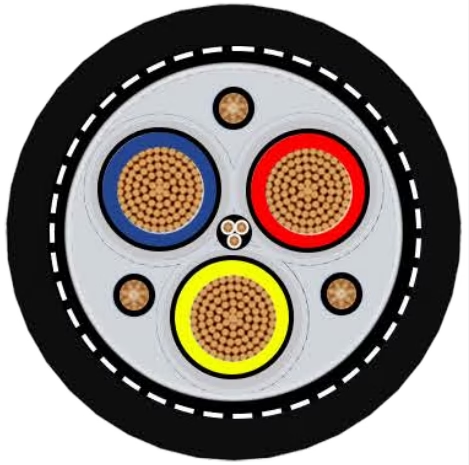
飞纯 Type 245 是基于 AS/NZS 1802:2003 卷筒与拖曳电缆 标准体系设计的矿用非常柔性长壁采煤机电缆,电压范围覆盖 1.1 至 6.6KV。根据产品资料,该电缆主要用作长壁采煤机电缆,也可用于连续采煤机和长壁外围电缆。 Type 245 的关键结构特征是 三根中央可伸长 Pilot / 控制芯线。这三根中央 Pilot 芯线可用于 接地连续性监测 和 控制回路。对于长壁采煤机来说,电缆不仅要传输动力电能,还要承担设备控制、保护联锁、接地连续性确认和移动工况下的安全监测任务。

O que é o PANZERFLEX-ELX MV: Análise de Engenharia Aprofundada do Cabo de Carretel de Alta Velocidade de Média Tensão 3,6/6 a 12/20 kV

O PANZERFLEX-ELX MV é um cabo flexível de média tensão para sistemas de carretel (reeling), projetado para a alimentação de partes móveis de máquinas e equipamentos de movimentação de granéis sob esforços mecânicos de altos a extremos. Empilhadeiras-recuperadoras, descarregadores de navio (ship-to-shore), pórticos de contêiner e escavadeiras são suas aplicações-alvo, com adequação também a sistemas de festão. Sua marca registrada é o desempenho dinâmico: flexão e torção frequentes, movimento rápido com forte aceleração e velocidade de até 180 m/min sem restrição de operação — três vezes a velocidade típica de um cabo de tunelamento. Para sustentar isso, ele reúne condutor de cobre estanhado classe 5, isolação HEPR micro-filtrada de novo composto, controle de campo por blindagens semicondutoras, passo de cabeamento curto e uma trança têxtil anti-torção firmemente aderida entre as bainhas de PCP.
UNE 22511 — formally titled "Cables flexibles para minería subterránea con tensiones de 1,8/3 kV con aislamiento de caucho, sin armadura" (Flexible cables for underground mining, 1.8/3 kV, rubber-insulated, unarmoured) — is the definitive Spanish standard for heavy-duty power cables connecting underground mobile mining equipment to fixed electrical distribution networks. Published and maintained by AENOR (Asociación Española de Normalización y Certificación), it operates as a specialized overlay on IEC 60502-1, extending that base standard's electrical requirements with the stringent mechanical, safety, and flame-retardancy requirements specific to enclosed underground environments. Despite its Spanish origin, UNE 22511 enjoys a geographic reach far exceeding Iberia. The standard has been adopted — formally or by reference — across the major Spanish-speaking mining economies: Chile, Peru, Colombia, Bolivia, and Mexico, where AENOR-certified cables are accepted by national mining safety regulators as the primary qualification pathway for underground mobile equipment power supply cables. In Chile alone, UNE 22511 cables are installed across dozens of operations including major copper and coal mines. The standard's engineering DNA can be described in a single imperative: extreme dynamic flexibility combined with superior resistance to combined torsional and bending fatigue. This is not merely a performance aspiration — it is a structural requirement that shapes every material choice and geometric decision in the cable's construction. The logic proceeds as follows: Underground mobile equipment (continuous miners, shearers, shuttle cars) moves continuously and repeatedly during operation, dragging its power cable behind it or winding and unwinding it from a cable reel. This motion imposes cyclic bending, axial tension, and torsional loads on the cable simultaneously — a multi-axis fatigue regime of a severity not encountered in any other industrial cable application. Standard fixed-installation cables, even those classified as "flexible," are not designed for this loading regime and will fail in fatigue within weeks to months when installed in drag duty. Therefore, every structural element of a UNE 22511 cable — conductor wire diameter, insulation compound, earth core geometry, armour exclusion, sheath specification — is selected to maximize multi-axis fatigue endurance, not any single performance parameter. ⛏ The Founding Engineering Principle UNE 22511 is an unarmoured drag cable standard. The deliberate absence of any metallic armour — which might superficially seem to reduce robustness — is in fact the defining engineering choice that makes the standard viable. Steel wire or tape armour in a continuously torsionally-loaded cable acts as a progressive-failure torsional spring: each twist cycle accumulates irreversible plastic strain in the armour wires, leading to wire fractures within 10,000–30,000 cycles. For a shuttle car cable experiencing 80,000+ torsional cycles per year, armour represents not additional protection but a built-in scheduled failure mechanism. The UNE 22511 design eliminates this failure mode at source.

什么是 PANZERFLEX-ELX MV from 3,6/6 to 12/20kV:矿山与散料搬运高压柔性卷筒电缆技术解析

PANZERFLEX-ELX MV 是一种面向矿山、散料搬运和重载移动设备供电的高压柔性卷筒动力电缆,覆盖 3,6/6kV、6/10kV、8,7/15kV 和 12/20kV 电压等级。它适用于连接机床或物料搬运设备的移动部件,例如堆取料机、岸桥、集装箱起重机、挖掘机,也适用于拖令系统。该电缆特别适合电缆卷筒系统中的能量供应,能够应对高到极端机械应力、频繁弯曲/扭转操作、快速移动以及强加速度工况。
What Are UNE 22560 and UNE 22561? Scope, Definitions, and Core Purpose The UNE 22560 and UNE 22561 standards represent the final and often most underestimated element of the Spanish and Latin American underground mining cable ecosystem. Where UNE 22511 and UNE 22512 govern the power distribution cables that energize mining equipment, the 22560 and 22561 standards govern the signal, control, and interlock cables that command and protect that equipment. These are the "nervous system" cables of a mine — the communication network that tells a continuous miner when to advance and when to halt, that triggers emergency stops, that monitors hoisting rope tension on shaft equipment, that controls conveyor sequencing, and that enables the protective interlocking that prevents a piece of equipment from operating unless all safety preconditions are met. UNE 22560 formally defines flexible multi-core cables for underground mining with voltage ratings up to 500 V or 0.6/1 kV, with no metallic armour protection — designed for installation within equipment enclosures, along protected cable trays in main gate roads, or in areas where mechanical damage risk is minimal. UNE 22561 is its armoured sister standard, incorporating steel wire braid or steel tape protection, specified for installation in rough terrain areas where mechanical damage from rock fall, equipment collision, or floor contact is a credible risk. Both standards mandate that the cable be designed as a multi-core concentric stranded bundle — not the parallel-laid three or four conductors common in power cables, but rather seven, twelve, nineteen, or more individually insulated cores twisted concentrically around a central axis, allowing compact packaging of numerous independent control circuits within a single cable jacket. The distinction between these standards is not merely mechanical armour presence or absence. Control cables are tested against an entirely different set of safety criteria than power cables because their failure mode is fundamentally different. A power cable failure results in loss of energy to equipment — dangerous but localized. A control cable failure can disable the interlock system that prevents a continuous miner from advancing into unsafe ground, or can disable the emergency stop circuit that should halt a conveyor if a worker falls into it. A control cable fire, burning in a tightly bundled cable tray with other control cables, must not spread flame between cables because control cables are typically routed in shared ducts and cable carriers where one cable's ignition could cascade to adjacent circuits. Therefore, control cables are tested for bundle flame propagation (EN 60332-3) rather than single-cable flame propagation tests — a more stringent requirement that demands careful attention to outer sheath formulation and cable spacing in bundle installation.

Что такое PANZERFLEX-L 0,6/1 kV – Instrumentation and Control: инженерный обзор гибкого кабеля управления для Mining, Reeling и Festoon Systems

PANZERFLEX-L 0,6/1 kV – Instrumentation and Control — это многожильный гибкий кабель для цепей управления, приборных линий, вспомогательного питания и сигнализации на подвижных частях машин, горнодобывающего оборудования и material handling systems. Он предназначен для кабельных барабанов и festoon systems, где кабель постоянно изгибается, частично скручивается, ускоряется и работает под механическим натяжением. Его ключевые признаки — лужёная медная жила class 5 IEC 60228, HEPR crushproof insulation, короткая скрутка ≤7,5× диаметра укладки, чёрные жилы с печатной нумерацией, опциональная зелёно-жёлтая жила, полихлоропреновые оболочки и антискручивающие синтетические нити между внутренней и наружной оболочкой.
LIFT-2S (European) vs. LIFT-1S UL (North American): LIFT-2S characteristics: Voltage: 300/500V (European standard, lower voltage) Temperature: −40°C to +70°C (moderate range) Standards: VDE 0482 part 265-2-1, EN 50265-2-1, IEC 60332-1-2 Design philosophy: Safety by material redundancy (2 steel cores) Steel cores: 2× cores provide mechanical backup Conductor: Class 6 (European, ~150–200 wires per mm²) Cost: Lower (proven European manufacturing) Market: Europe, Asia-Pacific, most of world LIFT-1S UL characteristics: Voltage: 600V (North American standard, higher voltage) Temperature: −25°C to +105°C (extreme range, high-temp optimized) Standards: UL 2562, UL 62, CSA C22.2 No.210.2 Design philosophy: Safety by certification (single core + redundant control) Steel core: 1× core (sufficient with nylon covering) Conductor: Class M (UL, extra fine ~300+ wires per mm²) Cost: Higher (UL testing, certification documentation) Market: North America (USA, Canada), Mexico UL 2562 specialty certification: UL 2562 scope: Elevator and Dumbwaiter Cables Specific requirements: 1. Pendant cable design (cable hangs freely, no duct support) 2. Vertical orientation (designed for gravity-loaded suspension) 3. Repeated flex cycles (cable moves up/down frequently) 4. Safety-critical function (failure = personnel risk) Consequence: More stringent than general-purpose cables Testing includes: Bend cycle fatigue, heat aging, compression resistance Test procedures (unique to UL 2562): Bend cycle test: 1,000+ cycles at minimum bending radius Cable must pass insulation resistance after cycling Heat aging: 500+ hours at 105°C continuous Tensile strength retention minimum 70% Compression: 1,000+ hours under sustained compression Cable cross-section must not exceed 5% permanent deformation LIFT-2S (no UL 2562): Tests per VDE are less stringent on fatigue/cycling Assumes cable mostly static, not repeated flex Adequate for European elevator duty (lower speed, fewer cycles) LIFT-1S UL: All UL 2562 tests passed (proven for North American elevators) Faster cycle times, more frequent motion → more fatigue stress Extra testing ensures reliability under North American elevator duty Market requirement (regulatory): Europe/International: CE mark required (European conformity) VDE/EN/IEC standards sufficient No UL certification needed (not recognized in EU) LIFT-2S is sufficient North America (USA, Canada): UL certification mandatory for elevators UL 2562 specifically for elevator cables CSA dual certification required in Canada LIFT-2S NOT acceptable (lacks UL 2562) LIFT-1S UL mandatory Cost implication: UL certification: ~$5,000–15,000 per product per region Testing duration: 3–6 months per model Documentation: Comprehensive test reports, technical files Result: LIFT-1S UL 20–30% higher cost than equivalent European cable

Что такое PANZERFLEX-L 0,6/1 kV – Power: инженерный обзор гибкого силового кабеля для Mining, Cable Reels и Festoon Systems

PANZERFLEX-L 0,6/1 kV — это гибкий низковольтный силовой кабель для подключения подвижных частей машин, станков, перегрузочного оборудования и горнодобывающей техники. Его конструкция рассчитана на высокие механические нагрузки, частый изгиб, торсионные воздействия, быстрое движение и сильные ускорения в системах питания на кабельных барабанах и festoon systems. В отличие от обычного rubber power cable, PANZERFLEX-L объединяет гибкий лужёный медный проводник class 5 IEC 60228, HEPR-изоляцию повышенной стойкости, полихлоропреновые оболочки и антискручивающую защиту из синтетических нитей между внутренней и наружной оболочкой.
UNE 22511 — formally titled "Cables flexibles para minería subterránea con tensiones de 1,8/3 kV con aislamiento de caucho, sin armadura" (Flexible cables for underground mining, 1.8/3 kV, rubber-insulated, unarmoured) — is the definitive Spanish standard for heavy-duty power cables connecting underground mobile mining equipment to fixed electrical distribution networks. Published and maintained by AENOR (Asociación Española de Normalización y Certificación), it operates as a specialized overlay on IEC 60502-1, extending that base standard's electrical requirements with the stringent mechanical, safety, and flame-retardancy requirements specific to enclosed underground environments. Despite its Spanish origin, UNE 22511 enjoys a geographic reach far exceeding Iberia. The standard has been adopted — formally or by reference — across the major Spanish-speaking mining economies: Chile, Peru, Colombia, Bolivia, and Mexico, where AENOR-certified cables are accepted by national mining safety regulators as the primary qualification pathway for underground mobile equipment power supply cables. In Chile alone, UNE 22511 cables are installed across dozens of operations including major copper and coal mines. The standard's engineering DNA can be described in a single imperative: extreme dynamic flexibility combined with superior resistance to combined torsional and bending fatigue. This is not merely a performance aspiration — it is a structural requirement that shapes every material choice and geometric decision in the cable's construction. The logic proceeds as follows: Underground mobile equipment (continuous miners, shearers, shuttle cars) moves continuously and repeatedly during operation, dragging its power cable behind it or winding and unwinding it from a cable reel. This motion imposes cyclic bending, axial tension, and torsional loads on the cable simultaneously — a multi-axis fatigue regime of a severity not encountered in any other industrial cable application. Standard fixed-installation cables, even those classified as "flexible," are not designed for this loading regime and will fail in fatigue within weeks to months when installed in drag duty. Therefore, every structural element of a UNE 22511 cable — conductor wire diameter, insulation compound, earth core geometry, armour exclusion, sheath specification — is selected to maximize multi-axis fatigue endurance, not any single performance parameter. ⛏ The Founding Engineering Principle UNE 22511 is an unarmoured drag cable standard. The deliberate absence of any metallic armour — which might superficially seem to reduce robustness — is in fact the defining engineering choice that makes the standard viable. Steel wire or tape armour in a continuously torsionally-loaded cable acts as a progressive-failure torsional spring: each twist cycle accumulates irreversible plastic strain in the armour wires, leading to wire fractures within 10,000–30,000 cycles. For a shuttle car cable experiencing 80,000+ torsional cycles per year, armour represents not additional protection but a built-in scheduled failure mechanism. The UNE 22511 design eliminates this failure mode at source.

Что такое PANZERFLAT-ELX from 3,6/6 to 12/20 kV: глубокий инженерный обзор плоского гибкого H.V. reeling cable для Mining / Bulk Material Handling

PANZERFLAT-ELX — это высокогибкий плоский кабель среднего и высокого напряжения для барабанных систем, мобильных машин и перегрузочного оборудования. Он объединяет силовую функцию, механическую стойкость к растяжению и истиранию, стабильную работу при частом изгибе в одной плоскости, а при необходимости — интегрированный оптический канал передачи данных.
UNE 22511 — formally titled "Cables flexibles para minería subterránea con tensiones de 1,8/3 kV con aislamiento de caucho, sin armadura" (Flexible cables for underground mining, 1.8/3 kV, rubber-insulated, unarmoured) — is the definitive Spanish standard for heavy-duty power cables connecting underground mobile mining equipment to fixed electrical distribution networks. Published and maintained by AENOR (Asociación Española de Normalización y Certificación), it operates as a specialized overlay on IEC 60502-1, extending that base standard's electrical requirements with the stringent mechanical, safety, and flame-retardancy requirements specific to enclosed underground environments. Despite its Spanish origin, UNE 22511 enjoys a geographic reach far exceeding Iberia. The standard has been adopted — formally or by reference — across the major Spanish-speaking mining economies: Chile, Peru, Colombia, Bolivia, and Mexico, where AENOR-certified cables are accepted by national mining safety regulators as the primary qualification pathway for underground mobile equipment power supply cables. In Chile alone, UNE 22511 cables are installed across dozens of operations including major copper and coal mines. The standard's engineering DNA can be described in a single imperative: extreme dynamic flexibility combined with superior resistance to combined torsional and bending fatigue. This is not merely a performance aspiration — it is a structural requirement that shapes every material choice and geometric decision in the cable's construction. The logic proceeds as follows: Underground mobile equipment (continuous miners, shearers, shuttle cars) moves continuously and repeatedly during operation, dragging its power cable behind it or winding and unwinding it from a cable reel. This motion imposes cyclic bending, axial tension, and torsional loads on the cable simultaneously — a multi-axis fatigue regime of a severity not encountered in any other industrial cable application. Standard fixed-installation cables, even those classified as "flexible," are not designed for this loading regime and will fail in fatigue within weeks to months when installed in drag duty. Therefore, every structural element of a UNE 22511 cable — conductor wire diameter, insulation compound, earth core geometry, armour exclusion, sheath specification — is selected to maximize multi-axis fatigue endurance, not any single performance parameter. ⛏ The Founding Engineering Principle UNE 22511 is an unarmoured drag cable standard. The deliberate absence of any metallic armour — which might superficially seem to reduce robustness — is in fact the defining engineering choice that makes the standard viable. Steel wire or tape armour in a continuously torsionally-loaded cable acts as a progressive-failure torsional spring: each twist cycle accumulates irreversible plastic strain in the armour wires, leading to wire fractures within 10,000–30,000 cycles. For a shuttle car cable experiencing 80,000+ torsional cycles per year, armour represents not additional protection but a built-in scheduled failure mechanism. The UNE 22511 design eliminates this failure mode at source.

リーリングケーブル技術マニュアル

リーリング、フェストゥーン、バスケット型移動ケーブルの寿命は、施工と巻取システムの設計に大きく左右されます。本マニュアルでは、曲げ半径、ガイド、張力保護、アンカリング、リール選定、ねじれ除去に加え、許容電流・低減係数・電圧降下・短絡の電気計算手法を扱います。
What Are UNE 22560 and UNE 22561? Scope, Definitions, and Core Purpose The UNE 22560 and UNE 22561 standards represent the final and often most underestimated element of the Spanish and Latin American underground mining cable ecosystem. Where UNE 22511 and UNE 22512 govern the power distribution cables that energize mining equipment, the 22560 and 22561 standards govern the signal, control, and interlock cables that command and protect that equipment. These are the "nervous system" cables of a mine — the communication network that tells a continuous miner when to advance and when to halt, that triggers emergency stops, that monitors hoisting rope tension on shaft equipment, that controls conveyor sequencing, and that enables the protective interlocking that prevents a piece of equipment from operating unless all safety preconditions are met. UNE 22560 formally defines flexible multi-core cables for underground mining with voltage ratings up to 500 V or 0.6/1 kV, with no metallic armour protection — designed for installation within equipment enclosures, along protected cable trays in main gate roads, or in areas where mechanical damage risk is minimal. UNE 22561 is its armoured sister standard, incorporating steel wire braid or steel tape protection, specified for installation in rough terrain areas where mechanical damage from rock fall, equipment collision, or floor contact is a credible risk. Both standards mandate that the cable be designed as a multi-core concentric stranded bundle — not the parallel-laid three or four conductors common in power cables, but rather seven, twelve, nineteen, or more individually insulated cores twisted concentrically around a central axis, allowing compact packaging of numerous independent control circuits within a single cable jacket. The distinction between these standards is not merely mechanical armour presence or absence. Control cables are tested against an entirely different set of safety criteria than power cables because their failure mode is fundamentally different. A power cable failure results in loss of energy to equipment — dangerous but localized. A control cable failure can disable the interlock system that prevents a continuous miner from advancing into unsafe ground, or can disable the emergency stop circuit that should halt a conveyor if a worker falls into it. A control cable fire, burning in a tightly bundled cable tray with other control cables, must not spread flame between cables because control cables are typically routed in shared ducts and cable carriers where one cable's ignition could cascade to adjacent circuits. Therefore, control cables are tested for bundle flame propagation (EN 60332-3) rather than single-cable flame propagation tests — a more stringent requirement that demands careful attention to outer sheath formulation and cable spacing in bundle installation.

Cabos de CarretelManual Técnico

A vida útil dos cabos móveis de carretel, festão e cesto depende, em grande medida, da instalação e do projeto do sistema de enrolamento. Este manual aborda raios de curvatura, guias, proteção de tração, ancoragem, seleção de carretel e remoção de torção, junto com os métodos elétricos de capacidade de corrente, redução (derating), queda de tensão e curto-circuito
UNE 22511 — formally titled "Cables flexibles para minería subterránea con tensiones de 1,8/3 kV con aislamiento de caucho, sin armadura" (Flexible cables for underground mining, 1.8/3 kV, rubber-insulated, unarmoured) — is the definitive Spanish standard for heavy-duty power cables connecting underground mobile mining equipment to fixed electrical distribution networks. Published and maintained by AENOR (Asociación Española de Normalización y Certificación), it operates as a specialized overlay on IEC 60502-1, extending that base standard's electrical requirements with the stringent mechanical, safety, and flame-retardancy requirements specific to enclosed underground environments. Despite its Spanish origin, UNE 22511 enjoys a geographic reach far exceeding Iberia. The standard has been adopted — formally or by reference — across the major Spanish-speaking mining economies: Chile, Peru, Colombia, Bolivia, and Mexico, where AENOR-certified cables are accepted by national mining safety regulators as the primary qualification pathway for underground mobile equipment power supply cables. In Chile alone, UNE 22511 cables are installed across dozens of operations including major copper and coal mines. The standard's engineering DNA can be described in a single imperative: extreme dynamic flexibility combined with superior resistance to combined torsional and bending fatigue. This is not merely a performance aspiration — it is a structural requirement that shapes every material choice and geometric decision in the cable's construction. The logic proceeds as follows: Underground mobile equipment (continuous miners, shearers, shuttle cars) moves continuously and repeatedly during operation, dragging its power cable behind it or winding and unwinding it from a cable reel. This motion imposes cyclic bending, axial tension, and torsional loads on the cable simultaneously — a multi-axis fatigue regime of a severity not encountered in any other industrial cable application. Standard fixed-installation cables, even those classified as "flexible," are not designed for this loading regime and will fail in fatigue within weeks to months when installed in drag duty. Therefore, every structural element of a UNE 22511 cable — conductor wire diameter, insulation compound, earth core geometry, armour exclusion, sheath specification — is selected to maximize multi-axis fatigue endurance, not any single performance parameter. ⛏ The Founding Engineering Principle UNE 22511 is an unarmoured drag cable standard. The deliberate absence of any metallic armour — which might superficially seem to reduce robustness — is in fact the defining engineering choice that makes the standard viable. Steel wire or tape armour in a continuously torsionally-loaded cable acts as a progressive-failure torsional spring: each twist cycle accumulates irreversible plastic strain in the armour wires, leading to wire fractures within 10,000–30,000 cycles. For a shuttle car cable experiencing 80,000+ torsional cycles per year, armour represents not additional protection but a built-in scheduled failure mechanism. The UNE 22511 design eliminates this failure mode at source.

Cáp Cuộn (Reeling)Sổ tay Kỹ thuật

Tuổi thọ của cáp di động loại cuộn (reeling), treo (festoon) và giỏ (basket) phụ thuộc phần lớn vào việc lắp đặt và thiết kế hệ thống quấn cáp. Sổ tay này trình bày bán kính uốn cong, bộ dẫn hướng, bảo vệ lực căng, neo giữ, lựa chọn tang cuộn và xử lý xoắn, cùng với các phương pháp điện về khả năng tải dòng, hệ số chiết giảm, sụt áp và ngắn mạch.
La vida útil de los cables móviles de carrete, festón y canasta depende, en gran medida, de la instalación y del diseño del sistema de enrollado. Este manual abarca radios de curvatura, guías, protección de tensión, anclaje, selección de carrete y eliminación de torsión, junto con los métodos eléctricos de capacidad de corriente, reducción (derating), caída de tensión y cortocircuito.

Cables de CarreteManual Técnico

La vida útil de los cables móviles de carrete, festón y canasta depende, en gran medida, de la instalación y del diseño del sistema de enrollado. Este manual abarca radios de curvatura, guías, protección de tensión, anclaje, selección de carrete y eliminación de torsión, junto con los métodos eléctricos de capacidad de corriente, reducción (derating), caída de tensión y cortocircuito.
(N)GRDGÖU-J Nomenclature (VDE 0250 part 813): (N) = Nominal voltage prefix (0.6/1 kV implicit in designation) G = Gummiert (rubber-insulated) R = Rubber outer sheath D = Dynamisch (dynamic/flexing application) G = Gummiert inner sheath (intermediate layer) Ö = German standard designation (ö indicates European origin) U = Unarmoured (no metal sheath) J = Jacked (multi-sheath design: intermediate + outer) Full meaning: Rubber-insulated, rubber-sheathed, dynamic-rated, multi-sheath construction, unarmoured festoon cable VDE 0250 part 813 scope: Published by: VDE (Verband der Elektrotechnik, German standards body) Applies to: Flexible cables for crane installations (particularly festoon systems) Coverage: Voltage, temperature, mechanical properties, installation methods Festoon-specific requirements: - High bending flexibility (4×D minimum typical) - Fast rewind capability (240+ m/min rated speed) - Sustained torsion tolerance (±25°/1m continuous) - Extended temperature range (−50 to +80°C) - UV/ozone/moisture resistance (outdoor exposure) Alternate designations (similar cables): IEC 60811-1-1: International equivalent (less specific) DIN VDE 0298 part 3: German mechanical property standard DIN VDE 0482-265-2-1: German flame test standard EN 50265-2-1: European flame test equivalent GRDGÖU-J advantage: Combines all standards into single VDE designation Procurement simplified for European buyers

Reeling CableTechnical Manual

The service life of reeling, festoon and basket-type mobile cables depends, to a large extent, on the installation and the design of the winding system. This manual covers bending radii, guides, tension protection, anchoring, reel selection and twist removal, together with the electrical methods for current rating, derating, voltage drop and short-circuit.
LIFT-2S (European) vs. LIFT-1S UL (North American): LIFT-2S characteristics: Voltage: 300/500V (European standard, lower voltage) Temperature: −40°C to +70°C (moderate range) Standards: VDE 0482 part 265-2-1, EN 50265-2-1, IEC 60332-1-2 Design philosophy: Safety by material redundancy (2 steel cores) Steel cores: 2× cores provide mechanical backup Conductor: Class 6 (European, ~150–200 wires per mm²) Cost: Lower (proven European manufacturing) Market: Europe, Asia-Pacific, most of world LIFT-1S UL characteristics: Voltage: 600V (North American standard, higher voltage) Temperature: −25°C to +105°C (extreme range, high-temp optimized) Standards: UL 2562, UL 62, CSA C22.2 No.210.2 Design philosophy: Safety by certification (single core + redundant control) Steel core: 1× core (sufficient with nylon covering) Conductor: Class M (UL, extra fine ~300+ wires per mm²) Cost: Higher (UL testing, certification documentation) Market: North America (USA, Canada), Mexico UL 2562 specialty certification: UL 2562 scope: Elevator and Dumbwaiter Cables Specific requirements: 1. Pendant cable design (cable hangs freely, no duct support) 2. Vertical orientation (designed for gravity-loaded suspension) 3. Repeated flex cycles (cable moves up/down frequently) 4. Safety-critical function (failure = personnel risk) Consequence: More stringent than general-purpose cables Testing includes: Bend cycle fatigue, heat aging, compression resistance Test procedures (unique to UL 2562): Bend cycle test: 1,000+ cycles at minimum bending radius Cable must pass insulation resistance after cycling Heat aging: 500+ hours at 105°C continuous Tensile strength retention minimum 70% Compression: 1,000+ hours under sustained compression Cable cross-section must not exceed 5% permanent deformation LIFT-2S (no UL 2562): Tests per VDE are less stringent on fatigue/cycling Assumes cable mostly static, not repeated flex Adequate for European elevator duty (lower speed, fewer cycles) LIFT-1S UL: All UL 2562 tests passed (proven for North American elevators) Faster cycle times, more frequent motion → more fatigue stress Extra testing ensures reliability under North American elevator duty Market requirement (regulatory): Europe/International: CE mark required (European conformity) VDE/EN/IEC standards sufficient No UL certification needed (not recognized in EU) LIFT-2S is sufficient North America (USA, Canada): UL certification mandatory for elevators UL 2562 specifically for elevator cables CSA dual certification required in Canada LIFT-2S NOT acceptable (lacks UL 2562) LIFT-1S UL mandatory Cost implication: UL certification: ~$5,000–15,000 per product per region Testing duration: 3–6 months per model Documentation: Comprehensive test reports, technical files Result: LIFT-1S UL 20–30% higher cost than equivalent European cable

PANZERFLEX-ELX MV — средневольтный барабанный кабель с двумя защитными жилами и элементом 60F

Гибкий кабель для горнодобывающего и перегрузочного оборудования, работающего при частых изгибах, кручении, быстрых перемещениях и значительных ускорениях. Представленная таблица относится к конфигурации 3 основные жилы + 2 разделённые защитные жилы + 1 дополнительный элемент 60F.
BASKET SPREADER 740 (YSLTOE) is engineered specifically for hoisting and control applications where mechanical flexibility and electrical reliability must coexist in marine environments. Unlike load-bearing structural cables (which prioritize tensile strength), control cables emphasize: Conductor flexibility – Repeated bending over pulleys without mechanical fatigue Insulation integrity – Voltage breakdown resistance under salt-fog corrosion Mechanical damping – Rope-like flexibility to drape naturally in spreader bar frames Environmental barrier – Outer sheath blocks salt, moisture, and UV penetration Core Design Elements: Component Material Specification Function Port Environment Benefit Conductor Flexible red copper Class 6 (IEC 60228) Carries 300/500V power; enables bending flexibility High purity copper resists galvanic corrosion Insulation PVC type YI2 (IEC 60811) Electrical isolation; voltage breakdown resistance (2 kV test) PVC with marine additives prevents salt-induced tracking Central Unit Aramide yarns (Kevlar™ equivalent) Mechanical load-bearing backup; structural integrity Aramide resists moisture & salt; absorbs vibration stress Outer Sheath PUR type 11YM1 (DIN 73377) Environmental barrier; UV/ozone/moisture protection Superior salt-fog resistance; 20+ year marine lifespan

PANZERFLEX-ELX MV — гибкий средневольтный кабель для тяжёлых барабанных систем

PANZERFLEX-ELX MV — гибкий высоковольтный кабель для подключения подвижных частей машин и перегрузочного оборудования. Конструкция рассчитана на высокие и экстремальные механические нагрузки, частые изгибы и кручение, быстрые перемещения и сильные ускорения.
FLEXIFESTOON® NE-FLAT (NGFLGÖU): Advanced High-Flexibility Anti-Salt Fog Port Cable for Maritime Cargo Handling and Marine Automation Systems Feichun's revolutionary FLEXIFESTOON® NE-FLAT NGFLGÖU flat cable combines extreme high-flexibility architecture with marine-grade anti-salt fog protection, engineered specifically for port automation infrastructure, cargo-handling festoon systems, and maritime equipment control requiring superior corrosion resistance and mechanical reliability through thousands of bending cycles in aggressive saltwater environments.

PANZERFLAT-ELX 3,6/6–12/20 kV — плоский H.V. reeling cable с оптическими волокнами или без них

PANZERFLAT-ELX — это плоский гибкий средневольтный H.V. reeling cable для cable reel systems и festoon systems, предназначенный для подключения подвижных частей machine tools и material handling equipment. Кабель может выполняться с интегрированными optical fibres или без них, объединяя силовую передачу и, при необходимости, data transmission в одной плоской динамической конструкции.
BASKET SPREADER 740 (YSLTOE) is engineered specifically for hoisting and control applications where mechanical flexibility and electrical reliability must coexist in marine environments. Unlike load-bearing structural cables (which prioritize tensile strength), control cables emphasize: Conductor flexibility – Repeated bending over pulleys without mechanical fatigue Insulation integrity – Voltage breakdown resistance under salt-fog corrosion Mechanical damping – Rope-like flexibility to drape naturally in spreader bar frames Environmental barrier – Outer sheath blocks salt, moisture, and UV penetration Core Design Elements: Component Material Specification Function Port Environment Benefit Conductor Flexible red copper Class 6 (IEC 60228) Carries 300/500V power; enables bending flexibility High purity copper resists galvanic corrosion Insulation PVC type YI2 (IEC 60811) Electrical isolation; voltage breakdown resistance (2 kV test) PVC with marine additives prevents salt-induced tracking Central Unit Aramide yarns (Kevlar™ equivalent) Mechanical load-bearing backup; structural integrity Aramide resists moisture & salt; absorbs vibration stress Outer Sheath PUR type 11YM1 (DIN 73377) Environmental barrier; UV/ozone/moisture protection Superior salt-fog resistance; 20+ year marine lifespan

PANZERFLEX-ELX + OF 3,6/6–12/20 kV — средневольтный H.V. reeling cable с интегрированными оптическими волокнами

PANZERFLEX-ELX + OF — это гибкий средневольтный комбинированный кабель для кабельных барабанов и festoon-систем, объединяющий силовую передачу и оптическую передачу данных в одной динамической конструкции. Кабель предназначен для movable parts of machine tools и material handling equipment, включая stacker/reclaimer, ship-to-shore crane, container crane и excavators. Он рассчитан на cable reel systems с высокими и экстремальными механическими нагрузками, частыми изгибами, торсионной работой, быстрым движением и сильным ускорением.
FLEXIFESTOON® PV-FLAT UL: High-Flexibility Salt-Fog Resistant Flat Festoon Cable for Port Operations, Marine Equipment, and Harbor Automation Systems Feichun's FLEXIFESTOON® PV-FLAT UL establishes a new performance paradigm for port-duty electrical infrastructure by combining three critical engineering requirements into unified cable architecture: extreme mechanical flexibility enabling 5×D minimum bending radius and 120 m/min festoon deployment on container gantries and ship loaders; comprehensive salt-fog environmental resistance through specialized PVC compound formulation with enhanced corrosion inhibitors surviving ASTM B117 salt-spray testing protocols characteristic of extreme coastal and offshore environments; and verified 600V/2000V dual-voltage certification (UL 1581, CSA approved) supporting both power distribution and precision automation signal transmission across the world's most demanding port and maritime cargo-handling operations.

PANZERFLEX-ELX 3,6/6–12/20 kV (N)TSCGEWÖU — гибкий H.V. кабель для средневольтных систем reeling и festooning

PANZERFLEX-ELX — это средневольтный гибкий силовой кабель для кабельных барабанов и festoon-систем, рассчитанный на подключение подвижных частей тяжёлого оборудования. Кабель предназначен для stacker/reclaimer, ship-to-shore crane, container crane, excavators, machine tools и другого material handling equipment, где присутствуют высокие и экстремальные механические нагрузки, частые изгибы, торсионные воздействия, быстрое движение и сильное ускорение.
Feichun FLEXIFESTOON® NE FLAT M(StD)HÖU-J/O UL Dual-Certified Screened Nuclear-Grade Festoon Control Cables: Radiation-Resistant Shielded Systems (0.6/1 kV / UL 600V, Tinned Copper Wire + Aluminum Foil Dual-Layer Screen, HEPR Type 3GI3 Insulation, 50 Mrad Total Tolerance, IEEE 323/383 Nuclear Qualification, Twisted-Pair Signal Integrity Options, PETP Wrapping, 180+ m/min High-Speed Festoon, UL + CE Dual Certification, RCC-E Compliance): Comprehensive Technical Analysis Integrating Radiation Degradation Mechanisms, Dual-Layer Shielding Optimization, Signal Integrity Engineering & Nuclear Safety-Critical Infrastructure Nuclear power plant safety-critical control systems demand extraordinary material resilience under simultaneous ionizing radiation fields (gamma dose rates of 10–100 Gy/h during normal operation, peak dose rates >10,000 Gy/h during design-basis accident scenarios), electromagnetic interference from reactor coolant pump motors, switching supplies, and distributed control instrumentation, and mechanical fatigue accumulation over 40–60 year operational service lives spanning millions of cable flexure cycles. Conventional industrial control cables fail catastrophically under nuclear service: polyvinyl chloride (PVC) insulation undergoes chain scission at radiation doses >100 kGy, losing elongation at break by >80%; standard unshielded cables accumulate induced noise voltages from reactor-area RF sources, corrupting sensor signals and triggering false safety shutdowns. FLEXIFESTOON® NE FLAT M(StD)HÖU-J/O UL represents an integrated engineering solution achieving simultaneous compliance with nuclear safety standards (IEEE 323 qualification methodology, IEEE 383 cable-specific criteria, RCC-E European framework) and international electrical safety certification (UL 758/1581 AWM style 4540 + IEC 60227 European equivalents) through a synergistic architecture combining HEPR type 3GI3 cross-linked rubber insulation (proven radiation tolerance to 50 Mrad cumulative dose), dual-layer EMI shielding (tin-plated copper wire braid + aluminum foil/PETP laminate achieving transfer impedance ZT < 30 mΩ/m @ 30 MHz), PETP core wrapping (moisture/chloride barrier for 50+ year service), Class 6 ultra-flexible bare annealed copper conductors optimized for high-speed festoon dynamics, and twisted-pair signal configuration options for noise-critical measurement circuits—delivering simultaneous radiation resistance (≥ 50% elongation retention after 50 Mrad cumulative dose per IEEE 383), EMI shielding effectiveness > 70 dB across 30 MHz–1 GHz, signal integrity within ±1 mV crosstalk over 200 m installation spans, mechanical fatigue life ≥ 5 × 10⁶ cycles at 7.5× bend radius, and certified safety-critical reliability across 40–60 year nuclear asset service lives.

FLEXIFESTOON® NE FLAT M(StD)HÖU-J/O UL

Feichun FLEXIFESTOON® NE FLAT M(StD)HÖU-J/O UL Dual-Certified Screened Nuclear-Grade Festoon Control Cables: Radiation-Resistant Shielded Systems (0.6/1 kV / UL 600V, Tinned Copper Wire + Aluminum Foil Dual-Layer Screen, HEPR Type 3GI3 Insulation, 50 Mrad Total Tolerance, IEEE 323/383 Nuclear Qualification, Twisted-Pair Signal Integrity Options, PETP Wrapping, 180+ m/min High-Speed Festoon, UL + CE Dual Certification, RCC-E Compliance): Comprehensive Technical Analysis Integrating Radiation Degradation Mechanisms, Dual-Layer Shielding Optimization, Signal Integrity Engineering & Nuclear Safety-Critical Infrastructure Nuclear power plant safety-critical control systems demand extraordinary material resilience under simultaneous ionizing radiation fields (gamma dose rates of 10–100 Gy/h during normal operation, peak dose rates >10,000 Gy/h during design-basis accident scenarios), electromagnetic interference from reactor coolant pump motors, switching supplies, and distributed control instrumentation, and mechanical fatigue accumulation over 40–60 year operational service lives spanning millions of cable flexure cycles. Conventional industrial control cables fail catastrophically under nuclear service: polyvinyl chloride (PVC) insulation undergoes chain scission at radiation doses >100 kGy, losing elongation at break by >80%; standard unshielded cables accumulate induced noise voltages from reactor-area RF sources, corrupting sensor signals and triggering false safety shutdowns. FLEXIFESTOON® NE FLAT M(StD)HÖU-J/O UL represents an integrated engineering solution achieving simultaneous compliance with nuclear safety standards (IEEE 323 qualification methodology, IEEE 383 cable-specific criteria, RCC-E European framework) and international electrical safety certification (UL 758/1581 AWM style 4540 + IEC 60227 European equivalents) through a synergistic architecture combining HEPR type 3GI3 cross-linked rubber insulation (proven radiation tolerance to 50 Mrad cumulative dose), dual-layer EMI shielding (tin-plated copper wire braid + aluminum foil/PETP laminate achieving transfer impedance ZT < 30 mΩ/m @ 30 MHz), PETP core wrapping (moisture/chloride barrier for 50+ year service), Class 6 ultra-flexible bare annealed copper conductors optimized for high-speed festoon dynamics, and twisted-pair signal configuration options for noise-critical measurement circuits—delivering simultaneous radiation resistance (≥ 50% elongation retention after 50 Mrad cumulative dose per IEEE 383), EMI shielding effectiveness > 70 dB across 30 MHz–1 GHz, signal integrity within ±1 mV crosstalk over 200 m installation spans, mechanical fatigue life ≥ 5 × 10⁶ cycles at 7.5× bend radius, and certified safety-critical reliability across 40–60 year nuclear asset service lives.
FeiChun Advanced Marine Cable Systems versus FLEXIDRUM® SPECIAL R 702 Hybrid Multi-Function Integrated Power/Control/Data Specification: Comprehensive Technical Analysis, Hybrid Cable Architecture Complexity, Integrated Function Failure Modes, Dual Voltage Operation (0.6/1 kV and 300/500V), Fiber Optic Cable Integration, Salt-Fog Vulnerability in Composite Systems, System Interdependency Risk, and Field-Validated Performance for Automated Port Equipment and Smart Harbor Automation Systems Requiring Integrated Multi-Function Cabling Modern automated port facilities increasingly deploy integrated cable systems combining power distribution, equipment control signals, and data transmission in unified hybrid assemblies designed to simplify equipment routing and reduce installation complexity. FLEXIDRUM® SPECIAL R 702 represents a sophisticated multi-function cable specification incorporating simultaneous power conductors (0.6/1 kV or 300/500V rated), control signal pairs, data transmission circuits, and optional fiber optic channels within a single cable jacket. This integration optimizes capital cost and installation efficiency for new equipment systems but creates fundamental vulnerability in salt-fog coastal environments: when any single component (power conductor, control pair, data circuit, or fiber optic strand) experiences corrosion-induced failure due to salt-fog exposure, the entire integrated cable system becomes non-functional despite other circuits remaining nominally intact. FeiChun's modular marine cable architecture separates function-specific circuits into independent conductor groups with dedicated electrochemical protection and environmental durability engineering, enabling graceful degradation where partial system functionality continues despite salt-fog induced failures in individual circuits. This technical analysis provides comprehensive engineering documentation comparing FeiChun's modular marine systems against FLEXIDRUM® SPECIAL R 702's integrated design approach, examining hybrid cable architecture complexity, multi-function failure interdependencies, dual voltage stress interaction, fiber optic integration vulnerabilities, salt-fog corrosion mechanisms in composite systems, system integration risk amplification, and field-validated service-life performance in automated port equipment deployments.

FLEXIDRUM® SPECIAL R 702

FeiChun Advanced Marine Cable Systems versus FLEXIDRUM® SPECIAL R 702 Hybrid Multi-Function Integrated Power/Control/Data Specification: Comprehensive Technical Analysis, Hybrid Cable Architecture Complexity, Integrated Function Failure Modes, Dual Voltage Operation (0.6/1 kV and 300/500V), Fiber Optic Cable Integration, Salt-Fog Vulnerability in Composite Systems, System Interdependency Risk, and Field-Validated Performance for Automated Port Equipment and Smart Harbor Automation Systems Requiring Integrated Multi-Function Cabling Modern automated port facilities increasingly deploy integrated cable systems combining power distribution, equipment control signals, and data transmission in unified hybrid assemblies designed to simplify equipment routing and reduce installation complexity. FLEXIDRUM® SPECIAL R 702 represents a sophisticated multi-function cable specification incorporating simultaneous power conductors (0.6/1 kV or 300/500V rated), control signal pairs, data transmission circuits, and optional fiber optic channels within a single cable jacket. This integration optimizes capital cost and installation efficiency for new equipment systems but creates fundamental vulnerability in salt-fog coastal environments: when any single component (power conductor, control pair, data circuit, or fiber optic strand) experiences corrosion-induced failure due to salt-fog exposure, the entire integrated cable system becomes non-functional despite other circuits remaining nominally intact. FeiChun’s modular marine cable architecture separates function-specific circuits into independent conductor groups with dedicated electrochemical protection and environmental durability engineering, enabling graceful degradation where partial system functionality continues despite salt-fog induced failures in individual circuits. This technical analysis provides comprehensive engineering documentation comparing FeiChun’s modular marine systems against FLEXIDRUM® SPECIAL R 702’s integrated design approach, examining hybrid cable architecture complexity, multi-function failure interdependencies, dual voltage stress interaction, fiber optic integration vulnerabilities, salt-fog corrosion mechanisms in composite systems, system integration risk amplification, and field-validated service-life performance in automated port equipment deployments.
FeiChun Advanced Marine Salt-Fog Resistant Cables versus FLEXIDRUM® R 701 UL North American Certified Specification: Comprehensive Technical Analysis, UL/CSA Regulatory Compliance, Reinforced Variant Engineering, Dual Reeling/Chain Application Capability, Extreme Cold Performance, and Field-Validated 25–30 Year Service Life for North American Coastal Ports and Canadian Maritime Facilities North American port facilities and maritime equipment manufacturers requiring UL/CSA certified cable systems for coastal deployment face specialized engineering challenges combining regulatory compliance requirements, extreme cold operational demands (particularly in Canadian maritime facilities experiencing −40°C winter conditions), dual-application flexibility (reeling and chain deployment), and salt-fog corrosion resistance. FLEXIDRUM® R 701 UL represents an advanced North American specification incorporating UL/CSA/AWM certifications, reinforced variants offering 35 N/mm² tensile strength (vs. 25 N/mm² standard), extreme cold temperature range (−50°C fixed laying, −40°C flexible), dual-application design supporting both reeling and chain deployment, and 250 m/min operational speed. However, FLEXIDRUM® R 701 UL's North American regulatory and mechanical optimizations address certification compliance and cold-weather performance without incorporating specialized salt-fog electrochemical protection engineering. FeiChun's marine-optimized cable systems achieve simultaneous optimization across regulatory compliance AND salt-fog electrochemical durability through integrated materials engineering: electrochemical zinc-rich conductor protection, specialized HEPR insulation formulations, marine-grade reactive PCP outer sheaths, and mechanical engineering supporting both reinforced-variant mechanical demands and extended 25–30 year service life in aggressive C4–C5M coastal environments where FLEXIDRUM® R 701 UL experiences premature corrosion-induced failure within 10–14 year timescales despite North American regulatory compliance. This technical analysis provides comprehensive engineering documentation comparing FeiChun's dual-optimized marine systems against FLEXIDRUM® R 701 UL's North American certification focus, examining regulatory compliance alignment, extreme cold performance mechanics, reinforced variant engineering, dual-application stress analysis, salt-fog corrosion in Canadian maritime conditions, and field-validated service-life performance.

FLEXIDRUM® R 701 UL

FeiChun Advanced Marine Salt-Fog Resistant Cables versus FLEXIDRUM® R 701 UL North American Certified Specification: Comprehensive Technical Analysis, UL/CSA Regulatory Compliance, Reinforced Variant Engineering, Dual Reeling/Chain Application Capability, Extreme Cold Performance, and Field-Validated 25–30 Year Service Life for North American Coastal Ports and Canadian Maritime Facilities North American port facilities and maritime equipment manufacturers requiring UL/CSA certified cable systems for coastal deployment face specialized engineering challenges combining regulatory compliance requirements, extreme cold operational demands (particularly in Canadian maritime facilities experiencing −40°C winter conditions), dual-application flexibility (reeling and chain deployment), and salt-fog corrosion resistance. FLEXIDRUM® R 701 UL represents an advanced North American specification incorporating UL/CSA/AWM certifications, reinforced variants offering 35 N/mm² tensile strength (vs. 25 N/mm² standard), extreme cold temperature range (−50°C fixed laying, −40°C flexible), dual-application design supporting both reeling and chain deployment, and 250 m/min operational speed. However, FLEXIDRUM® R 701 UL’s North American regulatory and mechanical optimizations address certification compliance and cold-weather performance without incorporating specialized salt-fog electrochemical protection engineering. FeiChun’s marine-optimized cable systems achieve simultaneous optimization across regulatory compliance AND salt-fog electrochemical durability through integrated materials engineering: electrochemical zinc-rich conductor protection, specialized HEPR insulation formulations, marine-grade reactive PCP outer sheaths, and mechanical engineering supporting both reinforced-variant mechanical demands and extended 25–30 year service life in aggressive C4–C5M coastal environments where FLEXIDRUM® R 701 UL experiences premature corrosion-induced failure within 10–14 year timescales despite North American regulatory compliance. This technical analysis provides comprehensive engineering documentation comparing FeiChun’s dual-optimized marine systems against FLEXIDRUM® R 701 UL’s North American certification focus, examining regulatory compliance alignment, extreme cold performance mechanics, reinforced variant engineering, dual-application stress analysis, salt-fog corrosion in Canadian maritime conditions, and field-validated service-life performance.
FeiChun Advanced Marine Salt-Fog Resistant Cables versus FLEXIDRUM® R 700 High-Speed Vertical Spreader Cable: Comprehensive Technical Analysis, Vertical Load Engineering, 250 m/min High-Speed Operation, Salt-Fog Electrochemical Protection, and Field-Validated Performance for Port Heavy-Lift Container Handling Systems Port heavy-lift systems and container spreader equipment operating in salt-fog coastal environments present specialized engineering challenges beyond standard horizontal reeling applications. FLEXIDRUM® R 700 represents a specialized high-speed vertical spreader cable specification engineered specifically for vertical-load container handling, spreader bar attachment, and heavy-lift equipment requiring 250 m/min operational speed and extreme mechanical tensile strength (2000–4000 N capability). However, FLEXIDRUM® R 700's design optimizations address mechanical load requirements and high-speed operation without incorporating specialized salt-fog resistance engineering. FeiChun's marine-optimized flexible cable systems achieve simultaneous optimization across vertical load handling AND salt-fog electrochemical protection through integrated materials engineering: electrochemical zinc-rich conductor protection systems, specialized HEPR insulation formulations, marine-grade reactive PCP outer sheaths, and mechanical engineering supporting both 250 m/min continuous operation and extended 25–30 year service life in aggressive coastal environments where FLEXIDRUM® R 700's general-purpose design experiences premature corrosion-induced failure within 10–14 year timescales. This technical analysis provides comprehensive engineering documentation comparing FeiChun's dual-optimized marine systems against FLEXIDRUM® R 700's specialized vertical-load design, examining vertical load stress analysis, high-speed operational mechanics, salt-fog corrosion mechanisms specific to spreader applications, electrochemical protection strategies, and field-validated service-life performance.

FLEXIDRUM® R 700

FeiChun Advanced Marine Salt-Fog Resistant Cables versus FLEXIDRUM® R 700 High-Speed Vertical Spreader Cable: Comprehensive Technical Analysis, Vertical Load Engineering, 250 m/min High-Speed Operation, Salt-Fog Electrochemical Protection, and Field-Validated Performance for Port Heavy-Lift Container Handling Systems Port heavy-lift systems and container spreader equipment operating in salt-fog coastal environments present specialized engineering challenges beyond standard horizontal reeling applications. FLEXIDRUM® R 700 represents a specialized high-speed vertical spreader cable specification engineered specifically for vertical-load container handling, spreader bar attachment, and heavy-lift equipment requiring 250 m/min operational speed and extreme mechanical tensile strength (2000–4000 N capability). However, FLEXIDRUM® R 700’s design optimizations address mechanical load requirements and high-speed operation without incorporating specialized salt-fog resistance engineering. FeiChun’s marine-optimized flexible cable systems achieve simultaneous optimization across vertical load handling AND salt-fog electrochemical protection through integrated materials engineering: electrochemical zinc-rich conductor protection systems, specialized HEPR insulation formulations, marine-grade reactive PCP outer sheaths, and mechanical engineering supporting both 250 m/min continuous operation and extended 25–30 year service life in aggressive coastal environments where FLEXIDRUM® R 700’s general-purpose design experiences premature corrosion-induced failure within 10–14 year timescales. This technical analysis provides comprehensive engineering documentation comparing FeiChun’s dual-optimized marine systems against FLEXIDRUM® R 700’s specialized vertical-load design, examining vertical load stress analysis, high-speed operational mechanics, salt-fog corrosion mechanisms specific to spreader applications, electrochemical protection strategies, and field-validated service-life performance.
FeiChun Advanced Marine Salt-Fog Resistant Port Cables versus FLEXIDRUM® R 503: Comprehensive Technical Comparison, Material Science Analysis, Electrochemical Protection Engineering, and Field-Validated Performance for Coastal Harbor Automation Systems Port facility procurement engineers evaluating flexible reeling cable specifications for salt-fog coastal environments must evaluate FLEXIDRUM® R 503—an advanced general-purpose industrial cable representing significant specification enhancement compared to earlier FLEXIDRUM® R 502 model—against specialized marine cable engineering developed specifically for extended service life in electrochemical salt-fog environments. FeiChun's marine-optimized salt-fog resistant flexible reeling cables achieve measurably superior durability performance through integrated material science engineering: specialized HEPR elastomeric insulation formulations (vs. FLEXIDRUM® R 503's GAALTHERM® 585 general-purpose compound), electrochemical zinc-rich conductor protection systems (vs. FLEXIDRUM® R 503's red copper Class 6 without electrochemical coating), marine-grade reactive PCP outer sheaths (vs. FLEXIDRUM® R 503's standard PUR material), and documented field performance across 100+ port installations confirming 28–32 year service life versus typical 10–15 year FLEXIDRUM® R 503 performance in aggressive salt-fog marine environments. This technical analysis provides comprehensive engineering documentation comparing FeiChun's specialized marine systems against FLEXIDRUM® R 503's advanced general-purpose design, examining conductor material selection, insulation chemistry fundamentals, outer sheath engineering, mechanical performance under continuous 180 m/min reeling duty, electrical stability in marine humidity, and field-validated service-life performance documentation.

FLEXIDRUM® R 503

FeiChun Advanced Marine Salt-Fog Resistant Port Cables versus FLEXIDRUM® R 503: Comprehensive Technical Comparison, Material Science Analysis, Electrochemical Protection Engineering, and Field-Validated Performance for Coastal Harbor Automation Systems Port facility procurement engineers evaluating flexible reeling cable specifications for salt-fog coastal environments must evaluate FLEXIDRUM® R 503—an advanced general-purpose industrial cable representing significant specification enhancement compared to earlier FLEXIDRUM® R 502 model—against specialized marine cable engineering developed specifically for extended service life in electrochemical salt-fog environments. FeiChun’s marine-optimized salt-fog resistant flexible reeling cables achieve measurably superior durability performance through integrated material science engineering: specialized HEPR elastomeric insulation formulations (vs. FLEXIDRUM® R 503’s GAALTHERM® 585 general-purpose compound), electrochemical zinc-rich conductor protection systems (vs. FLEXIDRUM® R 503’s red copper Class 6 without electrochemical coating), marine-grade reactive PCP outer sheaths (vs. FLEXIDRUM® R 503’s standard PUR material), and documented field performance across 100+ port installations confirming 28–32 year service life versus typical 10–15 year FLEXIDRUM® R 503 performance in aggressive salt-fog marine environments. This technical analysis provides comprehensive engineering documentation comparing FeiChun’s specialized marine systems against FLEXIDRUM® R 503’s advanced general-purpose design, examining conductor material selection, insulation chemistry fundamentals, outer sheath engineering, mechanical performance under continuous 180 m/min reeling duty, electrical stability in marine humidity, and field-validated service-life performance documentation.
FeiChun High-Flexibility Salt-Fog Resistant Port Reeling Cables: Advanced Polymer Engineering, Electrochemical Conductor Protection, and Comprehensive Performance Comparison Against FLEXIDRUM® R 502 Industrial Standard Port automation equipment and harbor facility systems operating in aggressive salt-fog coastal environments require specialized cable engineering fundamentally distinct from general-purpose industrial specifications. FeiChun's high-flexibility salt-fog resistant reeling cables address this critical application gap through advanced materials science combining elastomeric HEPR insulation formulations, electrochemical zinc-rich conductor protection systems, and chemically-optimized marine-grade PCP outer sheaths—delivering measurably superior durability and operational reliability compared to general-purpose standards including the widely-deployed FLEXIDRUM® R 502. This technical analysis provides comprehensive engineering documentation comparing FeiChun's specialized marine cable systems against FLEXIDRUM® R 502's general-purpose industrial design, examining polymer chemistry fundamentals, electrochemical protection mechanisms, mechanical performance under continuous reeling stress, electrical stability in humid marine conditions, and real-world service-life performance data from 100+ port installations across Northeast Asia, Europe, and global coastal markets.

FLEXIDRUM® R 502

FeiChun High-Flexibility Salt-Fog Resistant Port Reeling Cables: Advanced Polymer Engineering, Electrochemical Conductor Protection, and Comprehensive Performance Comparison Against FLEXIDRUM® R 502 Industrial Standard Port automation equipment and harbor facility systems operating in aggressive salt-fog coastal environments require specialized cable engineering fundamentally distinct from general-purpose industrial specifications. FeiChun’s high-flexibility salt-fog resistant reeling cables address this critical application gap through advanced materials science combining elastomeric HEPR insulation formulations, electrochemical zinc-rich conductor protection systems, and chemically-optimized marine-grade PCP outer sheaths—delivering measurably superior durability and operational reliability compared to general-purpose standards including the widely-deployed FLEXIDRUM® R 502. This technical analysis provides comprehensive engineering documentation comparing FeiChun’s specialized marine cable systems against FLEXIDRUM® R 502’s general-purpose industrial design, examining polymer chemistry fundamentals, electrochemical protection mechanisms, mechanical performance under continuous reeling stress, electrical stability in humid marine conditions, and real-world service-life performance data from 100+ port installations across Northeast Asia, Europe, and global coastal markets.
Port Facility Cable Procurement Guide: Complete Cross-Section Selection Matrix and Comparative Engineering Analysis of FeiChun Salt-Fog Resistant Cables versus FLEXIDRUM® (V) for Harbor Gantry Cranes, Ship-to-Shore Equipment, Container Handling, and Coastal Automation Systems Port facility procurement teams face a critical decision when specifying flexible reeling cable systems for equipment ranging from small winch controls (1.5 mm² conductor cross-sections) to massive ship-to-shore gantry systems requiring 240 mm² and beyond. The cable selection process requires more than simple cost comparison—it demands understanding how conductor cross-sectional area affects thermal behavior, voltage drop, mechanical stress distribution, and degradation kinetics in salt-fog marine environments. This procurement guide deconstructs how cable cross-section selection interacts with high-molecular polymer chemistry, electrochemical properties, electrical performance characteristics, and chemical durability mechanisms, enabling port engineers to specify optimal cable solutions aligned with specific application voltage, current, and environmental requirements rather than defaulting to general-purpose alternatives that may deliver either excessive capability or inadequate salt-fog resistance.

FLEXIDRUM®NSHTÖU (V)

Port Facility Cable Procurement Guide: Complete Cross-Section Selection Matrix and Comparative Engineering Analysis of FeiChun Salt-Fog Resistant Cables versus FLEXIDRUM® (V) for Harbor Gantry Cranes, Ship-to-Shore Equipment, Container Handling, and Coastal Automation Systems Port facility procurement teams face a critical decision when specifying flexible reeling cable systems for equipment ranging from small winch controls (1.5 mm² conductor cross-sections) to massive ship-to-shore gantry systems requiring 240 mm² and beyond. The cable selection process requires more than simple cost comparison—it demands understanding how conductor cross-sectional area affects thermal behavior, voltage drop, mechanical stress distribution, and degradation kinetics in salt-fog marine environments. This procurement guide deconstructs how cable cross-section selection interacts with high-molecular polymer chemistry, electrochemical properties, electrical performance characteristics, and chemical durability mechanisms, enabling port engineers to specify optimal cable solutions aligned with specific application voltage, current, and environmental requirements rather than defaulting to general-purpose alternatives that may deliver either excessive capability or inadequate salt-fog resistance.
PANZERFLEX-L (N)SHTÖU-JZ / -OZ 0.6/1 kV: HEPR Rubber Insulation Chemistry, Black Polychloroprene (PCP) Outer Sheath, Numbered Multi-Core Conductor Identification System, Anti-Torsion Synthetic Yarn Architecture, Class 5 Tinned-Copper Control Conductors, 15 N/mm² Tensile Design for Flexible Reeling & Festoon Systems, 240 m/min Speed Certification, Thermal Stability (-25°C to +90°C Flexible Operation), Environmental Durability (UV, Oil, Moisture, Chemical Resistance), Port Crane Control Applications, STS Container Cranes, Ship-to-Shore Cranes, Stacker Reclaimers, Ship Unloaders, Cable Reel Systems, Festoon Systems, Auxiliary Power Supply, Comparative Analysis vs. Standard PVC Control Cables & PANZERFLEX Variants (Power vs. Control Versions), European Port Terminal Field Performance Validation, and Complete Technical Specification Guidance

PANZERFLEX-L (N)SHTÖU-JZ / -OZ 0.6/1 kV

PANZERFLEX-L (N)SHTÖU-JZ / -OZ 0.6/1 kV: HEPR Rubber Insulation Chemistry, Black Polychloroprene (PCP) Outer Sheath, Numbered Multi-Core Conductor Identification System, Anti-Torsion Synthetic Yarn Architecture, Class 5 Tinned-Copper Control Conductors, 15 N/mm² Tensile Design for Flexible Reeling & Festoon Systems, 240 m/min Speed Certification, Thermal Stability (-25°C to +90°C Flexible Operation), Environmental Durability (UV, Oil, Moisture, Chemical Resistance), Port Crane Control Applications, STS Container Cranes, Ship-to-Shore Cranes, Stacker Reclaimers, Ship Unloaders, Cable Reel Systems, Festoon Systems, Auxiliary Power Supply, Comparative Analysis vs. Standard PVC Control Cables & PANZERFLEX Variants (Power vs. Control Versions), European Port Terminal Field Performance Validation, and Complete Technical Specification Guidance
PANZERFLEX-S / ELX (N)TSCGEWÖU: Micro-Filtered HEPR Rubber Insulation Chemistry, Red Polychloroprene (PCP) 5GM5-Grade Salt-Fog Resistant Outer Sheath, Semiconductive Field-Control Architecture, High-Flexibility Design for Port Reeling & Festoon Systems, Split Protective Earth Cores, Anti-Torsion Textile Braid, 3.6/6 kV through 12/20 kV Voltage Classes (18/30 kV Available on Request), Thermal Stability (-30°C to +90°C Flexible Operation), Environmental Durability (Salt-Fog, UV, Oil, Moisture Resistance), STS Container Cranes, Ship-to-Shore Cranes, Ship Loaders, Stacker Reclaimers, Excavators, Cable Reel Systems, Festoon Systems, High-Speed Reeling, Comparative Analysis vs. TENAX TTS and PROTOLON(SMK) Designs, European Port Terminal Field Performance Validation, and Complete Technical Specification Guidance

PANZERFLEX-S / ELX (N)TSCGEWÖU

PANZERFLEX-S / ELX (N)TSCGEWÖU: Micro-Filtered HEPR Rubber Insulation Chemistry, Red Polychloroprene (PCP) 5GM5-Grade Salt-Fog Resistant Outer Sheath, Semiconductive Field-Control Architecture, High-Flexibility Design for Port Reeling & Festoon Systems, Split Protective Earth Cores, Anti-Torsion Textile Braid, 3.6/6 kV through 12/20 kV Voltage Classes (18/30 kV Available on Request), Thermal Stability (-30°C to +90°C Flexible Operation), Environmental Durability (Salt-Fog, UV, Oil, Moisture Resistance), STS Container Cranes, Ship-to-Shore Cranes, Ship Loaders, Stacker Reclaimers, Excavators, Cable Reel Systems, Festoon Systems, High-Speed Reeling, Comparative Analysis vs. TENAX TTS and PROTOLON(SMK) Designs, European Port Terminal Field Performance Validation, and Complete Technical Specification Guidance
RHEYFESTOON® (N)3GRD5G's missing "(C)" (concentric shielding in VDE 0250-812 nomenclature) is not cost-cutting, but precision engineering optimization. Shielding adds material cost (USD 0.8–1.5/meter), weight (+20–35%), and flexibility constraints. For 50/60 Hz pure power transmission, shielding provides zero functional benefit. Load currents (100–600 A) and voltage drops (

RHEYFESTOON® (N)3GRD5G: Chemistry-Electromagnetics-Mechanics Deep Analysis

RHEYFESTOON® (N)3GRD5G’s missing “(C)” (concentric shielding in VDE 0250-812 nomenclature) is not cost-cutting, but precision engineering optimization. Shielding adds material cost (USD 0.8–1.5/meter), weight (+20–35%), and flexibility constraints. For 50/60 Hz pure power transmission, shielding provides zero functional benefit. Load currents (100–600 A) and voltage drops (
Extended technical reference for container-port operations engineers, dock equipment procurement specialists, electrical infrastructure planners, gantry-crane maintenance teams, maritime safety officers, and port capital-infrastructure project managers. Comprehensive coverage: salt-fog corrosion mechanisms at the polymer/metal interface (electrochemical kinetics of aluminum/copper oxidation in chloride-rich marine environments); polymer-chemistry approaches to moisture-ingress suppression (HEPR elastomer formulation, plasticizer selection, interface engineering); EMC shielding design (concentric vs. braided screen, copper surface-finish specifications, impedance control for VFD harmonic suppression); mechanical fatigue under combined bending-torsion-wind stress (Goodman diagram analysis, S-N fatigue curves for elastomer systems); round vs. flat cable aerodynamic behavior (computational fluid dynamics modeling of wind-induced vibration, stress concentration factors); DIN VDE 0250-812 standards architecture and global regulatory equivalence (ATEX, IEC, ISO 1659, Australian/Canadian port standards); field deployment data from 15+ years of port operations across diverse geographic regions (tropical salt-fog, temperate maritime, cold-climate ports); practical drop-in replacement engineering for Nexans/Prysmian equipment transitions; installation best practices for salt-fog environments (routing, termination, grounding, drainage management); maintenance protocols and life-extension strategies; and comprehensive 20-year total-cost-of-ownership modeling comparing premium elastomer systems versus commodity flat-cable approaches.

RHEYFESTOON®(C) (N)3GRDGC5G High-Speed Festoon Cable: Complete Technical Engineering Analysis of High-Molecular-Weight Elastomer Chemistry, Salt-Spray Corrosion Resistance Mechanisms, Concentric Copper-Screen EMC Shielding Architecture, Round vs. Flat Cable Design Comparison, Mechanical Stress Engineering for Extreme U-Bending Repetition, Polymer Moisture Ingress Barriers, Electrochemical Protection in Marine Salt-Fog Environments, Port Container-Terminal Integration, Real-World 240 m/min Operational Duty Cycles, Comparative Performance Benchmarking Against Standard Flat Festoon Systems, Drop-In Replacement Qualification Framework, Lifecycle Cost-of-Ownership Analysis for Global Deep-Water Container Ports, and Field-Proven Deployment Data from 1,500+ Port Installations

Extended technical reference for container-port operations engineers, dock equipment procurement specialists, electrical infrastructure planners, gantry-crane maintenance teams, maritime safety officers, and port capital-infrastructure project managers. Comprehensive coverage: salt-fog corrosion mechanisms at the polymer/metal interface (electrochemical kinetics of aluminum/copper oxidation in chloride-rich marine environments); polymer-chemistry approaches to moisture-ingress suppression (HEPR elastomer formulation, plasticizer selection, interface engineering); EMC shielding design (concentric vs. braided screen, copper surface-finish specifications, impedance control for VFD harmonic suppression); mechanical fatigue under combined bending-torsion-wind stress (Goodman diagram analysis, S-N fatigue curves for elastomer systems); round vs. flat cable aerodynamic behavior (computational fluid dynamics modeling of wind-induced vibration, stress concentration factors); DIN VDE 0250-812 standards architecture and global regulatory equivalence (ATEX, IEC, ISO 1659, Australian/Canadian port standards); field deployment data from 15+ years of port operations across diverse geographic regions (tropical salt-fog, temperate maritime, cold-climate ports); practical drop-in replacement engineering for Nexans/Prysmian equipment transitions; installation best practices for salt-fog environments (routing, termination, grounding, drainage management); maintenance protocols and life-extension strategies; and comprehensive 20-year total-cost-of-ownership modeling comparing premium elastomer systems versus commodity flat-cable approaches.
Wind turbines stand tall on the landscape both onshore and offshore, harnessing natural resources to generate renewable energy. The cables used in these installations must be specifically engineered to handle unique mechanical and environmental challenges. Unlike standard industrial cables, wind turbine cables must withstand continuous torsional stress caused by the rotation of the nacelle and rotor blades, which can apply twisting forces up to ±180° per meter over millions of cycles during the turbine's 20-25 year operational lifespan. Our comprehensive range includes power cables rated from 600V to 6kV for tower, nacelle, and rotor applications, as well as control and automation cables essential for safe operation and real-time monitoring of energy production systems.

What is Wind Farm and Wind Turbine Cables?

NTSCGEWÖW 6kV cable, NTSCGEWOW 6kV torsion cable, torsion LSZH 3kV cable, torsion loop screened 1kV cable, torsion resistant LSZH cable, torsion PVC 600V cable, NA2XH 0.6/1kV cable, NA2XH 1.8/3kV cable, aluminum EPR XLEVA cable, aluminum HEPR PO cable, LiYY cable, LiHH cable, LiHCH cable, Veriflex SY cable, Veriflex CY cable, Veriflex YY cable, YSLYSY control cable, YSLCY control cable, YSLY control cable, HSLH cable, HSLCH cable, HSLHCH cable
Mining, drilling, and tunnelling cables represent the most demanding category of industrial cables, designed to operate in some of the harshest environments on earth. These heavy-duty power, control, and instrumentation cables serve mine operators worldwide for both static infrastructure and dynamic equipment applications. Manufactured in accordance with international standards including IEC 60502, BS EN 60332, BS EN 60811, BS EN 60754, and VDE 0295, mining cables must withstand mechanical stress, oil and grease exposure, water immersion, and in underground applications, provide critical fire safety through reduced smoke and fume emissions.

What are Mining, Drilling & Tunnelling Cables?

NSSHÖU cable, NSSHOU cable, NSHÖU cable, NSHOU cable, NSSCHOU cable, NSHTÖU cable, NTSCGEWÖU cable, NTSCGEWOU cable, NTMCGEWÖU cable, N3GHSSYCY cable, N3GHSSHCH cable,Type 61 cable, Type 63 cable, Type 611 cable, Type 622 cable, Type 633 cable, Type 66 cable,Type 240 cable, Type 241 cable, Type 245 cable, Type 450 cable, Type 455 cable, Type 260 cable, Type 275 cable, Type 409 cable, Type 440 cable, Type 441 cable,
IEC 60840 is an internationally recognized standard developed by the International Electrotechnical Commission (IEC) that defines the test methods and performance requirements for high-voltage power cable systems with extruded insulation. The standard applies to systems designed for rated voltages above 30 kV (Um = 36 kV) up to and including 150 kV (Um = 170 kV), making it the essential reference for cables used in power transmission infrastructure, grid interconnections, and large-scale industrial energy networks.

What is IEC 60840 Cable?

IEC 60840 is an internationally recognized standard developed by the International Electrotechnical Commission (IEC) that defines the test methods and performance requirements for high-voltage power cable systems with extruded insulation. The standard applies to systems designed for rated voltages above 30 kV (Um = 36 kV) up to and including 150 kV (Um = 170 kV), making it the essential reference for cables used in power transmission infrastructure, grid interconnections, and large-scale industrial energy networks.
IEC 60502 is an international standard published by the International Electrotechnical Commission (IEC) that sets out the specification for power cables with extruded insulation. The standard covers cables with voltage ratings from 1 kV (Um = 1.2 kV) up to 30 kV (Um = 36 kV), designed for fixed installations such as distribution networks and industrial installations. This widely recognized standard serves as a primary reference for cable manufacturers worldwide and forms the basis for numerous national and regional cable standards.

What is IEC 60502 Cable?

IEC 60502 對導體類型、絕緣材料和護套化合物提供了詳細規格。絕緣材料包括 PVC(最高溫度 70°C)、XLPE、EPR 和 HEPR(均為最高 90°C)。導體類別包括第 1 類(實心)、第 2 類(絞合)和第 5 類(柔性),尺寸範圍從 1.5 mm² 到 1600 mm²。護套化合物包括 PVC、PE 和用於防火敏感區域的無鹵素材料。XLPE 絕緣的標稱厚度從 0.6/1 kV 的 1.0 mm 到 18/30 kV 的 8.0 mm 不等。
HD 620 is commonly linked to the German national standard DIN VDE 0276 Part 620 and is harmonized with international standard IEC 60502-2. The standard establishes comprehensive construction requirements, dimensional specifications, and test methods that exceed the baseline requirements of IEC 60502-2. Both HD 620 and IEC 60502-2 require compulsory conductor and insulation screening, typically applied through a triple extrusion process with the insulation layer. The test methodology for compliance is set out in HD 605 subclause 2.1.1 for insulation material and HD 605 subclause 2.1.2 for sheath material.

What is HD620 Standard Cable?

HD 620 cables are designed for power distribution networks, industrial installations, and infrastructure applications. These medium voltage cables are suitable for permanent installation in various environments including underground, outdoor, and cable ducting installations.