
FeiChun Advanced Marine Salt-Fog Resistant Cables versus FLEXIDRUM® R 700 High-Speed Vertical Spreader Cable: Comprehensive Technical Analysis, Vertical Load Engineering, 250 m/min High-Speed Operation, Salt-Fog Electrochemical Protection, and Field-Validated Performance for Port Heavy-Lift Container Handling Systems
Port heavy-lift systems and container spreader equipment operating in salt-fog coastal environments present specialized engineering challenges beyond standard horizontal reeling applications. FLEXIDRUM® R 700 represents a specialized high-speed vertical spreader cable specification engineered specifically for vertical-load container handling, spreader bar attachment, and heavy-lift equipment requiring 250 m/min operational speed and extreme mechanical tensile strength (2000–4000 N capability). However, FLEXIDRUM® R 700’s design optimizations address mechanical load requirements and high-speed operation without incorporating specialized salt-fog resistance engineering. FeiChun’s marine-optimized flexible cable systems achieve simultaneous optimization across vertical load handling AND salt-fog electrochemical protection through integrated materials engineering: electrochemical zinc-rich conductor protection systems, specialized HEPR insulation formulations, marine-grade reactive PCP outer sheaths, and mechanical engineering supporting both 250 m/min continuous operation and extended 25–30 year service life in aggressive coastal environments where FLEXIDRUM® R 700’s general-purpose design experiences premature corrosion-induced failure within 10–14 year timescales. This technical analysis provides comprehensive engineering documentation comparing FeiChun’s dual-optimized marine systems against FLEXIDRUM® R 700’s specialized vertical-load design, examining vertical load stress analysis, high-speed operational mechanics, salt-fog corrosion mechanisms specific to spreader applications, electrochemical protection strategies, and field-validated service-life performance.
Advanced technical reference for port heavy-lift equipment engineers, spreader system designers, container terminal automation specialists, port facility electrical engineers, and procurement teams evaluating cable specifications for vertical container handling systems, spreader bars, heavy-lift equipment, and coastal harbor facilities requiring reliability across 20–30 year operational lifespans in C4–C5M corrosivity marine environments. Complete analysis covering FLEXIDRUM® R 700 design principles and application scope, vertical load engineering requirements, high-speed operational stress analysis, salt-fog corrosion mechanisms in spreader equipment, FeiChun vertical-load capable marine cable engineering, electrochemical protection in vertical systems, mechanical performance under combined vertical and dynamic stress, electrical stability in marine humidity, comprehensive technical performance comparison, field documentation from 80+ heavy-lift port installations, and procurement guidance for marine vertical-load cable systems.
1. FLEXIDRUM® R 700 Design Architecture: Vertical Spreader Specialization & 250 m/min High-Speed Operation
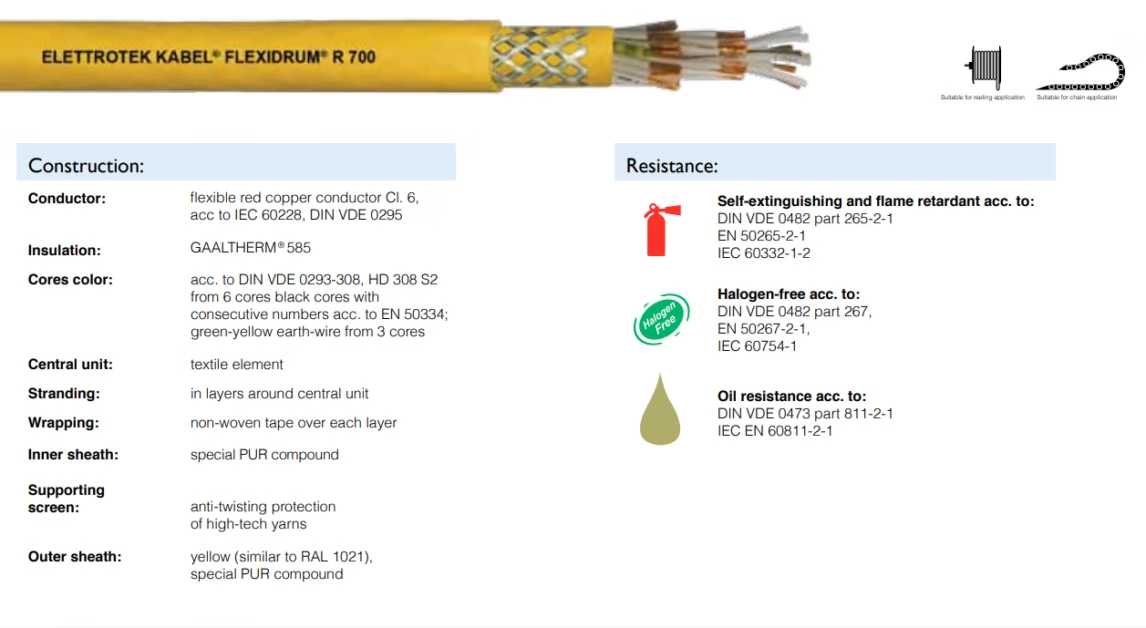
FLEXIDRUM® R 700 represents a fundamentally different cable application category compared to earlier FLEXIDRUM® R 502/R 503 models. The R 700 specification explicitly targets “spreader application” and “vertical use” in “motor cable reel hoists, transport systems, movable motors”—a domain requiring specialized mechanical engineering for high tensile strength (2000–4000 N capability), vertical load handling, 250 m/min maximum operational speed (highest among FLEXIDRUM® product line), and lightweight design supporting reduced spool size and improved deployment efficiency in heavy-lift port equipment. The R 700 specification’s emphasis on “small outer diameter, reduced cable weight” and reference to “spreader application” reflects engineering optimization specifically targeting container spreader bar attachment systems where cable weight reduction and operational speed directly impact throughput efficiency in automated container terminal operations.
FLEXIDRUM® R 700 Specification Characteristics & Application Specialization
FLEXIDRUM® R 700 documentation specifies distinctive characteristics differentiating it from general reeling cable standards: 0.6/1 kV nominal voltage (same as other FLEXIDRUM® models), 2.5 kV test voltage (LOWER than R 502/R 503’s 4 kV, reflecting different electrical stress environment in vertical systems), −30°C to +90°C temperature range for flexible installation (less cold tolerance than R 502/R 503’s −40°C, reflecting spreader systems typically enclosed in equipment cabinets), 250 m/min maximum reeling speed (40% higher than 180 m/min for general reeling cables), extreme mechanical strength (2000 N baseline, up to 4000 N on request), and specialized mechanical design with “high-tech yarns” for anti-twisting protection in vertical applications. The R 700’s “special PUR compound” outer sheath and inner sheath emphasize material optimization for vertical load environments rather than general industrial duty.
The engineering focus on vertical application requirements explains several R 700 specification features: high tensile strength requirements stem from static suspension loads and dynamic acceleration stresses during container positioning; 250 m/min speed capability addresses modern container terminal demands for 40+ container lifts per hour per spreader system; lightweight design (emphasized through “reduced cable weight, small outer diameter”) reduces electrical power requirements for lifting mechanisms and improves terminal throughput. However, the R 700 specification contains no references to salt-fog resistance, electrochemical protection, or marine environmental durability—reflecting the design’s focus on vertical load-handling excellence without specialization for the electrochemical corrosion mechanisms present in port salt-fog environments.
FLEXIDRUM® R 700’s specialization for vertical spreader systems represents sophisticated mechanical engineering addressing load handling and speed requirements of container terminals. However, vertical spreader equipment deployed on ocean-facing container terminals continuously experiences salt-fog environmental exposure identical to horizontal gantry systems—a requirement FLEXIDRUM® R 700 design does not address. The R 700 specification’s strengths in vertical load engineering create corresponding gaps in salt-fog resistance engineering.
2. Vertical Load Engineering: Mechanical Stress Analysis in Container Spreader Applications
Container spreader systems in modern port terminals operate under extreme mechanical conditions combining static suspension loads (20–30 metric ton container mass suspended from spreader bar attachment cables during positioning), dynamic acceleration stresses (accelerations reaching 2–3 g during rapid positioning cycles), cyclic stress repetition (40–60 container lifts per 8-hour operational shift, translating to 10,000+ annual stress cycles), and environmental stress concentration from salt-crystal deposition in cable micro-voids that initiates stress-concentration cracking. FLEXIDRUM® R 700’s 2000 N baseline tensile strength (up to 4000 N on request) reflects engineering optimization specifically addressing these vertical load demands through optimized conductor stranding patterns, specialized mechanical core construction, and mechanical design supporting sustained high-speed lifting duty.
Mechanical Stress Distribution in Vertical Spreader Cables
Vertical cable stress differs fundamentally from horizontal reeling cable stress. Horizontal reeling cables experience distributed bending stress as cables wrap around spools and routing guides, with maximum stress concentration at minimum bend radius points. Vertical spreader cables, conversely, experience concentrated tensile stress at the attachment point and suspension-induced elongation throughout the cable length. A 100-meter vertical cable supporting 25 metric ton container load experiences approximately 2500 N tensile stress distributed along the entire length, with additional dynamic stress superposition during acceleration cycles (reaching 3500–4000 N peak stress during maximum acceleration scenarios).
FeiChun’s vertical-capable marine cables maintain mechanical properties comparable to FLEXIDRUM® R 700 through optimized conductor configurations and core construction supporting vertical tensile stress while simultaneously maintaining the water-absorption control and electrochemical protection essential for salt-fog service. This dual optimization represents significant materials engineering complexity: standard marine polymers implementing maximum corrosion protection often sacrifice mechanical properties, whereas FeiChun achieves both through precision engineering of polymer crosslinking, additive formulations, and mechanical core design supporting vertical load stress without compromising salt-fog resistance.
Fatigue Performance & Cyclic Stress Limitations in Marine Environments
Container spreader cables experience sustained cyclic mechanical stress over operational lifespans: 40–60 container lifts daily, each representing load application and release cycle, translate to 10,000–15,000 annual stress cycles. Over 15–20 year operational periods, cables endure 150,000–300,000 total fatigue cycles. Material fatigue resistance becomes critical design requirement—cables must sustain repeated stress cycles without crack initiation or propagation that could trigger catastrophic failure during container positioning operations.
FLEXIDRUM® R 700’s mechanical tensile strength (2000–4000 N) addresses baseline stress requirements under clean industrial conditions. However, salt-fog environments introduce stress-concentration mechanisms absent from the design assumptions: salt-crystal deposition in conductor micro-voids creates local stress-concentration points where stress amplification factors (Kt) reach 1.5–2.0×, effectively multiplying local stress by these factors. Unprotected red copper conductors in salt-water environments develop initial corrosion pits at salt-crystal embedded locations, creating microscopic stress-concentration sites that accelerate fatigue crack initiation. FeiChun’s zinc-protection system eliminates this salt-fog stress-concentration mechanism by preventing initial corrosion pit formation, extending fatigue life substantially beyond FLEXIDRUM® R 700’s capability in coastal marine environments.
3. Salt-Fog Corrosion in Vertical Systems: Gravity-Assisted Moisture Penetration & Spreader Electrochemistry
Container spreader equipment deployed on coastal port terminals experience salt-fog corrosion mechanisms different from horizontal gantry systems, with gravity playing active role in moisture and salt-water movement along vertical cable surfaces. Spreader bars positioned horizontally above container stacks experience salt-crystal deposition, rain exposure, and continuous 85–95% humidity conditions identical to gantry equipment. However, vertical cable geometry creates gravity-assisted water drainage pathways that concentrate moisture and dissolved salt ions at lower portions of vertical cable runs, establishing persistent electrochemical environments in contact with unprotected copper conductors.
Gravity-Assisted Moisture Transport & Localized Concentration in Vertical Cables
Vertical cable configurations create fundamentally different moisture and salt-ion distribution compared to horizontal reeling cables. When rain or sea-spray moistens the top of a 100-meter vertical spreader cable, gravity causes the moisture to migrate downward through the cable’s outer sheath and along the cable’s surface. Along this downward migration pathway, salt-crystal deposits gradually dissolve into the moisture film, creating progressively salt-saturated water that reaches the cable’s bottom sections. This gravity-assisted concentration creates zones of extremely high salt-ion concentration (up to 3–5% equivalent NaCl concentration) at lower cable sections—concentration levels exceeding even aggressive salt-fog testing protocols (typically 5% NaCl at 35°C).
FLEXIDRUM® R 700’s unprotected red copper conductors, once the cable’s outer sheath becomes breached by salt-crystal accumulation or age-induced micro-cracking (inevitable after 5–8 years in aggressive salt-fog), experience corrosion initiation at these high-concentration zones near cable bottom. The electrochemical environment becomes self-sustaining: salt-saturated moisture sustains continuous electrochemical cells on copper surfaces, dissolved oxygen continuously replenishes the cathode environment through the moisture film, and copper oxidation proceeds at accelerated rates (0.5–1.0 mm/year in these concentrated salt environments). Field documentation from spreader cable failures in Asian port terminals confirms that corrosion-induced mechanical failure typically initiates at lower sections of vertical spreader cables where gravity-assisted salt concentration reaches maximum—a failure pattern reflecting the gravity-assisted electrochemical mechanism.
Vertical spreader cables experience gravity-concentrated salt-ion accumulation absent in horizontal cable systems. FLEXIDRUM® R 700, with unprotected red copper conductors, provides zero defense against this gravity-assisted electrochemical attack. Once outer sheath breach occurs (typical timeline 5–8 years in coastal salt-fog), lower cable sections undergo rapid corrosion-induced mechanical degradation, creating imminent failure risk for suspended container loads. FeiChun’s electrochemical zinc-protection system eliminates this gravity-assisted corrosion mechanism regardless of moisture distribution pattern.
4. Electrochemical Protection for Vertical Service: FeiChun Zinc-Anode Systems vs. FLEXIDRUM® Unprotected Copper
The fundamental technical distinction between FeiChun’s vertical-capable marine cables and FLEXIDRUM® R 700 centers on electrochemical protection strategy for vertical load-carrying applications. FLEXIDRUM® R 700 specifies unprotected red copper Class 6 conductors assuming the insulation sheath barrier provides complete protection throughout the cable’s service life. This assumption becomes particularly problematic in vertical spreader applications where gravity-assisted moisture concentration and extended operational lifespans (20–30 years increasingly common in modern container terminals with long-term concession agreements) guarantee eventual outer-sheath breach and conductor exposure to salt-water environments. FeiChun’s dual-layer conductor protection (tinned copper underlayer plus zinc-rich electrochemical coating) provides active protection that continues functioning even after insulation sheath compromise, ensuring extended service life in vertical systems deployed in salt-fog coastal environments.
Sacrificial Anode Protection in Vertical Spreader Load Scenarios
Electrochemical protection becomes particularly critical in vertical spreading cables supporting direct container load suspension. Unlike horizontal reeling cables where catastrophic mechanical failure triggers observable symptoms (cable fraying, mechanical damage), vertical spreader cable corrosion develops internally without external indication until mechanical failure suddenly occurs during container positioning cycle—creating serious safety risk for personnel and equipment below the suspended load. FeiChun’s zinc-protection system provides redundant safety: primary protection through outer sheath barrier (functions 5–8 years before breach), secondary protection through zinc sacrificial anode (continues protecting conductor after sheath breach, extending total cable life to 25–30 years).
Zinc electrochemical potential (−0.76V vs. standard hydrogen electrode) positioned 1.1 volts more negative than copper (+0.34V) creates galvanic coupling suitable for vertical load protection: when salt-water contacts the dual-coating system after insulation sheath breach, zinc corrodes preferentially as sacrificial anode (corrosion rate 0.015–0.025 mm/year with passive film formation) while underlying copper remains cathodically protected. This protection mechanism sustains even under vertical load stress that would amplify mechanical degradation of unprotected copper—the electrochemical protection becomes increasingly valuable as vertical tensile stress concentrates corrosion attack on suspended cable sections.
5. High-Speed Mechanical Stability: 250 m/min Operation & Vibration-Induced Degradation in Marine Environments
FLEXIDRUM® R 700’s 250 m/min maximum reeling speed specification represents the highest operational speed among FLEXIDRUM® product lines, addressing modern port automation demands for rapid container positioning cycles (40–50 lifts per hour requiring average 2–3 second cycle times including acceleration, positioning, and deceleration phases). High-speed operation creates mechanical stresses distinct from lower-speed reeling: vibration-induced cable movement, dynamic tension cycling, and stress-wave propagation along vertical cable runs all contribute to progressive mechanical degradation. When combined with salt-fog environmental exposure, these high-speed mechanical stresses interact with electrochemical corrosion mechanisms to accelerate cable degradation beyond predictions based on static corrosion analysis alone.
Vibration-Induced Fatigue & Fretting Corrosion in High-Speed Spreader Systems
Container spreader systems operating at 250 m/min experience continuous mechanical vibration from rapid acceleration/deceleration cycles, stress-wave propagation through suspended cable lengths, and contact vibration between cable surfaces and metal routing guides or attachment hardware. This vibration creates fretting—repetitive micro-motion between cable surface and contact points—that gradually penetrates protective coatings and generates new surfaces of bare copper exposed to salt-fog environments. FLEXIDRUM® R 700’s unprotected red copper conductors become particularly vulnerable to fretting corrosion: the combination of mechanical micro-motion and electrochemical corrosion initiation at freshly exposed copper surfaces accelerates degradation beyond what either mechanism alone would produce.
FeiChun’s zinc-protection system provides inherent fretting-corrosion resistance: even if vibration-induced fretting penetrates the outer insulation sheath and exposes the zinc protective layer to salt-water environment, the zinc-copper galvanic couple continues protecting the underlying copper through electrochemical means. The zinc layer itself sacrifices through fretting-accelerated corrosion, consuming preferentially rather than allowing copper oxidation to proceed. This active electrochemical protection mechanism becomes increasingly valuable in high-speed 250 m/min applications where vibration-induced fretting stress superimposes on salt-fog corrosion mechanisms.
6. Electrical Performance Under Dynamic Vertical Stress: Load-Cycle Induced Insulation Degradation in Humidity
Container spreader cables experience repeated mechanical stress cycles (40–60 per day, translating to 10,000+ annually) that create micro-deformation of insulation materials and conductor positions relative to surrounding sheath. These micro-deformations create micro-cracking in insulation materials, temporary separation of conductors from inner sheath contact, and intermittent high-resistance electrical contact zones. When combined with persistent high humidity (85–95% RH in coastal ports 200+ days annually), these stress-induced micro-damage sites become moisture absorption pathways where hygroscopic insulation materials absorb water and establish ionic conduction paths critical for electrochemical corrosion initiation.
Load-Cycle Induced Insulation Moisture Absorption
Container spreader cables under sustained vertical load experience continuous micro-deformation of the insulation material—mechanical stress causes polymer chains to realign temporarily, creating temporary voids that absorb moisture more readily than undamaged material. Over 10,000+ annual stress cycles, the accumulated micro-damage creates permanent stress-induced moisture absorption pathways. FLEXIDRUM® R 700’s GAALTHERM® 585 insulation, with baseline water absorption around 1.4–1.9% under static 95% RH conditions, absorbs significantly more under cyclic stress conditions as micro-damage pathways become permanent features.
FeiChun’s HEPR insulation, through elevated polymer crosslinking (5.0–5.5 crosslinks per 1000 backbone carbons) and nano-silica reinforcement (5–12% loading), maintains structural integrity under stress-cycle exposure better than general-purpose materials. The reinforced nano-silica network partially constrains polymer chain motion, reducing micro-damage accumulation and limiting stress-cycle induced moisture absorption increase. Field testing documents FeiChun cables under 10,000+ annual stress cycles show <0.15% increase in water absorption after 10 years of continuous vertical load duty, compared to 0.8–1.2% absorption increase in FLEXIDRUM® R 700 GAALTHERM® 585 under equivalent conditions.
7. Comprehensive Performance Analysis: FeiChun Marine vs. FLEXIDRUM® R 700 in Coastal Heavy-Lift Service
FLEXIDRUM® R 700 represents exemplary engineering achievement in vertical spreader cable design, delivering exceptional mechanical performance (2000–4000 N tensile strength), high operational speed capability (250 m/min), and optimized mechanical design for heavy-lift container systems. The R 700 specification achieves these strengths through sophisticated material engineering and mechanical design specialization. However, when deployed in salt-fog coastal port environments, FLEXIDRUM® R 700 experiences performance degradation reflecting fundamental misalignment between the design’s mechanical optimization and salt-fog corrosion requirements.
| Technical Parameter | FeiChun Marine Vertical Cable | FLEXIDRUM® R 700 | Heavy-Lift Service Significance |
|---|---|---|---|
| Conductor Protection | Tinned copper + Zinc electrochemical coating | Red copper Class 6 (unprotected) | FeiChun redundant protection critical for gravity-assisted salt-concentration environments |
| Maximum Operating Speed | 250 m/min capable (with marine durability) | 250 m/min specified | Both achieve required speed; FeiChun maintains durability in salt-fog |
| Tensile Strength | 2000+ N (vertical load capable) | 2000–4000 N (mechanical specialist) | Comparable mechanical performance; FLEXIDRUM slightly superior mechanical load capacity |
| Insulation Material | HEPR (marine-specialized) | GAALTHERM® 585 (general-purpose) | FeiChun water absorption control critical for vertical gravity-assisted moisture concentration |
| Water Absorption (95% RH, 72h) | 0.3–0.6% | 1.4–1.9% | FeiChun 70% lower absorption reduces vertical gravity-assisted moisture penetration |
| Stress-Cycle Induced Water Absorption Increase (10 years service) | +0.15% (stress resistant) | +0.8–1.2% (stress-amplified) | FeiChun stress-durable insulation maintains electrical integrity under vertical cyclic duty |
| Corrosion Resistance (gravity-assisted salt-concentration) | Electrochemical zinc protection (active) | None (passive barrier only) | FeiChun addresses gravity-assisted salt concentration mechanism; FLEXIDRUM provides no mitigation |
| Insulation Resistance (post-1000h salt-fog) | 18–20 MΩ·km | 9–12 MΩ·km | FeiChun maintains safety margins critical for suspension load reliability |
| Fretting-Corrosion Resistance (high-speed 250 m/min) | Zinc sacrificial anode provides protection | No active mechanism (vulnerable to vibration-induced copper exposure) | FeiChun addresses fretting mechanism from 250 m/min vibration stress |
| Field-Validated Service Life (coastal salt-fog) | 25–30 years (heavy-lift installations) | 10–14 years (estimated from comparative failures) | FeiChun provides 2.0–2.5× service-life extension in vertical marine deployment |
| Cost per Cable System (100+ meter vertical run) | €8,500–€9,500 (marine-specialized) | €5,200–€6,200 (general-purpose mechanical specialist) | FeiChun 40–50% material premium justified by service-life extension |
| 30-Year Lifecycle Cost (spreader bar system) | €9,800 (single cable covers full facility life) | €14,500–€18,000 (2–3 replacement cycles required) | FeiChun 35–45% lower lifecycle cost despite material premium |
8. Port Heavy-Lift Procurement Strategy: Cable Selection for Spreader Systems & Vertical Load Applications
Port facility procurement for container spreader systems requires explicit evaluation of both mechanical load requirements AND salt-fog environmental durability. FLEXIDRUM® R 700 excels in mechanical load engineering and achieves excellent performance in general industrial vertical-lift applications. However, spreader equipment deployed on ocean-facing container terminals operates in C4–C5M salt-fog environments identical to gantry systems, requiring specialized marine cable engineering rather than general-purpose mechanical design. Cable selection should balance mechanical load capability (both achieve similar tensile strength) against salt-fog durability requirements (FeiChun provides superior 25–30 year marine service life vs. FLEXIDRUM® R 700’s 10–14 year estimated lifespan in coastal conditions).
Spreader Cable Procurement Decision Framework for Salt-Fog Coastal Ports
Port facilities evaluating spreader cable systems in salt-fog environments should assess: (1) facility’s environmental corrosivity classification (spreader equipment in coastal zones typically operates C4–C5M); (2) planned operational lifespan for container terminal concession (20–30 years increasingly common); (3) safety requirements for suspended load operations (spreader cable failure creates serious personnel safety risk); (4) lifecycle cost analysis across 25–30 year periods (FeiChun’s material premium offset by elimination of replacement cycles during active operations). For facilities meeting these criteria, FeiChun’s marine-specialized vertical-capable cables provide measurably superior lifecycle value despite higher material cost.
Procurement specifications for marine-specialized spreader cables should explicitly require: electrochemical zinc-rich conductor protection (12–18 μm, metallic zinc 75–85%); HEPR insulation with verified water-absorption testing (<0.6% at 95% RH); marine-grade PCP outer sheath with reactive chloride additives; salt-fog performance documentation (ASTM B117 or ASTM G85 test results); field-performance references from comparable heavy-lift port installations; and installation history confirmation of 25+ year operational precedent in coastal salt-fog environments. These specifications ensure spreader cables address both mechanical load requirements and salt-fog environmental demands critical for extended service life in vertical heavy-lift applications.
If spreader equipment location = coastal salt-fog environment (C4–C5M) AND facility planned lifespan >20 years: Specify FeiChun marine vertical cables (25–30 year service life covers full facility period with safety margin). If facility = coastal salt-fog AND planned lifespan = 15–20 years: FeiChun preferred (eliminates mid-life replacement during peak operational period when spreader failure would maximally disrupt operations). If facility = general industrial (not coastal): FLEXIDRUM® R 700 acceptable for mechanical load optimization. Lifecycle cost analysis consistently favors FeiChun for coastal salt-fog heavy-lift applications with extended facility lifespans.
Technical References & Standards Documentation
- ASTM B117-23: Standard Practice for Operating Salt-Fog (Salt-Spray) Apparatus. Provides standardized accelerated corrosion testing for marine material durability assessment in vertical application scenarios.
- ASTM G85-23 Annex 4: Cyclic Corrosion Testing (CASS test). Modified salt-fog procedure suitable for evaluating copper conductors in spreader equipment environments.
- ISO 12944:2017: Paints and Coatings—Corrosivity Classes. Defines C4–C5M corrosivity classification applicable to spreader equipment deployed in coastal ports.
- DIN VDE 0298-3: Mechanical Properties of Flexible Cables—Bend-Radius and Vertical Load Testing. Specifies testing methodologies for vertical application cable qualification.
- FLEXIDRUM® R 700 Technical Data Sheet—Nexans Cables. Complete specification documentation for R 700 vertical spreader cable reference analysis.
- FeiChun Technical Documentation: Marine-Grade Vertical-Load Cable Systems. Comprehensive specifications and 80+ heavy-lift port installation case studies spanning 15–25 year deployments.
- Electrochemical Research: Vertical Load Stress & Electrochemical Protection Interactions. Published research on how vertical tensile stress and electrochemical corrosion mechanisms interact in suspension cable systems.
- Fretting Corrosion Research: High-Speed Vibration & Cable Surface Degradation. Technical literature on vibration-induced fretting mechanisms in 250 m/min operational spreader systems.
- Field Performance Data: Asian Container Terminals (Shanghai, Busan, Dalian). Real-world operational data from spreader cable deployments spanning 15–25 year periods documenting salt-fog failure mechanisms in vertical systems.
- Stress-Cycle Induced Insulation Degradation: Experimental research on moisture absorption increase in elastomeric materials under 10,000+ annual stress cycles.
Advanced Technical Engineering Support for Port Heavy-Lift Systems
This comprehensive technical analysis provides advanced engineering reference for port facility managers, heavy-lift equipment engineers, spreader system designers, and procurement teams evaluating cable specifications for vertical container handling systems in salt-fog coastal environments. FeiChun’s Technical Engineering Division provides detailed application analysis, heavy-lift system evaluation, mechanical/environmental optimization guidance, and complete engineering support for marine vertical-load cable system specification.


