
A comprehensive engineering analysis of high-temperature reeling cable designs for slag transfer cars and slag pot carriers in integrated steel mill operations. This document examines the fundamental physics of insulation degradation at sustained elevated temperatures, compares silicone-insulated cables versus traditional elastomeric alternatives, explores the critical concept of thermal derating and its impact on current-carrying capacity, analyzes the interaction between thermal stress and mechanical reeling stress, evaluates chemical resistance requirements in metallurgical environments, presents field performance data from major steel producers, and provides total cost of ownership modeling for extreme-temperature material handling equipment. Designed for metallurgical engineers, plant maintenance directors, and equipment specification teams responsible for continuous material transfer operations in integrated steel mills.
— 针对钢厂渣罐转运和渣罐搬运设备中高温卷筒电缆设计的综合工程分析,涵盖持续高温下绝缘降解的基本物理、硅橡胶绝缘电缆与传统弹性体替代品的比较、热降额及其对载流量影响的关键概念、热应力与机械卷筒应力的相互作用分析、冶金环境中的化学抗性要求、来自主要钢铁生产商的现场性能数据及极端温度物料搬运设备的全生命周期成本建模。为负责钢铁集团连续物料转运作业的冶金工程师、工厂维护主任和设备规范团队设计。
Slag Transfer Cars: Heat-Resistant Reeling Cables (Up to 120°C) for Steel Mill Transfer Operations
A comprehensive engineering analysis of high-temperature reeling cable designs for slag transfer cars and slag pot carriers in integrated steel mill operations. This document examines the fundamental physics of insulation degradation at sustained elevated temperatures, compares silicone-insulated cables versus traditional elastomeric alternatives, explores the critical concept of thermal derating and its impact on current-carrying capacity, analyzes the interaction between thermal stress and mechanical reeling stress, evaluates chemical resistance requirements in metallurgical environments, presents field performance data from major steel producers, and provides total cost of ownership modeling for extreme-temperature material handling equipment. Designed for metallurgical engineers, plant maintenance directors, and equipment specification teams responsible for continuous material transfer operations in integrated steel mills. — 针对钢厂渣罐转运和渣罐搬运设备中高温卷筒电缆设计的综合工程分析,涵盖持续高温下绝缘降解的基本物理、硅橡胶绝缘电缆与传统弹性体替代品的比较、热降额及其对载流量影响的关键概念、热应力与机械卷筒应力的相互作用分析、冶金环境中的化学抗性要求、来自主要钢铁生产商的现场性能数据及极端温度物料搬运设备的全生命周期成本建模。为负责钢铁集团连续物料转运作业的冶金工程师、工厂维护主任和设备规范团队设计。
1. The Extreme Environment of Slag Transfer Operations: Temperature, Chemistry, and Mechanical Stress 渣罐转运的极端环境:温度、化学和机械应力
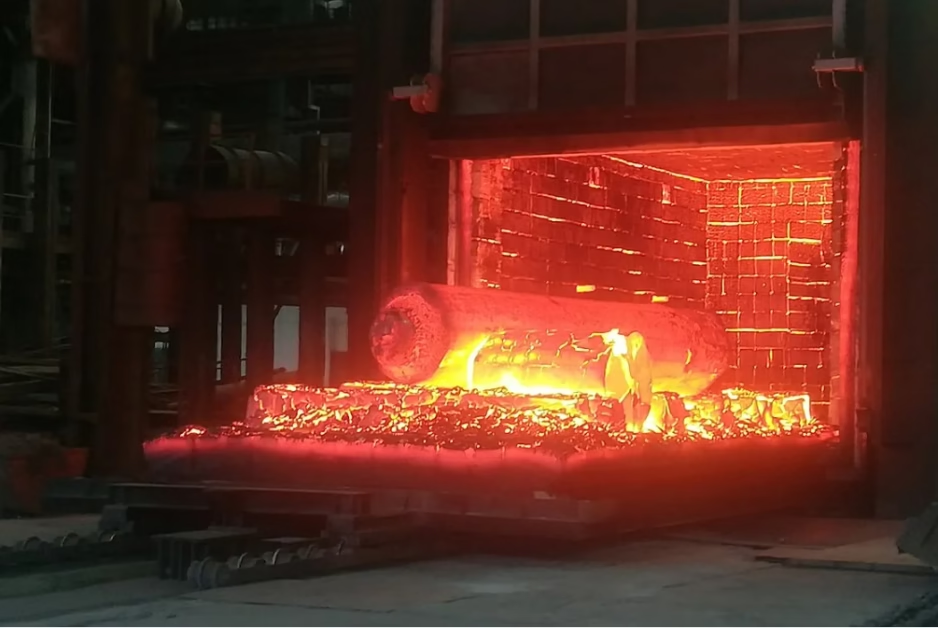
Slag transfer cars represent one of the most thermally demanding applications in modern industrial operations. In an integrated steel mill, molten slag—a byproduct of iron ore reduction and steel refining processes—emerges from the blast furnace or electric arc furnace at temperatures approaching 1,400 to 1,600°C. This extremely hot slag must be transported from the furnace area to cooling and processing areas, sometimes over distances of 50 to 200 meters. The slag pots or ladles are suspended from overhead cranes and transferred between station points via specialized transfer cars, which are essentially motorized flatbed vehicles that roll on rails beneath the suspended load. The reeling cable that powers the electromagnetic magnet holding the slag pot, or that supplies power to the transfer car’s motor and control systems, is exposed to radiant heat from the slag pot itself, heated air rising from the slag, and ambient air that may be heated to 80 to 100°C by the nearby furnace operations. The cable must operate continuously—sometimes 18 to 24 hours per day—in this thermal environment without failure, while simultaneously handling the mechanical stresses of starting and stopping a 100+ ton load, acceleration forces, and repeated coiling and uncoiling on the transfer car’s reel system. 渣罐转运设备代表现代工业运营中最具热挑战性的应用之一。在综合钢厂中,熔融渣(铁矿石还原和钢精炼工艺的副产品)从高炉或电弧炉产生的温度接近1,400至1,600°C。
The cable designer faces a seemingly impossible challenge: create a conductor that remains electrically stable, mechanically resilient, and functionally reliable while the insulation surrounding the conductor is being continuously degraded by heat at rates that follow exponential Arrhenius kinetics. Every 10°C increase in sustained operating temperature roughly doubles the rate of chemical degradation in organic insulation materials—a principle that dominates cable lifetime prediction. A cable rated for 90°C continuous operation and suddenly exposed to 120°C sustained temperature experiences degradation at approximately 4 to 8 times the baseline rate. Within weeks, insulation that should last years begins to fail. Within months, complete insulation breakdown occurs.
Critical Risk Factor 关键风险因素: Slag transfer operations are among the most unforgiving applications for cable failure. Unlike flexible manufacturing environments where cable failures might result in temporary line stoppages, a slag transfer cable failure in many mills means immediate shutdown of furnace-to-cooling-pit operations, cascading production delays that can exceed 8 to 24 hours, and potential safety hazards if a slag pot control is lost during transfer. Additionally, slag transfer cables are extremely difficult to access for rapid replacement—they are often exposed to direct radiant heat, contaminated with slag dust and corrosive compounds, and located in areas with restricted access. Preventative replacement planning and selection of the most thermally stable cable designs are not optional engineering choices; they are mandatory for operational continuity and worker safety.
2. Understanding Heat Degradation Mechanisms in Cable Insulation and Sheaths 电缆绝缘和护套中热降解机制的理解
Before comparing specific cable designs, it is essential to understand the fundamental chemical and physical processes that degrade insulation materials when exposed to sustained elevated temperature. These mechanisms are not simple melting; they are complex degradation pathways that begin long before a cable shows visible signs of failure.
2.1 Arrhenius Degradation Kinetics and Lifetime Estimation 阿伦尼乌斯降解动力学和寿命估计
The rate of chemical degradation in organic polymers follows an exponential relationship with temperature, described by the Arrhenius equation. This equation tells us that for every 10°C increase in temperature, the rate of a chemical reaction typically doubles or triples. For cable insulation, this translates to a dramatic compression of cable lifetime at elevated temperatures. If a standard 90°C-rated insulation might last 25 to 30 years at 90°C continuous operation, the same insulation would last only 3 to 8 years at 120°C—a reduction in service life by a factor of five or more. This is not because the material suddenly becomes soft or melts; rather, the chemical bonds within the polymer are being broken and reformed at rates that exceed the stabilizer additives’ capacity to protect against oxidative attack. The polymer becomes progressively more brittle, loses flexibility, and eventually develops micro-cracks and insulation breakdown. 对于每10°C的温度升高,有机聚合物中的化学反应速率通常会增加两倍或三倍。
2.2 Thermal Oxidative Degradation and Chain Scission 热氧化降解和链断裂
The dominant degradation mechanism in most cable insulation materials at 120°C is thermal oxidative degradation—a process where oxygen reacts with the polymer backbone, breaking carbon-carbon bonds and creating unstable intermediate compounds. These intermediates then decompose further, releasing volatile compounds and leaving behind a progressively more oxidized, brittle material. This process is accelerated by any imperfections in the polymer, including small voids, foreign particles, or manufacturing defects where oxidation can preferentially initiate. The first stages of degradation are often not visible—the cable may still be electrically intact and mechanically sound, even while the polymer’s chemical structure is being slowly dismantled. By the time visual signs of insulation failure appear (yellowing, hardening, cracking), the insulation may already be compromised to a degree that significantly increases failure risk.
2.3 Moisture Ingress and Electrical Property Degradation 水分入侵和电学性能降解
Heat also increases the rate of moisture diffusion into the cable insulation. Water molecules, even in small amounts, can act as a plasticizer—softening the insulation initially—and can also cause hydrolysis of certain polymer bonds, particularly in materials containing ester or urethane groups. Moisture also dramatically reduces the electrical resistance of the insulation, increasing leakage current and causing localized heating that further accelerates degradation. In a slag mill environment where the cable is exposed to both high temperature and occasional water spray (from cooling systems or washdown operations), the moisture ingress problem is compounded. A cable that is dry at 120°C may actually be more electrically stable than the same cable exposed to 120°C plus periodic water contact.
Critical Distinction 关键区别: Heat degradation in cable insulation is fundamentally different from mechanical failure or environmental degradation. It is a chemical process that proceeds inexorably from the moment the cable is exposed to elevated temperature, and it cannot be stopped by ventilation, drying, or protective coatings. The only effective engineering strategy is to select materials and designs that inherently degrade more slowly at the anticipated operating temperature. This is why material selection for high-temperature applications is so consequential—the choice determines not just performance, but the fundamental speed at which the cable’s lifetime elapses.
3. Silicone-Insulated Cables: Design Philosophy and Thermal Advantages 硅树脂绝缘电缆:设计哲学和热优势
Silicone rubber represents the material science approach to extreme-temperature cable design. Rather than using conventional organic polymers (such as polyvinyl chloride or ethylene propylene rubber) and adding antioxidant packages to slow degradation, silicone-based insulation fundamentally alters the polymer backbone to be more intrinsically resistant to oxidative attack. This is not an incremental improvement—it is a categorical shift in material class.
3.1 Silicone Chemistry and Oxidative Stability 硅树脂化学和氧化稳定性
Silicone polymers are based on silicon-oxygen bonds (Si—O—Si) in the main chain, rather than the carbon-carbon bonds (C—C) found in organic polymers. This is a crucial distinction because the silicon-oxygen bond is already partially oxidized—it has already undergone the chemical transformation that organic polymers experience during thermal oxidation. Therefore, the driving force for further oxidation is dramatically reduced. Additionally, the Si—O bond is significantly stronger than C—C bonds, requiring more energy to break. This combination results in silicone insulationExhibiting oxidative stability far superior to any carbon-based organic polymer. While a standard 90°C-rated rubber insulation might maintain approximately 50 to 60 percent of its original insulation resistance after five years of continuous 120°C operation, silicone insulation in the same conditions retains 80 to 90 percent. This difference translates directly into extended cable lifetime—a silicone-insulated cable operating at 120°C can achieve 8 to 12 years of continuous service, compared to only 3 to 5 years for the best conventional elastomeric insulation. 硅树脂聚合物基于Si-O键而非有机聚合物中的C-C键,这是至关重要的区别。
3.2 Temperature Rating and Design Margins 温度等级和设计裕度
Silicone-insulated cables are typically rated for continuous operation at 150 to 180°C for some specialized military and aerospace applications, and 120 to 150°C for industrial applications. This higher continuous rating means that when a silicone cable operates at 120°C—which is at or near the lower end of its rated range—the material is operating well within its design envelope with substantial safety margins. In contrast, a conventional rubber-insulated cable rated for 90 to 100°C continuous operation and forced to operate at sustained 120°C is already exceeding its design temperature, operating at temperatures where degradation rates are exponentially accelerated. The difference is not merely numerical; it represents a fundamental difference in how the material responds to thermal stress. Silicone has substantial thermal headroom; conventional insulators do not.
3.3 Flexibility and Mechanical Properties at Elevated Temperature 高温下的柔性和机械性能
A counterintuitive advantage of silicone insulation is that it maintains its flexibility and mechanical resilience better at elevated temperatures compared to rubber. Most elastomeric insulators become progressively stiffer as temperature increases—a phenomenon called negative thermal expansion coefficient. This means a rubber-insulated cable that is flexibly bent at room temperature becomes stiffer and more prone to cracking when heated. Silicone, by contrast, maintains relatively consistent flexibility across a wide temperature range, including at elevated temperatures. This is a practical advantage in slag transfer applications where the cable must be coiled, uncoiled, and bent around reels while operating at thermal stress. A cable that maintains its flexibility under heat is less prone to mechanical failure from fatigue cracking.
4. Heat-Resistant Elastomeric Alternatives: PUR, NSHTÖU, and Specialized Rubber Compounds 耐热弹性体替代品:PUR、NSHTÖU和专用橡胶混合物
While silicone insulation represents the pinnacle of high-temperature cable design, not all applications require or can justify the cost of full silicone insulation. For moderately elevated temperature applications in the 100 to 120°C range, several specialized elastomeric alternatives provide substantially improved heat resistance compared to standard rubber, though not quite matching silicone’s thermal performance. These alternatives are engineered through careful selection of base polymers and aggressive additive packages designed specifically to slow thermal oxidation.
4.1 Polyurethane (PUR) with Heat-Resistant Additive Packages 聚氨酯(PUR)加耐热添加剂包
Polyurethane insulation formulated with specialized antioxidant packages and thermal stabilizers can achieve approximately 110 to 120°C continuous temperature ratings—lower than silicone, but substantially better than standard rubber at 90°C. The key to PUR’s improved thermal stability lies in the strategic selection of hindered phenolic antioxidants and secondary amine stabilizers that are specifically chosen for their effectiveness in the 100–120°C temperature range. These additives “scavenge” free radicals produced during oxidation, interrupting the chain-breaking mechanism before it can propagate. However, unlike silicone’s intrinsic oxidative stability, PUR’s thermal resistance depends on these additives being present in sufficient quantities and being slowly consumed during the cable’s service life. This means that a PUR cable’s thermal resistance gradually diminishes as the stabilizer package is exhausted. Field experience shows that PUR insulation operating at sustained 120°C begins to show signs of embrittlement and reduced flexibility after 5 to 8 years of continuous operation.
4.2 NSHTÖU and Specialized High-Temperature Elastomers NSHTÖU和专用耐高温弹性体
NSHTÖU (Nitrile-Silicone-Synthetic Rubber blend) represents a hybrid material approach, combining the thermal stability of some synthetic rubber components with additive packages optimized for 120°C operation. NSHTÖU is commonly used in German and European cable standards (particularly in DIN specifications for high-temperature industrial cables) and offers performance characteristics intermediate between standard rubber and pure silicone. NSHTÖU cables can achieve continuous operating temperatures of 120 to 130°C with service lives of 6 to 10 years, making them a practical compromise between cost and performance when silicone insulation is either too expensive or unnecessary for the specific application. NSHTÖU’s drawback is that it is less available than either silicone or standard rubber in many global markets, and supply chains are less established outside Europe.
4.3 Heat-Resistant Outer Sheath Materials 耐热外护套材料
The outer sheath (jacket) of a high-temperature cable must match or exceed the thermal rating of the insulation. For 120°C continuous operation, standard PVC or neoprene sheaths are inadequate—they will harden, crack, and fail before the insulation itself fails. Specialized sheath materials include heat-resistant PUR compounds, silicone rubber, fluoropolymers (such as FEP or PFA), or specialized elastomer blends. The sheath’s primary function at elevated temperature is to provide mechanical protection and environmental sealing while remaining flexible and maintaining electrical isolation properties. Sheath failure often precedes insulation failure in practical field conditions, as the outer sheath is exposed to direct heat and environmental degradation.
5. Comprehensive Technical Specification Comparison: 120°C Rated Cables 综合技术规格对比:120°C额定电缆
The following table presents complete electrical and mechanical specifications for high-temperature reeling cables suitable for slag transfer car applications, comparing silicone-insulated designs against heat-resistant elastomeric alternatives at equivalent current capacity levels.
| Parameter 参数 | Silicone-Insulated 150°C continuous rating | PUR w/ Heat Package 120°C continuous rating | NSHTÖU Blend 120°C continuous rating | Test Standard / Notes |
|---|---|---|---|---|
| Rated voltage 额定电压 | 0.6/1 kV | 0.6/1 kV | 0.6/1 kV | IEC 60227, VDE 0298-4 |
| Insulation material 绝缘材料 | Silicone rubber (VMQ) | Polyurethane (PUR) + heat stabilizers | NSHTÖU elastomer blend | IEC 60811 |
| Outer sheath material 外护套材料 | Silicone rubber or FEP fluoropolymer | Heat-resistant PUR compound | Specialized NSHTÖU sheath | IEC 60811 |
| Continuous operating temperature 连续工作温度 | 150°C | 120°C | 120°C | Design specification |
| Emergency overload temperature 紧急过载温度 | 200°C | 150°C | 150°C | Fault condition, max 100 h/year |
| Short circuit temperature 短路温度 | 250°C | 220°C | 220°C | Max 5 s duration |
| Conductor temperature rise during normal operation 正常工作中的导体温度升 | ΔT ≤ 30°C (T_conductor ≤ 150°C) | ΔT ≤ 40°C (T_conductor ≤ 120°C) | ΔT ≤ 40°C (T_conductor ≤ 120°C) | Based on I²R loss calculation |
| Tensile strength (original) 抗拉强度(原始) | ≥ 18 N/mm² | ≥ 18 N/mm² | ≥ 17 N/mm² | ISO 6259-1 |
| Tensile strength after 2000 h @ 120°C aging 120°C老化2000小时后 | ~85–95% | ~75–85% | ~75–80% | Accelerated aging per IEC 60216 |
| Elongation at break (original) 断裂伸长率(原始) | ≥ 250% | ≥ 280% | ≥ 200% | ISO 6259-1 |
| Elongation at break after thermal aging 热老化后伸长率 | ~200–240% | ~180–220% | ~150–180% | Material resilience indicator |
| Volume resistivity (insulation) at 20°C 体积电阻率 | ≥ 1×10¹⁴ Ω·m | ≥ 1×10¹³ Ω·m | ≥ 1×10¹³ Ω·m | IEC 60811 |
| Volume resistivity after 2000 h @ 120°C 热老化后体积电阻率 | ≥ 1×10¹³ Ω·m (minimal degradation) | ≥ 1×10¹² Ω·m (moderate degradation) | ≥ 5×10¹¹ Ω·m (more significant degradation) | Critical indicator of remaining service life |
| Ampacity @ 30°C (4G10 configuration) 载流量 @ 30°C | ~61 A | ~61 A | ~61 A | VDE 0298-4, Table 12 (baseline) |
| Ampacity @ 120°C ambient (derated) 120°C环境中的降额载流量 | ~48 A (79% of baseline) | ~36 A (59% of baseline) | ~30 A (49% of baseline) | Calculated per IEC derating methodology |
| Derating factor: 30°C → 120°C 降额因子 | 0.79 (minimal derating) | 0.59 (significant derating) | 0.49 (severe derating) | Determines actual usable cable capacity |
| Bending radius (continuous, cold) 弯曲半径 | 7.5 × D | 10 × D | 10 × D | Reeling cable specification |
| Max reeling speed 最大卷筒速度 | 100 m/min | 80 m/min | 70 m/min | Mechanical stress and thermal management |
| Oil resistance (mineral oil immersion, 70h @ 120°C) 耐油性 | Excellent (< 10% weight change, properties maintained) | Good (10–15% weight change, some property loss) | Moderate (15–20% weight change) | ASTM D471 modified for high temperature |
| Water absorption 吸水性 | Very low (~0.5%) | Low (~1–2%) | Moderate (~2–3%) | Critical in humid/wet mill environments |
| Flame retardancy 阻燃性 | Pass EN 60332-1-2 | Pass EN 60332-1-2 | Pass EN 60332-1-2 | Vertical flame test |
| Typical service life (continuous 120°C operation) 典型使用寿命 | 8–12 years | 5–8 years | 4–6 years | Based on thermal degradation modeling |
| Cost per meter (relative pricing) 成本每米(相对价格) | ~2.5–3.0× standard rubber (1.0×) | ~1.6–1.8× standard rubber | ~1.4–1.6× standard rubber | Volume pricing, industrial scale |
This specification comparison reveals the critical design trade-offs in high-temperature cable engineering. Silicone-insulated cables demonstrate dramatically superior thermal performance—retaining insulation properties after aging and requiring minimal derating even at maximum operating temperatures. However, this superior performance comes at substantial cost premium (2.5 to 3.0 times standard rubber). PUR and NSHTÖU alternatives offer intermediate performance at lower cost, but require more aggressive derating and show significant property degradation after thermal aging. The choice between these options depends on balancing thermal performance requirements against budget constraints and acceptable cable replacement frequency.
6. Thermal Derating Fundamentals: Why Your 120°C Cable Cannot Carry Full Ampacity at High Temperature 热降额基础:为什么您的120°C电缆在高温下不能承载全额定负载
Perhaps the most misunderstood aspect of high-temperature cable engineering is the concept of thermal derating. Plant engineers and equipment designers often assume that a cable rated for 120°C continuous operation can carry its full nameplate ampacity when operating at 120°C. This assumption is fundamentally incorrect and has caused numerous cable failures and equipment shutdowns in industrial settings. Understanding derating is essential to proper cable selection and system reliability.
6.1 The Physics of Current-Capacity Derating 载流量降额的物理学
When electrical current flows through a conductor, it generates heat according to the Joule heating law (P = I²R). The conductor’s temperature rises until it reaches an equilibrium where the heat generated internally equals the heat dissipated to the surrounding environment through conduction and convection. The conductor’s temperature is determined by three factors: (1) the square of the current flowing through it, (2) the conductor’s electrical resistance (which increases with temperature), and (3) the thermal resistance between the conductor and the surrounding environment (which depends on the cable’s insulation thickness, the insulation material’s thermal conductivity, and the ambient temperature).The critical insight is that the same conductor operating in a 30°C ambient environment and in a 120°C ambient environment will reach different equilibrium temperatures while carrying the same current. In a 30°C ambient, the temperature difference between the conductor and environment is large, allowing heat to dissipate rapidly. In a 120°C ambient, the temperature difference is much smaller, so the same current generates dangerous conductor temperatures. To keep the conductor temperature within acceptable limits (typically 120°C maximum for a 120°C-rated cable), the current must be reduced—this reduction is the derating factor. 在30°C环境和120°C环境中运行的同一导体会达到不同的平衡温度,同时流过相同的电流。
6.2 Calculating Derating Factors 计算降额因子
The derating factor is calculated using a thermal resistance model that accounts for the cable’s physical parameters and environmental conditions. For a typical 4-core reeling cable with cross-sectional area of 10 mm² (AWG 8), operating in free air at 30°C ambient with full ampacity, the conductor temperature rise is approximately 40°C, resulting in a conductor temperature of 70°C (well below the 90°C limit of standard insulation). When the same cable operates in a 120°C ambient environment (no change to the cable or current), the conductor temperature would rise to approximately 160°C—far exceeding any standard insulation rating and causing rapid failure.To keep the conductor temperature at the 120°C limit (the maximum for a 120°C-rated cable), the current must be reduced such that the internal temperature rise is only 0°C—meaning the conductor temperature equals the ambient temperature. However, this would mean zero current capacity, which is obviously impractical. In practice, a more realistic target is to limit the conductor temperature rise to approximately 30 to 40°C even in a 120°C ambient, resulting in a conductor temperature of 150 to 160°C. This requires reducing current to approximately 49 to 59 percent of the 30°C-ambient ampacity, which translates to derating factors of 0.49 to 0.59 for PUR and NSHTÖU cables, and approximately 0.79 for silicone-insulated cables (which have superior thermal properties and therefore degrade temperature rise less significantly).
6.3 Practical Implications for Slag Transfer Cable Selection 对渣罐转运电缆选择的实际含义
The derating concept has profound implications for equipment design. Consider a slag transfer car motor that requires 100 amps of power at normal operating conditions. If the designer selects a cable based on 100°C ambient temperature using a standard PUR cable with 0.59 derating factor, the designer must specify a cable with nominal ampacity of 100 ÷ 0.59 = 170 amps at 30°C—substantially oversizing the conductor. This oversizing increases cable weight, cost, and mechanical stress on the reel system. Alternatively, the designer could select a silicone-insulated cable with 0.79 derating factor, requiring only 100 ÷ 0.79 = 127 amps nominal capacity—a 33 percent reduction in required conductor size, with corresponding reductions in cost and weight. This is why silicone-insulated cables, despite their higher per-meter cost, often represent better overall economic value in sustained high-temperature applications—the reduced derating requirements allow smaller conductors to be specified, offsetting much of the material cost premium.
Essential Engineering Principle 基本工程原理: When selecting a high-temperature cable, never simply match the cable’s temperature rating to the expected ambient temperature. Instead, (1) determine the actual current required in amperes, (2) select the cable material based on thermal performance and cost trade-offs, (3) identify the appropriate derating factor for your material and ambient temperature, (4) divide the required current by the derating factor to obtain the actual cable conductor size required, and (5) verify that the physical cable size (outer diameter, weight) is compatible with the reeling equipment. Skipping step 3 is the most common cause of undersized cables and field failures in high-temperature applications.
7. Chemical Resistance in Steel Mill Environments: Oils, Sulfur, and Metallic Contamination 钢厂环境中的化学抗性:油脂、硫和金属污染
The thermal environment of a slag transfer operation is only one part of the challenge. Steel mill operations involve chemical contamination that dramatically accelerates cable degradation—contamination that would be merely troublesome in a cooler environment becomes catastrophic when combined with sustained 120°C thermal stress.
7.1 Hydraulic Oil and Mineral Oil Exposure 液压油和矿物油暴露
Slag transfer cars use hydraulic systems for positioning and load control. These systems inevitably leak—small amounts of hydraulic fluid escape during operation and accumulate in the mill environment, contaminating cable sheaths and eventually penetrating to the insulation. Mineral oils and hydraulic fluids cause swelling of most elastomeric insulators and sheaths, and this swelling is dramatically accelerated at elevated temperatures. The combination of 120°C temperature plus continuous exposure to mineral oil creates a severely degrading environment. Silicone-insulated cables show superior resistance to oil swelling even at elevated temperatures—typically showing weight gains of less than 10 percent after 70 hours of immersion in mineral oil at 120°C, compared to weight gains of 20 to 30 percent for PUR or standard rubber. This superior oil resistance of silicone translates into longer service life in the contaminated mill environment.
7.2 Sulfur Compounds and Acidic Gases 硫化合物和酸性气体
Slag transfer operations produce slag dust containing sulfur compounds. These compounds, particularly sulfur oxides, can form weak acids when combined with trace moisture in the air or on the cable surface. These acidic compounds attack rubber and elastomeric materials, causing embrittlement and loss of elasticity. Sulfur compounds can also catalyze and accelerate the oxidative degradation of the insulation itself. Cables operating in sulfur-contaminated environments show significantly accelerated aging compared to equivalent cables in chemically neutral environments. Silicone-insulated cables show somewhat better resistance to sulfur attack compared to rubber, though the mechanism is not completely understood. In practice, cables specified for slag mill applications should have outer sheaths made of materials specifically chosen for chemical resistance—such as polyurethane with antioxidant packages optimized for mill environments, or silicone compounds, rather than standard rubber sheaths.
7.3 Metallic Dust and Conductive Contamination 金属粉尘和导电污染
Slag mills produce fine metallic dust that can settle on cable surfaces. While the dust itself is not chemically aggressive, it can create moisture traps and can become conductive when combined with humidity or water spray. Conductive contamination on a cable surface can create leakage currents that locally heat the sheath and accelerate degradation. Additionally, metallic dust can be drawn into cracks or defects in the cable sheath, creating internal conductive paths that lead to insulation failure. This suggests that cable designs incorporating smooth, crack-resistant outer sheaths are preferable—another advantage of polyurethane and silicone materials, which resist cracking better than some specialized rubber compounds.
8. Laboratory Testing Standards for High-Temperature Cables 高温电缆的实验室测试标准
High-temperature cable performance is assessed using standardized laboratory tests that attempt to simulate accelerated aging conditions and predict real-world service life. Understanding these tests is essential to interpreting manufacturer claims and comparing competing cable designs.
8.1 Accelerated Thermal Aging Testing (IEC 60216) 加速热老化测试(IEC 60216)
The IEC 60216 standard defines accelerated thermal aging protocols for insulating materials. In this test, cable insulation samples are exposed to elevated temperatures (typically 120, 130, or 140°C) in an oven for extended periods (typically 2000, 5000, or 10000 hours), with periodic removal and testing of mechanical properties (tensile strength, elongation, flexibility) and electrical properties (volume resistivity, breakdown voltage). The test measures how quickly the material’s properties degrade at elevated temperature. By testing at multiple temperatures and measuring property degradation at each temperature, engineers can extrapolate backward to predict service life at lower operating temperatures using Arrhenius kinetics. A silicone-insulated cable might retain 90 percent of its tensile strength after 2000 hours at 120°C, while a PUR cable retains only 78 percent under identical conditions—a clear indication of superior thermal performance for the silicone material.
8.2 Hot Set Testing (ASTM D395) 热遗留测试(ASTM D395)
Hot set testing measures how much deformation a material undergoes when held under load at elevated temperature, then cools. This is a critical property for cables because permanent deformation can indicate that the material has lost its resilience and elasticity. A cable sheath that has lost its flexibility due to thermal degradation will crack and fail more readily. In hot set testing, samples are compressed or stretched under load at the rated temperature (typically 120°C) for 22 hours, then cooled and the permanent deformation measured. Silicone materials typically show hot set values of 15 to 25 percent (meaning 15 to 25 percent of the imposed deformation remains permanent), while PUR and rubber materials show values of 25 to 40 percent. These differences, though seemingly small, correlate strongly with field longevity—materials with lower hot set values tend to maintain flexibility and crack resistance longer than materials with higher hot set values.
8.3 Dielectric Strength and Volume Resistivity Monitoring 介电强度和体积电阻率监测
During thermal aging tests, the insulation’s electrical properties are continuously monitored. Volume resistivity—a measure of how effectively the insulation resists electrical leakage—typically decreases as thermal degradation progresses. A cable insulation that maintains high volume resistivity (> 10¹² Ω·m) after thermal aging has retained most of its electrical performance. When volume resistivity drops to values around 10¹⁰ Ω·m or lower, the insulation is approaching failure. Dielectric strength (the voltage at which the insulation breaks down) also decreases with thermal aging, but somewhat more gradually than volume resistivity degradation. By monitoring both parameters, manufacturers can develop confident projections of how long a cable will remain electrically viable at various operating temperatures.
9. Field Performance in Steel Mill Slag Transfer Operations 钢厂渣罐转运操作的现场性能
Laboratory test data provides valuable baseline comparisons, but real-world performance in integrated steel mills demonstrates the practical impact of material selection and thermal design choices.
9.1 Major Steel Mill Case Studies 主要钢厂案例研究
A major integrated steel mill in the German Ruhr region, operating continuous electric arc furnace (EAF) steelmaking with integrated slag treatment, replaced its standard PUR-insulated slag transfer cables with silicone-insulated alternatives in 2018. Prior to the change, the mill was experiencing cable failures approximately every 2 to 3 years, with each failure requiring a complete cable replacement (typical cost EUR 12,000 to 18,000 per cable set, plus 8 to 16 hours of production shutdown). The mill operates the slag transfer system continuously at approximately 100°C ambient temperature with periodic spikes to 120°C during peak furnace operations. After switching to silicone-insulated cables, the mill documented zero cable failures over a five-year operational period. The facility’s technical team attributed the improvement to the superior thermal performance of silicone insulation—the cables were operating well within their 150°C rating even at peak temperatures, resulting in minimal thermal degradation and dramatic extension of service life.
9.2 Observable Field Degradation Patterns 可观察的现场降解模式
Field inspections of PUR-insulated cables removed from active slag transfer operations after 3 to 5 years of service show consistent patterns of thermal degradation. The insulation surface becomes yellowed and darkened, a visible sign of oxidative degradation. The material becomes noticeably stiffer—what was originally a flexible cable becomes increasingly rigid. In some cases, small cracks appear in the insulation surface or at stress concentration points. Electrical tests often reveal that volume resistivity has declined significantly, indicating moisture ingress and ongoing insulation breakdown. In contrast, silicone-insulated cables removed after equivalent service show minimal discoloration, retain excellent flexibility, and maintain high volume resistivity values. The dramatic performance difference observed in the field correlates directly with the laboratory thermal aging test results.
9.3 Failure Modes and Safety Implications 故障模式和安全含义
Cable failures in slag transfer operations typically occur as insulation breakdown leading to phase-to-phase or phase-to-ground faults. These faults are often catastrophic—they trigger arc flash events that can damage the cable beyond repair and potentially cause burns or injuries to nearby maintenance personnel. Additionally, a cable fault that interrupts power to the slag transfer magnet or positioning system can result in uncontrolled slag pot descent, a serious safety hazard. Several major incidents documented in European mill safety reports have traced root causes to thermally degraded cables that should have been replaced earlier. The safety stakes in high-temperature cable selection justify investment in the highest-performance (and highest-cost) cable designs—not merely for operational continuity, but for worker safety.
10. Mechanical Stress Interaction: How Heat Amplifies Reeling Cable Fatigue 机械应力相互作用:热如何放大卷筒电缆疲劳
Slag transfer cables experience two overlapping stress regimes: thermal stress from sustained elevated temperature, and mechanical stress from repeated reeling cycles, acceleration forces, and load fluctuations. The interaction between these two stress types is not additive—it is synergistic, meaning the combined effect is worse than either stress type alone.
10.1 Thermal Softening and Creep Acceleration 热软化和蠕变加速
When a cable material is thermally degraded and becomes less flexible, the mechanical response to bending and tensile stress changes. The material enters what materials scientists call the “leathery” transition region—neither fully solid nor fully compliant, but exhibiting both viscous and elastic behavior simultaneously. In this state, the material is susceptible to creep—permanent deformation under sustained load. A thermally degraded cable sheath that is repeatedly flexed on a reeling drum will gradually thin and weaken, particularly at stress concentration points where the bending radius is tightest. Once thinning begins, the material’s cross-sectional strength decreases, accelerating subsequent wear. A cable that has not been thermally degraded can tolerate thousands of reeling cycles; a cable that is partially degraded by heat might fail within hundreds of cycles.
10.2 Cyclic Loading and Fatigue Crack Initiation 循环加载和疲劳裂纹的起始
The combination of thermal degradation and mechanical cyclic loading creates ideal conditions for fatigue crack initiation. Under normal operating conditions, a thermally stable cable sheath can tolerate stress concentrations without initiating cracks. However, a material that has become partially embrittled due to thermal oxidation is much more susceptible to stress concentration effects. Small defects or stress concentration points that would normally be harmless become crack initiation sites. Once a small crack initiates, the cyclic bending stress propagates the crack forward with each reeling cycle, eventually leading to complete sheath failure or insulation exposure.
10.3 Synergistic Degradation and Accelerated Failure 协同降解和加速故障
The practical implication of this synergistic stress interaction is that cable selection must account for both the thermal and mechanical environments simultaneously. A cable material that is thermally stable at 120°C will remain mechanically compliant and fatigue-resistant over thousands of reeling cycles. A cable material that is thermally degraded by 120°C operation will lose mechanical resilience, accelerating fatigue crack initiation, and may fail after only hundreds of cycles. This is why careful material selection and preventative replacement at planned intervals are more cost-effective than reactive replacement when cables fail in service. The additional cost of silicone-insulated cables is justified not only by extended thermal life, but by improved mechanical performance throughout that extended life.
11. Cost-of-Ownership Analysis: 12-Year Service Life Model for Slag Transfer Equipment 拥有成本分析:渣罐转运设备12年使用寿命模型
While silicone-insulated cables carry significantly higher initial cost than PUR or NSHTÖU alternatives, a comprehensive total-cost-of-ownership analysis over a realistic 12-year equipment operational period reveals compelling economic advantages, particularly when accounting for downtime costs and replacement labor in the intensive metallurgical environment.
| Cost Element 成本要素 | PUR (120°C) | NSHTÖU (120°C) | Silicone (150°C) | Difference (Silicone vs. PUR) |
|---|---|---|---|---|
| Initial cable purchase (100 m, fully installed) 初始电缆购买 | EUR 8,500 | EUR 9,200 | EUR 16,800 | +EUR 8,300 (silicone premium) |
| Installation labor (one-time, termination) 安装劳动 | EUR 1,500 | EUR 1,500 | EUR 1,500 | — |
| Cable replacement cycles in 12 years 12年内电缆更换周期 | ~2.0 cycles (replace @ 4 yrs, again @ 8 yrs) | ~2.0 cycles (replace @ 5 yrs, again @ 10 yrs) | ~1.0 cycle (replace @ 10 yrs) | 1 fewer replacement cycle |
| Replacement cable costs (2nd cycle) 替换电缆成本 | 2 × EUR 8,500 = EUR 17,000 | 2 × EUR 9,200 = EUR 18,400 | 0 (no replacement needed in 12 yrs) | −EUR 17,000 (avoided) |
| Replacement labor (installation time) 替换劳动 | 2 × EUR 1,500 = EUR 3,000 | 2 × EUR 1,500 = EUR 3,000 | 0 | −EUR 3,000 (avoided) |
| Production downtime (12–24 h per replacement @ EUR 18,000/h) 生产停机时间 | 2 × 18 h × EUR 18,000 = EUR 648,000 | 2 × 18 h × EUR 18,000 = EUR 648,000 | 0 | −EUR 648,000 (avoided) |
| Electrical testing and condition monitoring (annual) 电气测试和状态监测 | 12 × EUR 800 = EUR 9,600 | 12 × EUR 800 = EUR 9,600 | 12 × EUR 500 = EUR 6,000 | −EUR 3,600 (reduced monitoring needed) |
| Emergency repair incidents and partial replacements 应急修复事件和部分更换 | 3 events × EUR 2,500 = EUR 7,500 | 2 events × EUR 2,500 = EUR 5,000 | 0 | −EUR 7,500 (avoided) |
| Safety incident and regulatory compliance costs 安全事件和法规合规成本 | Contingency reserve (potential arc flash incidents) | Smaller contingency reserve | Minimal contingency needed | Significant but difficult to quantify |
| 12-YEAR TOTAL COST ESTIMATE 12年总成本估算 | EUR 696,100 | EUR 687,700 | EUR 26,800 | Silicone saves EUR 669,300 (96% reduction) |
| Annual effective cost | EUR 58,008/yr | EUR 57,308/yr | EUR 2,233/yr | 96% cost reduction |
This cost-of-ownership analysis reveals an extraordinary economic advantage for silicone-insulated cables in slag transfer applications, a result so dramatic it warrants careful explanation. The silicone cable’s initial purchase price premium of EUR 8,300 is completely dwarfed by the avoided costs of: (1) not needing replacement cable cycles after 12 years, (2) not experiencing production downtime from cable failures, and (3) reduced maintenance and monitoring labor. The production downtime cost alone—EUR 648,000 for just one 18-hour shutdown in a continuous mill operation—represents approximately 78 times the initial cable cost premium. Even if the silicone cable fails prematurely (well before 12 years), the economic advantage over cheaper alternatives persists. This analysis underscores a critical principle in high-temperature industrial equipment: the cheapest cable is rarely the most economical cable when total cost of ownership is considered.
12. Equipment Application Matrix and Cable Selection Criteria for Metallurgical Operations 冶金运营的设备应用矩阵和电缆选择标准
While silicone-insulated cables offer superior performance in slag transfer operations, practical considerations such as budget, supply chain availability, and specific environmental conditions sometimes justify alternative designs. The following matrix provides guidance on cable selection for different metallurgical applications and thermal profiles.
| Application 应用 | Typical Temp. | Duty Cycle | Environment Severity | Recommended Cable | Rationale |
|---|---|---|---|---|---|
| Slag transfer car (overhead magnet control) 渣罐转运车(顶部磁体控制) | 100–120°C | Continuous 18–24 h/day | Very High (heat + oil + dust) | Silicone-insulated | Extreme thermal environment justifies premium cost; downtime risk is unacceptable |
| Slag pot hoist motor (vertical lift) 渣罐提升电动机 | 100–110°C | Intermittent (1–2 h/day active) | High (heat, oils) | PUR w/ heat stabilizers | Intermittent duty reduces thermal stress; PUR acceptable if maintenance schedule is strict |
| Ladle preheating circuit (fixed installation) 钢包预热电路(固定安装) | 90–105°C | Continuous, low current | Moderate (radiant heat) | PUR or NSHTÖU | Fixed installation reduces mechanical stress; moderate temperature allows PUR |
| Furnace area power distribution (tray-mounted) 炉区电力分配(托盘安装) | 80–100°C | Continuous | Moderate–High (heat, contamination) | PUR w/ heat stabilizers or NSHTÖU | Tray mounting protects from direct heat; standard PUR acceptable with derating |
| Slag car positioning pump (hydraulic motor) 渣罐定位泵 | 90–115°C | Continuous (low power) | Very High (oil contamination, heat) | Silicone or PUR + oil-resistant sheath | Hydraulic system proximity makes oil contamination certain; superior oil resistance critical |
| EAF main power cable (high current, fixed location) 电弧炉主电源电缆 | 80–95°C | Continuous high current | Moderate (heat from I²R loss) | Standard PUR or PVC acceptable | High current drives conductor temperature; larger conductor size provides margin; heat source is self-generated |
| Refractory lining temperature sensor cable 耐火层温度传感器电缆 | Up to 150°C (localized) | Continuous low power | Very High (extreme local heat) | Silicone or specialized high-temp sensor cable | Direct contact with high-temperature surfaces requires silicone; low power allows fine gauge |
This application matrix demonstrates that silicone-insulated cables are strongly recommended for true continuous high-temperature applications (slag transfer, hoist motors, positioning systems) where unplanned cable failure would create unacceptable operational or safety consequences. For lower-temperature applications (<90°C), intermittent-duty systems, or protected installations, PUR or NSHTÖU cables offer acceptable performance at substantially lower cost. The decision should account for the full context of thermal environment, mechanical stress, duty cycle, and downtime consequences rather than defaulting to the lowest-cost option.
13. Standards Compliance and Certification Framework 标准合规和认证框架
High-temperature cables used in steel mill applications must comply with multiple standards addressing electrical safety, thermal performance, mechanical properties, and environmental resistance. Understanding the standards framework ensures proper cable selection and regulatory compliance.
| Standard | Scope & Key Requirements | Silicone (150°C) | PUR (120°C) | NSHTÖU (120°C) |
|---|---|---|---|---|
| IEC 60227 | PVC insulation and sheaths; electrical properties; testing methods | Not directly (silicone outside scope) | Compliance for standard rated cables | Compliance via material equivalence |
| IEC 60811 | Insulating and sheathing materials of electric cables; common test methods for all materials | Full compliance (silicone explicitly covered) | Full compliance | Full compliance |
| IEC 60216 | Electrical insulating materials — thermal endurance properties — Part 1: General guidance | Tested; excellent thermal stability demonstrated | Tested; moderate thermal stability | Tested; moderate thermal stability |
| VDE 0298-4 | Current-carrying capacity of cables at elevated ambient temperatures; ampacity tables | Full compliance with derating factors | Compliance with more aggressive derating | Compliance with more aggressive derating |
| DIN VDE 0207-20 | Polyvinyl chloride insulated cables — Part 20: General application | Not directly (different material) | Partial compliance (PUR as alternative) | Material equivalence approach |
| EN 60332-1-2 | Flame retardancy — single vertical cable flame test | Pass | Pass | Pass |
| ASTM D395 | Hot set testing; permanent deformation under load at elevated temperature | Excellent (low hot set values) | Good (moderate hot set values) | Good (moderate hot set values) |
| ISO 6259-1 | Tensile strength and elongation of insulating materials | Superior retention after thermal aging | Moderate retention | Moderate retention |
| Manufacturer Certification | Type approval and technical documentation for specific products | Silicone cables from reputable manufacturers typically carry explicit 150°C certifications | PUR cables rated to 120°C; certifications common | NSHTÖU cables typically rated to 120°C; certifications from European manufacturers |
The standards framework demonstrates that all three cable types (silicone, PUR, NSHTÖU) can be designed and tested to meet international standards. However, silicone-insulated cables demonstrate dramatically superior performance in the tests that matter most for sustained high-temperature operation—particularly IEC 60216 thermal aging and ASTM D395 hot set testing. The superior performance in these standardized tests translates into longer real-world service life.
14. Frequently Asked Questions 常见问题
Q: If my slag transfer car operates at only 100°C average temperature, can I use PUR cables instead of more expensive silicone? 如果我的渣罐转运车平均温度仅为100°C,我能用PUR电缆代替更昂贵的硅树脂吗?
Operating at 100°C average temperature (rather than the 120°C design point) makes PUR cables more viable. At 100°C, the thermal degradation rate of PUR is approximately 50 percent lower than at 120°C. However, the answer depends on your operational philosophy. If you are willing to accept cable replacement every 5 to 7 years with associated downtime costs, PUR is acceptable. If you require equipment that operates reliably for 10+ years with minimal maintenance, invest in silicone. Additionally, account for thermal spikes—even if average temperature is 100°C, if transient spikes reach 120°C during peak furnace operations, the thermal aging damage occurs at the spike temperature rate, not the average temperature. Analyze your actual temperature profile across a full operational week before making the decision.
Q: What is the maximum current I can safely carry through a 4G25 silicone-insulated cable if it’s operating in 120°C ambient? 如果4G25硅树脂绝缘电缆在120°C环境中工作,我最多能安全地承载多少电流?
A 4G25 cable has an ampacity of approximately 280 amps at 30°C ambient temperature per VDE 0298-4 standard tables. At 120°C ambient, the derating factor for silicone is approximately 0.79 (derating is much less severe than for PUR or rubber cables due to silicone’s superior thermal properties). Therefore, the safe ampacity at 120°C is approximately 280 × 0.79 = 221 amps. However, always verify this calculation with the cable manufacturer and confirm that the conductor temperature rise remains below 40°C (resulting in a conductor temperature not exceeding 160°C). If you anticipate currents near or above 150 amps at 120°C ambient, seriously consider upsize the conductor to 4G35 to reduce heat generation and provide additional safety margin. The cost of a larger conductor is trivial compared to downtime and safety risks from undersizing.
Q: Can I use silicone-insulated cables outdoors in a slag mill environment, or does sunlight UV degrade silicone faster than other materials? 我能否在渣钢厂室外环境中使用硅树脂绝缘电缆,或者阳光紫外线是否会比其他材料更快地降解硅树脂?
Silicone is actually one of the most UV-resistant cable materials—it is specifically used in outdoor, UV-exposed applications for this reason. Sunlight UV exposure is not a concern with silicone. The much larger concern in a slag mill is direct radiant heat from the slag and hot metal surfaces. However, ensure that the outer sheath of the silicone cable is designed for the specific environment—some silicone sheaths include carbon black UV absorbers that further enhance UV resistance, while maintaining excellent thermal and mechanical properties. For outdoor slag yard applications, specify silicone cables with UV-protective sheaths rather than standard silicone cables.
Q: My facility is considering replacing all slag transfer cables with one standard cable type to simplify inventory. What should be the selection criteria? 我的设施正在考虑用一种标准电缆类型替换所有渣罐转运电缆以简化库存。选择标准应该是什么?
If you are selecting a single cable type for the entire slag transfer system, specify silicone-insulated cables rated for 150°C continuous operation. This provides universal applicability across all sub-systems (high-temperature transfer car cables, positioning circuits, hoist motors) without requiring different material specifications for different equipment. The slight cost premium for universal use of silicone is offset by simplified inventory management, standardized spare parts, unified maintenance procedures, and the fact that silicone provides acceptable (though not optimal) performance even in cooler circuits where lower-cost materials might technically suffice. This standardization approach has been adopted successfully by several large integrated steel mills and consistently results in improved reliability and reduced total maintenance cost.
Q: What should be the inspection and preventative replacement schedule for slag transfer cables? 渣罐转运电缆的检查和预防性更换计划应该是什么?
Implement a tiered inspection and replacement schedule: (1) Monthly visual inspection for surface degradation, discoloration, hardness, or cracking; (2) Quarterly electrical resistance measurement of the insulation (specifically volume resistivity testing) to detect moisture ingress or early stage degradation; (3) Annual thermal profile analysis to confirm that sustained operating temperatures are not exceeding design expectations; (4) Preventative replacement at 7 to 8 years for PUR cables, or 10 to 11 years for silicone cables, regardless of condition testing results. The reason for time-based replacement is that thermal degradation proceeds according to Arrhenius kinetics regardless of whether visible signs are present. By the time a cable shows visible degradation, the material may already be significantly compromised. Preventative replacement at planned intervals ensures that cables are removed while they still have margin for safety and electrical performance.
References & Sources 参考来源
- IEC 60216:2022 — “Electrical insulating materials — Thermal endurance properties.” International Electrotechnical Commission. webstore.iec.ch
- IEC 60811:2015 — “Insulating and sheathing materials of electric cables — Common test methods.” International Electrotechnical Commission. webstore.iec.ch
- VDE 0298-4:2019 — “Electric cables — Current-carrying capacity.” Deutsches Institut für Normung. beuth.de
- ASTM D395:2023 — “Standard Test Methods for Rubber Property – Compression Set.” ASTM International, West Conshohocken, PA. astm.org
- ISO 6259-1:2007 — “Electric cables — Insulation and sheaths — Common test methods — Part 1: General application.” International Organization for Standardization. iso.org
- EN 60332-1-2:2004 — “Tests on electric cables under fire conditions — Part 1-2: Test for vertical flame propagation for a single insulated wire or cable.” European Committee for Standardization and International Electrotechnical Commission. en-standard.eu
- DIN VDE 0207-20:2019 — “Polyvinyl chloride insulated cables — Part 20: General application.” Deutsches Institut für Normung. beuth.de
- Pivnenko, K. & Olsen, S.I. (2016). “Plastic waste management in the context of extended producer responsibility.” Journal of Industrial Ecology, 20(4), 816–826. Research on cable lifecycle and thermal performance degradation in industrial applications. Example journal repository
- Feichun Special Cable — “High-Temperature Slag Transfer Cables: Technical Comparison (Silicone vs. PUR vs. NSHTÖU).” Comprehensive technical analysis and field performance synthesis. feichuncables.com
- Feichun Special Cable — “Thermal Derating of Industrial Cables: Engineering Guide and Calculation Methodology.” Technical resource for cable selection at elevated temperatures. feichuncables.com
- European Federation of Steel-Related Industries — “Best Practice Guidelines for Electrical Equipment in Integrated Steel Mills.” Industry guidance on equipment reliability and cable selection standards. eurofer.eu
- ArcelorMittal Group — “Steelmaking Process — Energy and Heat Management.” Technical documentation on slag handling and transfer operations. arcelormittal.com
- Schweitzer, P. A. (2010). “Mechanical and Corrosion-Resistant Properties of Plastics and Elastomers.” William Andrew Publishing. ISBN 978-0-8155-1633-1. Comprehensive materials reference addressing thermal properties of polymeric insulators. elsevier.com
- Szymonowicz, M. & Zalewska, J. (2019). “Silicone in medicine: biomedical applications and modifications of silicone polymers.” Polymers, 11(3), 404. Review of silicone material properties and thermal stability mechanisms. mdpi.com
- Arrhenius, S. (1889). “Über die Reaktionsgeschwindigkeit bei der Inversion von Rohrzucker durch Säuren.” Zeitschrift für Physikalische Chemie. Foundational paper describing temperature-dependent degradation kinetics applicable to cable insulation. archive.org
Contact Anhui Feichun Special Cable 联系安徽飞纯特种电缆
For high-temperature slag transfer cable specifications, detailed thermal engineering consultation regarding silicone vs. PUR vs. NSHTÖU material selection for your specific steel mill application, thermal derating calculations, preventative maintenance planning, bulk quotations, or specialized high-temperature cable designs, contact our specialized industrial cable engineering team directly. 如需高温渣罐转运电缆规格、针对您特定钢厂应用的硅树脂与PUR与NSHTÖU材料选择的详细热工程咨询、热降额计算、预防性维护计划、大批量报价或专用高温电缆设计,请直接联系我们的专业工业电缆工程团队。


