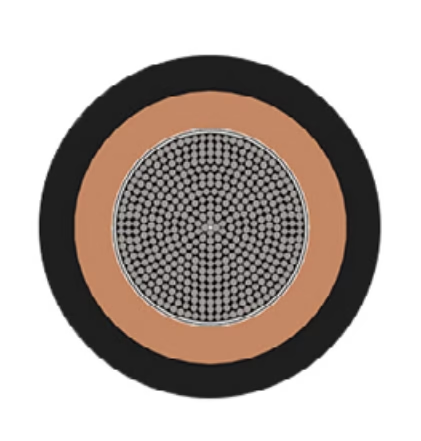
Heat Resistant Cable

For cables deployed in the extreme radiant heat environment near steel mill slag transfer cars, where surface temperatures frequently reach 120°C to 150°C and occasionally exceed 160°C, the LAPP ÖLFLEX HEAT 180 silicone cable is substantially better suited than the standard (N)GRXGöu rubber cable, provided appropriate thermal monitoring and distance spacing are maintained. The LAPP ÖLFLEX HEAT 180, with its continuous operating temperature rating of 180°C (short-term to 200°C), provides a practical safety margin that allows reliable operation even when cable surface temperatures approach 150°C, whereas the (N)GRXGöu, rated for 90°C continuous operation (or 120°C for specialized high-temperature variants), begins to experience unacceptable material degradation at surface temperatures above 100°C to 110°C. However, the critical distinction that engineers often overlook is that a cable rated for 180°C continuous operation is not automatically safe when placed near a radiant heat source at 150°C surface temperature. The actual service life and reliability depend on multiple factors beyond the simple temperature comparison: the duration of exposure, whether the radiant heat exposure is continuous or intermittent, thermal cycling between high and low temperatures, the specific material composition and thermal cycling resistance of the insulation, cable routing distance from the heat source, and implementation of heat shielding or protective conduit. In actual steel mill deployments at integrated steelworks and open-hearth facilities, cables properly routed with 1 to 2 meters clearance from slag cars and protected with ceramic or reflective heat shielding can achieve 3 to 5 years of reliable service using LAPP ÖLFLEX HEAT 180, compared to approximately 6 to 12 months of acceptable service for standard (N)GRXGöu in the same thermal environment. The premium cost of LAPP ÖLFLEX HEAT 180—typically 40 to 60 percent higher than standard (N)GRXGöu—is economically justified in steel mill applications primarily because the extended service life and reduced replacement frequency far outweigh the higher initial cable cost, and secondarily because unplanned cable failures in integrated steelworks can cause production shutdowns costing tens of thousands of euros per hour.


High-Temperature Cable Selection: Can (N)GRXGöu or LAPP ÖLFLEX HEAT 180 Survive Radiant Heat Near Steel Mill Slag Transfer Cars?

For cables deployed in the extreme radiant heat environment near steel mill slag transfer cars, where surface temperatures frequently reach 120°C to 150°C and occasionally exceed 160°C, the LAPP ÖLFLEX HEAT 180 silicone cable is substantially better suited than the standard (N)GRXGöu rubber cable, provided appropriate thermal monitoring and distance spacing are maintained. The LAPP ÖLFLEX HEAT 180, with its continuous operating temperature rating of 180°C (short-term to 200°C), provides a practical safety margin that allows reliable operation even when cable surface temperatures approach 150°C, whereas the (N)GRXGöu, rated for 90°C continuous operation (or 120°C for specialized high-temperature variants), begins to experience unacceptable material degradation at surface temperatures above 100°C to 110°C. However, the critical distinction that engineers often overlook is that a cable rated for 180°C continuous operation is not automatically safe when placed near a radiant heat source at 150°C surface temperature. The actual service life and reliability depend on multiple factors beyond the simple temperature comparison: the duration of exposure, whether the radiant heat exposure is continuous or intermittent, thermal cycling between high and low temperatures, the specific material composition and thermal cycling resistance of the insulation, cable routing distance from the heat source, and implementation of heat shielding or protective conduit. In actual steel mill deployments at integrated steelworks and open-hearth facilities, cables properly routed with 1 to 2 meters clearance from slag cars and protected with ceramic or reflective heat shielding can achieve 3 to 5 years of reliable service using LAPP ÖLFLEX HEAT 180, compared to approximately 6 to 12 months of acceptable service for standard (N)GRXGöu in the same thermal environment. The premium cost of LAPP ÖLFLEX HEAT 180—typically 40 to 60 percent higher than standard (N)GRXGöu—is economically justified in steel mill applications primarily because the extended service life and reduced replacement frequency far outweigh the higher initial cable cost, and secondarily because unplanned cable failures in integrated steelworks can cause production shutdowns costing tens of thousands of euros per hour.
Slag transfer cars represent one of the most thermally demanding applications in modern industrial operations. In an integrated steel mill, molten slag—a byproduct of iron ore reduction and steel refining processes—emerges from the blast furnace or electric arc furnace at temperatures approaching 1,400 to 1,600°C. This extremely hot slag must be transported from the furnace area to cooling and processing areas, sometimes over distances of 50 to 200 meters. The slag pots or ladles are suspended from overhead cranes and transferred between station points via specialized transfer cars, which are essentially motorized flatbed vehicles that roll on rails beneath the suspended load. The reeling cable that powers the electromagnetic magnet holding the slag pot, or that supplies power to the transfer car's motor and control systems, is exposed to radiant heat from the slag pot itself, heated air rising from the slag, and ambient air that may be heated to 80 to 100°C by the nearby furnace operations. The cable must operate continuously—sometimes 18 to 24 hours per day—in this thermal environment without failure, while simultaneously handling the mechanical stresses of starting and stopping a 100+ ton load, acceleration forces, and repeated coiling and uncoiling on the transfer car's reel system. 渣罐转运设备代表现代工业运营中最具热挑战性的应用之一。在综合钢厂中,熔融渣(铁矿石还原和钢精炼工艺的副产品)从高炉或电弧炉产生的温度接近1,400至1,600°C。

Slag Transfer Cars: Heat-Resistant Reeling Cables (Up to 120°C) for Steel Mill Transfer Operations

Slag transfer cars represent one of the most thermally demanding applications in modern industrial operations. In an integrated steel mill, molten slag—a byproduct of iron ore reduction and steel refining processes—emerges from the blast furnace or electric arc furnace at temperatures approaching 1,400 to 1,600°C. This extremely hot slag must be transported from the furnace area to cooling and processing areas, sometimes over distances of 50 to 200 meters. The slag pots or ladles are suspended from overhead cranes and transferred between station points via specialized transfer cars, which are essentially motorized flatbed vehicles that roll on rails beneath the suspended load. The reeling cable that powers the electromagnetic magnet holding the slag pot, or that supplies power to the transfer car’s motor and control systems, is exposed to radiant heat from the slag pot itself, heated air rising from the slag, and ambient air that may be heated to 80 to 100°C by the nearby furnace operations. The cable must operate continuously—sometimes 18 to 24 hours per day—in this thermal environment without failure, while simultaneously handling the mechanical stresses of starting and stopping a 100+ ton load, acceleration forces, and repeated coiling and uncoiling on the transfer car’s reel system. 渣罐转运设备代表现代工业运营中最具热挑战性的应用之一。在综合钢厂中,熔融渣(铁矿石还原和钢精炼工艺的副产品)从高炉或电弧炉产生的温度接近1,400至1,600°C。
To understand why Type 450-FO composite cables represent such a significant advancement for stacker-reclaimer applications, we first need to appreciate what makes these cables different from traditional power or communication cables. Think of a Type 450-FO composite cable as a sophisticated integration of two fundamentally different technologies working together in harmony within a single protective structure. The designation "450-FO" tells us important information about this cable's design: the "450" typically indicates the voltage rating in volts for the power conductors, while "FO" stands for Fiber Optic, signaling that optical fibers are integrated within the same cable assembly alongside the copper power conductors. 要理解为什么Type 450-FO复合电缆代表了堆取料机应用的重大进步,我们首先需要了解是什么使这些电缆与传统的电力或通信电缆不同。将Type 450-FO复合电缆想象为两种根本不同技术的复杂集成,在单个保护结构内和谐地协同工作。"450-FO"名称告诉我们有关这种电缆设计的重要信息:"450"通常表示电力导体的额定电压(以伏特为单位),而"FO"代表光纤,表示光纤与铜电力导体一起集成在同一电缆组件中。

Integrated Fiber Optics: Advantages of Type 450-FO Composite Cables for Remote-Controlled Stacker-Reclaimers

To understand why Type 450-FO composite cables represent such a significant advancement for stacker-reclaimer applications, we first need to appreciate what makes these cables different from traditional power or communication cables. Think of a Type 450-FO composite cable as a sophisticated integration of two fundamentally different technologies working together in harmony within a single protective structure. The designation “450-FO” tells us important information about this cable’s design: the “450” typically indicates the voltage rating in volts for the power conductors, while “FO” stands for Fiber Optic, signaling that optical fibers are integrated within the same cable assembly alongside the copper power conductors. 要理解为什么Type 450-FO复合电缆代表了堆取料机应用的重大进步,我们首先需要了解是什么使这些电缆与传统的电力或通信电缆不同。将Type 450-FO复合电缆想象为两种根本不同技术的复杂集成,在单个保护结构内和谐地协同工作。”450-FO”名称告诉我们有关这种电缆设计的重要信息:”450″通常表示电力导体的额定电压(以伏特为单位),而”FO”代表光纤,表示光纤与铜电力导体一起集成在同一电缆组件中。
Сварочные кабели серии TENAX®-SL H01N2-D и H01N2-E производятся в соответствии с международным стандартом DIN VDE 0282, часть 6. Данный стандарт определяет требования к конструкции, материалам и электрическим характеристикам гибких кабелей для сварочного оборудования.

Сварочные кабели TENAX®-SL H01N2-D H01N2-E

сварочный кабель H01N2-D, сварочный кабель TENAX, гибкий сварочный кабель, кабель для дуговой сварки, кабель для сварочного аппарата, кабель сварочный медный, кабель сварочный резиновый, токовая нагрузка сварочного кабеля, сечение сварочного кабеля, кабель КГ сварочный, кабель для электродной сварки, кабель сварочный маслостойкий, кабель сварочный морозостойкий
The Canadian Standards Association (CSA) sets out the requirements for the Canadian Electrical Code (Part 2) including flexible cords, elevator cables, and hoistway cables with a maximum voltage rating of 600V in the standard CSA 22.2. Standard CSA 22.2 Part 210-11 is designated for Appliance Wiring Material (AWM) Products such as heavy-duty cables with an increased voltage rating and a higher temperature rating than ordinary panel wires. The standard applies to both single conductor and multi-core cables, either round, flat, or coiled, which includes the range holding CSA, UL, and British Standard approvals.

What is CSA 22.2 No. 210-11 Cable?

CSA 22.2 No. 210-11 cable, tri-rated cable, H05V2-K cable, H07V2-K cable, BS 6231 cable, UL1015 cable, UL 758 cable, panel wire, switchgear cable, control panel wire, AWM cable, appliance wiring material, Class 5 flexible copper, PVC insulation, 600V cable, 1000V cable, 105°C cable, heat resistant cable, flame retardant cable, motor starter cable, rectifier wiring, electrical cabinet wire, equipment export cable, harmonised cable, BASEC approved, triple certified cable, EN 50525-2-31, IEC 60228, controlgear wiring, Feichun cable
British Standard BS7917 covers a wide range of cable types used in fixed wiring applications in offshore units where additional fire resistant properties are required. It sets out the constructional requirements and additional tests under fire conditions. The purpose of producing BS7917 was to promote the use of cables with fire resistance in the event of fire, ensuring continued circuit integrity during emergency situations.

What is BS7917 Cable?

BS7917 cable, BS7917 fire resistant cable, BS7917 SW2, BS7917 SW3, BS7917 SW4, fire resistant offshore cable, elastomer insulated cable, EPR insulation cable, GSWB armoured cable, galvanized steel wire braid, 0.6/1kV offshore cable, 150/250V instrumentation cable, halogen free cable, LSZH marine cable, low smoke zero halogen, mica glass tape fire resistant, F0 fire rating 750°C, F1 fire rating 950°C, 3 hour fire resistance, circuit integrity cable, offshore platform cable, FPSO cable, marine vessel cable, ship wiring cable, oil platform cable, gas platform cable, tinned copper conductor, Class 5 flexible conductor, Class 2 stranded conductor, collective screen cable, individual screen cable, BS6883 cable, IEC 60331-21, IEC 60332-3-22, IEC 60754-1, oil resistant cable, flame retardant cable, heat resistant cable, offshore fixed wiring, mobile offshore unit, fixed offshore unit, TCu/MGT/EPR cable, ASHM GSWB cable, offshore crane cable, propulsion circuit cable, control instrumentation cable, emergency system cable, BS7917電纜, 防火電纜, 耐火電纜, 海上電纜, 船用電纜, 無鹵電纜, 低煙無鹵, 阻燃電纜, 耐油電纜, 海洋平台電纜, Anhui Feichun cable, Feichun Special Cable, 安徽飛純電纜
BS6195 Standard covers the requirements for insulated flexible cables and cords typically known as coil end leads. These specialized cables are engineered for permanent and direct connection to coil windings or other electrical equipment, providing the essential flexibility and durability required in demanding industrial environments where motors, generators, transformers, and circuit breakers operate.

What is BS6195 Cable?

BS6195 Standard covers the requirements for insulated flexible cables and cords typically known as coil end leads. These specialized cables are engineered for permanent and direct connection to coil windings or other electrical equipment such as motors, generators, transformers, and circuit breakers.
600V 3TC-RB (600V 3PNCT) Crane Cable Class 3 600V Ethylene Propylene Rubber-Insulated Polychloroprene Rubber Sheath Cable

600V 3TC-RB (600V 3PNCT) Crane Cable

The 600V 3TC-RB cable, also known as 600V 3PNCT, represents a specialized class of flexible power cables engineered specifically for demanding industrial applications. This cable system is designed for mobile machinery operations where continuous flexing, environmental resistance, and electrical reliability are paramount. The designation “3TC-RB” indicates a Class 3 stranded conductor configuration with ethylene propylene rubber insulation and polychloroprene rubber sheath construction.
The 2TC Light-SB (2PNCT-SB) crane cable represents a specialized category of industrial power transmission cables engineered specifically for demanding applications in material handling, crane systems, and mobile industrial equipment.

What is 2TC Light-SB (2PNCT-SB) Crane Cable?

The 2TC Light-SB (2PNCT-SB) crane cable represents a specialized category of industrial power transmission cables engineered specifically for demanding applications in material handling, crane systems, and mobile industrial equipment.
DIN VDE 0250 German Standard Flexible Power Reeling Cable

What is DIN VDE 0250 Reeling Cables?

DIN VDE 0250 represents the globally recognized German standard for flexible electrical cables designed specifically for cranes, material handling equipment, and mobile machinery applications. As Germany remains the only country to have issued special design regulations for flexible electrical cables covering cranes and material handling equipment, this standard has achieved worldwide acceptance as the ultimate benchmark for tough rubber-sheathed flexible reeling cables.