
AC 600 V Spreader Basket System Flexible Cable with Steel-Wire-Stranded Conductors for Enhanced Tension Resistance, −40°C to +90°C Ambient Temperature Rating, High-Core-Count Configurations of 30, 36, and 42 Cores at 3.5 mm² — Purpose-Built for Spreader Cables Used on Gravity Collector Basket Systems for Yard Crane Operation at Harbours, Container Terminals, and Intermodal Logistics Facilities
Specialised Spreader-to-Trolley Cable Engineering: Optimised for the Unique Mechanical Demands of Gravity Collector Basket (Festoon Basket) Cable Management — Where the Cable Hangs in Free-Forming Loops Between Trolley-Mounted Basket Carriers and Must Withstand Continuous Lateral Bending, Self-Weight Suspension, Wind Loading, and Hundreds of Thousands of Formation-and-Collapse Cycles Without Conductor Fatigue, Insulation Abrasion, or Signal Degradation Across 30 to 42 Independent Control and Signal Circuits
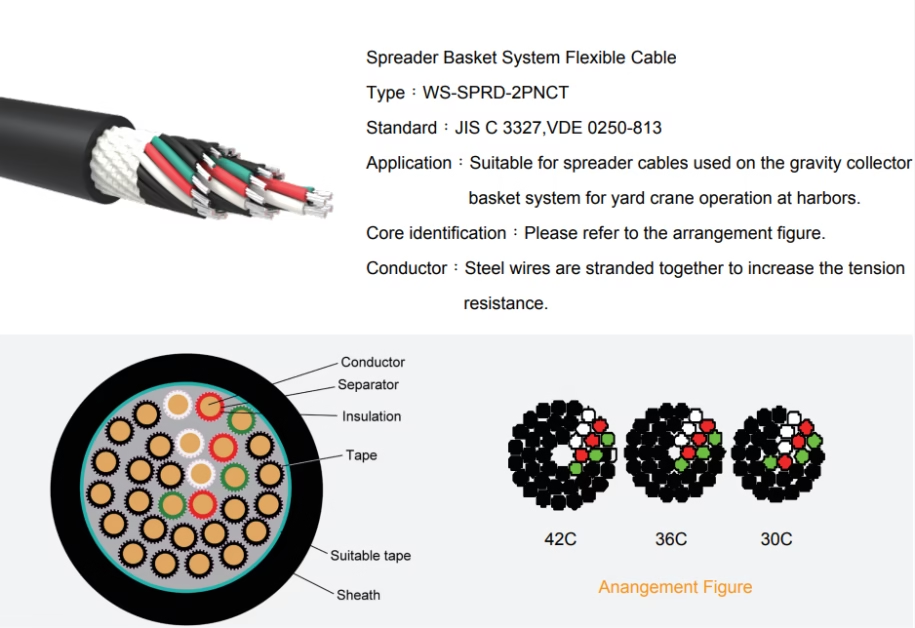
WALSREEN® WS-SPRD-2PNCT Spreader Basket System Flexible Cable
AC 600 V Spreader Basket System Flexible Cable with Steel-Wire-Stranded Conductors for Enhanced Tension Resistance, −40°C to +90°C Ambient Temperature Rating, High-Core-Count Configurations of 30, 36, and 42 Cores at 3.5 mm² — Purpose-Built for Spreader Cables Used on Gravity Collector Basket Systems for Yard Crane Operation at Harbours, Container Terminals, and Intermodal Logistics Facilities
Specialised Spreader-to-Trolley Cable Engineering: Optimised for the Unique Mechanical Demands of Gravity Collector Basket (Festoon Basket) Cable Management — Where the Cable Hangs in Free-Forming Loops Between Trolley-Mounted Basket Carriers and Must Withstand Continuous Lateral Bending, Self-Weight Suspension, Wind Loading, and Hundreds of Thousands of Formation-and-Collapse Cycles Without Conductor Fatigue, Insulation Abrasion, or Signal Degradation Across 30 to 42 Independent Control and Signal Circuits
Introduction: The Cable That Hangs, Swings, and Survives
Of all the cable types deployed on a modern container handling crane, the spreader basket cable endures the most visually dramatic — and mechanically complex — duty cycle. Unlike reel system cables that spool and unspool around a drum in a controlled, predictable motion, a gravity collector basket cable hangs in free-forming catenary loops between trolley-mounted basket carriers, constantly changing shape as the trolley traverses the crane’s span. Each loop forms under gravity, collapses and reforms as the trolley moves, swings laterally in coastal winds, and accumulates lateral bending cycles numbering in the hundreds of thousands per year. The cable is never still, never straight, and never in the same shape twice.
The WALSREEN® WS-SPRD-2PNCT was engineered specifically for this unforgiving application. It combines high-core-count construction (30, 36, or 42 cores at 3.5 mm²) to carry the full complement of spreader control and signal circuits in a single cable, steel-wire-stranded conductors for tension resistance under self-weight suspension, chloroprene rubber sheathing for oil, ozone, and UV resistance in coastal port environments, and a cable geometry specifically optimised for the continuous lateral bending and catenary formation cycles unique to gravity collector basket systems.
Manufactured to dual standards — JIS C 3327 (rubber-insulated machinery cables) and VDE 0250-813 (flexible cables) — the WS-SPRD-2PNCT represents dedicated engineering for a niche but mission-critical application. A failed spreader basket cable means a stopped crane, a grounded spreader, and halted container operations. There is no redundancy — the cable is the sole electrical lifeline between the crane’s trolley and the spreader that grips the containers.
The WS-SPRD-2PNCT is specifically designed for gravity collector basket (festoon basket) cable management systems. It is not suitable for motorised cable reel systems (use WS-RLIN-2PNCT/3PNCT instead), cable chain/energy chain systems (which require different bending radius and abrasion characteristics), or direct-suspended festoon systems without basket carriers (which impose different catenary loading patterns). Using this cable in the wrong cable management system will result in premature failure. Always verify compatibility between the cable specification and the basket system manufacturer’s cable requirements before installation.
Technical Specifications: Complete Dual-Standard Breakdown
| Parameter | Specification |
|---|---|
| Product Designation | WALSREEN® WS-SPRD-2PNCT Spreader Basket System Flexible Cable |
| Standard Compliance | JIS C 3327 (rubber-insulated cables for machinery), VDE 0250-813 (flexible cables) |
| Application | Spreader cables used on gravity collector basket systems for yard crane operation at harbours |
| Rated Voltage | AC 600 V |
| Test Voltage | AC 3,000 V / 1 minute |
| Rated Temperature | 90°C (maximum continuous conductor temperature) |
| Ambient Temperature Range | −40°C to +90°C |
| Rated Tensile Strength | 15 N/mm² |
| Conductor Structure | Steel wire stranded — steel wires are stranded together with copper to increase tension resistance during catenary suspension |
| Conductor Size | 3.5 mm² (all cores, all configurations) |
| Core Configurations | 30, 36, or 42 cores |
| Core Identification | Per arrangement figure — colour coding and/or sequential numbering per JIS standard |
| Insulation Material | Ethylene Propylene Rubber (EPR) — high-temperature, high-flexibility elastomer |
| Sheath Material | Chloroprene Rubber (CR) — oil-resistant, flame-retardant, UV and ozone resistant |
| Flame Retardancy | Per JIS C 3005. Self-extinguishing. |
| Oil Resistance | Per JIS C 3005. Resistant to hydraulic oil, lubricants, and diesel fuel contact. |
| Abrasion Resistance | Per JIS C 3327, Table 6 |
| Weather Resistance | Resistant to ozone, UV radiation, and moisture. Rated for permanent outdoor installation. |
The Gravity Collector Basket System: How It Works
A gravity collector basket system (also known as a festoon basket system or cable basket system) is a cable management mechanism that connects the moving trolley of a yard crane to the crane’s fixed electrical infrastructure. Unlike a motorised cable reel that winds and unwinds the cable around a drum, the basket system uses a series of wheeled carrier trolleys that ride along a rail mounted beneath the crane’s bridge girder. The cable hangs in free-forming loops (catenaries) between adjacent carriers, and the carriers move along the rail as the trolley traverses, collecting and distributing the cable loops automatically under gravity.
When the trolley moves toward one end of the crane span, the carriers on that side compress together and the cable loops shorten. Simultaneously, the carriers on the opposite side spread apart and the cable loops lengthen. The cable continuously transitions between short, tight loops and long, sweeping catenaries — a dynamic process driven entirely by the cable’s own weight and the trolley’s motion. There is no powered winding mechanism, no tensioner, and no drum — the system relies purely on gravity and the cable’s natural flexibility to manage itself.
This elegantly simple mechanism imposes uniquely demanding requirements on the cable. The cable must be flexible enough to form smooth catenary loops without developing kinks or permanent set. It must be heavy enough to hang predictably under gravity without being so heavy that it overloads the carrier trolleys. It must resist the abrasion of continuous contact with the basket carrier saddles as the loops form and collapse. And it must maintain electrical integrity across 30 to 42 independent circuits despite the continuous dynamic bending, torsion, and self-weight loading of basket system operation. The WS-SPRD-2PNCT is engineered to meet all of these requirements simultaneously.
Gravity collector basket systems are the preferred cable management solution for yard cranes (RTG and RMG cranes) for several reasons. Basket systems have no moving electrical or mechanical components (no motors, no tensioners, no slip rings) — reducing maintenance costs and improving reliability. They accommodate longer cable travel distances than typical reel systems without requiring oversized drums. They impose lower bending stress on the cable than drum-wound reel systems (the cable’s minimum bend radius in a catenary is naturally larger than a reel drum radius). And they are simpler to install and maintain than motorised reel systems. The trade-off is that basket cables must be specifically engineered for catenary-loop dynamics — which is precisely what the WS-SPRD-2PNCT provides.
Why Spreader Basket Cables Are Different
A spreader basket cable is not simply a multi-core flexible cable adapted for outdoor use. It is engineered from the ground up for four mechanical demands that are unique to gravity collector basket systems and that would destroy a general-purpose flexible cable within months.
Demand 1: Continuous lateral bending in alternating directions. As the cable forms and collapses its catenary loops, every section of the cable’s length experiences repeated lateral bending — first curving one way to form the loop’s descending arc, then straightening, then curving the opposite way as the next carrier movement reshapes the catenary. This alternating-direction bending is more fatiguing than the unidirectional bending of a reel system cable, because each bending reversal subjects the conductor strands and insulation to a full tension-compression cycle. The WS-SPRD-2PNCT’s conductor stranding geometry and insulation formulation are optimised for this alternating-bend fatigue mode.
Demand 2: Self-weight suspension across variable spans. The cable hangs freely between basket carriers under its own weight. As the carriers move apart, the span increases and the gravitational tensile load on the cable at the carrier contact points increases proportionally. The cable must support this variable tensile load without conductor elongation or permanent deformation. The steel-wire-stranded conductor construction provides the necessary tensile strength to resist self-weight loading across the full range of carrier spacings.
Demand 3: Continuous abrasion at carrier contact points. The cable rests on saddle-shaped supports within each basket carrier. As the loops form and collapse, the cable slides laterally across these saddle surfaces — generating continuous abrasion at the contact points. Over hundreds of thousands of cycles, this abrasion can wear through the outer sheath, exposing the insulation and eventually the conductor. The WS-SPRD-2PNCT’s chloroprene rubber sheath is formulated with enhanced abrasion-resistant compounds, and the sheath thickness (3.3–3.7 mm) provides a substantial wear allowance for the cable’s planned service life.
Demand 4: Torsion from wind-induced cable swing. In coastal port environments, sustained winds of 20–40 km/h cause the cable loops to swing laterally, imposing torsional loads on the cable at each carrier contact point. The cable must absorb this torsion without core migration (where individual conductor cores shift position within the cable cross-section, changing the cable’s bending characteristics and eventually causing core breakage). The WS-SPRD-2PNCT’s internal core geometry is designed to resist migration under torsional loading.
Steel-Stranded Conductor Construction
Every core of the WS-SPRD-2PNCT uses steel-wire-stranded conductor construction — copper conductors interwoven with steel reinforcement wires to increase the cable’s tensile capacity under the self-weight loading inherent in basket system operation. All cores are 3.5 mm² with an approximate conductor diameter of 2.5 mm.
In a gravity collector basket system, the cable hangs freely between carriers in catenary loops. The gravitational force on each loop is a function of the cable’s weight per unit length and the carrier spacing. A 42-core WS-SPRD-2PNCT cable weighs 2,930 kg/km (2.93 kg/m). At a typical carrier spacing of 3–4 metres, each cable loop contains 6–8 metres of cable with a gravitational mass of approximately 17–23 kg — all of which must be supported by the cable’s internal tensile structure at the two carrier contact points. Without steel reinforcement, the copper conductors would gradually elongate under this sustained loading, increasing electrical resistance and eventually causing conductor breakage through creep failure.
The steel wires within each conductor core are positioned at the geometric centre of the conductor bundle, carrying the majority of the tensile load while the surrounding copper strands carry electrical current. This dual-function construction ensures that the cable’s electrical properties remain stable throughout its service life — conductor resistance remains within specification even after years of continuous gravitational loading in the basket system.
High-Core-Count Architecture: 30, 36 & 42 Cores
Modern container handling spreaders are sophisticated electromechanical systems that require a surprisingly large number of independent electrical circuits. The WS-SPRD-2PNCT’s high-core-count configurations (30, 36, and 42 cores) are specifically tailored to the electrical requirements of contemporary yard crane spreader systems.
Spreader motor circuits: A twin-lift or tandem-lift spreader requires multiple motor drive circuits for spreader extension/retraction, flipper actuation, twist-lock rotation, and telescoping operations. Each motor circuit typically uses 3 conductors (three-phase) or 2 conductors (single-phase), consuming 6–12 cores for motor functions alone.
Sensor and limit switch circuits: Modern spreaders incorporate position sensors, weight sensors, container-present detectors, twist-lock position indicators, and multiple limit switches for end-of-travel protection. Each sensor or switch pair requires 2 conductors, and a fully instrumented spreader may require 8–16 cores for sensor circuits.
Control bus and communication: Fieldbus communication (Profibus, DeviceNet, or CANopen) between the trolley PLC and the spreader’s local I/O modules requires 2–4 dedicated signal cores with controlled impedance characteristics.
Power supply and earth: The spreader’s local control electronics, LED lighting, and auxiliary systems require dedicated low-voltage power supply conductors (typically 24 VDC or 48 VDC) and protective earth conductors — consuming 4–6 additional cores.
Spare cores: Good engineering practice reserves 2–4 spare cores for future system expansion, field troubleshooting (using a spare core to bypass a damaged core), or the addition of new sensors during the crane’s operational life.
30-core — suited for standard single-lift spreaders with basic instrumentation and no spare cores. 36-core — the most commonly specified configuration, providing capacity for a fully instrumented single-lift or basic twin-lift spreader with 2–4 spare cores. 42-core — specified for twin-lift and tandem-lift spreaders with full instrumentation, fieldbus communication, integrated LED lighting, and adequate spare cores for future expansion. When in doubt, specify the higher core count — the marginal cost difference between configurations is minimal compared to the cost of re-cabling a crane that requires additional circuits in the future.
Cable Construction: Layer-by-Layer Engineering
The WS-SPRD-2PNCT’s cross-section is engineered for three simultaneous objectives: maximum lateral bending flexibility for catenary loop formation, resistance to core migration under torsion, and a circular, consistent external profile for uniform contact with the basket carrier saddles.
Layer 1 — Conductors: 30, 36, or 42 steel-stranded copper conductors at 3.5 mm² (2.5 mm diameter each). The conductors are arranged in concentric layers around a central bundle, with each layer stranded in the opposite helical direction to the adjacent layer. This counter-stranding technique ensures that the cable does not develop a rotational bias during bending — a critical requirement for basket system operation where the cable experiences bending in all directions as the catenary loops form and collapse.
Layer 2 — Insulation: 0.8 mm EPR (ethylene propylene rubber) insulation on each conductor. The insulation thickness is optimised for the 600 V rating with a 3,000 V withstand margin, while minimising the cable’s overall diameter — a critical parameter because larger diameter cables form larger catenary loops and require wider basket carrier spacing. Individual cores are colour-coded and/or sequentially numbered per the arrangement figure for positive identification during spreader termination.
Layer 3 — Internal Structure: A filling compound and binding layer bundles the insulated cores into a circular cross-section and provides mechanical cushioning between adjacent cores. This layer prevents core-on-core abrasion during the continuous internal movement caused by catenary bending, and it resists core migration under the torsional loads generated by wind-induced cable swing.
Layer 4 — Outer Sheath: Chloroprene rubber (CR) sheath with thickness from 3.3 mm (30-core) to 3.7 mm (42-core). The sheath is the cable’s first line of defence against the carrier saddle abrasion, UV radiation, salt spray, hydraulic oil contamination, and mechanical impacts that are routine in port environments. The sheath thickness is engineered to provide a sufficient wear allowance — the cable can lose a measurable percentage of its sheath thickness to abrasion over its service life without exposing the insulation layer beneath.
Configuration Options & Dimensional Data
The WS-SPRD-2PNCT is available in three standard configurations, all using 3.5 mm² steel-stranded copper conductors. The configuration is selected based on the spreader’s total circuit count requirement plus adequate spare cores for future expansion.
| No. of Cores | Conductor Size (mm²) | Conductor Ø (mm) | Insulation Thickness (mm) | Sheath Thickness (mm) | Approx. OD (mm) | Approx. Mass (kg/km) | Max. Conductor Resistance 20°C (Ω/km) | Min. Insulation Resistance 20°C (MΩ·km) |
|---|---|---|---|---|---|---|---|---|
| 30 | 3.5 | 2.5 | 0.8 | 3.3 | 37.0 | 2,130 | 5.54 | 400 |
| 36 | 3.5 | 2.5 | 0.8 | 3.5 | 40.0 | 2,520 | 5.54 | 400 |
| 42 | 3.5 | 2.5 | 0.8 | 3.7 | 43.0 | 2,930 | 5.54 | 400 |
The cable’s mass per unit length directly determines the gravitational force on each catenary loop and the load on each basket carrier. The 42-core configuration at 2,930 kg/km (2.93 kg/m) is approximately 38% heavier than the 30-core configuration at 2,130 kg/km (2.13 kg/m). When upgrading from a 30-core to a 42-core cable on an existing basket system, verify that the basket carriers, carrier wheels, rail, and support structure are rated for the increased cable weight. Most modern basket systems are designed with capacity margins that accommodate the full WS-SPRD-2PNCT range, but older or lightly built systems may require carrier wheel or rail reinforcement.
Application Guide: Yard Cranes & Harbour Spreader Systems
Rubber-Tyred Gantry Cranes (RTG)
RTG cranes are the primary application for the WS-SPRD-2PNCT. These cranes straddle container stacks in the yard and use a trolley-mounted spreader to place and retrieve containers. The spreader basket cable connects the trolley’s electrical systems to the spreader, carrying all motor drive, sensor, communication, and auxiliary power circuits. A typical RTG crane has a trolley travel distance of 20–25 metres with 6–8 basket carrier trolleys. The 36-core configuration is the most commonly specified for RTG spreader applications, providing capacity for a standard single-lift spreader with adequate spare cores.
Rail-Mounted Gantry Cranes (RMG)
RMG cranes — including automated stacking cranes (ASC) — use gravity collector basket systems for both the trolley-to-spreader cable and, in some designs, the bridge-to-trolley cable. Automated RMG cranes often require the 42-core configuration to accommodate the additional sensor and communication circuits needed for autonomous container handling, including spreader-mounted cameras, RFID tag readers, and multiple position feedback sensors.
Ship-to-Shore (STS) Crane Spreader Cables
While STS cranes typically use cable reel systems for the boom-to-trolley connection, the trolley-to-spreader cable segment on some STS designs uses a short basket system within the trolley frame. The WS-SPRD-2PNCT’s 42-core configuration is specified for STS spreader applications where the spreader carries extensive instrumentation for automated container handling — anti-sway sensors, corner-guide cameras, twist-lock monitoring, and container weighing systems.
Harbour Mobile Cranes
Harbour mobile cranes (HMC) and reach stackers with spreader attachments occasionally use basket-type cable management for the spreader cable. The WS-SPRD-2PNCT’s compact diameter (37.0–43.0 mm) and moderate weight make it suitable for the smaller basket systems used on these mobile equipment types.
Intermodal Rail Terminals
Intermodal rail-to-road transfer cranes at railway terminals use identical spreader systems and basket cable management to port yard cranes. The WS-SPRD-2PNCT’s environmental resistance specifications (−40°C to +90°C, UV, ozone, moisture) ensure reliable operation across the extreme continental temperature ranges experienced at inland intermodal terminals, where summer temperatures may exceed +50°C and winter temperatures may drop below −30°C.
Environmental Resistance & Coastal Durability
Yard crane spreader basket cables operate in permanent outdoor exposure — typically 15–25 years without any protective enclosure or conduit. The cable is directly exposed to every environmental hazard that the port location can deliver.
Oil resistance (JIS C 3005): Spreader cables inevitably contact hydraulic oil, grease, and diesel fuel — leaked from the spreader’s hydraulic system, dripped from the hoist mechanism above, or splashed from container surfaces. The chloroprene rubber sheath resists swelling, softening, and chemical degradation from petroleum-based fluids, maintaining its mechanical strength and abrasion resistance even after prolonged oil exposure.
Ozone and UV resistance: The cable hangs in open air with full exposure to direct sunlight and atmospheric ozone. Ozone concentrations are elevated in coastal environments due to intense solar radiation and marine aerosol photochemistry. The sheath formulation includes ozone and UV stabilisers that prevent surface cracking and photo-degradation over the cable’s multi-decade service life.
Temperature performance (−40°C to +90°C): The cable’s extended ambient temperature range covers arctic port installations (where the cable must remain flexible at −40°C to form catenary loops without cracking) and tropical and Middle Eastern terminals (where cable surface temperatures can exceed +80°C in direct sun on steel structures). The EPR insulation and chloroprene sheath maintain flexibility, dielectric strength, and mechanical integrity across this entire range.
Salt spray and moisture: The chloroprene sheath provides continuous protection against salt spray, rain, and atmospheric moisture. The sheath’s moisture resistance prevents water ingress that could degrade insulation resistance between adjacent cores — a critical concern in a 30–42 core cable where multiple circuits with different voltage levels and signal types run in close proximity.
Abrasion resistance (JIS C 3327, Table 6): The sheath passes the abrasion testing requirements of JIS C 3327, Table 6 — essential for a cable that slides across basket carrier saddle surfaces during every trolley movement. The abrasion-resistant formulation ensures that the sheath wear rate remains within engineered limits throughout the cable’s service life.
Installation & Basket System Best Practices
Basket Carrier Saddle Radius
The cable rests on saddle-shaped supports within each basket carrier. The saddle radius must be large enough to prevent excessive bending stress at the contact point — typically a minimum of 6–8 × OD. For a 42-core cable at 43.0 mm OD, the saddle should have a minimum contact radius of approximately 260–345 mm. Saddles with sharp edges or insufficient radius concentrate bending stress and accelerate sheath abrasion at the contact points, dramatically reducing cable life.
Carrier Spacing
The spacing between adjacent basket carriers determines the catenary loop length and the gravitational tensile load at each contact point. Typical carrier spacing is 2.5–4.0 metres for yard crane spreader applications. Wider spacing produces longer, heavier loops that increase tensile loading but reduce the number of carriers and associated maintenance. Narrower spacing reduces loop weight but requires more carriers and increases the number of abrasion contact points. The optimal spacing is determined by the basket system manufacturer based on the cable’s weight, diameter, and the crane’s trolley speed.
Cable Installation Procedure
The cable should be installed into the basket system from one end, threading through each carrier saddle sequentially. The cable must not be twisted during installation — any twist will become a permanent feature of the cable’s catenary behaviour and will cause accelerated fatigue at the twist location. After installation, verify that the cable forms smooth, symmetric catenary loops at all carrier positions across the full trolley travel range. Asymmetric loops indicate a twist, a stiff section, or a carrier alignment problem that must be corrected before the crane enters service.
Termination
The cable terminates at the trolley end (where it connects to the trolley’s terminal box) and at the spreader end (where it connects to the spreader’s electrical junction box). At both termination points, strain-relief fittings must transfer the cable’s weight to the mechanical structure — not to the conductor connections. The termination enclosures must be weatherproof (IP65 minimum) and vibration-resistant, as the spreader generates significant mechanical vibration during container handling operations. Core identification follows the arrangement figure supplied with each cable delivery — always verify core assignments before connecting circuits.
Inspection Schedule
Spreader basket cables should be visually inspected at every 6-month maintenance interval for sheath wear at carrier contact points, visible cracking, oil contamination, and any twist or deformation in the catenary loop pattern. The sheath thickness at the highest-wear contact points should be measured annually using a calliper or ultrasonic thickness gauge. Plan cable replacement when the sheath thickness at any contact point drops below 50% of the original specification. Proactive replacement on a scheduled basis is always preferable to reactive replacement after a cable failure stops the crane.
Comparison: WS-SPRD-2PNCT vs. Standard Festoon Cables
| Feature | WS-SPRD-2PNCT | General-Purpose Festoon Cable |
|---|---|---|
| Design Objective | Gravity collector basket systems | General festoon / catenary applications |
| Standard Compliance | JIS C 3327 + VDE 0250-813 | Varies (typically single standard) |
| Conductor Reinforcement | Steel-wire stranded | Standard copper (no reinforcement) |
| Rated Tensile Strength | 15 N/mm² | 5–8 N/mm² (typical) |
| Core Count Options | 30, 36, 42 (optimised for spreaders) | Variable (general-purpose range) |
| Sheath Material | Chloroprene rubber (CR) | PVC or PUR (typical) |
| Abrasion Resistance | JIS C 3327 Table 6 (high) | Standard (not optimised for carrier contact) |
| Oil Resistance | JIS C 3005 (high) | Moderate (PVC) to Good (PUR) |
| Temperature Range | −40°C to +90°C | −20°C to +70°C (typical PVC) |
| Ozone & UV Resistance | Excellent (CR formulation) | Poor (PVC) to Moderate (PUR) |
| Alternating-Bend Fatigue Life | Optimised (counter-stranded layers) | Standard |
| Torsion Resistance | Optimised (migration-resistant core design) | Standard |
| Expected Service Life (yard crane) | 8–15 years | 3–6 years |
| Relative Cable Cost | ~130% | 100% (baseline) |
| Total Cost of Ownership | Lower (fewer replacements, less downtime) | Higher (frequent replacement) |
General-purpose festoon cables may function initially in basket system applications, but they lack the steel-reinforced conductors, abrasion-rated chloroprene sheath, and alternating-bend-optimised construction that are essential for the mechanical demands of a gravity collector basket system operating 18+ hours per day in a port environment. The WS-SPRD-2PNCT’s purpose-built design delivers 2–4× the service life of a general-purpose substitute, more than justifying the modest cost premium in any total-cost-of-ownership analysis.
Cost-Effective Feichun Equivalent
Feichun Lead Times: 4–6 weeks for standard WS-SPRD-2PNCT configurations. Japanese OEM suppliers: 12–16 weeks.
Feichun Pricing: Japanese OEM WS-SPRD-2PNCT 42-core quoted at ¥7,500–11,000/metre; Feichun FC-SPRD™ equivalent: ¥3,800–5,800/metre. Per 300-metre order (typical single crane requirement): savings of ¥1,110,000–¥1,560,000.
Case Study: South Asian Container Terminal RTG Fleet Renewal: A major container terminal in South Asia re-cabling 18 RTG cranes with new spreader basket cables needed 36-core WS-SPRD-2PNCT totalling 5,400 metres (300 metres per crane). The Japanese OEM quoted US$1.62 million with a 14-week lead time. Feichun quoted US$810,000 with a 5-week lead time, delivering cables in three phased batches of 6 cranes each to align with the terminal’s rolling maintenance schedule. All cables passed comprehensive testing: 3,000 V/1-minute withstand on all 36 cores, conductor resistance verification within specification on all cores, 10,000-cycle accelerated alternating-bend fatigue test simulating basket system operation, and sheath abrasion testing per JIS C 3327 Table 6. Total savings: US$810,000 with 9 weeks faster delivery. The re-cabling project was completed 2 months ahead of schedule, with zero crane operational interruptions.
Feichun manufactures WS-SPRD-2PNCT equivalents in extended configurations: higher core counts (up to 61 cores for complex twin-lift and tandem-lift spreader systems), mixed conductor sizes (combining 3.5 mm² control cores with larger power cores in a single cable for spreaders with integrated motor drives), screened/shielded cores (individually screened pairs for fieldbus communication or encoder signals), integrated fibre optic elements (hybrid power + fibre for automated spreader camera and sensor systems), and composite cables combining the spreader basket cable with a separate coaxial or triaxial element for spreader-mounted video. Contact the engineering department for specifications.
Technical FAQ
Why is the conductor diameter 2.5 mm for a 3.5 mm² cable?
The 2.5 mm diameter (compared to 2.6 mm in the standard WALSREEN range) reflects the steel-stranded conductor construction. The steel wires occupy part of the conductor’s cross-sectional area, slightly reducing the effective copper diameter while maintaining the specified 3.5 mm² copper cross-section for electrical performance. The conductor resistance of 5.54 Ω/km at 20°C confirms that the copper cross-section meets the 3.5 mm² specification — the steel reinforcement adds tensile strength without affecting electrical conductivity.
Can I use a reel system cable (WS-RLIN-2PNCT) in a basket system?
This is not recommended. Reel system cables are optimised for unidirectional bending around a drum at a consistent radius. Basket system cables experience alternating-direction bending at variable radii as the catenary loops form and collapse. A reel cable’s stranding geometry is not optimised for alternating-bend fatigue and will accumulate fatigue damage more rapidly than the WS-SPRD-2PNCT in basket system operation. Additionally, reel cables may lack the abrasion resistance specification needed for continuous contact with basket carrier saddles.
What is the typical service life in a busy container terminal?
Based on field data from operating RTG cranes: 8–15 years depending on crane utilisation, environmental severity, and maintenance practices. High-utilisation terminals (18–22 hours/day operation, aggressive spreader cycling) typically achieve 8–10 years. Moderate-utilisation terminals (12–16 hours/day) typically achieve 12–15 years. Regular inspection and proactive replacement at 50% sheath thickness ensures that cables are replaced before failure, preventing unplanned crane downtime.
Can I mix core counts on the same crane fleet?
Yes, but this complicates spare parts management. If some cranes in a fleet have 36-core spreaders and others have 42-core spreaders, maintaining both cable types in inventory increases procurement complexity. Feichun recommends standardising on a single core count across the fleet — typically the higher count needed by the most instrumented spreader in the fleet, with unused cores reserved as spares on the less instrumented cranes. The cost difference between 36-core and 42-core cables is minimal compared to the operational benefits of fleet-wide standardisation.
How does the cable handle wind-induced swing?
The WS-SPRD-2PNCT’s counter-stranded core layout and migration-resistant internal structure ensure that wind-induced lateral swing does not cause permanent core displacement or torsional damage. In severe wind conditions (sustained winds > 55 km/h), most port operators suspend crane operations for safety reasons — the cable’s mechanical limits are not the constraining factor. For terminals in extreme-wind locations, Feichun offers an enhanced variant with Kevlar reinforcement (WS-SPRD-3PNCT, available on request) for additional torsion and tensile resistance.
Is the cable suitable for energy chain (cable chain) systems?
No. Energy chain systems impose very different mechanical demands — unidirectional bending at a fixed radius with high-frequency cycles and restricted torsion. The WS-SPRD-2PNCT is optimised for the variable-radius, alternating-direction, gravity-loaded bending of basket systems. Using it in an energy chain wastes its basket-specific engineering and may not meet the energy chain’s minimum bend radius requirements. Feichun offers dedicated energy chain cables for cable chain applications.
References & Standards
- JIS C 3327, Rubber insulated cables for machinery — Requirements and test methods.
- VDE 0250-813, Flexible cables and cords — Particular types.
- JIS C 3005, Test methods for rubber or plastic insulated cables and cords (flame retardancy testing).
- JIS C 3005, Test methods for rubber or plastic insulated cables and cords (oil resistance testing).
- IEC 60228, Conductors of insulated cables — Classes and construction.
- FEM 1.001, Rules for the Design of Hoisting Appliances — Classification and Loading on Structures and Mechanisms.
- ISO 4309, Cranes — Wire ropes — Care and maintenance, inspection and discard (referenced for cable inspection methodology).
- IEC 60332-1-2, Vertical flame propagation test on single insulated wires or cables.


