DIN VDE 0250

Based on DIN VDE 0250-813 · 3,6/6–14/25 kV · tốc độ cuốn đến 180 m/min · ba dây PE chia đều · EPDM đặc biệt · vỏ kép 5GM3/5GM5 và bện polyamide chống xoắn. Bài giữ đủ 40 dòng OD, khối lượng và tải kéo của catalogue 2025, đồng thời chỉ rõ lỗi ghép trang OCR để kỹ sư không đặt nhầm biến thể +FO.

R-(N)TSKCGEWÖU: cáp cuốn trung thế có cradle separator cho tải kéo tăng cường

Based on DIN VDE 0250-813 · 3,6/6–14/25 kV · tốc độ cuốn đến 180 m/min · ba dây PE chia đều · EPDM đặc biệt · vỏ kép 5GM3/5GM5 và bện polyamide chống xoắn. Bài giữ đủ 40 dòng OD, khối lượng và tải kéo của catalogue 2025, đồng thời chỉ rõ lỗi ghép trang OCR để kỹ sư không đặt nhầm biến thể +FO.
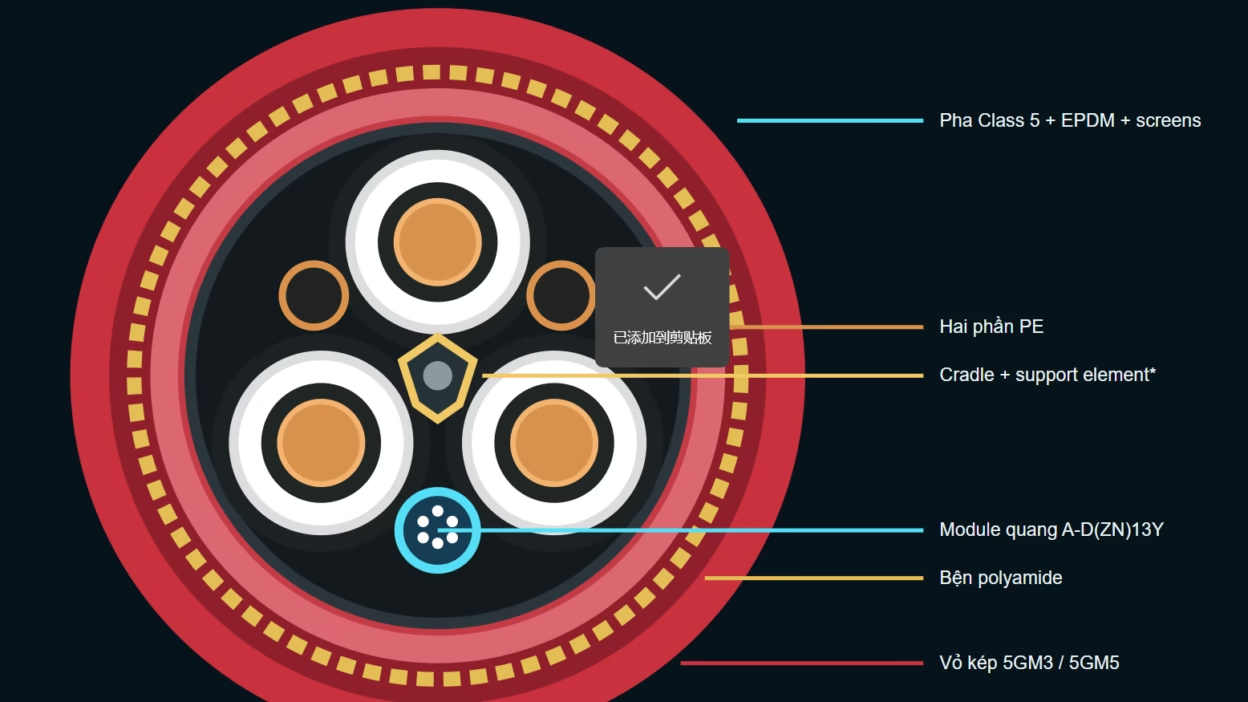
Thiết kế kết hợp ba lõi công suất trung thế có màn bán dẫn, PE tổng chia đôi và mô-đun quang A-D(ZN)13Y quanh lõi điền đầy dẫn điện. Hệ vỏ đỏ 5GM3–bện polyamide–5GM5 phục vụ tang monospiral/cylindrical dưới lực kéo, xoắn và tốc độ cao. Dữ liệu công bố: 3,6/6 đến 12/20 kV, PD tại 1,25U₀ tối đa 20 pC, 100°/m, 180 m/min, 20 N/mm² và 33 cấu hình.

R-(N)TSCGEWÖU + FO: cáp tang cuốn trung thế tích hợp 6–24 sợi quang

Thiết kế kết hợp ba lõi công suất trung thế có màn bán dẫn, PE tổng chia đôi và mô-đun quang A-D(ZN)13Y quanh lõi điền đầy dẫn điện. Hệ vỏ đỏ 5GM3–bện polyamide–5GM5 phục vụ tang monospiral/cylindrical dưới lực kéo, xoắn và tốc độ cao. Dữ liệu công bố: 3,6/6 đến 12/20 kV, PD tại 1,25U₀ tối đa 20 pC, 100°/m, 180 m/min, 20 N/mm² và 33 cấu hình.
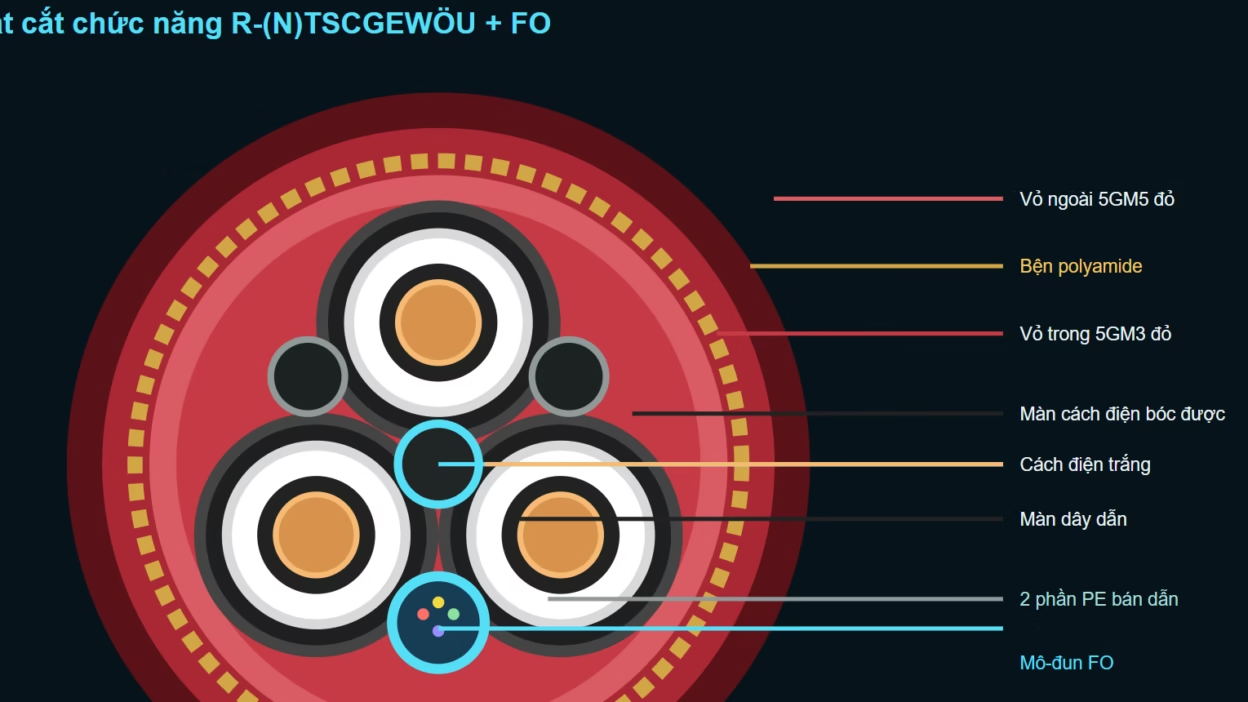
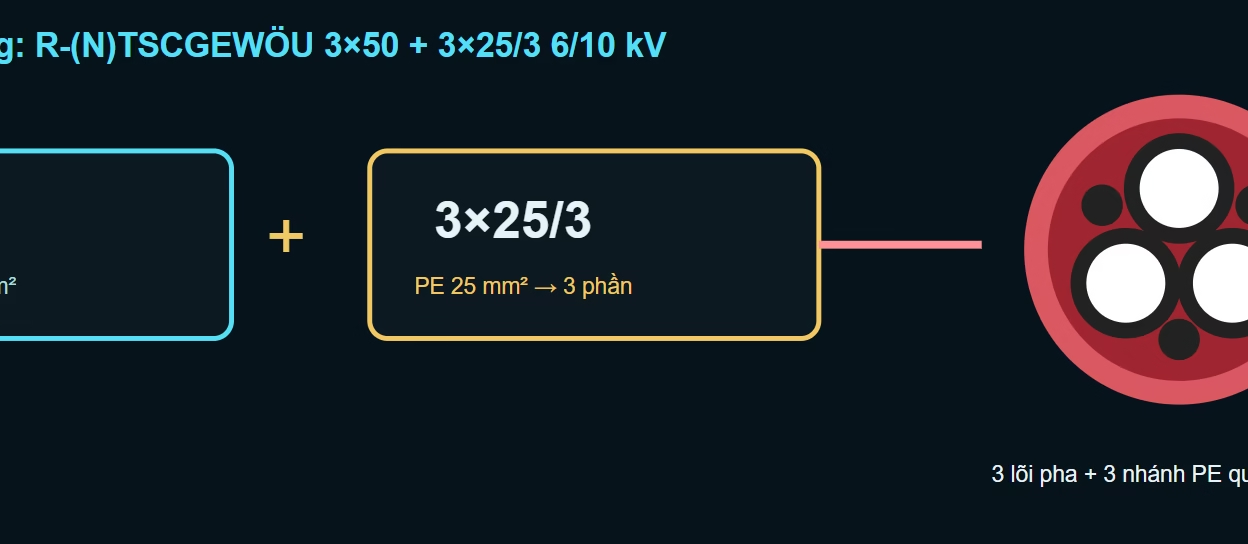
R-(N)TSCGEWÖU kết hợp hệ cách điện trung thế có màn bán dẫn, ba lõi công suất, PE tổng chia thành ba phần, lõi điền đầy dẫn điện, graphite chống dính, vỏ trong 5GM3, bện polyamide chống xoắn và vỏ ngoài 5GM5 màu đỏ. Dữ liệu công bố gồm tang monospiral/cylindrical, tốc độ đến 180 m/min, xoắn 100°/m, lực kéo 20 N/mm² và kiểm tra phóng điện cục bộ tại 1,25U₀ với mức tối đa 20 pC.

R-(N)TSCGEWÖU 3,6/6–12/20 kV: cáp tang cuốn trung thế cho tải cơ cực cao

R-(N)TSCGEWÖU kết hợp hệ cách điện trung thế có màn bán dẫn, ba lõi công suất, PE tổng chia thành ba phần, lõi điền đầy dẫn điện, graphite chống dính, vỏ trong 5GM3, bện polyamide chống xoắn và vỏ ngoài 5GM5 màu đỏ. Dữ liệu công bố gồm tang monospiral/cylindrical, tốc độ đến 180 m/min, xoắn 100°/m, lực kéo 20 N/mm² và kiểm tra phóng điện cục bộ tại 1,25U₀ với mức tối đa 20 pC.
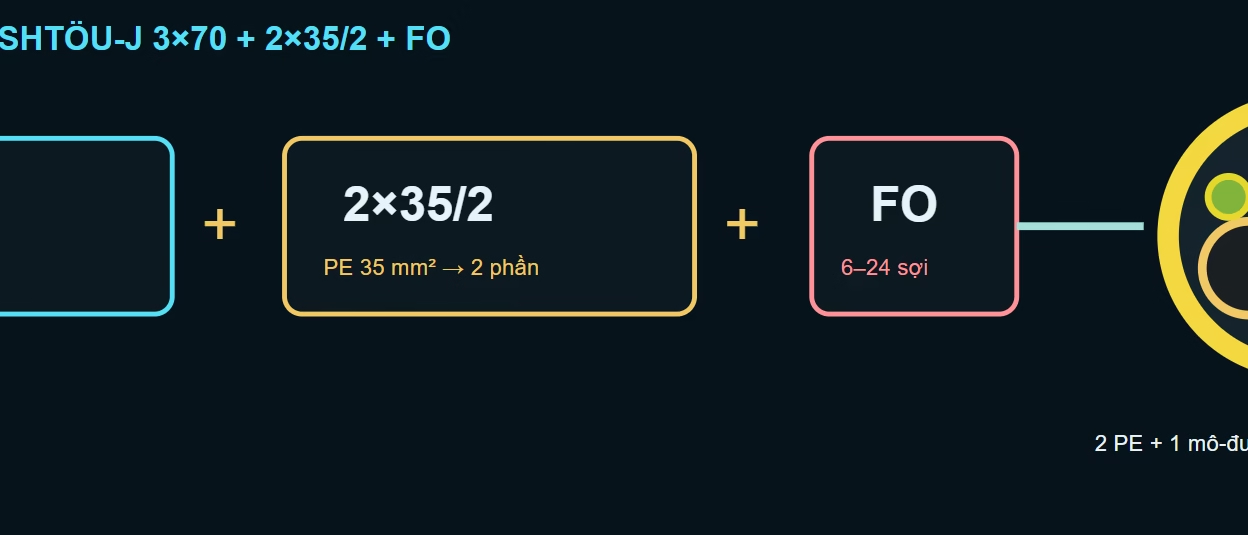
Thiết kế gom ba lõi công suất, một dây bảo vệ PE tổng chia thành hai phần và mô-đun quang A-D(ZN)13Y vào cùng một cáp tang cuốn màu vàng. Cấu trúc dành cho cuốn–nhả thường xuyên dưới lực kéo và xoắn đồng thời, với tốc độ công bố đến 250 m/min, giới hạn xoắn 50°/m, bện polyamide chống xoắn và vỏ ngoài 5GM5 chống xé, va đập, mài mòn.

(N)SHTÖU-J 3×CS + 2×CS/2 + FO: cáp cao su 0,6/1 kV tích hợp nguồn, PE chia đôi và sợi quang

Thiết kế gom ba lõi công suất, một dây bảo vệ PE tổng chia thành hai phần và mô-đun quang A-D(ZN)13Y vào cùng một cáp tang cuốn màu vàng. Cấu trúc dành cho cuốn–nhả thường xuyên dưới lực kéo và xoắn đồng thời, với tốc độ công bố đến 250 m/min, giới hạn xoắn 50°/m, bện polyamide chống xoắn và vỏ ngoài 5GM5 chống xé, va đập, mài mòn.
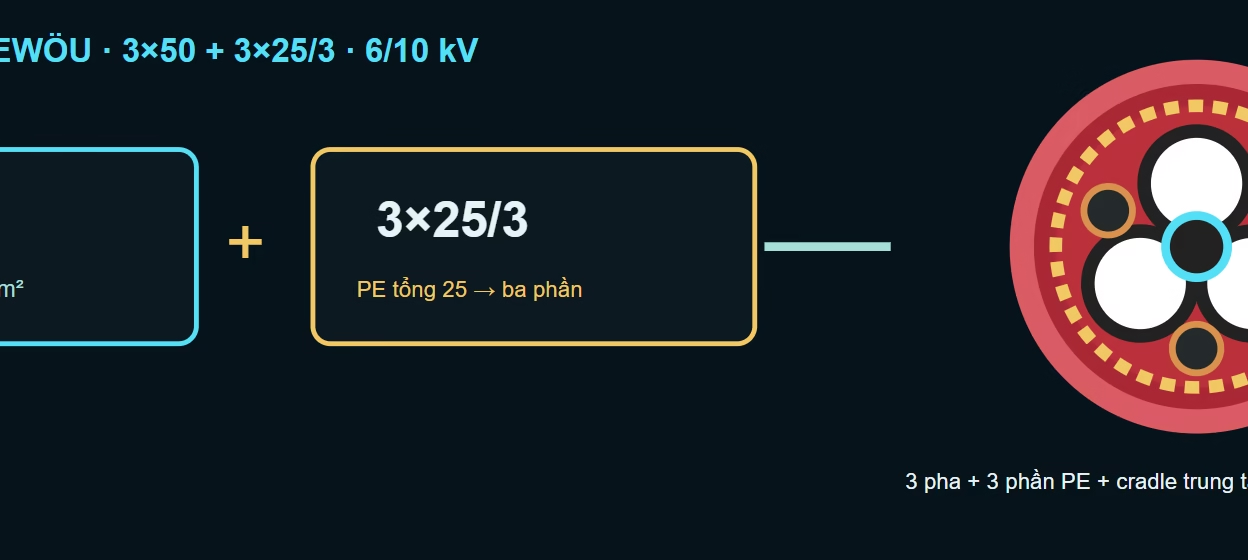
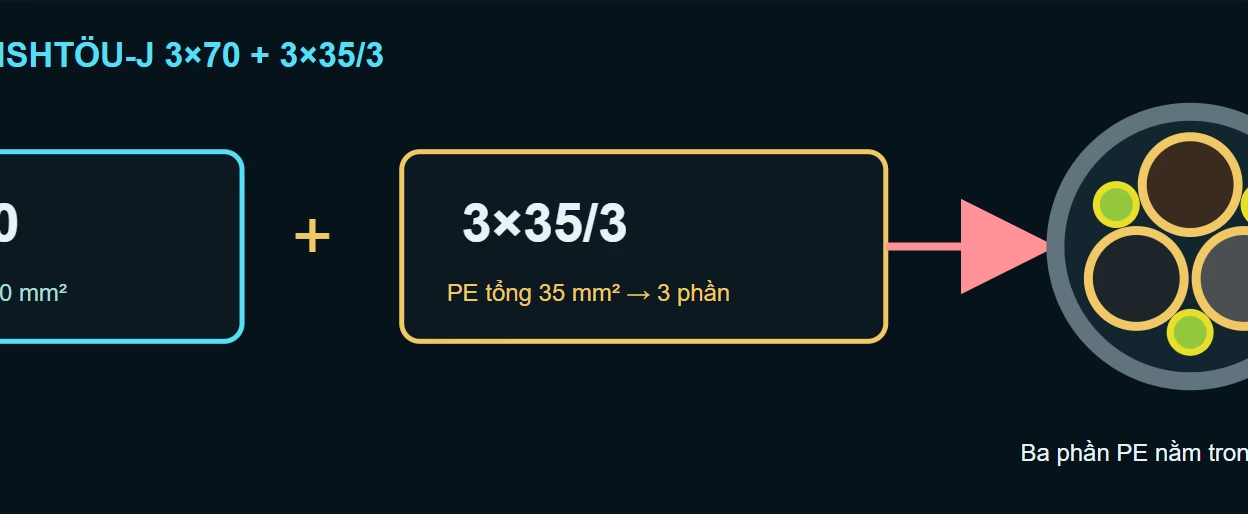
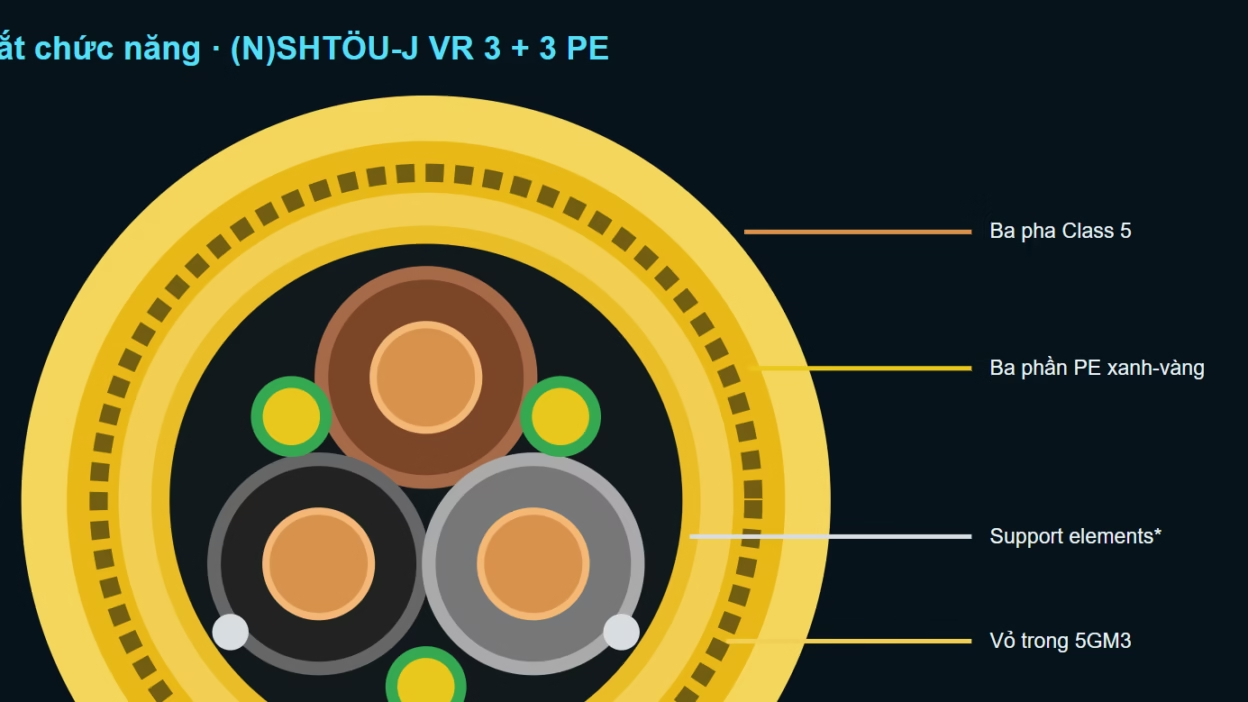
Đây là biến thể NSHTÖU-J 0,6/1 kV có ba lõi công suất và một dây bảo vệ PE tổng, được chia thành ba phần đặt đối xứng trong ba khe giữa các lõi pha. Hình học này làm tròn bó lõi, cải thiện cân bằng cơ khi uốn–xoắn và tạo đường PE đối xứng hơn quanh ba pha. Dữ liệu sản phẩm công bố tốc độ đến 250 m/min, tải kéo 20 N/mm² và chín cấu hình từ 3×35 + 3×16/3 đến 3×300 + 3×150/3.

NSHTÖU-J 3×CS + 3×CS/3: cáp cao su tang cuốn với dây PE chia ba cho ứng suất động rất cao

Đây là biến thể NSHTÖU-J 0,6/1 kV có ba lõi công suất và một dây bảo vệ PE tổng, được chia thành ba phần đặt đối xứng trong ba khe giữa các lõi pha. Hình học này làm tròn bó lõi, cải thiện cân bằng cơ khi uốn–xoắn và tạo đường PE đối xứng hơn quanh ba pha. Dữ liệu sản phẩm công bố tốc độ đến 250 m/min, tải kéo 20 N/mm² và chín cấu hình từ 3×35 + 3×16/3 đến 3×300 + 3×150/3.
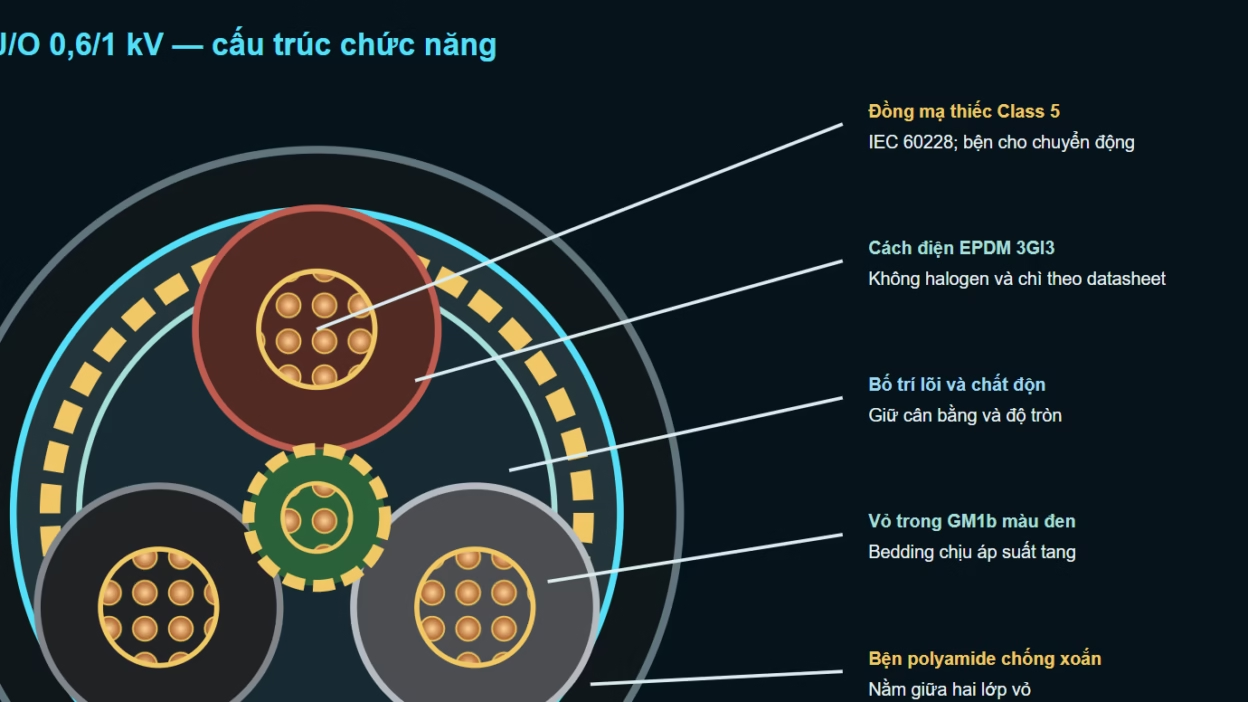
NSHTÖU-J/O là cáp mềm cao su hạ áp dành cho cuốn và nhả lặp lại dưới lực kéo và xoắn đồng thời. Cấu trúc TFCrane được công bố với VDE Marks Approval, dây dẫn đồng mạ thiếc cấp 5, cách điện EPDM 3GI3 không halogen và chì, vỏ trong GM1b, bện polyamide chống xoắn và vỏ ngoài 5GM3. Bài viết này khôi phục chính xác dữ liệu bị xáo trộn bởi PDF hai cột, giữ nguyên toàn bộ 61 cấu hình tiêu chuẩn và tách riêng biến thể PE chia ba tốc độ cao.

NSHTÖU-J/O 0,6/1 kV theo DIN VDE 0250-814: cấu trúc, giới hạn động và đầy đủ ma trận kích thước

NSHTÖU-J/O là cáp mềm cao su hạ áp dành cho cuốn và nhả lặp lại dưới lực kéo và xoắn đồng thời. Cấu trúc TFCrane được công bố với VDE Marks Approval, dây dẫn đồng mạ thiếc cấp 5, cách điện EPDM 3GI3 không halogen và chì, vỏ trong GM1b, bện polyamide chống xoắn và vỏ ngoài 5GM3. Bài viết này khôi phục chính xác dữ liệu bị xáo trộn bởi PDF hai cột, giữ nguyên toàn bộ 61 cấu hình tiêu chuẩn và tách riêng biến thể PE chia ba tốc độ cao.
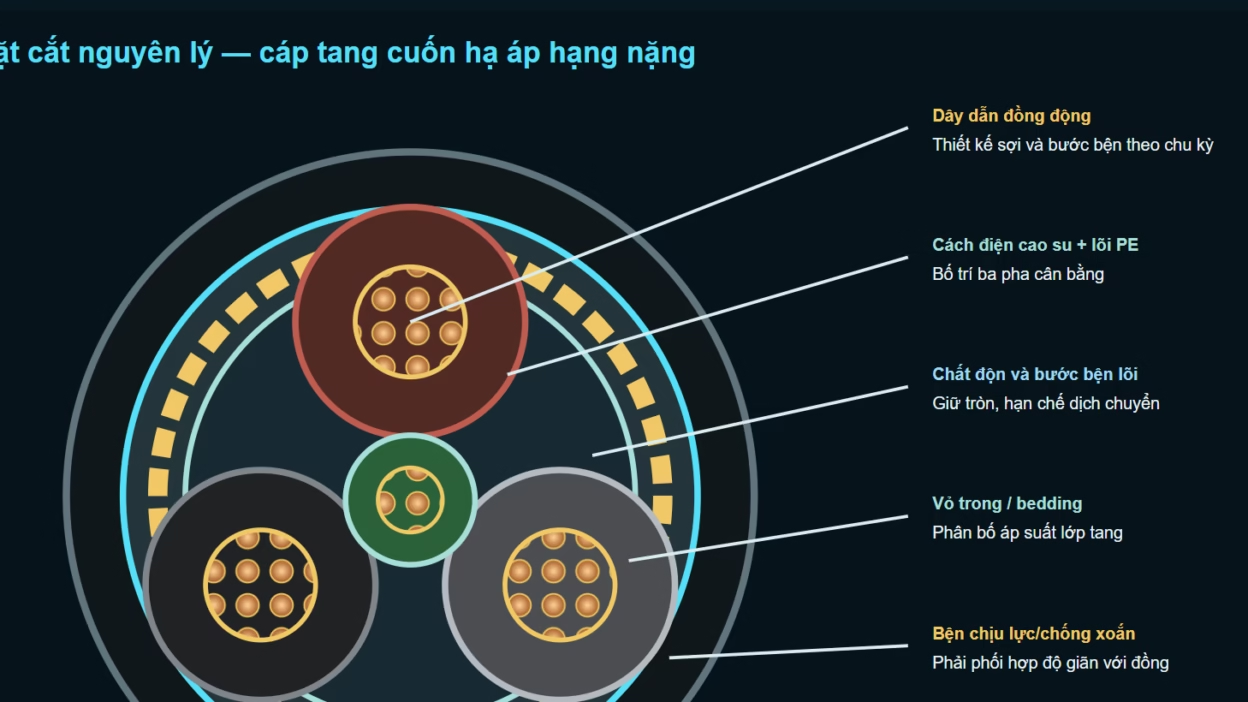
Cáp tang cuốn hạng nặng không phải là “cáp mềm có vỏ dày”. Đây là một hệ thống điện–cơ được tối ưu đồng thời cho uốn lặp lại, đảo chiều uốn, lực kéo dọc trục, xoắn, áp suất giữa các lớp cáp, mài mòn, nhiệt độ và điện áp. Bài viết này trình bày cách lựa chọn giữa NSHTÖU, NTS, (N)TSCGEWÖU và các thiết kế chuyên dụng cho tang cuốn đơn xoắn ốc, tang xếp lớp, cuốn ngẫu nhiên, tang thẳng đứng và tang spreader.

Cáp tang cuốn hạng nặng: từ cấu trúc cáp đến hệ thống tang cuốn được kiểm chứng

Cáp tang cuốn hạng nặng không phải là “cáp mềm có vỏ dày”. Đây là một hệ thống điện–cơ được tối ưu đồng thời cho uốn lặp lại, đảo chiều uốn, lực kéo dọc trục, xoắn, áp suất giữa các lớp cáp, mài mòn, nhiệt độ và điện áp. Bài viết này trình bày cách lựa chọn giữa NSHTÖU, NTS, (N)TSCGEWÖU và các thiết kế chuyên dụng cho tang cuốn đơn xoắn ốc, tang xếp lớp, cuốn ngẫu nhiên, tang thẳng đứng và tang spreader.
These families are engineered around motion, not merely flexibility. NSHTÖU provides the recognized 0.6/1 kV rubber flexible route under DIN VDE 0250-814; NTS identifies the heavy trailing-cable route under DIN VDE 0250-813; and modern (N)TSCGEWÖU designs apply the Part 813 electrical architecture to high-dynamic medium-voltage reeling systems. Correct selection depends on the reel, guide geometry, tensile load, torsion, voltage class, protective-earth concept, thermal duty and verified cycle envelope.

NSHTÖU, NTS and (N)TSCGEWÖU: True Reeling Cable Families Explained

These families are engineered around motion, not merely flexibility. NSHTÖU provides the recognized 0.6/1 kV rubber flexible route under DIN VDE 0250-814; NTS identifies the heavy trailing-cable route under DIN VDE 0250-813; and modern (N)TSCGEWÖU designs apply the Part 813 electrical architecture to high-dynamic medium-voltage reeling systems. Correct selection depends on the reel, guide geometry, tensile load, torsion, voltage class, protective-earth concept, thermal duty and verified cycle envelope.
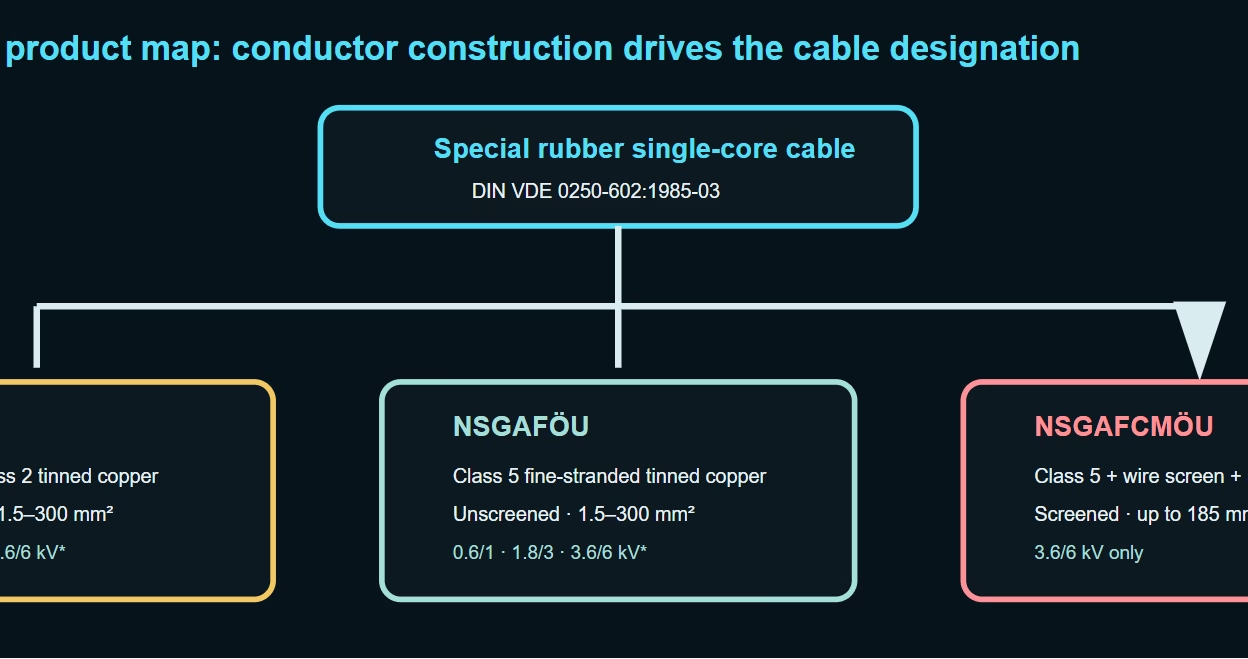
DIN VDE 0250-602 defines special rubber-insulated single-core cables for power installations—not welding leads, general XLPE distribution cables or heavy-duty multicore trailing cables. Its three construction families combine tinned copper conductors, 3GI3 rubber insulation and a 5GM3 rubber outer covering; the screened NSGAFCMÖU design adds a defined wire screen and outer sheath. Correct selection requires the full type designation, voltage class, conductor construction, installation method, touch-protection strategy and short-circuit duty.

VDE 0250 Part 602 Cable: Complete Engineering Guide to NSGAÖU, NSGAFÖU and NSGAFCMÖU

DIN VDE 0250-602 defines special rubber-insulated single-core cables for power installations—not welding leads, general XLPE distribution cables or heavy-duty multicore trailing cables. Its three construction families combine tinned copper conductors, 3GI3 rubber insulation and a 5GM3 rubber outer covering; the screened NSGAFCMÖU design adds a defined wire screen and outer sheath. Correct selection requires the full type designation, voltage class, conductor construction, installation method, touch-protection strategy and short-circuit duty.
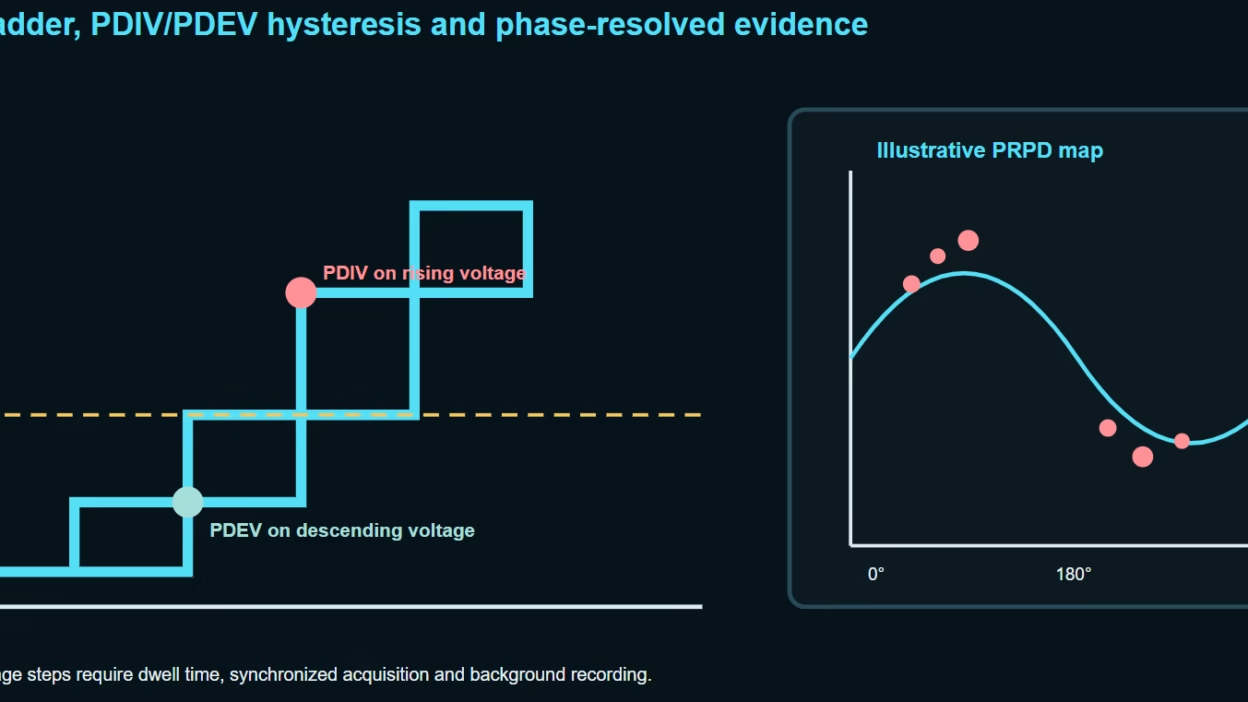
For a new installed cable system, the most common defensible criterion is: no repeatable, defect-related, localized partial discharge attributable to the cable, a joint or a termination at the specified commissioning voltage, above a detection sensitivity that has been demonstrated for the relevant location. PD that persists at or below normal phase-to-ground operating voltage U0 is normally a reject or rework condition.

What Acceptance Criteria or Pass/Fail Thresholds Are Commonly Used for Partial Discharge Measurements on New Cable Installations?

For a new installed cable system, the most common defensible criterion is: no repeatable, defect-related, localized partial discharge attributable to the cable, a joint or a termination at the specified commissioning voltage, above a detection sensitivity that has been demonstrated for the relevant location. PD that persists at or below normal phase-to-ground operating voltage U0 is normally a reject or rework condition.
IEC 60502系列规定1 kV至30 kV挤包固体绝缘电力电缆的结构、尺寸和试验,并规定6–30 kV范围内附件的型式试验。它证明电缆或附件在标准试验条件下满足规定要求;现场是否安全可靠仍取决于系统电压、接地、载流量、压降、短路、金属屏蔽接地、附件匹配和施工质量。

IEC 60502 Cable:从1 kV低压到30 kV中压的完整工程指南

IEC 60502系列规定1 kV至30 kV挤包固体绝缘电力电缆的结构、尺寸和试验,并规定6–30 kV范围内附件的型式试验。它证明电缆或附件在标准试验条件下满足规定要求;现场是否安全可靠仍取决于系统电压、接地、载流量、压降、短路、金属屏蔽接地、附件匹配和施工质量。
本型号的核心组合是XLPE绝缘 + 铝塑复合带总屏蔽 + LSOH外护套。它能在正常运行中提供良好绝缘与EMC屏障,并通过指定试验评价成束阻燃、卤酸气体和烟密度;但结构中没有云母耐火层,不能仅凭“XLPE/LSOH”宣称IEC 60331线路完整性。

BS 5308 第一部分1类XLPE绝缘 + 总屏蔽 + LSOH护套仪表电缆

本型号的核心组合是XLPE绝缘 + 铝塑复合带总屏蔽 + LSOH外护套。它能在正常运行中提供良好绝缘与EMC屏障,并通过指定试验评价成束阻燃、卤酸气体和烟密度;但结构中没有云母耐火层,不能仅凭“XLPE/LSOH”宣称IEC 60331线路完整性。
电力电缆不是“导体截面 + 电压等级”的简单商品,而是一套同时处理电场、热场、短路力、机械防护、水分迁移、火灾风险、接地与附件界面的输电系统。真正可靠的选型必须把电缆结构、敷设环境、负载曲线、保护整定、金属屏蔽接地和全寿命维护放在同一模型中。

Power Cable 电力电缆:从低压配电到中高压输电、载流量与系统可靠性的工程指南

电力电缆不是“导体截面 + 电压等级”的简单商品,而是一套同时处理电场、热场、短路力、机械防护、水分迁移、火灾风险、接地与附件界面的输电系统。真正可靠的选型必须把电缆结构、敷设环境、负载曲线、保护整定、金属屏蔽接地和全寿命维护放在同一模型中。
LSZH 最容易被误解成“绝对零卤、绝对无毒、天然阻燃、天然耐火”。真正专业的技术规格必须把 Low Smoke、Halogen/Acid Gas、Corrosivity、Flame Propagation、Heat Release、CPR Euroclass 和 Circuit Integrity 分开。本文从 IEC 60754、IEC 61034、IEC 60332、BS EN 50399、BS EN 50575、BS 7211 与 BS 6724 出发,建立可验证的 LSZH 电缆工程语言。

Low Smoke Zero Halogen Cable:LSZH / LSOH / HFFR 的低烟、卤酸、腐蚀性、阻燃与 CPR 工程指南

LSZH 最容易被误解成“绝对零卤、绝对无毒、天然阻燃、天然耐火”。真正专业的技术规格必须把 Low Smoke、Halogen/Acid Gas、Corrosivity、Flame Propagation、Heat Release、CPR Euroclass 和 Circuit Integrity 分开。本文从 IEC 60754、IEC 61034、IEC 60332、BS EN 50399、BS EN 50575、BS 7211 与 BS 6724 出发,建立可验证的 LSZH 电缆工程语言。
XLPE Cable 指采用 Cross-linked Polyethylene(交联聚乙烯)作主绝缘的电缆。交联把原本可熔融流动的聚乙烯分子链连接成三维网络,提高热形变、蠕变和长期热稳定性;但“XLPE”本身并不自动代表铠装、低烟无卤、阻燃、耐火、耐油、阻水、抗紫外或高柔性。

XLPE Cable 交联聚乙烯绝缘电缆:从分子交联、电场控制到港口矿山供电的工程指南

XLPE Cable 指采用 Cross-linked Polyethylene(交联聚乙烯)作主绝缘的电缆。交联把原本可熔融流动的聚乙烯分子链连接成三维网络,提高热形变、蠕变和长期热稳定性;但“XLPE”本身并不自动代表铠装、低烟无卤、阻燃、耐火、耐油、阻水、抗紫外或高柔性。
SWA 是 Steel Wire Armoured 的缩写,表示电缆内衬与外护套之间具有一层钢丝铠装。钢丝层主要提供抗冲击、抗压、安装机械防护和可计算的金属故障电流通路;它不决定绝缘材料、额定电压、低烟性能或耐火等级,也不代表电缆适合连续弯曲。

SWA Cable 钢丝铠装电缆:从结构、标准到接地与港口矿山应用的完整工程指南

SWA 是 Steel Wire Armoured 的缩写,表示电缆内衬与外护套之间具有一层钢丝铠装。钢丝层主要提供抗冲击、抗压、安装机械防护和可计算的金属故障电流通路;它不决定绝缘材料、额定电压、低烟性能或耐火等级,也不代表电缆适合连续弯曲。
BS 5308 仍然是国际 EPC、石化、港口和矿山项目里非常常见的仪表电缆搜索词,但它已经不是当前英国新项目的现行标准号。历史 BS 5308 后来由 PAS 5308 延续详细尺寸和更高工作电压场景;PAS 5308-1:2009 与 PAS 5308-2:2009 又在 2024 年 4 月 3 日撤销。当前 BSI 把 BS EN 50288-7:2005 列为 Current, Under Review。

BS 5308 Instrument Cable Series:从 Legacy BS/PAS 5308 到 BS EN 50288-7 的仪表电缆结构、屏蔽、电容、本安与工程选型

BS 5308 仍然是国际 EPC、石化、港口和矿山项目里非常常见的仪表电缆搜索词,但它已经不是当前英国新项目的现行标准号。历史 BS 5308 后来由 PAS 5308 延续详细尺寸和更高工作电压场景;PAS 5308-1:2009 与 PAS 5308-2:2009 又在 2024 年 4 月 3 日撤销。当前 BSI 把 BS EN 50288-7:2005 列为 Current, Under Review。
BS 7919 is not a current universal cable family. BS 7919:2001 was a British Standard for flexible cables rated up to 450/750 V, intended for appliances and equipment in industrial and similar environments. BSI records it as withdrawn on 1 December 2012. The phrase “BS 7919 series” is now best understood as a legacy search term that must be translated into a current construction-specific standard.

BS 7919 Cable Series: Legacy Flexible Industrial Cables and Their Modern Cross-References

BS 7919 is not a current universal cable family. BS 7919:2001 was a British Standard for flexible cables rated up to 450/750 V, intended for appliances and equipment in industrial and similar environments. BSI records it as withdrawn on 1 December 2012. The phrase “BS 7919 series” is now best understood as a legacy search term that must be translated into a current construction-specific standard.
BS EN 50525-2-81:2011 is the British adoption of the European particular standard for single-core arc-welding cables with a cross-linked elastomeric covering. Its scope is deliberately narrower than the broad “low-voltage energy cable up to 450/750 V” title: the welding cables covered by the BSI scope are rated U₀/U 100/100 V.

BS EN 50525-2-81: Engineering Guide to H01N2-D / H01N2-E Arc-Welding Cables

A practical standards-based explanation of the European arc-welding cable family: what the British adoption actually covers, why the rated voltage is 100/100 V, how Class D and Class E differ, how current and voltage drop should be assessed, and what a serious RFQ must contain before a welding lead is released for production.
A practical engineering guide to a highly resilient round cable family for container-crane trolleys, process cranes, foundries, steel mills, stacker/reclaimers, car dumpers, ship unloaders and transport carriers. TXG combines class-5 copper, EPR insulation, layered stranding and a wear-resistant synthetic-rubber sheath for continuous dynamic duty in severe atmospheric conditions.

Cable TXG / TXG-D: Neoprene Round Cable for Heavy-Duty Festoon Systems

A practical engineering guide to a highly resilient round cable family for container-crane trolleys, process cranes, foundries, steel mills, stacker/reclaimers, car dumpers, ship unloaders and transport carriers. TXG combines class-5 copper, EPR insulation, layered stranding and a wear-resistant synthetic-rubber sheath for continuous dynamic duty in severe atmospheric conditions.
A practical engineering guide to a halogen-free polyurethane round cable family for continuous heavy-duty conveying machinery, container-crane trolleys, process cranes, conveyors and moveable stage equipment. The design target is not merely flexibility; it is stable performance while speed, acceleration, guide forces, abrasion, temperature and atmospheric exposure act at the same time.

TXP / TXP-D: PUR Round Cable for Heavy-Duty Festoon and Energy-Guiding Applications

A practical engineering guide to a halogen-free polyurethane round cable family for continuous heavy-duty conveying machinery, container-crane trolleys, process cranes, conveyors and moveable stage equipment. The design target is not merely flexibility; it is stable performance while speed, acceleration, guide forces, abrasion, temperature and atmospheric exposure act at the same time.
Cable TG is a standardized rubber round cable concept for continuous standard-duty service where moisture, humidity, oil, ozone and outdoor exposure are part of the operating reality. It is intended for crane and trolley power/control, travel cars, dockyard cranes and horizontal machinery moving on a festoon system. The supplied technical record also gives a separate reeling limit of up to 60 m/min. That distinction matters: a cable that works in a controlled festoon loop is not automatically qualified for spring-reel take-up.

Cable TG — H07RN-F rubber round cable for basic festoon and reeling systems

Cable TG is a standardized rubber round cable concept for continuous standard-duty service where moisture, humidity, oil, ozone and outdoor exposure are part of the operating reality. It is intended for crane and trolley power/control, travel cars, dockyard cranes and horizontal machinery moving on a festoon system. The supplied technical record also gives a separate reeling limit of up to 60 m/min. That distinction matters: a cable that works in a controlled festoon loop is not automatically qualified for spring-reel take-up.
FV / FV-D is a practical flat-cable family for festoon installations where the cable travels on a controlled single plane and the priority is a compact, cost-efficient system. The supplied record covers standard PVC power and control cables, screened KYFLCY / KYFLTCY variants, FV-D control-and-data arrangements, and a separate LSOH FV-L section. The important engineering decision is not simply “flat cable or round cable”; it is whether the selected voltage, shield, temperature, fire, geometry and tensile data match the actual festoon system.

FV / FV-D — PVC flat cable for basic-duty festoon systems

FV / FV-D is a practical flat-cable family for festoon installations where the cable travels on a controlled single plane and the priority is a compact, cost-efficient system. The supplied record covers standard PVC power and control cables, screened KYFLCY / KYFLTCY variants, FV-D control-and-data arrangements, and a separate LSOH FV-L section. The important engineering decision is not simply “flat cable or round cable”; it is whether the selected voltage, shield, temperature, fire, geometry and tensile data match the actual festoon system.
The corrected procurement string identifies a REELTEC (K) NSHTU-JB 4G350, 0.6/1 kV cable for reeling service. The notation 4G350 is normally read as four cores of 350 mm² with a protective-conductor designation, but the released core schedule must confirm that interpretation. The corrected voltage is reproduced as 0.6/1 KV, consistent with the public low-voltage NSHTÖU family context. The exact 4G350 construction, dimensions, ratings and dynamic limits remain project-specific release items.

REELTEC (K) NSHTU-JB 4G350, 0.6/1 KV, REELING CABLE

The corrected procurement string identifies a REELTEC (K) NSHTU-JB 4G350, 0.6/1 kV cable for reeling service. The notation 4G350 is normally read as four cores of 350 mm² with a protective-conductor designation, but the released core schedule must confirm that interpretation. The corrected voltage is reproduced as 0.6/1 KV, consistent with the public low-voltage NSHTÖU family context. The exact 4G350 construction, dimensions, ratings and dynamic limits remain project-specific release items.
The supplied procurement description identifies a composite reeling cable with a 6/10 kV rating, three nominal 120 mm² power cores, a 2CX70/2 earth-conductor notation and an integrated 18FO optical-fibre count. The working engineering notation is 6/10 kV reeling cable — 3×120 + 2×70/2 + 18FO. This article preserves the buyer string exactly, explains the design questions it creates and keeps all unprovided construction, dimension, rating, fibre and certification values as project-confirmation fields.

6/10KV REELING CABLE 3CX120 & 2CX70/2+18FO — integrated medium-voltage power, earth and optical-fibre reeling cable

The supplied procurement description identifies a composite reeling cable with a 6/10 kV rating, three nominal 120 mm² power cores, a 2CX70/2 earth-conductor notation and an integrated 18FO optical-fibre count. The working engineering notation is 6/10 kV reeling cable — 3×120 + 2×70/2 + 18FO. This article preserves the buyer string exactly, explains the design questions it creates and keeps all unprovided construction, dimension, rating, fibre and certification values as project-confirmation fields.
The supplied string identifies a flat PNCT-RF reeling cable with four cores, a nominal 185 mm² cross-section and a 0.6/1 kV voltage designation. In normal engineering notation this is read as PNCT-RF flat reeling cable — 4C × 185 mm² — 0.6/1 kV, subject to confirmation that 185SQ means 185 mm² per core. This guide explains how to specify, install and qualify the cable without inventing the missing dynamic ratings. Public manufacturers describe PNCT-RF as a flat reeling/festoon family; the exact Feichun construction must still be released against the machine duty.

FLAT REELING CABLE PNCT-RF 4C 185SQ 0.6/1KV — construction logic, flat-reel mechanics and procurement engineering

The supplied string identifies a flat PNCT-RF reeling cable with four cores, a nominal 185 mm² cross-section and a 0.6/1 kV voltage designation. In normal engineering notation this is read as PNCT-RF flat reeling cable — 4C × 185 mm² — 0.6/1 kV, subject to confirmation that 185SQ means 185 mm² per core. This guide explains how to specify, install and qualify the cable without inventing the missing dynamic ratings. Public manufacturers describe PNCT-RF as a flat reeling/festoon family; the exact Feichun construction must still be released against the machine duty.