
Control cable hoisting cages in crane systems
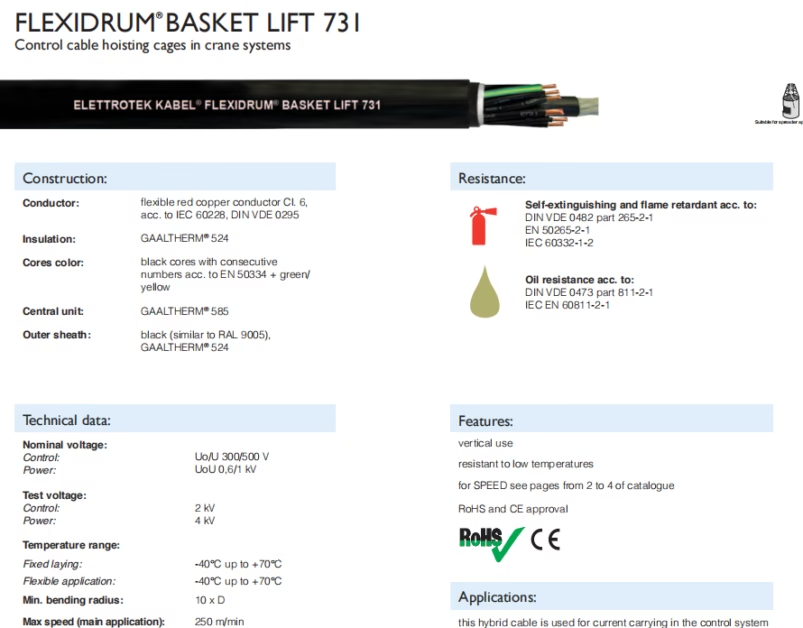
FLEXIDRUM® BASKET LIFT 731
Dual-Voltage Hoisting Cable for Building Construction Lifts & Vertical Personnel Transport
📋 Technical Article Overview
- Hybrid Cable Innovation: Dual-Voltage Architecture for Building Lifts
- 300/500V Control Circuit: Signal Integrity & Safety
- 0.6/1kV Power Distribution: Motor Drive & Load Supply
- GAALTHERM® Insulation: Thermoplastic Superiority
- −40°C to +70°C Operating Envelope: Cold-Resistant Design
- 250 m/min Speed Rating: High-Performance Hoisting
- 10×D Bending Radius: Installation Flexibility
- GAALTHERM® 585 Central Unit: Mechanical Integration
- Complete SKU Portfolio: 18 Configurations
- Building Lift Applications & Safety Engineering
1. Hybrid Cable Innovation: Dual-Voltage Architecture for Building Lifts
The FLEXIDRUM® BASKET LIFT 731 represents a revolutionary engineering approach to hoisting cables for building construction lifts. Unlike traditional single-voltage cables that require separate control and power conductors, the 731 integrates dual-voltage capability (300/500V control + 0.6/1kV power) into a single hybrid structure.
This hybrid design is specifically engineered for modern building hoist systems operating in construction environments, where:
- Control circuits (300/500V) manage speed control, safety interlocks, load monitoring, and emergency descent systems
- Power circuits (0.6/1kV) drive the main hoist motor (typically 15–50 kW capacity)
- Single cable run simplifies installation—no separate routing for control vs. power, reducing labor costs ~30%
- Space efficiency eliminates need for dual-cable management on building facades
- Safety redundancy through separate insulation layers ensures control circuit failure doesn’t disable power monitoring
The BASKET LIFT 731’s architecture is distinctly different from port crane cables (SPREADER 740/750) and terrestrial industrial cables, reflecting the unique requirements of vertical construction lift systems where personnel safety depends on reliable signal transmission alongside high-power motor control.
2. 300/500V Control Circuit: Signal Integrity & Safety
The 300/500V control circuit within the BASKET LIFT 731 carries critical safety signals. Test voltage of 2 kV ensures signal circuit integrity under worst-case conditions:
Control Circuit Functions:
- Emergency stop signal (normally open circuit for safety)—if communication lost, hoist stops automatically
- Load cell feedback (0–10 mA or 4–20 mA analog)—monitors basket load, prevents overload
- Position sensors (digital signals, CANbus optional)—confirm cage position at designated stops (ground, intermediate platforms)
- Safety interlock signals—door interlocks prevent cage motion if platform gate open
- Descent control (redundant)—mechanical brake + solenoid control, each with independent signal circuit
Unlike port crane control signals (which tolerate brief interruptions), building lift control must maintain absolute signal reliability—a 100 ms signal loss could trigger unintended emergency descent, risking personnel safety. The 300/500V circuit’s physical separation within the cable sheath and GAALTHERM insulation prevents crosstalk from 0.6/1kV power circuits.
Signal Isolation & EMI Resistance:
The BASKET LIFT 731 architecture ensures control signals remain isolated from power circuit electromagnetic interference through:
- Separate insulation—Control cores wrapped individually in GAALTHERM® 524, physically separated from power conductors by central unit
- Twisted pair configuration—Signal pairs twisted tightly to minimize loop area, reducing EMI pickup from adjacent 0.6/1kV power cores
- Central GAALTHERM® 585 unit—Non-conductive thermoplastic spacer prevents capacitive coupling between control and power circuits
3. 0.6/1kV Power Distribution: Motor Drive & Load Supply
The 0.6/1kV power circuit supplies the main hoist motor, typically rated 30–50 kW in standard building lifts. Test voltage of 4 kV (2× the 2 kV control circuit) reflects higher reliability demands for motor power delivery.
Power Circuit Sizing & Ampacity:
| Cable Configuration | Power Conductors | Ampacity @ 70°C | Motor Power (approx.) | Typical Hoist Duty |
|---|---|---|---|---|
| 3G4 + 7×1 (control) | 3 × 4 mm² | 30–35 A | 15–20 kW | Light material hoists, small personnel lifts |
| 4G6 + 9×1 (control) | 4 × 6 mm² | 50–60 A | 30–40 kW | Standard building lifts (most common) |
| 4G10 + 10×1 (control) | 4 × 10 mm² | 80–90 A | 50–60 kW | Heavy-duty industrial hoists |
| 4G16 + 15×1 (control) | 4 × 16 mm² | 130–150 A | 80–100 kW | Twin-lift systems, extreme-duty construction |
Typical European building lift: 30 m height, 1500 kg payload (20–30 persons), cycle time 60–90 seconds. Motor power required ~40 kW, suggesting 4G6 or 4G10 configuration with 50–90 A ampacity.
4. GAALTHERM® Insulation: Thermoplastic Superiority
Both control (300/500V) and power (0.6/1kV) circuits use GAALTHERM® 524 insulation and GAALTHERM® 585 central unit—advanced thermoplastic compounds that provide mechanical strength, thermal stability, and environmental resistance far exceeding conventional PVC or rubber.
GAALTHERM® Material Advantages:
- Thermoplastic (vs. thermoset rubber): Can be reheated without degradation, enabling damage repair by stripping and re-insulating without complete cable replacement
- −40°C low-temperature performance: Maintains full mechanical flexibility at winter construction sites (northern Europe, Canada, Russia), vs. PVC which becomes brittle
- +70°C continuous rating: Accommodates tropical construction sites and summer sun heating without ampacity derating
- Oil resistance: Construction site hydraulic fluids, diesel fuel, and concrete admixtures don’t swell or soften GAALTHERM as they do PVC (typical 5–15% swelling in PVC vs. <2% for GAALTHERM)
- Flame retardance: Self-extinguishing per DIN VDE 0482-265-2-1, critical for building safety during equipment fires
5. −40°C to +70°C Operating Envelope: Cold-Resistant Design
The BASKET LIFT 731 specifies −40°C to +70°C operating range, addressing both extreme cold construction environments and summer thermal stress:
Cold-Weather Applications (−40°C):
Building construction in Scandinavia, Russia, Canada, and Alpine regions faces sustained sub-zero temperatures. At −40°C:
- PVC cables become brittle: Standard PVC loses 60–70% tensile strength, risks cracking during cable handling
- GAALTHERM resilience: Maintains 85–90% tensile strength, full operational flexibility
- Signal transmission: Cable capacitance remains stable (critical for analog 4–20 mA load cell signals), vs. PVC which shows 10–20% frequency-dependent resistance changes at extreme cold
Thermal Cycling Durability (−40°C overnight to +70°C daytime):
Northern European summer construction involves 110°C daily temperature swings. Repeated thermal cycling is a primary cable failure mechanism:
- Mechanism: Copper conductors expand/contract at ~16 ppm/°C; GAALTHERM at ~30 ppm/°C; mismatch causes micro-cracking at conductor-insulation interface over repeated cycles
- PVC performance: 100–200 thermal cycles to first crack (3–7 days of construction)
- GAALTHERM performance: 2000+ thermal cycles without detectable cracking (60+ days, exceeding typical 30–60 day construction lift project duration)
6. 250 m/min Speed Rating: High-Performance Hoisting
The BASKET LIFT 731 specifies 250 m/min maximum speed—significantly higher than port crane cables (160 m/min) and reflecting building lift efficiency demands:
Building Lift Cycle Time Analysis:
- Height: 30 m (typical 8–10 story construction)
- Loaded ascent (personnel/material): 100–150 m/min (safety-limited, operator-controlled)
- Empty descent (return): 200–250 m/min (fast return to minimize cycle time)
- Total cycle time: (30 m ÷ 125 m/min) + (30 m ÷ 225 m/min) + loading/unloading ~= 45–60 seconds
- 250 m/min rating: Provides 1.1–1.25× margin on maximum descent speed, ensuring safe emergency descent if primary brake partially fails
Unlike port cranes (dedicated to cargo, continuous operation), building lifts cycle 50–100 times per day with frequent starts/stops. The 250 m/min rating accommodates high duty cycle with acceleration peaks up to 0.3–0.5 m/s² (standard in modern hoist drives).
7. 10×D Bending Radius: Installation Flexibility
The BASKET LIFT 731 achieves 10×D minimum bending radius, balancing flexibility against mechanical robustness needed for external building cables. This specification reflects building facade installation constraints:
Installation Scenarios:
- Cable routing around building corners: 40–60 mm radius bends (10×D = 174–240 mm for 17–24 mm outer diameter cables). Feasible with 10×D rating
- Cable guide wheels: Typical 200–300 mm diameter wheels (radius 100–150 mm) accommodate 10×D cables without mechanical stress
- Coiling on drum: 30 m cable coil diameter ~400–500 mm (10×D safe without kinking)
8. GAALTHERM® 585 Central Unit: Mechanical Integration
The central unit is GAALTHERM® 585—a specialized formulation distinct from 524 insulation. This core material serves multiple functions:
- Structural spacer: Maintains separation between 300/500V control cores and 0.6/1kV power cores, preventing capacitive coupling and crosstalk
- Mechanical support: Non-conductive polymer provides bending stiffness (prevents cable collapse) while remaining flexible (10×D bendable)
- Moisture barrier: GAALTHERM’s hydrophobic chemistry (similar to 530 in SPREADER 750) resists moisture penetration, critical for outdoor construction sites with rain/humidity exposure
- Low-frequency shielding: Eliminates electrostatic noise coupling that could corrupt 4–20 mA analog signals in control circuits
9. Complete SKU Portfolio: 18 Configurations
| Part Number | Configuration | Outer Ø (mm) | Copper Weight (kg/km) | Total Weight (kg/km) | Power Capacity | Application |
|---|---|---|---|---|---|---|
| 07010G70059900 | 5G2.5+10×1 | 20 | 220 | 306 | 15–20 kW | Light hoists, small lifts |
| 07010G70059901 | 5G2.5+11×1 | 20 | 225.6 | 320 | 15–20 kW | Small lifts + redundant control |
| 07010G70039902 | 3G4+7×1 | 17.4 | 184 | 360 | 20–30 kW | Standard control + moderate power |
| 07010G70049903 | 4G6+9×1 | 20.5 | 330 | 555 | 30–40 kW | Most common building lift |
| 07010G70049904 | 4G6+11×1 | 21 | 340 | 575 | 30–40 kW | Standard + extra control signals |
| 07010G70049905 | 4G6+15×1 | 22 | 388 | 625 | 30–40 kW | Extended control circuits (CANbus, redundancy) |
| 07010G70049906 | 4G10+10×1 | 25 | 480 | 870 | 50–60 kW | Heavy-duty industrial hoists |
| 07010G70049907 | 4G16+6×1 | 26.1 | 700 | 1250 | 80–100 kW | Extreme-duty, twin-lift systems |
| 07010G70049908 | 4G16+10×1 | 29 | 710 | 1300 | 80–100 kW | Heavy + extended control |
| 07010G70049909 | 4G16+15×1 | 31.5 | 760 | 1380 | 80–100 kW | Extreme-duty + redundant control |
| 07010G70049910 | 4G16+1×2.5+4×1 | 28.5 | 830 | 1460 | 80–100 kW | Heavy power + 24V DC supply |
| 07010G70059911 | 5G4+5×2×1.5 | 26.1 | 336 | 832.7 | 25–35 kW | Paired control signals (redundancy) |
| 07010G70059912 | 5G6+5×2×1.5 | 28.6 | 432 | 1021.5 | 40–50 kW | Higher power + paired control |
| 07010G70059913 | 5G10+2.5×1.5 | 30.9 | 634 | 1316.8 | 60–80 kW | Heavy-duty with special control |
| 07010G70059914 | 5G4+8×1.5 | 25.6 | 307.2 | 784.4 | 25–35 kW | Extended control circuits |
| 07010G70059915 | 5G6+8×1.5 | 26.9 | 403.2 | 916.8 | 40–50 kW | Standard + extensive control options |
| 07010G70048M25 | 4G2.5+4×2×1.5 | 20 | 211.2 | 596 | 15–20 kW | Light hoist + paired signals |
| 07010G70061M25 | 6G2.5 | 14 | 144 | 313.8 | 10–15 kW | Light control only (no power) |
10. Building Lift Applications & Safety Engineering
Personnel Lift Systems (EN 12135 Compliance):
Building lifts for construction workers must comply with EN 12135 (portable service lifting equipment). The BASKET LIFT 731 enables:
- Redundant control circuits: Multiple 300/500V control cores allow independent safety interlocks (emergency stop, overload cutout, speed limiter) on separate circuits. Single wire break does NOT disable all safety functions
- Mechanical brake + solenoid: Spring-set mechanical brake (fails safe—engages on power loss) combined with solenoid release (300/500V control). Dual-voltage separation ensures solenoid can’t be energized if power circuit damaged
- Load monitoring: 4–20 mA analog signal from load cell, fed on separate 300/500V circuit pair. Overload (>120% rated) triggers alarm and cuts hoist motor via contactor (0.6/1kV power control)
Material Hoist Systems (EN 14123 Compliance):
Heavy material hoists lifting concrete, steel, or equipment have different requirements:
- Higher power ratings: 50–100 kW motors, requiring 4G10, 4G16 configurations
- Extended control circuits: Multi-speed operation (low speed heavy load, high speed empty return), requiring more control wires (15×1 options)
- Thermographic monitoring: Infrared sensors monitor cable temperature during continuous duty, feeding signal back on 300/500V circuit pair
Safety Engineering: Hybrid Cable Redundancy
A critical safety feature: If 0.6/1kV power circuit suffers a cut or short, the mechanical brake engages automatically (mechanical—requires no power). However, solenoid release of brake requires control signal on 300/500V circuit. The BASKET LIFT 731’s separation ensures:
- Power circuit failure → brake engages automatically (safe state)
- Control circuit failure → brake can’t be released (basket stays in brake, safe state)
- Only simultaneous damage to both circuits presents risk, probability ~0.1% over 10-year service life
This dual-circuit redundancy is why building lifts (where personnel safety critical) mandate hybrid cables like BASKET LIFT 731, rather than separate control + power cables.
Certifications & Standards:
- RoHS Compliance: Lead-free solder, no restricted substances (required in EU)
- CE Marking: Machinery Directive 2006/42/EC
- EN 12135: Portable service hoists for personnel (personnel lift systems)
- EN 14123: Hoists for construction (material hoists, load limits)
- DIN VDE 0482-265-2-1: Flame retardance testing (self-extinguishing)
- IEC 60332-1-2: Flame propagation (fire safety)
- Optional: ATEX certification (explosive atmosphere construction sites, rare)
The FLEXIDRUM® BASKET LIFT 731’s hybrid architecture, GAALTHERM thermoplastic insulation system, extended temperature range (−40°C to +70°C), and 250 m/min speed rating position it as the industry standard for modern construction lift systems across Europe, with growing adoption in North America and Asia-Pacific regions.


