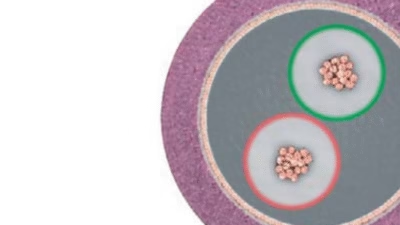
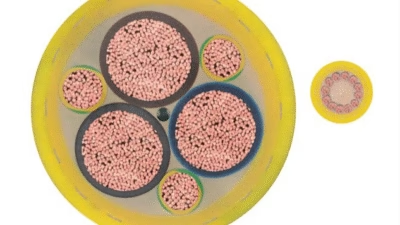
What is a (N)GRDGOEU / (N)GRDCGOEU Cable?
CXG-6 Rubber Round Cable Highly Flexible for Energy Guiding Chains
The (N)GRDGOEU and (N)GRDCGOEU cables represent the pinnacle of heavy-duty flexible cable engineering. These advanced rubber round cables feature resilient EPR (Ethylene Propylene Rubber) insulation and ultra-wear-resistant EVA (Ethylene Vinyl Acetate) sheathing, specifically designed for the most demanding industrial applications where conventional cables fail. Manufactured by Anhui Feichun Special Cable Co., Ltd., these cables excel in extreme-duty environments including container cranes, process cranes, steel mills, stackers, and reclaimers.
The “(N)GRDGOEU” designation refers to unscreened power and control cables, while “(N)GRDCGOEU” indicates screened variants with superior electromagnetic interference (EMI) protection. Both types are halogen-free, featuring Class 5 flexible copper conductors and engineered to withstand extreme temperatures (-35°C to +80°C), high travel speeds (up to 300 m/min), and millions of bending cycles in the harshest continuous-flex applications.
Key distinguishing features: Compact 2-layer stranding design, protective inner sheath for core stability, extremely wear-resistant EVA compound with low friction properties, and unlimited resistance to atmospheric corrosion. These cables are the preferred choice when maximum reliability, durability, and performance are non-negotiable.
1. Purpose and Heavy-Duty Applications
Primary Application: Energy Guiding Chains for Extreme-Duty Equipment
The (N)GRDGOEU and (N)GRDCGOEU cables are engineered specifically for energy guiding chains (cable carriers) in the most demanding industrial environments. Unlike standard PVC cables, these rubber cables handle medium to very high dynamic travel speeds, extreme acceleration forces, and very high duty cycles with exceptional bending frequency tolerance.
When to Specify These Heavy-Duty Cables:
- High Travel Speed Applications: Designed for speeds up to 300 m/min (double that of standard PVC cables)
- Extreme Acceleration Forces: Medium to very high dynamic forces in continuous operation
- Very High Duty Cycle: Applications with intense bending frequency and 24/7/365 operation
- Unlimited Atmospheric Exposure: Outdoor installations requiring complete weather resistance
- Extreme Temperature Range: Operating environments from -35°C to +80°C
- Maximum Durability Requirements: When downtime is unacceptable and cable life must be maximized
Secondary Application: Festoon Trolley Systems
Festoon systems for heavy-duty cranes and material handling equipment benefit from the cable’s exceptional abrasion resistance, low friction EVA sheath, and ability to withstand atmospheric corrosion without degradation.
Container Crane Trolleys
Ship-to-shore (STS) gantry cranes, rubber-tired gantry (RTG) cranes, and rail-mounted gantry (RMG) cranes requiring maximum reliability for port operations. High speeds, constant motion, and exposure to marine environments.
Process Crane Systems
Heavy-duty overhead cranes and trolleys in steel plants, foundries, and manufacturing facilities. Continuous operation with high temperature exposure, abrasive dust, and demanding duty cycles.
Stackers & Reclaimers
Bulk material handling equipment in mines, power plants, and storage facilities. Extreme outdoor exposure, high loads, and 24/7 operation in harsh conditions.
Steel & Rolling Mills
Hot metal cranes, ladle handling, and material transfer systems. High ambient temperatures, heavy mechanical loads, and critical uptime requirements.
2. Advanced Characteristics and Superior Performance Features
Revolutionary Design Elements
🔄 Compact 2-Layer Stranding Design
Space optimization: Innovative 2-layer stranding technique achieves smaller cable diameter compared to traditional constructions. This compact design reduces chain size requirements, lowers system weight, and enables tighter bending radii while maintaining full electrical performance.
🌀 Reverse Twist Stranding Technology
Eliminates corkscrewing: Conductors are stranded with precision reverse twist lay, completely preventing the cable from spiraling or corkscrewing during flexing. This reduces tensile force on the core, extends service life, and maintains stable positioning within chains.
🛡️ Protective Inner Sheath Layer
Core stability enhancement: A highly stable protective inner sheath covers the core bundle, preventing conductor migration, maintaining cable roundness, and providing additional mechanical protection. This critical layer ensures consistent performance throughout the cable’s lifespan.
💪 Extremely Wear-Resistant EVA Sheath
Unmatched durability: EVA (Ethylene Vinyl Acetate) compound provides exceptional resistance to mechanical wear, abrasion, and friction. The low-friction surface reduces drag in chains and on trolley systems, extending both cable and system life significantly.
🌡️ Wide Operating Temperature Range
Extreme environment capability: Operates from -35°C to +80°C in flexing applications (-50°C to +80°C fixed). This far exceeds standard PVC cables (-5°C to +80°C), enabling use in arctic conditions, outdoor winter operations, and high-temperature industrial environments.
📡 Advanced EMI Protection (Screened Types)
Superior shielding: Tin-plated braided copper screen with >80% coverage and coupling resistance <100 Ω/m at 30 MHz. The earth conductor is divided into three parts for enhanced grounding effectiveness in electrically noisy environments.
Performance Comparison: Rubber vs. PVC Cables
| Performance Parameter | (N)GRDGOEU Rubber | YRDMY-J PVC | Advantage |
|---|---|---|---|
| Maximum Travel Speed | 300 m/min | 150 m/min | 2× faster |
| Minimum Flexing Temperature | -35°C | -5°C | 30°C lower |
| Maximum Conductor Temperature | 90°C | 70°C | 20°C higher |
| Short-Circuit Temperature | 250°C | 150°C | 100°C higher |
| Halogen Content | Halogen-free | Contains chlorine | Safer in fire |
| Ozone Resistance | Excellent | Limited | Unlimited outdoor |
| Atmospheric Corrosion | Unlimited resistance | Good | Superior outdoor life |
3. Material Structure and Advanced Construction
Layer-by-Layer Cable Architecture
⚡ Conductor Design
Material: Bare electrolytic copper (oxygen-free, high conductivity)
Flexibility Class: Category 5 according to DIN VDE 0295 / IEC 60228
Construction: Ultra-fine multi-wire stranded for maximum flexibility in extreme-flex applications
Advantage: Unlike natural rubber applications, EPR does not require tinned conductors, simplifying construction while maintaining performance
🔴 Core Insulation: EPR Compound
Material: Resilient EPR (Ethylene Propylene Rubber) compounds – minimum 3GI3 grade
Key Properties:
- High dielectric strength: Superior electrical insulation properties
- Exceptional flexibility: Softer than natural or SBR rubbers, enabling tighter bending
- Thermal stability: Wide temperature range from -35°C to +90°C continuous operation
- Ozone resistance: Unlike organic rubbers, EPR exhibits excellent ozone and corona resistance
- Water resistance: Lower sensitivity to water treeing compared to XLPE
- Chemical resistance: Resistant to acids, alkalis, and many industrial chemicals
Color Coding:
- Up to 5 conductors: Standard colors according to DIN VDE 0293-308
- 6+ conductors: Black cores with white numbering plus green/yellow earth conductor
🌀 Advanced 2-Layer Stranding Configuration
Innovation: Compact 2-layer stranding with reverse twist
Benefits:
- Smaller overall cable diameter compared to traditional 3-layer designs
- Reduced internal stress during bending cycles
- Lower tensile force on individual cores
- Complete elimination of corkscrewing tendency
- Improved space efficiency in energy chains
🛡️ Protective Inner Sheath
Material: EPR compound basis, GM1b type, black color
Function:
- Provides highly stable bond around core bundle
- Prevents core migration during extreme flexing
- Maintains cable roundness under mechanical stress
- Acts as moisture barrier protecting cores
- Enhances overall mechanical integrity
Design Note: This protective layer is a key differentiator enabling the cable’s exceptional durability in high-duty-cycle applications.
📡 Electromagnetic Shielding ((N)GRDCGOEU Only)
Shield Construction: Tin-plated braided copper wires
Coverage: >80% optical coverage
Performance: Coupling resistance <100 Ω/m at 30 MHz
Unique Feature: Earth conductor divided into three parts for optimized EMI prevention
Application: Essential for VFD-driven motors, servo systems, and sensitive control equipment in electrically noisy industrial environments
🔥 Outer Sheath: EVA Compound (Halogen-Free)
Material: EVA (Ethylene Vinyl Acetate) compound with high resistance to wear and atmospheric corrosion
Color: Black (opaque) for maximum UV protection
Outstanding Properties:
- Extremely wear-resistant: Significantly outperforms PVC in abrasion resistance
- Low friction surface: Reduces drag in chains and on trolley systems
- Halogen-free composition: No toxic gas emission in fire events
- Flame retardant: Self-extinguishing per IEC 60332-1
- Ozone resistant: Unlimited outdoor exposure capability
- UV-resistant: No degradation from sunlight exposure
- Oil-resistant: Withstands mineral oils and hydraulic fluids
- Weather-resistant: Unlimited resistance to atmospheric corrosion
- LBS-free / Silicone-free: Environmentally compliant composition
Cable Designation Code Explanation
(N)GRDGOEU-J / (N)GRDCGOEU-J Designation Breakdown:
(N) = Adapted to VDE standard (compliant with German electrical standards)
G = Core insulation: Rubber compound (EPR)
RD = Cable shape: Round (Rund)
C = Shield: Braided copper wires (only in GRDCGOEU)
G = Outer sheath material: EVA-rubber compound
O = Oil-resistant outer sheath (Ölbeständig)
E = Outer sheath characteristic: EVA compound
U = Outer sheath property: Low flammability (Unbrennbar/”fire-proof”)
-J = With green/yellow identification of earth/ground conductor
-O = Without green/yellow earth conductor (power single-core only)
Example: (N)GRDGOEU-J 5 G 10
= EPR insulated, round, EVA sheathed, oil-resistant, low-flammability cable with 5 conductors (including earth), 10 mm² cross-section
4. Compliance with International Standards
Primary Standards and Certifications
| Standard | Description | Compliance Aspect |
|---|---|---|
| DIN VDE 0250 | Adapted to VDE standards for power cables | Cable design, construction, and performance requirements |
| DIN VDE 0295 | Conductors of insulated cables | Category 5 flexible conductor specifications |
| DIN VDE 0293-308 | Color coding of conductors | Standard color identification system |
| DIN VDE 0298-3 | Application – Tensile loads for moving cables | 15 N/mm² tensile load-bearing capacity during operation |
| DIN VDE 0298-4 | Application – Current-carrying capacity | Ampacity ratings at specified conditions |
| IEC 60228 | Conductors of insulated cables | International standard for Class 5 flexible conductors |
| IEC 60332-1 | Flame propagation test for single cables | Flame retardant and self-extinguishing properties |
| DIN VDE 0482-265-2-1 | Fire behavior of cables | Equivalent to IEC 60332-1 for flame retardancy |
Halogen-Free Performance
Environmental and Safety Advantages of Halogen-Free Construction:
Unlike PVC-sheathed cables which contain chlorine (a halogen), the (N)GRDGOEU and (N)GRDCGOEU cables are completely halogen-free. This provides critical advantages:
- No toxic gas emission: In fire events, halogen-free cables do not release hydrochloric acid or other corrosive, toxic gases
- Equipment protection: Absence of corrosive gases prevents damage to sensitive electronic equipment
- Personnel safety: Eliminates respiratory hazards from halogen compounds during fire
- Environmental compliance: Meets increasingly strict environmental regulations worldwide
- Reduced smoke opacity: Halogen-free formulations typically produce less dense smoke
5. Electrical Parameters and Enhanced Safety Thresholds
Voltage Ratings (Identical for Both Types)
| Voltage Parameter | Rating | Notes |
|---|---|---|
| Rated Voltage Uo/U | 600/1,000 V | Uo = voltage to earth; U = voltage between conductors |
| Maximum AC Operating Voltage | 700/1,200 V | 20% safety margin above rated voltage |
| Maximum DC Operating Voltage | 900/1,800 V | Higher DC rating due to absence of AC stress |
| AC Test Voltage | 2.5 kV | 5-minute withstand test between conductors and earth |
Enhanced Temperature Ratings
| Operating Condition | Temperature Range | Advantage Over PVC |
|---|---|---|
| Flexing Operation | -35°C to +80°C | 30°C lower minimum vs. PVC (-5°C) |
| Fixed Installation | -50°C to +80°C | 35°C lower minimum vs. PVC (-15°C) |
| Maximum Conductor Temperature | +90°C | 20°C higher than PVC (70°C) |
| Short-Circuit Temperature | +250°C | 100°C higher than PVC (150°C) |
⚠️ Critical Operating Thresholds:
Never exceed +90°C conductor temperature during normal operation. While the cable can briefly withstand +250°C during short-circuit events, continuous operation above +90°C will cause:
- Accelerated insulation aging
- Reduced mechanical properties
- Shortened service life
- Potential safety hazards
For outdoor winter operations below -35°C: Provide additional protection or use heated cable systems. EPR becomes stiffer at extreme cold but remains functional; however, bending should be minimized below -35°C.
Current-Carrying Capacity (Ampacity)
Higher conductor temperature rating (+90°C vs. +70°C for PVC) allows these cables to carry similar ampacity despite the superior insulation properties. The ampacity values are based on:
- Ambient temperature of 30°C
- Cables installed in free air or on support surface
- 100% duty cycle (continuous operation)
Ampacity Adjustment for Heavy-Duty Applications:
For the extreme conditions these cables are designed for, consider these factors:
- High ambient temperatures: Steel mills and outdoor summer operations require derating
- Enclosed chains: Limited air circulation reduces heat dissipation
- Bundled cables: Multiple cables in same chain generate heat collectively
- High duty cycle: Constant motion generates frictional heat in addition to electrical heat
Consult DIN VDE 0298-4 derating tables and consider thermal modeling for critical applications.
6. Detailed Technical Specifications
(N)GRDGOEU-J Control Cables (Unscreened)
| Conductors × Cross-section | Outer Diameter (mm) | Weight (kg/100m) | Ampacity (A) | Tensile Load (N) |
|---|---|---|---|---|
| 1.5 mm² Cross-section Control | ||||
| 12 G 1.5 | 11.7 – 13.7 | 30.5 | 9.5 | 270 |
| 24 G 1.5 | 19.9 – 21.9 | 62.5 | 7.6 | 540 |
| 2.5 mm² Cross-section Control | ||||
| 7 G 2.5 | 11.3 – 13.3 | 29.0 | 16.4 | 260 |
| 12 G 2.5 | 15.4 – 17.4 | 43.0 | 13.8 | 450 |
| 18 G 2.5 | 19.5 – 21.5 | 68.0 | 12.2 | 675 |
| 24 G 2.5 | 22.5 – 24.5 | 101.0 | 10.9 | 900 |
(N)GRDGOEU-O Power Cables (Single-Core, No Earth)
| Cross-section | Outer Diameter (mm) | Weight (kg/100m) | Ampacity (A) | Tensile Load (N) |
|---|---|---|---|---|
| 1 × 16 | 8.7 – 9.7 | 21.0 | 98.0 | 240 |
| 1 × 25 | 10.6 – 12.2 | 32.5 | 129.0 | 375 |
| 1 × 35 | 12.3 – 13.9 | 44.5 | 158.0 | 525 |
| 1 × 50 | 13.9 – 15.9 | 60.5 | 198.0 | 750 |
| 1 × 70 | 15.9 – 17.9 | 83.0 | 245.0 | 1,050 |
| 1 × 95 | 19.1 – 21.1 | 112.0 | 292.0 | 1,425 |
| 1 × 120 | 20.8 – 22.8 | 139.0 | 344.0 | 1,800 |
| 1 × 150 | 23.0 – 26.0 | 174.0 | 391.0 | 2,250 |
| 1 × 185 | 25.2 – 28.2 | 209.0 | 448.0 | 2,775 |
(N)GRDGOEU-J Power Cables (4-Core, 5-Core, 7-Core)
| Conductors × Cross-section | Outer Diameter (mm) | Weight (kg/100m) | Ampacity (A) | Tensile Load (N) |
|---|---|---|---|---|
| 4-Core Power Cables | ||||
| 4 G 4 | 12.7 – 14.7 | 32.5 | 34.0 | 240 |
| 4 G 6 | 14.2 – 16.2 | 43.5 | 44.0 | 360 |
| 4 G 10 | 16.7 – 18.7 | 65.0 | 61.0 | 600 |
| 4 G 16 | 20.0 – 22.0 | 96.0 | 82.0 | 960 |
| 4 G 25 | 25.9 – 28.9 | 158.0 | 108.0 | 1,500 |
| 3 × 35 + 3 G 6 | 26.4 – 29.4 | 177.0 | 135.0 | 1,575 |
| 3 × 50 + 3 G 25/3 | 31.5 – 34.5 | 251.0 | 168.0 | 2,250 |
| 5-Core and 7-Core Power | ||||
| 7 G 4 | 16.7 – 18.7 | 53.5 | 21.4 | 420 |
| 5 G 6 | 15.8 – 17.8 | 53.5 | 37.4 | 450 |
| 5 G 10 | 19.7 – 21.7 | 85.0 | 51.2 | 750 |
| 5 G 16 | 22.8 – 24.8 | 122.0 | 69.7 | 1,200 |
(N)GRDCGOEU-J Screened Control Cables
| Conductors × Cross-section | Outer Diameter (mm) | Weight (kg/100m) | Ampacity (A) | Tensile Load (N) |
|---|---|---|---|---|
| 12 G 1.5 C | 14.7 – 16.7 | 44.0 | 9.5 | 270 |
| 4 G 2.5 C | 11.3 – 13.3 | 30.5 | 26.0 | 150 |
| 5 G 2.5 C | 12.7 – 14.7 | 37.0 | 22.1 | 185 |
(N)GRDCGOEU-O Screened Single-Core Power Cables
| Cross-section | Outer Diameter (mm) | Weight (kg/100m) | Ampacity (A) | Tensile Load (N) |
|---|---|---|---|---|
| 1 × 16 C | 10.1 – 12.1 | 32.0 | 98.0 | 240 |
| 1 × 25 C | 12.8 – 14.8 | 45.0 | 129.0 | 375 |
| 1 × 35 C | 13.9 – 15.9 | 55.5 | 158.0 | 525 |
| 1 × 50 C | 15.7 – 17.7 | 74.5 | 198.0 | 750 |
| 1 × 70 C | 18.7 – 20.7 | 109.0 | 245.0 | 1,050 |
| 1 × 95 C | 20.8 – 22.8 | 133.0 | 292.0 | 1,425 |
| 1 × 120 C | 22.8 – 24.8 | 158.0 | 344.0 | 1,800 |
| 1 × 150 C | 25.6 – 28.6 | 200.0 | 391.0 | 2,250 |
| 1 × 185 C | 27.8 – 30.8 | 239.0 | 448.0 | 2,775 |
Bus Cables and Fiber Optic Options
| Type | Outer Diameter (mm) | Weight (kg/100m) | Ampacity (A) | Tensile Load (N) |
|---|---|---|---|---|
| Screened Bus Cables | ||||
| 1 × (2 × 0.5) C | 8.0 – 10.0 | 13.5 | 6.0 | 15 |
| 4 × (2 × 0.5) C | 19.0 – 21.0 | 62.5 | 3.4 | 60 |
| (4 × 2 × 0.5) C | 19.2 – 21.2 | 60.5 | 3.4 | 60 |
| 6 × (2 × 0.5) C | 20.2 – 22.2 | 73.0 | 3.2 | 90 |
| 6 × (2 × 1) C | 26.3 – 29.3 | 112.0 | 8.0 | 180 |
| Fiber Optic Cables (LWL) | ||||
| LWL 6 G 62.5/125 | 14.0 – 16.0 | 24.0 | – | 300 |
| LWL 12 G 62.5/125 | 14.0 – 16.0 | 24.0 | – | 300 |
| LWL 6 G 9/125 | 14.0 – 16.0 | 24.0 | – | 300 |
Note: “G” indicates inclusion of green/yellow protective earth conductor. “C” indicates screened construction. LWL = Lichtwellenleiter (fiber optic).
7. Installation Guidelines and Precautions for Heavy-Duty Use
Pre-Installation Assessment for Extreme Applications
⚠️ Critical Planning Considerations:
Heavy-duty applications demand thorough engineering analysis before installation:
- Travel parameters: Maximum distance, speed (up to 300 m/min), and acceleration profiles
- Dynamic forces: Calculate peak loads during acceleration, deceleration, and emergency stops
- Duty cycle analysis: Determine actual bending cycles per hour/day/year
- Environmental extremes: Document temperature range, weather exposure, chemical presence
- Chain design: Verify bending radius meets minimum 7.5× cable diameter requirement
- Support structure: Ensure festoon system or chain track can handle cable weight plus loads
- Safety factors: Apply appropriate engineering margins for critical applications
Handling and Storage for Rubber Cables
Rubber-Specific Handling Requirements:
- Storage temperature: -20°C to +50°C; avoid temperature extremes during storage
- Ozone protection: While cable is ozone-resistant, minimize exposure to high-ozone environments (electric motors, welding) during storage
- UV exposure: Although UV-resistant, store indoors or covered for extended periods
- Minimum bending radius during handling: Never bend tighter than 7.5× diameter even temporarily
- Moisture protection: Store in dry location; rubber is hygroscopic and can absorb moisture over time
- Reel unwinding: Use reel jack or turntable; never roll drum on ground (causes twist)
- Chemical contamination: Keep away from solvents, strong acids, alkalis during storage
Installation Best Practices for Energy Chains
🔧 Heavy-Duty Energy Chain Installation:
- Cable pre-conditioning: Allow cables to equilibrate to installation temperature for 24 hours before installation
- Chain sizing: Select chain with generous internal dimensions – minimum 20% clearance around cable bundle
- Bending radius verification: Confirm actual chain radius ≥ 7.5× largest cable diameter (larger is better for service life)
- Separation: Use robust dividers to separate power from control/communication cables
- Strain relief: Install heavy-duty strain relief at both ends with appropriate cable glands
- Length calculation: Account for full travel distance plus bending radius geometry plus safety margin
- Neutral position installation: Install with chain at mid-travel to minimize pre-stress
- Support: Ensure adequate support along festoon or stationary side of chain
- Lubrication: Do not lubricate cables or chain internals (reduces friction benefit of low-friction EVA sheath)
- Testing: Perform mechanical testing of full travel before energizing system
Electrical Installation for High-Power Applications
⚡ High-Current Installation Requirements:
- Ampacity verification: Calculate actual ampacity considering ambient temperature, bundling, and duty cycle
- Voltage drop: For long runs, verify voltage drop remains within acceptable limits
- Grounding: Mandatory connection of green/yellow earth conductor to protective earth at both ends
- Screen termination ((N)GRDCGOEU): Ground tin-plated copper screen at supply end only to prevent ground loops
- Terminations: Use heavy-duty cable glands and terminals rated for cable size and current
- Circuit protection: Install appropriately sized overcurrent protection at source
- Thermal monitoring: Consider temperature sensors for critical high-current applications
- Phasing: Maintain correct phasing for three-phase power cables
- Isolation: Ensure proper lockout/tagout procedures during installation
Environmental Considerations for Outdoor/Marine Use
| Condition | Suitability | Precautions/Notes |
|---|---|---|
| Outdoor Use | ✓ Excellent | Unlimited resistance to atmospheric corrosion; UV-resistant; designed for outdoor applications |
| Marine/Port Operations | ✓ Excellent | Resistant to salt spray, humidity, and marine atmosphere. Ideal for container cranes and port equipment |
| Extreme Cold | ✓ Good to -35°C flexing | Arctic operations, winter outdoor use. Below -35°C, minimize bending or provide heating |
| High Temperature | ✓ Excellent to +80°C | Steel mills, foundries, hot environments. Conductor temperature up to +90°C permitted |
| Industrial Oils | ✓ Excellent | Oil-resistant formulation handles mineral oils, hydraulic fluids, greases without degradation |
| Ozone Exposure | ✓ Excellent | EPR insulation and EVA sheath both ozone-resistant; no cracking or degradation |
| Chemical Exposure | ⚠ Limited | Resistant to many chemicals but not strong acids, alkalis, or solvents. Consult manufacturer for specifics |
| Abrasive Dust | ✓ Excellent | Wear-resistant EVA sheath excels in dusty environments (mines, bulk handling, steel mills) |
Maintenance and Inspection for Maximum Service Life
Recommended Maintenance Schedule for Heavy-Duty Applications:
- Daily visual inspection: Quick check for obvious damage during equipment rounds
- Weekly detailed inspection: Examine full cable length for abrasion, cuts, or deformation
- Monthly mechanical check: Verify smooth cable movement, check for binding or unusual wear patterns
- Quarterly electrical testing: Measure insulation resistance (minimum 1 MΩ at 1000V DC)
- Semi-annual connection inspection: Check terminations for looseness, corrosion, overheating
- Annual comprehensive assessment: Full system evaluation including chain, supports, and electrical performance
- Predictive monitoring: For critical applications, consider continuous temperature monitoring or vibration analysis
- Documentation: Maintain detailed records of inspections, repairs, and replacement history
⚠️ Immediate Replacement Criteria:
Replace cable immediately if any condition observed:
- Visible conductor exposure through damaged sheath or insulation
- Severe abrasion with >50% sheath thickness reduction
- Insulation resistance below 1 MΩ
- Permanent deformation, kinking, or flattening of cable
- Conductor breakage (partial or complete)
- Heat damage, charring, or melting
- Chemical attack causing softening or swelling of sheath
- Core migration resulting in cable elongation or non-roundness
- Any condition that could lead to electrical failure or safety hazard
8. Common Problems and Advanced Troubleshooting
Problem 1: Premature Cable Failure in Heavy-Duty Service
| Symptom | Likely Cause | Solution |
|---|---|---|
| Rapid conductor breakage |
• Bending radius too tight • Excessive travel speed (>300 m/min) • High acceleration forces • Chain jamming or binding |
• Increase chain bending radius • Reduce travel speed • Smooth acceleration profiles • Inspect and repair chain system |
| Sheath abrasion/wear |
• Inadequate chain clearance • Sharp edges in chain • Contamination with abrasive particles • Excessive friction |
• Verify chain dimensions adequate • Remove sharp edges, burrs • Regular cleaning of chain • Check for proper cable support |
| Failure at terminations |
• Inadequate strain relief • Excessive tensile load • Vibration fatigue • Improper gland selection |
• Install heavy-duty strain relief • Reduce load or upgrade cable • Secure mounting points • Use cable glands rated for dynamic service |
Problem 2: Cable Twisting or Rotation in Chain
Description:
Cable develops twist or rotation during operation despite reverse-twist stranding design.
Causes:
- Cable installed with pre-twist during installation
- Incorrect unwinding from drum (rolled drum creates twist)
- Chain design forcing rotation due to misalignment
- Asymmetric loading in multi-cable installations
- Using non-genuine cables without proper reverse twist design
Prevention/Solution:
- Use reel jack or turntable when unwinding cable – never roll drum
- Install cable in neutral position without any pre-twist
- Verify chain track is straight and properly aligned
- Balance loading if multiple cables in same chain
- Confirm cable is genuine (N)GRDGOEU/(N)GRDCGOEU with reverse twist construction
- If twist persists, check for chain mechanical issues causing rotation
Problem 3: Overheating in High-Current Applications
Description:
Cable runs excessively hot during operation, potentially exceeding +90°C conductor temperature limit.
Causes:
- Current exceeds actual ampacity for installation conditions
- Inadequate heat dissipation in enclosed chain system
- High ambient temperature (steel mills, outdoor summer)
- Multiple cables bundled without proper derating
- Poor connections creating high resistance points
- Undersized cable for application
Solutions:
- Measure actual conductor temperature – must not exceed +90°C
- Calculate actual ampacity considering all derating factors
- Reduce load current or upgrade to larger conductor size
- Improve ventilation in chain if possible
- Verify all terminations are tight and properly made
- Consider thermal imaging survey to identify hot spots
- For extreme cases, implement forced cooling or reduce duty cycle
Problem 4: Cold Weather Operation Issues
Description:
Cable becomes stiff or difficult to flex in cold weather, or experiences cracking at low temperatures.
Analysis:
The (N)GRDGOEU/(N)GRDCGOEU cables are rated to -35°C for flexing operation, which is exceptional compared to PVC cables (-5°C minimum). However, below -35°C, the EPR insulation and EVA sheath will become stiffer:
- -35°C to -25°C: Cable becomes noticeably stiffer but remains flexible
- -40°C to -35°C: Significantly reduced flexibility; minimize bending
- Below -40°C: Not recommended for flexing applications without heating
Solutions:
- For arctic applications below -35°C, implement cable heating system
- Increase bending radius in cold weather if possible
- Reduce travel speed during extreme cold
- Allow equipment warm-up period before full-speed operation
- Consider installing wind/weather protection around cable system
- For fixed installations in extreme cold, cable rated to -50°C
Problem 5: EMI/RFI Interference in Screened Cables
| Symptom | Likely Cause | Solution |
|---|---|---|
| Control signal errors despite using (N)GRDCGOEU |
• Screen not grounded properly • Screen grounded at both ends (ground loop) • Screen damage reducing effectiveness • Extreme EMI environment |
• Verify screen grounded at supply end only • Check screen continuity along cable length • Inspect for screen damage • Add ferrite filters if needed • Increase separation from power cables |
| VFD-related interference |
• High-frequency switching noise • Power and control cables too close • Inadequate grounding • VFD harmonics |
• Use (N)GRDCGOEU screened cables • Separate power/control with chain dividers • Install VFD output filters • Verify proper earth grounding system |
Problem 6: Accelerated Aging in Outdoor Service
Description:
Cable shows signs of premature aging despite being rated for outdoor use.
Contributing Factors:
- Extreme UV exposure in high-altitude or tropical regions
- Thermal cycling (large day-night temperature variations)
- Chemical contamination from industrial atmosphere
- Ozone from nearby high-voltage equipment
- Salt spray in marine environments (though cable is resistant)
Improvement Actions:
- Regular visual inspection for surface changes
- Clean cable periodically to remove contaminants
- Consider additional UV shielding for extreme sun exposure
- Document environmental conditions for warranty purposes
- While cable has unlimited atmospheric corrosion resistance, extreme conditions may warrant inspection frequency increase
- Note that properly installed (N)GRDGOEU/(N)GRDCGOEU cables should provide 5-10+ years of service even in harsh outdoor environments
9. Selection Guide: When to Use (N)GRDGOEU vs. (N)GRDCGOEU
Choose (N)GRDGOEU (Unscreened) When:
- Pure power transmission: Motors, heaters, heavy equipment power supply
- Low EMI environment: Minimal electrical noise
- Cost optimization: Best price-performance ratio
- Simple applications: No sensitive control or data signals
- High power requirements: Large conductor sizes for heavy loads
Choose (N)GRDCGOEU (Screened) When:
- VFD applications: Variable frequency drives creating high EMI
- Control systems: PLCs, automation controllers, servo drives
- Mixed installation: Power and control/data in same chain
- Sensitive equipment: Instrumentation, measurement systems
- EMI compliance required: Meeting specific electromagnetic compatibility standards
Comparison with PVC Cables: When to Upgrade to Rubber
Use (N)GRDGOEU/(N)GRDCGOEU Rubber Cables Instead of PVC When:
- Travel speed exceeds 150 m/min: Rubber rated to 300 m/min vs. 150 m/min for PVC
- Temperature below -5°C: Rubber operates to -35°C; PVC becomes brittle below -5°C
- Very high duty cycle: Continuous 24/7/365 operation with frequent bending
- Outdoor exposure: Unlimited atmospheric corrosion resistance vs. good for PVC
- High ambient temperature: Conductor operates to 90°C vs. 70°C for PVC
- Extreme abrasion: EVA sheath significantly more wear-resistant than PVC
- Halogen-free requirement: Safety, environmental compliance, or insurance mandates
- Maximum reliability: When downtime cost exceeds cable cost premium
- Long service life: Rubber typically lasts 30-50% longer than PVC in demanding applications
10. Quality Assurance and Manufacturing Excellence
Anhui Feichun Special Cable Co., Ltd. Quality Standards:
All (N)GRDGOEU and (N)GRDCGOEU cables undergo stringent quality control:
- Raw material verification: EPR compounds, EVA materials, and copper conductors tested before production
- In-process monitoring: Continuous measurement of insulation thickness, diameter, and conductor lay
- 100% electrical testing: Every cable length tested for continuity, insulation resistance, voltage withstand
- Mechanical testing: Sample batch testing for tensile strength, bending cycles, abrasion resistance
- Flame retardant certification: IEC 60332-1 compliance verified by independent laboratories
- Temperature cycle testing: Validation of performance across full -35°C to +80°C range
- Accelerated life testing: Simulated bending cycles to verify design life expectations
- Traceability: Complete batch tracking from raw materials through finished product
Conclusion
The (N)GRDGOEU and (N)GRDCGOEU cables represent the ultimate solution for extreme-duty continuous-flex applications in the world’s most demanding industrial environments. With their advanced EPR insulation, ultra-wear-resistant EVA sheath, halogen-free construction, and exceptional thermal range (-35°C to +80°C), these cables deliver unmatched performance where conventional PVC cables simply cannot survive.
Engineered for container cranes, process cranes, steel mills, stackers, and reclaimers, these cables excel in applications with high travel speeds (up to 300 m/min), extreme acceleration forces, very high duty cycles, and unlimited outdoor atmospheric exposure. The compact 2-layer stranding design with reverse twist eliminates corkscrewing, the protective inner sheath ensures core stability, and the low-friction EVA compound minimizes wear while maximizing service life.
For maximum reliability and performance: Select unscreened (N)GRDGOEU for pure power applications or screened (N)GRDCGOEU for EMI-sensitive control systems. Properly size conductors for current requirements plus safety margin. Install with adequate bending radius (≥7.5× cable diameter). Follow manufacturer’s installation guidelines. Implement regular inspection and preventive maintenance programs. When downtime is unacceptable and maximum cable life is essential, the (N)GRDGOEU and (N)GRDCGOEU cables are the engineered solution.