
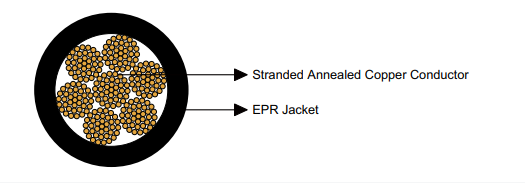
Professional-grade 600V portable arc-welding cable with flexible EPR jacket for electric arc welding systems. Class K/M stranded copper, exceptional flexibility, 6 AWG to 500 kcmil. ICEA S-75-381, UL 1581 certified for industrial fabrication, construction, shipbuilding applications.
Global Hotline: +86 13855123218
Portable Arc-Welding Cable with Heavy-Duty Ethylene Propylene Rubber Jacket – 600 Volt Rating
Professional-grade flexible welding cable engineered for demanding secondary circuit applications in electric arc welding operations across industrial fabrication, construction, and manufacturing environments. This single-conductor cable features ultra-flexible Class K/M copper stranding combined with durable EPR elastomeric jacketing, delivering the exceptional flexibility and mechanical durability essential for daily welding operations. Designed specifically to connect electrode holders to welding power sources, accommodating the continuous flexing, dragging, and abrasion encountered in real-world fabrication and repair welding applications.
Welding Process Applications and Operational Environments
This welding cable serves as the critical electrical connection in the secondary (low-voltage, high-current) circuit of electric arc welding systems, transmitting welding current from the power source to the electrode holder or torch assembly. The cable must withstand extreme mechanical abuse including repeated flexing during welding operations, dragging across shop floors and structural steel, exposure to weld spatter and heat, and contact with sharp edges and abrasive surfaces. Primary welding process applications include:
- Shielded Metal Arc Welding (SMAW/Stick Welding): Primary electrode lead cable for manual stick welding operations universally employed across structural steel fabrication, pipeline construction, equipment repair, and general maintenance welding. The cable connects the electrode holder (stinger) to the welding machine’s positive or negative terminal depending on electrode polarity requirements. SMAW welding demands highly flexible cables that accommodate continuous repositioning as welders move along weld joints while maintaining reliable electrical connection throughout extended welding cycles.
- Gas Tungsten Arc Welding (GTAW/TIG Welding): Power cable for TIG torch assemblies used in precision welding of stainless steel, aluminum, exotic alloys, and applications requiring superior weld quality. While TIG welding typically operates at lower current levels compared to SMAW, the cable must still provide excellent flexibility for intricate welding positions and accommodate the precise torch manipulation characteristic of TIG welding technique.
- Gas Metal Arc Welding (GMAW/MIG Welding): Ground return cable in MIG/MAG welding systems where workpiece grounding requires robust, flexible connections. Although the welding wire feed through the torch assembly typically uses integrated cable assemblies, separate welding cables provide critical ground connections and may serve as power conductors in some system configurations.
- Flux-Cored Arc Welding (FCAW): Electrode cables for semi-automatic and automatic flux-cored welding operations common in heavy structural fabrication, shipbuilding, and pressure vessel construction. FCAW processes typically operate at high current levels demanding adequate conductor sizing to minimize voltage drop and maintain consistent arc characteristics.
- Industrial Fabrication Shops: General welding cable applications in manufacturing facilities producing structural steel components, heavy machinery, industrial equipment, and metal fabrications. Shop environments demand cables capable of withstanding daily abuse from dragging across concrete floors, contact with steel work surfaces, and exposure to metal chips, grinding dust, and welding debris.
- Construction and Field Welding: Portable welding leads for construction sites, pipeline welding, tank farm maintenance, bridge construction, and industrial plant maintenance where welding equipment must be relocated frequently and cables experience rough handling in outdoor environments with exposure to weather, mud, gravel surfaces, and construction debris.
- Shipbuilding and Marine Fabrication: Welding cable applications in shipyards and marine fabrication facilities where welding operations occur on steel plate, bulkheads, decks, and structural components. Marine fabrication environments subject cables to particularly severe conditions including exposure to saltwater spray, steel grit from abrasive blasting, sharp edges on steel plate, and the challenging ergonomics of welding in confined spaces aboard vessels under construction.
Industry Standards and Certification Requirements
Manufacturing processes for this welding cable conform to multiple industry standards ensuring product quality, safety, and performance characteristics appropriate for professional welding applications:
- ICEA S-75-381 and NEMA WC 58: While primarily focused on mining cables, these Insulated Cable Engineers Association and National Electrical Manufacturers Association standards provide relevant guidance for flexible cable construction, conductor stranding requirements, and testing protocols applicable to welding cable design and manufacturing quality control.
- ASTM B 172: Standard specification governing rope-lay-stranded copper conductors with bunch-stranded members. This specification is particularly relevant for welding cables which require exceptional flexibility achieved through highly-stranded conductor configurations. Class K and Class M stranding designations defined in this standard represent the most flexible conductor constructions available, essential for welding cable applications.
- ASTM B 33: Specification for annealed copper wire ensuring conductors utilize soft, annealed copper providing maximum flexibility while maintaining adequate tensile strength. Annealing is critical for welding cables where conductor flexibility directly impacts cable handling characteristics and service life under repeated flexing.
- CAN/CSA C22.2 No. 96: Canadian Standards Association requirements providing additional verification of cable construction adequacy and safety characteristics, facilitating cable use in Canadian welding facilities and compliance with provincial electrical codes.
- UL 1581: Underwriters Laboratories standard for electrical wires, cables, and flexible cords. This comprehensive standard establishes testing protocols for electrical, mechanical, and environmental performance characteristics including insulation voltage withstand, conductor resistance, flexibility testing, flame propagation resistance, and environmental aging. UL 1581 compliance provides assurance of cable suitability for professional welding applications across diverse operational environments.
Construction Details and Material Selection
Ultra-Flexible Conductor Engineering
The conductor comprises annealed copper wire assembled in Class K or Class M stranding configurations representing the most flexible conductor constructions commercially available. Class K stranding typically incorporates 30% more individual copper strands compared to Class B (standard flexible) conductors of equivalent cross-sectional area, while Class M stranding represents even finer subdivision with approximately 46% more strands than Class B. This extremely fine stranding enables the exceptional flexibility essential for welding cable applications where cables experience continuous bending, coiling, and uncoiling throughout normal operations. The annealing process thermally softens the copper, further enhancing flexibility by relieving internal stresses and maximizing ductility. Conductor sizes span from 6 AWG through 500 kcmil, accommodating welding currents from approximately 125 amperes through nearly 2000 amperes depending on conductor size, duty cycle, and ambient cooling conditions.
EPR Jacket System
The conductor receives protection from a heavy-duty or medium-duty Ethylene Propylene Rubber (EPR) jacket extruded directly over the copper stranding. EPR was selected for welding cable applications due to its exceptional combination of properties: outstanding flexibility retention across wide temperature ranges maintaining pliability in cold weather and hot shop conditions, excellent resistance to ozone and weathering enabling outdoor storage and field use, good resistance to oils and hydraulic fluids commonly encountered in industrial environments, superior abrasion resistance withstanding dragging across concrete, steel, and gravel surfaces, excellent flame resistance limiting fire propagation risk, and good electrical insulation properties despite the relatively low 600V voltage rating. The black elastomeric compound incorporates carbon black for UV protection and antioxidants for thermal aging resistance. Jacket thickness varies from 0.060 inches (1.5mm) for smaller conductor sizes through 0.095 inches (2.4mm) for the largest conductors, providing a balance between mechanical protection and overall cable flexibility.
Single-Conductor Configuration
Unlike multi-conductor power cables, welding cables utilize single-conductor construction because welding circuit configurations typically require separate positive (electrode) and negative (ground) connections with different routing paths. The electrode cable runs from the welding machine to the electrode holder or torch assembly carried by the welder, while the ground cable connects from the machine to clamps attached to the workpiece. This separate cable configuration provides welders maximum flexibility in positioning equipment and managing cable routing to accommodate varying workpiece geometries and welding positions.
Alternative Jacket Materials and Custom Options
Specialized Jacket Compounds: While EPR provides optimal overall performance for most welding applications, alternative jacket materials can be supplied for specialized requirements. Natural Rubber (NR) offers exceptional flexibility and abrasion resistance for shop environments with minimal chemical exposure. Chlorosulfonated Polyethylene (CSP/Hypalon) provides enhanced chemical resistance and superior weathering characteristics for outdoor field welding in harsh climates. Polychloroprene (PCP/Neoprene) delivers moderate oil resistance with good flexibility for maintenance welding in industrial plants. Nitrile Butadiene Rubber (NBR) offers superior petroleum and hydraulic fluid resistance for welding in refineries, petrochemical facilities, and equipment maintenance applications. Polyvinyl Chloride (PVC) provides a cost-effective option for light-duty welding applications with minimal mechanical abuse.
Heavy-Duty Reinforced Construction: For extreme-duty applications such as shipyard welding, heavy equipment repair, or environments with exceptionally severe mechanical abuse, a reinforced dual-layer jacket construction incorporating textile or aramid fiber reinforcement between inner and outer jacket layers can be manufactured. This construction dramatically increases resistance to cut-through, substantially improves tear propagation resistance, and significantly extends cable service life in the most demanding welding environments.
Physical and Thermal Operating Specifications
Minimum Bending Radius: Six times the cable’s overall outside diameter. This specification—notably more flexible than power feeder cables which typically require eight times diameter—reflects the exceptional flexibility requirements for welding cable applications. The reduced bending radius enables tight coiling for storage and transportation while accommodating the tight bends frequently encountered during welding operations in confined spaces or around structural members.
Maximum Conductor Operating Temperature: 90°C (194°F). This temperature rating represents the maximum sustained conductor temperature under continuous current loading. However, welding operations typically involve intermittent duty cycles with periods of high current followed by cooling intervals, so actual conductor temperatures generally remain well below this maximum even during high-current welding operations.
Voltage Rating: 600 volts. Welding cables operate in the secondary (low-voltage, high-current) circuit of welding power sources where open-circuit voltages typically range from 20 to 80 volts depending on welding process and power source design. The 600V insulation rating provides substantial safety margin above operational voltages while maintaining the flexibility essential for welding cable applications.
Ambient Operating Temperature: The EPR jacket maintains flexibility and mechanical properties across ambient temperatures from approximately -40°C to +75°C, enabling cable use in winter outdoor construction applications and hot summer shop environments without degradation of handling characteristics or jacket integrity.
Complete Technical Specifications and Ampacity Data
The comprehensive specification table below presents complete dimensional and electrical data for all standard conductor sizes. Current capacity ratings reflect typical welding application conditions with intermittent duty cycles. Actual permissible current depends on multiple factors including duty cycle (percentage of time arc is energized), ambient temperature, cooling conditions, and acceptable conductor temperature rise. For continuous-duty applications, current ratings should be derated appropriately.
| Conductor Size | Strand Count | Insulation Thickness | Overall Diameter | Cable Weight | Ampacity |
|---|---|---|---|---|---|
| (AWG/kcmil) | (Strands) | inch (mm) | inch (mm) | lbs/kft (kg/km) | (Amperes) |
| 6 AWG | 259 | 0.060 (1.5) | 0.37 (9.4) | 124 (184) | 125 |
| 4 AWG | 420 | 0.060 (1.5) | 0.42 (10.7) | 180 (268) | 182 |
| 2 AWG | 665 | 0.060 (1.5) | 0.49 (12.5) | 268 (399) | 271 |
| 1 AWG | 836 | 0.080 (2.0) | 0.53 (13.3) | 319 (475) | 360 |
| 1/0 AWG | 1045 | 0.080 (2.0) | 0.59 (14.9) | 415 (617) | 444 |
| 2/0 AWG | 1330 | 0.080 (2.0) | 0.64 (16.3) | 508 (756) | 535 |
| 3/0 AWG | 1672 | 0.080 (2.0) | 0.70 (17.8) | 628 (934) | 667 |
| 4/0 AWG | 2107 | 0.080 (2.0) | 0.81 (20.7) | 775 (1153) | 809 |
| 250 kcmil | 2499 | 0.095 (2.4) | 0.88 (22.4) | 934 (1390) | 1048 |
| 350 kcmil | 3458 | 0.095 (2.4) | 1.01 (25.6) | 1267 (1885) | 1396 |
| 500 kcmil | 5054 | 0.095 (2.4) | 1.18 (30.0) | 1801 (2680) | 1973 |
Cable Size Selection Guidelines by Welding Application
Proper cable sizing ensures adequate current-carrying capacity while minimizing voltage drop that can adversely affect arc stability and weld quality. Selection considerations include welding process, maximum welding current, duty cycle, cable length from power source to electrode holder or workpiece, and ambient temperature conditions:
Light-Duty Welding (6 AWG – 2 AWG)
- Current Range: 125 to 271 amperes
- Typical Applications: Light fabrication, maintenance welding, TIG welding, thin material SMAW
- Welding Processes: GTAW up to 200A, SMAW with electrodes up to 5/32 inch, light MIG work
- Cable Length: Suitable for runs up to 50 feet with minimal voltage drop
- Environments: Shop welding, light repair work, hobbyist applications
Medium-Duty Welding (1 AWG – 2/0 AWG)
- Current Range: 360 to 535 amperes
- Typical Applications: General fabrication, structural steel welding, equipment repair
- Welding Processes: SMAW with electrodes up to 3/16 inch, FCAW, general MIG fabrication
- Cable Length: Appropriate for 50 to 100 foot runs maintaining arc quality
- Environments: Industrial fabrication shops, construction sites, maintenance facilities
Heavy-Duty Welding (3/0 AWG – 500 kcmil)
- Current Range: 667 to 1973 amperes
- Typical Applications: Heavy structural fabrication, shipbuilding, pipe welding, pressure vessels
- Welding Processes: High-current SMAW, heavy plate FCAW, submerged arc welding ground cables
- Cable Length: Enables extended cable runs up to 150+ feet for large work areas
- Environments: Shipyards, heavy equipment manufacturers, large fabrication facilities, pipeline construction
Proper Handling, Storage, and Maintenance Practices
Maximizing welding cable service life and ensuring safe operation requires proper handling techniques and routine maintenance. Cables should be stored on reels or properly coiled when not in use, avoiding tight kinks or sharp bends that can damage conductors or jacket. When deploying cables, avoid dragging over sharp edges, through metal chips or grinding debris, or across surfaces covered with weld slag. Periodically inspect cables for jacket cuts, abrasions, exposed conductors, or damaged terminations—damaged cables present shock hazards and should be repaired or replaced immediately.
Protect cables from weld spatter by routing away from the immediate welding zone when practical, and clean spatter from jacket surfaces regularly before it embeds into the elastomer. Avoid running cables through standing water or allowing prolonged submersion. Inspect terminations regularly, ensuring cable lugs are properly crimped and connections to electrode holders and ground clamps are tight and free from corrosion. Loose connections create resistance heating that can damage cable insulation and create fire hazards. Replace worn electrode holders and ground clamps that no longer grip cables securely.
For long-term storage, coil cables loosely on reels or cable trees, avoiding tight bends. Store in dry locations protected from direct sunlight, which can degrade jacket materials over time. Cables stored outdoors should be covered or placed in weatherproof enclosures. Before use after extended storage, inspect carefully for cracking, hardening, or degradation of jacket material—environmental aging can reduce flexibility and compromise electrical safety.
Professional Welding Cable Solutions and Technical Consultation
Our engineering team provides comprehensive support for welding cable selection, custom length fabrication with installed terminations, and bulk cable supply for large projects. We maintain extensive inventory of standard sizes and can manufacture custom configurations for specialized welding applications.
Technical Support: [email protected] | Direct Line: +86 13855123218


