
Complete Technical Guide to International Conductor Standard — Class 1, 2, 5, 6 Conductors for Power Cables & Flexible Cords

Anhui Feichun Special Cable Co., Ltd.
安徽飞纯特种电缆有限公司
What is IEC 60228 Cable?
Complete Technical Guide to International Conductor Standard — Class 1, 2, 5, 6 Conductors for Power Cables & Flexible Cords
1. Introduction to IEC 60228 Standard
The International Electrotechnical Commission’s IEC 60228 standard covers the nominal cross-sectional areas for conductors of insulated electric power cables and cords. This fundamental international standard specifies requirements for solid and stranded copper, aluminium, and aluminium alloy conductors in cables for fixed installations, as well as flexible copper conductors for portable equipment and flexible cords.
IEC 60228 focuses on the physical and electrical properties of conductors, including their cross-sectional area, resistance values, and the number and arrangement of strands within a conductor. This standard ensures that conductors in cables meet specific performance requirements for electrical safety and reliability across all international markets.
| Standard Authority | IEC — International Electrotechnical Commission (TC 20) |
| Current Edition | IEC 60228:2023 (Edition 4.0) |
| Previous Edition | IEC 60228:2004 (Edition 3.0) |
| European Adoption | EN 60228 (CENELEC) |
| UK National Standard | BS EN 60228 |
| Cross-Sectional Range | 0.5mm² to 2500mm² (expanded to 3000mm² in 2023) |
| Conductor Materials | Copper (plain/tinned), Aluminium, Aluminium Alloy |
| Exclusions | Does NOT apply to telecommunication cables |
A key distinction of IEC 60228 is that it defines conductors by their nominal size determined by resistance rather than physical dimensions. This is critical because not all copper has the same resistivity value — a 4mm² conductor from two different suppliers may have different resistance values if specified by dimensions alone. IEC 60228 provides a standardized definition based solely on electrical characteristics.
Source: Eland Cables – IEC 60228 Standard Cable
EspañolIntroducción al Estándar IEC 60228
La norma IEC 60228 de la Comisión Electrotécnica Internacional cubre las áreas de sección transversal nominal para conductores de cables eléctricos de potencia y cordones aislados. Esta norma internacional fundamental especifica requisitos para conductores sólidos y trenzados de cobre, aluminio y aleación de aluminio en cables para instalaciones fijas, así como conductores de cobre flexibles para equipos portátiles. IEC 60228 define los conductores por su tamaño nominal determinado por la resistencia en lugar de las dimensiones físicas, proporcionando una definición estandarizada basada únicamente en características eléctricas.
繁體中文IEC 60228 標準簡介
國際電工委員會(IEC)的IEC 60228標準涵蓋了絕緣電力電纜和軟線導體的標稱截面積。這一基礎國際標準規定了固定安裝電纜中實心和絞合銅、鋁及鋁合金導體的要求,以及便攜式設備和軟線用柔性銅導體的要求。IEC 60228的一個關鍵區別是它通過電阻而非物理尺寸來定義導體的標稱尺寸。這一點至關重要,因為並非所有銅都具有相同的電阻率值,因此IEC 60228提供了完全基於電氣特性的標準化定義。該標準已被CENELEC作為歐洲標準(EN 60228)採用,並在英國作為BS EN 60228引用。
2. Conductor Classification System
IEC 60228 classifies conductors into four classes based on their construction and intended flexibility. Each class is designed for specific application groups, and understanding these differences is essential for proper cable selection.
⚡ IEC 60228 Conductor Classes
Class 1
Fixed installations
Lowest resistance
Lowest cost
Class 2
Fixed installations
More flexible than Class 1
Easier installation
Class 5
Flexible cables & cords
Portable equipment
Repeated flexing
Class 6
Most flexible
Industrial robots
Continuous movement
2.1 Class Application Summary
| Class | Construction | Material | Primary Application | Flexibility |
|---|---|---|---|---|
| Class 1 | Solid (single wire) | Cu Al | Fixed installations | Rigid |
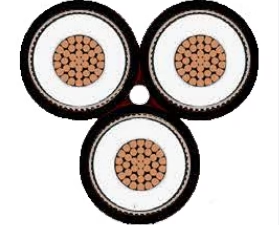
| Class 2 | Stranded (min 7 wires) | Cu Al | Fixed installations | Semi-flexible |
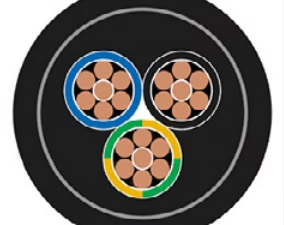
| Class 5 | Flexible (many fine wires) | Cu only | Flexible cables/cords | Flexible |
| Class 6 | Extra flexible (very fine wires) | Cu only | Highly flexible cables | Most flexible |
Important: IEC 60228 only permits the use of aluminium for Class 1 and Class 2 conductors. Flexible cables (Class 5 and 6) require copper conductors because aluminium has inferior mechanical properties for repeated bending applications.
3. IEC 60228 Conductor Sizes
IEC 60228 specifies nominal cross-sectional areas ranging from 0.5mm² to 2500mm² (expanded to 3000mm² in the 2023 edition). These sizes are specified in metric values — the US continues to use the American Wire Gauge (AWG) system instead.
3.1 Standard Cross-Sectional Areas
| Small Sizes | Medium Sizes | Large Sizes | Extra Large Sizes |
|---|---|---|---|
| 0.5mm² | 6mm² | 70mm² | 300mm² |
| 0.75mm² | 10mm² | 95mm² | 400mm² |
| 1mm² | 16mm² | 120mm² | 500mm² |
| 1.5mm² | 25mm² | 150mm² | 630mm² |
| 2.5mm² | 35mm² | 185mm² | 800mm² |
| 4mm² | 50mm² | 240mm² | 1000mm² |
| — | — | — | 1200-2500mm² |
3.2 AWG to IEC 60228 Conversion
| AWG Size | IEC 60228 (mm²) | Actual Area (mm²) | Notes |
|---|---|---|---|
| 20 AWG | 0.5mm² | 0.52mm² | Close match |
| 18 AWG | 0.75mm² | 0.82mm² | Close match |
| 16 AWG | 1.5mm² | 1.31mm² | IEC larger |
| 14 AWG | 2.5mm² | 2.08mm² | IEC larger |
| 12 AWG | 4mm² | 3.31mm² | IEC larger |
| 10 AWG | 6mm² | 5.26mm² | IEC larger |
| 8 AWG | 10mm² | 8.37mm² | IEC larger |
| 6 AWG | 16mm² | 13.3mm² | IEC larger |
| 4 AWG | 25mm² | 21.2mm² | IEC larger |
| 2 AWG | 35mm² | 33.6mm² | Close match |
| 1/0 AWG | 50mm² | 53.5mm² | Close match |
| 2/0 AWG | 70mm² | 67.4mm² | Close match |
| 4/0 AWG | 120mm² | 107mm² | IEC larger |
4. Maximum Resistance Values at 20°C
Each conductor size in IEC 60228 is required to meet a maximum resistance value measured at 20°C. This is the defining characteristic that ensures consistent electrical performance regardless of physical construction variations.
4.1 Class 1 & Class 2 — Fixed Installation Conductors
| Nominal Area (mm²) | Class 1 & 2 Max Resistance (Ω/km at 20°C) | ||
|---|---|---|---|
| Plain Copper | Tinned Copper | Aluminium | |
| Small Sizes | |||
| 0.5 | 36.0 | 36.7 | — |
| 0.75 | 24.5 | 24.8 | — |
| 1.0 | 18.1 | 18.2 | — |
| 1.5 | 12.1 | 12.2 | — |
| 2.5 | 7.41 | 7.56 | — |
| 4 | 4.61 | 4.70 | — |
| 6 | 3.08 | 3.11 | — |
| Medium Sizes | |||
| 10 | 1.83 | 1.84 | 3.08 |
| 16 | 1.15 | 1.16 | 1.91 |
| 25 | 0.727 | — | 1.20 |
| 35 | 0.524 | — | 0.868 |
| 50 | 0.387 | — | 0.641 |
| 70 | 0.268 | — | 0.443 |
| 95 | 0.193 | — | 0.320 |
| 120 | 0.153 | — | 0.253 |
| 150 | 0.124 | — | 0.206 |
| 185 | 0.0991 | — | 0.164 |
| 240 | 0.0754 | — | 0.125 |
| 300 | 0.0601 | — | 0.100 |
| 400 | 0.0470 | — | 0.0778 |
| 500 | 0.0366 | — | 0.0605 |
| 630 | 0.0283 | — | 0.0469 |
4.2 Class 5 & Class 6 — Flexible Conductors (Copper Only)
| Nominal Area (mm²) | Class 5 Max Resistance (Ω/km) | Class 6 Max Resistance (Ω/km) | ||
|---|---|---|---|---|
| Plain Cu | Tinned Cu | Plain Cu | Tinned Cu | |
| Small Sizes | ||||
| 0.5 | 39.0 | 40.1 | — | — |
| 0.75 | 26.0 | 26.7 | — | — |
| 1.0 | 19.5 | 20.0 | — | — |
| 1.5 | 13.3 | 13.7 | — | — |
| 2.5 | 7.98 | 8.21 | — | — |
| 4 | 4.95 | 5.09 | — | — |
| Medium Sizes | ||||
| 6 | 3.30 | 3.39 | — | — |
| 10 | 1.91 | 1.95 | 1.91 | 1.95 |
| 16 | 1.21 | 1.24 | 1.21 | 1.24 |
| 25 | 0.780 | 0.795 | 0.780 | 0.795 |
| 35 | 0.554 | 0.565 | 0.554 | 0.565 |
| 50 | 0.386 | 0.393 | 0.386 | 0.393 |
| 70 | 0.272 | 0.277 | 0.272 | 0.277 |
| 95 | 0.206 | 0.210 | 0.206 | 0.210 |
| 120 | 0.161 | 0.164 | 0.161 | 0.164 |
| 150 | 0.129 | 0.132 | 0.129 | 0.132 |
| 185 | 0.106 | 0.108 | 0.106 | 0.108 |
| 240 | 0.0801 | 0.0817 | 0.0801 | 0.0817 |
| 300 | 0.0641 | 0.0654 | 0.0641 | 0.0654 |
Note: Class 5 and 6 conductors have approximately 4-5% higher resistance than Class 1 and 2 with the same cross-sectional area. For example, a 10mm² Class 2 copper conductor has maximum resistance of 1.83 Ω/km, while Class 5 with the same area has 1.91 Ω/km.
5. Minimum Number of Wires
IEC 60228 specifies the minimum number of wires required for stranded conductors. Class 5 and 6 require progressively more wires with smaller diameters to achieve greater flexibility.
| Nominal Area (mm²) | Class 2 (Stranded) | Class 5 (Flexible) | Class 6 (Extra Flexible) |
|---|---|---|---|
| 0.5 | 7 | 16 | — |
| 0.75 | 7 | 24 | — |
| 1.0 | 7 | 32 | — |
| 1.5 | 7 | 30 | — |
| 2.5 | 7 | 50 | — |
| 4 | 7 | 56 | — |
| 6 | 7 | 84 | — |
| 10 | 7 | 80 | 126 |
| 16 | 7 | 126 | 196 |
| 25 | 7 | 196 | 315 |
| 35 | 7 | 276 | 441 |
| 50 | 19 | 396 | 630 |
| 70 | 19 | 360 | 567 |
| 95 | 19 | 475 | 756 |
| 120 | 37 | 608 | 972 |
| 150 | 37 | 756 | 1189 |
| 185 | 37 | 925 | 1482 |
| 240 | 61 | 1221 | 1925 |
| 300 | 61 | 1525 | 2401 |
6. Conductor Materials
6.1 Copper Conductors
| Material Types | Plain (bare) copper, Tinned copper, Metal-coated copper |
| Resistivity at 20°C | Plain: 0.017241 Ω·mm²/m | Tinned: 0.01756 Ω·mm²/m |
| Temperature Coefficient | 0.00393 per °C |
| Available Classes | 1 2 5 6 |
| Advantages | Highest conductivity, excellent flexibility, superior corrosion resistance |
| Applications | Fixed installations, flexible cables, power cords, welding cables |
6.2 Aluminium Conductors
| Material Types | Pure aluminium, Aluminium alloy (×1.162 resistance factor) |
| Resistivity at 20°C | 0.028264 Ω·mm²/m |
| Temperature Coefficient | 0.00403 per °C |
| Available Classes | 1 2 only |
| Minimum Size | 10mm² (solid) or as specified |
| Advantages | Lighter weight (~30% of copper), lower cost |
| Limitations | Not permitted for flexible cables (Class 5/6) |
Note: For aluminium alloy conductors, the resistance values from standard tables must be multiplied by a factor of 1.162 unless otherwise agreed between manufacturer and purchaser.
Source: Wikipedia – IEC 60228
7. Key Technical Parameters
Size Range
Reference Temperature
Conductor Classes
Materials
Cu Resistivity
Al Resistivity
Al/Cu Ratio
Al Alloy Factor
8. International Standard Adoption
IEC 60228 has been adopted by CENELEC as a European standard and subsequently ratified by all member countries. It is referenced under various national designations across Europe and internationally.
| Region | Standard Designation | Authority | Status |
|---|---|---|---|
| International | IEC 60228 | IEC (TC 20) | Active (Ed 4.0: 2023) |
| Europe | EN 60228 | CENELEC | Harmonized |
| United Kingdom | BS EN 60228 | BSI | National adoption |
| Germany | DIN EN 60228 / VDE 0295 | DIN/VDE | National adoption |
| France | NF EN 60228 | AFNOR | National adoption |
| Italy | CEI EN 60228 | CEI | National adoption |
| Vietnam | TCVN 6612:2007 | TCVN | Equivalent to IEC 60228:2004 |
Note: The US and Canada continue to use the American Wire Gauge (AWG) system and kcmil for larger sizes. IEC TC 20 cable product standards do not prescribe cables with AWG/kcmil conductors, though IEC TR 62602 provides guidance for AWG conductor specifications.
9. Application by Conductor Class
| Class 1 Solid Conductors | |
| Applications | Building wiring, fixed power cables, mineral insulated cables, underground cables |
| Advantages | Lowest resistance, lowest cost, simple termination |
| Class 2 Stranded Conductors | |
| Applications | Fixed power cables, industrial wiring, armoured cables, MV/HV cables |
| Advantages | Easier installation (bending), better for larger sizes |
| Class 5 Flexible Conductors | |
| Applications | Portable equipment, power cords, extension cables, trailing cables |
| Advantages | Good flexibility, suitable for repeated bending |
| Class 6 Extra Flexible Conductors | |
| Applications | Industrial robots, welding cables, drag chain cables, crane cables |
| Advantages | Maximum flexibility, continuous movement applications |
10. Temperature Correction Factors
IEC 60228 specifies that resistance values are measured at 20°C. Annex B provides exact formulae for temperature correction factors to convert measured resistance at other temperatures to the standard 20°C reference.
| Temperature (°C) | Copper Factor (kt) | Aluminium Factor (kt) |
|---|---|---|
| 5 | 1.059 | 1.062 |
| 10 | 1.039 | 1.041 |
| 15 | 1.020 | 1.020 |
| 20 | 1.000 | 1.000 |
| 25 | 0.981 | 0.980 |
| 30 | 0.962 | 0.961 |
| 35 | 0.944 | 0.943 |
Formula: R₂₀ = Rt × kt where Rt is measured resistance at temperature t°C
Authoritative External References
https://www.elandcables.com/…/iec-60228-cable
https://www.clevelandcable.com/…/iec-60228-cable
https://ngoclancable.com/…/iec-60228
https://en.wikipedia.org/wiki/IEC_60228
https://www.nexans.be/…/IEC60228_ENG.pdf
https://webstore.iec.ch/…/14035
https://standards.globalspec.com/…/IEC60228
https://www.cableizer.com/…/cable-conductor-sizes
https://www.sab-cable.com/…/european-cable-stranding
https://www.tekima.com/…/Conductors.pdf
Contact Feichun Cable
For technical support with IEC 60228 conductor specifications, Class 1/2/5/6 cables, copper and aluminium conductor applications, please contact our engineering team.
[…] 参考: Feichun Cables – IEC 60228 Cable Standard Guide, Interpower – Importance of Minimum Bend […]