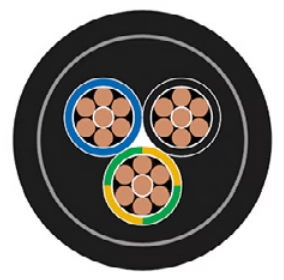
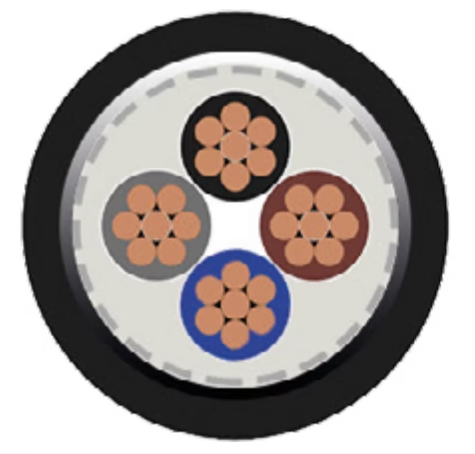
copper conductor

SWA Cable Architecture & Engineering Design Strategy Purpose & Application Scope: Steel Wire Armored (SWA) cables represent the engineering solution for power distribution where mechanical protection, fire safety, and environmental resistance create absolute requirements. Unlike conventional cables relying solely on conduit or external protection, SWA cables integrate mechanical armoring as an integral structural component, offering permanent protection against physical damage, burrowing animals, excavation equipment, and external mechanical stress. Core Engineering Philosophy: SWA cable design employs multi-layer engineering architecture combining XLPE insulation excellence with steel wire mechanical protection and halogen-free outer sheathing. This integrated approach eliminates the need for external conduit in most underground, outdoor, and hazardous-area applications—reducing installation cost, complexity, and maintenance requirements while providing superior long-term reliability. Market Position & Regulatory Compliance: SWA cables comply with IEC 60502-1 international standards and equivalent national specifications including KS C specifications. These cables specifically address the requirements of the EN 50288 and equivalent standards covering cables with protective conductors and armored configurations. The combination of XLPE insulation with halogen-free sheathing provides automatic compliance with fire safety codes adopted across Europe, Asia, and industrial facilities worldwide where smoke emission and toxic fume generation create liability concerns.

0.6/1kV XLPE Insulated Halogen-Free Steel Wire Armored Cable

SWA Cable Architecture & Engineering Design Strategy Purpose & Application Scope: Steel Wire Armored (SWA) cables represent the engineering solution for power distribution where mechanical protection, fire safety, and environmental resistance create absolute requirements. Unlike conventional cables relying solely on conduit or external protection, SWA cables integrate mechanical armoring as an integral structural component, offering permanent protection against physical damage, burrowing animals, excavation equipment, and external mechanical stress. Core Engineering Philosophy: SWA cable design employs multi-layer engineering architecture combining XLPE insulation excellence with steel wire mechanical protection and halogen-free outer sheathing. This integrated approach eliminates the need for external conduit in most underground, outdoor, and hazardous-area applications—reducing installation cost, complexity, and maintenance requirements while providing superior long-term reliability. Market Position & Regulatory Compliance: SWA cables comply with IEC 60502-1 international standards and equivalent national specifications including KS C specifications. These cables specifically address the requirements of the EN 50288 and equivalent standards covering cables with protective conductors and armored configurations. The combination of XLPE insulation with halogen-free sheathing provides automatic compliance with fire safety codes adopted across Europe, Asia, and industrial facilities worldwide where smoke emission and toxic fume generation create liability concerns.
Ethylene Propylene Rubber (EPR) insulated cables represent the professional approach to flexible electrical distribution—cables engineered to accommodate dynamic deployment, repetitive coiling/uncoiling, temperature variation, and mechanical stress inherent in portable and industrial equipment applications. Unlike fixed-installation cables optimized for stationary performance, EPR cables balance electrical performance, mechanical flexibility, environmental durability, and cost-effectiveness required for equipment requiring frequent relocation or deployment flexibility. Fundamental Design Philosophy: EPR cables employ elastomeric insulation material (ethylene propylene rubber) selected specifically for flexibility maintenance across wide temperature range. This material provides sustained flexibility even at cold temperatures (−40°C minimum), maintains electrical properties across elevated temperature range (continuous operation to +100°C), and demonstrates superior resistance to ozone, UV radiation, and environmental contamination characteristic of portable equipment deployment. Conductor Architecture for Flexibility: Rather than single-strand conductors (rigid, prone to breaking under flex stress), EPR cables employ multi-strand conductor design—typically 7, 19, 37, or 61 individual wires woven together. This multi-strand architecture enables smooth bending without conductor fracture, distributes mechanical stress across multiple strands preventing single-point failure, and maintains consistent electrical performance through tens of thousands of flex cycles. Voltage Rating & Safety Margin: Standard 0.6/1KV rating provides nominal 600V operating margin with 1000V safety ceiling—appropriate for most industrial equipment, portable power systems, and temporary installations. The dual rating nomenclature indicates 0.6KV continuous operating voltage with 1KV maximum transient voltage tolerance, providing balanced safety margin against impulse transients and surge events.

Ethylene Propylene Rubber (EPR) Insulated Cable Family

Ethylene Propylene Rubber (EPR) insulated cables represent the professional approach to flexible electrical distribution—cables engineered to accommodate dynamic deployment, repetitive coiling/uncoiling, temperature variation, and mechanical stress inherent in portable and industrial equipment applications. Unlike fixed-installation cables optimized for stationary performance, EPR cables balance electrical performance, mechanical flexibility, environmental durability, and cost-effectiveness required for equipment requiring frequent relocation or deployment flexibility. Fundamental Design Philosophy: EPR cables employ elastomeric insulation material (ethylene propylene rubber) selected specifically for flexibility maintenance across wide temperature range. This material provides sustained flexibility even at cold temperatures (−40°C minimum), maintains electrical properties across elevated temperature range (continuous operation to +100°C), and demonstrates superior resistance to ozone, UV radiation, and environmental contamination characteristic of portable equipment deployment. Conductor Architecture for Flexibility: Rather than single-strand conductors (rigid, prone to breaking under flex stress), EPR cables employ multi-strand conductor design—typically 7, 19, 37, or 61 individual wires woven together. This multi-strand architecture enables smooth bending without conductor fracture, distributes mechanical stress across multiple strands preventing single-point failure, and maintains consistent electrical performance through tens of thousands of flex cycles. Voltage Rating & Safety Margin: Standard 0.6/1KV rating provides nominal 600V operating margin with 1000V safety ceiling—appropriate for most industrial equipment, portable power systems, and temporary installations. The dual rating nomenclature indicates 0.6KV continuous operating voltage with 1KV maximum transient voltage tolerance, providing balanced safety margin against impulse transients and surge events.
Festoon cables (also called curtain cables or loop cables) are specialized power distribution cables designed for overhead, suspended installations where the cable hangs in loops from fixed support points while a moving trolley or crane pulls the cable along beneath it. The term "festoon" derives from the architectural practice of hanging decorative swags between fixed points—a metaphor that accurately describes how these cables are installed in crane systems. FC-PNCT festoon cables serve as the primary power supply for overhead equipment including container cranes, gantry cranes, overhead bridge cranes, and related port equipment. The cable hangs in a series of gentle loops from fixed hanger points spaced approximately 5–10 meters apart. As the crane moves along the runway, the moving trolley pulls the cable along with it, creating a smooth, coordinated motion that maintains electrical contact between fixed shore power and the moving equipment. Festoon cables experience fundamentally different stresses compared to reel-mounted high-tension cables: • Repetitive bending cycles as the cable forms and reforms loops—but at a slower rate than reel cables • Lower tensile stress because the cable hangs relatively stationary between support points • Environmental exposure to saltwater spray, UV radiation, and thermal cycling—same as reel cables • Gentle, predictable bending geometry with consistent bend radii determined by hanger spacing • Lower operational temperature due to reduced mechanical stress and typically lower current demands These differences necessitate a distinctly different cable design optimized specifically for festoon applications. Festoon cables prioritize superior bending flexibility, excellent environmental resistance, and long-term durability under repetitive but gentle mechanical stress.

FC-PNCT Korean Standard Festoon Cables

Festoon cables (also called curtain cables or loop cables) are specialized power distribution cables designed for overhead, suspended installations where the cable hangs in loops from fixed support points while a moving trolley or crane pulls the cable along beneath it. The term “festoon” derives from the architectural practice of hanging decorative swags between fixed points—a metaphor that accurately describes how these cables are installed in crane systems. FC-PNCT festoon cables serve as the primary power supply for overhead equipment including container cranes, gantry cranes, overhead bridge cranes, and related port equipment. The cable hangs in a series of gentle loops from fixed hanger points spaced approximately 5–10 meters apart. As the crane moves along the runway, the moving trolley pulls the cable along with it, creating a smooth, coordinated motion that maintains electrical contact between fixed shore power and the moving equipment. Festoon cables experience fundamentally different stresses compared to reel-mounted high-tension cables: • Repetitive bending cycles as the cable forms and reforms loops—but at a slower rate than reel cables • Lower tensile stress because the cable hangs relatively stationary between support points • Environmental exposure to saltwater spray, UV radiation, and thermal cycling—same as reel cables • Gentle, predictable bending geometry with consistent bend radii determined by hanger spacing • Lower operational temperature due to reduced mechanical stress and typically lower current demands These differences necessitate a distinctly different cable design optimized specifically for festoon applications. Festoon cables prioritize superior bending flexibility, excellent environmental resistance, and long-term durability under repetitive but gentle mechanical stress.
HT-PNCT cable family represents a comprehensive, professional ecosystem of high-tension power distribution cables engineered to serve the complete spectrum of port equipment applications. Rather than a single cable type, HT-PNCT encompasses a carefully developed family of variants, each optimized for specific application requirements, electrical loads, environmental conditions, and operational constraints. The family architecture is organized around five core cable types: 1. HT-PNCT-RF — Reinforced Festoon variant with large conductor sizes (240–300 sq mm) and flexible sheath options (1.5, 2.5, 4.0 mm). Optimized for extended-span festoon applications with demanding tensile and environmental requirements. 2. HT-PNCT (Standard) — Non-shielded multi-core configuration (3–30 conductor cores) with optimized conductor size and sheath thickness combinations. Base specification for equipment without sensitive electronics or electromagnetic sensitivity. 3. HT-PNCT(S) — Shielded variant of standard cable featuring tinned copper braid shield. Engineered for equipment with variable frequency drive (VFD) motors, crane controls, and sensitive automation electronics requiring electromagnetic interference (EMI) attenuation. 4. HT-PNCT-R — Reinforced non-shielded variant with enhanced mechanical strength and extended tensile capacity. For applications requiring maximum tensile strength without electromagnetic protection needs. 5. HT-PNCT(S)-R — Premium reinforced-shielded variant combining maximum tensile strength with full electromagnetic protection. For next-generation high-power equipment with VFD systems and extreme service life requirements. This family structure enables terminal operators to select the optimal cable for each specific application—balancing performance, cost, environmental requirements, and operational constraints. The shared engineering platform across family members ensures interoperability and simplifies spare cable management.

Complete HT-PNCT High Tension Cable Family

HT-PNCT cable family represents a comprehensive, professional ecosystem of high-tension power distribution cables engineered to serve the complete spectrum of port equipment applications. Rather than a single cable type, HT-PNCT encompasses a carefully developed family of variants, each optimized for specific application requirements, electrical loads, environmental conditions, and operational constraints. The family architecture is organized around five core cable types: 1. HT-PNCT-RF — Reinforced Festoon variant with large conductor sizes (240–300 sq mm) and flexible sheath options (1.5, 2.5, 4.0 mm). Optimized for extended-span festoon applications with demanding tensile and environmental requirements. 2. HT-PNCT (Standard) — Non-shielded multi-core configuration (3–30 conductor cores) with optimized conductor size and sheath thickness combinations. Base specification for equipment without sensitive electronics or electromagnetic sensitivity. 3. HT-PNCT(S) — Shielded variant of standard cable featuring tinned copper braid shield. Engineered for equipment with variable frequency drive (VFD) motors, crane controls, and sensitive automation electronics requiring electromagnetic interference (EMI) attenuation. 4. HT-PNCT-R — Reinforced non-shielded variant with enhanced mechanical strength and extended tensile capacity. For applications requiring maximum tensile strength without electromagnetic protection needs. 5. HT-PNCT(S)-R — Premium reinforced-shielded variant combining maximum tensile strength with full electromagnetic protection. For next-generation high-power equipment with VFD systems and extreme service life requirements. This family structure enables terminal operators to select the optimal cable for each specific application—balancing performance, cost, environmental requirements, and operational constraints. The shared engineering platform across family members ensures interoperability and simplifies spare cable management.
HT-PNCT-F cable, Korean standard cable, high tension cable, port equipment cable, festoon-reel cable, unloader cable, stacker cable, reclaimer cable, gantry crane cable, tape braid reinforcement, 0.6/1KV cable, KSC 3317, IEC 60502-1, tape reinforcement, braid reinforcement, cable architecture, layer structure, synthetic tape, polyester tape, polypropylene tape, braid layer, glass-fiber reinforced nylon, hybrid reinforcement, tape-braid hybrid, load-carrying mechanism, copper conductor, Class 2 stranding, EP rubber insulation, chloroprene sheath, outer diameter, cable weight, conductor resistance, insulation resistance, test voltage, dielectric strength, tensile strength, flex-cycle endurance, impact resistance, bending flexibility, reelability, environmental durability, saltwater resistance, UV resistance, thermal cycling, flame retardance, operational temperature, 3-core configuration, 4-core configuration, conductor size range, ship unloader, gantry crane, stacker reclaimer, mobile harbour crane, conveyor drive system, reel preparation, minimum bend radius, cable winding, slip ring termination, preventive maintenance, insulation resistance test, quality assurance, electrical testing, mechanical testing, reinforcement layer testing, environmental testing, reel-specific testing, ASTM B117, IEC 60811, ISO 12947, IEC 60331-1, Feichun HT-PNCT-F, HT-PNCT-F-S shielded, HT-PNCT-F-EX enhanced braid, HT-PNCT-F-SX full premium, VFD cable, EMI shielding, port terminal, Busan port, Korean Industrial Standard, festoon power supply, reel-mounted equipment

HT-PNCT-F Korean Standard High Tension Cables

HT-PNCT-F cable, Korean standard cable, high tension cable, port equipment cable, festoon-reel cable, unloader cable, stacker cable, reclaimer cable, gantry crane cable, tape braid reinforcement, 0.6/1KV cable, KSC 3317, IEC 60502-1, tape reinforcement, braid reinforcement, cable architecture, layer structure, synthetic tape, polyester tape, polypropylene tape, braid layer, glass-fiber reinforced nylon, hybrid reinforcement, tape-braid hybrid, load-carrying mechanism, copper conductor, Class 2 stranding, EP rubber insulation, chloroprene sheath, outer diameter, cable weight, conductor resistance, insulation resistance, test voltage, dielectric strength, tensile strength, flex-cycle endurance, impact resistance, bending flexibility, reelability, environmental durability, saltwater resistance, UV resistance, thermal cycling, flame retardance, operational temperature, 3-core configuration, 4-core configuration, conductor size range, ship unloader, gantry crane, stacker reclaimer, mobile harbour crane, conveyor drive system, reel preparation, minimum bend radius, cable winding, slip ring termination, preventive maintenance, insulation resistance test, quality assurance, electrical testing, mechanical testing, reinforcement layer testing, environmental testing, reel-specific testing, ASTM B117, IEC 60811, ISO 12947, IEC 60331-1, Feichun HT-PNCT-F, HT-PNCT-F-S shielded, HT-PNCT-F-EX enhanced braid, HT-PNCT-F-SX full premium, VFD cable, EMI shielding, port terminal, Busan port, Korean Industrial Standard, festoon power supply, reel-mounted equipment
The (N)TSCGEWÖU 3x95+3x50/3 6/10kV reeling cable, which represents a three-conductor medium-voltage power cable with three equally-sized 50 mm² grounding conductors distributed around the cable circumference, achieves a maximum continuous operating conductor temperature of 90°C according to DIN VDE 0250-813 and VDE 0298-4 standards. This 90°C temperature rating represents the absolute upper limit at which the cable can be operated indefinitely without experiencing accelerated insulation degradation or mechanical property loss. The three-phase power conductors, each with 95 mm² copper cross-section (approximately AWG 3/0), are designed to operate continuously at this 90°C conductor temperature under normal load conditions without exceeding the safe design envelope established by European electrical standards. Regarding the theoretical 125°C overload temperature: high-quality EPR (ethylene propylene rubber, type 3GI3) insulation can theoretically tolerate brief exposure to temperatures of 125°C to 130°C during emergency overload conditions lasting no more than 100 hours per year or 5 seconds for short-circuit faults. However, DIN VDE 0250-813 and VDE 0298-4 do not officially recommend 125°C as a design basis for the (N)TSCGEWÖU cable, particularly because this cable is a flexible reeling cable subject to frequent mechanical stress, dynamic bending, and repeated thermal cycling. Operating routinely at elevated temperatures significantly accelerates the rubber jacketing's aging process, dramatically reducing the cable's mechanical flexibility and service life in the demanding coil-wound configurations typical of dragline and excavator equipment. The professional engineering recommendation is clear: design all (N)TSCGEWÖU installations for 90°C operation as the safe design maximum, treat any sustained operation above 90°C as an emergency condition requiring immediate investigation, and never use 125°C as a routine design basis without explicit written approval from both the cable manufacturer and the equipment operator.

Maximum Conductor Temperature: Is (N)TSCGEWÖU 3×95+3×50/3 Rated for 90°C or 125°C Overload?

The (N)TSCGEWÖU 3×95+3×50/3 6/10kV reeling cable, which represents a three-conductor medium-voltage power cable with three equally-sized 50 mm² grounding conductors distributed around the cable circumference, achieves a maximum continuous operating conductor temperature of 90°C according to DIN VDE 0250-813 and VDE 0298-4 standards. This 90°C temperature rating represents the absolute upper limit at which the cable can be operated indefinitely without experiencing accelerated insulation degradation or mechanical property loss. The three-phase power conductors, each with 95 mm² copper cross-section (approximately AWG 3/0), are designed to operate continuously at this 90°C conductor temperature under normal load conditions without exceeding the safe design envelope established by European electrical standards. Regarding the theoretical 125°C overload temperature: high-quality EPR (ethylene propylene rubber, type 3GI3) insulation can theoretically tolerate brief exposure to temperatures of 125°C to 130°C during emergency overload conditions lasting no more than 100 hours per year or 5 seconds for short-circuit faults. However, DIN VDE 0250-813 and VDE 0298-4 do not officially recommend 125°C as a design basis for the (N)TSCGEWÖU cable, particularly because this cable is a flexible reeling cable subject to frequent mechanical stress, dynamic bending, and repeated thermal cycling. Operating routinely at elevated temperatures significantly accelerates the rubber jacketing’s aging process, dramatically reducing the cable’s mechanical flexibility and service life in the demanding coil-wound configurations typical of dragline and excavator equipment. The professional engineering recommendation is clear: design all (N)TSCGEWÖU installations for 90°C operation as the safe design maximum, treat any sustained operation above 90°C as an emergency condition requiring immediate investigation, and never use 125°C as a routine design basis without explicit written approval from both the cable manufacturer and the equipment operator.
The question of whether a Type 450 33kV cable requires a bending radius of twelve times or fifteen times its overall diameter when installed on a monospiral reel is not merely an academic exercise but a critical consideration that directly impacts cable longevity, system reliability, and operational safety in medium-voltage power distribution networks. Understanding the correct specification requires examining the interplay between international standards, cable construction characteristics, and the specific mechanical conditions imposed by monospiral reel systems. Type 450 33kV电缆在单螺旋卷筒上安装时,其弯曲半径是需要12倍还是15倍外径,这不仅仅是一个学术问题,而是直接影响电缆寿命、系统可靠性和中压配电网络运行安全的关键考虑因素。理解正确的规范需要研究国际标准、电缆结构特性以及单螺旋卷筒系统施加的特定机械条件之间的相互作用。

Bending Radius for Type 450 33kV Cables on Monospiral Reels: 12xOD or 15xOD?

The question of whether a Type 450 33kV cable requires a bending radius of twelve times or fifteen times its overall diameter when installed on a monospiral reel is not merely an academic exercise but a critical consideration that directly impacts cable longevity, system reliability, and operational safety in medium-voltage power distribution networks. Understanding the correct specification requires examining the interplay between international standards, cable construction characteristics, and the specific mechanical conditions imposed by monospiral reel systems. Type 450 33kV电缆在单螺旋卷筒上安装时,其弯曲半径是需要12倍还是15倍外径,这不仅仅是一个学术问题,而是直接影响电缆寿命、系统可靠性和中压配电网络运行安全的关键考虑因素。理解正确的规范需要研究国际标准、电缆结构特性以及单螺旋卷筒系统施加的特定机械条件之间的相互作用。
rail cables, railway cables, metro cables, trackside cables, overhead line cables, OHL cables, NR/PS/SIG/00005, NR/PS/TEL/00015, NR/PS/ELP/00008, EN 45545-2, EN 50264, Network Rail approved, LUL approved cables, LSZH railway cable, N2XS2Y cable, N2XSY cable, 25/44kV cable, Hornet OHL cable, Cockroach overhead line, signalling cable Type A, signalling cable Type B, signalling cable Type C, signalling cable Type D, signalling cable Type E, G7250 LSZH, SE1047 concentric, S1108 trackfeeder, railway electrification, traction power cable, catenary wire, contact wire 107mm, copper silver contact wire, dropper wire, axle counter cable, SCADA pilot cable, rolling stock cable, Part 6 Type I, Part 6 Type II, train cable, underground cable, tunnel cable, fire rated railway cable, HL3 cable, screening conductor, railway EMC, BS EN 50182, BS EN 50149, medium voltage railway, armoured trackside cable, copper conductor, aluminium conductor AAC, railway signalling system, interlocking cable, track circuit cable, 600/1000V railway, 300/500V signalling, China railway cable, Anhui Feichun cable, special cable manufacturer

Rail & Metro Cables for Trackside and OHL Applications

EN 45545-2 railway cable, EN 50264 rolling stock cable, Network Rail approved cables, NR/PS/SIG/00005 Type A cable, NR/PS/SIG/00005 Type B cable, NR/PS/SIG/00005 Type C cable, NR/PS/SIG/00005 Type D cable, NR/PS/SIG/00005 Type E cable, LUL approved cables, London Underground cables, BS EN 50182 OHL conductor, BS EN 50149 contact wire, IEC 60332 fire rated cable, RISQS approved cable supplier
The international nature of power infrastructure means that MV cables are specified using various national nomenclatures and standards. While the German DIN VDE nomenclature (such as N2XSY, NA2XSH) has become widely recognized across Europe, British Standards (BS6622, BS7835, BS7870), French (NF C 33-226), Spanish (RHZ1), Portuguese (XHIOE, LXHIOV), and other national specifications remain essential for projects in their respective regions.

What is Medium Voltage Cable?

(N)TSCGEWÖU cable, (N)TMCGEWÖU cable, (N)TSCGECECWÖU cable, (N)3GHSSHCH cable, (N)3GHSSYCY cable, N2XSY cable, N2XSH cable, NA2XSY cable, NA2XSH cable, N2XS2Y cable, N2XS(F)2Y cable, N2XS(FL)2Y cable, NA2XS2Y cable, NA2XS(F)2Y cable, NA2XS(FL)2Y cable, N2XSEY cable, NA2XSEY cable, N2XS(F)H cable, N2XS(FL)H cable, NA2XS(F)H cable, NA2XS(FL)H cable
Armoured cables, commonly referred to as SWA (Steel Wire Armoured) or AWA (Aluminium Wire Armoured) cables, are robust power cables designed with metallic armour protection for demanding installation environments. The armour provides mechanical protection where physical stress could damage the cable, such as direct burial underground, outdoor installations, or industrial environments. These cables are manufactured in accordance with British, European, and International standards including BS 5467, BS 6724, BS 6622, BS 7835, and IEC 60502.

What are Armoured Cables SWA & AWA?

SWA cable, AWA cable, armoured cable, steel wire armoured, aluminium wire armoured, BS 5467, BS 6724, BS 6622, BS 7835, IEC 60502, BASEC approved, XLPE cable, LSZH cable, underground cable, 0.6/1kV, 11kV cable, 33kV cable, N2XRY, NYFGBY, power cable, industrial cable, direct burial, 鎧裝電纜, 鋼絲鎧裝, cable blindado
SANS 1507 standard, published by the South African Bureau of Standards (SABS), specifies requirements for electrical cables with extruded solid dielectric insulation designed for fixed installation. This comprehensive standard covers cables with voltage ratings from 300/500V to 1.9/3.3kV, encompassing wiring cables, distribution cables, and service cables used throughout South Africa and many other African nations.

What is SANS 1507 Cable?

南非标准电缆, 南非標準電纜, SANS电缆, SANS電纜, 配电电缆, 配電電纜, 钢丝铠装电缆, 鋼絲鎧裝電纜, 交联聚乙烯电缆, 交聯聚乙烯電纜, 矿用电缆, 礦用電纜, mining cable, industrial distribution cable, commercial building cable, power utility cable, substation cable, switchgear cable, infrastructure cable, SANS 1507, SANS 1507-3, SANS 1507-4, SANS Type 41, SANS Type 61a, 640/1100V cable, 1kV distribution cable, XLPE insulation, PVC insulation, steel wire armour, SWA cable, SABS cable, South African standard, direct burial cable, mining cable, industrial cable, copper conductor, aluminium conductor, armoured distribution cable, XLPE-SWA-PVC, PVC-SWA-PVC, IEC 60502-1, IEC 60228, African power cable, underground cable, service cable, Class 2 conductor, 90°C cable, halogen-free cable, SANS 1520, Eskom, cable manufacturer China, 南非標準電纜, 配電電纜, 鋼絲鎧裝, cable de distribución, cable blindado
NF C32-322 is a French national standard (Norme Française) that specifies requirements for armoured low voltage power cables. These cables, commonly designated as U-1000 RVFV (copper conductor) and U-1000 ARVFV (aluminium conductor), are widely used rigid industrial cables designed for installations requiring mechanical protection. They represent the armoured equivalent of the NF C32-321 unarmoured cables.

What is NF C32-322 Cable?

NF C32-322, U-1000 RVFV, U-1000 ARVFV, U-1000 XAV, NF C32 322, RVFV cable, ARVFV cable, French standard armoured cable, 0.6/1kV cable, 1kV armoured cable, 600/1000V cable, low voltage armoured cable, LV power cable, 1000V industrial cable, NF C32-322 standard, NF C32-070 C2, IEC 60502-1, IEC 60228, IEC 60332-1-2, French cable standard, Norme Française cable, AFNOR cable standard, flame retardant cable,低压电缆, 低壓電纜, 铠装电缆, 鎧裝電纜, 交联聚乙烯电缆, 交聯聚乙烯電纜, 钢带铠装, 鋼帶鎧裝, 法国标准电缆, 法國標準電纜, 工业电缆, 工業電纜, 直埋电缆, 直埋電纜
IEC 60502 is an international standard published by the International Electrotechnical Commission (IEC) that sets out the specification for power cables with extruded insulation. The standard covers cables with voltage ratings from 1 kV (Um = 1.2 kV) up to 30 kV (Um = 36 kV), designed for fixed installations such as distribution networks and industrial installations. This widely recognized standard serves as a primary reference for cable manufacturers worldwide and forms the basis for numerous national and regional cable standards.

What is IEC 60502 Cable?

IEC 60502 對導體類型、絕緣材料和護套化合物提供了詳細規格。絕緣材料包括 PVC(最高溫度 70°C)、XLPE、EPR 和 HEPR(均為最高 90°C)。導體類別包括第 1 類(實心)、第 2 類(絞合)和第 5 類(柔性),尺寸範圍從 1.5 mm² 到 1600 mm²。護套化合物包括 PVC、PE 和用於防火敏感區域的無鹵素材料。XLPE 絕緣的標稱厚度從 0.6/1 kV 的 1.0 mm 到 18/30 kV 的 8.0 mm 不等。
BS6724 is a British Standard specification for thermosetting insulated, armoured cables with rated voltages of 600/1000V and 1900/3300V, specifically designed to have low emission of smoke and corrosive gases when affected by fire. This standard is widely adopted in the UK and internationally for applications where fire safety is critical.

What is BS6724 Cable?

BS6724, BS 6724, BS6724 cable, BS6724 standard, BS 6724 cable specification, BS6724 LSZH cable, BS6724 SWA cable, BS6724 AWA cable, 600/1000V cable, 1900/3300V cable, 0.6/1kV cable, 1.9/3.3kV cable, low voltage cable BS6724,BS6724電纜, 低煙無鹵電纜, LSZH電纜, 低壓電纜, 鎧裝電纜, 鋼絲鎧裝電纜, 鋁絲鎧裝電纜, 阻燃電纜, 防火電纜, 公共建築電纜, 醫院電纜, 機場電纜, 隧道電纜, 數據中心電纜, 特種電纜, 電力電纜