
TXP-4 PUR Round Cable – Halogen-Free Highly Flexible Crane Festoon Cable with Superior Temperature Range

What is 12YHRDC11YH Cable?
TXP-4 PUR Round Cable – Halogen-Free Highly Flexible Crane Festoon Cable with Superior Temperature Range
Anhui Feichun Special Cable Co., Ltd. (安徽飞纯特种电缆有限公司)
12YHRDC11YH cables, also known as TXP-4 PUR round cables, represent the next generation of environmentally responsible industrial cabling technology. Unlike traditional PVC or rubber-sheathed cables, these cables feature halogen-free polyurethane (PUR) construction that provides superior mechanical properties, exceptional chemical resistance, and outstanding environmental safety. With an impressive operating temperature range of -40°C to +90°C in flexing applications, these cables excel where conventional cables fail. Specifically engineered for demanding applications including container crane trolleys, foundries, steel mills, and process equipment, 12YHRDC11YH cables combine the flexibility required for festoon systems with the durability needed for energy guiding chains (drag chains). This comprehensive technical guide provides engineers, safety managers, and procurement specialists with essential knowledge for specifying and deploying these premium halogen-free cables in safety-conscious and environmentally regulated installations.
Table of Contents
- 1. Cable Overview and TXP-4 Designation
- 2. Purpose and Critical Applications
- 3. PUR and Halogen-Free Characteristics
- 4. Material Structure and Advanced Design
- 5. Compliance with International Standards
- 6. Electrical and Thermal Parameters
- 7. Safety Thresholds and Environmental Benefits
- 8. Installation and Usage Precautions
- 9. Common Problems and Solutions
- 10. Selection Guidelines and Comparisons
1. Cable Overview and TXP-4 Designation
The 12YHRDC11YH cable designation follows German cable nomenclature standards (DIN VDE 0250), providing specific technical information about the cable’s halogen-free construction and polyurethane materials.
Understanding the 12YHRDC11YH Code:
- 12YH: Core insulation based on polyester (PE), halogen-free
- RD: Round cable construction
- C: Braided copper shields – inner shield or screened pairs of conductors
- 11YH: Outer sheath based on polyurethane (PUR), halogen-free
Non-Screened Variant: 12YHRD11YH
- Same construction without the “C” screening designation
- Used for applications not requiring EMF protection
🌿 TXP-4 Classification and Environmental Excellence
The TXP-4 designation specifically identifies this cable as a Type 4 PUR round cable optimized for middle to high dynamic applications with halogen-free safety:
- T: Trolley system and traveling application
- X: Extra flexibility and durability
- P: Polyurethane construction
- 4: Performance class for dynamic loads and dual application (festoon + energy chains)
Halogen-Free Advantage: Unlike PVC cables that release toxic hydrogen chloride (HCl) and dense black smoke during fire, PUR halogen-free cables emit minimal smoke and no corrosive gases, significantly improving evacuation safety and protecting sensitive equipment from acid gas damage.
Reference: SAB Cable – PUR Cable Technical Data
2. Purpose and Critical Applications
Primary Purpose
12YHRDC11YH cables are purpose-designed for industrial applications requiring:
- Middle to high dynamic travel speeds and acceleration forces
- Frequent and continuous flexing due to high duty cycles
- Robust and durable construction with high reliability
- Halogen-free cables resistant to atmospheric corrosion
- Broad operating temperature range from -40°C to +90°C
- Compliance with stringent fire safety and environmental regulations
Dual Application Capability
Main Application: Festoon Trolley Systems
The cable’s excellent flexibility and resilience make it ideal for festoon systems where cables travel alongside moving cranes and trolleys. The 2-layer stranding design provides small cable dimensions while maintaining robust mechanical properties.
Secondary Application: Energy Guiding Chains (Drag Chains)
Unique among festoon cables, 12YHRDC11YH cables feature short stranding lays with reverse twist specifically engineered for energy chain applications. This design prevents conductor strand breakage during the repetitive bending cycles characteristic of drag chain systems. The minimum bending radius increases to 7.5× cable diameter for energy chains versus 5× for festoon applications.
Typical Industrial Applications
Container Crane Trolleys
High-reliability power supply for container handling gantry cranes in ports and intermodal terminals
Process Crane Trolleys
Manufacturing facility cranes handling production materials with continuous operation requirements
Foundries & Steel Mills
Extreme environment cranes near molten metal requiring halogen-free safety and high temperature tolerance
Stackers & Reclaimers
Bulk material handling in mining and storage with 24/7 duty cycles and outdoor exposure
Ship Unloaders
Port crane systems exposed to marine environments requiring oil resistance and UV stability
Transfer Cars
Industrial material transport systems with variable speed and direction requirements
Automated Production Lines
Energy chain applications in automated assembly systems, CNC machine tools, and robotic cells
Food & Beverage Industry
Clean room environments where halogen-free and microbial-resistant properties are essential
✓ Why Choose Halogen-Free for Critical Applications?
- Personnel Safety: In fire events, halogen-free cables produce minimal smoke (visibility >10m vs. <2m for PVC), giving occupants critical extra evacuation time
- Equipment Protection: No corrosive acid gases (HCl, HBr) that damage electronics, motor windings, and control systems
- Environmental Compliance: Meets EU CPR (Construction Products Regulation), IEC 60754, and EN 50265 halogen-free standards
- Insurance Benefits: Many insurers offer premium reductions for facilities using halogen-free cabling
- Regulatory Requirements: Mandatory in many EU countries for public buildings, tunnels, and transportation systems
Reference: Central Wires – PUR Cable Benefits and Differences
3. PUR and Halogen-Free Characteristics
Polyurethane (PUR) Material Advantages
Superior Mechanical Properties
Polyurethane offers a unique combination of properties that make it superior to PVC, rubber, and other conventional cable materials:
- Exceptional Abrasion Resistance: PUR withstands 5-10× more abrasion cycles than PVC, ideal for drag chains and festoon systems with frequent cable contact
- High Tensile Strength: Greater mechanical strength prevents cable stretching and deformation under load
- Tear Resistance: Excellent resistance to cuts and nicks from sharp edges and rough surfaces
- Low-Temperature Flexibility: Maintains flexibility down to -40°C (vs. -30°C for rubber, -10°C for PVC)
- Elastic Memory: Returns to original shape after compression or bending, extending service life
- Small Bend Radius: 5× diameter for festoon (excellent flexibility for compact installations)
Chemical Resistance Profile
🛢️ Oil Resistance
Outstanding resistance to mineral oils, hydraulic fluids, and petroleum-based lubricants. Suitable for continuous immersion in oily environments common in machine tool and automotive industries.
💧 Humidity & Water
Excellent resistance to humidity and water exposure. Suitable for outdoor installations and wet industrial environments without degradation.
☀️ UV Resistance
PUR formulation includes UV stabilizers providing long-term outdoor durability without cracking or hardening from sunlight exposure.
☁️ Ozone Resistance
Completely resistant to ozone-induced cracking, suitable for high-voltage environments and areas with ozone-generating equipment.
🏭 Atmospheric Corrosion
Unlimited resistance to atmospheric corrosion in industrial, coastal, and chemical processing environments.
🧪 Chemical Resistance
Good resistance to weak acids, alkalis, and many solvents. PUR on polyether base (recommended) resists hydrolysis better than polyester-based PUR.
Halogen-Free Fire Safety Benefits
🔥 Low Flammability Performance
Compliant with DIN EN 50265-2-1 for low flammability characteristics:
- Self-Extinguishing: Cable stops burning when flame source is removed
- Low Smoke Density: Produces clear, light smoke (vs. dense black smoke from PVC)
- No Toxic Halogens: Zero fluorine, chlorine, bromine, or iodine emissions
- No Corrosive Gases: Does not produce HCl acid gas that damages equipment and respiratory systems
- Improved Visibility: Light smoke allows for safer evacuation during fire emergencies
- Equipment Protection: No acid gas corrosion of electronic components, motor windings, or control systems
Temperature Performance
Exceptional Temperature Range
| Condition | Temperature Range | Application |
|---|---|---|
| Flexing (Dynamic) | -40°C to +90°C | Festoon trolleys, energy chains, continuous movement |
| Fixed Installation | -50°C to +90°C | Stationary installations with no mechanical movement |
| Max Conductor Temp | +90°C continuous | Full-load operation (higher than 60°C rubber cables) |
| Short-Circuit Temp | +200°C (5 sec max) | Fault condition temperature limit |
Advantage over Standard Cables: The -40°C to +90°C flexing range is significantly broader than H07RN-F rubber cables (-30°C to +60°C), enabling use in extreme cold environments and high-temperature industrial processes.
Advanced Design Features
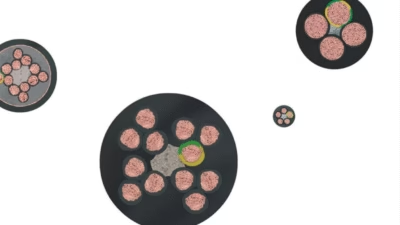
Highly Stable Construction
- Rubber Filler Between Conductors: Pressure-filled construction maintains circular geometry and prevents conductor movement during flexing
- Excellent Axial Rigidity: Resists elongation under tensile load while maintaining flexibility for bending
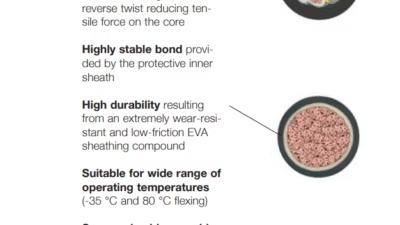
- Interlinked Co-Extruded Sheaths: Polyester insulation and PUR sheath are chemically bonded for superior resilience
- Small Dimensions: 2-layer stranding reduces overall cable diameter by 15-20% compared to conventional designs
- Short Stranding Lays with Reverse Twist: Optimized for energy chain applications to prevent conductor fatigue
Environmental and Health Benefits
- LBS-Free: Low Boiling Solvents free formulation prevents environmental contamination
- Silicone-Free: Prevents contamination in painting, coating, and clean room environments
- Recyclable: PUR materials can be recycled, unlike halogen-containing cables
- Microbial Resistance: PUR limits bacterial and microbe growth – essential for food & beverage industry
- Hygienic: Smooth outer surface is easy to clean and doesn’t harbor contaminants
4. Material Structure and Advanced Design
Conductor Construction
The foundation of 12YHRDC11YH cable performance lies in its ultra-flexible conductor design:
Conductor Specifications
- Material: Bare electrolytic copper (>99.9% purity, oxygen-free)
- Flexibility Class: Category 5 according to DIN VDE 0295 and IEC 60228
- Stranding: Fine wire strands (0.2-0.3mm diameter) in optimized lay configuration
- Special Design: Short stranding lays with reverse twist for energy chain applications
- Surface: Bare copper (no tinning required due to polyester insulation compatibility)
Polyester Core Insulation
Unlike conventional EPR or PVC insulation, 12YHRDC11YH uses polyester-based insulation:
Polyester Insulation Characteristics
- Material Type: Halogen-free polyester compound (designated 12YH)
- Temperature Rating: Continuous operation up to 90°C conductor temperature
- Dielectric Strength: Excellent electrical insulation properties for 600/1,000V rating
- Flexibility: Remains flexible across full temperature range (-40°C to +90°C)
- Halogen-Free: Contains no fluorine, chlorine, bromine, or iodine
- Chemical Compatibility: Works synergistically with PUR outer sheath
2-Layer Stranding Design
The cable employs advanced 2-layer stranding to achieve compact dimensions:
- First Layer: Individual insulated conductors are arranged in an inner layer around central filler
- Second Layer: Remaining conductors form outer layer with optimized lay length
- Filler Material: Rubber compound fills all interstitial spaces (pressure-filled extrusion)
- Result: 15-20% diameter reduction compared to single-layer stranding while maintaining flexibility
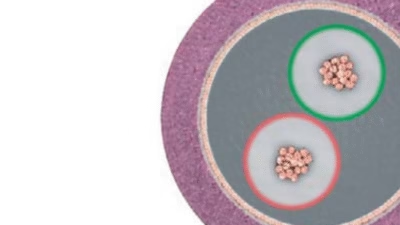
Braided Shield Construction (12YHRDC11YH)
The screened variant includes comprehensive EMF protection:
Shield Specifications
- Shield Material: Tinned copper wire braid (0.15-0.20mm diameter wires)
- Coverage: Approximately 85% optical coverage for effective EMF shielding
- Configuration Options:
- Inner shield over complete cable core (control and power cables)
- Screened pairs of conductors (bus cables for fieldbus applications)
- Shielding Effectiveness: >35dB attenuation across broad frequency spectrum
- Ground Continuity: Low DC resistance (<10 mΩ/m) for effective fault protection
Polyurethane (PUR) Outer Sheath
The protective outer sheath provides comprehensive mechanical and environmental protection:
| Property | Specification | Benefit |
|---|---|---|
| Base Material | Halogen-free polyurethane (designated 11YH) | Superior mechanical properties and environmental safety |
| Shore Hardness | 85-95 Shore A (typical) | Excellent abrasion resistance while maintaining flexibility |
| Tensile Strength | >35 N/mm² | High mechanical strength for demanding applications |
| Elongation at Break | >450% | Exceptional elasticity and flexibility retention |
| Abrasion Resistance | Superior to PVC and rubber | 5-10× longer service life in high-wear applications |
| Color | Black (standard), other colors available | UV stability and professional appearance |
Core Identification System
Conductor identification follows DIN 0293 color coding standards:
| Number of Conductors | Color Identification |
|---|---|
| Up to 5 conductors | Standard colors: Brown, Blue, Black, Grey, Green/Yellow |
| 6 or more conductors | White with black numbers + Green/Yellow protective earth |
| Power cables (4G) | Brown, Black, Grey (or Blue), Green/Yellow |
| Power cables (5G) | Brown, Black, Grey, Blue, Green/Yellow |
Interlinked Co-Extruded Technology
Advanced Manufacturing Process
The polyester insulation and PUR outer sheath are co-extruded and chemically bonded during the manufacturing process, creating a monolithic structure with superior properties:
- Delamination Prevention: Layers cannot separate under mechanical stress or chemical exposure
- Enhanced Mechanical Strength: Combined structure exceeds the sum of individual layer strengths
- Water Blocking: No interface pathways for moisture migration between layers
- Improved Flex Life: Unified structure eliminates interlayer friction during continuous bending
- Axial Rigidity: Resists cable elongation under tensile load (important for long festoon runs)
- Resilience: Excellent recovery from compression and deformation
Reference: Yifang Electric – PUR Cable Guide
5. Compliance with International Standards
Primary Manufacturing Standards
| Standard | Description | Scope |
|---|---|---|
| DIN VDE 0250 | German standard for flexible cables | Adapted standard for halogen-free PUR cables |
| DIN VDE 0295 | Conductor classification | Class 5 flexibility, stranding requirements |
| DIN VDE 0298-3 | Use of cables in power installations | Tensile load-bearing capacity (15 N/mm²) for moving cables |
| DIN VDE 0298-4 | Current-carrying capacity | Ampacity calculations and temperature limits |
| DIN 0293 | Core identification | Color coding of insulated conductors |
Halogen-Free and Fire Safety Standards
🌿 Halogen-Free Compliance
- IEC 60754-1: Test on gases evolved during combustion – Determination of halogen acid gas content
- IEC 60754-2: Determination of degree of acidity of gases (pH and conductivity measurement)
- IEC 62821: Electric cables – Halogen-free, low-smoke thermoplastic insulated cables (voltage rating up to 750V)
- DIN EN 50265-2-1: Low flammability test for cables (vertical flame propagation)
- Test Requirements: Halogen content <0.5% by weight; HCl gas release <100 mg/g material
Fire Performance Standards
- Low Flammability: Adapted to DIN EN 50265-2-1 (self-extinguishing properties)
- Smoke Density: Low smoke emission according to IEC 61034 (light transmittance >60%)
- Flame Retardancy: Prevents flame spread in vertical installation
- Non-Corrosive: No acid gas production per IEC 60754 testing
European Construction Products Regulation (CPR)
For cables permanently installed in buildings within the EU, 12YHRDC11YH cables can be manufactured to comply with:
- EN 50575: Power, control and communication cables – Cables for general applications in construction works subject to reaction to fire requirements
- CPR Classification: Typically achieves Cca, Dca, or Eca class depending on specific formulation
- AVCP: Assessment and Verification of Constancy of Performance certification
- DoP: Declaration of Performance documentation required for EU installations
Mechanical and Electrical Standards
- IEC 60228: Conductors of insulated cables (Class 5 flexible conductor specification)
- IEC 60332-1: Tests on electric cables under fire conditions – vertical flame test
- IEC 60364-5-52: Electrical installations – Selection and erection of electrical equipment
- EN 60811 Series: Insulation and sheathing materials – common test methods
Environmental and Safety Certifications
Compliance Certifications
- RoHS Compliance: Restriction of Hazardous Substances – free of lead, mercury, cadmium, and hexavalent chromium
- REACH Compliance: European chemicals regulation – no SVHC (Substances of Very High Concern)
- LBS-Free: Low Boiling Solvents free formulation for environmental protection
- Silicone-Free: Prevents contamination in sensitive manufacturing environments
- Halogen-Free: Zero fluorine, chlorine, bromine, iodine, or astatine content
- CE Marking: Compliance with applicable European Union directives
- ISO 9001: Quality management system certification for manufacturing
Testing and Type Approval
| Test Category | Test Parameters | Acceptance Criteria |
|---|---|---|
| Electrical Tests | AC test voltage 2.5kV (5 minutes), insulation resistance, conductor resistance | No breakdown, insulation resistance >20 MΩ·km |
| Mechanical Tests | Tensile strength, elongation, abrasion, flex life cycles | >500,000 flex cycles at 5× diameter bending radius |
| Temperature Tests | Low temp flexibility (-40°C), high temp aging (+90°C) | No cracking, hardening, or property degradation |
| Fire Tests | Vertical flame test, halogen content, smoke density | Self-extinguishing, <0.5% halogen, >60% light transmittance |
| Environmental Tests | Oil immersion, ozone exposure, UV aging, humidity | No visible deterioration after specified exposure periods |
Reference: CB Cables – LSZH Cable Standards and Applications
6. Electrical and Thermal Parameters
Voltage Ratings
| Parameter | Value | Application Notes |
|---|---|---|
| Rated Voltage (Uo/U) | 600/1,000 V AC | Standard rating (Uo = phase-to-ground, U = phase-to-phase) |
| Maximum AC Operating Voltage | 700/1,200 V AC | Permissible overvoltage for short periods |
| Maximum DC Operating Voltage | 900/1,800 V DC | For DC drive systems and traction applications |
| AC Test Voltage | 2.5 kV for 5 minutes | Factory type test voltage |
Current-Carrying Capacity (Ampacity)
Reference Conditions for Ampacity Ratings
- Ambient Temperature: 30°C (standard reference)
- Installation Method: Individual support at even surface (accumulation at support)
- Conductor Operating Temperature: 90°C continuous (higher than rubber cables at 60°C)
- Duty Cycle: 100% continuous operation at rated load
- Important Note: Deviating conditions require ampacity adjustment using DIN VDE 0298 part 4 derating factors
Sample Ampacity and Load Values
| Cable Type | Configuration | Ampacity (A) | Tensile Load (N) |
|---|---|---|---|
| Control Cable | 12G 1.5 | 9.5 | 270 |
| Control Cable | 24G 2.5 | 11.0 | 900 |
| Power 1-core | 1×70 | 245.0 | 1,050 |
| Power 1-core | 1×185 | 448.0 | 2,775 |
| Power 4-core | 4G 16 | 82.0 | 960 |
| Power 5-core | 5G 25 | 102.7 | 1,875 |
| Screened Control | 12G 1.5 C | 9.5 | 270 |
| Screened Power | 4G 25 C | 113.4 | 1,500 |
⚠ Ampacity Derating Factors
Actual current-carrying capacity must be adjusted for:
- Ambient Temperature: Derate by 10-15% for every 10°C above 30°C reference
- Grouping: Multiple cables in close proximity require derating per VDE 0298-4
- Installation Method: Enclosed conduits, cable trays, or bundled cables reduce ampacity
- Duty Cycle: Intermittent operation may allow higher currents; consult standards
- Energy Chains: Limited air circulation in drag chains typically requires 20-30% derating
Thermal Parameters
| Parameter | Flexing Application | Fixed Installation |
|---|---|---|
| Minimum Ambient Temperature | -40°C | -50°C |
| Maximum Ambient Temperature | +90°C | +90°C |
| Max Conductor Temperature | +90°C continuous operation | |
| Short-Circuit Temperature | +200°C (maximum 5 seconds) | |
Mechanical Load Capacity
| Parameter | Specification | Notes |
|---|---|---|
| Travel Speed | Up to 210 m/min (>210 on request) | Maximum trolley/crane travel speed |
| Bending Radius (Festoon) | 5 × Cable Outer Diameter | Minimum for festoon trolley applications |
| Bending Radius (Energy Chains) | 7.5 × Cable Outer Diameter | Minimum for drag chain applications (tighter bending) |
| Tensile Load Capacity | 15 N/mm² conductor area | Maximum during operation per DIN VDE 0298-3 |
| Torsional Stress | None | Cable should not be subjected to twisting forces |
Conductor DC Resistance (20°C)
Maximum conductor resistance values per DIN VDE 0295:
- 1.5mm²: ≤13.3 Ω/km
- 2.5mm²: ≤7.98 Ω/km
- 4mm²: ≤4.95 Ω/km
- 10mm²: ≤1.91 Ω/km
- 25mm²: ≤0.780 Ω/km
- 50mm²: ≤0.387 Ω/km
- 95mm²: ≤0.206 Ω/km
- 185mm²: ≤0.106 Ω/km
Temperature Coefficient: Resistance increases approximately 0.393% per °C for copper conductors
Reference: Angreen – PUR Cable Material Properties
7. Safety Thresholds and Environmental Benefits
Fire Safety Performance
🔥 Superior Fire Safety Characteristics
The halogen-free construction of 12YHRDC11YH cables provides critical safety advantages during fire events:
Low Smoke Emission:
- Visibility: Maintains >60% light transmittance (vs. <10% for PVC cables)
- Evacuation Time: Provides 5-10× longer visibility period for safe evacuation
- Firefighter Safety: Clear smoke allows firefighters to locate fire source and conduct rescue operations
- Smoke Color: Light gray/white smoke (vs. dense black smoke from PVC)
Zero Halogen Acid Gas:
- No HCl: Zero hydrogen chloride gas (PVC releases up to 30% HCl by weight)
- Non-Corrosive: No acid gas damage to electronics, motors, control systems, or building infrastructure
- Respiratory Safety: No corrosive gases that burn lungs and respiratory systems
- Environmental: No persistent environmental contamination from halogen compounds
Low Flammability:
- Self-Extinguishing: Cable stops burning when flame source is removed
- Flame Retardant: Prevents flame propagation along cable runs
- Vertical Test: Passes DIN EN 50265-2-1 vertical flame test
Personnel Safety Improvements
✓ Life Safety Benefits
Statistics show that 80% of fire fatalities result from toxic smoke and gases, not flames. Halogen-free cables address this critical safety issue:
- Extended Evacuation Time: 5-10 minutes additional visibility vs. 1-2 minutes with PVC cables
- Reduced Toxicity: No toxic halogen gases (HCl, HBr, HF) that cause rapid incapacitation
- Clear Visibility: Occupants can locate exits and escape routes during fire
- Reduced Panic: Better visibility reduces panic and improves orderly evacuation
- Firefighter Safety: Safer working conditions for first responders
Equipment Protection
Asset Protection from Fire Damage
Halogen-free cables significantly reduce equipment damage during and after fire events:
- No Acid Gas Corrosion: Electronics, circuit boards, and motor windings remain intact
- Reduced Secondary Damage: No corrosive residue requiring extensive decontamination
- Faster Recovery: Undamaged equipment can be restored to service more quickly
- Lower Insurance Costs: Many insurers recognize reduced fire damage risk with halogen-free installations
- Critical Systems Protection: Control rooms, data centers, and automation systems protected from acid gas damage
Environmental Safety
🌿 Environmental Benefits
- No Persistent Pollutants: No halogen compounds released into environment during fire or disposal
- Recyclable: PUR materials can be recycled without releasing toxic gases
- Reduced Waste Toxicity: End-of-life disposal does not contaminate soil or groundwater
- Lower Carbon Footprint: Manufacturing process generally has lower environmental impact than PVC
- Sustainable: Supports green building certifications (LEED, BREEAM)
- Regulatory Compliance: Meets increasingly stringent environmental regulations worldwide
Chemical and Environmental Resistance
| Environmental Factor | Resistance Level | Performance Rating |
|---|---|---|
| Mineral Oils | Excellent | Continuous immersion acceptable |
| Hydraulic Fluids | Excellent | No degradation in oil-based hydraulics |
| Water/Humidity | Excellent | 0-100% RH, outdoor installation suitable |
| UV Radiation | Excellent | UV-stabilized for outdoor use |
| Ozone | Excellent | No cracking in high-voltage environments |
| Atmospheric Corrosion | Unlimited | Coastal, industrial, chemical environments |
| Weak Acids/Alkalis | Good | Suitable for most industrial chemicals |
| Microbes/Bacteria | Excellent | Limits microbial growth (food industry) |
Regulatory Compliance Benefits
✓ Meeting Modern Safety Regulations
- EU CPR Compliance: Meets Construction Products Regulation for building installations
- Transportation Systems: Mandatory for rail, metro, and underground systems in many jurisdictions
- Public Buildings: Required in many EU countries for schools, hospitals, theaters, and assembly occupancies
- Tunnels: Mandatory for road and rail tunnels per tunnel safety directives
- Nuclear Facilities: Preferred for new nuclear plant construction
- Ships and Marine: Increasingly specified for shipboard and offshore installations
- Data Centers: Best practice for modern data center design
⚠ Safety Precautions
- Electrical Safety: Always verify proper grounding of protective earth conductor
- Overcurrent Protection: Install appropriate circuit breakers or fuses for conductor ampacity
- Periodic Testing: Conduct annual insulation resistance testing (minimum 1 MΩ acceptable)
- Fire Detection: Halogen-free cables reduce fire damage but do not eliminate fire risk – maintain proper fire detection systems
- Load Management: Never exceed rated ampacity; monitor loads in high-duty-cycle applications
8. Installation and Usage Precautions
Pre-Installation Planning
Critical Planning Steps
- Application Assessment: Determine if festoon trolley or energy chain application (affects minimum bending radius)
- Temperature Verification: Confirm ambient temperature range is within -40°C to +90°C specification
- Chemical Exposure: Verify compatibility with any chemicals present in operating environment
- Travel Speed: Confirm crane/trolley travel speed does not exceed 210 m/min (or arrange for higher-speed cable)
- EMC Requirements: Determine if screened variant (12YHRDC11YH with “C”) is required for EMF protection
- Ampacity Calculation: Calculate required conductor size based on load current, cable length, and derating factors
- Cable Length: For festoon systems, order 115-120% of travel distance to allow proper loop formation
Storage and Handling
- Storage Temperature: Store at -10°C to +40°C in dry, well-ventilated area
- Reel Protection: Keep reels covered to protect from UV exposure and contamination
- Reel Rotation: Rotate stored reels quarterly if storage exceeds 6 months
- Moisture Protection: Seal cable ends with heat-shrink or tape to prevent moisture ingress
- Handling Temperature: Allow cables to warm to >0°C before unreeling in cold weather
- Unreeling: Maintain 8× diameter minimum bend radius during unreeling process
- PUR Care: Avoid dragging PUR-sheathed cables across sharp edges or rough concrete
Installation for Festoon Trolley Systems
Festoon-Specific Installation Requirements
- Minimum Bending Radius: 5× cable outer diameter for all bend points
- Trolley Spacing: 1.5-2.5m intervals typical for standard applications
- Cable Loops: Allow cable to form natural catenary loops between trolleys
- Strain Relief: Install proper strain relief at both fixed and mobile termination points
- Cable Guidance: Ensure cable cannot contact sharp edges or moving machinery
- Track Alignment: Festoon track must be aligned within ±5mm over full length
- End Clamps: Secure cable without crushing or deforming the PUR sheath
- Travel Speed: Verify application is within 210 m/min specification
Installation for Energy Guiding Chains
Energy Chain (Drag Chain) Specific Requirements
- Minimum Bending Radius: 7.5× cable outer diameter (larger than festoon due to tighter bending)
- Chain Selection: Use chain with adequate inner height and width for cable bundle
- Cable Separation: Separate power and control cables with dividers in chain
- Fill Ratio: Do not exceed 50-60% fill ratio of chain cross-section
- Cable Routing: Route cables in neutral axis of chain (neither tension nor compression side)
- Reverse Twist Utilization: The cable’s reverse twist design prevents conductor fatigue in chains
- Chain Support: Provide proper support at fixed and moving ends of chain
- Travel Testing: Test full travel range before final installation to verify no binding or excessive friction
Termination Procedures
Professional Termination Best Practices
- PUR Sheath Removal: Use rotary cable stripper or very sharp knife; PUR is tougher than PVC and requires more force
- Shield Termination (if applicable): Carefully fold back tinned copper braid and secure with shield gland or grounding clamp
- Insulation Stripping: Strip polyester insulation to minimum required length (10-15mm typical)
- Conductor Preparation: Ensure no strand damage; do not over-twist fine strands
- Ferrule Installation: Use properly sized compression ferrules for all conductor terminations
- Crimping: Use calibrated hydraulic crimping tool; verify crimp quality by pull testing
- Torque Application: Tighten terminal screws to manufacturer specifications using torque wrench
- Strain Relief: Use cable glands with proper clamping force for PUR sheath
- Environmental Sealing: Install glands with appropriate IP rating (minimum IP54 for festoon, IP65+ for outdoor)
Operational Monitoring
| Monitoring Activity | Frequency | Action Items |
|---|---|---|
| Visual Inspection | Weekly | Check for abrasion, cuts, proper routing, and trolley/chain operation |
| Load Monitoring | Continuous | Monitor current draw; alarm at 90% of rated ampacity |
| Detailed Cable Inspection | Monthly | Examine full cable length, terminations, strain relief, bending points |
| System Service | Quarterly | Clean festoon tracks/chains, inspect trolley bearings, verify alignment |
| Electrical Testing | Semi-annually | Insulation resistance, earth continuity, shield continuity (if applicable) |
| Comprehensive Assessment | Annually | Full electrical testing, thermal imaging, flex life evaluation |
⚠ PUR-Specific Handling Precautions
- Sharp Tool Use: PUR is tougher than PVC; use sharp knives and rotary strippers
- Cold Weather: PUR can be stiffer in cold weather; allow cables to warm before installation
- Lubricants: Use silicone-free lubricants if needed for cable pulls
- Hydrolysis: For long-term high-humidity environments, specify polyether-based PUR (not polyester-based)
- UV Exposure: Although UV-resistant, minimize prolonged storage in direct sunlight before installation
- Chemical Spills: Clean up any strong acid or solvent spills immediately to prevent PUR degradation
⚠ NEVER Perform These Actions
- Install with bending radius less than 5× diameter (festoon) or 7.5× diameter (energy chains)
- Exceed travel speed of 210 m/min without consulting manufacturer
- Operate outside temperature range of -40°C to +90°C for flexing applications
- Use damaged cables with cuts, abrasions, or compromised sheath integrity
- Exceed rated ampacity even for short periods
- Install cables in environments with strong acids or organic solvents without compatibility verification
- Splice cables within festoon or energy chain runs (use proper junction boxes if absolutely necessary)
- Subject cables to torsional (twisting) stress during operation
9. Common Problems and Solutions
PUR-Specific Issues
Problem: PUR Sheath Hardening or Stiffening
Causes:
- Exposure to incompatible strong organic solvents (ketones, esters)
- Long-term exposure to warm water or high humidity with polyester-based PUR
- UV degradation from prolonged outdoor storage before installation
- Exceeding maximum operating temperature of +90°C
Solutions:
- Verify chemical compatibility before installation in industrial environments
- For high-humidity applications, specify polyether-based PUR (superior hydrolysis resistance)
- Store cables properly and minimize pre-installation UV exposure
- Monitor operating temperatures; ensure adequate ventilation if necessary
- If hardening has occurred, replace affected cable section
Problem: PUR Sheath Surface Tackiness
Causes:
- Migration of plasticizers to surface in high-temperature environments
- Chemical reaction with certain oils or cleaning agents
- Substandard PUR formulation with poor additive selection
Solutions:
- Clean surface with isopropyl alcohol or mild detergent solution
- Verify operating temperature is within specification
- Source cables from reputable manufacturers with proven PUR formulations
- Avoid contact with silicone-based lubricants and certain mineral oils
Energy Chain Specific Problems
Problem: Conductor Breakage in Energy Chains
Causes:
- Bending radius less than 7.5× cable diameter
- Excessive chain fill ratio causing cable compression
- Cable routed on tension or compression side of chain rather than neutral axis
- Chain acceleration/deceleration too rapid
- Exceeded design flex cycle life
Solutions:
- Verify actual chain bending radius exceeds 7.5× cable diameter
- Reduce cable fill to 50-60% of chain cross-section
- Route cables in neutral axis of chain using proper cable separators
- Implement soft-start/soft-stop controls to reduce acceleration shock
- Track flex cycles and implement predictive replacement program
Temperature-Related Issues
Problem: Cable Overheating
Causes:
- Conductor undersized for actual load and duty cycle
- Inadequate ampacity derating for energy chain or festoon installation
- Poor termination connections creating high resistance
- Ambient temperature exceeds 30°C reference without derating adjustment
Solutions:
- Perform thermal imaging to identify hot spots
- Recalculate ampacity using DIN VDE 0298-4 with proper derating factors
- Inspect and remake all terminations; verify proper ferrule crimping and torque
- If ambient >40°C, consider forced ventilation or cable upsizing
- Monitor conductor temperature if possible; alarm at 80°C
Mechanical Wear Problems
Problem: Premature Abrasion Wear
Causes:
- Contact with sharp edges on festoon track, chain, or structure
- Contamination (sand, metal chips) in festoon track or energy chain
- Insufficient trolley spacing causing excessive cable sag and dragging
- Vibration causing cable to rub against structure
Solutions:
- Install edge guards or protective covers over sharp edges
- Implement regular cleaning schedule for tracks and chains
- Add intermediate trolleys to reduce cable sag
- Install vibration dampers at fixed termination points
- Despite excellent abrasion resistance, PUR has limits; address root cause of excessive wear
Electrical Performance Issues
Problem: Insulation Resistance Degradation
Causes:
- Moisture ingress at cable ends or damaged sections
- Contamination from conductive dust or chemicals
- Internal damage from excessive bending or crushing
- Aging in extreme temperature environments
Solutions:
- Test insulation resistance with megger (expect >10 MΩ·km for good cable)
- Inspect terminations; reseal with proper IP-rated glands
- Clean cable surface if contaminated; dry thoroughly before retesting
- If internal damage suspected, replace affected cable section
- For cables in extreme environments, establish baseline and monitor trends
Installation Errors
⚠ Common Installation Mistakes
- Wrong Bending Radius: Using festoon specification (5×) for energy chain installation (requires 7.5×)
- Incorrect Variant: Using non-screened (12YHRD11YH) when EMF protection required (12YHRDC11YH)
- Inadequate Cable Length: Not allowing 115-120% of travel distance for festoon systems
- Poor Chain Installation: Routing cables on tension/compression side instead of neutral axis
- Temperature Derating Ignored: Not derating ampacity for actual ambient temperature
- PUR Handling: Using dull tools that tear PUR sheath instead of cutting cleanly
Diagnostic Procedures
Systematic Troubleshooting Approach
- Visual Inspection: Examine cable for cuts, abrasions, deformation, or discoloration
- Electrical Testing:
- Insulation resistance: Conductor-to-conductor and conductor-to-shield (>1 MΩ acceptable, >10 MΩ good)
- Earth continuity: <0.5Ω for protective earth conductor
- Shield continuity (if applicable): <10 mΩ/m for braided shield
- Conductor resistance: Compare to specifications to detect internal damage
- Thermal Assessment: Use IR camera under load to identify overheating connections or conductors
- Mechanical Evaluation:
- Measure actual bending radii at all critical points
- Check trolley/chain operation and alignment
- Verify clearances and inspect for collision damage
- Assess cable flexibility – compare to new cable sample
- Environmental Check: Verify operating temperature, chemical exposure, and humidity levels
Reference: LAPP Group – PUR Cable Troubleshooting
10. Selection Guidelines and Comparisons
When to Specify 12YHRDC11YH / 12YHRD11YH
✓ Ideal Applications for TXP-4 PUR Cables
12YHRDC11YH cables are the optimal choice when your application includes these requirements:
- Halogen-Free Requirement: Fire safety regulations or insurance requirements mandate halogen-free cables
- Broad Temperature Range: Operating temperatures from -40°C to +90°C in flexing applications
- Superior Abrasion Resistance: High-wear environments requiring maximum cable service life
- Oil Resistance: Continuous exposure to mineral oils, hydraulic fluids, or lubricants
- Dual Application: Need for both festoon trolley and energy chain suitability
- Food & Beverage: Hygienic environments requiring microbial-resistant cables
- Environmental Compliance: REACH, RoHS, and CPR compliance required
- Premium Performance: Priority on reliability, durability, and safety over initial cost
12YHRDC11YH vs. H07RN-F Comparison
| Feature | 12YHRDC11YH (PUR) | H07RN-F (Rubber) |
|---|---|---|
| Sheath Material | Polyurethane (PUR) | Polychloroprene (Rubber) |
| Halogen Content | Halogen-Free (0%) | Contains chlorine from neoprene |
| Fire Safety | Low smoke, no toxic gases | Moderate smoke, HCl gas |
| Temp Range (Flexing) | -40°C to +90°C | -30°C to +60°C |
| Max Conductor Temp | 90°C | 60°C |
| Abrasion Resistance | Superior (5-10× better) | Good |
| Oil Resistance | Excellent | Good |
| Flexibility | Excellent (5× diameter) | Excellent (5× diameter) |
| Energy Chain Suitable | Yes (7.5× diameter) | Limited |
| Microbial Resistance | Excellent | Fair |
| Environmental | RoHS, REACH compliant | Some chlorine content |
| Relative Cost | Premium (120-150% of H07RN-F) | Standard baseline |
| Typical Service Life | 8-15 years | 5-8 years |
Screened vs. Non-Screened Selection
12YHRDC11YH (Screened) vs. 12YHRD11YH (Non-Screened)
Choose Screened (12YHRDC11YH) when:
- Sensitive electronic controls or automation systems are present
- EMC compliance required per EN 55011/55022
- Cable runs parallel to high-power cables
- Data or communication signals share cable bundle
- VFD (variable frequency drive) powered motors are used
- Process control requires noise-free signal transmission
Choose Non-Screened (12YHRD11YH) when:
- Pure power transmission with no sensitive electronics
- Cost optimization is priority
- No EMC requirements in application environment
- Simple on/off motor control without VFDs
Configuration Selection Guidelines
| Application Type | Recommended Configuration | Typical Sizes |
|---|---|---|
| Complex Control Systems | Control cables screened | 12G1.5C, 18G1.5C, 12G2.5C, 18G2.5C |
| Simple Control Circuits | Control cables non-screened | 4G1.5, 7G1.5, 4G2.5, 5G2.5 |
| Three-Phase Power (Low) | 4-core or 5-core power cables | 4G4, 5G4, 4G6, 5G6 |
| Three-Phase Power (Medium) | 4-core or 5-core power cables | 4G16, 5G16, 4G25, 5G25 |
| High-Current Single Phase | Single-core cables | 1×70, 1×95, 1×120, 1×150 |
| VFD Motor Circuits | Screened 4-core power | 4G10C, 4G16C, 4G25C, 4G35C |
| Fieldbus/Data | Bus cables screened pairs | 6×(2×1)C (RXP-8 model) |
Total Cost of Ownership Analysis
💰 Economic Justification for PUR Cables
While 12YHRDC11YH cables cost 120-150% more than standard H07RN-F initially, total cost of ownership is often lower:
Direct Cost Benefits:
- Extended Service Life: 8-15 years vs. 5-8 years (50-100% longer service life)
- Reduced Replacement Frequency: Fewer cable replacements over facility lifetime
- Lower Maintenance Costs: Fewer inspections and repairs due to superior durability
- Reduced Downtime: Higher reliability means fewer unplanned production stops
Indirect Cost Benefits:
- Fire Safety: Reduced fire damage and faster recovery lowers insurance premiums
- Equipment Protection: No acid gas corrosion extends life of expensive equipment
- Regulatory Compliance: Avoids costly retrofits when regulations change
- Environmental: Supports sustainability goals and green building certifications
- Reputation: Demonstrates commitment to safety and environmental responsibility
Risk Mitigation:
- Life Safety: Priceless value of improved personnel safety during fire events
- Business Continuity: Reduced risk of major fire damage to facility
- Liability: Lower liability exposure with documented use of safety-rated cables
Procurement Specifications
When preparing procurement documents for 12YHRDC11YH cables, include:
- Cable type designation: 12YHRDC11YH (screened) or 12YHRD11YH (non-screened) per DIN VDE 0250
- Rated voltage: 600/1,000V AC
- Number of cores and conductor cross-section (e.g., 5G16, 12G2.5C, 1×95C)
- Application: Festoon trolley and/or energy guiding chains
- Required cable lengths and cutting tolerance (±1%)
- Packaging requirements: reels preferred for festoon applications
- Halogen-free certification: IEC 60754-1/2 test reports required
- Test certificates: Electrical tests, flame retardancy, shield continuity (if screened)
- Environmental compliance: RoHS, REACH, CPR (if applicable)
- Manufacturer certifications: ISO 9001 quality management
- Delivery schedule and storage requirements
- Warranty period: Typically 24-36 months from delivery
✓ Quality Verification Checklist
- Verify cable marking includes “12YHRDC11YH” or “12YHRD11YH” designation
- Check halogen-free certification documents (IEC 60754 test reports)
- Verify cable flexibility (should bend easily at 5× diameter)
- Confirm PUR sheath has smooth, uniform surface without tackiness
- Verify shield presence and coverage (if screened variant)
- Check conductor color coding matches DIN 0293 standards
- Verify cable weight matches specifications (PUR is denser than PVC)
- Confirm manufacturer ISO 9001 certification
Reference: R&M – Advantages of PUR for Cable Jackets
Conclusion
The 12YHRDC11YH Type TXP-4 PUR round cable represents the convergence of advanced material technology, environmental responsibility, and superior engineering design. Its halogen-free polyurethane construction delivers exceptional fire safety performance, broader operating temperature range, superior mechanical properties, and environmental compliance that conventional PVC and rubber cables cannot match. The dual application capability for both festoon trolley systems and energy guiding chains, combined with outstanding chemical resistance and microbial inhibition properties, makes these cables the preferred choice for modern industrial installations prioritizing safety, reliability, and sustainability.
For engineers, safety managers, and procurement specialists working with crane systems, automated production lines, and material handling equipment in safety-conscious or environmentally regulated facilities, understanding the comprehensive technical specifications, halogen-free advantages, and proper installation procedures of 12YHRDC11YH cables is essential. While the initial investment is higher than conventional cables, the superior performance, extended service life, enhanced safety, reduced fire damage risk, and environmental benefits provide excellent total cost of ownership and demonstrate corporate commitment to personnel safety and environmental stewardship.
Contact Anhui Feichun Special Cable Co., Ltd. for Expert Support
For technical consultation, halogen-free cable specifications, or procurement of 12YHRDC11YH highly flexible PUR crane festoon cables, our team of specialists is ready to assist you in selecting the optimal halogen-free cable solution for your safety-critical applications.
References and Further Reading
- SAB Cable – PUR Cables & Wires Technical Data and Applications
- Central Wires – PUR Cable Benefits and Differences
- Banner Engineering – PVC Cable or PUR Cable: How to Choose
- Angreen – Durable PUR Cable Material for Harsh Environments
- Yifang Electric – Cable Guide: PUR Cable
- Eland Cables – PUR Cables Technical Specifications
- LAPP Group – Polyurethane / High Tough Cables
- CB Cables – When to Use Low Smoke Zero Halogen (LSZH) Cables
- SAB Cable – Halogen-Free Cable Fire Protection
- Digi-Key – Get to Know Low-Smoke Zero-Halogen (LSZH) Cables
- Wikipedia – Low Smoke Zero Halogen Technology
- Eland Cables – LSZH Cable Technical Information
- R&M – Advantages of PUR for Cable Jackets
- IEC Webstore – International Electrotechnical Standards
- VDE – German Association for Electrical, Electronic & Information Technologies
[…] FeiChun Cable, What is 12YHRDC11YH Cable? (TXP-4 PUR round cable). [страница] […]