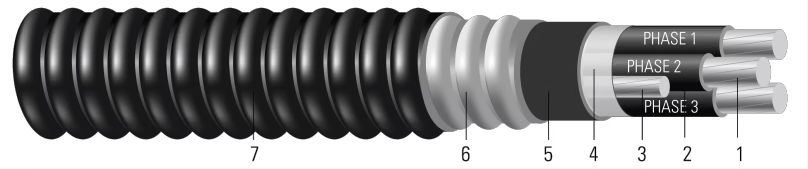
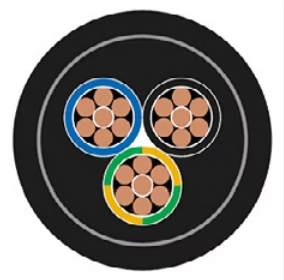
![PVC Linear Chain Architecture—Structural Vulnerability: Polyvinyl chloride (PVC) consists of linear polymer backbone: −[CH₂−CHCl]−n−, where each carbon-chlorine bond (C−Cl) is polar. PVC chosen historically for cables due to: (1) easy extrusion (processing temp ~200°C), (2) inherent flame retardancy (chlorine atoms suppress combustion), (3) low cost. However, linear structure has critical weakness: polymer chains held together only by van der Waals forces + few covalent cross-links (vs XLPE which is heavily cross-linked via peroxide or electron beam). Consequence: thermal energy at elevated temperature (60–80°C) causes thermal motion to exceed van der Waals bond energy, enabling chain slip + bond breakage. Thermal Oxidation Cascade—Free Radical Chain Reaction: At 70°C (GOST PVC design limit in mines): (1) Heat causes C−H bond scission (bond dissociation energy ~350 kJ/mol), generating alkyl radicals R•, (2) R• + O₂ (from air + moisture) → peroxyl radical ROO•, (3) ROO• + polymer chain → hydroxyl group −OH + new radical, (4) Repeat step 3 creates chain reaction (one broken bond triggers cascade), (5) Net result: polymer backbone breaks into smaller fragments (molecular weight drops), material becomes brittle. Oxidation rate: approximately ∝ exp(E_a/RT) per Arrhenius law, so 10°C increase ~2–3× oxidation rate.](https://feichuncables.com/blog/wp-content/uploads/image-1013-929x702.avif "КШВЭБбШв-6 kV Material Science Deep-Dive: PVC vs XLPE Thermal Aging & Lifespan Physics 1")
КШВЭБбШв-6 kV Material Science Deep-Dive: PVC vs XLPE Thermal Aging & Lifespan Physics
PVC Linear Chain Architecture—Structural Vulnerability: Polyvinyl chloride (PVC) consists of linear polymer backbone: −[CH₂−CHCl]−n−, where each carbon-chlorine bond (C−Cl) is polar. PVC chosen historically for cables due to: (1) easy extrusion (processing temp ~200°C), (2) inherent flame retardancy (chlorine atoms suppress combustion), (3) low cost. However, linear structure has critical weakness: polymer chains held together only by van der Waals forces + few covalent cross-links (vs XLPE which is heavily cross-linked via peroxide or electron beam). Consequence: thermal energy at elevated temperature (60–80°C) causes thermal motion to exceed van der Waals bond energy, enabling chain slip + bond breakage.
Thermal Oxidation Cascade—Free Radical Chain Reaction: At 70°C (GOST PVC design limit in mines): (1) Heat causes C−H bond scission (bond dissociation energy ~350 kJ/mol), generating alkyl radicals R•, (2) R• + O₂ (from air + moisture) → peroxyl radical ROO•, (3) ROO• + polymer chain → hydroxyl group −OH + new radical, (4) Repeat step 3 creates chain reaction (one broken bond triggers cascade), (5) Net result: polymer backbone breaks into smaller fragments (molecular weight drops), material becomes brittle. Oxidation rate: approximately ∝ exp(E_a/RT) per Arrhenius law, so 10°C increase ~2–3× oxidation rate.


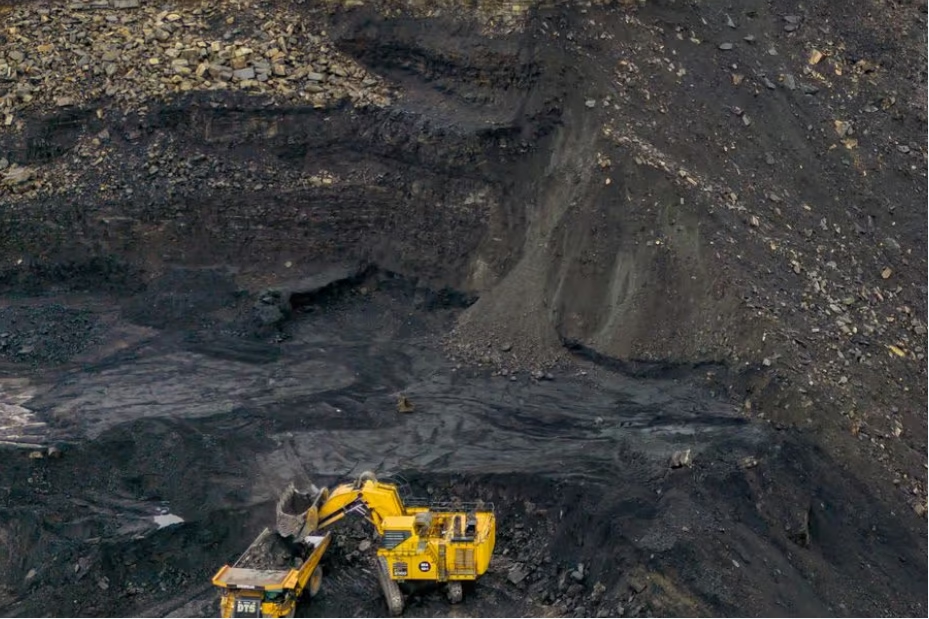
![(N)TSKCGEWÖU specifications. This protective layer serves multiple critical functions within the cable assembly, with mechanical stress redistribution being among its most important roles. According to research published by Sibelco, the bedding compound is defined as the material applied around insulated conductors to maintain their position and provide bedding for protective armoring.[1] This layer functions as an intermediary component positioned between the laid-up cores and the metallic armor, creating what cable engineers describe as a separation sheath that fundamentally alters how mechanical forces are distributed throughout the cable structure.](https://feichuncables.com/blog/wp-content/uploads/image-596.avif "Inner Sheath Function: Mechanical Stress Redistribution in (N)TSKCGEWÖU Cables 7")