
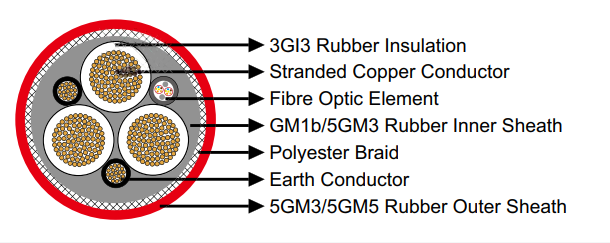
(N)TSCGEWOEU Fiber Cable
Smart Mining Equipment with Integrated Fiber Optic Communications
Smart Systems Technical Support:
Anhui Feichun Special Cable Co., Ltd.
Industry 4.0 Smart Mining Cable Technology
The (N)TSCGEWOEU medium voltage reeling cable with integrated fiber optics represents the future of intelligent mining operations. This revolutionary hybrid cable combines robust power transmission with high-speed data communication, enabling real-time monitoring, predictive maintenance, and autonomous operation of heavy mining equipment including excavators, spreaders, and gantry cranes in the most demanding industrial environments.
🤖 Smart Equipment Applications
- Autonomous excavators with real-time telemetry systems
- Intelligent spreaders with predictive maintenance monitoring
- Smart gantry cranes with load optimization algorithms
- Connected construction machinery for fleet management
- IoT-enabled material handling systems
- Remote-controlled mining equipment operations
🌐 Industry 4.0 Integration Features
- 12-core fiber optic data transmission backbone
- Real-time equipment health monitoring and diagnostics
- Motorized reeling compatibility (monospiral/level-wind)
- Integrated power and communication in single cable
- Edge computing and AI analytics support
- Cloud connectivity for fleet management systems
Advanced Fiber Optic Communication Systems
💡 Smart Mining Innovation
The integrated 12-core fiber optic system enables simultaneous power delivery and high-bandwidth data transmission, supporting advanced applications like machine vision, AI-driven automation, and real-time optimization algorithms essential for modern autonomous mining operations.
Fiber Optic Configuration Options
Multimode 50/125μm
Bandwidth: Up to 10Gbps over 300m
Applications: High-speed equipment networks, video transmission
Advantage: Cost-effective for medium-distance connections
Multimode 62.5/125μm
Bandwidth: 1Gbps over 300m
Applications: Legacy system integration, sensor networks
Advantage: Wide compatibility with existing infrastructure
Singlemode E9/125μm
Bandwidth: 100Gbps over 40km+
Applications: Mine-to-control room links, wide area networks
Advantage: Maximum distance and bandwidth capability
Global Smart Mining Standards & Fiber Optic Compliance
Hybrid power and fiber optic cables must meet both electrical safety and telecommunications standards. Understanding international compliance requirements is essential for global smart mining deployments and interoperability.
🇩🇪 German VDE Standard
VDE 0250-813 for power + ITU fiber optic standards compliance
🇪🇺 European Harmonized
European power cable + fiber optic communication standards
🇬🇧 British Standard
UK medium voltage + optical fiber cable specifications
🇺🇸 American Standard
US portable power + telecommunications fiber cable standards
🇦🇺 Australian Standard
Australian mining cable + optical fiber communication standards
🇨🇳 Chinese National
Chinese mining cable + fiber optic communication standards
Hybrid Cable Architecture & Smart Materials Engineering
Power Transmission System
Conductors: Class 5 flexible stranded copper
Semiconductive Layers: Electric field stress control
Insulation: EPR type 3GI3 for voltage classes up to 18/30kV
Earth System: Split conductor design in outer interstices
Fiber Optic Communication
Configuration: 12-core fiber bundle within protective sheath
Protection: Individual fiber coating and collective buffering
Materials: Low-loss glass fibers with UV-resistant jacketing
Performance: High-bandwidth data transmission up to 100Gbps
Mechanical Protection System
Inner Sheath: Rubber type GM1b/5GM3 for cable core protection
Reinforcement: Polyester anti-torsion braid for reeling applications
Outer Sheath: Rubber type 5GM3/5GM5 flame retardant compound
Design: Optimized for motorized reeling systems
Comprehensive Hybrid Cable Specifications
3.6/6kV Smart Mining Configuration
| Power Cores | Earth Cores | Fiber Optics | Min Ø Diameter | Max Ø Diameter | Weight | Data Bandwidth |
|---|---|---|---|---|---|---|
| 3×25 mm² | 2×25/2 mm² | 12×LWL | 39.0 mm | 42.0 mm | 2410 kg/km | 10 Gbps |
| 3×35 mm² | 2×25/2 mm² | 12×LWL | 42.0 mm | 45.0 mm | 2995 kg/km | 10 Gbps |
| 3×50 mm² | 2×25/2 mm² | 12×LWL | 45.0 mm | 48.0 mm | 3645 kg/km | 10 Gbps |
| 3×70 mm² | 2×35/2 mm² | 12×LWL | 50.0 mm | 54.0 mm | 4760 kg/km | 10 Gbps |
| 3×95 mm² | 2×50/2 mm² | 12×LWL | 54.0 mm | 58.0 mm | 5580 kg/km | 10 Gbps |
| 3×120 mm² | 2×70/2 mm² | 12×LWL | 58.0 mm | 62.0 mm | 6690 kg/km | 10 Gbps |
| 3×150 mm² | 2×70/2 mm² | 12×LWL | 63.0 mm | 67.0 mm | 7990 kg/km | 10 Gbps |
| 3×185 mm² | 2×95/2 mm² | 12×LWL | 67.0 mm | 72.0 mm | 9330 kg/km | 10 Gbps |
6/10kV Smart Mining Configuration
| Power Cores | Earth Cores | Fiber Optics | Min Ø Diameter | Max Ø Diameter | Weight | Data Bandwidth |
|---|---|---|---|---|---|---|
| 3×25 mm² | 2×25/2 mm² | 12×LWL | 40.0 mm | 43.0 mm | 2450 kg/km | 10 Gbps |
| 3×35 mm² | 2×25/2 mm² | 12×LWL | 43.0 mm | 46.0 mm | 3035 kg/km | 10 Gbps |
| 3×50 mm² | 2×25/2 mm² | 12×LWL | 46.0 mm | 49.0 mm | 3690 kg/km | 10 Gbps |
| 3×70 mm² | 2×35/2 mm² | 12×LWL | 51.0 mm | 55.0 mm | 4800 kg/km | 10 Gbps |
| 3×95 mm² | 2×50/2 mm² | 12×LWL | 55.0 mm | 59.0 mm | 5620 kg/km | 10 Gbps |
| 3×120 mm² | 2×70/2 mm² | 12×LWL | 59.0 mm | 63.0 mm | 6740 kg/km | 10 Gbps |
| 3×150 mm² | 2×70/2 mm² | 12×LWL | 64.0 mm | 68.0 mm | 8040 kg/km | 10 Gbps |
| 3×185 mm² | 2×95/2 mm² | 12×LWL | 68.0 mm | 72.0 mm | 9380 kg/km | 10 Gbps |
12/20kV Smart Mining Configuration
High-voltage class optimized for large autonomous mining equipment with comprehensive IoT integration and real-time analytics.
18/30kV Smart Mining Configuration
Ultra-high voltage class for the largest autonomous mining operations with advanced AI-driven optimization systems.
Smart Mining Cable Technology FAQ
How does integrated fiber optic communication enhance mining equipment performance?
Integrated fiber optic communication revolutionizes mining equipment operation by enabling real-time data transmission for predictive maintenance, autonomous navigation, and operational optimization. The 12-core fiber system supports high-bandwidth applications including machine vision, AI processing, and fleet coordination. This allows for immediate response to equipment conditions, reduced downtime through predictive analytics, and improved safety through remote monitoring capabilities. The fiber integration eliminates the need for separate communication cables, reducing installation complexity and maintenance requirements.
What Industry 4.0 applications are supported by this hybrid cable system?
The hybrid cable enables comprehensive Industry 4.0 implementations including digital twin creation, edge computing, AI-driven optimization, and real-time equipment health monitoring. Applications include autonomous excavator control, intelligent load management for cranes, predictive maintenance systems, fleet management networks, environmental monitoring, and safety systems integration. The high-bandwidth fiber optic system supports advanced protocols like TSN (Time-Sensitive Networking), OPC UA, and industrial Ethernet, enabling seamless integration with modern mining automation architectures.
How do motorized reeling systems work with fiber optic integration?
Motorized reeling systems (monospiral and level-wind) are specifically engineered to accommodate the fiber optic elements through careful cable design and reeling parameters. The anti-torsion braid reinforcement prevents fiber stress during winding/unwinding cycles. Controlled reeling speeds and tension limits protect the delicate fiber cores while maintaining data transmission integrity. The cable construction includes specialized fiber routing and protection that allows continuous flexing without signal degradation. Advanced reeling systems include fiber optic slip rings or rotary joints at the connection points to maintain continuous data paths.
What are the key considerations for fiber optic cable selection in mining applications?
Fiber selection depends on transmission distance, bandwidth requirements, and environmental conditions. Multimode 50/125μm fibers are optimal for high-speed equipment networks up to 300m with 10Gbps capability. Singlemode E9/125μm fibers support long-distance connections (>2km) and ultra-high bandwidth applications. Consider bend radius limitations, temperature cycling effects, and mechanical protection requirements. The integrated design must balance fiber performance with power transmission needs while maintaining overall cable flexibility for reeling applications.
How does the split earth conductor design benefit smart mining operations?
The split earth conductor configuration (2×earth cores in outer interstices) provides redundant grounding paths essential for safety in smart mining operations. This design ensures reliable earthing even if one conductor fails, crucial for equipment operating with sensitive electronic systems. The split arrangement also allows for differential grounding schemes, supporting advanced EMI suppression for fiber optic signals and reducing electromagnetic interference that could affect data transmission quality. This configuration enhances overall system reliability and electromagnetic compatibility in complex automation environments.
What maintenance practices ensure optimal hybrid cable performance?
Hybrid cable maintenance requires both electrical and optical testing protocols. Regular optical time-domain reflectometry (OTDR) testing identifies fiber degradation or damage. Power circuit testing includes insulation resistance, continuity, and thermal imaging. Monitor reeling system parameters to prevent over-stressing. Implement condition monitoring through the fiber optic system itself – using embedded sensors for cable health monitoring. Maintain proper reeling parameters including tension limits, speed controls, and environmental protection. Schedule regular cleaning of optical connectors and inspection of cable routing to prevent mechanical damage.


