
(N)SHOEU Industrial Cable
0.6/1kV Heavy-Duty Mining & Industrial Applications
Professional Mining Cable Solution
The (N)SHOEU 0.6/1kV flexible cable represents cutting-edge engineering in heavy-duty industrial power transmission. Specifically engineered for demanding mining environments, this cable delivers exceptional performance in excavator operations, conveyor belt systems, and submersible pump installations where continuous mechanical stress and movement are inevitable.
🏭 Primary Applications
- Open-cast mining excavator operations
- Mobile conveyor belt systems
- Submersible pump installations (ascending pipe earth conductor)
- Heavy machinery with continuous movement requirements
- Industrial equipment requiring flexible power transmission
⚡ Key Technical Features
- VDE 0250 Part 812 compliance certification
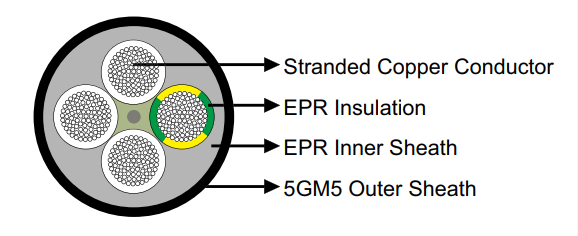
- Class 5 flexible stranded copper conductors
- EPR insulation system for superior dielectric properties
- 5GM5 outer sheath for mechanical protection
- Voltage rating: 0.6/1kV operational capacity
International Cable Designations & Regional Codes
The (N)SHOEU cable system is recognized under various international standards and regional coding systems. Understanding these designations is crucial for procurement and compliance in different markets.
🇩🇪 German Standard (VDE)
Primary designation under VDE 0250-812
🇪🇺 European Harmonized
Harmonized European designation equivalent
🇬🇧 British Standard
UK equivalent for mining applications
🇺🇸 North American
US/Canadian portable cord equivalent
🇦🇺 Australian Standard
Australian/New Zealand mining cable standard
🇨🇳 Chinese National
Chinese standard for flexible cables
Advanced Cable Construction Analysis
Engineering Note
The multi-layer construction design ensures optimal flexibility while maintaining electrical integrity under severe mechanical stress conditions typical in mining environments.
Conductor Specification
Material: High-conductivity oxygen-free copper
Construction: Flexible stranded Class 5 (DIN VDE 0295/IEC 60228)
Advantage: Maximum flexibility with minimal conductor resistance
Insulation System
Primary Insulation: Ethylene Propylene Rubber (EPR)
Inner Sheath: EPR compound for additional protection
Benefit: Excellent thermal and chemical resistance
Protective Sheathing
Outer Sheath: CM type 5GM5 compound
Earth Conductor: Integrated 4th core or split configuration
Performance: Superior abrasion and impact resistance
Comprehensive Technical Specifications
(N)SHOEU-J Configuration (With Earth Conductor)
| Cores × Cross Section | Insulation Thickness | Inner Sheath | Outer Sheath | Min Ø Diameter | Max Ø Diameter | Weight |
|---|---|---|---|---|---|---|
| 3×1.0 mm² | 0.60 mm | 0.8 mm | 1.2 mm | 9.2 mm | 9.6 mm | 160 kg/km |
| 3×1.5 mm² | 0.60 mm | 0.8 mm | 1.2 mm | 10.4 mm | 12.0 mm | 180 kg/km |
| 3×2.5 mm² | 0.70 mm | 0.8 mm | 1.2 mm | 11.3 mm | 12.9 mm | 240 kg/km |
| 3×4 mm² | 0.80 mm | 0.9 mm | 1.3 mm | 12.5 mm | 14.1 mm | 295 kg/km |
| 3×6 mm² | 0.80 mm | 1.0 mm | 1.4 mm | 13.9 mm | 15.5 mm | 370 kg/km |
| 3×10 mm² | 1.00 mm | 1.0 mm | 1.4 mm | 16.8 mm | 18.8 mm | 570 kg/km |
| 3×50+3×25/3 mm² | 1.10 mm | 1.4 mm | 2.5 mm | 31.5 mm | 34.5 mm | 2500 kg/km |
| 3×70+3×35/3 mm² | 1.10 mm | 1.4 mm | 2.5 mm | 36.2 mm | 39.2 mm | 3400 kg/km |
| 3×95+3×50/3 mm² | 1.20 mm | 1.7 mm | 2.8 mm | 42.0 mm | 45.0 mm | 4475 kg/km |
| 3×120+3×70/3 mm² | 1.20 mm | 2.0 mm | 3.0 mm | 46.0 mm | 49.0 mm | 5400 kg/km |
4-Core Standard Configurations
| Configuration | Insulation | Inner Sheath | Outer Sheath | Overall Diameter | Weight |
|---|---|---|---|---|---|
| 4×1.5 mm² | 0.60 mm | 0.8 mm | 1.2 mm | 10.7-13.0 mm | 210 kg/km |
| 4×2.5 mm² | 0.70 mm | 0.9 mm | 1.4 mm | 11.7-13.7 mm | 260 kg/km |
| 4×4 mm² | 0.80 mm | 0.9 mm | 1.4 mm | 13.7-15.7 mm | 350 kg/km |
| 4×6 mm² | 0.80 mm | 1.0 mm | 1.4 mm | 15.2-17.2 mm | 485 kg/km |
| 4×10 mm² | 1.00 mm | 1.0 mm | 1.6 mm | 19.0-21.0 mm | 690 kg/km |
| 4×25 mm² | 1.00 mm | 1.3 mm | 2.2 mm | 26.5-29.5 mm | 1600 kg/km |
| 4×50 mm² | 1.10 mm | 1.5 mm | 2.6 mm | 34.5-38.5 mm | 2700 kg/km |
| 4×120 mm² | 1.20 mm | 2.0 mm | 3.3 mm | 51.0-55.0 mm | 6020 kg/km |
Configuration Comparison Analysis
(N)SHOEU-J Series
Earth Conductor: Integrated 4th core or tri-split design
Best for: Submersible pumps, ascending pipe earth systems
Advantage: Superior earthing performance in wet environments
(N)SHOEU-O Series
Configuration: Multi-core without dedicated earth
Best for: Standard excavator operations, conveyor systems
Advantage: Enhanced flexibility, cost-effective solution
Single Core Variants
Range: 16mm² to 300mm² cross-sections
Best for: High-current applications, welding equipment
Advantage: Maximum current carrying capacity
Frequently Asked Questions
What makes (N)SHOEU cables suitable for mining applications?
The (N)SHOEU cable incorporates Class 5 flexible copper conductors and EPR insulation specifically engineered for continuous mechanical stress. The 5GM5 outer sheath provides exceptional abrasion resistance, while the VDE 0250-812 standard ensures compliance with European mining safety regulations. The cable maintains electrical integrity even under severe flexing conditions typical in excavator and conveyor operations.
How do I select the correct cross-sectional area for my application?
Cross-sectional area selection depends on current load, voltage drop considerations, and environmental factors. For excavator applications, typically 4×25mm² to 4×70mm² configurations are used. Conveyor systems often utilize 3×16mm² to 3×35mm² depending on motor power. Submersible pumps require earth conductor variants (J-series) with sizing based on pump motor specifications and cable length.
What is the difference between -J and -O series configurations?
The -J series incorporates a dedicated earth conductor either as a 4th core or split into outer interstices, making it ideal for submersible pump applications where the ascending pipe serves as earth conductor. The -O series represents standard multi-core configurations without dedicated earthing, suitable for general excavator and conveyor applications with separate earthing arrangements.
Can these cables be used in underwater applications?
While (N)SHOEU cables feature water-resistant EPR insulation and robust sheathing, they are not specifically designed for continuous submersion. For underwater applications, consider specialized submarine cables with enhanced moisture barriers. However, the -J series with integrated earth conductor is suitable for submersible pump applications where temporary water exposure occurs.
What temperature range can these cables operate in?
EPR insulation allows continuous operation from -40°C to +90°C, with short-term emergency overload capability up to +130°C. The 5GM5 outer sheath maintains flexibility down to -25°C. For extreme cold applications below -40°C, consider specialized Arctic-grade compounds or heating systems to maintain cable flexibility.
How do I calculate voltage drop for long cable runs?
Voltage drop calculation requires conductor resistance, current load, and cable length. For copper conductors at 20°C, use resistance values from IEC 60228. Formula: Voltage Drop = (ρ × L × I) / A, where ρ = resistivity, L = length, I = current, A = cross-sectional area. For mining applications, limit voltage drop to 3% for motor starting and 5% for continuous operation to ensure proper equipment performance.


