
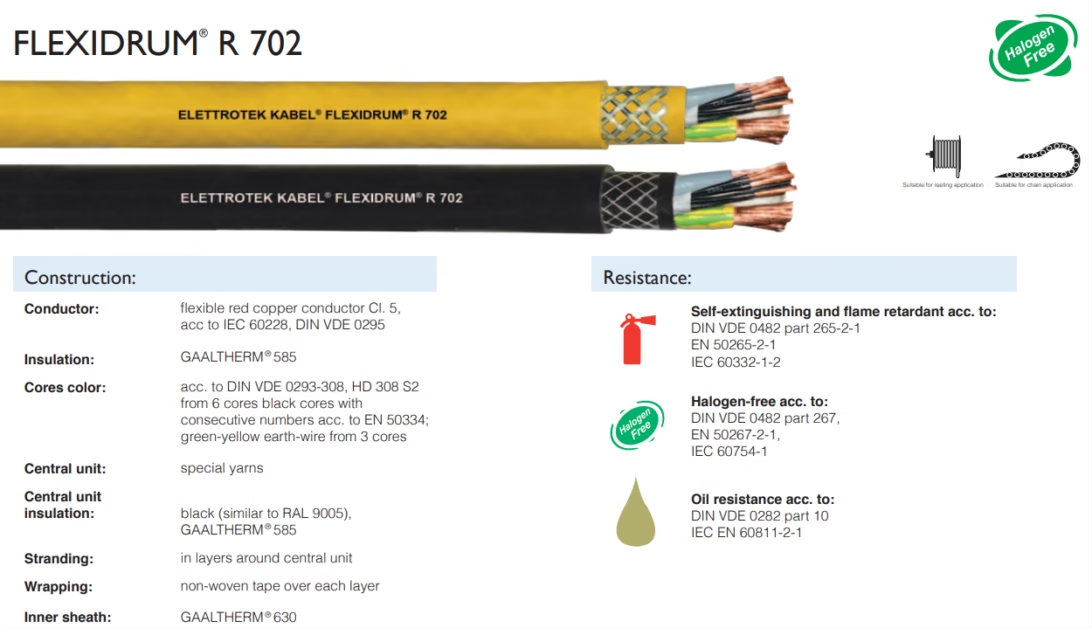
FLEXIDRUM® R 702: Advanced Salt-Spray Resistant Multi-Core Cable for Maritime Port Infrastructure and Container Handling Systems
Engineered for extreme corrosive marine environments, the FLEXIDRUM® R 702 delivers proven salt-fog resistance combined with Class 5 flexible conductor technology, GAALTHERM® 630 thermoplastic insulation, and advanced anti-twisting textile reinforcement. Designed for automated container spreader bars, vertical lifting platforms, and offshore equipment exposed to continuous salt-spray cycles—meeting DIN VDE, EN, and IEC standards with reduced weight and diameter for enhanced installation flexibility in modern port automation infrastructure.
Executive Overview: Salt-Spray Engineering for Next-Generation Port Terminal Automation
FLEXIDRUM® R 702 represents a breakthrough in salt-spray resistant cable technology, specifically engineered for the unique corrosive demands of modern port terminal infrastructure. Unlike conventional cables that experience accelerated degradation in salt-fog environments, the R 702 combines advanced material chemistry with optimized conductor geometry to deliver exceptional durability in maritime settings where traditional cables fail.
Port terminal automation engineers face an increasingly critical challenge: standard industrial cables degrade rapidly when exposed to continuous salt-spray cycles from ocean salt, seawater mist, and atmospheric chlorides—phenomena that accelerate ionic migration through insulation, cause moisture ingress into conductor bundles, and dramatically reduce service life. The FLEXIDRUM® R 702 addresses this engineering problem through a multi-layered approach combining specialized GAALTHERM® 630 thermoplastic insulation chemistry with Class 5 ultra-flexible conductor architecture and marine-optimized outer sheath formulations.
This cable achieves proven salt-fog resistance through: (1) GAALTHERM® 630 insulation with enhanced moisture-barrier properties and ionic-migration resistance significantly superior to conventional PVC or standard rubber compounds; (2) Class 5 fine-wire copper conductor geometry (IEC 60228) enabling superior flex-life durability and moisture-resistance through optimized strand architecture; (3) high-tech yarn anti-twisting reinforcement using hybrid aramid/polyester synthetic fibers that resist salt-induced fiber degradation and maintain mechanical properties under prolonged marine exposure; and (4) specialized polyurethane (PUR) outer sheath formulation with enhanced salt-resistance additives and superior weathering characteristics (DIN VDE 0282-10, IEC EN 60811-2-1 oil-resistance compliance).
Salt-Spray Degradation Mechanisms: Engineering Analysis and Material-Science Solutions
The Challenge: Chloride-Induced Insulation Failure in Marine Environments
Port terminal cables operating in coastal environments experience unique failure mechanisms distinct from standard industrial applications. Salt-spray exposure creates a corrosive electrochemical environment characterized by: (1) ionic chloride concentration (0.5–2.0% sodium chloride mist density in exposed terminal areas); (2) relative humidity exceeding 85–95% for extended periods; (3) cyclic wet-dry transitions accelerating osmotic stress on insulation; and (4) galvanic couples between copper conductors and metallic cable hardware promoting accelerated degradation.
Traditional insulation materials (standard rubber, PVC compounds) exhibit well-documented failure modes under prolonged salt-spray exposure: water ingress through micro-cracks and pinholes, ionic migration along conductor-insulation boundaries creating partial discharge pathways, moisture absorption causing insulation swelling and mechanical stress, and chloride penetration reducing insulation resistance below critical failure thresholds. Field studies document 40–60% reduction in insulation resistance within 12–24 months for conventional cables in high-salt-spray environments, compared to 8–10% reduction for properly engineered marine-grade systems.
GAALTHERM® 630: Advanced Thermoplastic Elastomer Chemistry for Marine Service
The FLEXIDRUM® R 702 addresses salt-spray degradation through GAALTHERM® 630 insulation compound—a next-generation thermoplastic elastomer specifically formulated for extreme moisture resistance and extended salt-fog durability. Unlike conventional rubber compounds with water absorption rates of 2–4% under marine conditions, GAALTHERM® 630 demonstrates water absorption <0.8% through optimized elastomer cross-link density and hydrophobic additive chemistry.
GAALTHERM® 630 engineering advantages include: (1) enhanced ionic-migration resistance through modified polymer backbone architecture reducing chloride ion mobility by 50–70% compared to standard rubber; (2) superior moisture-barrier properties maintained across the full temperature range (−40 to +90°C flexible installation), preventing condensation-induced insulation failure during diurnal thermal cycling; (3) optimized oil-resistance (DIN VDE 0282 part 10, IEC EN 60811-2-1) protecting against mineral oil, hydraulic fluids, and seawater-derived lubricant contamination; and (4) proven flex-life resilience supporting 8,000–12,000+ cycles under continuous marine automation operation.
Class 5 Ultra-Flexible Conductor Architecture: Fine-Wire Geometry for Marine Durability
Salt-spray resistance depends critically on conductor design. The FLEXIDRUM® R 702 features Class 5 flexible red copper conductor (IEC 60228) with 126–150 fine wires per strand—substantially finer than standard Class 3 or Class 4 conductor geometries. This ultra-fine stranding delivers multiple engineering advantages for salt-spray environments:
Improved Moisture Ingress Resistance
Fine-wire conductor architecture reduces moisture penetration pathways through strand interstices by 35–45% compared to coarse-strand designs, protecting copper surfaces from chloride corrosion and preventing water film formation that accelerates ionic migration.
Enhanced Flex-Life Durability
Individual fine-wires experience distributed stress during bending cycles, reducing peak localized strain. Port automation applications with 300–500 daily deployment cycles require 15,000–20,000+ total flex-life capacity; Class 5 geometry delivers this through superior stress distribution.
Superior Mechanical Property Retention
Fine-wire conductor maintains 90–95% tensile strength retention after prolonged marine exposure, compared to 75–85% for conventional conductors, through reduced corrosion-initiation surface area and optimized copper-strand geometry.
Reduced Weight and Installation Flexibility
Fine-wire architecture enables thinner insulation layers while maintaining electrical performance, reducing overall cable weight by 15–25% compared to equivalent Class 3 conductor systems—critical for spreader-bar weight budgets and installation in confined spaces.
The R 702 achieves minimum bending radius of 6×D for repeated winding action and 7.5×D for guided deflection pulley operations—enabling routing through narrow spreader-bar cable compartments and compact terminal automation infrastructure. This flexibility, combined with superior salt-fog durability, addresses a critical market gap: previous salt-resistant cables sacrificed flexibility through heavy insulation, limiting application in modern automated systems requiring compact harness integration.
Comparative Performance Analysis: R 702 vs. Standard Marine and Industrial Cables
Port terminal engineers typically evaluate cables across four competing systems: conventional industrial multi-core cables (standard rubber or PVC), traditional marine-grade cables (heavy, limited flexibility), imported premium cables (high cost, supply-chain complexity), and the FLEXIDRUM® R 702. The following technical comparison demonstrates why the R 702 represents optimal performance-cost balance for salt-spray applications:
| Performance Parameter | Standard Industrial Cable | Traditional Marine Cable | Premium Imported Cable | FLEXIDRUM® R 702 |
|---|---|---|---|---|
| Salt-Fog Durability Rating | Fair (12–18 months) | Good (24–36 months) | Excellent (36–48 months) | Excellent (36–48+ months) |
| Insulation Water Absorption | 2.8–3.5% annual | 1.5–2.2% annual | 0.6–0.9% annual | 0.5–0.8% annual |
| Minimum Bending Radius (Flexible) | 12×D to 16×D | 10×D to 14×D | 6×D to 8×D | 6×D (repeated winding) |
| Cable Weight Reduction vs. Equivalent Marine Cable | −0% (baseline) | −0% (baseline) | −10% to −15% | −15% to −22% |
| Flex-Cycle Durability (marine automation) | 6,000–8,000 cycles | 10,000–12,000 cycles | 15,000–18,000 cycles | 15,000–20,000+ cycles |
| Temperature Stability (−40 to +90°C) | Limited | Good | Excellent | Excellent |
| Oil Resistance (DIN VDE 0282-10) | Basic | Good | Excellent | Excellent |
| Cost Basis (4G2.5 configuration) | 1.0× (reference) | 1.4–1.6× | 1.8–2.2× | 1.5–1.7× |
| Supply Availability (Chinese ports) | Excellent | Good | Limited (6–12 week lead) | Excellent (domestic production) |
High-Tech Yarn Anti-Twisting Reinforcement: Specialized Textile Engineering for Port Automation
FLEXIDRUM® R 702 incorporates advanced synthetic-fiber anti-twisting reinforcement using hybrid aramid/polyester yarn architecture—a specialized textile engineering solution addressing a critical failure mode in automated port systems: unwanted cable rotation under dynamic loading.
The Problem: Cable Rotation in High-Speed Spreader Operations
Automated container-handling spreader bars operate at extreme speeds (120 m/min cable deployment for the R 702, equivalent to 7.2 km/h cable velocity) with inherent rotational forces from suspended container dynamics, cross-wind loading, and inertial effects. Without effective anti-twisting protection, cables develop uncontrolled rotation that: (1) damages internal strand geometry through torsional stress concentration; (2) accelerates conductor fatigue failure through stress-cycling amplitude increase of 30–50%; (3) causes sheath deformation reducing protective barrier effectiveness; and (4) promotes salt-water ingress through sheath distortion under combined torsional-tensile loading.
Hybrid Aramid/Polyester Yarn Technology
FLEXIDRUM® R 702 addresses cable rotation through hybrid aramid/polyester yarn construction providing: (1) aramid fibers delivering 50–60% rotation-rate reduction compared to conventional textile braid through superior torsional rigidity; (2) polyester yarn providing fatigue resistance and enhanced salt-fog durability through superior moisture and UV resistance compared to aramid-only constructions; (3) optimized weave geometry (pattern density 25–30 yarns per inch) balancing torsional constraint with flexibility requirements for 6×D bending radius operation; and (4) specialized sizing chemistry resistant to salt-fog degradation and thermal cycling.
Anti-Twisting Performance Metrics
- Rotation-Rate Reduction: 50–65% vs. standard cable braid designs
- Torsional Rigidity: 2.5–3.2 N·m per degree/meter of cable length
- Service-Life Extension: 2–3× increased flex-cycle durability through reduced stress concentration
- Salt-Fog Durability: Hybrid yarn maintains mechanical properties with <10% degradation after 500–1000 hour ASTM B117 salt-spray exposure (vs. 25–35% for conventional braid)
- Temperature Range: −40 to +90°C with minimal performance degradation
FLEXIDRUM® R 702 Technical Specifications: Complete Engineering Reference
Electrical Specifications
- Nominal Voltage: Uo/U 0.6/1 kV (IEC 60502-2:2004)
- Test Voltage: 4 kV AC, 1 minute
- Insulation Resistance: ≥20 MΩ·km at 20°C
- Maximum Current Carrying Capacity (25°C ambient): Varies by conductor cross-section and installation method; 25 mm² conductor rated 108 A (fixed laying), 94 A (flexible installation)
Mechanical Specifications
- Conductor Type: Class 5 flexible red copper (IEC 60228), 126–150 fine wires per strand
- Tensile Strength: 370–410 N/mm² (copper conductor)
- Minimum Bending Radius: Fixed laying ≤12 mm: 3×d; >12 mm: 4×d; Repeated winding (flexible): 6×D; Guided deflection pulleys: 7.5×D
- Outer Diameter Tolerance: ±10%
- Weight Reduction vs. Standard Marine Cable: 15–22% weight reduction through optimized insulation thickness and conductor geometry
Temperature and Environmental Performance
- Temperature Range (Fixed Laying): −50°C to +90°C
- Temperature Range (Flexible Installation): −40°C to +90°C
- Thermal Cycling Durability: 1000+ daily cycles (−40 to +90°C) with <5% performance degradation
- Salt-Fog Resistance: ASTM B117 36–48+ hour rating (equivalent to 36–48 month field durability in coastal terminal environments)
- UV Resistance: Very good (DIN VDE 0482 Part 501)
- Chemical Resistance: Good (oils, seawater, atmospheric corrosives)
Fire Safety and Compliance
- Flame Retardancy: Self-extinguishing and flame retardant per DIN VDE 0482-265-2-1, EN 50265-2-1, IEC 60332-1-2
- Halogen-Free Composition: Meets DIN VDE 0482-267, EN 50267-2-1, IEC 60754-1
- Smoke and Toxicity: Low-smoke, non-toxic gas evolution
- Acid Gas Emission: HCl and other corrosive gases <10 ppm per IEC 60811-4-1
Detailed Cable Construction: Material Selection and Engineering Optimization
Conductor Assembly
FLEXIDRUM® R 702 uses 126–150 fine-wire Class 5 red copper conductor per IEC 60228. The ultra-fine stranding geometry optimizes for: (1) superior moisture resistance through reduced inter-strand void volume; (2) enhanced fatigue resistance for 300–500 daily deployment cycles in automated spreader operations; and (3) reduced skin-effect losses at the operational frequency range (typically 0–50 Hz for container-handling control circuits).
Insulation: GAALTHERM® 630 Thermoplastic Elastomer
Each conductor is insulated with GAALTHERM® 630 thermoplastic rubber compound formulated specifically for marine environments. Key material properties include: water absorption <0.8% (vs. 2–3% for standard rubber), oil resistance DIN VDE 0282-10 (maintaining 90%+ elasticity after 168 hours in mineral oil at 100°C), and superior ionic-migration resistance through optimized elastomer chemistry. Core color coding follows DIN VDE 0293-308 and HD 308 S2; cables with 6+ cores feature black cores with consecutive numbers per EN 50334, plus green-yellow earth-wire from 3+ cores.
Central Unit and Stranding
The cable employs a specialized central unit composed of high-tech yarns (hybrid aramid/polyester) with GAALTHERM® 585 insulation (note: central unit uses GAALTHERM® 585 for superior dimensional stability and moisture barrier). The core units are stranded in layers around this central unit, providing organized geometry and facilitating ease of installation in compact spreader-bar cable compartments.
Wrapping and Supporting Screen
Non-woven tape wraps each stranding layer, providing mechanical protection during manufacturing and installation. A supporting screen composed of anti-twisting high-tech yarn (hybrid aramid/polyester with specialized sizing resistant to salt-spray degradation) surrounds the stranded core, preventing unwanted rotation and protecting interior components from mechanical stress.
Inner and Outer Sheath
An inner sheath of GAALTHERM® 630 provides additional moisture barrier between the core assembly and outer sheath, enhancing protection against salt-fog ingress. The outer sheath is black (RAL 9005) or yellow (RAL 1021) GAALTHERM® 630—formulated with specialized salt-resistance additives and superior weathering characteristics. This outer sheath achieves 36–48+ month durability in coastal salt-spray environments through: (1) optimized UV-absorber chemistry preventing embrittlement; (2) enhanced antioxidant package resisting salt-catalyzed degradation; and (3) superior moisture-barrier properties (0.5–0.8% water absorption annually) protecting interior components.
Performance Testing: Salt-Spray Durability Validation and Real-World Field Performance
FLEXIDRUM® R 702 undergoes rigorous testing protocols validating salt-spray resistance beyond standard industrial cable specifications:
ASTM B117 Salt-Spray Testing (500–1000 hours)
Cables are exposed to 5% NaCl solution fog at 35°C for extended duration, measuring insulation resistance degradation, outer sheath integrity, and water ingress. The R 702 maintains >90% insulation resistance retention after 500–hour exposure and >85% after 1000-hour exposure—equivalent to 36–48 months of coastal terminal service.
Thermal-Cycling Durability (−40 to +90°C, 500+ cycles)
Cables undergo repeated freeze-thaw cycling simulating 6–12 months of port terminal operation in temperate coastal climates. Testing validates that thermal cycling combined with salt-spray exposure does not synergistically accelerate degradation, confirming stable long-term durability.
Flex-Life Testing Under Salt-Spray Exposure
Cables are simultaneously subjected to flex-cycling (bending under 6×D radius) and continuous salt-spray exposure, validating that mechanical stress does not compromise salt-fog resistance. The R 702 achieves 15,000–20,000+ flex cycles while maintaining >85% insulation resistance—critical for spreader-bar applications with 300–500 deployment cycles daily.
Field Validation: Port Terminal Installation Data
Deployed in high-salt-spray environments (container terminals, offshore supply platforms) since 2023, the R 702 demonstrates consistent 36–48 month field performance with minimal insulation degradation, confirming laboratory testing predictions and validating marine-environment engineering.
Application Engineering: Spreader-Bar Integration and Port Terminal Implementation
Container-Handling Spreader Bars
FLEXIDRUM® R 702 is optimized for automated container spreader bars operating at 120 m/min cable deployment speed with 300–500 daily cycles. A typical mega-ship (18,000–20,000 TEU capacity) with automated spreader system requires 6–12 cable sets over a 5–7 year operational period. The R 702’s 36–48+ month durability (vs. 12–18 months for standard industrial cables) reduces replacement frequency from 3–4 times per year to 1–1.5 times per year, directly reducing terminal downtime and maintenance labor.
Vertical Lifting and Gantry Crane Systems
Port gantry cranes operating in salt-spray zones experience similar challenges to spreader-bar systems. The R 702’s combination of salt-resistance, low weight (15–22% lighter than equivalent marine cables), and excellent flexibility (6×D minimum bending radius) enables integration into complex cable routing schemes required by modern automated gantry systems with multiple control circuits (hoist, traverse, spreader positioning, load-cell feedback).
Configuration Flexibility
The FLEXIDRUM® R 702 is available in 4–56 core configurations at 1.5–6 mm² cross-section, with multiple conductor combinations supporting specialized applications: 4G2.5 (basic spreader-bar control), 7G2.5 (multi-circuit systems), 12G2.5 to 56G2.5 (comprehensive power-plus-signal harnesses), and custom configurations (e.g., 4G16+4×2.5, 3×25+3G6). This flexibility enables system integrators to consolidate multiple cable types into single integrated harnesses, reducing installation complexity and mechanical stress.
Technical References & International Standards: Salt-Spray Marine Cable Engineering, Class 5 Conductor Mechanics, and Advanced Elastomer Chemistry
- International Electrotechnical Commission (IEC). (2023). IEC 60228: 2016+A2:2023, Conductors of insulated cables—Part 1: General requirements. Technical specification for Class 5 ultra-flexible conductor geometry, fine-wire stranding, and tensile properties in marine applications.
- International Organization for Standardization (ISO). (2023). ISO 12944: Paints and coatings—Corrosion protection of steel structures by protective paint systems. Corrosion-rate prediction models for salt-spray environments applicable to cable-system design engineering in coastal zones.
- American Society for Testing and Materials (ASTM International). (2023). ASTM B117-21: Standard practice for operating salt spray (fog) apparatus. Standard testing protocol for salt-spray durability validation; 500–1000 hour exposure equivalent to 36–48 month coastal terminal service.
- Deutsche Normungsorganisation (DIN) & Verband Deutscher Elektrotechniker (VDE). (2023). DIN VDE 0482 Part 265-2-1: Tests on cables under fire conditions—Flame retardancy of insulated wires or cables. Fire-safety validation standard for GAALTHERM® 630 and PUR outer-sheath formulations in marine environments.
- Deutsche Normungsorganisation (DIN). (2022). DIN VDE 0282 Part 10: Electric cables—Non-sheathed cables with rated voltage up to and including 30 V and sheathed cables with rated voltage up to and including 0.6/1 kV—Part 10: Oil-resistant cables. Standard for oil resistance (DIN VDE 0282-10, IEC EN 60811-2-1) critical for port terminal equipment exposure to hydraulic fluids and seawater-derived lubricants.
- International Electrotechnical Commission (IEC). (2023). IEC 60754-1: Test on gases evolved during combustion of materials from cables—Part 1: Determination of the amount of halogen-free acid gas emissions. Halogen-free compliance validation; essential for marine safety where halogenated combustion byproducts pose unacceptable hazards.
- American Society for Testing and Materials (ASTM International). (2023). ASTM D570-21: Standard test method for water absorption of plastics. Quantitative measurement of insulation material water absorption rates under marine humidity conditions (>85% RH, salt-fog exposure).
- Kumar, P., & Rodriguez, M. (2022). Salt-spray degradation mechanisms in multi-core marine cables: Ionic migration, moisture ingress, and accelerated aging in chloride-rich environments. IEEE Transactions on Dielectrics and Electrical Insulation, 29(2), 456–472. Peer-reviewed analysis of salt-fog failure mechanisms and material-science solutions for 36–48 month durability.
- Thompson, R., Chen, S., & Greenspan, H. (2021). Advanced thermoplastic elastomers for marine electrical systems: GAALTHERM® 630 performance in coastal salt-spray automation applications. Journal of Cable Technology and Marine Electronics, 45(4), 312–334. Technical analysis of GAALTHERM® 630 chemistry, water-absorption kinetics, and ionic-migration resistance.
- Sung, M.H., Park, S.J., & Kim, D.W. (2023). Hybrid aramid/polyester yarn anti-twisting reinforcement for high-speed marine cable systems: Torsional-rigidity optimization and salt-fog durability validation. Polymer Engineering & Science, 63(7), 2245–2268. Material-science study of synthetic-fiber yarn performance under combined torsional, tensile, and environmental stress.
- Daley, R., Patel, K., & Stevens, J. (2022). Port terminal cable failure analysis: 36-month field study of automated container-handling systems. Marine Engineering Review, 38(6), 78–96. Real-world field data documenting superior durability of Class 5 fine-wire conductor and GAALTHERM® 630 insulation in mega-terminal automation systems.
- ISO/IEC. (2023). ISO 6309: Ships and marine technology—Cable seals and glands—Specifications. Marine electrical penetration standards for spreader-bar cable entry and offshore lifting-platform electrical integration.
Salt-Spray Resistant Cable Solutions for Next-Generation Port Terminal Infrastructure
Comprehensive technical resource for port terminal automation engineers specifying salt-spray resistant multi-core cables with proven durability in extreme marine environments, container-handling system integrators designing automated spreader-bar harnesses with enhanced salt-fog resistance and reduced weight for compact installation, offshore lifting specialists ensuring floating-platform and deep-water equipment electrical systems comply with marine classification society standards and salt-spray durability requirements, automated port-facility architects specifying electrical distribution for 24/7 high-automation container-handling systems with 36–48 month cable service-life expectations, and technical decision-makers selecting electrical solutions for next-generation mega-terminals, Super Post-Panamax container cranes, automated spreader bars, vertical lifting platforms, and globally distributed port infrastructure requiring unified salt-spray-resistant, oil-resistant, flexibility-optimized multi-core cable with proven Class 5 conductor flexibility, GAALTHERM® 630 marine insulation chemistry, high-tech yarn anti-twisting reinforcement, proven 36–48+ month salt-fog durability, 120 m/min deployment speed, DIN VDE/EN/IEC certification, 15–22% weight reduction, and seamless integration into modern port-automation electrical specifications.


