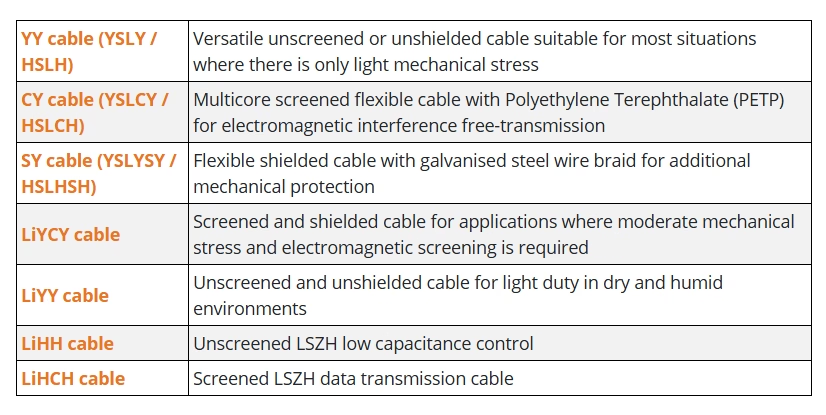
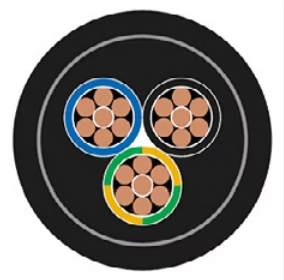
multi-core cable

UNE 22511 Design Philosophy: Ultimate Flexibility for Underground Mobile Equipment Within the taxonomy of mining cables, the distinction between the UNE 22511 and UNE 22512 standards represents a fundamental divergence in design philosophy — not merely a difference in specification parameters. Understanding this divergence is essential for engineers procuring replacement cables for underground coal mines in Spain, Chile, Colombia, and other markets operating under the AENOR (Asociación Española de Normalización y Certificación) regulatory framework. The UNE 22511 standard governs cables for flexible connection of mobile underground mining machinery — the specific class of heavy-duty cable designed for equipment that moves continuously during operation: continuous miners, longwall shearers, shuttle cars, and cable reel systems. The engineering DNA of a UNE 22511 cable can be summarized in a single phrase: engineered for mechanical endurance, not for static installation security. This philosophy manifests in every structural element of the cable: the conductor class, the insulation compound, the earth core arrangement, the absence of metallic armor, and the sheath compound selection. Each element is chosen not to maximize any single parameter but to achieve an optimal balance of torsional resilience, bending flexibility, and sheath durability under the combined mechanical loading of continuous dragging, occasional running-over by shuttle car wheels, and periodic full-tension pulling by cable reel drum systems.

YSLCY Shielded Control Cable | Anti-Interference | VDE 0250 | EAC & GOST Fire | Russia Factory

An engineering-grade technical reference for industrial electrical control installations across Russian Federation manufacturing facilities, automation systems, programmable logic controllers (PLCs), and distributed industrial infrastructure. This document explains the comprehensive electromagnetic shielding architecture that protects sensitive control signals from external noise sources in high-voltage industrial environments, establishes the twisted-pair core construction that provides signal integrity over extended cable runs, documents compliance with VDE 0250 mining and industrial cable standards, and provides performance specifications and field integration guidance for seamless deployment into automation networks operating in Russian factory and heavy industrial settings.
What Are UNE 22560 and UNE 22561? Scope, Definitions, and Core Purpose The UNE 22560 and UNE 22561 standards represent the final and often most underestimated element of the Spanish and Latin American underground mining cable ecosystem. Where UNE 22511 and UNE 22512 govern the power distribution cables that energize mining equipment, the 22560 and 22561 standards govern the signal, control, and interlock cables that command and protect that equipment. These are the "nervous system" cables of a mine — the communication network that tells a continuous miner when to advance and when to halt, that triggers emergency stops, that monitors hoisting rope tension on shaft equipment, that controls conveyor sequencing, and that enables the protective interlocking that prevents a piece of equipment from operating unless all safety preconditions are met. UNE 22560 formally defines flexible multi-core cables for underground mining with voltage ratings up to 500 V or 0.6/1 kV, with no metallic armour protection — designed for installation within equipment enclosures, along protected cable trays in main gate roads, or in areas where mechanical damage risk is minimal. UNE 22561 is its armoured sister standard, incorporating steel wire braid or steel tape protection, specified for installation in rough terrain areas where mechanical damage from rock fall, equipment collision, or floor contact is a credible risk. Both standards mandate that the cable be designed as a multi-core concentric stranded bundle — not the parallel-laid three or four conductors common in power cables, but rather seven, twelve, nineteen, or more individually insulated cores twisted concentrically around a central axis, allowing compact packaging of numerous independent control circuits within a single cable jacket. The distinction between these standards is not merely mechanical armour presence or absence. Control cables are tested against an entirely different set of safety criteria than power cables because their failure mode is fundamentally different. A power cable failure results in loss of energy to equipment — dangerous but localized. A control cable failure can disable the interlock system that prevents a continuous miner from advancing into unsafe ground, or can disable the emergency stop circuit that should halt a conveyor if a worker falls into it. A control cable fire, burning in a tightly bundled cable tray with other control cables, must not spread flame between cables because control cables are typically routed in shared ducts and cable carriers where one cable's ignition could cascade to adjacent circuits. Therefore, control cables are tested for bundle flame propagation (EN 60332-3) rather than single-cable flame propagation tests — a more stringent requirement that demands careful attention to outer sheath formulation and cable spacing in bundle installation.

UNE 22560

What Are UNE 22560 and UNE 22561? Scope, Definitions, and Core Purpose The UNE 22560 and UNE 22561 standards represent the final and often most underestimated element of the Spanish and Latin American underground mining cable ecosystem. Where UNE 22511 and UNE 22512 govern the power distribution cables that energize mining equipment, the 22560 and 22561 standards govern the signal, control, and interlock cables that command and protect that equipment. These are the “nervous system” cables of a mine — the communication network that tells a continuous miner when to advance and when to halt, that triggers emergency stops, that monitors hoisting rope tension on shaft equipment, that controls conveyor sequencing, and that enables the protective interlocking that prevents a piece of equipment from operating unless all safety preconditions are met. UNE 22560 formally defines flexible multi-core cables for underground mining with voltage ratings up to 500 V or 0.6/1 kV, with no metallic armour protection — designed for installation within equipment enclosures, along protected cable trays in main gate roads, or in areas where mechanical damage risk is minimal. UNE 22561 is its armoured sister standard, incorporating steel wire braid or steel tape protection, specified for installation in rough terrain areas where mechanical damage from rock fall, equipment collision, or floor contact is a credible risk. Both standards mandate that the cable be designed as a multi-core concentric stranded bundle — not the parallel-laid three or four conductors common in power cables, but rather seven, twelve, nineteen, or more individually insulated cores twisted concentrically around a central axis, allowing compact packaging of numerous independent control circuits within a single cable jacket. The distinction between these standards is not merely mechanical armour presence or absence. Control cables are tested against an entirely different set of safety criteria than power cables because their failure mode is fundamentally different. A power cable failure results in loss of energy to equipment — dangerous but localized. A control cable failure can disable the interlock system that prevents a continuous miner from advancing into unsafe ground, or can disable the emergency stop circuit that should halt a conveyor if a worker falls into it. A control cable fire, burning in a tightly bundled cable tray with other control cables, must not spread flame between cables because control cables are typically routed in shared ducts and cable carriers where one cable’s ignition could cascade to adjacent circuits. Therefore, control cables are tested for bundle flame propagation (EN 60332-3) rather than single-cable flame propagation tests — a more stringent requirement that demands careful attention to outer sheath formulation and cable spacing in bundle installation.
FLEXIDRUM® R 702: Advanced Salt-Spray Resistant Multi-Core Cable for Maritime Port Infrastructure and Container Handling Systems Engineered for extreme corrosive marine environments, the FLEXIDRUM® R 702 delivers proven salt-fog resistance combined with Class 5 flexible conductor technology, GAALTHERM® 630 thermoplastic insulation, and advanced anti-twisting textile reinforcement. Designed for automated container spreader bars, vertical lifting platforms, and offshore equipment exposed to continuous salt-spray cycles—meeting DIN VDE, EN, and IEC standards with reduced weight and diameter for enhanced installation flexibility in modern port automation infrastructure.

FLEXIDRUM® R 702

FLEXIDRUM® R 702: Advanced Salt-Spray Resistant Multi-Core Cable for Maritime Port Infrastructure and Container Handling Systems Engineered for extreme corrosive marine environments, the FLEXIDRUM® R 702 delivers proven salt-fog resistance combined with Class 5 flexible conductor technology, GAALTHERM® 630 thermoplastic insulation, and advanced anti-twisting textile reinforcement. Designed for automated container spreader bars, vertical lifting platforms, and offshore equipment exposed to continuous salt-spray cycles—meeting DIN VDE, EN, and IEC standards with reduced weight and diameter for enhanced installation flexibility in modern port automation infrastructure.
Feichun's comprehensive port equipment cable portfolio encompasses two primary cable family streams engineered for fundamentally different equipment operating environments, each with multiple reinforcement, shielding, and configuration variants optimized for specific applications. Design Philosophy: Rather than attempting to create a single universal cable for all port applications, Feichun engineers cables within two distinct families, each optimized for its operational environment. High-tension cables prioritize tensile strength and mechanical robustness for reel-mounted applications. Festoon cables prioritize bending flexibility and environmental durability for suspended overhead systems. Within each family, reinforcement, shielding, and configuration options address specialized requirements. Two Core Cable Families: 1. High-Tension Reel Cables (HT-PNCT Family) — Engineered for equipment where cables wind onto rotating reels including ship unloaders, stackers, reclaimers, and mobile cranes. Optimized for extreme tensile stress, intensive bending cycles, and long unsupported spans. 2. Festoon Suspended Cables (FC-PNCT Family) — Engineered for equipment with suspended overhead power distribution including container cranes, gantry cranes, and overhead bridge systems. Optimized for gentle bending, environmental durability, and multi-circuit power distribution. Within each family, variants address specialized requirements through reinforcement (enhanced tensile strength and service life), electromagnetic shielding (protection for VFD systems and automation electronics), and flexible configuration options (3–30 conductor cores, three conductor sizes).

Feichun Port Equipment Cable Portfolio

Feichun’s comprehensive port equipment cable portfolio encompasses two primary cable family streams engineered for fundamentally different equipment operating environments, each with multiple reinforcement, shielding, and configuration variants optimized for specific applications. Design Philosophy: Rather than attempting to create a single universal cable for all port applications, Feichun engineers cables within two distinct families, each optimized for its operational environment. High-tension cables prioritize tensile strength and mechanical robustness for reel-mounted applications. Festoon cables prioritize bending flexibility and environmental durability for suspended overhead systems. Within each family, reinforcement, shielding, and configuration options address specialized requirements. Two Core Cable Families: 1. High-Tension Reel Cables (HT-PNCT Family) — Engineered for equipment where cables wind onto rotating reels including ship unloaders, stackers, reclaimers, and mobile cranes. Optimized for extreme tensile stress, intensive bending cycles, and long unsupported spans. 2. Festoon Suspended Cables (FC-PNCT Family) — Engineered for equipment with suspended overhead power distribution including container cranes, gantry cranes, and overhead bridge systems. Optimized for gentle bending, environmental durability, and multi-circuit power distribution. Within each family, variants address specialized requirements through reinforcement (enhanced tensile strength and service life), electromagnetic shielding (protection for VFD systems and automation electronics), and flexible configuration options (3–30 conductor cores, three conductor sizes).
FC-PNCT-R and FC-PNCT(S)-R reinforced festoon cables represent the premium tier of overhead power distribution technology, engineered for next-generation crane systems demanding superior electrical performance, extended service life, electromagnetic compatibility, and multi-circuit power distribution capabilities. Reinforced festoon cables incorporate a fundamentally different architecture compared to standard festoon cables—adding mechanical reinforcement (braid-tape structure), overall electromagnetic shielding (in the shielded variant), and optimized multi-core configurations supporting independent circuit distribution. These enhancements address the operational requirements of modern automated port equipment, VFD-driven crane systems, and advanced cargo handling machinery. Key Design Innovations: • Integrated Reinforcement Layer: A tape-braid composite structure carrying a portion of mechanical stress, extending insulation life and reducing temperature rise during operation • Overall Screen Shielding: Tinned copper braid surrounding the entire cable assembly (in FC-PNCT(S)-R variant) providing complete electromagnetic protection • Multi-Core Architecture: 3–30 independent conductor cores enabling single-cable distribution for complex equipment with multiple independent motor systems • Size Flexibility: Three conductor size options (1.5, 2.5, 4.0) scaled to specific application requirements and current demands These innovations enable reinforced festoon cables to deliver 7–10 year service intervals in demanding applications—approximately 40–60% longer than standard festoon cables. For terminal operators prioritizing equipment reliability and minimizing replacement downtime, the premium investment in reinforced cables delivers outstanding value.

FC-PNCT-R/FC-PNCT(S)-R Reinforced Festoon Cables

FC-PNCT-R and FC-PNCT(S)-R reinforced festoon cables represent the premium tier of overhead power distribution technology, engineered for next-generation crane systems demanding superior electrical performance, extended service life, electromagnetic compatibility, and multi-circuit power distribution capabilities. Reinforced festoon cables incorporate a fundamentally different architecture compared to standard festoon cables—adding mechanical reinforcement (braid-tape structure), overall electromagnetic shielding (in the shielded variant), and optimized multi-core configurations supporting independent circuit distribution. These enhancements address the operational requirements of modern automated port equipment, VFD-driven crane systems, and advanced cargo handling machinery. Key Design Innovations: • Integrated Reinforcement Layer: A tape-braid composite structure carrying a portion of mechanical stress, extending insulation life and reducing temperature rise during operation • Overall Screen Shielding: Tinned copper braid surrounding the entire cable assembly (in FC-PNCT(S)-R variant) providing complete electromagnetic protection • Multi-Core Architecture: 3–30 independent conductor cores enabling single-cable distribution for complex equipment with multiple independent motor systems • Size Flexibility: Three conductor size options (1.5, 2.5, 4.0) scaled to specific application requirements and current demands These innovations enable reinforced festoon cables to deliver 7–10 year service intervals in demanding applications—approximately 40–60% longer than standard festoon cables. For terminal operators prioritizing equipment reliability and minimizing replacement downtime, the premium investment in reinforced cables delivers outstanding value.
NSHTÖU-J 24G2.5 flexible reeling cable is the globally recognized industry standard for ship-to-shore crane spreader basket vertical lift systems, featuring 24 conductors with 2.5 mm² cross-section per core (one conductor designated green/yellow for grounding/safety) providing approximately 30 amperes current capacity in free-air installation at 30°C ambient, but derating to approximately 15 amperes actual safe continuous current when accounting for the multi-core bundle derating factor of 0.45 to 0.50 and tropical port ambient temperatures. The cable's nominal outer diameter ranges from 28.5 to 32.5 millimeters, with total weight of approximately 1,350 kilograms per kilometer, making it manageable for standard spreader basket spools while maintaining the conductor density necessary for reliable simultaneous power and control signal transmission. The cable features proprietary anti-torsion braid structure embedded between inner and outer sheaths—a critical innovation that provides resistance to ±50° per meter torsional deformation, fundamentally preventing the destructive corkscrew effect that kills ordinary flexible cables within 3 to 6 months of tropical port operation. The cable incorporates Class 5 tinned copper conductors engineered specifically for the fatigue resistance required by continuous 160 meters per minute reeling cycles, EPDM insulation maintaining electrical integrity at the 90°C conductor temperatures that result from high-speed duty cycles in multi-core bundles, 5GM5 elastomer outer sheath providing exceptional resistance to salt-spray corrosion, UV degradation, petroleum-based oils, and mechanical abrasion encountered in global container ports. The cable is rated for 0.6/1.0 kilovolt nominal operation, with dielectric test voltage capability reaching 3 kilovolts, more than adequate for spreader basket control circuits and auxiliary power distribution. Unlike generic "marine-grade" cables or rebranded industrial flexible cables, NSHTÖU-J 24G2.5 is purpose-built to tolerate the combined mechanical, thermal, and environmental stresses unique to STS crane spreader applications—making it not simply the preferred option but the only technically defensible choice for reliability-critical spreader systems operating in high-intensity container port environments.

STS Crane Spreader Baskets: Why NSHTÖU-J 24G2.5 is the Industry Standard for Vertical Lift Power & Control

NSHTÖU-J 24G2.5 flexible reeling cable is the globally recognized industry standard for ship-to-shore crane spreader basket vertical lift systems, featuring 24 conductors with 2.5 mm² cross-section per core (one conductor designated green/yellow for grounding/safety) providing approximately 30 amperes current capacity in free-air installation at 30°C ambient, but derating to approximately 15 amperes actual safe continuous current when accounting for the multi-core bundle derating factor of 0.45 to 0.50 and tropical port ambient temperatures. The cable’s nominal outer diameter ranges from 28.5 to 32.5 millimeters, with total weight of approximately 1,350 kilograms per kilometer, making it manageable for standard spreader basket spools while maintaining the conductor density necessary for reliable simultaneous power and control signal transmission. The cable features proprietary anti-torsion braid structure embedded between inner and outer sheaths—a critical innovation that provides resistance to ±50° per meter torsional deformation, fundamentally preventing the destructive corkscrew effect that kills ordinary flexible cables within 3 to 6 months of tropical port operation. The cable incorporates Class 5 tinned copper conductors engineered specifically for the fatigue resistance required by continuous 160 meters per minute reeling cycles, EPDM insulation maintaining electrical integrity at the 90°C conductor temperatures that result from high-speed duty cycles in multi-core bundles, 5GM5 elastomer outer sheath providing exceptional resistance to salt-spray corrosion, UV degradation, petroleum-based oils, and mechanical abrasion encountered in global container ports. The cable is rated for 0.6/1.0 kilovolt nominal operation, with dielectric test voltage capability reaching 3 kilovolts, more than adequate for spreader basket control circuits and auxiliary power distribution. Unlike generic “marine-grade” cables or rebranded industrial flexible cables, NSHTÖU-J 24G2.5 is purpose-built to tolerate the combined mechanical, thermal, and environmental stresses unique to STS crane spreader applications—making it not simply the preferred option but the only technically defensible choice for reliability-critical spreader systems operating in high-intensity container port environments.
The European and American approaches to cable engineering reflect fundamentally different environmental threat models. BFOU cables manufactured to NEK 606 specifications incorporate halogen-free insulation, SHF2 H-M compound sheathing, and mica glass tape (MGT) as a fire barrier, enabling uninterrupted power delivery during fire situations in accordance with IEC 60331-21. This design prioritizes survival of critical systems during extreme thermal events—a recognized hazard in confined spaces such as engine rooms and living quarters aboard offshore vessels.

Why Your BFOU Cable Needs a Type N Jacket Upgrade?

The European and American approaches to cable engineering reflect fundamentally different environmental threat models. BFOU cables manufactured to NEK 606 specifications incorporate halogen-free insulation, SHF2 H-M compound sheathing, and mica glass tape (MGT) as a fire barrier, enabling uninterrupted power delivery during fire situations in accordance with IEC 60331-21. This design prioritizes survival of critical systems during extreme thermal events—a recognized hazard in confined spaces such as engine rooms and living quarters aboard offshore vessels.
The selection of appropriate submersible pump cables for acidic mine water dewatering applications represents a critical engineering decision that directly impacts operational safety, equipment longevity, and maintenance costs. While Type 441 cables may appear suitable for general submersible pump applications, the harsh chemical environment of acidic mine water typically necessitates the use of specialized EPR (Ethylene Propylene Rubber) or CSP (Chlorosulfonated Polyethylene) insulated cables specifically engineered for corrosive conditions. 为酸性矿井水脱水应用选择合适的潜水泵电缆是一项关键的工程决策,直接影响运行安全、设备寿命和维护成本。虽然441型电缆可能适用于一般潜水泵应用,但酸性矿井水的恶劣化学环境通常需要使用专门设计用于腐蚀性条件的EPR(乙丙橡胶)或CSP(氯磺化聚乙烯)绝缘电缆。

TUNNELFLEX-R-PUR HF with Antitwisting Protection 1 KV

TUNNELFLEX-R-PUR HF represents a specialized category of halogen-free, flame-retardant flexible power cables engineered specifically for the demanding requirements of underground mining and tunneling operations. This cable combines advanced polyurethane (PUR) sheathing technology with integrated antitwisting protection to deliver exceptional mechanical durability, environmental resistance, and most importantly, enhanced safety through its halogen-free construction that significantly reduces toxic gas emissions during fire incidents. TUNNELFLEX-R-PUR HF电缆是专为地下采矿和隧道作业的苛刻要求而设计的无卤阻燃柔性电力电缆。该电缆结合了先进的聚氨酯护套技术和集成的防扭转保护,提供卓越的机械耐久性、环境抵抗力,以及通过无卤结构在火灾事故中显著减少有毒气体排放的增强安全性。
UNE 21123 standard refers to the design and cross-sectional area specifications for cables used by utilities on power distribution circuits with voltage ratings up to and including 600/1000V (0.6/1kV). UNE standards are released by AENOR (Asociación Española de Normalización y Certificación), the Spanish Association for Standardisation and Certification. As AENOR is a member of ISO, IEC, and CENELEC, many of its standards are harmonized with European and international conventions.

What is UNE 21123 Cable?

UNE 21123 standard refers to the design and cross-sectional area specifications for cables used by utilities on power distribution circuits with voltage ratings up to and including 600/1000V (0.6/1kV). UNE standards are released by AENOR (Asociación Española de Normalización y Certificación), the Spanish Association for Standardisation and Certification. As AENOR is a member of ISO, IEC, and CENELEC, many of its standards are harmonized with European and international conventions.
NF C32-322 is a French national standard (Norme Française) that specifies requirements for armoured low voltage power cables. These cables, commonly designated as U-1000 RVFV (copper conductor) and U-1000 ARVFV (aluminium conductor), are widely used rigid industrial cables designed for installations requiring mechanical protection. They represent the armoured equivalent of the NF C32-321 unarmoured cables.

What is NF C32-322 Cable?

NF C32-322, U-1000 RVFV, U-1000 ARVFV, U-1000 XAV, NF C32 322, RVFV cable, ARVFV cable, French standard armoured cable, 0.6/1kV cable, 1kV armoured cable, 600/1000V cable, low voltage armoured cable, LV power cable, 1000V industrial cable, NF C32-322 standard, NF C32-070 C2, IEC 60502-1, IEC 60228, IEC 60332-1-2, French cable standard, Norme Française cable, AFNOR cable standard, flame retardant cable,低压电缆, 低壓電纜, 铠装电缆, 鎧裝電纜, 交联聚乙烯电缆, 交聯聚乙烯電纜, 钢带铠装, 鋼帶鎧裝, 法国标准电缆, 法國標準電纜, 工业电缆, 工業電纜, 直埋电缆, 直埋電纜
EN 50525 cable, H07V-K cable, H07RN-F cable, H05VV-F cable, 6491X cable, 6491B cable, tri-rated cable, H07V2-K, H05V2-K, 318Y cable, 2491X cable, 2192Y cable, H07Z1-K LSZH cable, H03VV-F cable, H05RR-F cable, H07BN4-F 6381TQ, H01N2-D welding cable, H05S-K silicone cable, EN 50525-2-11, EN 50525-2-21, EN 50525-2-31, EN 50525-3-31, BS6500 replacement, CENELEC harmonized cable, low voltage cable 450/750V, European cable standard, PVC insulated cable, LSZH cable specification, elastomeric cable industrial, flexible thermoplastic cable, cable para instalación fija, cable libre de halógenos, cable de silicona alta temperatura, cable soldadura EN 50525, norma europea cables, cable armonizado CENELEC, cable baja tensión 750V, especificación cable EN 50525, cable industrial pesado H07RN-F, cable doméstico H05VV-F, cable tri-rated automotriz, EN 50525電纜, 歐洲統一電纜標準, 低壓電纜450/750V, LSZH無鹵電纜, 矽膠高溫電纜, 工業用橡膠電纜

¿Qué es el Cable EN 50525?

EN 50525 cable, H07V-K cable, H07RN-F cable, H05VV-F cable, 6491X cable, 6491B cable, tri-rated cable, H07V2-K, H05V2-K, 318Y cable, 2491X cable, 2192Y cable, H07Z1-K LSZH cable, H03VV-F cable, H05RR-F cable, H07BN4-F 6381TQ, H01N2-D welding cable, H05S-K silicone cable, EN 50525-2-11, EN 50525-2-21, EN 50525-2-31, EN 50525-3-31, BS6500 replacement, CENELEC harmonized cable, low voltage cable 450/750V, European cable standard, PVC insulated cable, LSZH cable specification, elastomeric cable industrial, flexible thermoplastic cable, cable para instalación fija, cable libre de halógenos, cable de silicona alta temperatura, cable soldadura EN 50525, norma europea cables, cable armonizado CENELEC, cable baja tensión 750V, especificación cable EN 50525, cable industrial pesado H07RN-F, cable doméstico H05VV-F, cable tri-rated automotriz, EN 50525電纜, 歐洲統一電纜標準, 低壓電纜450/750V, LSZH無鹵電纜, 矽膠高溫電纜, 工業用橡膠電纜
FESTOONFLEX-LX 0,6/1 kV is a premium instrumentation and control cable engineered for mining operations and bulk material handling applications. This cable is specifically designed for festoon systems and connecting movable parts of machine tools where fast movement, strong acceleration, and frequent bending during operation are critical requirements.

FESTOONFLEX-LX 0,6/1 kV Instrumentation & Control Cable

FESTOONFLEX-LX, FESTOONFLEX-LX 0.6/1kV, instrumentation cable, control cable, mining control cable, festoon cable, IEC 60228 Class 5, DIN VDE 0298, screened pairs cable, EPR insulation, polychloroprene sheath, UV resistant cable, oil resistant cable, crushproof cable, 90°C rated cable, -30°C low temperature, mining equipment cable, crane control cable, conveyor instrumentation, bulk material handling, high flex cable, torsion resistant cable, EMI shielded cable, 80% screen coverage, 4G control cable, 5G control cable, multi-core cable, Anhui Feichun cable, 礦用控制電纜, 儀表電纜, 懸掛電纜, 屏蔽對電纜, 特種電纜
British Standard BS7870 Part 3 covers low voltage cables used for the provision of an electricity supply from a distribution main. These cables are manufactured in accordance with BS7870 Parts 3.11, 3.12, 3.20, and 3.22 for use by distribution and generation utilities. They are generally buried underground to connect individual houses or commercial properties to the grid by transmission, distribution, and power generation networks.

What is BS7870 Part 3 Cable?

BS7870 Part 3 cable, BS7870-3.11, BS7870-3.12, BS7870-3.21, BS7870-3.22, BS7870-3.40, BS7870-3.50, XLPE insulated cable, concentric cable, split concentric cable, waveform cable, 0.6/1kV cable, low voltage cable, PVC sheath cable, LSZH cable, low smoke zero halogen, copper conductor cable, aluminium conductor cable, underground distribution cable, service entrance cable, British Standard cable, UK power cable, CNE cable, combined neutral earth, utility distribution cable, BS7671 compliant, IEC 60228, Class 2 conductor, Class 1 conductor, residential power cable, commercial distribution, TN-S system, TN-C-S PME system, fixed installation cable, three-phase cable, single core cable, multi-core cable, power generation cable, transmission distribution cable, BS7870電纜, 低壓配電電纜, XLPE絕緣電纜, 同心電纜, 分裂同心電纜, 低煙無鹵電纜, 英國標準電纜, Anhui Feichun cable, Feichun Special Cable, 安徽飛純電纜
CEI 20-27 CENELEC HD361 Cable

What is CEI 20-27 CENELEC HD361 Cable?

CEI 20-27 CENELEC HD361 represents a standardized cable designation system developed by the European Committee for Electrotechnical Standardisation (CENELEC) to provide uniform identification and classification of harmonized power cables and cords across European markets. This systematic coding methodology enables engineers, procurement specialists, and electrical contractors to precisely identify cable specifications including voltage ratings, insulation materials, conductor types, and sheathing compounds through a structured alphanumeric designation format.