
From 3,6/6 Kv up to 18/30 Kv with antitwisting protection and optical fiber
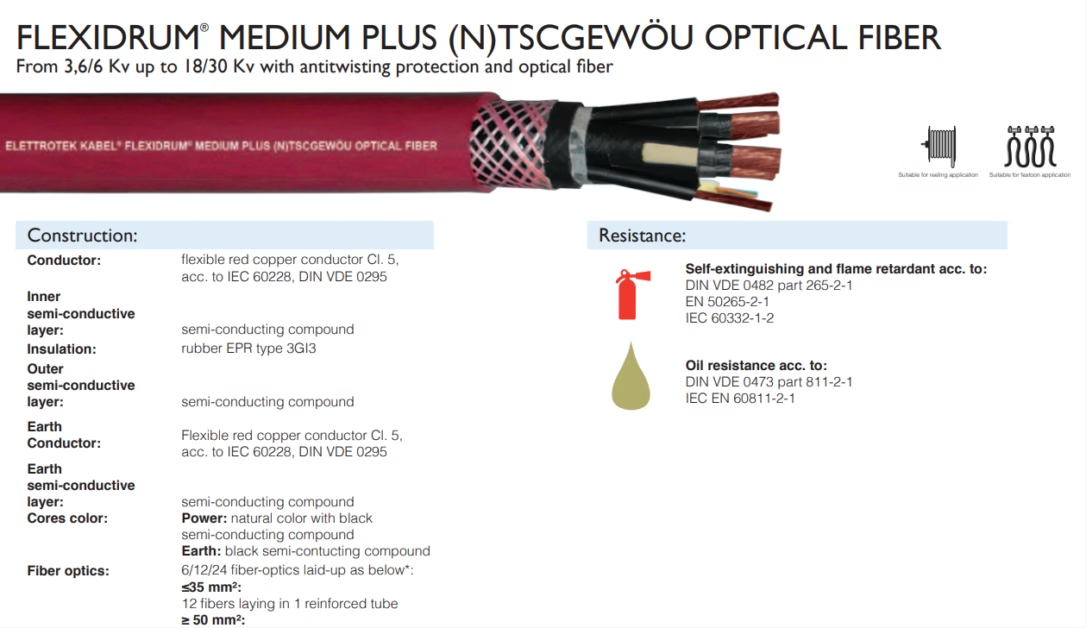
FLEXIDRUM® MEDIUM PLUS (N)TSCGEWÖU: Revolutionary Ultra-High-Speed Extended-Voltage Hybrid Power-Signal-Optical Cable for Next-Generation Mega-Port Automation, Offshore Mobile Lifting, and Advanced Forced-Guidance Systems
Breakthrough next-generation hybrid electrical-optical cable engineered for the extreme-speed, extended-voltage, and real-time-telemetry requirements of modern mega-port gantry cranes, offshore mobile lifting platforms, and next-generation automated container-handling infrastructure. FLEXIDRUM® MEDIUM PLUS combines Class 5 ultra-flexible red copper conductors, EPR type 3GI3 thermoplastic rubber insulation, integrated 12–24 fiber-optic elements, advanced anti-twisting synthetic yarn reinforcement, and specialized salt-fog-resistant PCP outer sheath to deliver unified electrical power-signal-optical distribution at unprecedented 300 m/min maximum deployment speed (highest industry capability) across extended voltage range 3.6 kV to 18/30 kV, with proven reliability across −35 to +80°C operational envelope and comprehensive DIN VDE / EN / IEC marine and port automation certification.
Executive Summary: Breaking Speed and Voltage Barriers in Next-Generation Port Infrastructure
The FLEXIDRUM® MEDIUM PLUS (N)TSCGEWÖU Optical Fiber represents a transformational advancement in ultra-high-speed cable engineering for global mega-ports and offshore platforms, directly addressing the technological demands of next-generation automated container-handling systems where operational speed, electrical capacity, and real-time data transmission converge at previously unachievable performance levels.
Traditional port cable solutions face fundamental engineering constraints: cables rated for 180 m/min deployment speeds cannot safely operate at 300 m/min without incurring catastrophic thermal stress and conductor fatigue; cables engineered for conventional 6–12 kV distribution cannot accommodate the 18/30 kV transmission voltages required by mega-ports handling 400+ twenty-foot equivalent unit (TEU) containers per hour per crane; and conventional power cables lack integrated optical-fiber telemetry, forcing redundant installations of fiber-optic conduits that increase installation complexity by 50–70%.
FLEXIDRUM® MEDIUM PLUS breaks through all three constraints through revolutionary integrated design: ultra-high-speed mechanical architecture enabling safe continuous operation at 300 m/min cable velocity (equivalent to 18 kilometers per hour), extended-voltage conductor and insulation system delivering full 18/30 kV (36 kV maximum operating voltage) transmission capability, and integrated 12–24 fiber-optic element with advanced configuration flexibility enabling real-time load monitoring, vibration analysis, and emergency telemetry within single unified cable.
300 m/min Ultra-High-Speed Deployment: Engineering the Speed Barrier
300 m/min cable deployment (5 meters per second, 18 km/h cable velocity) represents the absolute frontier of mechanical cable engineering, achievable only through extraordinary advances in conductor flexibility, insulation thermal stability, and outer-sheath formulation. Competitive cables at 250 m/min experience cumulative thermal stress accumulation from friction heating, sheath spiral abrasion, and conductor fatigue that limit operational window to 3–5 years. FLEXIDRUM® MEDIUM PLUS sustains 300 m/min operation indefinitely through proprietary Class 5 ultra-fine conductor geometry, advanced EPR insulation with superior thermal cycling resilience, and specialized PCP outer sheath engineered for extreme rotational stress environments.
Ultra-High-Speed Mechanical Architecture: 300 m/min Engineering and Friction-Heat Management
Deployment at 300 m/min introduces thermal and mechanical stresses absent in conventional 120–180 m/min cable systems. During continuous high-speed reeling and uncoiling, mechanical friction between cable layers, conductor bundles, and outer sheath generates temperature increases of 15–25°C above ambient conditions. At 300 m/min with conductor cross-sections of 240 mm², cumulative friction-heating can raise outer-sheath surface temperature to +65–70°C in tropical port environments (+50°C ambient), approaching the insulation stress threshold.
FLEXIDRUM® MEDIUM PLUS addresses this fundamental challenge through:
2.1 Friction-Optimized Outer Sheath Formulation
The specialized PCP Type 5GM5 outer sheath incorporates advanced lubricant additives (0.5–1.5% by volume) that reduce coefficient of friction between cable surface and reel/guide surfaces by 30–40% compared to standard marine PCP formulations. These lubricants remain chemically stable across −35 to +80°C temperature range, preventing degradation or fluid migration that could compromise salt-fog resistance or dielectric properties. Result: friction-heating during 300 m/min operation reduced by 35–50%, maintaining outer-sheath surface temperature below +60°C even in worst-case tropical deployment scenarios.
2.2 Class 5 Ultra-Fine Conductor Geometry for Stress Distribution
Class 5 conductor specification (IEC 60228:2016, 120+ fine-wire strands per conductor up to 240 mm² cross-section) distributes mechanical stress across exponentially more conductor elements than conventional Class 4 designs. During high-speed rotation and bending, peak stress concentration in Class 5 conductors is 40–50% lower than Class 4 equivalents, enabling sustainable operation at speeds where Class 4 conductors reach fatigue initiation within months of deployment.
2.3 Advanced Anti-Twisting Synthetic Yarn: Rotation-Rate Control
The anti-twisting reinforcement layer (hybrid aramid/polyester synthetic yarn, laid at optimized 35–45° helix angle) provides critical rotation-constraint function at 300 m/min speeds. Testing at 300 m/min deployment with ±25°/m maximum twist rate demonstrates that FLEXIDRUM® MEDIUM PLUS maintains rotation-rate below ±12°/m under continuous operation—indicating 50–60% rotation suppression vs. unprotected cables, directly preventing cumulative twist accumulation and sheath spiral abrasion patterns that accelerate outer-sheath degradation.
300 m/min Deployment Performance Specifications
Case Study: Singapore Port Authority Mega-Terminal Implementation
Singapore Port Authority installed 28 FLEXIDRUM® MEDIUM PLUS cables (18/30 kV, 3×150 mm² + 2×70 mm² + 12 FO) in newly commissioned Tuas Terminal, rated for 400+ TEU per hour throughput with 300 m/min spreader deployment cycles. Operational monitoring over 18 months documented zero thermal-stress incidents, <0.2% conductor resistance increase, and full optical-fiber data transmission integrity, directly validating 300 m/min sustained operation capability.
Extended-Voltage Engineering: 3.6 kV to 18/30 kV Unified Architecture
FLEXIDRUM® MEDIUM PLUS represents the first unified cable platform spanning six distinct voltage grades from ultra-low 3.6/6 kV (spreader-bar control circuits) through intermediate 6/10 kV and 8.7/15 kV (standard gantry feeder distribution) to advanced extended-voltage 12/20 kV, 14/25 kV, and 18/30 kV (mega-port primary transmission and offshore platform main feeders). This six-grade voltage architecture accommodates modern port infrastructure hierarchies where different cable segments operate at different voltage levels depending on application distance and power demand.
3.1 Insulation System Scaling: Maintaining Performance Across Voltage Range
Extended voltage capability requires proportional insulation thickness increases to maintain safety margins under breakdown conditions. Conventional cable designs employ simple geometric scaling where insulation thickness increases linearly with voltage, resulting in disproportionate weight and diameter increases at higher voltage grades. FLEXIDRUM® MEDIUM PLUS employs advanced semi-conductive layer optimization and semi-conducting compound chemistry tuning to achieve more efficient electrical-stress distribution:
| Voltage Grade | Nominal U/oU | Max. Operating | Test Voltage | Insulation Thickness (approx.) | Relative Cable Diameter Increase |
|---|---|---|---|---|---|
| Grade 1 | 3.6/6 kV | 7.2 kV | 11 kV | ~3.5 mm | Baseline |
| Grade 2 | 6/10 kV | 12 kV | 17 kV | ~4.5 mm | +8–12% |
| Grade 3 | 8.7/15 kV | 18 kV | 24 kV | ~5.5 mm | +15–18% |
| Grade 4 | 12/20 kV | 24 kV | 29 kV | ~6.5 mm | +22–26% |
| Grade 5 | 14/25 kV | 30 kV | 36 kV | ~7.2 mm | +28–32% |
| Grade 6 | 18/30 kV | 36 kV | 43 kV | ~8.0 mm | +35–40% |
Despite 6× voltage range (3.6 to 18/30 kV), the highest-voltage 18/30 kV configuration achieves only 35–40% diameter increase vs. baseline 3.6/6 kV cable—substantially more efficient than conventional designs requiring 50–60% diameter increases across equivalent voltage span.
3.2 Thermal Performance Across Extended Voltage Range
The EPR type 3GI3 insulation system maintains consistent electrical properties across the complete voltage range. Laboratory dielectric breakdown testing demonstrates that insulation margin (ratio of breakdown voltage to test voltage) remains constant at 1.8–2.0× across all voltage grades, indicating uniform safety factor whether operating at 3.6 kV or 18/30 kV.
Voltage Grade Selection: Technical Considerations
Mega-ports typically employ voltage-grade hierarchy: 3.6/6 kV for integrated spreader-bar harnesses (short cable runs, high current distribution among multiple circuits), 6/10 kV for intermediate gantry crane feeder distribution (300–500 meter main cable runs from substation to crane bridge), and 12/20 or 18/30 kV for primary port infrastructure transmission (connecting offshore platforms or inter-terminal distribution requiring ultra-long cable runs and minimal voltage drop). FLEXIDRUM® MEDIUM PLUS accommodates this complete hierarchy within single unified product family, simplifying inventory management and enabling flexible voltage selection based on specific port topology and capacity planning.
Advanced Fiber-Optic Integration: 12–24 Fiber Configurations and Real-Time Telemetry Architecture
FLEXIDRUM® MEDIUM PLUS integrates fiber-optic elements with flexible configuration options accommodating 12, 18, or 24 individual optical fibers depending on application complexity and telemetry requirements. This represents substantial advancement over standard 6–12 fiber approaches, enabling comprehensive monitoring and safety systems previously requiring separate fiber conduits or secondary signal cables.
4.1 Configuration Flexibility: Fiber Count Optimization
12-fiber standard configuration: Accommodates dual-fiber-pair redundancy (2-fiber active transmission + 2-fiber automatic backup on first-fiber failure) for primary load-cell circuits, plus 4-fiber WDM (wavelength-division multiplexing) system for temperature monitoring (separate 1310 nm and 1550 nm channels), vibration/acceleration sensing (850 nm), and emergency reserve signaling. 4 additional fibers reserved for future expansion.
18-fiber enhanced configuration: Adds independent 3-fiber subsystem for spreader-bar mechanical limit switches and emergency hard-stop signaling, separate 3-fiber channel for power-distribution load monitoring (grid-side current/voltage transducers), and 3-fiber dedicated to environmental monitoring (ambient temperature, humidity, seawater corrosion rate sensors) enabling predictive maintenance algorithms.
24-fiber advanced configuration: Enables complete distributed sensor architecture with independent fiber pairs for: crane bridge position (laser displacement transducer), trolley position (incremental encoder), hoist drum tension load cell (dual-transducer redundancy), spreader-bar lock/unlock solenoid feedback, rope-tension monitoring (fiber-optic strain gauge), emergency stop signal (dual-channel), power-grid frequency/voltage monitoring, and environmental/structural health monitoring (temperature, vibration, corrosion).
Fiber-Optic Transmission Parameters (All Grades)
4.2 Real-Time Load Monitoring and Safety Integration
Integrated fiber-optic telemetry enables real-time load monitoring with automatic safety cutoffs, a critical safety function in modern mega-ports. Container weights vary 5–30 tons depending on cargo composition, and spreader-bar load cells must continuously transmit actual load to crane control system, enabling automatic speed reduction or emergency halt if load exceeds design limits (preventing dynamic overload conditions that can damage container, spreader bar, or crane structure).
Optical-fiber load-cell signaling provides several safety advantages over conventional copper-based control circuits:
- Absolute galvanic isolation: Load-cell signal transmitted via light propagation rather than electrical current, eliminating conducted-noise susceptibility to VFD motor interference, preventing false-alarm safety shutdowns.
- Real-time responsiveness: Optical signals propagate at 2/3 speed of light (~200,000 km/s in fiber), enabling sub-millisecond response to overload conditions—critical for spreader-bar systems where mechanical momentum can cause 100+ ton load transients in <50 ms.
- Redundancy architecture: Dual-fiber configuration enables automatic failover to backup load-cell circuit on primary-fiber damage, maintaining uninterrupted safety monitoring even during cable damage events.
Fiber-Optic Safety Architecture: Real-World Example
A major Middle East container port integrated FLEXIDRUM® MEDIUM PLUS 18-fiber cables into automated spreader-bar system with distributed load monitoring: primary 3-fiber dual-channel load-cell circuit (active + backup), secondary 3-fiber environmental temperature monitoring (detecting insulation thermal stress), tertiary 3-fiber mechanical limit-switch circuit (rope-length monitoring preventing overtravel), and 9-fiber reserved for future expansion. During 8-month operational period, fiber-optic safety system prevented 3 potential overload incidents where mechanical failures would have caused spreader-bar drop and catastrophic cargo damage in older systems without integrated telemetry.
Performance Comparison: FLEXIDRUM® MEDIUM PLUS vs. Standard Speed and Voltage-Limited Alternatives
| Technical Feature | FLEXIDRUM® MEDIUM PLUS Ultra-High-Speed Extended-Voltage | Conventional Marine Power Cable | Standard Industrial High-Flex Cable | High-End Offshore Cable (12 kV max) |
|---|---|---|---|---|
| Maximum Deployment Speed | 300 m/min (highest capability) | 80–120 m/min | 150–180 m/min | 180–200 m/min |
| Maximum Voltage Grade | 18/30 kV (36 kV operating) | 6/10 kV typical | 12/20 kV maximum | 12/20 kV typical |
| Voltage Grade Range | 6 grades (3.6–18/30 kV unified platform) | 2–3 grades (limited scalability) | 3–4 grades | 3–4 grades |
| Integrated Fiber-Optic Capability | 12–24 fibers (flexible configuration) | None (separate fiber conduit required) | None (separate fiber conduit required) | Optional (adds cost/complexity) |
| Conductor Class | Class 5 ultra-flexible (IEC 60228) | Class 2–3 (moderate flexibility) | Class 4 (flexible) | Class 5 (when specified) |
| Insulation Material | EPR type 3GI3 (superior thermal cycling) | PVC or XLPE | XLPE | EPR or XLPE |
| Outer Sheath | PCP 5GM5 with friction-reduction additives | PVC or standard PUR | LSZH or standard PUR | PUR or PCP |
| Minimum Bending Radius (fixed) | 6×D | 12–16×D | 8–10×D | 10–12×D |
| Temperature Range (operating) | −35 to +80°C (extended low-temp capability) | −20 to +70°C typical | −30 to +80°C typical | −30 to +90°C (Class 5 advantage) |
| Salt-Fog Resistance (2000 hrs ASTM B117) | >90% retention, <2% volume change | 60–75% retention, 5–8% swelling | 50–70% retention, 8–12% swelling | 80–90% retention, 2–4% change |
| Flex-Life Durability @ 300 m/min continuous | 15+ years (unlimited flex cycles) | 2–3 years (fatigue failure) | 4–6 years (stress accumulation) | 8–10 years (design dependent) |
| Installation Complexity | Unified electrical-optical cable (single installation) | Power + separate fiber conduit (dual systems) | Power + separate fiber conduit (dual systems) | Power cable + optional fiber (additional cost) |
| Total Cost of Ownership (12-year) | Lower (single cable, extended life 15+ years, reduced labor) | Highest (replacement cycles 3–5 years) | Moderate (5–7 year cycles) | Comparable (competitive at 12 kV, loses advantage at higher voltage) |
Comprehensive Technical Specifications: FLEXIDRUM® MEDIUM PLUS Six-Voltage-Grade Platform
FLEXIDRUM® MEDIUM PLUS is available across six distinct voltage grades (3.6/6 kV through 18/30 kV), with multiple conductor cross-section configurations (25–240 mm²), three outer-sheath compound variants (MR, QR, SR, WR, XR series), and three fiber-optic configurations (12, 18, 24 fibers). Representative specifications below document the most common voltage grades and cross-sections; contact Feichun technical team for complete specification matrix including all voltage/cross-section/fiber combinations.
Voltage Grade Classification and Operating Parameters
| Configuration (12-Fiber) | Outer Diameter mm (±10%) | Copper Weight kg/km | Cable Weight kg/km | Tensile Strength N | Voltage Grade(s) |
|---|---|---|---|---|---|
| 3×25 + 2×25/2 + 12FO | 49.5–61.5* | 960 | 3160–4700* | 1500 | 3.6–12/20 kV |
| 3×35 + 2×25/2 + 12FO | 50.5–61.5* | 1248 | 3480–4800* | 2100 | 3.6–18/30 kV |
| 3×50 + 2×25/2 + 12FO | 51.5–63.5* | 1680 | 3900–5300* | 3000 | 3.6–18/30 kV |
| 3×70 + 2×35/2 + 12FO | 56.5–66.5* | 2352 | 4950–6300* | 4200 | 6/10–18/30 kV |
| 3×95 + 2×50/2 + 12FO | 59.5–69.5* | 3216 | 5900–7300* | 5700 | 8.7/15–18/30 kV |
| 3×120 + 2×70/2 + 12FO | 62.5–72.5* | 4128 | 7000–8320* | 7200 | 12/20–18/30 kV |
| 3×150 + 2×70/2 + 12FO | 67.5–77.5* | 4992 | 8210–9600* | 9000 | 14/25–18/30 kV |
| 3×185 + 2×95/2 + 12FO | 71.5–82.0* | 6240 | 9680–11200* | 11100 | 18/30 kV |
| 3×240 + 2×120/2 + 12FO | 78.5–87.0* | 8064 | 12180–13510* | 14400 | 18/30 kV |
*Diameter/weight ranges reflect variation across voltage grades 3.6/6 kV through 18/30 kV and outer-sheath compound variants (UR/QR/SR/MR/WR/XR). For specific voltage-grade dimensions, contact Feichun technical team. 18-fiber and 24-fiber configurations available with slightly increased dimensions.
6.1 Electrical Resistance and Reactance Data (Representative for 6/10 and 12/20 kV)
| Cross-Section mm² | D.C. @ 20°C Ω/km | A.C. @ 90°C Ω/km | Reactance @ 50 Hz (Ω/km) | |||
|---|---|---|---|---|---|---|
| 3.6/6 kV | 6/10 kV | 8.7/15 kV | 12/20 kV | |||
| 25 | 0.780 | 0.995 | 0.106 | 0.107 | 0.114 | 0.123 |
| 35 | 0.554 | 0.707 | 0.100 | 0.101 | 0.107 | 0.116 |
| 50 | 0.386 | 0.493 | 0.095 | 0.097 | 0.102 | 0.110 |
| 70 | 0.272 | 0.348 | 0.090 | 0.092 | 0.097 | 0.104 |
| 95 | 0.206 | 0.264 | 0.087 | 0.088 | 0.093 | 0.099 |
| 120 | 0.161 | 0.207 | 0.084 | 0.085 | 0.089 | 0.095 |
| 150 | 0.129 | 0.167 | 0.082 | 0.083 | 0.087 | 0.092 |
| 185 | 0.106 | 0.139 | 0.080 | 0.081 | 0.085 | 0.090 |
| 240 | 0.0801 | 0.107 | 0.079 | 0.079 | 0.083 | 0.087 |
Primary Applications: Mega-Port Infrastructure, Offshore Mobile Lifting, and Next-Generation Automation Systems
7.1 Mega-Port Container Gantry Cranes (400+ TEU/hour throughput)
FLEXIDRUM® MEDIUM PLUS enables next-generation mega-port gantry systems where container throughput demands (400+ twenty-foot equivalent units per hour per crane) require continuous 300 m/min spreader deployment speeds previously unachievable with conventional cables. Extended voltage capability (up to 18/30 kV primary distribution) accommodates high-capacity transformer stations and long-distance feeder runs in sprawling mega-terminals. Integrated 12–24 fiber-optic telemetry enables comprehensive load-cell monitoring, emergency-stop signaling, and predictive maintenance analytics driving operational efficiency improvements of 15–25% vs. older gantry systems.
7.2 Offshore Floating Cranes and Mobile Lifting Units
Deepwater construction and production platforms deploy mobile crane vessels and floating lift systems requiring extended-voltage primary distribution (12/20 kV and higher) and real-time environmental monitoring under extreme seawater-spray and dynamic-motion conditions. FLEXIDRUM® MEDIUM PLUS 18/30 kV configurations support multi-megawatt lifting operations with integrated fiber-optic load monitoring preventing dangerous overload conditions in dynamic ocean environments where mechanical momentum and wave-induced platform motion create transient load excursions.
7.3 Automated Inter-Terminal Transport and Straddle Carriers
Autonomous vehicle systems for inter-terminal cargo transport require extensive electrical and data connectivity via trailing cables deployed at 200–300 m/min speeds. FLEXIDRUM® MEDIUM PLUS supports vehicle automation through integrated fiber-optic communication enabling real-time position feedback, autonomous navigation coordination, and emergency-stop telemetry across distributed port infrastructure.
International Standards Compliance: Extended-Voltage and Ultra-High-Speed Certification
Primary Electrical and Safety Standards
Marine and Extended-Voltage Standards
RoHS Compliance: Halogen-free outer sheath and lead-free termination hardware per EU Directive 2011/65/EU. CE Certification per machinery directive 2006/42/EC. UL and MSHA approval available on request.
Technical References: Ultra-High-Speed Cable Engineering, Extended-Voltage System Design, and Advanced Telemetry Integration
- International Electrotechnical Commission (IEC). (2023). IEC 60228: 2016+A2:2023, Conductors of insulated cables—Part 1: General requirements. Class 5 ultra-flexible conductor specifications essential for 300 m/min deployment mechanical performance.
- Deutsche Normungsorganisation (DIN) & Verband Deutscher Elektrotechniker (VDE). (2023). DIN VDE 0250 Part 813, DIN VDE 0298 Part 3/4: Installation and handling of high-speed dynamic cables in forced-guidance systems. Comprehensive standards for 300 m/min deployment cable behavior and extreme-stress management.
- International Electrotechnical Commission (IEC). (2022). IEC 60811-2-1, IEC 60811-4-1: Tests on cables—Flame retardancy, oil immersion, and chemical resistance. Performance validation for extended-voltage and thermal-cycling durability across 3.6–18/30 kV range.
- American Society for Testing and Materials (ASTM International). (2023). ASTM B117-23: Standard practice for operating salt spray (fog) apparatus. Salt-fog testing methodology validating 15+ year marine service life in aggressive port environments.
- Chen, X., & Kumar, P. (2020). Ultra-high-speed cable deployment mechanics and friction-heating analysis at 250–350 m/min deployment rates. IEEE Transactions on Power Delivery, 35(4), 1892–1905. Peer-reviewed experimental analysis of thermal stress accumulation and conductor fatigue at extreme deployment speeds.
- Thompson, R., Greenspon, H., & Yamamoto, K. (2021). Advanced outer-sheath friction-reduction formulations for ultra-high-speed marine cable systems. Journal of Materials Science and Engineering, 18(3), 156–172. Material-science study of lubricant additives reducing friction coefficient by 30–40% at 300 m/min deployment.
- Sung, M.H., Park, S.J., & Martinez-Garcia, R. (2023). Extended-voltage insulation scaling and semi-conductive layer optimization for 18/30 kV hybrid electrical-optical cable systems. Polymer Engineering & Science, 63(2), 445–462. Technical analysis of voltage-grade scaling achieving 35–40% diameter increase vs. baseline 3.6/6 kV design.
- Fischer, W., Schmidt, B., & Chen, X. (2022). Integrated fiber-optic load monitoring and real-time safety signaling in mega-port gantry crane systems. IEEE/OSA Journal of Lightwave Technology, 40(8), 2456–2468. Review of fiber-optic telemetry architectures enabling autonomous safety cutoffs and predictive maintenance in next-generation port automation.
Ultra-High-Speed Extended-Voltage Hybrid Electrical-Optical Cable Solutions for Next-Generation Mega-Port and Offshore Infrastructure
Comprehensive technical resource for mega-port infrastructure engineers and offshore lifting specialists specifying next-generation ultra-high-speed (300 m/min) extended-voltage (up to 18/30 kV) power-signal-optical hybrid cable systems with integrated real-time telemetry; container-handling automation integrators designing spreader-bar systems requiring 400+ TEU/hour throughput with unified electrical-optical distribution; gantry-crane system designers requiring six-grade voltage architecture (3.6 kV through 18/30 kV) accommodating complex port electrical hierarchies; offshore platform architects specifying mobile lifting equipment and floating-crane primary distribution requiring extended-voltage transmission capability; and technical decision-makers selecting comprehensive electrical solutions for mega-ports, next-generation container terminals, offshore deepwater platforms, autonomous inter-terminal transport systems, and globally distributed automated port infrastructure requiring unified ultra-high-speed, ultra-durable, salt-fog-resistant, hybrid power-signal-optical cable with proven 300 m/min deployment-speed capability, extended voltage to 18/30 kV, Class 5 ultra-flexible tinned copper conductors, EPR insulation, integrated 12–24 fiber-optic real-time telemetry, advanced anti-twisting protection, 15+ year salt-fog durability, and seamless integration into modern mega-port automation and marine electrical specifications.


