
Feichun N2XS(F)H 12/20 kV — Cca Water-Blocked LSZH Medium-Voltage Cable
A full-English engineering guide to the N2XS(F)H single-core XLPE cable family for fixed medium-voltage networks. The supplied reference identifies class 2 copper conductors, a 12/20 (24) kV rating, radial and longitudinal water blocking, an LSZH outer sheath, Cca fire performance and complete 120–400 mm² electrical and thermal data.
Contents
- Engineering position
- Designation and application logic
- Standards and evidence boundary
- Complete family specification
- Full 120–400 mm² source matrix
- Layer-by-layer cross-section
- Radial and longitudinal water blocking
- Electrical, thermal and short-circuit design
- Fire performance and LSZH
- Fixed-route application architecture
- Handling, bending and termination
- Selection comparison
- Failure mode analysis
- Feichun certification scope
- Source and data audit
1. Engineering position: a water-aware MV cable for fixed energy networks
The class 2 stranded copper conductor carries phase current. The conductor screen, XLPE insulation and insulation screen form the controlled radial dielectric system required for MV stress management.
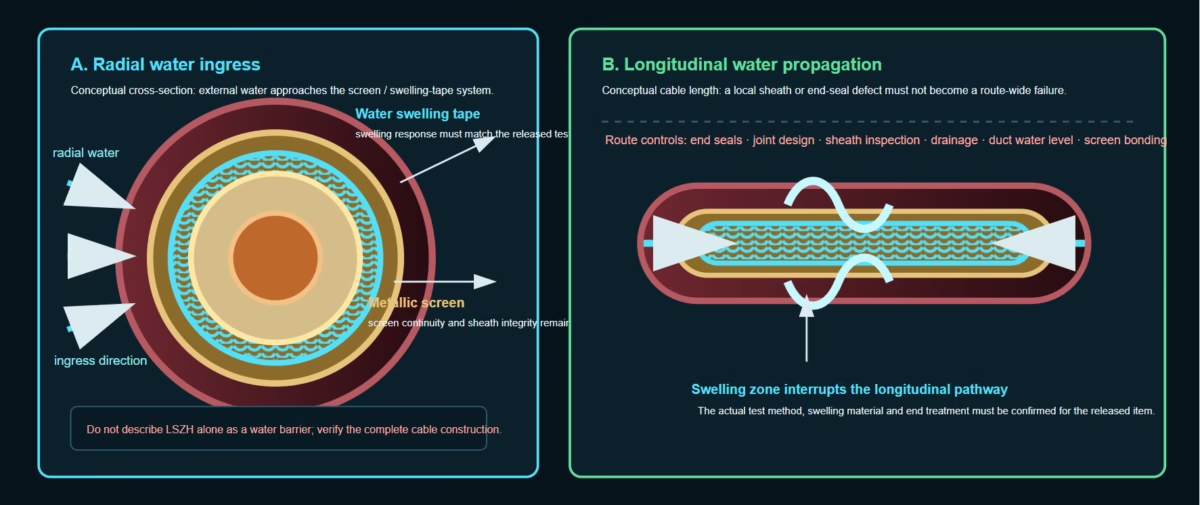
Radial and longitudinal water movement are different failure modes. A swelling tape and metallic screen construction can limit propagation, but end seals, joints, sheath integrity and drainage still determine installed performance.
The supplied family title states Cca. The source separately lists IEC 60332-3 Cat. C, IEC 60754-1/-2 and IEC 61034-2; these references answer different fire, smoke and gas questions.
Single-core formation, screen bonding, cleats, terminations, induced-current control, current rating and short-circuit duty must be designed as one cable system rather than selected from the conductor area alone.
2. N2XS(F)H designation and application logic
| Designation / field | Engineering reading | Design consequence | Data status |
|---|---|---|---|
| N | European / national designation family. | Read the complete construction and standard; the first letter is not a sufficient purchase specification. | Designation context |
| 2X | XLPE insulation family. | Coordinate the dielectric system with 12/20 (24) kV accessories and test requirements. | Reference construction |
| S | Copper metallic screen construction. | Screen continuity, bonding, earth-fault duty and induced-current control are mandatory design items. | Reference construction |
| (F) | Used here as part of the source product designation whose construction explicitly states radial and longitudinal water blocking. | Do not decode the parenthetical letter beyond the current controlled product document; verify the actual water-blocking materials and test basis. | Source designation + construction |
| H | Halogen-free / LSZH sheath family. | Supports low-smoke and halogen-related fire strategy; exact CPR performance remains product-specific. | Reference construction |
| 12/20 (24) kV | Rated voltage Uo/U with Um notation. | Check system earthing, insulation coordination, terminations, joints and testing against the project voltage class. | Supplied source |
| 120–400 mm² | Four listed copper-conductor nominal areas. | Choose by thermal capacity, voltage drop, fault duty, pulling mechanics and accessory availability—not current alone. | Supplied matrix |
Fixed distribution feeders, transformer connections, industrial plants, switchgear, process facilities, residential or industrial areas, underground routes and ducts when accessories and installation conditions are compatible.
Wet ducts, groundwater, damaged sheath sections and long cable runs can turn a local defect into a route-wide dielectric and corrosion risk. Longitudinal water blocking addresses propagation; it does not remove the need for sealing.
This fixed-installation reference is not automatically a mining trailing cable, crane reeling cable, festoon cable, drag-chain cable, continuous-torsion cable, shipboard cable or submarine cable.
It can be evaluated for fixed shore-side MV feeders serving port substations and industrial loads. A moving STS, RTG or shipboard route needs a cable family and accessory system designed for motion, torsion and the applicable special standard.
3. Standards and evidence boundary
| Reference | What it addresses | How to use it in an engineering decision | Evidence boundary |
|---|---|---|---|
| IEC 60502-2 | Product standard listed by the source for extruded-insulation MV power cables. | Use for construction, dimensions and test-basis review for the 12/20 (24) kV fixed-installation class. | Confirm current adopted edition and the exact Feichun conformity file. |
| IEC 60332-3 Cat. C | Bunched-cable vertical flame-spread test category. | Use as a flame-spread test reference; do not equate it with Cca or with a complete route fire strategy. | Source-listed test reference; current report required. |
| IEC 60754-1; IEC 60754-2 | Halogen-acid-gas / corrosivity-related fire-performance references. | Use when smoke and corrosive-gas exposure are part of the building, tunnel or plant safety case. | Source-listed; compound and report must match the ordered product. |
| IEC 61034-2 | Smoke-density test reference. | Combine with cable grouping, ventilation, enclosure geometry and emergency-egress requirements. | Source-listed; not a standalone CPR declaration. |
| Cca | Fire-performance class stated in the supplied family title. | Place the exact class in the project fire schedule only after checking the current product-specific declaration and qualifiers. | The supplied data does not state s1, d0 or a1 qualifiers. |
4. Complete N2XS(F)H 12/20 kV Cca family specification
| Specification field | Reference value | Engineering interpretation | Data status |
|---|---|---|---|
| Product designation | N2XS(F)H 12/20 kV Cca | Single-core XLPE-insulated medium-voltage cable with a copper conductor and LSZH outer sheath; the source title specifies radial and longitudinal water blocking. | Supplied / Nexans family reference |
| Product description | 12/20 kV XLPE insulated single core cables with copper conductor and LSZH outer sheath with radial and longitudinal water blocking | A fixed-installation MV architecture in which water blocking is a primary selection feature for underground and duct routes. | Supplied source |
| Product standard | IEC 60502-2 | The source lists IEC 60502-2. Confirm the project-adopted edition, conformity route and accessory standard before release. | Supplied source — current edition to be confirmed |
| Conductor material | Copper | Low-resistance phase conductor for medium-voltage distribution and industrial feeders. | Supplied source |
| Conductor flexibility | Class 2 | Stranded construction supports installation handling; it does not create a continuous-flex or reeling rating. | Supplied source |
| Number of cores | 1 | Single-core system; phase formation, screen bonding, induced current and cleat forces are installation-level design inputs. | Official product page / PDF |
| Rated Voltage Uo/U (Um) | 12 / 20 (24) kV | The 24 kV Um value is the maximum system-voltage notation supplied for the cable family. | Supplied source |
| Operating temperature, range | -20 … 90 °C | The supplied usage range and current official product page record; ambient, laying, accessory and sheath limits still govern the complete installation. | Supplied source / current official page |
| Older official PDF operating range | -20 … 60 °C | The older official family PDF record contains a different operating-range value. It must not be merged with the supplied 90 °C record; confirm the controlled revision before procurement. | Older official PDF — Generated 7/11/25 |
| Max. conductor temperature in service | 90 °C | Continuous conductor temperature limit stated in the supplied characteristics and current official product page. | Supplied source / current official page |
| Short-circuit max. conductor temperature | 250 °C | Use with the exact protection clearing time, conductor I²t calculation and accessory short-circuit capability. | Official product page / PDF |
| Longitudinally watertight | Yes | Longitudinal water propagation is a declared design characteristic; cable ends, joints and terminations still require sealing control. | Supplied source / official page |
| Radial water blocking | Yes | The product description explicitly states radial and longitudinal water blocking; the released test basis must be matched to the ordered design. | Supplied source / official page |
| Insulation | XLPE | The principal solid dielectric layer for the 12/20 kV voltage class. | Supplied source |
| Conductor screen | Semi-conducting compound (XLPE) | Electric-field transition between conductor and XLPE insulation; preparation quality is critical at MV accessories. | Supplied source |
| Insulation screen / water-blocking build | Semi-conducting compound (XLPE) + water swelling tape + copper wires with counter helix of copper tape | The source construction places the swelling tape and metallic screen system in the insulation-screen region; exact layer thickness and lay are controlled-drawing items. | Supplied source |
| Outer sheath | LSZH | Low-smoke, halogen-free sheath family; exact compound, colour, thickness and CPR declaration must match the released product. | Supplied source |
| Flame retardant | IEC 60332-3 Cat. C | A bunched-cable vertical flame-spread test reference; it is not a substitute for the Cca classification or its supporting declaration. | Supplied source |
| Halogen free | IEC 60754-1; IEC 60754-2 | Halogen-acid-gas and corrosivity-related references listed by the source; use the current test report for the ordered compound. | Supplied source |
| Smoke density | IEC 61034-2 | Smoke-performance test reference listed by the source; route geometry and cable grouping remain part of the fire assessment. | Supplied source |
| Fire performance class | Cca | Cca is the fire-class designation shown in the supplied family title. The source title alone does not state the smoke, droplet or acidity qualifiers. | Supplied source — qualifiers require current DoP |
| Official DoP fire declaration | Cca-s1,d2,a1 | The official family DoP record declares Cca-s1,d2,a1 according to EN 50575:2014+A1:2016 for the listed product family references; verify the exact ordered product and current declaration. | Official DoP — family record |
| Application | Energy networks with sudden load changes; residential or industrial areas; underground or in ducts | Use for fixed MV routes when voltage, thermal, mechanical, water, fire and accessory conditions are all closed by design. | Supplied source |
| Source record | Generated 8/4/26 — www.nexans.com.tr — Page 1 / 2 | Preserved from the supplied reference; confirm the controlled document revision before procurement. | Supplied source metadata |
| Source record continuation | N2XS(F)H 12/20 kV Cca — Page 2 / 2 | The supplied matrix and characteristics are treated as the user reference record for this article. | Supplied source metadata |
| Official PDF record | Generated 7/11/25 — Page 1 / 2 and Page 2 / 2 | The official family PDF is retained as a separate revision record because its operating range differs from the supplied/current-page value. | Older official PDF metadata |
| Bending factor when laying | Not stated in the supplied Cca reference | No minimum laying radius is derived here. Obtain the released Feichun installation factor and accessory instructions for the ordered size. | Not supplied — do not infer |
5. Full source matrix — N2XS(F)H 12/20 kV Cca
The following matrix preserves every supplied row and field. “Perm. current rating” values apply only to the stated ambient and flat formation in the source; they are not universal ampacity values.
| Cross section [mm²] | Nom. outer diam. [mm] | Max. DC Resist. Cond. 20 °C [Ohm/km] | short circuit conductor 1 s [kA] | Reactance at 50 Hz [Ohm/km] | Voltage Drop [V/A.km] | Perm. current rating in air 30 °C – flat formation [A] | Perm. current rating buried 20 °C – flat formation [A] | Nexans Ref. |
|---|---|---|---|---|---|---|---|---|
| 120 | 32.6 | 0.153 | 17.2 | 0.12 | 0.4 | 500 | 323 | 10582786 |
| 185 | 34.3 | 0.0991 | 26.5 | 0.11 | 0.3 | 637 | 406 | 10581520 |
| 300 | 39.7 | 0.0601 | 42.9 | 0.1 | 0.2 | 846 | 526 | 10582784 |
| 400 | 42.3 | 0.047 | 57.2 | 0.1 | 0.2 | 938 | 590 | 10582785 |
The matrix is reproduced from the supplied N2XS(F)H 12/20 kV Cca reference. Product drawings, dimensions and ratings are indicative until the current controlled manufacturer document and project calculation are accepted.
6. Layer-by-layer cross-section — why the water-blocking detail is important
The supplied construction sequence is: copper conductor; semi-conducting conductor screen; XLPE insulation; semi-conducting insulation screen; water swelling tape; copper wires with counter helix of copper tape; and LSZH outer sheath. The swelling tape is shown as a functional layer, not as a claim that every geometric detail is identical to the illustrative drawing.
Stranding improves installation handling. It does not remove the need to control pulling load, sidewall pressure, radius, cleat spacing and termination preparation.
These layers control the radial electric-field transition. Screen stripping, semicon removal and stress-control interface quality are critical at MV joints and terminations.
The source places a water swelling tape in the insulation-screen construction. Its material, overlap, swelling response and test method must be verified in the released Feichun drawing and report.
The screen is an electrical and fault-path component. Its continuity, bonding arrangement, induced-current loss and short-circuit duty must be calculated and tested.
7. Radial and longitudinal water blocking — an engineer’s failure-path model
Water can approach from the outside toward the screen and dielectric interfaces after sheath damage, immersion or a wet route. The complete radial barrier claim must be tied to the current design and type-test evidence.
Water can travel along interstices or interfaces over the cable length. “Longitudinally watertight: Yes” is useful for route reliability, but a cut end, joint or termination remains a potential entry point.
Water swelling materials limit propagation; they do not replace duct drainage, route grading, end sealing, joint enclosure selection or inspection after installation.
Moisture management protects more than insulation. It also reduces the risk of corrosion, screen discontinuity, accessory contamination and difficult fault-current paths.
8. Electrical, thermal and short-circuit design
The source matrix gives air ratings at 30 °C and buried ratings at 20 °C, both in flat formation. These are boundary conditions, not generic values. Actual soil thermal resistivity, depth, grouping, spacing, duct thermal resistance, ambient and solar exposure must be solved.
Maximum DC resistance is specified at 20 °C. For voltage drop and losses, correct for conductor temperature and use the applicable AC resistance, reactance, power factor, route length and phase arrangement.
Flat formation affects reactance, induced currents, screen losses and cleat forces. Phase spacing and screen bonding cannot be left to a generic multicore-cable assumption.
The matrix supplies conductor short-circuit current for 1 s. Verify protection clearing time, conductor 250 °C limit, screen fault duty, bonding method, joint capability and termination capability as one I²t chain.
| Engineering check | Source field to use | Why it matters | Release decision |
|---|---|---|---|
| Normal loading | Air / buried permissible current | Formation, ambient, soil and grouping change heat dissipation. | Recalculate for the actual route. |
| Voltage drop | DCR, reactance and voltage-drop fields | Motor starting, load change, power factor and route length can govern the area. | Use project load profile. |
| Conductor fault duty | Short-circuit conductor 1 s [kA] and 250 °C limit | Clearing time and initial conductor temperature affect I²t. | Verify with protection study. |
| Screen fault duty | Screen construction; no screen-current value supplied in the matrix | Screen continuity and bonding must carry the intended earth-fault current. | Must be confirmed before release. |
9. Fire performance, smoke and LSZH
The supplied family title states Cca. The same reference separately lists IEC 60332-3 Cat. C, IEC 60754-1; IEC 60754-2 and IEC 61034-2. These should be read as separate evidence layers: a fire-performance class, a flame-spread test reference, halogen-acid-gas / corrosivity references and a smoke-density reference.
Use the exact product-specific reaction-to-fire declaration in the project fire schedule. The supplied material does not state the smoke, droplet or acidity qualifiers, so they must not be invented.
The official IEC publication describes a bunched-cable vertical flame-spread test. Category C uses a defined non-metallic-material volume and flame-application time; it is not itself a CPR Cca declaration.
These references support evaluation of halogen-acid-gas and corrosivity-related behaviour. Exact values must match the sheath and insulation compound in the ordered construction.
Smoke density is a test result, not a guarantee of visibility in every installed arrangement. Cable grouping, ventilation, enclosure and fire compartmentation remain decisive.
Low-smoke, halogen-free construction supports human-safety and equipment-protection objectives, but LSZH alone does not automatically establish Cca or any particular sub-class.
Confirm cable classification, DoP, route grouping, fire stopping, penetration seals, support system, emergency egress and local building requirements together.
10. Fixed-route application architecture
Use matched MV terminations and screen-bonding hardware. Confirm phase formation, clearances, induced current, touch-voltage design and accessory heat.
Use the water-blocking feature as part of a complete route design: drainage, duct fill, pulling method, sidewall pressure, end seals, joints, water level and thermal soil parameters.
UV resistance, rodent protection and LSZH construction can be useful in demanding fixed routes. Chemical exposure, impact, vibration, fire compartmentation and maintenance access still require review.
Do not place this fixed-installation reference into a reeling, festoon or drag-chain route without a separate dynamic design. Travel speed, acceleration, torsion, cycles, rollers and winding geometry govern that selection.
11. Handling, bending and termination
- Confirm drum label, Nexans reference or Feichun product code, cable length, end seals, outside diameter and delivered mass before unloading.
- Obtain and use the released bending factor. The supplied Cca reference does not state a laying factor; no bending radius is derived below. Obtain the released factor and accessory instructions for the ordered size.
- Align the drum, pay off in the marked direction and prevent reverse winding, flange impact, uncontrolled twist and local sheath abrasion.
- Use a controlled pulling method. Verify pulling load, sidewall pressure, roller spacing, entry geometry and minimum radius from the current method statement.
- Keep cable ends sealed during storage and installation. Water blocking cannot compensate for open ends, damaged sheath or contaminated joint interfaces.
- Prepare semiconducting screens and XLPE interfaces with controlled tools and dimensions. Termination workmanship is part of dielectric reliability.
- Bond the metallic screen according to the earthing design. Verify continuity, bonding arrangement, induced-current assumptions and termination torque.
- Before energisation, complete conductor resistance, screen continuity, insulation / sheath tests, MV withstand or partial-discharge tests where specified, phase identification, accessory inspection, fire documentation and as-built records.
| Cross section | Nominal outer diameter | Derived circumference πD | Derived perimeter | Interpretation |
|---|---|---|---|---|
| 120 mm² | 32.6 mm | π × 32.6 mm | 102.4 mm | Geometry only; not a bending-radius value |
| 185 mm² | 34.3 mm | π × 34.3 mm | 107.8 mm | Geometry only; not a bending-radius value |
| 300 mm² | 39.7 mm | π × 39.7 mm | 124.7 mm | Geometry only; not a bending-radius value |
| 400 mm² | 42.3 mm | π × 42.3 mm | 132.9 mm | Geometry only; not a bending-radius value |
12. Selection comparison for engineers
| Requirement | N2XS(F)H reference | Comparison / risk | Engineering decision |
|---|---|---|---|
| Wet underground or duct route | Radial and longitudinal water blocking stated; longitudinally watertight: Yes. | Stronger water-management basis than a construction where water blocking is not stated; drainage and end sealing are still required. | Strong candidate subject to current test evidence. |
| 12/20 kV fixed distribution | Cu / XLPE / copper screen / LSZH, IEC 60502-2 listed. | Voltage class and accessory system must be matched; screen bonding and fault duty are not optional. | Suitable subject to calculation and accessory approval. |
| Fire-sensitive industrial route | Cca title; IEC 60332-3 Cat. C; IEC 60754-1/-2; IEC 61034-2; LSZH. | Fire class, test references and route fire strategy must not be collapsed into one marketing label. | Use current declaration for exact size. |
| High-current feeder | 120–400 mm² matrix with air and buried flat ratings. | Ratings change with ambient, soil, depth, grouping, spacing, screen losses and duct thermal resistance. | Select after thermal study. |
| Port shore-side fixed feeder | Potentially relevant to fixed substation, duct and industrial routes. | Salt atmosphere, flooding, UV, rodents, impact, fire compartments and maintenance access require a project review. | Confirm environmental construction. |
| Shipboard, submarine or moving crane route | Not established by this fixed-installation reference. | Special standards, dynamic cycles, torsion, reeling geometry and accessory design are different. | Select a dedicated cable family. |
13. Failure mode and effects analysis
14. Feichun Cable certification and project assurance
Confirm product code, 12/20 (24) kV rating, conductor area, outside diameter, mass, DCR, reactance, voltage drop, formation ratings, conductor and screen fault duty, water-blocking construction, fire class, LSZH compounds and accessory compatibility.
Certification capability does not make every N2XS(F)H size automatically Cca, IEC 60502-2 compliant, IECEx, ATEX, EAC or fire-certified. The exact cable, test report, declaration and market documentation must match.
The controlled release should identify radial and longitudinal water-blocking materials, screen construction, end treatment, joint compatibility, test method, acceptance criteria and revision status.
Feichun can develop the N2XS(F)H architecture as a water-aware, fire-performance MV platform while adapting conductor, screen, sheath, dimensions and project testing to the actual route instead of copying a reference label.
15. Source map and data-status audit
| Source | Use in this article | Status and limitation |
|---|---|---|
| Nexans Türkiye N2XS(F)H 12/20 kV – Cca family page | Product title, radial and longitudinal water-blocking description, IEC 60502-2 listing, application, construction, characteristics and family references. | Manufacturer family reference; confirm current availability, revision and Feichun configuration separately. |
| Nexans Türkiye N2XS(F)H 12/20 kV Cca technical PDF | Cross-check of the two-page family PDF, construction, characteristic fields and product list. | A family PDF; do not silently generalise revision-specific fields without confirming the ordered item. |
| Nexans Türkiye CPR Declaration of Performance | Official family DoP record for Cca-s1,d2,a1 according to EN 50575:2014+A1:2016 and the listed product references. | Use only for the exact ordered product and current declaration; it does not create a Feichun certificate. |
| IEC 60754-1; IEC 60754-2; IEC 61034-2 | Official standard records for halogen-acid-gas content, gas acidity / conductivity and smoke-density test context. | Test references only; the product-specific compound, test report and project fire requirements control. |
| IEC 60502-2 official consolidated publication record | Standard-scope review for extruded-insulation cables from 6 kV up to 30 kV, fixed installations and water-ingress considerations. | Project adoption and current controlled edition must be checked before a conformity claim. |
| IEC 60332-3-24:2018 official publication record | Category C bunched-cable vertical flame-spread test context. | Test method reference; it is not itself a CPR Cca declaration. |
| User-supplied reference record | Complete 120–400 mm² matrix, source metadata, fire references, operating temperatures, water-tightness claim and construction text reproduced in this article. | Preserved as supplied; drawings, dimensions, weights and ratings remain subject to current document confirmation. |


