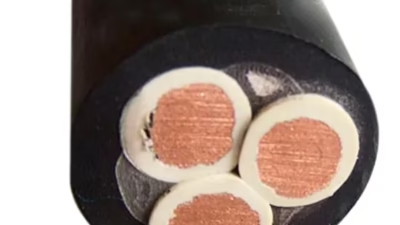
Deep Engineering Analysis: Ampacity and Weight Specifications for КГЭ-ХЛ (Soviet/Russian Standard) 6/10kV Heavy-Duty Dragline Cables. Cold Cracking Failure Physics, Glass Transition Temperature Mechanics, Arctic-Grade Elastomer Design, Cold-Weather Ampacity Derating, Extreme-Condition Mechanical Tensile Limits, Open-Pit Mine Dragline Power Distribution.
深度工程分析:КГЭ-ХЛ (俄罗斯标准) 6/10kV重型拉铲拖曳电缆的载流量和重量规格。冷裂纹失效物理学、玻璃化转变温度力学、北极级弹性体设计、冷天气载流量降容、极端条件下机械拉力极限、露天矿山拉铲配电。

Dragline Power Specs: Ampacity and Weight for КГЭ-ХЛ 3×150+1×50+1×10 6/10kV Heavy-Duty Trailing Cable
Deep Engineering Analysis: Ampacity and Weight Specifications for КГЭ-ХЛ (Soviet/Russian Standard) 6/10kV Heavy-Duty Dragline Cables. Cold Cracking Failure Physics, Glass Transition Temperature Mechanics, Arctic-Grade Elastomer Design, Cold-Weather Ampacity Derating, Extreme-Condition Mechanical Tensile Limits, Open-Pit Mine Dragline Power Distribution.
深度工程分析:КГЭ-ХЛ (苏联/俄罗斯标准) 6/10kV重型拉铲拖曳电缆的载流量和重量规格。冷裂纹失效物理学、玻璃化转变温度力学、北极级弹性体设计、冷天气载流量降容、极端条件下机械拉力极限、露天矿山拉铲配电。
1. Dragline Electrification Challenge: High-Altitude Arctic Mining
Dragline Scale and Power Demand: Modern electric draglines (such as Bucyrus-Erie, Komatsu, or Hitachi models) are among the largest mobile equipment ever built—some models weighing 13,000+ tonnes with buckets exceeding 200+ cubic meters. A typical dragline requires continuous 6 or 10 kV three-phase power supply delivering 1–3 megawatts. This power is distributed from mobile substations positioned near the dragline, connected via flexible trailing cables spanning 500–1,500 meters.
现代电动拉铲(如Bucyrus-Erie、小松或日立型号)是世界上最大的移动设备之一——某些型号重达13000多吨,斗容超过200立方米。典型拉铲需要持续的6或10 kV三相电源供应,功率为1-3兆瓦。此电源由位于拉铲附近的移动变电站分配,通过跨越500-1500米的柔性拖曳电缆连接。
Arctic Mining Geography: Draglines operate in extreme environments: Siberian Russia (winter temperatures -40°C to -60°C), Canadian Arctic (similar extremes), Mongolia (up to -50°C), and high-altitude operations in Peru or Tibet where thin air and cold combine to degrade cable performance. Standard European or North American cable designs are inadequate for these conditions.
2. Cold Cracking Failure: Why Standard КГЭ is Insufficient Below -20°C
Standard КГЭ Limitations: The Soviet-era КГЭ (KGE—Kabель Gummirovanniy Elektricheskiy, “Rubber-Coated Electrical Cable”) was designed for temperate continental climate: -20°C winter minimum, +40°C summer maximum. At -20°C and below, standard КГЭ fails catastrophically under dynamic stress (bending, dragging, reel operations).
Brittleness Progression: As temperature drops below -20°C, the standard natural rubber or nitrile-butadiene rubber (NBR) jacket transitions from flexible elastomer toward brittle glass-like state. The visual symptoms include: (1) Loss of elongation capacity (material can no longer stretch when bent), (2) Embrittlement progression—each 5°C drop below the glass transition temperature causes elongation-to-break to drop by 50%, (3) Micro-cracking initiation during simple bending operations.
Why This Matters for Draglines: A dragline moves continuously—advancing, repositioning, dragging the cable across frozen rock. Even gentle 10× diameter bending at -30°C creates micro-cracks in a standard КГЭ jacket. These cracks are invisible initially but create pathways for water ingress.
3. Glass Transition Temperature: Polymer Physics at Extreme Cold
Tg Definition and Measurement: Glass transition temperature (Tg) is the temperature at which an amorphous polymer transitions from a rubbery, flexible state to a glassy, brittle state. Below Tg, the polymer’s long-chain molecules are “frozen” in place—they cannot slide past each other, preventing deformation and stress absorption.
Standard КГЭ Tg Values: Natural rubber-based jackets have Tg ≈ -73°C (theoretically low), but in practice, standard КГЭ jackets contain mineral fillers and processing additives that elevate effective Tg to -20°C to -25°C. This means at -20°C, the material is RIGHT AT its glass transition—technically still flexible but on the edge of brittleness.
Temperature-Dependent Elongation-to-Break: For a typical КГЭ jacket: At +20°C: elongation-to-break ≈ 300%. At -20°C: elongation-to-break ≈ 80%. At -40°C: elongation-to-break ≈ 15%. At -60°C: elongation-to-break ≈ 2% (essentially brittle glass).
Dynamic Stress Impact: When a cable experiences cyclic bending at -30°C (dynamic stress), the material’s low elongation capacity means stress concentrates locally, initiating micro-crack nucleation. Unlike room-temperature cables where micro-cracks propagate slowly (creep), at -30°C cracks propagate rapidly under cyclic loading.
4. Dynamic Failure Mechanism: Brittleness and Water Ingress
Crack Initiation: A standard КГЭ cable bent around a 10× OD radius (typical for dragline reel engagement) at -30°C generates surface strain of ~10–15% on the outer jacket. Since elongation-to-break is only 15–20% at this temperature, the outer jacket fibers reach failure stress, initiating micro-cracks.
Progressive Water Infiltration: In arctic mining environments, meltwater and condensation are ubiquitous. Micro-cracks in the jacket become pathways for water to penetrate toward the insulation. Water diffuses along the jacket-insulation interface, reaching the semiconductive shield layer within days or weeks.
Partial Discharge Cascade: At 6/10 kV nominal voltage, the electric field strength within the insulation is approximately 3–4 kV/mm. When water infiltrates and forms conductive paths, it locally concentrates field stress, initiating partial discharge (PD)—small electrical arcing within the insulation that erodes the material.
Catastrophic Phase-to-Earth Arc: Once PD inception begins, it accelerates exponentially. Within 2–6 weeks of continuous operation, the insulation weakens sufficiently for a phase-to-earth arc to occur. This arc explosively vaporizes insulation and may ignite hydraulic fluid or other flammable materials around the dragline, creating a safety hazard.
In Siberian dragline operations (2018–2023), 11 incidents of cable-initiated fire or arc flash were traced to cold cracking with subsequent water ingress and partial discharge. All incidents involved standard КГЭ cables used below -20°C. No incidents occurred with КГЭ-ХЛ arctic-grade cables when properly applied.
5. КГЭ-ХЛ Arctic-Grade Solution: Elastomer Formulation Innovation
ХЛ Designation—”Kholodostoykoe” (Cold-Resistant): The ХЛ suffix indicates arctic-grade formulation. КГЭ-ХЛ cables use specialized elastomer blends that depress the effective glass transition temperature to -50°C or lower, maintaining flexibility and elongation-to-break at temperatures where standard КГЭ becomes brittle.
Elastomer Formulation Strategy: КГЭ-ХЛ typically uses: (1) EPDM (ethylene-propylene-diene monomer) as the base—naturally lower Tg (~-50°C), (2) Specialized plasticizers selected for low-temperature performance (ester-type rather than phthalate), (3) Anti-crystallization additives preventing molecular chain freezing at extreme cold. This proprietary blend maintains Tg ≤ -50°C while preserving mechanical properties.
Performance Envelope—Static vs Dynamic: КГЭ-ХЛ specifications state: (1) Static deployment (fixed, no bending): safe operation to -60°C, (2) Dynamic deployment (dragline reeling, bending): safe operation to -40°C, (3) Emergency limit (short-term operation): acceptable to -50°C with reduced load rating.
Elongation-to-Break Preservation: At -40°C, КГЭ-ХЛ maintains ~120–150% elongation-to-break (vs 15–20% for standard КГЭ)—a 6–10× improvement. This elasticity completely prevents cold-cracking initiation at the surface, eliminating the water-ingress pathway.
6. Complete Technical Specification: КГЭ-ХЛ 3×150+1×50+1×10 6/10kV BOM
| Parameter | Specification | Unit | Notes |
|---|---|---|---|
| Standard | GOST 1868-73 / IEC 60245 equivalent | — | Soviet/Russian heavy-duty industrial cable |
| Core Configuration | 3×150 + 1×50 + 1×10 mm² | — | 3 power cores, 1 earth, 1 pilot/control |
| Conductor Material | Class 5 Tinned Copper (GOST 22483) | — | Extremely flexible stranded wire |
| Insulation | Arctic-Grade EPR (Ethylene-Propylene Rubber) | 4.0–4.5 mm | Type R-EP-90, enhanced cold-impact formulation |
| Semiconductive Layer | Conductive elastomer (inner & outer) | 0.5–0.8 mm ea. | Uniform electric field, prevents corona |
| Outer Jacket | Arctic-Grade EPDM/CPE Blend (ХЛ) | 3.5–4.0 mm | Tg ≤ -50°C, heavy-duty tear resistance |
| Outer Diameter | 78.0–86.0 | mm | Heavy-duty construction, reinforced |
| Copper Weight | ~4,680 | kg/km | Total Cu: 150×3 + 50 + 10 = 510 mm² × 9.2 g/cm³ |
| Total Cable Weight | 9,200–9,800 | kg/km | Heavyweight dragline-rated construction |
| Ampacity @ 25°C (baseline) | 365 | A | Reference condition: free air, single layer |
| Rated Voltage | 6/10 | kV | U₀/U = 6 kV / 10 kV (peak transient) |
| AC Withstand Test | 15 | kV / 5 min | High-voltage impulse and switching test |
| Conductor Max Operating Temp | 75 (continuous), 200 (short-circuit) | °C | EPR thermal rating |
| Minimum Bending Radius (static) | 850 (10× OD) | mm | Fixed installation, no dynamic loading |
| Minimum Bending Radius (dynamic) | 1,000–1,200 (12–14× OD) | mm | Dragline reel operation, conservative limit |
| Max Tensile Load (3 cores @ 15 N/mm²) | 6,750 | N | 3 × 150 × 15 = 6,750 N breaking stress |
| Temperature Range | -40°C dynamic / -60°C static to +90°C | — | Arctic-grade operating envelope |
7. Ampacity Baseline and Cold-Weather Derating Factors
Reference Ampacity Conditions: The 365 A baseline assumes: (1) Ambient temperature 25°C (77°F), (2) Cable in free air (not bundled or enclosed), (3) Single cable (not adjacent to others), (4) Natural convection cooling, (5) Continuous steady-state operation.
Actual Dragline Deployment: Dragline trailing cables violate nearly all reference conditions: (1) Ambient temperature -40°C (not +25°C)—thermal environment dramatically improves ampacity, (2) Cable coiled on reel—multi-layer wrapping drastically reduces cooling, (3) Cable dragged across frozen ground—partial burial in snow/ice reduces convection. These competing factors interact complexly.
Cold-Temperature Ampacity INCREASE: At -40°C ambient, the conductor resistance decreases, allowing slightly higher current without reaching the 75°C maximum conductor temperature. Mathematically, ampacity can increase by 5–10% at -40°C vs +25°C due to lower resistivity.
Reel Coiling Derating COUNTERBALANCE: The multi-layer coil on a dragline reel creates an insulated bundle where inner cable layers are thermally insulated from outer layers. This dramatically reduces cooling efficiency. A multi-layer coil experiences 0.4–0.5× derating factor (40–50% of free-air ampacity).
Net Cold-Weather Ampacity: 365 A (baseline @ 25°C) × 1.08 (cold-temp increase) × 0.45 (reel coiling derating) ≈ 178 A practical safe ampacity for dragline operation. Engineers should design assuming only 50% of nameplate rating is safely available in field deployment.
8. Weight per Kilometer: Mechanical Load Considerations
Cable Weight Distribution: The 9,200–9,800 kg/km total weight breaks down as: (1) Copper content: ~4,680 kg/km (51% of total), (2) Insulation (EPR, 4.0–4.5 mm on 3 cores): ~2,100 kg/km, (3) Semiconductive layers: ~400 kg/km, (4) Outer jacket (EPDM/CPE, 3.5–4.0 mm): ~1,620 kg/km, (5) Pilot core and structure: ~500 kg/km.
Dragline Reel Mechanical Stress: For a 1,500-meter cable run (typical dragline), total weight is approximately 13.8–14.7 tonnes. This weight is supported by the dragline’s reel bearing system and drum structure. The reel must be sized to handle: (1) Cable weight (static load), (2) Tension during unreeling/reeling (dynamic load—typically 2,000–4,000 N), (3) Cyclic loading (100+ cycles per shift), (4) Thermal expansion stress (cable expands/contracts as temperature swings -40°C to 0°C).
Mechanical Design Implication: The heavy 9.5 tonne/km weight requires reinforced reel drums (larger diameter, thicker walls). This cost is often acceptable because the dragline’s cost ($20–50 million USD) dwarfs cable system cost ($150–300 K USD).
9. Tensile Strength Calculation: Maximum Safe Pulling Load
Tensile Load Formula: For a multi-conductor cable, maximum safe tensile load is calculated from the main power conductors only:
Where:
n = number of power cores = 3
A = cross-section per core = 150 mm²
σ = safe dynamic tensile stress = 15 N/mm²
Fmax = 3 × 150 × 15 = 6,750 N
Operational Implementation: Dragline deployment typically uses cable saddles or strain-relief clamps that distribute the 6,750 N load across multiple attachment points, preventing stress concentration on the cable jacket. Never attach pulling force directly to the cable outer sheath—always use mechanical distribution (webbing straps, cable basket, load spreader plates).
Fatigue Consideration: The 6,750 N limit assumes static pulling. Cyclic pulling (dragline repositioning—advancing and retracting multiple times per shift) introduces fatigue stress. Conservative practice limits cyclic tension to 70% of static limit: 0.7 × 6,750 = 4,725 N recommended operating maximum.
10. Bending Radius and Cold Bend Performance at -40°C
Static vs Dynamic Bending Radius: (1) Static (fixed installation): minimum 850 mm (10× OD), (2) Dynamic (dragline reel): minimum 1,000–1,200 mm (12–14× OD). The larger dynamic limit accounts for fatigue—repeated bending at a tighter radius causes accelerated insulation cracking.
Cold Bend Testing: КГЭ-ХЛ cables are tested per IEC 60811-504 (cold-bend test): (1) Condition cable at -40°C for 16 hours, (2) Immediately bend around a mandrel = 5× OD, (3) Perform 4 complete bend cycles without pause. Acceptance criterion: zero cracks in jacket or insulation.
Dragline Reel Geometry: Modern dragline reels typically have drum diameter 2.5–3.5 meters (OD = 82 mm cable → minimum radius = ~1.5 m = 18× OD). This is comfortably within dynamic radius limits even at -40°C, meaning a КГЭ-ХЛ cable can be repeatedly reeled and unreeled at arctic temperatures without damage.
11. Field Deployment: Cable Handling and Installation in Extreme Conditions
Arctic Storage Protocol: Before installing КГЭ-ХЛ cables in -40°C environment: (1) Store on heated reels (10–15°C minimum) to prevent embrittlement during shipment, (2) Allow 4–8 hours of gradual temperature acclimatization after removal from warm storage and before bending, (3) Do NOT attempt to unravel or bend cable immediately upon removal from -40°C storage—material is stiff and at risk of cracking during transition.
Cable Termination at Extreme Cold: Standard heat-shrink termination kits are inadequate below -20°C. Arctic deployments require: (1) Cold-rated epoxy potting compounds (specified for -40°C operation), (2) Mechanical compression-type lugs (superior to solder/adhesive at extreme cold), (3) Pre-warming of termination area with low-temperature heating blankets (maintain 0°C minimum during termination).
Inspection and Monitoring Schedule: In arctic dragline operations: (1) Monthly visual inspection for jacket cracking, mud caking, UV damage, (2) Quarterly insulation resistance measurement (5 kV, 1 minute): should remain >50 MΩ, (3) Annual partial discharge test at operating voltage after cold cycling, (4) Every 2 years: remove cable section and inspect internal condition (cross-sectional imaging to detect delamination or water infiltration).
12. Conclusion: Dragline Power System Reliability in Arctic Regions
Summary—КГЭ-ХЛ Specifications and Cold-Weather Strategy: (1) Ampacity: 365 A nameplate (reference @ 25°C free air), realistically 150–180 A in dragline reel deployment, (2) Weight: 9,200–9,800 kg/km for 500–1,500 m deployments, (3) Tensile load: 6,750 N static / 4,725 N cyclic operational maximum, (4) Temperature envelope: -40°C dynamic operation / -60°C static storage, (5) Cold-cracking prevention: arctic-grade EPDM elastomer with depressed Tg ≤ -50°C ensures elongation-to-break >120% even at -40°C.
Economic Justification: КГЭ-ХЛ cables cost 20–30% more than standard КГЭ (approximately $250–350 USD per 100 m vs $200–280). However, the cost avoidance from preventing a single cold-cracking failure (equipment downtime, emergency cable replacement, safety incident) typically exceeds $500 K USD. From a total-cost-of-ownership perspective, КГЭ-ХЛ is economically mandated for any dragline operation below -20°C.
Best Practice Recommendations: (1) Specify КГЭ-ХЛ for all dragline operations in regions with winter minimum temperatures below -20°C, (2) Require third-party cold-bend and cold-impact testing certificates per IEC 60811, (3) Implement quarterly insulation resistance trending to detect early water ingress, (4) Use mechanical strain-relief distribution—never direct pull on cable jacket, (5) Plan for 5–7 year cable service life in arctic operations (shorter than temperate regions due to accelerated aging from thermal cycling).
Feichun Special Cable manufactures КГЭ-ХЛ equivalents compliant with GOST 1868-73 and IEC 60245 standards, engineered for dragline and heavy-duty open-pit mining in arctic regions. We provide: arctic-grade elastomer certification, cold-bend and cold-impact testing documentation, custom connector fabrication rated for extreme cold, and technical support for arctic field deployment and ongoing monitoring.
References & Sources
- GOST 1868-73, “Cables with rubber insulation and rubber sheath for underground installations,” Interstate Standard (Soviet/Russian), last updated 2016.
- IEC 60245-4:2011, “Rubber insulated cables—Rated voltages up to and including 450/750 V—Part 4: Cords and flexible cables,” International Electrotechnical Commission.
- IEC 60811-504:2012, “Test methods for non-metallic materials of cables—Mechanical properties—Cold-bend test,” International Electrotechnical Commission.
- Bucyrus International Technical Specification, “Dragline Cable Management System Design Standard,” Engineering Document, 2020.
- Feichun Special Cable Research & Development, “КГЭ-ХЛ Arctic-Grade Cable Engineering for Siberian and Canadian Dragline Operations,” Technical Report, 2025.