
CPE versus TPU, dynamic design data, failure analysis and Feichun engineering
DIN VDE 0250 Trailing & Reeling Cable
CPE versus TPU, dynamic design data, failure analysis and Feichun engineering
A technical procurement and design guide for DIN VDE 0250 trailing, festoon and reeling cables used on port cranes, mining machines, conveyors and mobile industrial equipment. It compares CPE/PCP and TPU sheath systems, quantifies the mechanical and electrical checks, maps failure modes to tests and explains why Feichun treats conductor, compound, geometry, reinforcement, reel and termination as one engineered system.
Important interpretation: DIN VDE 0250 is a family and numbering framework. A cable is not “VDE 0250 compliant” in the abstract. The purchase specification must identify the exact part or construction, voltage, conductor class, insulation and sheath compounds, temperature range, mechanical duty, test schedule and approval documents.
1. What DIN VDE 0250 actually is
DIN VDE 0250 is associated with German requirements for insulated wires and cables, especially rubber-insulated and elastomeric constructions used in industrial, mobile and demanding environments. The number is a standards family reference; the engineering meaning comes from the applicable part, cable designation and product construction. In practice, a project team may also need to coordinate VDE 0295 / IEC 60228 conductor classes, VDE 0207 compound designations, EN/IEC voltage standards, fire tests, EMC requirements and the local installation code.
The VDE system exists to make a cable designation testable. It connects a material and construction to measurable requirements such as conductor resistance, insulation thickness, mechanical strength, elongation, thermal ageing, ozone/ oil behaviour, cold flexibility, flame performance and electrical withstand. That connection is why a correct designation is more valuable than a marketing phrase such as “heavy duty” or “extra flexible.”
2. How to read a VDE 0250 cable designation
The safe workflow is to decode the type code only after reading the manufacturer’s legend. Feichun’s engineering files map each letter to a layer, a material, a dimension and a test. That prevents an installer from treating two visually similar cables as interchangeable when their torsional or water-resistance design is different.
3. The technical layers behind the standard
| Layer / parameter | What the VDE approach forces engineers to define | Why it matters in service |
|---|---|---|
| Conductor | Material, nominal area, resistance, stranding and flexibility class | Controls voltage drop, heat, fatigue life and termination reliability. |
| Conductor screen | Whether a semiconductive screen is required and how continuity is verified | Controls electric-field stress in medium-voltage constructions. |
| Insulation | Elastomer family, wall thickness, ageing and electrical tests | Determines thermal endurance, dielectric margin and partial-discharge behaviour. |
| Earth / metallic screen | Section, coverage, continuity and fault-current path | Provides equipotential bonding and a controlled return path during faults. |
| Inner sheath / bedding | Compatibility, adhesion, stripability and mechanical support | Prevents layer migration and reduces stress concentration during bending. |
| Outer sheath | Compound, thickness, tensile/elongation, oil, ozone, UV, water and abrasion limits | Protects the electrical core from the actual site environment. |
| Marking | Permanent identification, metre marking, manufacturer and rating | Supports installation control, maintenance and audit traceability. |
4. Why a VDE reference is necessary in specifications
A 0.6/1 kV rubber cable, a reeling cable and a 6/10 kV screened mining cable may all look black and round. Their electrical and mechanical duties are different. The exact VDE type prevents a low-duty substitution.
Compound names alone are not enough. The specification links insulation and sheath performance to tests, dimensions, ageing and operating limits.
Glands, potheads, couplers, stress-control components and clamps are selected from the cable diameter, screen, insulation and bending requirements defined in the construction.
Correct selection reduces premature failures caused by fatigue, water ingress, wrong radius, chemical attack, poor stripping or incompatible termination kits.
A standards reference is therefore a procurement control, a design input and a maintenance document. It gives the EPC contractor a common language for cable, accessory, installation and inspection decisions.
5. Fixed, flexible, reeling and submersible duty: the boundary matters
| Duty | Typical engineering demand | DIN VDE 0250 implication | Feichun design response |
|---|---|---|---|
| Fixed industrial | Low movement; support carries cable weight | Thermal, electrical and environmental requirements dominate | Dimension and sheath selected for installation route |
| Flexible / trailing | Repeated bending and occasional tension | Conductor class, lay length and compound flexibility become critical | Fine-stranded copper, controlled lay and elastomeric jacket |
| Reeling / festoon | Reverse bending, torsion, compression between layers | Dynamic radius and torsion limits must be tested, not assumed | Dedicated reel/festoon geometry and mechanical qualification |
| Submersible pump | Water pressure, suspension load, vibration, sealed termination | Water-resistance and accessory interface are as important as insulation | Continuous-length options, reinforced sheath and controlled termination |
DIN VDE 0250 does not turn every rubber-insulated cable into a mining, reeling or submersible cable. The application class must be declared and validated with a complete cable system: cable, clamps, glands, termination, supports, protection and operating envelope.
6. Why manufacturing these cables is specialist engineering
Feichun’s challenge is not simply extruding a black sheath. A high-performance VDE cable is a layered mechanical and electrical system. The process must keep conductor resistance, lay geometry, concentricity, screen continuity, insulation wall, adhesion, sheath thickness and finished diameter inside a controlled window while the cable remains flexible.
Process control chain
Failure chain Feichun must interrupt
- Fine stranding: more strands improve bending behaviour but increase requirements for compaction, cleanliness, tinning and resistance control.
- Lay balance: the conductor, core assembly, screen and sheath need compatible lay lengths so bending does not force one layer to carry the whole strain.
- Elastomer processing: cure temperature, line speed and compound rheology affect voids, adhesion, hardness and ageing.
- Screen continuity: a medium-voltage screen must remain electrically continuous through production and termination; a visual braid is not proof of field control.
- Dimensional control: finished diameter governs glands, couplers, reels, clamps, bending radius and logistics.
7. Feichun’s professional manufacturing logic
| Capability | What it means technically | Why the customer benefits |
|---|---|---|
| Application-specific construction | Mining, crane, reeling, submersible and MV cable platforms are engineered with different mechanical assumptions | The cable is matched to the duty instead of being forced into an unsuitable generic type. |
| Material discipline | Conductor, EPR/thermoset insulation, semiconductive layers, metallic screens and sheath compounds are controlled as a system | Stable electrical performance and repeatable stripping/termination. |
| Mechanical qualification | Bending, torsion, abrasion, cold flexibility, tensile and crush considerations are built into the design review | Fewer failures caused by installation geometry or movement. |
| Electrical qualification | Resistance, insulation, withstand, screen continuity and dimensional checks are documented | Traceable acceptance for EPC, OEM replacement and maintenance files. |
| Custom engineering | Lengths, colour, marking, auxiliary cores, ground conductors and termination interfaces can be specified | Shorter adaptation time for legacy equipment and constrained sites. |
8. What to request in a DIN VDE 0250 cable quotation
- Exact cable designation and applicable DIN/VDE part or equivalent product standard.
- Rated voltage U₀/U, conductor class, nominal resistance and conductor material.
- Insulation and sheath compound, temperature range, oil/ozone/UV/water limits and flame class where required.
- Minimum static and dynamic bending radius, allowable tensile force, torsion limits and reel data.
- Screen/earth construction, short-circuit capability and termination requirements.
- Routine, type and sample test plan with test certificates and lot traceability.
- Finished diameter, mass, packaging, marking, storage life and handling instructions.
- Explicit statement of the intended application: fixed, trailing, reeling, festoon, submersible or mining.
9. DIN VDE 0250 parts that matter for trailing and reeling duty
A purchase order should identify the exact cable family, standard part, edition and any project amendments. Two widely specified low-voltage families illustrate why the part number matters:
| Reference | Recognised cable family | Engineering use | What must still be declared |
|---|---|---|---|
| DIN VDE 0250-812:1985-05 | NSSHÖU rubber-insulated flexible cable | Heavy-duty flexible supply, mining and industrial service; screened variants may be specified separately | Voltage, core count, conductor section, screen/earth design, radius, load, compound and installation limits |
| DIN VDE 0250-814:1985-02 | NSHTÖU rubber-insulated trailing cable | Trailing and reeling service with a strain-bearing construction; frequently associated with cranes and material handling | Reel geometry, speed, acceleration, tensile force, torsion, support element, duty cycle and termination |
| Project-specific or other part | Medium-voltage, screened, mining, control or combined constructions | Where voltage stress, EMC, monitoring cores or site rules exceed the low-voltage family | The controlling product standard, test schedule and certificate scope |
Standards evidence: the official VDE listing identifies DIN VDE 0250-812 as the current 1985-05 standard for NSSHÖU rubber-insulated flexible cable. The corresponding -814 listing identifies NSHTÖU. These titles establish the product family; they do not define the user’s complete reel, ambient or chemical duty. See VDE 0250-812 and the VDE standards portal.
10. CPE/PCP versus TPU: choose by failure mechanism
The outer sheath is the cable’s load-transfer and environmental barrier. “Oil-resistant” and “abrasion-resistant” are incomplete specifications because performance changes with polymer grade, plasticiser package, hardness, temperature, fluid, immersion time and test method. Feichun selects and qualifies the compound against a duty matrix instead of selecting by polymer name alone.
| Decision factor | CPE / PCP elastomeric sheath | TPU sheath | Engineering decision |
|---|---|---|---|
| Abrasion and cutting | Robust heavy-industry balance; wear depends strongly on compound and reinforcement | Often offers higher tear, cut and abrasion resistance at comparable thickness | Use a declared DIN ISO 4649 / ISO 4649 abrasion result and a site wear simulation; polymer name is insufficient |
| Mineral oil / hydraulic fluid | CPE/PCP systems are commonly selected for oil, ozone and weather resistance | TPU performance depends on chemistry and fluid; swelling or loss of properties must be tested | Specify actual oil, temperature and duration under IEC/EN 60811-404 or an agreed immersion protocol |
| Water and hydrolysis | Suitable formulations can provide strong wet-environment service | Polyether TPU is generally preferred where long-term hydrolysis resistance is critical; polyester TPU requires careful validation | Declare continuous/temporary immersion, water temperature, pressure and expected life |
| Low-temperature flexing | Compound-specific; an unsuitable grade can stiffen and crack | Selected grades can retain excellent low-temperature flexibility | Verify cold bend, cold elongation and dynamic flex at the minimum installation temperature |
| Flame behaviour | Flame-retardant industrial formulations are well established | Must be formulated and tested; high mechanical performance does not imply flame compliance | State the required test, for example IEC/EN 60332-1-2, and record pass/fail |
| Ozone and UV | Common strength of correctly formulated CPE/PCP jackets | Grade and stabiliser package control the result | Use an ozone/UV requirement tied to test duration, concentration and exposure |
| Friction and handling | Good industrial handling; surface finish can be tuned | Can give a smooth, tough surface suited to guides and drag systems | Check drum, guide and pulley material; low friction alone does not prevent sidewall pressure |
| Termination / repair | Often familiar to mining and crane technicians; bonding system must match the compound | Can be harder to strip or bond; accessory compatibility is essential | Approve gland, resin, moulding and repair system on the actual jacket |
| Cost and lifecycle | Often strong value where oil, ozone, flame and general mechanical duty dominate | Higher material cost can be justified by wear life in severe abrasion or cut duty | Compare cost per operating cycle or operating hour, including outage and replacement labour |
Cable system: every interface carries load
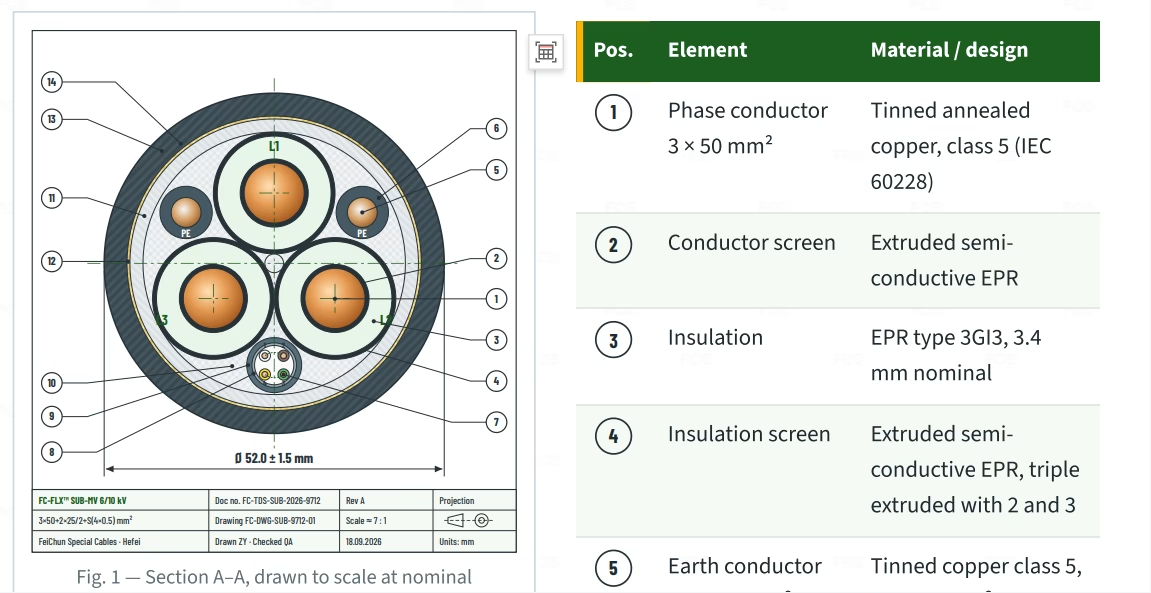
Illustrative construction. Screen, earth conductors, optical fibres, pilot cores, support braid and layer sequence depend on the selected cable.
Polymer selection logic
Quantified procurement targets: examples for a project specification
The following figures are useful as an engineering starting sheet. They are not universal DIN VDE 0250 limits and not automatic Feichun product declarations. The signed Feichun datasheet, test plan and certificate for the exact part number control the supply.
| Parameter | Example starting requirement | Verification / design note |
|---|---|---|
| Conductor | Tinned or bare copper; IEC/DIN EN 60228 Class 5 or Class 6 as specified | Measure DC resistance at 20 °C; record strand design and lay |
| Continuous conductor temperature | Often 90 °C for selected elastomer systems | Confirm against the exact standard part, compound and installation; reel layering can require derating |
| Ambient design window | Common platform study range: approximately −40 to +90 °C fixed; dynamic minimum must be separately declared | Do not transfer this range to a product without its datasheet and cold-flex qualification |
| Dynamic bend radius | Initial study: 8D to 12D; use 10D for preliminary reel geometry | Final radius depends on cable family, speed, tension, layer count and reverse bends |
| Fixed bend radius | Initial study: 4D to 6D | Confirm the datasheet; termination entry may require a larger radius |
| Tensile load | Declare continuous and peak force in N | Allocate force to a support element or cable design; do not assume copper conductors are the hauling member |
| Abrasion | Agree maximum volume loss in mm³ under ISO 4649 / DIN ISO 4649 | Example tender targets might distinguish standard duty ≤250 mm³ and severe-wear duty ≤120 mm³; validate feasibility with the chosen compound |
| Oil resistance | Declare oil type, temperature, immersion time and permissible tensile/elongation or volume change | Use IEC/EN 60811-404 or an agreed equivalent; hydraulic fluid and diesel are different exposures |
| Ozone | Declare concentration, temperature, duration, strain and “no cracks” criterion | Verify the complete sheath formulation, not only the base polymer |
| Flame | Pass the project’s named test, commonly IEC/EN 60332-1-2 where applicable | Record the exact test standard and specimen result |
| Finished cable | OD tolerance, ovality, mass, core identification and metre marking | OD controls gland, drum and guide compatibility; ovality influences spooling |
11. Reeling mechanics: numbers that control cable life
A reelable cable fails through the combined action of curvature, tension, torsion, acceleration, crushing and temperature. A compliant sheath cannot correct an undersized drum or a fleet angle that forces the cable against the flange.
Electrical sizing must include the moving installation
Current capacity also changes when cable is wound in multiple layers because adjacent turns retain heat. The calculation should include drum fill, duty cycle, ambient temperature, solar gain, grouping and the maximum acceptable conductor temperature. A free-air ampacity copied from a catalogue is not a reel ampacity.
| Input needed | Why it matters | Common error |
|---|---|---|
| Drum root and maximum winding diameter | Sets minimum curvature and number of cable layers | Checking drum diameter but ignoring the smaller entry sheave |
| Travel distance and stored length | Controls reel capacity, cable mass and voltage drop | Ordering route length without service loop and termination allowance |
| Speed, acceleration and emergency stop | Defines dynamic peak load and strand fatigue | Using steady-state pull only |
| Fleet angle and guide alignment | Controls sidewall pressure, abrasion and cross-winding | Specifying a wear-resistant jacket while leaving the guide misaligned |
| Horizontal, vertical or catenary travel | Changes self-weight and support-element load | Ignoring suspended length in vertical service |
| Cycles per hour and target life | Converts “flexible” into a measurable fatigue programme | No cycle target, so quotations cannot be compared |
| Reel torque control | Prevents slack, over-tension and core migration | Using constant torque across changing drum diameter |
12. Failure-mode engineering and corrective action
| Observed failure | Likely physical cause | Evidence to inspect | Design / operating response |
|---|---|---|---|
| Broken conductor strands near a sheave | Radius too small, reverse bending, excessive tension or conductor lay mismatch | Break location, strand fracture surface, sheave diameter, cycle history | Increase radius, reduce pull, optimise bunching/lay, remove unintended reverse bend |
| Sheath corkscrew or cable twist | Torsional lock-up, bad reel alignment, asymmetric core geometry | Lay direction, swivel policy, fleet angle, twist per metre | Balance cable geometry, control torsion and align reel/guide |
| Core migration / sheath bulge | High traction, poor internal friction balance or emergency-stop shock | Bulge position, peak torque log, elongation and support-member condition | Use strain-bearing design, control reel torque and qualify pull cycles |
| Soft, swollen or sticky jacket | Fluid incompatibility or thermal ageing | Identify fluid; measure mass, volume, tensile and elongation changes | Change CPE/TPU grade and specify the actual immersion exposure |
| Cold cracking | Compound glass-transition/stiffness, small radius or installation below declared temperature | Ambient log, crack pattern, cold bend result | Use cold-qualified compound and temperature-specific dynamic test |
| TPU embrittlement or property loss in wet heat | Unqualified TPU chemistry or hydrolysis exposure | Water temperature, immersion duration, retained tensile/elongation | Evaluate polyether TPU or qualified alternative; validate wet ageing |
| Insulation resistance decline | Water ingress at termination, sheath damage or electrical treeing in MV cable | IR trend, sheath test, termination dissection, PD data where applicable | Improve seals, screen interface and termination process; repair sheath damage |
| Hot conductor or discoloured termination | Undersized section, loose lug, reel thermal build-up or conductor damage | Thermography, torque record, resistance balance, drum layer state | Recalculate ampacity/voltage drop, correct termination and derate reeled operation |
| Screen / earth discontinuity | Repeated flex fatigue, wrong braid coverage or termination strain | Continuity resistance, braid fracture zone, fault path calculation | Optimise screen/earth geometry and prove short-circuit and flex performance |
13. Application cases: how an engineer would choose
Case A — port crane motorized reel
| Duty | 120 m active travel, 35 mm cable OD, outdoor UV/salt atmosphere, hydraulic oil splash, repeated acceleration and multi-layer reel |
|---|---|
| Preliminary geometry | At 10D, minimum cable-centreline bend radius = 350 mm; the smallest drum or sheave is the controlling component |
| Material decision | CPE/PCP is a strong baseline when oil, ozone, flame and weather balance dominate. TPU should be evaluated if guide abrasion and cutting cause the observed failures. |
| Acceptance | Reeling cycle test at project tension and radius, oil immersion, ozone/UV, flame test, OD/ovality and conductor/screen continuity before and after cycling |
Case B — mine conveyor trailing supply
| Duty | Cable drags on abrasive ground, sees rock impact and hydraulic oil; maintenance access is limited |
|---|---|
| Risk hierarchy | Cut/impact, oil swelling, conductor fatigue, earth continuity and flame performance |
| Material decision | A qualified CPE/PCP design offers a proven heavy-industry balance. A TPU sheath can be justified when measured abrasion/cut damage dominates and the selected grade passes oil, flame, wet and repair-system tests. |
| Acceptance | Site-fluid immersion, abrasion volume loss, tear/cut test, crush/impact, drag simulation, flame test and post-test electrical integrity |
Case C — cold-climate yard crane
| Duty | Outdoor reeling at −35 °C with ice, grit and start-stop service |
|---|---|
| Risk hierarchy | Low-temperature stiffening, small-radius start-up, surface cutting and reel torque spike |
| Material decision | A cold-qualified TPU grade may provide an advantage, but only complete-cable dynamic testing at −35 °C proves the insulation, fillers, reinforcement and sheath work together. |
| Acceptance | Cold bend/impact plus powered reeling test at minimum temperature; record torque, jacket cracking and conductor resistance balance |
Case D — festoon system with reverse bends
| Duty | Crane trolley festoon with clamps, saddles and repeated S-bending |
|---|---|
| Risk hierarchy | Clamp pressure, reverse-bend fatigue, core migration and local sheath wear |
| Design response | Use controlled lay, compatible support geometry, large saddle radius and clamp pressure that restrains without crushing |
| Acceptance | Festoon cycle test using production cable and representative trolley hardware, followed by dissection and electrical tests |
Case E — wet pump, dredging or dewatering connection
| Duty | Wet handling, possible immersion, axial load and repeated recovery |
|---|---|
| Risk hierarchy | Termination water path, longitudinal migration, jacket damage and unsupported cable weight |
| Design response | Continuous length, water-qualified materials, strain relief independent of conductor joints, and a matched moulded or gland termination |
| Acceptance | Immersion/pressure protocol, insulation resistance trend, sheath integrity, pull test and finished termination inspection |
14. Feichun design and manufacturing control plan
Feichun’s technical advantage comes from controlling the interfaces that generic catalogue selection leaves unresolved. The value is measurable when the quotation connects every service input to a construction choice and an acceptance test.
| Control stage | Feichun engineering action | Record / evidence requested by the buyer | Field consequence |
|---|---|---|---|
| Application review | Capture reel, festoon or trailing geometry; speed; tension; cycles; fluids; temperature; voltage; EMC and termination data | Signed design input sheet and deviation list | Prevents a static cable from being sold into dynamic service |
| Conductor design | Select strand diameter, bunching, lay length, tinning and compaction for electrical resistance and fatigue | Conductor class, nominal resistance and in-process resistance results | Reduces strand fatigue, hot spots and termination variability |
| Insulation system | Choose elastomer grade and wall thickness for voltage, temperature, wet duty and dynamic strain | Material batch, wall-thickness map, eccentricity and electrical test | Controls dielectric stress and thin-wall failure |
| Core geometry | Balance lay direction, lay length, fillers and anti-torsion/strain elements | Construction drawing, lay records and roundness data | Reduces corkscrew, core migration and ovality |
| CPE/PCP or TPU jacket | Select the formulation from the real oil, abrasion, hydrolysis, flame, UV and temperature matrix | Compound identification, batch traceability and agreed property tests | Matches the dominant environmental failure mechanism |
| Extrusion | Control conductor preheat, pressure, line speed, cooling, concentricity and surface finish | Process traveller, OD trend, wall measurements and spark test | Avoids thin spots, voids, adhesion variation and gland mismatch |
| Dynamic qualification | Configure reel, festoon, drag, torsion or bend testing around the project radius, load, speed and cycles | Test setup, cycle count, stop criteria, before/after electrical data and teardown report | Demonstrates the complete cable, not only a raw-material coupon |
| Release and documentation | Link finished length, drum, raw material and test results to the manufacturing lot | Routine test report, dimensional report, certificate list, marking and drum record | Supports commissioning, audit and failure investigation |
Factory acceptance and qualification matrix
| Test group | Routine / lot / type | Typical measurements | Purpose |
|---|---|---|---|
| Conductor | Routine / lot | DC resistance, strand count/diameter, conductor OD, tinning where specified | Electrical capacity and flexibility baseline |
| Geometry | Routine | Insulation/sheath minimum and average thickness, eccentricity, cable OD, ovality | Dielectric uniformity and mechanical fit |
| Electrical | Routine / type | Voltage withstand, insulation resistance, continuity; partial discharge for MV when required | Detects defects and verifies insulation system |
| Earth/screen | Routine / type | Continuity, resistance, coverage or construction; fault-current thermal calculation | Protective and EMC performance |
| Compound | Lot / type | Tensile strength, elongation, ageing retention, hot set where applicable | Confirms cure and material consistency |
| Environment | Type / project | Oil immersion, ozone, UV, water/hydrolysis, cold bend/impact, flame | Matches the declared service environment |
| Mechanical | Type / project | Abrasion, tear, crush, impact, torsion and tensile load | Quantifies resistance to handling and site damage |
| Dynamic system | Project qualification | Reeling/festoon/drag cycles at defined radius, tension, speed and temperature | Validates interaction of all cable layers |
| Final release | 100% / routine | Length, marking, visual surface, drum winding, end sealing and documentation check | Ensures the delivered cable matches the approved design |
15. Why select Feichun for CPE or TPU flexible cable
- Feichun converts motion into a specification. Radius, travel, speed, acceleration, tension, torsion and cycle target become measurable design inputs.
- Feichun can compare CPE/PCP and TPU on the same duty matrix. The recommendation follows the dominant failure mechanism and required test evidence.
- Feichun engineers the whole cable. Fine-stranded conductors, insulation modulus, core lay, fillers, support members, screens and jacket must move compatibly.
- Feichun supports custom interfaces. Core arrangement, control pairs, earth conductors, optical elements, finished OD, continuous length, marking, drum and termination geometry can be designed around equipment constraints.
- Feichun builds a qualification plan. Reel, festoon, torsion, drag, cold and fluid exposures can be converted into agreed pass/fail criteria where the project requires them.
- Feichun supplies an auditable quality package. Buyers can require raw-material traceability, calibrated test records, dimensional reports and certificate scope tied to the exact product.
- Feichun supports legacy and OEM replacement engineering. The review covers electrical fit, mechanical envelope, gland/seal interface, drum capacity and installation method, rather than matching only core size and voltage.
Commercially useful conclusion: the reason to choose Feichun is not a generic claim that one jacket material is “best.” It is the ability to turn a real machine duty into a controlled conductor, insulation, reinforcement and CPE/TPU sheath design, then connect that design to documented acceptance tests. That approach reduces the most expensive risks: unexpected outage, repeated cable replacement, termination rework and damage to connected equipment.
Certificate scope: Feichun maintains a comprehensive certification and quality-documentation capability, but certification is always product- and scope-specific. The buyer should request the current certificate, issuing body, standard, voltage, construction, factory and validity that apply to the exact cable being ordered. “DIN VDE 0250,” “CPE” or “TPU” alone is not a certificate.
16. Tender checklist for comparable supplier bids
| Bid item | Required declaration | Reject or clarify when… |
|---|---|---|
| Standard | Exact DIN VDE 0250 part, edition and cable designation | The bid says only “VDE cable” |
| Electrical | U₀/U, section, conductor class, resistance, ampacity assumptions and voltage drop | Ampacity ignores wound-on-reel conditions |
| Mechanical | Static/dynamic radius, continuous/peak tension, torsion and cycle capability | Only “highly flexible” appears |
| Sheath | Exact CPE/PCP or TPU system plus declared test results | Only “oil and abrasion resistant” appears |
| Environment | Temperature, UV, ozone, water/hydrolysis, flame and named site fluids | Test fluid or exposure condition is missing |
| Construction | Drawing, OD/mass tolerance, support element, earth/screen and lay concept | OD and mechanical support are undeclared |
| Testing | Routine, lot, type and project-qualification plan with pass/fail limits | A certificate is offered without scope or product link |
| Delivery | Continuous length, drum dimensions, end sealing, marking and storage instructions | Drum capacity or transport bend radius is unchecked |
17. References and engineering conclusion
VDE / DKE: DIN and VDE requirements are developed within the German electrotechnical standards system. Consult the current VDE Verlag listing for the exact edition and part applicable to the cable construction: VDE Verlag standards portal.
Conductor classification: IEC 60228 / DIN EN 60228 defines nominal conductor sizes and classes; use the applicable edition and manufacturer declaration for the purchased cable.
Industrial product context: German cable manufacturers and distributors list NSSHÖU, NSHTÖU and (N)TSCGEWÖU families for flexible industrial, mining, reeling and handling duties. The complete type code and product data sheet remain the controlling documents.
Feichun engineering: Feichun applies the VDE design logic to mining, crane, reeling, submersible and medium-voltage cable platforms, with application-specific construction, testing and documentation.


