how does reeling cable differ from standard power cable

DIN VDE 0250 is associated with German requirements for insulated wires and cables, especially rubber-insulated and elastomeric constructions used in industrial, mobile and demanding environments. The number is a standards family reference; the engineering meaning comes from the applicable part, cable designation and product construction. In practice, a project team may also need to coordinate VDE 0295 / IEC 60228 conductor classes, VDE 0207 compound designations, EN/IEC voltage standards, fire tests, EMC requirements and the local installation code. The VDE system exists to make a cable designation testable. It connects a material and construction to measurable requirements such as conductor resistance, insulation thickness, mechanical strength, elongation, thermal ageing, ozone/ oil behaviour, cold flexibility, flame performance and electrical withstand. That connection is why a correct designation is more valuable than a marketing phrase such as “heavy duty” or “extra flexible.”
DIN VDE 0250 Trailing & Reeling Cable

DIN VDE 0250 is associated with German requirements for insulated wires and cables, especially rubber-insulated and elastomeric constructions used in industrial, mobile and demanding environments. The number is a standards family reference; the engineering meaning comes from the applicable part, cable designation and product construction. In practice, a project team may also need to coordinate VDE 0295 / IEC 60228 conductor classes, VDE 0207 compound designations, EN/IEC voltage standards, fire tests, EMC requirements and the local installation code. The VDE system exists to make a cable designation testable. It connects a material and construction to measurable requirements such as conductor resistance, insulation thickness, mechanical strength, elongation, thermal ageing, ozone/ oil behaviour, cold flexibility, flame performance and electrical withstand. That connection is why a correct designation is more valuable than a marketing phrase such as “heavy duty” or “extra flexible.”
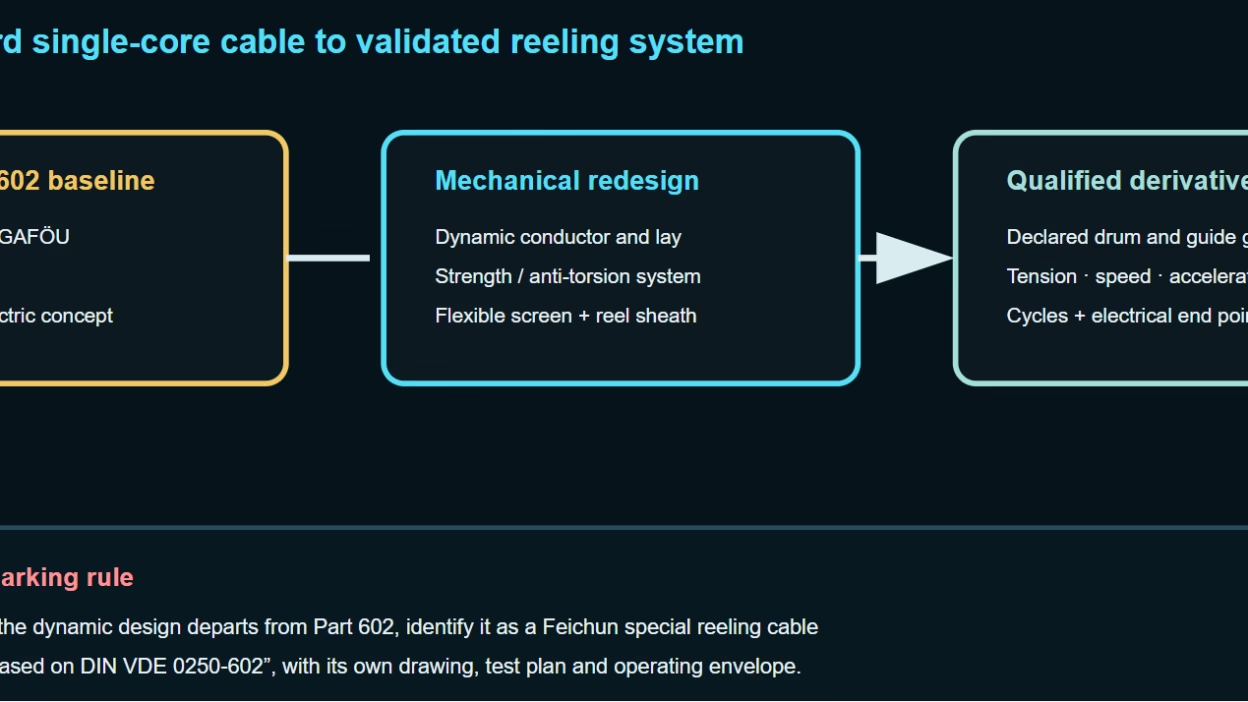
Yes—but only as application-specific derivatives with a controlled change of designation and a full dynamic qualification program. Standard DIN VDE 0250-602 versions are special rubber-insulated single-core cables for fixed or limited movement; they do not automatically possess the conductor stability, tensile load sharing, torsion control, flexible screening, abrasion resistance, drum heat behavior or verified bending life required for continuous motorized reeling.

Can NSGAÖU, NSGAFÖU and NSGAFCMÖU Be Developed as Reeling Cables?

Yes—but only as application-specific derivatives with a controlled change of designation and a full dynamic qualification program. Standard DIN VDE 0250-602 versions are special rubber-insulated single-core cables for fixed or limited movement; they do not automatically possess the conductor stability, tensile load sharing, torsion control, flexible screening, abrasion resistance, drum heat behavior or verified bending life required for continuous motorized reeling.
The supplied string identifies a flat PNCT-RF reeling cable with four cores, a nominal 185 mm² cross-section and a 0.6/1 kV voltage designation. In normal engineering notation this is read as PNCT-RF flat reeling cable — 4C × 185 mm² — 0.6/1 kV, subject to confirmation that 185SQ means 185 mm² per core. This guide explains how to specify, install and qualify the cable without inventing the missing dynamic ratings. Public manufacturers describe PNCT-RF as a flat reeling/festoon family; the exact Feichun construction must still be released against the machine duty.

FLAT REELING CABLE PNCT-RF 4C 185SQ 0.6/1KV — construction logic, flat-reel mechanics and procurement engineering

The supplied string identifies a flat PNCT-RF reeling cable with four cores, a nominal 185 mm² cross-section and a 0.6/1 kV voltage designation. In normal engineering notation this is read as PNCT-RF flat reeling cable — 4C × 185 mm² — 0.6/1 kV, subject to confirmation that 185SQ means 185 mm² per core. This guide explains how to specify, install and qualify the cable without inventing the missing dynamic ratings. Public manufacturers describe PNCT-RF as a flat reeling/festoon family; the exact Feichun construction must still be released against the machine duty.
This article treats DE HIGHLY FLEXIBLE 4X35 MM2 REELING CABLE NSHTOEU 0.6/1KV as the purchaser's supplied description and translates it into a controlled cable specification. The published NSHTOEU reference construction is a four-core, 35 mm²-per-core, 0.6/1 kV flexible reeling cable with fine-stranded tinned copper, rubber/EPR insulation, a rubber inner sheath, polyester reinforcement and a heavy-duty rubber outer sheath [1]. Feichun can develop a functional equivalent, but the released drawing, test plan and project conditions must govern the final product.

DE HIGHLY FLEXIBLE 4X35 MM2 REELING CABLE NSHTOEU 0.6/1KV — an engineering guide for dynamic power service

This article treats DE HIGHLY FLEXIBLE 4X35 MM2 REELING CABLE NSHTOEU 0.6/1KV as the purchaser’s supplied description and translates it into a controlled cable specification. The published NSHTOEU reference construction is a four-core, 35 mm²-per-core, 0.6/1 kV flexible reeling cable with fine-stranded tinned copper, rubber/EPR insulation, a rubber inner sheath, polyester reinforcement and a heavy-duty rubber outer sheath [1]. Feichun can develop a functional equivalent, but the released drawing, test plan and project conditions must govern the final product.
FEICHUN Reeling cable

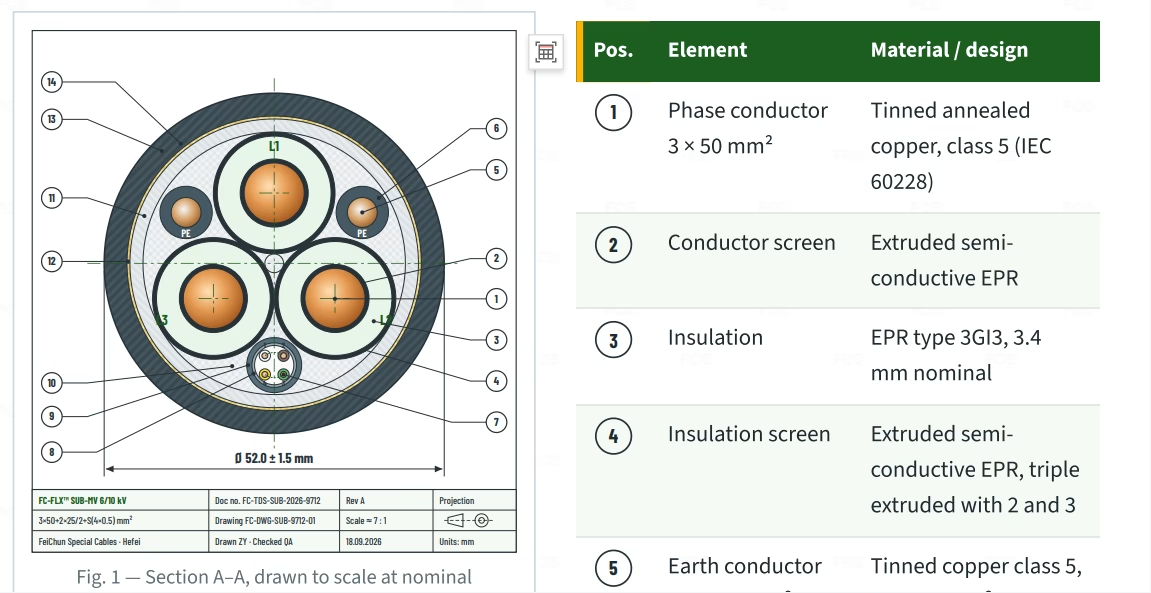
What is RELCT (MV) Reeling Cables for Container Cranes?

RELCT (MV) reeling cables serve a critical function in container crane electrification systems. Specifically, these cables are deployed to deliver electrical power from fixed power supply systems to the rotating reel mechanisms and traveling components of container handling cranes. The cable must accommodate continuous mechanical stressing from repetitive coiling and uncoiling operations while maintaining electrical integrity and safety performance.