
A comprehensive technical analysis of the fundamental differences between Australian/New Zealand and European mining cable earthing architectures — from earth structure philosophy and conductor configuration through safety principles, regional implementation standards, and Feichun’s dual-standard manufacturing capability enabling seamless operation across both international standards.
AS/NZS 1802 Type 241 vs. VDE 0250: Complete Earthing Differences Guide
A comprehensive technical analysis of the fundamental differences between Australian/New Zealand and European mining cable earthing architectures — from earth structure philosophy and conductor configuration through safety principles, regional implementation standards, and Feichun’s dual-standard manufacturing capability enabling seamless operation across both international standards.
📋 Article Contents
- AS/NZS 1802 Type 241: Origin, Adoption, and Application Domain in Pacific Mining
- VDE 0250 (N)TSCGEWÖU: German Standard Basis and Central European Implementation
- Why Did Two Fundamentally Different Earthing Architectures Emerge? Historical Context
- AS/NZS Type 241 Single-Core Earth: Design Rationale and Performance Characteristics
- VDE 0250 Symmetric 3×S1 + 3×S2 Earth: Distributed Architecture and Torsional Balance
- Comparative Analysis: Bending Performance, EMI Attenuation, and Fault Tolerance
- Safe Interchangeability: Can AS/NZS Cables Be Used in VDE-Standard Equipment?
Standard Origins & Regional Implementation
1. AS/NZS 1802 Type 241: Origin, Adoption, and Application Domain in Pacific Mining
AS/NZS 1802 (Australian/New Zealand Standard 1802) establishes the technical requirements for flexible mining cables used in underground and open-pit mining operations across Australia, New Zealand, and the broader Pacific region. Type 241 within this standard designates unarmoured flexible power cables rated at 0.6/1 kV with a Class 5 copper conductor, suitable for mobile mining equipment and drag cable applications. The standard was initially published in 1993 and has been progressively updated (most recently 2019) to incorporate advances in materials science and safety requirements.
AS/NZS 1802 Type 241 employs a single-core earth architecture: the cable contains one dedicated protective earth conductor of specified cross-section, positioned at a fixed location within the cable cross-section (typically at the “6 o’clock” position relative to the three phase conductors at 12, 4, and 8 o’clock). This single-core design reflects a pragmatic engineering philosophy: the earth conductor is sized to carry fault currents, provide equipotential grounding for equipment frames, and enable protective relay operation in the event of phase-to-frame faults.
2. VDE 0250 (N)TSCGEWÖU: German Standard Basis and Central European Implementation
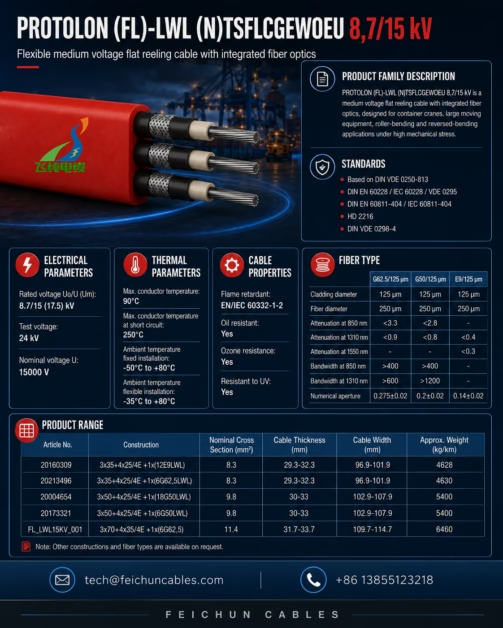
VDE 0250-813 is the German technical standard (published by Verband der Elektrotechnik, Elektronik und Informationstechnik — the German Electrical Engineering Association) that specifies mining reeling cables. The designation (N)TSCGEWÖU describes the cable’s technical characteristics: (N) indicating “new” specification, TS indicating a flexible (zug-schwach) cable, CG indicating copper conductors with specific flexibility properties, E indicating EPR insulation, W indicating a weather-resistant outer sheath, Ö indicating a special formulation, and U indicating unarmoured construction.
VDE 0250 mining cables employ a symmetric 3×S1 + 3×S2 earth structure: three primary protective earth conductors (S1) and three secondary/monitoring earth conductors (S2) distributed at 120° intervals around the cable cross-section. This symmetric arrangement is not accidental — it reflects a deliberate design philosophy that prioritizes mechanical balance and torsional stability during reel operations.
3. Why Did Two Fundamentally Different Earthing Architectures Emerge? Historical Context
The divergence between AS/NZS single-core earth and VDE symmetric earth architectures reflects different historical priorities in mining safety innovation. Australian mining safety standards, developed during the 1960s–1990s in the era of rapidly mechanizing open-pit copper mines, prioritized simplicity and cost efficiency. The single-core earth approach was straightforward to manufacture, easy to understand for equipment operators, and sufficient for the electrical protection requirements of the era (large AC motors with simple on/off protection, minimal variable frequency drive complexity).
German mining standards, evolved from Central European underground coal mining traditions where complex mechanized equipment had been deployed since the 1950s, prioritized mechanical reliability and operator safety in confined underground spaces. German engineers observed that asymmetrically located earth conductors caused cables to develop a “preferred bending direction” — they would naturally twist during reel operations, complicating installation and increasing risk of mechanical damage. The symmetric 3×S1 + 3×S2 architecture eliminates this preferred direction by making the cable structurally balanced in all radial directions.
Earthing Architecture Deep Dive
4. AS/NZS Type 241 Single-Core Earth: Design Rationale and Performance Characteristics
AS/NZS Type 241 single-core earth cables feature one earth conductor of specified cross-section (typically 25–50 mm² for 3×95 mm² phase cables, roughly 1/4 of phase conductor cross-section). This single earth conductor is sized by standards formulas to: (a) carry maximum short-circuit current under fault conditions without exceeding 160°C temperature rise over 5 seconds (IEC 60364 protection requirement); (b) provide sufficient conductivity for equipotential bonding of equipment frames; and (c) enable protective relay operation via sufficient voltage drop across the earth conductor during fault conditions.
The single-core earth is positioned at a fixed location in the cable cross-section (commonly the 6 o’clock position, located symmetrically opposite the three-phase center point). This positioning choice was historically based on manufacturing convenience — during the era when AS/NZS 1802 was drafted, cables were constructed by hand-layering conductors around a central axis, and placing the earth conductor at the 6 o’clock position allowed easy visual verification of correct assembly.
5. VDE 0250 Symmetric 3×S1 + 3×S2 Earth: Distributed Architecture and Torsional Balance
VDE 0250 symmetric earth design fundamentally reimagines earth conductor function. Rather than a single conductor performing all grounding functions, the design splits functionality: S1 conductors (primary earth, sized roughly 1/3 of phase conductor cross-section, typically 30–80 mm² for 3×95 mm² cables) carry protective currents and provide equipotential bonding; S2 conductors (secondary/monitoring earth, typically 50% of S1 cross-section) provide redundancy and enable equipment condition monitoring through continuous resistance measurement.
The three S1 conductors are positioned at 120° spacing (roughly at the 12 o’clock, 4 o’clock, and 8 o’clock positions relative to the cable center). The three S2 conductors are similarly positioned at 120° spacing, displaced from S1 positions (at 0°, 120°, 240°). This arrangement creates perfect rotational symmetry about the cable’s central axis — imagine the cable cross-section as a wheel with six evenly spaced spokes (three S1, three S2), rather than an asymmetric arrangement with earth located at one spoke position.
The practical benefit is mechanical: during reel operations, a symmetric cable has no preferred bending direction. An asymmetric cable with single-core earth will tend to roll or corkscrew during winding/unwinding because the asymmetric mass distribution creates torque. A symmetric cable resists this torsional instability, reducing operator effort during reel operations and decreasing risk of cable damage from torsion-induced stresses.
6. Comparative Analysis: Bending Performance, EMI Attenuation, and Fault Tolerance
| Performance Metric | AS/NZS Type 241 (Single-Core) | VDE 0250 (Symmetric Earth) | Performance Implication | Operational Impact |
|---|---|---|---|---|
| Torsional Stiffness Variation | Asymmetric; stiffness varies with rotation angle | Symmetric; uniform stiffness in all directions | VDE cable resists corkscrew rolling | VDE easier handling on standard reels |
| Preferred Bending Direction | Yes — cable naturally wants to bend in direction of single earth core | No — cable bends equally freely in all directions | AS/NZS requires skill to route through cable trays | VDE supports faster installation with less training |
| EMI Attenuation Effectiveness | Asymmetric earth distribution reduces effectiveness ~10% | Distributed S1 bonding provides 40–60 dB attenuation at 1 MHz | VDE achieves superior EMI control in noisy environments | VDE preferred for equipment with sensitive electronics |
| Short-Circuit Fault Current Capability | Single earth conductor carries full fault current; temperature rise ~160°C in 5 sec | Three S1 conductors share fault current; temperature rise distributed | VDE distributes thermal stress across three conductors | VDE achieves longer cable life under repeated fault events |
| Monitoring Capability | Single earth; monitoring requires interrupting main earth circuit | Dual S1+S2 structure; S2 enables continuous monitoring without disruption | VDE supports predictive maintenance without shutdown | VDE enables automated cable health monitoring systems |
| Manual Installation Ease | Single conductor easier to terminate and understand | Three S1 conductors require coordinated termination technique | AS/NZS simpler for field technicians learning the system | AS/NZS preferred for operations with limited training resources |
7. Safe Interchangeability: Can AS/NZS Cables Be Used in VDE-Standard Equipment?
This is the critical question for mining operations spanning multiple regions or transitioning between standards. The answer is: **AS/NZS Type 241 cables can be safely installed in VDE-standard equipment in most circumstances, but not vice versa.** The reasoning is electrical safety hierarchy: both standards achieve equivalent fault current protection and equipotential grounding. AS/NZS single-core earth provides these functions through concentration in one conductor; VDE distributed earth provides them through distribution across three conductors.
However, VDE equipment (particularly older STS cranes and fixed portal gantries designed in German facilities) was engineered assuming the presence of three distinct S1 earth points at 120° spacing. The equipment’s cable termination hardware, earthing lugs, and bonding circuits are designed to distribute earth current among three symmetrically positioned terminals. When an AS/NZS single-core cable is installed in such equipment, all earth current must flow through a single lug designed to accommodate 1/3 of total earth current. The single lug experiences 3× designed current density, causing overheating and potential connection failure in high-fault-current scenarios.
Conversely, VDE cables installed in AS/NZS equipment (designed with a single earth connection point) pose no safety risk — the three S1 conductors are simply bonded together at installation, and they collectively provide the same single-point earth capability as an AS/NZS cable.
Manufacturing & Global Operations
8. Feichun’s Dual-Standard Manufacturing: Engineering Both Architectures with Equal Precision
Feichun’s manufacturing capability spans both AS/NZS Type 241 and VDE 0250 standards with equal engineering precision. The facility maintains separate extrusion tooling, conductor assembly templates, and quality verification protocols for each standard. This dual capability is valuable for mining companies operating across regions: Australian copper mining companies expanding into Papua New Guinea might simultaneously source AS/NZS cables for domestic operations and VDE cables for PNG equipment (which often derives from German supplier specifications); European companies expanding into Australian operations maintain AS/NZS sourcing without disrupting their established VDE supply chain.
Manufacturing AS/NZS Type 241 requires: single-core earth assembly at the fixed 6 o’clock position, diameter management to maintain cable flexibility with single-core offset, and testing per AS/NZS dimensions and tolerance specifications. Manufacturing VDE 0250 requires: precise three-position earth placement at 120° intervals, complex conductor layout to maintain circularity with six distributed cores (three S1 + three S2), and verification per VDE 0250 mechanical and electrical specifications.
From a manufacturing perspective, VDE 0250 is more complex — it requires tighter dimensional tolerances and more sophisticated assembly sequencing. However, Feichun has invested in automated assembly equipment that handles both standards, treating the complexity difference as a calibration adjustment rather than a line reconfiguration.
9. Global Mining Operations: Which Standard to Specify for International Projects
For mining companies expanding internationally, the standard selection is not a technical choice but a supply chain and equipment compatibility choice. A company deploying Australian-manufactured mining equipment (continuous miners, mobile drill rigs) into new markets should specify AS/NZS Type 241 cables, because the equipment terminations are engineered for single-core earth. Conversely, companies using German or Central European equipment (common for underground coal operations) should specify VDE 0250 cables to match equipment design.
The key principle: **match the cable standard to the equipment manufacturer, not to the installation location.** An Australian mine operating German-designed STS cranes (from Liebherr, Gottwald, or similar) should source VDE-standard cables, not AS/NZS cables, despite operating in an AS/NZS jurisdiction. Likewise, a European mining company deploying Australian equipment in South Africa should source AS/NZS-standard cables despite the equipment being installed in a non-Australian region.
10. Cost and Lead Time Implications of Standard Selection
AS/NZS Type 241 cables generally cost 5–10% less to manufacture than equivalent VDE cables due to simpler earth conductor assembly (single vs. three cores). Manufacturing lead time is similar (4–8 weeks from Feichun) regardless of standard. However, supply chain implications differ: AS/NZS cables are most readily sourced from Asia-Pacific manufacturers (Australia-based suppliers, Feichun), while VDE cables are sourced from both European and Asian manufacturers with similar lead times.
For procurement teams, the cost difference is negligible compared to the operational consequence of specifying the wrong standard. Installing AS/NZS cables in VDE-standard equipment creates potential safety risks and compatibility problems that far outweigh any minor cost savings. Standard selection should be driven by equipment compatibility, not cost optimization.


