
A practical engineering guide to the DIN VDE 0250 family for flexible rubber-insulated power and control cables. It explains how the standard framework relates to conductor class, elastomer selection, voltage rating, mechanical duty, dynamic installation and verification — and why Feichun treats each cable as an engineered system rather than a catalogue colour and cross-section.
DIN VDE 0250
Why the standard matters — and why manufacturing to it is specialist work
A practical engineering guide to the DIN VDE 0250 family for flexible rubber-insulated power and control cables. It explains how the standard framework relates to conductor class, elastomer selection, voltage rating, mechanical duty, dynamic installation and verification — and why Feichun treats each cable as an engineered system rather than a catalogue colour and cross-section.
Important interpretation: DIN VDE 0250 is a family and numbering framework. A cable is not “VDE 0250 compliant” in the abstract. The purchase specification must identify the exact part or construction, voltage, conductor class, insulation and sheath compounds, temperature range, mechanical duty, test schedule and approval documents.
1. What DIN VDE 0250 actually is
DIN VDE 0250 is associated with German requirements for insulated wires and cables, especially rubber-insulated and elastomeric constructions used in industrial, mobile and demanding environments. The number is a standards family reference; the engineering meaning comes from the applicable part, cable designation and product construction. In practice, a project team may also need to coordinate VDE 0295 / IEC 60228 conductor classes, VDE 0207 compound designations, EN/IEC voltage standards, fire tests, EMC requirements and the local installation code.
The VDE system exists to make a cable designation testable. It connects a material and construction to measurable requirements such as conductor resistance, insulation thickness, mechanical strength, elongation, thermal ageing, ozone/ oil behaviour, cold flexibility, flame performance and electrical withstand. That connection is why a correct designation is more valuable than a marketing phrase such as “heavy duty” or “extra flexible.”
2. How to read a VDE 0250 cable designation
The safe workflow is to decode the type code only after reading the manufacturer’s legend. Feichun’s engineering files map each letter to a layer, a material, a dimension and a test. That prevents an installer from treating two visually similar cables as interchangeable when their torsional or water-resistance design is different.
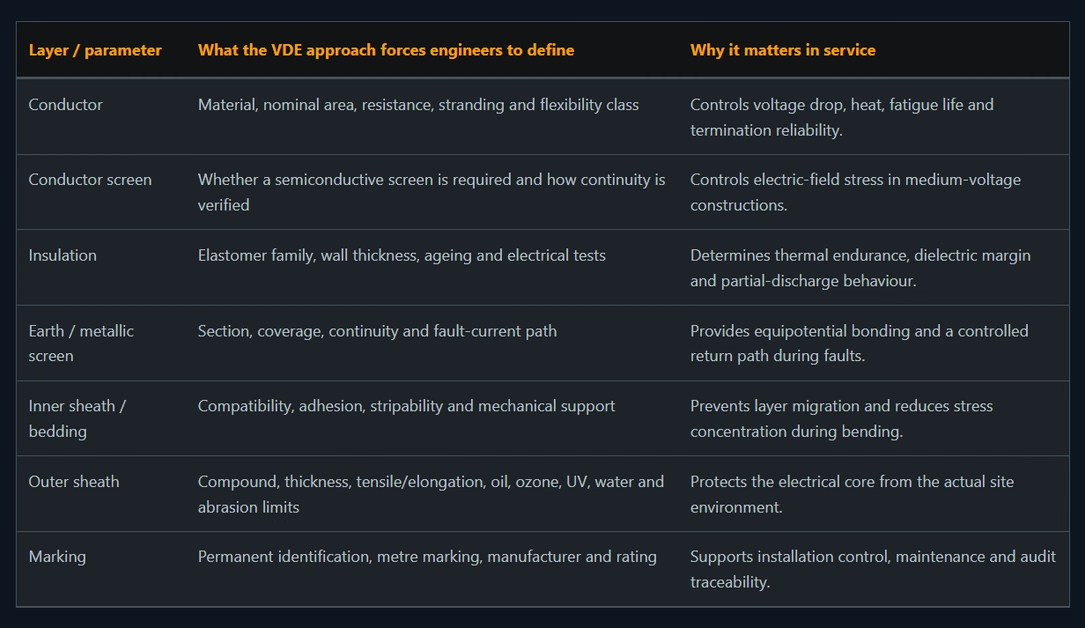
3. The technical layers behind the standard
| Layer / parameter | What the VDE approach forces engineers to define | Why it matters in service |
|---|---|---|
| Conductor | Material, nominal area, resistance, stranding and flexibility class | Controls voltage drop, heat, fatigue life and termination reliability. |
| Conductor screen | Whether a semiconductive screen is required and how continuity is verified | Controls electric-field stress in medium-voltage constructions. |
| Insulation | Elastomer family, wall thickness, ageing and electrical tests | Determines thermal endurance, dielectric margin and partial-discharge behaviour. |
| Earth / metallic screen | Section, coverage, continuity and fault-current path | Provides equipotential bonding and a controlled return path during faults. |
| Inner sheath / bedding | Compatibility, adhesion, stripability and mechanical support | Prevents layer migration and reduces stress concentration during bending. |
| Outer sheath | Compound, thickness, tensile/elongation, oil, ozone, UV, water and abrasion limits | Protects the electrical core from the actual site environment. |
| Marking | Permanent identification, metre marking, manufacturer and rating | Supports installation control, maintenance and audit traceability. |
4. Why a VDE reference is necessary in specifications
A 0.6/1 kV rubber cable, a reeling cable and a 6/10 kV screened mining cable may all look black and round. Their electrical and mechanical duties are different. The exact VDE type prevents a low-duty substitution.
Compound names alone are not enough. The specification links insulation and sheath performance to tests, dimensions, ageing and operating limits.
Glands, potheads, couplers, stress-control components and clamps are selected from the cable diameter, screen, insulation and bending requirements defined in the construction.
Correct selection reduces premature failures caused by fatigue, water ingress, wrong radius, chemical attack, poor stripping or incompatible termination kits.
A standards reference is therefore a procurement control, a design input and a maintenance document. It gives the EPC contractor a common language for cable, accessory, installation and inspection decisions.
5. Fixed, flexible, reeling and submersible duty: the boundary matters
| Duty | Typical engineering demand | DIN VDE 0250 implication | Feichun design response |
|---|---|---|---|
| Fixed industrial | Low movement; support carries cable weight | Thermal, electrical and environmental requirements dominate | Dimension and sheath selected for installation route |
| Flexible / trailing | Repeated bending and occasional tension | Conductor class, lay length and compound flexibility become critical | Fine-stranded copper, controlled lay and elastomeric jacket |
| Reeling / festoon | Reverse bending, torsion, compression between layers | Dynamic radius and torsion limits must be tested, not assumed | Dedicated reel/festoon geometry and mechanical qualification |
| Submersible pump | Water pressure, suspension load, vibration, sealed termination | Water-resistance and accessory interface are as important as insulation | Continuous-length options, reinforced sheath and controlled termination |
DIN VDE 0250 does not turn every rubber-insulated cable into a mining, reeling or submersible cable. The application class must be declared and validated with a complete cable system: cable, clamps, glands, termination, supports, protection and operating envelope.
6. Why manufacturing these cables is specialist engineering
Feichun’s challenge is not simply extruding a black sheath. A high-performance VDE cable is a layered mechanical and electrical system. The process must keep conductor resistance, lay geometry, concentricity, screen continuity, insulation wall, adhesion, sheath thickness and finished diameter inside a controlled window while the cable remains flexible.
Process control chain
Failure chain Feichun must interrupt
- Fine stranding: more strands improve bending behaviour but increase requirements for compaction, cleanliness, tinning and resistance control.
- Lay balance: the conductor, core assembly, screen and sheath need compatible lay lengths so bending does not force one layer to carry the whole strain.
- Elastomer processing: cure temperature, line speed and compound rheology affect voids, adhesion, hardness and ageing.
- Screen continuity: a medium-voltage screen must remain electrically continuous through production and termination; a visual braid is not proof of field control.
- Dimensional control: finished diameter governs glands, couplers, reels, clamps, bending radius and logistics.
7. Feichun’s professional manufacturing logic
| Capability | What it means technically | Why the customer benefits |
|---|---|---|
| Application-specific construction | Mining, crane, reeling, submersible and MV cable platforms are engineered with different mechanical assumptions | The cable is matched to the duty instead of being forced into an unsuitable generic type. |
| Material discipline | Conductor, EPR/thermoset insulation, semiconductive layers, metallic screens and sheath compounds are controlled as a system | Stable electrical performance and repeatable stripping/termination. |
| Mechanical qualification | Bending, torsion, abrasion, cold flexibility, tensile and crush considerations are built into the design review | Fewer failures caused by installation geometry or movement. |
| Electrical qualification | Resistance, insulation, withstand, screen continuity and dimensional checks are documented | Traceable acceptance for EPC, OEM replacement and maintenance files. |
| Custom engineering | Lengths, colour, marking, auxiliary cores, ground conductors and termination interfaces can be specified | Shorter adaptation time for legacy equipment and constrained sites. |
8. What to request in a DIN VDE 0250 cable quotation
- Exact cable designation and applicable DIN/VDE part or equivalent product standard.
- Rated voltage U₀/U, conductor class, nominal resistance and conductor material.
- Insulation and sheath compound, temperature range, oil/ozone/UV/water limits and flame class where required.
- Minimum static and dynamic bending radius, allowable tensile force, torsion limits and reel data.
- Screen/earth construction, short-circuit capability and termination requirements.
- Routine, type and sample test plan with test certificates and lot traceability.
- Finished diameter, mass, packaging, marking, storage life and handling instructions.
- Explicit statement of the intended application: fixed, trailing, reeling, festoon, submersible or mining.
9. References and practical conclusion
VDE / DKE: DIN and VDE requirements are developed within the German electrotechnical standards system. Consult the current VDE Verlag listing for the exact edition and part applicable to the cable construction: VDE Verlag standards portal.
Conductor classification: IEC 60228 / DIN EN 60228 defines nominal conductor sizes and classes; use the applicable edition and manufacturer declaration for the purchased cable.
Industrial product context: German cable manufacturers and distributors list NSSHÖU, NSHTÖU and (N)TSCGEWÖU families for flexible industrial, mining, reeling and handling duties. The complete type code and product data sheet remain the controlling documents.
Feichun engineering: Feichun applies the VDE design logic to mining, crane, reeling, submersible and medium-voltage cable platforms, with application-specific construction, testing and documentation.


