
A rigorous engineering analysis of thermal conductivity, radiative emissivity, solar absorption, and IEC 60287 current-rating implications when replacing opaque PCP/CPE sheaths with crystal-clear TPU on self-illuminating mining trailing cables. — 当自发光矿用拖曳电缆的不透明PCP/CPE护套被透明TPU替代时,对热导率、辐射发射率、太阳吸收率及IEC 60287载流量计算的严格工程分析。
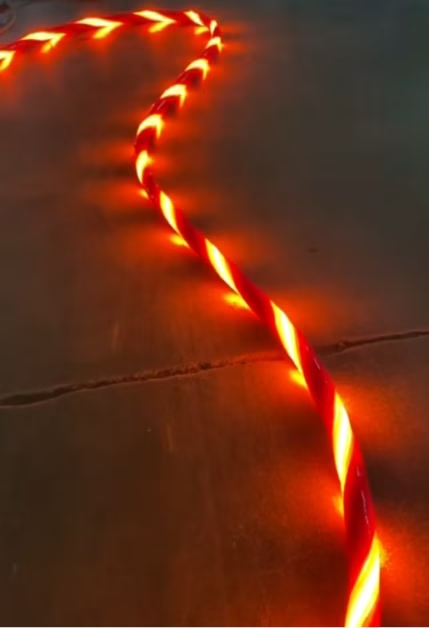
Heat Dissipation: Does the TPU Transparent Sheath Affect the Ampacity of the Cable Compared to Black Rubber?
A rigorous engineering analysis of thermal conductivity, radiative emissivity, solar absorption, and IEC 60287 current-rating implications when replacing opaque PCP/CPE sheaths with crystal-clear TPU on self-illuminating mining trailing cables. — 当自发光矿用拖曳电缆的不透明PCP/CPE护套被透明TPU替代时,对热导率、辐射发射率、太阳吸收率及IEC 60287载流量计算的严格工程分析。
1. Why This Question Matters 为什么这个问题很重要
When engineers first encounter the concept of a self-illuminating mining cable — such as the (N)TSCGEH3S / TENAX-LUMEN type — one of the most natural questions that arises is about the transparent outer sheath. Traditional mining trailing cables use opaque black polychloroprene (PCP, also known as neoprene or CR) or chlorinated polyethylene (CPE) outer jackets. These materials have decades of proven thermal performance data. Replacing them with a crystal-clear thermoplastic polyurethane (TPU) immediately raises the concern: does the change in sheath material and color affect how much current the cable can safely carry?
This is not a trivial question. The ampacity (current-carrying capacity) of a power cable is fundamentally a thermal problem. Every ampere of current flowing through the conductor generates I²R heat losses. That heat must travel outward through every layer of the cable — insulation, screens, inner sheath, monitoring shield, and finally the outer sheath — before being dissipated to the surrounding environment by convection and radiation. If any layer in this thermal chain acts as a better or worse insulator, or if the cable surface radiates heat more or less efficiently, the maximum allowable current changes. 载流量本质上是一个热学问题:导体中的I²R热量必须穿过每一层传导到外部环境——如果任何层的热性能改变,最大允许电流就会变化。
2. How Cable Ampacity Is Determined (IEC 60287) 电缆载流量的确定方法(IEC 60287)
The international standard IEC 60287 — “Electric cables – Calculation of the current rating” — is the universally accepted method for computing cable ampacity. The standard is divided into three main parts: IEC 60287-1-1 covers the current rating equations and loss calculations; IEC 60287-2-1 provides methods for calculating thermal resistances; and IEC 60287-3-1 gives guidance on operating conditions by country. 国际标准IEC 60287是计算电缆载流量的普遍接受方法,分为电流方程与损耗计算、热阻计算以及各国运行条件三个主要部分。
The fundamental ampacity equation for an AC cable in steady-state operation (100% load factor) where soil drying does not occur can be expressed conceptually as follows. The permissible current is determined by the maximum allowable temperature rise (Δθ) divided by the total thermal resistance of the system multiplied by the AC resistance of the conductor, with corrections for dielectric losses and loss factors in metallic sheaths and armour.
IEC 60287-1-1 Simplified Ampacity Concept:
I = √[ Δθ / ( R · (T1 + n·(1+λ₁)·T2 + n·(1+λ₁+λ₂)·(T3 + T4)) ) ]
Where:
Δθ = Permissible conductor temperature rise above ambient (K)
R = AC resistance of conductor at max operating temp (Ω/m)
T1 = Thermal resistance: conductor → sheath (K·m/W)
T2 = Thermal resistance: sheath → armour (K·m/W)
T3 = Thermal resistance: outer covering / sheath (K·m/W) ← THE VARIABLE IN QUESTION
T4 = External thermal resistance: cable surface → ambient (K·m/W)
n = Number of load-carrying conductors
λ₁, λ₂ = Sheath and armour loss factors
The thermal resistance of the outer sheath, T3, is calculated using the standard annular-layer formula provided in IEC 60287-2-1:
T3 = (ρ / 2π) · ln(1 + 2·t₃ / D₃)
Where:
ρ = Thermal resistivity of outer sheath material (K·m/W)
t₃ = Thickness of outer sheath (m)
D₃ = External diameter of the layer immediately beneath the outer sheath (m)
Key Insight 关键见解: From this equation, we can immediately see that only two variables determine the outer sheath’s contribution to the cable’s thermal circuit: the thermal resistivity (ρ) of the sheath material, and the geometric ratio (thickness over diameter). If two sheath materials have the same thermal resistivity and the cable is manufactured to the same dimensional specifications, the T3 value — and hence its contribution to ampacity — will be identical.
3. Thermal Conductivity: TPU vs. PCP vs. CPE 热导率对比:TPU与PCP及CPE
The thermal resistivity (ρ, in K·m/W) is the reciprocal of thermal conductivity (λ, in W/(m·K)). It represents how effectively a material resists the flow of heat. A lower thermal resistivity means heat passes through the material more easily, which is favorable for cable ampacity because it reduces T3 and allows the conductor’s heat to escape more readily.
IEC 60287-2-1, Table 1 provides standardized thermal resistivity values for cable materials. The standard groups most rubber and plastic protective coverings at thermal resistivities in the range of 3.5 to 6.0 K·m/W. For practical engineering calculations, both PCP (polychloroprene/neoprene) and CPE (chlorinated polyethylene) outer sheaths are typically assigned values around 5.5 K·m/W by cable engineers following IEC 60287 guidance.
| Material | Thermal Resistivity ρ (K·m/W) | Thermal Conductivity λ (W/m·K) | IEC 60287 Category | Notes 备注 |
|---|---|---|---|---|
| PCP (Polychloroprene / Neoprene) 氯丁橡胶 | 5.0 – 6.0 | 0.17 – 0.20 | Rubber compound | Traditional opaque black mining sheath; ref. DIN VDE 0207-21 types GM1b, 5GM3, 5GM5 |
| CPE (Chlorinated Polyethylene) 氯化聚乙烯 | 5.0 – 6.0 | 0.17 – 0.20 | Rubber compound | Alternative opaque black mining sheath; common in North American Type SHD-GC cables |
| TPU (Thermoplastic Polyurethane) — opaque 热塑性聚氨酯—不透明 | 4.5 – 6.0 | 0.17 – 0.22 | Plastic compound | Already used as extra-heavy-duty jacket per ICEA S-75-381 Tab. 3-3 |
| TPU — crystal-clear (transparent H3 grade) 透明H3级TPU | 4.5 – 6.0 | 0.17 – 0.22 | Plastic compound | Used on (N)TSCGEH3S / TENAX-LUMEN self-illuminating cables |
| EPR (Ethylene Propylene Rubber) — insulation EPR绝缘 | 3.5 | 0.29 | Rubber insulation | Per IEC 60287-2-1 Table 1; reference only — this is the insulation layer, not the sheath |
| XLPE — insulation XLPE绝缘 | 3.5 | 0.29 | Plastic insulation | Reference only |
| PVC — sheath PVC护套 | 5.0 – 6.0 | 0.17 – 0.20 | Plastic compound | Not used in mining trailing cables but included for comparison |
Engineering Conclusion #1 工程结论 #1: The thermal resistivity of transparent TPU and that of opaque black PCP/CPE both fall in the same 5.0–6.0 K·m/W range. The base polymer chemistry — polyurethane vs. polychloroprene vs. chlorinated polyethylene — produces only minor variations within this band. The transparency of the TPU (achieved through careful control of crystallinity and pigment-free formulation) does not introduce any meaningful change in bulk thermal conductivity. From a conductive heat transfer perspective through the sheath wall, the two materials are functionally equivalent. 透明TPU与不透明黑色PCP/CPE的热阻率均在5.0–6.0 K·m/W范围内。从穿过护套壁的导热角度来看,两种材料功能等效。
4. Radiative Heat Transfer: Emissivity & Surface Color 辐射传热:发射率与表面颜色
The second mechanism by which the outer sheath influences ampacity is through its surface emissivity — the efficiency with which the cable surface radiates thermal energy to its surroundings. IEC 60287-2-1 explicitly addresses this in its calculation of external thermal resistance (T4) for cables laid in free air. The standard provides heat dissipation coefficients specifically for “black surfaces of cables in free air” (Figures 7–9 of the standard), and the calculations assume a surface emissivity of approximately 0.9 for non-metallic cable sheaths.
This is where the question of color enters the picture. The physics of thermal radiation are governed by the Stefan-Boltzmann law, where radiated power is proportional to the emissivity (ε) of the surface. A perfect “blackbody” has ε = 1.0, and most dark-colored non-metallic surfaces (including black rubber) achieve ε ≈ 0.9. 热辐射遵循Stefan-Boltzmann定律,辐射功率与表面发射率(ε)成正比。大多数深色非金属表面的ε约为0.9。
| Surface Type | Emissivity (ε) | Radiation Efficiency | Impact on T4 |
|---|---|---|---|
| Black PCP/CPE (matte finish) 黑色PCP/CPE(哑光) | 0.90 – 0.95 | Excellent | Lowest T4 (best heat dissipation) |
| Dark-colored TPU (black, dark grey) 深色TPU | 0.85 – 0.93 | Excellent | Very close to black rubber |
| Transparent / clear TPU (H3 grade) 透明TPU (H3级) | 0.80 – 0.90 | Good to Excellent | Slightly higher T4 in free-air radiative path |
| Bare metallic sheath (aluminum) 裸金属护套 | 0.10 – 0.20 | Very poor | Significantly higher T4 |
| White paint / white plastic 白色涂层/塑料 | 0.85 – 0.95 | Excellent | Low T4 (high IR emissivity despite being white) |
An important nuance arises here. While many people intuitively assume that “transparent = poor emitter,” this is only partially true. In the visible light spectrum (0.4–0.7 μm wavelength), transparent TPU transmits most radiation — that is precisely why we can see the LED elements through it. However, the thermal radiation emitted by a cable surface at operating temperatures of 40–70°C falls in the far-infrared spectrum (8–14 μm wavelength). In this far-infrared range, most polymers — including clear TPU — are actually quite opaque and have relatively high emissivity, typically 0.80–0.90. This is because the C–H, C–O, and N–H molecular bonds in polyurethane strongly absorb and emit at infrared wavelengths regardless of whether the material is optically transparent. 在40–70°C工作温度下电缆表面发出的热辐射位于远红外光谱(8–14 μm),在此波段,大多数聚合物(包括透明TPU)实际上相当不透明,发射率通常为0.80–0.90。
Key Insight 关键见解: Optical transparency (visible light) ≠ infrared transparency. A material can be visually clear yet still radiate thermal energy efficiently in the infrared. The emissivity reduction from black PCP (ε ≈ 0.90–0.95) to clear TPU (ε ≈ 0.80–0.90) is modest — and in practical mining cable geometries, this small difference translates to a negligible impact on ampacity.
5. Solar Radiation Absorption 太阳辐射吸收
For cables operated in free air and exposed to direct sunlight — a common scenario for surface mining trailing cables — IEC 60287-2-1 includes a method to account for solar heating via a solar absorption coefficient (Table 4 of the standard). This is the one parameter where a transparent or light-colored sheath can actually provide a small advantage over a black sheath.
| Cable Surface | Absorption Coefficient (αs) | Relative Solar Heating |
|---|---|---|
| Black PCP/CPE sheath 黑色PCP/CPE护套 | 0.8 – 0.9 | Highest — absorbs most solar energy |
| Dark-colored rubber/plastic 深色橡胶/塑料 | 0.7 – 0.8 | High |
| Transparent / clear TPU 透明TPU | 0.4 – 0.6 (estimated) | Lower — transmits/reflects more solar energy |
| White or very light colored 白色或极浅色 | 0.4 – 0.6 | Lowest |
| Bare metal (polished) 裸金属(抛光) | 0.2 – 0.4 | Very low solar absorption |
A black sheath absorbs approximately 80–90% of incident solar radiation, converting it directly into additional heat that the cable must dissipate. A transparent or light-colored TPU sheath absorbs significantly less — estimated at 40–60% — because a substantial portion of the solar spectrum passes through or is reflected rather than being absorbed by the sheath material. In sunny open-pit mining environments (e.g., Australian outback, Chilean Atacama, or Middle Eastern mines) where solar irradiance can exceed 1,000 W/m², this reduced solar absorption can translate to a measurably lower surface temperature for the transparent cable compared to a black-sheathed equivalent. 在强烈日照的露天矿环境中,透明TPU更低的太阳吸收率可使电缆表面温度明显低于黑色护套。
Engineering Conclusion #2 工程结论 #2: Under direct solar exposure, transparent TPU actually has a thermal advantage over black rubber — it absorbs less solar heat, partially or fully offsetting the modest reduction in far-infrared emissivity. In sun-exposed surface mining applications, the net thermal effect of the transparent sheath is neutral to slightly favorable.
6. Quantitative Thermal Resistance Comparison (T3) 外护套热阻定量对比(T3)
To illustrate that the outer sheath material swap has minimal effect on the actual T3 value, consider a representative 3 × 95 mm² mining trailing cable rated 6/10 kV, with a nominal outer sheath thickness of 4.5 mm over a core assembly diameter of approximately 65 mm.
| Parameter | Black PCP Sheath | Transparent TPU (H3) Sheath |
|---|---|---|
| Thermal resistivity ρ (K·m/W) | 5.5 (typical) | 5.5 (typical) |
| Outer sheath thickness t₃ (mm) | 4.5 | 4.5 |
| Diameter under sheath D₃ (mm) | 65 | 65 |
| T3 = (ρ/2π)·ln(1 + 2t₃/D₃) | ||
| = (5.5 / 6.283) · ln(1 + 9/65) | ||
| = 0.875 · ln(1.138) | ||
| = 0.875 · 0.1295 | ||
| T3 result | 0.113 K·m/W | 0.113 K·m/W |
| Difference | Zero (identical) | |
Because both materials have the same thermal resistivity (within the measurement precision of the IEC 60287 standard values) and the cable is manufactured to the same dimensional specifications, the T3 thermal resistance of the outer covering is mathematically identical for both sheath materials. Even if we assume a minor variation (e.g., TPU at 5.0 K·m/W vs. PCP at 5.5 K·m/W), the T3 would change to approximately 0.103 K·m/W — a difference of only 0.010 K·m/W, which translates to less than 1% impact on overall ampacity. 即使假设存在微小的热阻率差异,T3变化仅约0.010 K·m/W,对总载流量的影响不到1%。
7. Net Effect on Ampacity: The Engineering Verdict 对载流量的净影响:工程结论
Bringing together the three thermal transfer mechanisms — conduction through the sheath (T3), radiative emission from the surface (contributing to T4), and solar absorption (also affecting T4) — we can summarize the net impact of switching from a black PCP/CPE sheath to a transparent TPU sheath.
| Thermal Mechanism | Effect of Transparent TPU vs. Black PCP | Direction | Magnitude |
|---|---|---|---|
| Conduction through sheath (T3) 穿过护套的热传导 | Same bulk thermal resistivity ρ ≈ 5.0–6.0 K·m/W | Neutral | Negligible (0–1% on T3) |
| Far-IR radiative emission (T4 component) 远红外辐射发射 | Slightly lower emissivity (0.80–0.90 vs 0.90–0.95) | Slight disadvantage | Minor (1–3% on T4 in free air) |
| Solar radiation absorption (T4 component) 太阳辐射吸收 | Significantly lower absorption (αs ≈ 0.4–0.6 vs 0.8–0.9) | Advantage | Moderate — offsets emissivity effect under sun |
| Convective heat transfer (T4 component) 对流传热 | Same — determined by cable OD, wind speed, and ambient temp | Neutral | Nil |
| NET RESULT 净结果: Ampacity impact is negligible — typically within ±1–3% of the black-sheathed equivalent | |||
Engineering Verdict 工程结论: The transparent TPU sheath on self-illuminating mining cables does NOT require any ampacity derating relative to an equivalent cable with a black PCP or CPE sheath. The cable can be rated and operated at the same current-carrying capacity specified by the manufacturer’s datasheet and IEC 60287 calculations. In sun-exposed surface mining environments, the transparent sheath may even provide a marginal thermal advantage due to reduced solar absorption. 透明TPU护套不需要相对于黑色PCP/CPE护套进行任何载流量降额。在日照充足的露天矿环境中,透明护套甚至可能因太阳吸收率更低而具有微弱的热性能优势。
8. Derating Factors & Practical Considerations 降额因素与实际考量
While the sheath material itself does not require derating, cable engineers must still account for the standard derating factors that apply to all trailing cables regardless of sheath type. These factors have a far larger impact on actual operating ampacity than any sheath material difference.
| Derating Factor 降额因素 | Typical Impact | Governing Standard | Notes |
|---|---|---|---|
| Ambient temperature above reference 高于参考值的环境温度 | 5–15% reduction per +10°C above reference | IEC 60287-3-1; DIN VDE 0298-4 | Reference is typically 30°C or 40°C depending on country |
| Cable grouping / bundling 电缆成组/捆扎 | 10–30% reduction | IEC 60287-2-2 | Mutual heating between adjacent cables |
| Solar radiation exposure 太阳辐射暴露 | 5–15% reduction | IEC 60287-2-1 §4.2 | Transparent TPU absorbs LESS solar heat than black — smaller derating needed |
| Altitude above 1,000 m 海拔1,000米以上 | 2–5% reduction per 1,000 m | Various national codes | Reduced air density = less convective cooling |
| Reeling drum / coiled storage 卷筒/盘绕存储 | 20–50% reduction | DIN VDE 0298-4 | Severely restricted heat dissipation when coiled |
| Enclosure in duct or trough 敷设在管道或槽中 | 15–30% reduction | IEC 60287-2-1 | Trailing cables are normally in free air — less relevant |
The point here is important for engineers who may be tempted to apply an “extra” derating for the transparent sheath: the standard derating factors above already account for hundreds of percent more thermal impact than any sheath color difference could produce. Adding an unnecessary derating for TPU transparency would result in an oversized, over-cost cable selection with no safety benefit. 为透明护套额外施加降额将导致电缆选型过大、成本过高,且无安全效益。
9. Material Properties Master Comparison 材料属性综合对比
The following table provides a comprehensive side-by-side comparison of all relevant engineering properties for the three most common mining cable outer sheath materials, allowing procurement and engineering teams to make fully informed decisions.
| Property | PCP (Neoprene) | CPE | TPU Transparent (H3) |
|---|---|---|---|
| Thermal resistivity ρ (K·m/W) 热阻率 | 5.0 – 6.0 | 5.0 – 6.0 | 4.5 – 6.0 |
| Surface emissivity ε (far-IR) 远红外发射率 | 0.90 – 0.95 | 0.90 – 0.95 | 0.80 – 0.90 |
| Solar absorption αs 太阳吸收率 | 0.8 – 0.9 | 0.8 – 0.9 | 0.4 – 0.6 |
| Visible-light transmittance 可见光透过率 | 0% (opaque) | 0% (opaque) | ≥ 85% |
| Tensile strength (N/mm²) 抗拉强度 | ≥ 10 | ≥ 10 | ≥ 15 |
| Elongation at break (%) 断裂伸长率 | ≥ 300 | ≥ 250 | ≥ 300 |
| Abrasion resistance (mm³ max) 耐磨性 | ≤ 350 | ≤ 400 | ≤ 300 |
| Tear strength (N/mm) 撕裂强度 | ≥ 20 | ≥ 15 | ≥ 30 |
| Oil resistance 耐油性 | Good | Good | Excellent |
| UV / ozone resistance 耐紫外线/臭氧 | Good | Moderate | Excellent |
| Cold-bend temperature 低温弯曲温度 | −25°C to −40°C | −25°C to −40°C | −50°C |
| Max continuous temperature 最高连续温度 | 90°C | 90°C | 90°C |
| Halogen-free 无卤 | No (contains Cl) | No (contains Cl) | Yes |
| Self-illumination compatible 兼容自发光 | No (opaque) | No (opaque) | Yes |
| Ampacity derating required? 需要载流量降额? | No | No | No |
10. Frequently Asked Questions 常见问题
Q: Does the LED light system inside the cable generate additional heat that reduces ampacity? 电缆内部的LED发光系统是否会产生额外热量从而降低载流量?
The electromagnetic induction harvesting modules and LED/EL elements operate in the milliwatt range per meter — typically less than 0.001% of the power being transmitted through the main conductors. This heat contribution is so small that it is below the measurement sensitivity of standard cable thermal testing equipment and does not appear in IEC 60287 calculations. It has zero practical impact on ampacity.
Q: If the transparent sheath gets coated in mud or dust, does its thermal performance change? 如果透明护套被泥浆或灰尘覆盖,其热性能是否会改变?
A layer of dust or mud on the cable surface actually increases the surface emissivity toward that of an opaque dark surface (ε ≈ 0.90+), which marginally improves radiative heat dissipation. At the same time, a thick mud layer adds slight thermal insulation. In practice, these two effects approximately cancel out. The TPU compound’s smooth, self-cleaning surface properties also help it shed particulate contamination more readily than textured rubber surfaces.
Q: Should I use different ampacity tables for a transparent-sheathed cable? 透明护套电缆是否应使用不同的载流量表?
No. The standard IEC 60287 calculation method and the manufacturer’s published ampacity tables are valid for both PCP/CPE and TPU-sheathed versions of the same cable design. When calculating per IEC 60287-2-1, use the same thermal resistivity value (ρ ≈ 5.0–6.0 K·m/W) for the TPU outer covering as you would for PCP or CPE. No additional derating factor is needed for the sheath material change.
Q: Does the transparent sheath perform differently when the cable is buried vs. in free air? 电缆埋设与架空时,透明护套的表现是否不同?
When a cable is directly buried in soil, the external thermal resistance (T4) is dominated entirely by the soil’s thermal resistivity — the cable surface emissivity and color become irrelevant because there is no radiation or solar absorption pathway. In this case, the transparent TPU and black PCP are thermally identical in every respect. The minor differences in emissivity and solar absorption only matter for cables in free air exposed to sunlight.
Q: What about fire performance — does TPU burn differently and affect emergency current ratings? 火灾性能——TPU的燃烧特性是否会影响紧急电流额定值?
Both PCP and TPU sheath grades used on mining trailing cables are formulated to pass EN 60332-1-2 (single vertical flame propagation) testing. The emergency and short-circuit current ratings of a cable are determined by the insulation material’s maximum permissible temperature under fault conditions (250°C for EPR), not by the outer sheath material. The sheath material choice does not change the cable’s emergency ampacity rating. Additionally, TPU is halogen-free, meaning it produces less toxic smoke in a fire event compared to PCP (which contains chlorine).
References & Sources 参考来源
- IEC 60287-1-1:2023 — “Electric cables – Calculation of the current rating – Part 1-1: Current rating equations (100% load factor) and calculation of losses – General.” webstore.iec.ch
- IEC 60287-2-1:2023 — “Electric cables – Calculation of the current rating – Part 2-1: Thermal resistance – Calculation of the thermal resistance.” Table 1: Thermal resistivities of materials. webstore.iec.ch
- IEC 60287-3-1:2017 — “Electric cables – Calculation of the current rating – Part 3-1: Operating conditions – Site reference conditions.” standards.iteh.ai (PDF preview)
- Cableizer — “IEC 60287-2: Calculation of thermal resistances of electric cables.” Technical blog. cableizer.com
- ETAP — “Cable Thermal Analysis: Neher-McGrath and IEC 60287 Ampacity Software.” etap.com
- RatedPower — “Cable sizing: Soil resistivity and temperature.” IEC 60287 application guide. ratedpower.com
- CalculatorsConversion — “Thermal Dissipation Calculation in Electrical Cables.” IEC 60287 surface emissivity discussion. calculatorsconversion.com
- BASF Elastollan® — “Cable Sheathing: Thermoplastic polyurethane (TPU) for wire and cable applications.” basf.com
- MISUMI — “Cable Jacket Material Guide: PVC vs. PUR vs. TPE.” PUR/TPU thermal and mechanical properties. us.misumi-ec.com
- Prysmian Group — “TENAX-LUMEN: Self-luminous power cable for trailing mining applications.” TPU transparent sheath specifications. prysmian.com
- Prysmian Group — “Cable Solutions for the Mining Industry.” TENAX-LUMEN with electroluminescent string. prysmian.com — Mining
- DIN VDE 0250-813 — “Trailing cables for rated voltages 3.6/6 kV to 18/30 kV.” standards.globalspec.com
- DIN VDE 0207-21 — “Insulated cables; thermosetting sheath compounds.” Material types GM1b, 5GM3, 5GM5.
- ICEA S-75-381 / NEMA WC-58 — “Portable and Power Feeder Cables for Use in Mines.” TPU jacket per Tab. 3-3. webstore.ansi.org
- DIN VDE 0298-4 — “Use of cables and flexible cords in power installations – Current-carrying capacity.” Derating tables for ambient temperature, grouping, and installation methods.
- EN 60332-1-2 — “Tests on electric and optical fibre cables under fire conditions – Flame propagation.”
- Feichun Special Cable — “DIN VDE 0250 – Reeling & Trailing Cables for Cranes & Mining.” feichuncables.com
- Feichun Special Cable — “Self-Illuminating TPU Mining Cable with LED Visual Monitoring System.” feichuncables.com
- QuickField — “Cable thermal conductivity: IEC 60287-2-1 thermal resistance calculation example.” quickfield.com
Contact Anhui Feichun Special Cable 联系安徽飞纯特种电缆
For cable thermal engineering consultation, ampacity verification, datasheets, or custom cable design, contact our technical team directly. 如需电缆热工程咨询、载流量验证、数据手册或定制电缆设计,请直接联系我们的技术团队。


