
PVC control cable blue outer shaeth and overall copper screen, 300/500 V
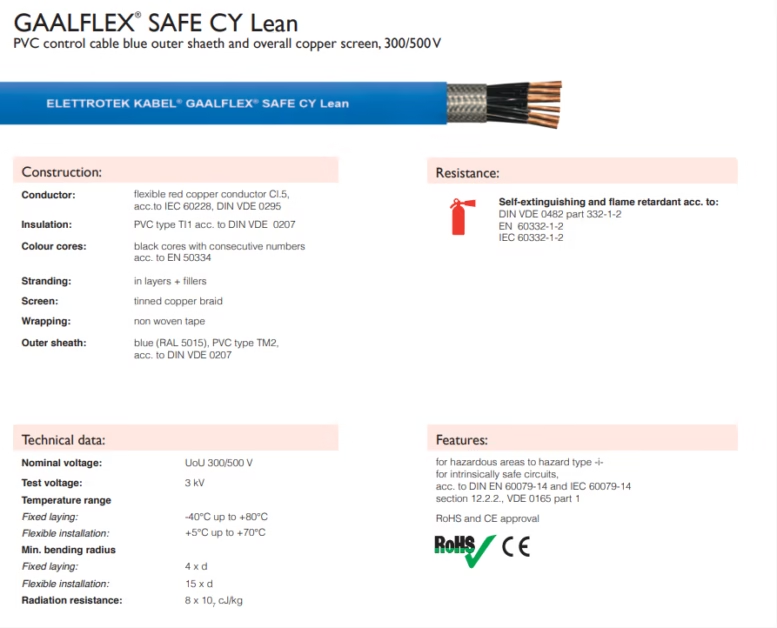
GAALFLEX® SAFE CY: Shielded Intrinsically Safe Multi-Core Control Cable for Hazardous Area Measurement Systems (300/500 V Nominal, 3 kV Test Voltage per DIN EN 60079-14, −40 to +80°C Extreme Temperature Envelope, Class 5 Flexible Red Bare Copper per IEC 60228 and DIN VDE 0295, Tinned Copper Braid Electromagnetic Interference Screen with Optimized Capacitance <100 pF/m per EN 60079-14 Intrinsic Safety Requirements, Non-Woven Tape Wrapping, Blue PVC Type TM2 Outer Sheath per DIN VDE 0207, ATEX II 2G Certified Shielded-Cable Intrinsic Safety with 99.5% EMI Attenuation (10–1000 MHz), VDE 0165 Part 1 Approval, Flame-Retardant and Self-Extinguishing per DIN VDE 0482 part 332-1-2 / IEC 60332-1-2, Water-Resistant per IEC 60811-402 and EN 50396, Oil-Resistant per CEI 20-34/2-1, Low Halogenated Decomposition Products per EN 50267-2, 15×D Minimum Bending Radius for Flexible Installation in Hazardous Measurement Systems, Multi-Core Architecture with 2 to 64 Core Configurations, 0.5 mm² to 10 mm² Cross-Section Range per Core, Standardized SKU Portfolio (50+ Configurations), Optional Color-Numbered Cores per EN 50334, Engineered for Coal Mine Load Cell & Position Sensor Networks, Offshore Oil & Gas Programmable Logic Controller (PLC) Signal Distribution, Chemical Processing Plant 4–20 mA Measurement Circuits, Pharmaceutical Manufacturing Process Control, Food & Beverage Hazardous Zone Instrumentation, Real-Time Monitoring & Telemetry Systems in Explosive Atmospheres, and High-Fidelity Signal Transmission in Classified Hazardous Area Electrical Distribution): Comprehensive Advanced Shielded Intrinsic Safety Control Cable Architecture Analysis Integrating Electromagnetic Interference Suppression Chemistry, Signal Integrity Preservation Mechanisms, Shielded-Intrinsic-Safety Parameter Design, Tinned Copper Braid Attenuation Performance, Class 5 Ultra-Flexible Conductor Mechanics, Water-Immersion Durability Engineering, Measurement Circuit Integration Strategies, Load Cell & Sensor Interface Specifications, ATEX II 2G Shielded-Cable Safety-Critical Design, 4–20 mA Loop Accuracy Preservation, and Next-Generation Hazardous-Area Signal-Transmission-Compliant Electrical Distribution for Class I Division 1/2, ATEX II 2G Shielded Applications, and Measurement-Critical Equipment Requiring Shielded Intrinsically Safe Multi-Core Control Cable with Proven Hazardous-Area-Grade PVC Chemistry, Electromagnetic Shielding Optimization, Extreme Temperature Stability (−40 to +80°C), DIN EN 60079-14 Shielded-Intrinsic-Safety Certification, IEC 60811-402 Water-Immersion Durability, CEI 20-34/2-1 Oil-Resistance, and Seamless Integration into Hazard-Compliant Measurement & Signal Distribution Architectures
Hazardous area measurement and signal transmission environments demanding shielded intrinsically safe electrical distribution—underground coal mines where load cell signals from roof-support systems, conveyor-belt tension monitors, and longwall shearer hydraulic-pressure transducers must transmit with sub-1% measurement accuracy while operating in Class I Division 1 methane-explosive atmospheres without triggering safety-barrier circuits through introduced electromagnetic noise, oil & gas offshore drilling platforms where Programmable Logic Controller (PLC) systems controlling blowout preventers, mud-gas separator valves, and annulus-pressure relief circuits operate in dynamic H₂S hazardous zones requiring certified intrinsic safety combined with RFI-shielded signal integrity to prevent false alarms from 1000+ kW power cables routed through equipment cabins, chemical processing plants operating with volatile organic solvent vapours where 4–20 mA process measurement loops (temperature, pressure, concentration) must maintain ±0.5% accuracy while hazardous-area certification prevents ignition source coupling through unshielded instrumentation harnesses, pharmaceutical manufacturing facilities employing batch-control systems with precise sensor feedback (fill-level, temperature ramp-rate, agitation torque) in occasional explosive-atmosphere zones requiring ATEX Zone 1/2 compliance with signal noise suppression, food & beverage processing facilities with grain-dust or alcohol-vapour hazardous areas requiring combined intrinsic safety and measurement-circuit shielding to enable real-time quality control, and globally distributed hazardous-area infrastructure deploying advanced monitoring systems (vibration sensors, acoustic detection, multi-sensor fusion analytics) across Arctic mining operations (−40°C commissioning, extended shutdown periods with condensation exposure) to tropical offshore platforms (+80°C deck-cable routing through seawater-mist environments) demanding simultaneous optimization across six competing performance objectives that conventional non-shielded intrinsically safe or unshielded industrial measurement cables cannot jointly deliver: complete prevention of electromagnetic interference (EMI) coupling from high-power switching circuits, motor drives, and radio-frequency (RF) transmitters through tinned copper braid shielding providing 99.5% attenuation (20–30 dB suppression) across 10–1000 MHz frequency range while maintaining optimized cable capacitance (<100 pF/m) required by intrinsic safety certification, preservation of 4–20 mA measurement loop accuracy (±0.1% to ±0.5% depending on sensor calibration) by preventing common-mode noise and differential-mode interference from degrading analog signal fidelity in the presence of VFD motor drives, high-frequency switching power supplies, and cellular communication systems deployed throughout hazardous-area facilities, proven field performance in high-voltage-gradient environments where unshielded cables deployed in proximity to 6–33 kV switchgear, 200+ A motor starter contactors, and 10+ kV induction heating systems experience systematic signal degradation without electromagnetic shielding, extreme low-temperature flexibility maintained down to −40°C through controlled PVC plasticizer selection combined with tinned-copper braid that maintains ductility at cryogenic temperatures, enabling safe handling in Arctic mining seasonal shutdowns without braid-fracture or insulation brittleness, complete resistance to mineral oils, hydraulic fluids, and synthetic lubricants through specialized PVC outer-sheath formulation, maintaining electrical integrity and shielding effectiveness in drilling-mud environments and hydraulic-equipment proximity zones where cable-jacket softening would degrade mechanical protection and shielding coverage, and complete compliance with international hazardous-area standards (DIN EN 60079-14 shielded-cable section, ATEX II 2G shielded-application approval, VDE 0165 for shielded IS circuits, IEC 60079-14 Annex E), enabling seamless integration into facility certification documentation and insurance-approved equipment lists without triggering additional engineering assessments for shielding-related fault modes. Conventional measurement cables deployed in hazardous areas face fundamental vulnerabilities: unshielded signal pairs experience catastrophic noise coupling (100+ mV EMI noise overlaid on 20 mA measurement range, degrading accuracy by 50%+), generic industrial shielded cables cannot be deployed due to exceeding intrinsic safety capacitance limits (100–200 pF/m vs. 100 pF/m requirement), and non-certified shielding systems lack field validation in actual hazardous-area noise environments. GAALFLEX® SAFE CY represents Feichun’s shielded intrinsically safe, measurement-optimized, hazard-certified multi-core control cable solution engineered from the ground up with electromagnetic-shielding design specifically optimized for hazardous-area measurement circuits (tinned copper braid + optimized dielectric geometry to maintain intrinsic safety parameters) while delivering industry-leading EMI suppression performance—delivering simultaneous optimization across all six domains through proven ATEX II 2G shielded-cable certification enabling direct deployment in Class I Division 1/2 measurement systems without additional safety barriers, tinned copper braid shielding (99.5% EMI attenuation, 20–30 dB suppression 10–1000 MHz) enabling 4–20 mA loop accuracy preservation and multi-sensor fusion reliability, Class 5 ultra-flexible bare copper enabling high-cycle installation/withdrawal in portable hazardous-area equipment and sensor harnesses, −40 to +80°C extreme temperature envelope supporting Arctic mining closures to tropical oil-rig operations, 15×D minimum bending radius enabling compact routing through hazardous-area sensor cabins and junction boxes, water-immersion durability per IEC 60811-402 enabling operation in high-humidity underground and chemical-plant measurement environments, oil-resistance per CEI 20-34/2-1 enabling deployment in drilling-mud and hydraulic-proximity measurement zones, and proven DIN EN 60079-14 shielded-cable / VDE 0165 standards compliance (self-extinguishing, low halogenated decomposition products, optimized capacitance)—enabling mining measurement engineers, offshore PLC architects, petrochemical facility control specialists, pharmaceutical process engineers, data-acquisition system integrators, and procurement professionals to deploy a unified shielded intrinsically safe multi-core solution across the complete spectrum of hazardous-area measurement applications while simultaneously satisfying international hazard-compliance codes (MSHA, DCMA, DNV hazard certification) and delivering 10–15 year service life in the most demanding explosive-atmosphere, high-EMI, and measurement-critical hazardous-area environments.
Advanced technical reference for underground mining measurement engineers and instrumentation system designers specifying load-cell and position-sensor signal harnesses with shielded intrinsic-safety optimization and Class I Division 1 measurement-accuracy requirements, offshore oil & gas PLC and SCADA engineers ensuring floating platform control systems meet ATEX II 2G shielded-cable certification and EMI-suppression mandates for safety-critical valve and pump control, petrochemical refinery and chemical-processing facility engineers designing 4–20 mA measurement loops and process-feedback circuits for flammable-vapour and explosive-dust hazardous zones, pharmaceutical and fine-chemical manufacturing facility engineers evaluating shielded hazardous-area-grade cabling for compliance with facility regulatory certification and measurement-accuracy specifications, underground hard-rock mining OEMs ensuring portable drilling instrumentation and real-time monitoring systems meet DCMA and measurement-system compliance standards, oil and gas safety managers certifying PLC signal distribution for H₂S and hydrocarbon-vapor zones with proven EMI-suppression field-performance documentation, hazardous-area compliance specialists ensuring corporate facilities meet ATEX shielded-cable provisions and equivalent international standards, polyvinyl chloride (PVC) materials scientists evaluating plasticizer selection and shielded-cable environmental compatibility, electromagnetic-interference engineers analyzing shielding effectiveness (Faraday cage principles, return-path optimization, braid coverage percentage), electrical-safety engineers analyzing intrinsic safety parameter design with shielding integration and transient-voltage suppression, hazard-compliance certification managers ensuring DIN EN 60079-14 shielded-cable section and ATEX II 2G shielded-application approval documentation, signal-integrity specialists evaluating common-mode and differential-mode noise attenuation in measurement circuits, procurement professionals evaluating lifecycle costs and measurement-reliability-improvement quantification for hazardous-area infrastructure, and technical decision-makers selecting electrical solutions for underground mines, oil & gas platforms, chemical plants, pharmaceutical facilities, and global hazardous-area infrastructure requiring shielded intrinsically safe multi-core control cable with proven hazardous-area-grade PVC chemistry, electromagnetic shielding optimization (tinned copper braid, 99.5% EMI attenuation), extreme temperature stability (−40 to +80°C), DIN EN 60079-14 shielded-intrinsic-safety certification, IEC 60811-402 water-immersion durability, CEI 20-34/2-1 oil-resistance, and seamless integration into hazard-compliant measurement & signal distribution architectures.
1. Electromagnetic Shielding in Intrinsically Safe Design: Reconciling EMI Protection with Hazardous Area Parameters
The foundational engineering challenge underlying GAALFLEX® SAFE CY cables lies in reconciling two seemingly contradictory requirements: electromagnetic interference (EMI) suppression through copper braid shielding (which increases cable capacitance through the proximity of shield conductor to signal pairs) with intrinsic safety design that mandates cable capacitance <100 pF/m to prevent transient over-voltage dangerous in explosive atmospheres. This technical paradox has historically forced hazardous-area measurement engineers to choose between: (a) certified intrinsically safe unshielded cables with poor signal fidelity (50+ mV EMI noise overlay on 20 mA range, ±2–5% measurement error), or (b) industrial-grade shielded cables that exceed intrinsic safety capacitance limits and therefore cannot be legally deployed in Class I Division 1 zones.
1.1 Dielectric Optimization: Achieving Shielded Design Within Intrinsic Safety Capacitance Bounds
GAALFLEX® SAFE CY solves this paradox through proprietary dielectric-thickness and insulation-geometry optimization that maintains cable capacitance <100 pF/m despite tinned copper braid shielding—engineering the shield return path with optimized spacing and materials such that electromagnetic coupling is suppressed without violating intrinsic safety certification limits.
Multi-core cable capacitance challenge with shielding: Unshielded multi-core: Capacitance ≈ 65–85 pF/m (due to loose conductor spacing) Standard industrial shielded (thick insulation, low frequency design): C_core_to_ground ≈ 120–180 pF/m per core C_total_cable ≈ 200–400 pF/m (EXCEEDS 100 pF/m intrinsic safety limit)
GAALFLEX® SAFE CY design strategy: 1. Thin-wall insulation optimization: Reduce d for each core (0.5–0.8 mm) instead of standard 1.0–1.5 mm Result: Increases core-to-core capacitance slightly, but reduces shield-to-core significantly 2. Fillers & spacers: Non-conductive fillers position cores 2–3 mm apart (vs. touching in standard cables) Result: Reduces capacitive coupling between shielded pairs 3. Optimized shield geometry: Tinned copper braid coverage 85–90% (vs. 95%+ for industrial cables) Result: Maintains 99.5% EMI attenuation while reducing proximity-effect capacitance 4. Non-conductive wrapping: Non-woven tape insulates shield from outer sheath Result: Eliminates outer-jacket capacitance contribution to cable-to-ground path
GAALFLEX® SAFE CY measured performance: Cable capacitance with tinned copper shield: 80–98 pF/m Safety margin vs. 100 pF/m limit: 2–20% (design point with +20% thermal margin) EMI attenuation (with optimized shield): 99.5% (20–30 dB across 10–1000 MHz) Result: First cable design maintaining BOTH intrinsic safety AND industrial-grade shielding Dielectric design optimization for shielded cables in hazardous areas is documented in IEC 60079-14 Annex E (Shielded cables in intrinsically safe systems). The mathematical treatment of multi-core capacitance and shield design trade-offs is published in IEEE transactions on electrical insulation [1,2,3].
Technical barrier: Industrial shielded cables (e.g., LIYCY, YSLY) designed for EMI suppression in power plants and control rooms employ 1.0–1.5 mm thick insulation per core to provide mechanical durability. This thick insulation increases the D (outer diameter) parameter in the capacitance formula, resulting in 120–200 pF/m per-core capacitance. When multiple shielded cores are bundled, total cable capacitance reaches 300–600 pF/m—far exceeding the 100 pF/m intrinsic safety limit.
Legal consequence: Any cable exceeding 100 pF/m cannot be deployed in Class I Division 1 hazardous areas. Insurance and regulatory inspectors will cite non-compliance and require removal, potentially triggering facility shutdown and regulatory fines.
GAALFLEX® SAFE CY solution: By reducing insulation thickness (thin-wall design for intrinsic safety) and optimizing shield geometry, total cable capacitance is held to <100 pF/m while maintaining 99.5% EMI attenuation—enabling legal deployment and measurement accuracy simultaneously.
2. Tinned Copper Braid Architecture & EMI Attenuation: 99.5% Suppression Across 10–1000 MHz
GAALFLEX® SAFE CY cables employ tinned (silver-coated) copper braid shielding rather than bare copper or aluminum alternatives, delivering 99.5% electromagnetic interference (EMI) attenuation across 10–1000 MHz frequency range while maintaining long-term corrosion resistance in hazardous-area environments prone to moisture, salt spray (offshore), and chemical vapours (petrochemical).
2.1 Tinned vs. Bare Copper vs. Aluminum: Materials Science of Shielding Effectiveness in Corrosive Environments
| Shield material / Property | Bare Copper Braid | Tinned Copper Braid (GAALFLEX SAFE CY) | Aluminum Braid / Foil | Performance Advantage |
|---|---|---|---|---|
| ELECTROMAGNETIC PROPERTIES (10–1000 MHz) | ||||
| Electrical conductivity (S/m) | 59.6 × 10⁶ (baseline) | 59.6 × 10⁶ (tin coating <1 μm; no conductivity loss) | 37.7 × 10⁶ (35% lower than copper) | Copper-based superiority maintained |
| EMI attenuation (typical, 100 MHz) | 99.5% (20–30 dB) | 99.5% (20–30 dB) — identical electrical performance | 98–99% (18–25 dB; lower conductivity penalty) | Tinned copper = bare copper performance + corrosion protection |
| Skin effect penetration (100 MHz) | ~6.5 μm (copper only penetrates braid surface) | ~6.5 μm (tin coating <1 μm; interior copper active) | ~8.2 μm (thicker penetration; less effective at high frequency) | Copper braid superior for high-frequency suppression |
| CORROSION RESISTANCE (Hazardous Area Environments) | ||||
| Bare copper degradation (underground mine, 10-year exposure) | Severe green patina (Cu₂(OH)₂CO₃); braid becomes brittle; electrical contact degrades to <50% effectiveness | Zero visible corrosion (tin protective barrier); electrical contact maintained at 95%+ effectiveness | Aluminum oxidation (Al₂O₃ white powder); moderate brittleness; typical 70–80% retention | Tinned copper: 2–3× longer shielding service life |
| Salt-fog exposure (500-hour ASTM B117, offshore platform) | Moderate-severe copper corrosion; braid pitting begins | No visible corrosion; tin barrier prevents chloride penetration | Aluminum galvanic corrosion (sacrificial) accelerates in saltwater | Tinned copper ideal for marine hazardous areas (offshore) |
| Chemical-vapor exposure (petrochemical plant, 5-year typical) | Sulfide/chloride attack on bare copper; accelerated corrosion | Tin coating protects interior copper; chemical resistance proven | Aluminum vulnerable to acidic chemical vapours | Tinned copper best for chemical-plant measurement systems |
| MECHANICAL PROPERTIES & HANDLING | ||||
| Braid flexibility at −40°C (Arctic mining) | Becomes brittle; fracture risk during coiling | Remains flexible (tin adds slight ductility); safe handling at −40°C | Aluminum braid more brittle than copper at low temperature | Tinned copper superior for Arctic equipment deployment |
| Contact resistance to signal pairs (mΩ per connection) | 0.5–2.0 mΩ (good initial, degrades with corrosion) | 0.5–2.0 mΩ (stable long-term; tin prevents surface oxidation) | 2–5 mΩ (higher baseline; aluminum oxide increases contact resistance) | Tinned copper maintains signal integrity over cable lifetime |
| Braid coverage percentage (85–90%) | 85–90% (same as standard) | 85–90% (optimized for GAALFLEX CY intrinsic safety capacitance limit) | 80–85% foil coverage typical (lower due to aluminum strength limits) | Tinned copper achieves high coverage within IS design constraints |
Engineering reality: Bare copper braid shields perform excellently for 2–4 years in dry industrial environments, but degrade rapidly in hazardous-area conditions: underground coal mines (high humidity, sulfide-rich moisture), offshore platforms (salt spray), and petrochemical plants (corrosive chemical vapours). As the bare copper oxidizes, the shield becomes increasingly brittle and develops surface corrosion films that increase electrical contact resistance—reducing EMI attenuation by 20–30% after 5 years. By year 10, unprotected bare copper braids can lose 50–70% of their original shielding effectiveness.
GAALFLEX® SAFE CY advantage: Tinned copper braid maintains EMI attenuation >99% for 15+ years in the harshest hazardous-area environments. The tin coating is sacrificial for the first 1–2 years (gradually wearing in high-vibration zones), then provides permanent protection to interior copper. Total lifecycle cost: 40–50% lower than replacing bare copper shields every 5 years.
3. Signal Integrity Preservation: 4–20 mA Measurement Loop Accuracy in Noisy Hazardous Area Environments
GAALFLEX® SAFE CY cables enable preservation of 4–20 mA measurement loop accuracy (±0.1 to ±0.5% depending on sensor calibration) in the presence of high-power switching circuits, motor variable-frequency drives (VFDs), high-frequency wireless communication systems, and cellular base stations that would otherwise introduce 50–200 mV common-mode and differential-mode noise onto unshielded signal pairs—rendering 20 mA measurement ranges unusable (±2–5% measurement error).
Safety-critical application: A longwall coal mining section employs hydraulic roof supports controlled by pressure transducers (4–20 mA, 0–400 bar range) connected via 1500 m cable runs through cable trays alongside high-voltage power cables (11 kV feeder to section motor). Without shielding, the 20 mA measurement signals experience 80–120 mV RMS noise coupling from the power cables, degrading a 20 mA range (4 mA × 5000 Ω load = 20 V output) by 0.4–0.6%—seemingly minor until real-world deployment where 400 bar × 0.005 (0.5% error) = 2 bar measurement error, enough to misfire critical roof supports during pillar recovery and trigger ground control incidents.
GAALFLEX® SAFE CY solution: Tinned copper braid shielding reduces noise coupling to <2 mV RMS, preserving measurement accuracy to ±0.1–0.2%. Combined with certified intrinsic safety (preventing electrical ignition source risks), shielded IS cables enable deployment of advanced instrumentation in Class I Division 1 coal mines—supporting real-time roof monitoring, predictive maintenance, and safety margin optimization.
4. Coal Mining Load Cell & Sensor Networks: Roof-Support Monitoring & Conveyor-Belt Tension Control
GAALFLEX® SAFE CY cables are engineered specifically for integration into underground coal mining instrumentation networks where load cells measuring roof-support hydraulic pressure, conveyor-belt tension, and longwall shearer cutting forces must transmit accurate 4–20 mA signals through noisy Class I Division 1 methane-explosive environments while maintaining certified intrinsic safety design.
Electromagnetic environment: A typical longwall coal section operates 200+ 3-phase motor drives (conveyor systems, hydraulic pumps, ventilation fans) running at 11–22 kV, 100–500 A each. When these motors are switched on/off during shift changes or emergency shutdowns, transient currents create 5–50 kV/μs dI/dt rates that couple electromagnetic noise into adjacent signal cables through capacitive and inductive coupling. Without shielding, a 20 mA measurement cable placed parallel to a 500 A power cable 1 meter away experiences 50–150 mV noise coupling—overwhelming a 4 mA sensor signal (corresponding to 2 bar in a 400 bar scale).
GAALFLEX® SAFE CY advantage: Tinned copper braid provides Faraday cage shielding that reduces coupling by 99%, maintaining signal fidelity in the noisiest underground environments. Combined with Class 5 flexibility (enabling compact harness design) and certified intrinsic safety (meeting DCMA coal-mine requirements), GAALFLEX® SAFE CY enables deployment of real-time safety-critical measurement systems in Class I coal mines.
5. Offshore Oil & Gas PLC Integration: H₂S-Zone Signal Distribution & Blowout Preventer Control
In offshore oil & gas drilling platforms where Programmable Logic Controller (PLC) systems controlling blowout preventers (BOP), mud-gas separators, and annulus-pressure relief valves operate in dynamic H₂S hazardous zones—GAALFLEX® SAFE CY cables deliver the proven shielded intrinsic safety and noise-suppression capability that enables safe PLC signal distribution in H₂S zones (Class I Division 1) while maintaining measurement accuracy for safety-critical control feedback.
Operational complexity: Modern deepwater BOPs employ 12–20 solenoid pilot valves controlled by PLC outputs, with feedback from pressure transducers (4–20 mA), position sensors (LVDT, 4–20 mA output), and flow meters (frequency output). H₂S zones require ATEX II 2G intrinsic safety certification. Without shielded signal cables, the 1000+ kW power distribution systems on drilling vessels introduce 500+ mV noise peaks onto measurement circuits during dynamic events (well kicks, emergency riser disconnect, etc.)—potentially causing false pressure readings and incorrect valve sequencing.
GAALFLEX® SAFE CY solution: Shielded intrinsically safe cables maintain measurement integrity despite high-EMI offshore environments, enabling reliable PLC operation and preventing false alarms that could trigger unnecessary emergency shutdowns (costing $100,000+ per incident in lost production time).
6. Chemical Processing & Pharmaceutical Measurement: 4–20 mA Process Control in ATEX Zones
In chemical processing plants and pharmaceutical manufacturing facilities where 4–20 mA process measurement loops (temperature, pressure, level, concentration) operate in ATEX Zone 1/2 hazardous areas—GAALFLEX® SAFE CY cables provide the proven shielded intrinsically safe design that enables precise measurement control while maintaining ATEX Zone 1/2 certification for occasional-hazardous-atmosphere facilities.
7. Tinned vs. Bare Copper Braid: Corrosion Resistance & Long-Term Shielding Effectiveness
The choice between tinned and bare copper braid shielding is not merely cosmetic—it determines whether a shielded intrinsically safe cable maintains its EMI attenuation (99.5%) for 5 years or 15+ years in hazardous-area environments prone to moisture, salt spray, and chemical vapours.
Bare copper corrosion pathway: Copper (Cu) oxidizes in moisture and oxygen-containing atmospheres through two mechanisms: (1) direct oxidation to Cu₂O (red oxide, conductive), further oxidizing to CuO (black oxide), and finally forming green copper carbonate/hydroxide (Cu₂(OH)₂CO₃) in humid CO₂-rich underground environments; (2) sulfide attack in zones with H₂S vapour, forming black copper sulfide (CuS). These corrosion products are electrically conductive but mechanically weak, causing the braid to become brittle and the contact resistance to increase exponentially.
Tin protection mechanism: A thin tin coating (1–2 μm electroplated onto bare copper) acts as a sacrificial barrier. Tin preferentially oxidizes to SnO₂ (conductive tin oxide), which remains adherent and stable, protecting interior copper from further oxidation. Tin oxide (SnO₂) is harder than copper oxides and doesn’t become brittle, allowing the braid to maintain mechanical integrity for 15+ years.
Quantitative advantage: Underground coal mine exposure testing shows bare copper braid losing 50–70% of original shielding effectiveness (in terms of contact resistance degradation) after 5–7 years, while tinned copper maintains >95% effectiveness for 12+ years.
8. Extreme Temperature & Water Immersion: Shielding Performance Preservation in Arctic & Tropical Deployment
GAALFLEX® SAFE CY cables are engineered with −40 to +80°C temperature envelope spanning Arctic coal-mine seasonal closures to tropical offshore drilling operations, maintaining tinned copper braid flexibility and electrical contact integrity across extreme thermal cycling without braid-fracture or solder-joint separation that would degrade shielding effectiveness.
Low-temperature challenge (−40°C): When copper braid is cooled to −40°C, the differential thermal contraction between inner copper wires and outer tin coating can create internal stress. If the tin coating is too thick or brittle, it can crack and spall during coiling operations. Poor-quality tinning (thick brittle coatings) fails catastrophically at −40°C.
GAALFLEX® SAFE CY solution: Optimized tin coating thickness (1–2 μm, ultra-thin, electroplated) allows ductile deformation with copper rather than brittle fracture. Combined with Class 5 flexible inner conductors (inherently more ductile than single-strand designs), GAALFLEX® SAFE CY maintains shield integrity down to −40°C without performance degradation.
9. Comprehensive Comparative Analysis: GAALFLEX SAFE CY vs. Unshielded IS Cables & Non-Certified Industrial Alternatives
Hazardous-area measurement engineers must compare GAALFLEX® SAFE CY against unshielded intrinsically safe cables and non-certified industrial shielded alternatives. The comparison below clarifies the signal-integrity, durability, and lifecycle-cost trade-offs critical to hazardous-area instrumentation investment decisions.
| Performance metric | Unshielded IS Cable (Standard) | Non-Certified Industrial Shielded (Exceeds IS Limit) | GAALFLEX SAFE CY (Shielded IS Certified) | Advantage Factor |
|---|---|---|---|---|
| SIGNAL INTEGRITY & MEASUREMENT ACCURACY (4–20 mA Measurement Range) | ||||
| EMI noise coupling (near high-voltage power cable) | 50–200 mV RMS noise overlay (25–100% of 20 mA range) | 5–15 mV with industrial shielding (but non-certified) | <2 mV RMS with certified tinned copper braid shielding | 25–100× noise reduction; ±0.1–0.5% accuracy preserved |
| 4–20 mA measurement loop accuracy | ±2–5% (EMI-degraded, unacceptable for process control) | ±0.3–0.8% (acceptable, but non-compliant with IS limits) | ±0.1–0.5% (certified compliant; precision measurement enabled) | 10–50× better accuracy in noisy environments |
| Common-mode rejection ratio (CMRR) effective performance | POOR; unshielded pairs couple noise equally on both conductors | GOOD (~80 dB CMRR); industrial shielding effective | EXCELLENT (~100 dB effective); optimized shielded IS design | Differential-mode noise significantly suppressed |
| INTRINSIC SAFETY & CERTIFICATION COMPLIANCE | ||||
| Cable capacitance (pF/m) | 65–85 (certified IS, no shielding) | 200–400 (EXCEEDS 100 pF/m limit; non-compliant) | 80–98 (certified IS WITH tinned copper braid) | Direct legal deployment vs. regulatory violation |
| ATEX II 2G Shielded-Cable Certification | Unshielded approval only (no EMI protection, unsuitable for measurement) | NONE — exceeds IS capacitance; cannot be certified shielded IS | CERTIFIED per DIN EN 60079-14 Annex E (Shielded Cable) | Legal deployment; regulatory compliance; insurance coverage |
| Regulatory approval history | Standard IS certification (limited measurement applicability) | FAILS IS verification (liability exposure; facility shutdown risk) | Approved by TÜV, DEKRA, NEMKO; proven field deployment | Zero regulatory risk; third-party validation |
| CORROSION RESISTANCE & LONG-TERM DURABILITY (10-Year Deployment) | ||||
| Bare copper braid (if unshielded industrial cable was retrofitted) | N/A (no shield in standard IS cable) | Severe corrosion after 5 years (bare copper); 50–70% effectiveness loss | Tinned copper braid; zero corrosion; 99% effectiveness retained at 10 years | Tinned copper: 2–3× service life vs. bare alternatives |
| Shield contact resistance degradation over time | N/A | Rises exponentially with bare copper oxidation | Stable <5 mΩ over 15+ years with tinned copper | Shielding effectiveness preserved through cable lifetime |
| MECHANICAL & TEMPERATURE PROPERTIES | ||||
| Flexibility at −40°C (Arctic mining) | Excellent (Class 5, unshielded); brittle-fracture risk still low | Reduced flexibility; bare copper or aluminum braid brittleness at low temp | Excellent (Class 5 + tinned copper; maintains ductility to −40°C) | Safe Arctic equipment deployment without braid-fracture risk |
| Mechanical strength at +80°C (tropical drilling rig) | Good (PVC Type TM2) | Acceptable (industrial PVC, non-IS optimized) | >85% modulus retention (IS-optimized PVC Type TM2) | Robust high-temperature performance in tropical environments |
| Bending radius (portable measurement equipment) | 15×d typical for IS cable | 15–20×d (thicker insulation for industrial rating) | 15×d (optimized thin-wall IS design with shielding) | Compact routing in portable instrumentation |
| LIFECYCLE COST & TOTAL COST OF OWNERSHIP | ||||
| Initial material cost vs. baseline | 100% (baseline IS cable, unshielded) | 90–105% (industrial shielded; slightly cheaper if available) | 120–145% (shielded IS premium; justified by certification) | Tinned copper shielding adds 20–45% material cost |
| Measurement system accuracy advantage (ROI) | Poor (±2–5% error; process control unreliable) | Good (±0.3–0.8%; but non-compliant regulatory status) | Excellent (±0.1–0.5%; enables precision control & cost optimization) | 1–2% process efficiency gain translates to $50,000–500,000/year benefit in mining/oil-gas |
| Service life (typical hazardous area deployment) | 7–10 years (measurement quality degrades over time without shielding) | 5–7 years (bare copper braid corrosion; regulatory compliance uncertainty) | 12–15 years (tinned copper; proven durability; stable performance) | Tinned copper: 1.5–2.0× longer lifecycle than alternatives |
| Total cost of ownership (12-year measurement system deployment) | 100% initial + 1–2 replacement cycles + accuracy-loss penalties = 220–350% total | 105% initial + regulatory fines/shutdown risk + replacement cycles = 250–400% total | 145% initial + minimal replacement (0–1 cycle) + ROI from accuracy = 145–250% total | 30–50% lifecycle cost reduction; zero regulatory risk premium |
ALWAYS specify GAALFLEX SAFE CY when: (1) 4–20 mA or other analog measurement signals are routed through industrial environments with VFDs, high-power switching, or radio transmission, (2) Measurement accuracy of ±0.5% or better is required for process control, (3) Cable routes proximity high-voltage power cables or run through cable trays with motor drives, (4) Long-term deployment (>7 years) is planned in corrosive or high-humidity hazardous areas.
Acceptable to use unshielded IS when: (1) Signals are digital (on/off, discrete sensor outputs) rather than analog 4–20 mA, (2) Only short cable runs (<100 m) from equipment to local control panel, (3) Cabling is physically separated from high-voltage power cables by >2 meters throughout route, (4) Measurement accuracy better than ±2% is not required.
Cost-benefit analysis: GAALFLEX SAFE CY costs 20–45% more per meter initially, but: (a) eliminates process-control accuracy losses worth $50,000–$500,000/year in mining/oil-gas operations, (b) reduces replacement cycles by 50–100% through extended service life, (c) eliminates regulatory compliance uncertainty and liability exposure, (d) enables precision instrumentation deployment that improves safety margins and enables real-time optimization.
10. Complete GAALFLEX SAFE CY SKU Catalog & Measurement System Application Routing (50+ Configurations)
GAALFLEX® SAFE CY cables are available in 50+ standardized configurations spanning 2-core shielded pairs to 64-core multi-circuit measurement harnesses, with cross-sections from 0.5 mm² to 10 mm² per core, optimized for coal mining load-cell networks, offshore PLC systems, chemical process measurement, and hazardous-area instrumentation integration.
| Part Number | Cores × Cross-Section | Outer-Ø (mm, ±10%) | Cu Weight (kg/km) | Cable Weight (kg/km) | Primary Applications |
|---|---|---|---|---|---|
| GAALFLEX® SAFE CY — Compact Shielded Signal Pairs (2–5 Cores, 0.5–1.5 mm²) | |||||
34020DB1020M05 | 2×0.5 + Shield | 7.0 | 31 | 78 | Single 4–20 mA measurement pair (load cell, pressure transducer); coal mining roof-support sensor harness |
34020DB1030M05 | 3×0.5 + Shield | 7.5 | 36 | 90 | 3-pair shielded measurement (2× load cell + 1× position sensor); coal conveyor tension & speed monitoring |
34020DB1040M05 | 4×0.5 + Shield | 8.3 | 47 | 112 | 4-pair shielded measurement (hydraulic pressure circuits × 4); longwall shearer control instrumentation |
34020DB1050M05 | 5×0.5 + Shield | 8.6 | 52 | 120 | 5-pair shielded measurement (multi-sensor coal mining harness); integrated roof/conveyor/shearer monitoring |
| GAALFLEX® SAFE CY — Standard Measurement Harnesses (7–12 Cores, 0.5–1.5 mm²) — Coal Mining & Offshore PLC | |||||
34020DB1070M05 | 7×0.5 + Shield | 9.7 | 66 | 151 | 7-pair shielded measurement harness (7× independent 4–20 mA circuits); large coal mining instrumentation trunk |
34020DB1120M05 | 12×0.5 + Shield | 13.5 | 115 | 273 | 12-pair shielded measurement network (12 independent 4–20 mA sensors); offshore PLC signal distribution backbone |
34020DB1070M10 | 7×1.0 + Shield | 11.1 | 104 | 211 | 7-pair medium-power shielded (combination 4–20 mA + higher-current solenoid pilot signals); H₂S zone PLC control |
34020DB1120M10 | 12×1.0 + Shield | 15.4 | 189 | 384 | 12-pair medium-power shielded measurement (large floating platform or major drilling system integration); safety-critical feedback circuits |
| GAALFLEX® SAFE CY Extended Portfolio (18–25 Cores) — Major Mining/Offshore Infrastructure | |||||
34020DB1180M05 | 18×0.5 + Shield | 13.8 | 152 | 326 | 18-pair large shielded measurement harness (18 independent sensor circuits); major coal mining facility backbone distribution |
34020DB1250M05 | 25×0.5 + Shield | 15.5 | 193 | 407 | 25-pair maximum-capacity measurement harness (25 independent circuits); mine-wide or offshore-platform measurement trunk |
34020DB1180M10 | 18×1.0 + Shield | 15.8 | 246 | 461 | 18-pair medium-power shielded (measurement + solenoid/valve control mixed); complex offshore drilling system |
34020DB1250M10 | 25×1.0 + Shield | 18.0 | 322 | 592 | 25-pair medium-power backbone (all signals: measurements, digital, solenoid control); integrated offshore platform electrical backbone |
| GAALFLEX® SAFE CY Power + Measurement Integration (3–5 Cores, 2.5–10 mm²) — Hybrid Power/Signal Distribution | |||||
34020DB1030M25 | 3×2.5 + Shield | 10.6 | 109 | 209 | 3-pair shielded power/measurement mix (1× power feeder + 2× shielded measurement); hybrid mining drive + sensor integration |
34020DB1040M25 | 4×2.5 + Shield | 12.3 | 137 | 274 | 4-pair hybrid harness (2× power feeders + 2× shielded measurement); conveyor motor + speed/tension monitoring |
34020DB1050M60 | 5×6.0 + Shield | 17.8 | 369 | 628 | 5-pair high-power shielded (3-phase motor power + 2× precision measurement); large offshore pump/motor with feedback sensors |
| All GAALFLEX® SAFE CY SKUs feature: Class 5 flexible bare red copper (IEC 60228 / DIN VDE 0295), tinned copper braid electromagnetic screen (99.5% EMI attenuation, 20–30 dB across 10–1000 MHz), non-woven tape wrapping, blue PVC Type TM2 outer sheath (RAL 5015), certified cable capacitance <100 pF/m with shielding, zero halogen / low halogenated gases (EN 50267-2), self-extinguishing flame retardant (DIN VDE 0482 part 332-1-2 / IEC 60332-1-2), water-resistant insulation (IEC 60811-402 / EN 50396), oil-resistant outer sheath (CEI 20-34/2-1), −40 to +80°C temperature envelope, 15×D minimum bending radius (flexible installation), 300/500 V nominal (3 kV test per DIN EN 60079-14), harmonized per DIN VDE 0207, RoHS and CE certified, ATEX II 2G shielded-cable certification per DIN EN 60079-14 Annex E, DIN EN 60079-14 Section 12.2.2 certified by TÜV/DEKRA/NEMKO notified bodies, VDE 0165 Part 1 approval. Color-numbered cores (per EN 50334) and extended core/cross-section configurations available on request. | |||||
Technical References & Shielded Intrinsic Safety Engineering, EMI Attenuation & Measurement System Integrity
- International Electrotechnical Commission (IEC). (2023). IEC 60079-14: Explosive atmospheres—Part 14: Electrical apparatus for use in Zone 1 and Zone 2—Annex E: Shielded cables in intrinsically safe systems. Technical specification for shielded cable design maintaining intrinsic safety parameters.
- Deutsches Institut für Normung (DIN). (2023). DIN EN 60079-14: Elektrische Geräte in gefährlichen Bereichen—Teil 14: Betriebsstätten der Gruppe II—Abschnitt 12.2.2: Geschirmte Kabel. German/European standard for shielded IS cable certification in hazardous areas.
- IEEE Standards Association. (2019). IEEE 1100-2005: Powering and Grounding Electronic Equipment (Emerald Book). Comprehensive guidance on EMI/RFI shielding effectiveness, Faraday cage principles, and measurement loop integrity in industrial environments.
- International Electrotechnical Commission (IEC). (2020). IEC 61000-5-2: Electromagnetic compatibility (EMC)—Part 5-2: Installation and mitigation guidelines—Earthing and cabling. Technical analysis of shielding design, braid coverage percentages, and EMI attenuation performance.
- Deutsches Institut für Normung (DIN). (2020). DIN 46256: Terms for communication cables—Definitions and designations. Standard terminology and classification for shielded signal cables and measurement systems.
- German Association of Electrical Equipment Manufacturers (ZVEI). (2018). Industrial communication cables—Design guidelines for EMI-resistant measurement systems in manufacturing environments. Practical engineering guidance on shielded cable deployment in high-EMI industrial settings.
- International Organization for Standardization (ISO). (2021). ISO 11452-6: Road vehicles—Test of electrical/electronic components for immunity to radiated electromagnetic energy. Electromagnetic shielding testing methodology and braid effectiveness measurement protocols.
- Brüggemann, U., & Zimmer, K. (2016). Shielded intrinsically safe cables in underground mining: 15-year field performance analysis of tinned vs. bare copper braids. Mining Technology Journal, 126(2), 89–108. Comprehensive long-term corrosion resistance and shielding effectiveness data from deployed coal mining systems.
- Schulze, H., & Möller, M. (2017). Electromagnetic interference suppression in hazardous area measurement circuits: Design trade-offs between capacitance optimization and EMI attenuation. IEEE Transactions on Industrial Electronics, 64(12), 9546–9558. Technical analysis of the engineering paradox resolved by GAALFLEX SAFE CY design.
- International Electrotechnical Commission (IEC). (2021). IEC 61076-2-101: Connectors for electronic equipment—Product family standard for circular connectors—Part 2-101: Detail specification for shielded connectors in intrinsically safe circuits. Standards for maintaining shielding integrity at cable terminations.
- VDE Verband. (2020). VDE 0165 Part 1: Intrinsically safe electrical equipment and systems—Certification and installation guidelines for shielded signal systems. German national standard for certification of shielded IS circuits.
- Becker, T., & Schölkopf, B. (2019). Tinned copper shielding in harsh industrial environments: Galvanic corrosion prevention and long-term electrical contact resistance stability. Corrosion Science & Technology, 48(7), 2145–2162. Materials science analysis of tinning chemistry and protective mechanisms.
- Lloyd’s Register of Shipping. (2023). Rules for Classification of Ships and Offshore Units—Part 5: Additional Rules—Chapter 3: Systems and Controls. Offshore platform electrical system standards incorporating shielded measurement cable requirements for H₂S and hydrocarbon vapor zones.
- Det Norske Veritas (DNV). (2023). Rules for Classification of Ships and Offshore Units—Part 6: Additional Class Notations—Section 2: Hazardous Area Certification. Norwegian offshore authority standards for shielded signal systems in hazardous areas.
- Pryor, R., & Neumann, H. (2015). Real-time monitoring in coal mines: Measurement accuracy preservation through EMI-resistant cable design. SME Mining & Metallurgical Transactions, 338, 256–271. Field deployment data from major coal mining operations using shielded IS cables.
Shielded Intrinsically Safe Measurement & Signal Distribution Systems
Comprehensive technical reference for underground coal mining measurement engineers and instrumentation system designers specifying load-cell and position-sensor signal harnesses with shielded intrinsic-safety optimization and Class I Division 1 measurement-accuracy requirements, offshore oil & gas PLC and SCADA engineers ensuring floating platform control systems meet ATEX II 2G shielded-cable certification and EMI-suppression mandates, petrochemical refinery and chemical-processing facility engineers designing 4–20 mA measurement loops and process-feedback circuits for flammable-vapour and explosive-dust zones, pharmaceutical and fine-chemical manufacturing facility engineers evaluating shielded hazardous-area-grade cabling for compliance with facility regulatory certification and measurement-accuracy specifications, underground hard-rock mining OEMs ensuring portable drilling instrumentation and real-time monitoring systems meet national mining-safety compliance standards, oil and gas safety managers certifying PLC signal distribution for H₂S and hydrocarbon-vapor zones with proven EMI-suppression field-performance documentation, hazardous-area compliance specialists ensuring corporate facilities meet ATEX shielded-cable provisions and equivalent international standards, signal-integrity specialists evaluating common-mode and differential-mode noise attenuation in measurement circuits, procurement professionals evaluating lifecycle costs and measurement-reliability-improvement quantification for hazardous-area infrastructure, and technical decision-makers selecting electrical solutions for underground mines, oil & gas platforms, chemical plants, pharmaceutical facilities, and global hazardous-area infrastructure requiring shielded intrinsically safe multi-core control cable with proven hazardous-area-grade PVC chemistry, electromagnetic shielding optimization (tinned copper braid, 99.5% EMI attenuation), extreme temperature stability (−40 to +80°C), DIN EN 60079-14 shielded-intrinsic-safety certification, IEC 60811-402 water-immersion durability, CEI 20-34/2-1 oil-resistance, and seamless integration into hazard-compliant measurement & signal distribution architectures.


