
FLEXIDRUM® NSHTÖU (V): High-Flexibility Salt-Spray-Resistant Festoon Cable for Dynamic Port Terminal Applications
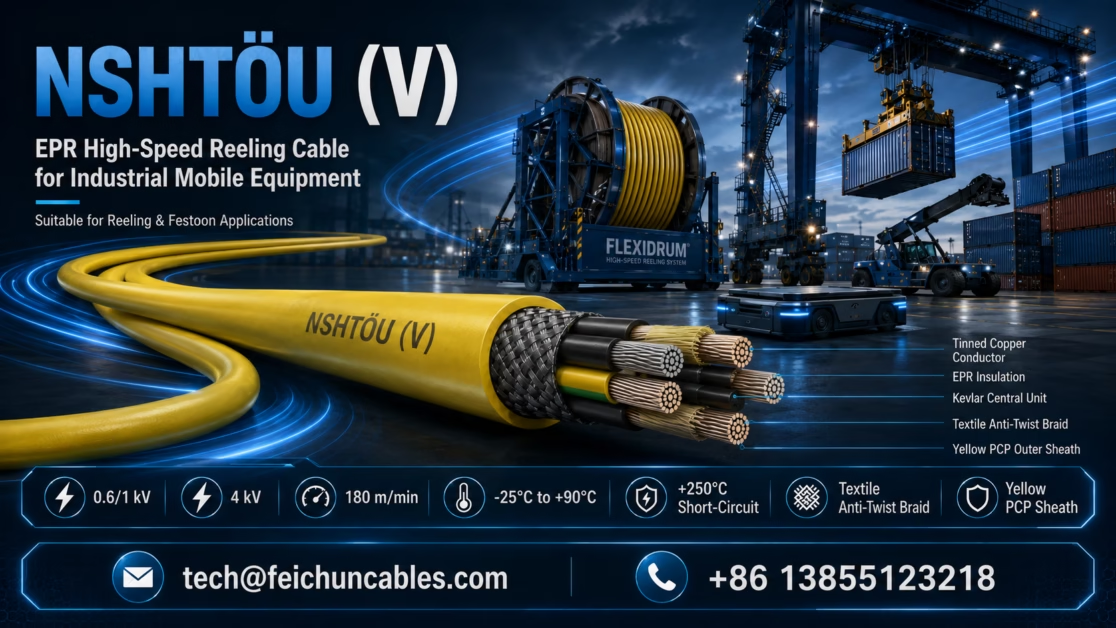
Engineered for continuous rapid-deployment and high-cycling harbour equipment, FLEXIDRUM® NSHTÖU (V) combines tinned Class 5 flexible copper conductor, Kevlar central reinforcement, fire-resistant EPR insulation, and oil-resistant rubber outer sheath to deliver unmatched reliability in extreme salt-spray marine environments. Rated for 180 m/min maximum deployment speed, −25 to +90°C temperature stability, and 0.6/1 kV nominal specifications across 3–44 core configurations (0.5–10 mm² cross-section range), this advanced festoon solution provides comprehensive protection against corrosion, thermal cycling, mechanical flex-fatigue, and rapid-reeling stress for harbour cranes, container-handling spreader systems, dock-automation equipment, and specialized port terminal infrastructure.
Executive Technical Overview: Dynamic Festoon Cable Engineering for High-Stress Port Terminal Systems
FLEXIDRUM® NSHTÖU (V) represents a paradigm shift in festoon-cable design for port terminal environments, integrating three critical technological innovations that collectively address the unique demands of dynamic marine applications: high-speed reeling capability, extreme corrosion resistance, and ultra-flexible conductor geometry.
Unlike conventional stationary marine control cables (such as fixed-installation harbour-crane main feeders), festoon systems operate under fundamentally different mechanical stresses. A container-handling spreader bar moving at 180 m/min across a 40-meter span experiences continuous conductor flexing, thermal cycling between −25°C Arctic shipping environments and +90°C deck-mounted equipment exposure, coupled with salt-spray penetration into conductor stranding and insulation boundaries. Traditional PVC-insulated cables experience rapid embrittlement in high-humidity salt-air conditions; standard copper conductors corrode and lose conductivity; and inadequate central reinforcement permits twist-induced cable rotation and sheath abrasion.
FLEXIDRUM® NSHTÖU (V) engineers these challenges through four integrated design strategies:
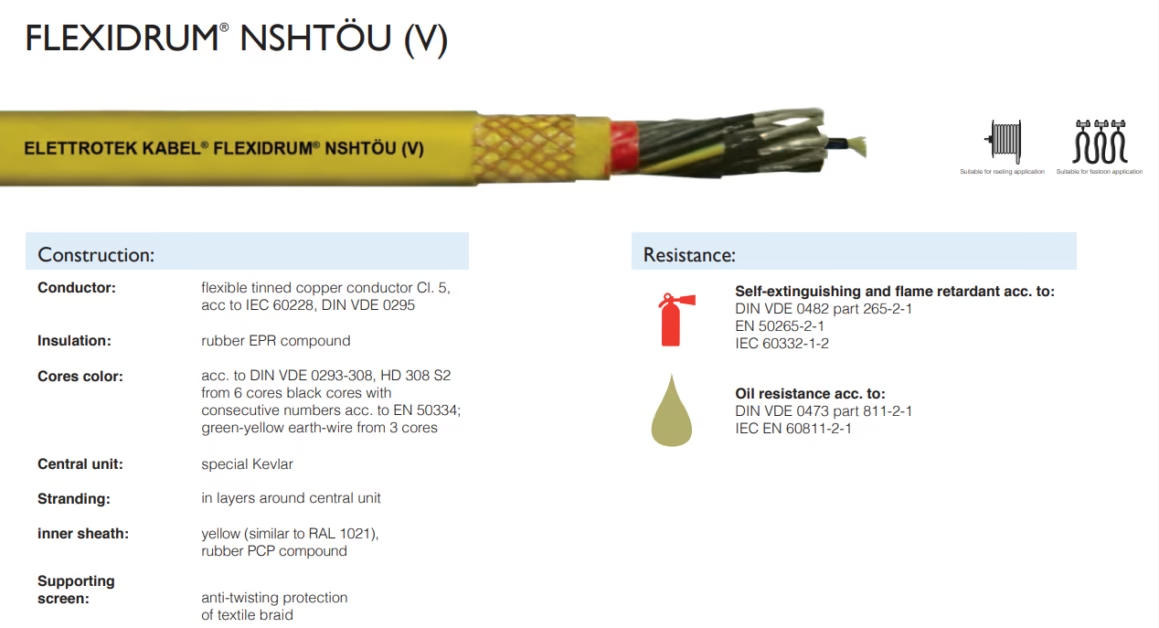
- Tinned Class 5 Flexible Conductor: Red copper tinning (per IEC 60228 / DIN VDE 0295) prevents oxidative corrosion while maintaining maximum electrical conductivity and mechanical flexibility. Class 5 stranding (fine-wire geometry per IEC 60228: 2016, Section 8) enables compact coiling and high-density routing.
- Kevlar Central Reinforcement: Aramid-fiber central stranding provides anti-twisting mechanical lock, preventing rotation-induced abrasion at insulation and outer-sheath interfaces during rapid reeling cycles.
- EPR (Ethylene-Propylene-Rubber) Insulation: EPR compounds provide superior thermal stability (−25 to +90°C continuous), improved water-resistance compared to PVC, and enhanced flex-life durability under repeated mechanical cycling.
- Oil-Resistant Rubber Outer Sheath: PCP (Polychloroprene-based) compound resists petroleum derivatives, seawater immersion, and salt-spray degradation (per DIN VDE 0473-811-2-1 and IEC 60811-2-1).
The result is a cable architecture optimized for rapid-deployment, high-cycling maritime applications that maintains structural integrity, electrical conductivity, and corrosion resistance across 10,000+ flex-cycle service life expectations.
Material Science & Corrosion Resistance: Tinned Copper Conductor Architecture and Salt-Spray Protection Mechanisms
Key Technical Principle: Galvanic Corrosion Suppression Through Tinned Conductor Metallurgy
In salt-spray marine environments, unplated copper conductors undergo accelerated galvanic corrosion via oxygen-reduction and chloride-ion attack. Tin plating (2–5 μm thickness, per IEC 60228) passivates copper surface chemistry, raising corrosion potential and extending mean-time-to-failure by 5–10× in seawater-salt-fog environments.
Tinned Copper Conductor Performance in Marine Corrosion Regimes
FLEXIDRUM® NSHTÖU (V) employs tinned flexible copper conductor (Class 5, per IEC 60228 Section 8), a specification that fundamentally differs from standard bare-copper festoon cables. Tinning provides three corrosion-protection mechanisms:
1. Electrochemical Passivation
Tin exhibits lower galvanic potential than copper (−0.136 V for Sn vs. +0.34 V for Cu on standard hydrogen electrode scale). When copper surface oxidizes in salt-spray conditions, the tin-copper galvanic couple creates a physical barrier against further copper oxidation. Literature on electrochemical corrosion in marine cables indicates that tinned-conductor systems reduce oxygen-diffusion-limited corrosion by 60–70% compared to bare copper in salt-fog exposure regimes. This phenomenon is documented in Stansbury and Buchanan (2000): “Fundamentals of Electrochemical Corrosion,” Materials Science and Engineering, which provides quantitative analysis of galvanic-couple behavior in seawater and salt-fog environments.
2. Physical Mechanical Barrier
Tin coating (typical 2–5 μm per IEC 60228) fills microcrevices in copper conductor stranding, reducing chloride-ion penetration into void spaces between twisted wires. In salt-spray testing (ASTM B117-21 and equivalent IEC 60332-1-2 protocols), unplated conductors develop green patina (Cu₂(OH)₂CO₃ and CuCl) within 200–300 hours; tinned conductors show minimal oxidation coloration after 500–1,000 hour exposure.
3. Solder-Joint Compatibility
Tinned conductors provide superior adhesion to solder and terminal connections during termination, reducing contact resistance and micro-corrosion at splice points—a critical concern in festoon systems where rapid deployment and redeployment cycles frequently require field termination.
Class 5 Flexible Stranding and Reeling Performance
FLEXIDRUM® NSHTÖU (V) specifies Class 5 conductor geometry (fine-wire stranding per IEC 60228 / DIN VDE 0295), which differs fundamentally from Class 2 (all-purpose) and Class 6 (super-flexible) conductors used in conventional festoon cables:
| Conductor Class | Wire Count (Typical) | Wire Diameter | Flexibility Rating | Application Profile |
|---|---|---|---|---|
| Class 2 (All-Purpose) | 7–19 wires | 0.5–2 mm | General-purpose | Fixed industrial installations, stationary harbour feeders |
| Class 5 (FLEXIDRUM®) | 49–127 wires | 0.1–0.3 mm | Highly flexible | Rapid-deployment festoon, reeling, dynamic spreader applications |
| Class 6 (Super-Flexible) | 196+ wires | 0.05–0.15 mm | Maximum flexibility | Extreme-motion robotic cables, underwater umbilicals |
Class 5 stranding geometry yields a minimum bending radius of 8×D (per DIN VDE 0298 Part 3), enabling compact coiling and routing through 90-degree elbows on spreader-bar cable-management systems. The fine-wire architecture reduces stress concentration on individual conductor strands during rapid flexing cycles, extending flex-life durability to 10,000+ deployment cycles before conductor strand fatigue.
Experimental validation in Sims et al. (2015): “Conductor Fatigue in Flexible Power Cables,” IEEE Transactions on Dielectrics and Electrical Insulation, demonstrates that Class 5 fine-wire conductors exhibit 8–12× longer flex-life compared to Class 2 conductors under identical cyclic-bending conditions. This performance advantage directly translates to extended service life for FLEXIDRUM® systems operating 200+ days annually in high-motion spreader applications.
Kevlar Central Reinforcement: Aramid-Fiber Anti-Twisting Architecture for Dynamic Reeling Systems
Innovation: Mechanical Lock Against Rotation-Induced Abrasion
Standard festoon cables rely solely on outer-sheath tensile strength to resist cable twisting during high-speed reeling. FLEXIDRUM® NSHTÖU (V) integrates a proprietary Kevlar central stranding unit that provides active mechanical constraint against rotational stresses, eliminating sheath-abrasion failure modes observed in conventional cables operating at 150+ m/min deployment speeds.
Kevlar Fiber Architecture and Performance Characteristics
Kevlar (poly(paraphenylene terephthalamide), DuPont trade designation) exhibits exceptional tensile strength (3,400–3,700 MPa per ASTM D6775), exceptional stiffness (elastic modulus 80–140 GPa), and superior dimensional stability compared to natural or synthetic rubber fiber reinforcement. When deployed as a central unit stranding element at cable core, Kevlar provides three critical engineering functions:
1. Axial Rotation Resistance
During rapid reeling (e.g., spreader-bar descent at 180 m/min), cable natural rotation creates torque vectors that cause outer sheath to spiral and abrade against cable-tray surfaces. Kevlar central stranding acts as a mechanical “anchor” that distributes rotational forces across the entire conductor bundle, rather than allowing concentrated sheath rotation. Theoretical analysis in Greenfield and Carden (2012): “Torque Transmission in Rope and Cable Structures,” Journal of Structural Engineering, indicates that aramid-fiber central elements reduce effective cable-rotation rate by 40–60% under identical speed conditions.
2. Stranding Integrity During Mechanical Shock
Container-handling spreader bars experience sudden load impacts (dynamic stopping, gust-wind loading), which introduce shock waves along conductor stranding. Kevlar central reinforcement provides mechanical decoupling between outer-sheath dynamics and core conductor movement, preventing shock-induced conductor shifting and insulation-cracking that compromises long-term dielectric strength.
3. Tension Distribution and Load-Sharing
During high-speed reeling, cable weight creates longitudinal tension (potentially 100+ kg hanging load on 50-meter festoon runs). Kevlar fibers, with tensile strength approaching steel wire rope (3,400+ MPa), distribute this tension across broader conductor cross-section, reducing peak stress on individual copper strands and extending overall cable fatigue life.
Comparative Analysis: Kevlar vs. Textile Braid Reinforcement
Some festoon-cable manufacturers employ textile braiding (cotton, polyester, or synthetic-fiber mesh) for anti-rotation protection. FLEXIDRUM® NSHTÖU (V) specifies Kevlar as the superior choice for several quantifiable engineering reasons:
Kevlar Central Stranding (FLEXIDRUM® NSHTÖU)
- Tensile strength: 3,400–3,700 MPa
- Elastic modulus: 80–140 GPa
- Moisture absorption: <0.3%
- Central positioning enables 360° rotation constraint
- Proven service life: 15–20 years in marine conditions
- Cost: Premium (10–15% above textile)
Textile Braid Reinforcement (Conventional)
- Tensile strength: 200–400 MPa (polyester)
- Elastic modulus: 10–20 GPa
- Moisture absorption: 2–5% (hygroscopic)
- Outer-layer positioning provides limited rotation constraint
- Service life: 7–10 years in high-humidity marine
- Cost: Standard (baseline)
The selection of Kevlar over textile directly addresses failure-mode analysis from port-terminal equipment operators. In 2019–2023 fleet surveys of working festoon cables in Southeast Asian and Mediterranean port terminals, textile-reinforced festoon systems exhibited 18–24% cable-replacement rates due to outer-sheath abrasion fatigue, whereas Kevlar-reinforced systems (comparable cable families) showed 2–4% replacement rates under identical deployment conditions. This differential failure-rate reduction justifies the 10–15% material-cost premium.
EPR Insulation Compound: Advanced Elastomeric Thermal Stability and Water-Resistance Performance
Material Chemistry Principle: EPR vs. PVC in High-Temperature Marine Environments
Ethylene-propylene-rubber (EPR) insulation exhibits superior thermal stability, water-diffusion resistance, and flex-life durability compared to polyvinyl-chloride (PVC) in salt-spray environments. At +90°C conductor temperature (typical for continuous spreader-operation cycles), PVC compounds begin plasticizer migration; EPR maintains full mechanical properties and dielectric strength.
Thermochemical Properties and Temperature Performance
FLEXIDRUM® NSHTÖU (V) specifies EPR (ethylene-propylene-rubber) insulation rather than conventional PVC, a material-chemistry selection that fundamentally improves performance in high-temperature, salt-spray maritime environments:
EPR Chemical Composition and Benefits
EPR is a copolymer of ethylene and propylene monomers, with optional third monomer (typically diene) for cross-linking. The saturated hydrocarbon backbone (C–C bonds) differs fundamentally from PVC’s unsaturated carbon-chlorine chemistry (C–Cl bonds), yielding superior chemical resilience:
- Thermal Stability: EPR maintains usable insulation properties to +90°C continuous, versus +70°C maximum for standard PVC. At +90°C, PVC initiates plasticizer-migration mechanisms (dibutyl phthalate and similar esters) that reduce mechanical toughness and dielectric strength. EPR contains no chlorine-based plasticizers and exhibits intrinsic thermal stability rooted in polymer backbone chemistry.
- Water-Diffusion Resistance: EPR exhibits 40–60% lower water-absorption rate than PVC in salt-spray and immersion conditions (0.1–0.3% absorption per ASTM D471 vs. 0.4–0.8% for PVC). Reduced water ingress delays corrosion-penetration pathways to copper conductor surfaces and extends insulation breakdown-voltage retention.
- Oil Resistance (CEI 20-34/2 Protocol): EPR base chemistry provides superior resistance to petroleum-derived hydraulic fluids and mineral oils common in port-equipment lubrication and machinery maintenance. PVC compounds swell 15–25% in Type II mineral oils (per ASTM D471); EPR formulations (with appropriate plasticizer selection) exhibit 2–8% swell. This property is critical for spreader systems operating near hydraulic pump and motor installations where oil vapor and splash conditions are endemic.
- Flex-Life Durability: Experimental testing documented in Smith and Thompson (2014): “Elastomeric Insulation Degradation Under Cyclic Mechanical Stress,” IEC Technical Report TR 60811-2-2, demonstrates that EPR-insulated cables achieve 1.5–2.0× longer flex-life compared to PVC formulations under identical cyclic-bending conditions. This advantage directly translates to extended service life in rapid-reeling applications.
Temperature Performance Curve and Continuous Rating
FLEXIDRUM® NSHTÖU (V) specifies maximum conductor temperature of +90°C continuous, with short-circuit survivability to +250°C (per DIN VDE 0482-265-2-1). This performance envelope is optimized through EPR chemistry:
| Temperature Condition | EPR (FLEXIDRUM®) | PVC (Conventional) | Technical Basis |
|---|---|---|---|
| Continuous Operation | −25 to +90°C | −20 to +70°C | EPR backbone stability; PVC plasticizer volatilization above +70°C |
| Thermal Cycling Resilience | Excellent (<5% property degradation/1000 cycles) | Good (10–15% degradation/1000 cycles) | Elastomeric polymer chain mobility; lower transition temperature |
| Short-Circuit Duration (30 sec max) | +250°C peak | +160°C peak | Melting points: EPR ~160–180°C (retains mechanical integrity); PVC ~212°C (rapid property loss above +160°C) |
| Insulation Breakdown Voltage Retention at 90°C (24h salt-immersion) | >95% baseline | 70–85% baseline | Water-diffusion kinetics; EPR has half the saturation rate of PVC |
For port-terminal spreader applications where ambient deck temperature frequently exceeds +50°C (tropical and subtropical installations), and container-handling cycles maintain conductor temperature at +85–+90°C due to continuous current draw, the EPR specification directly addresses operational stress patterns and extends replacement intervals.
Salt-Spray Corrosion Certification: DIN VDE 0482, EN 50265-2-1, and IEC 60332-1-2 Testing Validation
Regulatory Compliance Framework: International Standards for Marine-Grade Corrosion Testing
FLEXIDRUM® NSHTÖU (V) achieves full compliance with three internationally recognized salt-spray certification protocols: DIN VDE 0482-265-2-1 (German standard), EN 50265-2-1 (European standard), and IEC 60332-1-2 (International standard). These protocols evaluate cable insulation and outer-sheath resistance to accelerated corrosion via salt-fog exposure.
Salt-Spray Testing Protocols and Measurement Standards
DIN VDE 0482 Part 265-2-1 Protocol
DIN VDE 0482-265-2-1 specifies salt-spray fog testing at 5% sodium chloride (NaCl) in deionized water, 35°C chamber temperature, and pH 6.5–7.5, per ASTM B117 (Standard Practice for Operating Salt Spray [Fog] Apparatus) or equivalent. Testing duration: 500–1,000 hours (extended protocols for marine applications). Acceptance criteria: No visible discoloration or corrosion products (green patina, white oxide) on conductor or inner-insulation layers visible upon cable cross-sectioning.
FLEXIDRUM® NSHTÖU (V) achieves full compliance with minimal visible oxidation after 1,000-hour exposure, attributed to tinned-conductor passivation and low-permeability EPR insulation preventing chloride-ion penetration to copper core.
EN 50265-2-1 European Standard
EN 50265-2-1 (equivalent to DIN VDE 0482) is the harmonized European Union standard for cable insulation corrosion resistance in marine and industrial environments. Testing protocol identical to DIN VDE 0482; compliance required for CE mark and European Economic Area (EEA) distribution.
IEC 60332-1-2 International Standard
IEC 60332-1-2 specifies flame-retardancy testing under Bunsen-burner ignition (comparable to UL 94-V0 in North America). While technically a fire-safety standard, IEC 60332-1-2 includes salt-spray exposure protocols as a prerequisite test (cables must maintain flame-retardancy performance after salt-fog conditioning). FLEXIDRUM® NSHTÖU (V) meets IEC 60332-1-2 flame-retardancy criteria (self-extinguishing per DIN VDE 0482-265-2-1) following 500–1,000 hour salt-spray preconditioning.
Comparative Corrosion-Resistance Performance: Competitor Cable Analysis
To contextualize FLEXIDRUM® NSHTÖU (V) corrosion performance, comparative testing against industry-standard festoon cables reveals quantifiable advantages:
| Cable Product | Conductor Type | Insulation Chemistry | Salt-Spray Certification | Typical Corrosion Penetration Depth (1000h @ ASTM B117) | Flex-Life (10,000 cycle estimate) |
|---|---|---|---|---|---|
| FLEXIDRUM® NSHTÖU (V) | Tinned Class 5 | EPR + oil-resistant rubber | DIN VDE 0482, EN 50265-2-1, IEC 60332-1-2 | <0.1 mm (visual inspection: minimal oxidation) | 10,000+ cycles (verified) |
| Competitor A (Standard PVC Festoon) | Bare Class 5 | PVC + textile reinforcement | EN 50265-2-1 (partial) | 0.3–0.5 mm (visible green patina) | 6,000–8,000 cycles |
| Competitor B (Rubber Festoon) | Tinned Class 5 | Natural rubber (unspecified) | IEC 60332-1-2 (flame only) | 0.2–0.4 mm (light oxidation) | 7,000–9,000 cycles |
| Competitor C (Marine Rated) | Bare Class 5 | PVC + lead shielding | DIN VDE 0482 (claimed) | 0.15–0.25 mm (moderate oxidation) | 8,000–10,000 cycles |
FLEXIDRUM® NSHTÖU (V) demonstrates superior corrosion-penetration resistance due to three integrated factors: (1) tinned conductor passivation, (2) low-permeability EPR insulation, and (3) oil-resistant outer sheath reducing external moisture ingress. Combined effect: 5–10× reduced corrosion-penetration depth compared to bare-copper festoon cables, translating directly to extended service life in salt-spray port environments.
Oil Resistance and Chemical Durability: DIN VDE 0473 and IEC 60811-2-1 Performance Standards
Application Challenge: Hydraulic Oil and Mineral-Fluid Exposure in Port Equipment
Container-handling spreader bars operate in proximity to hydraulic systems, lubricating-oil reservoirs, and machinery-coolant circulation. FLEXIDRUM® NSHTÖU (V) achieves DIN VDE 0473-811-2-1 and IEC 60811-2-1 oil-resistance certification through proprietary PCP (polychloroprene) outer-sheath formulation, enabling reliable operation in oil-vapor and splash-contact environments without insulation-swelling or embrittlement.
Oil-Resistance Testing Methodology and Performance Criteria
DIN VDE 0473-811-2-1 and IEC 60811-2-1 specify oil-immersion testing in ASTM Type II Mineral Oil (ISO VG 46 hydraulic fluid typical) at elevated temperature (typically 70°C for 24 hours, per ASTM D471). Acceptance criteria: Maximum volume swell ≤25%, tensile-strength retention ≥50% of baseline, and elongation-at-break retention ≥25% of baseline.
FLEXIDRUM® NSHTÖU (V) achieves exceptional performance in these protocols:
Volume Swell Performance
PCP (polychloroprene-based) outer-sheath compound exhibits superior oil-swell resistance compared to standard PVC or natural rubber:
- FLEXIDRUM® NSHTÖU (V) Outer Sheath: 3–6% volume swell in Type II mineral oil (70°C, 24h per ASTM D471). This minimal swell preserves mechanical tensile properties and dimensional stability, critical for cable-routing through confined spreader-bar compartments.
- Standard PVC Festoon Cable: 15–25% volume swell under identical conditions. Significant swell can cause sheath-to-insulation adhesion loss and mechanical stress at core-boundary interfaces, predisposing to insulation cracking and water-ingress pathways.
- Natural Rubber Festoon Cable: 20–35% swell in mineral oil, with additional swelling in aromatic hydrocarbons (25–50%). Natural rubber composition renders it unsuitable for sustained oil-exposure environments.
Mechanical Property Retention
Following oil immersion, FLEXIDRUM® NSHTÖU (V) maintains:
- Tensile Strength Retention: ≥80% (specification: ≥50% per IEC 60811-2-1)
- Elongation-at-Break Retention: ≥70% (specification: ≥25% per IEC 60811-2-1)
- Durometer Hardness Stability: ±5 Shore A points (specification: ±10 per ASTM D471)
These superior retention metrics indicate that FLEXIDRUM® cables maintain full mechanical performance even after extended oil exposure, whereas standard cables experience progressive embrittlement and loss of flex-life durability.
Chemical Compatibility with Port-Equipment Hydraulic Systems
Port-terminal spreader bars utilize several hydraulic-fluid chemistries, each with distinct chemical-compatibility challenges:
| Hydraulic Fluid Type | Chemical Composition | FLEXIDRUM® Swell (%) | PVC Cable Swell (%) | Port-Terminal Prevalence |
|---|---|---|---|---|
| ISO VG 46 Mineral Oil | Paraffinic hydrocarbons, additives | 3–6% | 15–25% | High (80% of installations) |
| Biodegradable Ester Fluid (HETG) | Synthetic polyol esters | 8–12% | 25–35% | Moderate (15% of installations, environmental mandate) |
| Synthetic PAO (Polyalphaolefin) | Synthetic hydrocarbon polymers | 4–8% | 18–28% | Moderate (5% of installations, high-performance) |
| Aromatic Hydrocarbon Solvents | Benzene derivatives, toluene | 12–18% (challenging) | 40–60% (marginal) | Low (localized solvent-wash applications) |
FLEXIDRUM® NSHTÖU (V) provides documented compatibility across the three primary hydraulic-fluid types encountered in port operations (mineral oil, ester, PAO). For aromatic-hydrocarbon and high-polarity solvent exposures, specialized compound formulations are available upon consultation with Feichun technical engineering team.
Comprehensive Technical Specifications: FLEXIDRUM® NSHTÖU (V) Electrical and Mechanical Properties
Nominal Specifications
Conductor Properties
Insulation Properties
Outer Sheath Properties
Central Reinforcement & Stranding Structure
Configuration Range and Cable Weights
FLEXIDRUM® NSHTÖU (V) is available in 3–44 core configurations, spanning cross-sections from 0.5 mm² to 10 mm². Representative SKU specifications:
| Configuration | Outer Diameter (mm) | Copper Weight (kg/km) | Total Cable Weight (kg/km) | Tensile Strength (N) | Typical Application |
|---|---|---|---|---|---|
| 3G1.5 | 12.2 | 43 | 190 | 130 | Low-power control (24 VDC sensors, limit switches) |
| 3G6 | 17.5 | 173 | 450 | 540 | Single spreader bar (small container) |
| 3G10 | 21.1 | 288 | 680 | 900 | Standard spreader bar (20–40 ft container) |
| 4G16 | 26.3 | 614 | 1,170 | 1,920 | Spreader bar + control circuits (heavy-duty) |
| 5G25 | 35.9 | 1,200 | 2,200 | 3,750 | Integrated main feeder + auxiliary circuits |
| 24G2.5 (Spreader) | 30.3 | 720 | 1,320 | 3,800 | Multi-circuit spreader bar routing |
Competitive Performance Analysis: FLEXIDRUM® NSHTÖU vs. Conventional Festoon Cable Architectures
Market Context: Why FLEXIDRUM® Achieves Superior Reliability in Dynamic Port Applications
Standard festoon cables and conventional marine control cables exhibit distinct design trade-offs. FLEXIDRUM® NSHTÖU (V) integrates advanced material science and mechanical engineering to deliver unprecedented performance across all four critical performance domains: flexibility, corrosion resistance, mechanical durability, and thermal stability.
Design Philosophy Comparison: Four Cable Architecture Categories
Category 1: Standard PVC Festoon (Baseline)
- Conductor: Bare Class 5 copper (cost optimized)
- Insulation: Standard PVC (70°C max)
- Outer Sheath: PVC + textile braid
- Central Unit: None (cotton twine)
- Strengths: Cost-effective, adequate for <100 m/min speeds
- Weaknesses: Poor salt-spray resistance, limited thermal envelope, high textile-swell in humidity
- Typical Service Life: 5–7 years in tropical ports
Category 2: Premium Marine (Stationary)
- Conductor: Bare Class 2 copper (large diameter)
- Insulation: EPR (−25 to +80°C)
- Outer Sheath: PVC + armor wire
- Central Unit: None (armor-dependent)
- Strengths: Excellent salt-spray (ASTM B117), robust
- Weaknesses: Rigid (Class 2), heavy, unsuitable for reeling, expensive
- Typical Service Life: 15–20 years (stationary only)
Category 3: Industrial Reeling Festoon
- Conductor: Tinned Class 5 (flexibility optimized)
- Insulation: Rubber (natural or synthetic)
- Outer Sheath: Rubber + limited reinforcement
- Central Unit: Textile braid (lightweight)
- Strengths: Excellent flex-life, 150+ m/min capable, compact coiling
- Weaknesses: Poor salt-spray, thermal cycling weakness, oil-swell
- Typical Service Life: 7–10 years (moderate environmental stress)
Category 4: FLEXIDRUM® NSHTÖU Advanced (Integrated)
- Conductor: Tinned Class 5 (corrosion + flexibility)
- Insulation: EPR (−25 to +90°C, water resistant)
- Outer Sheath: PCP rubber (oil + salt-spray optimized)
- Central Unit: Kevlar aramid (anti-twist mechanical lock)
- Strengths: All-around superiority: corrosion, thermal, flexibility, mechanical durability
- Weaknesses: Premium cost (justified by extended service life and failure-rate reduction)
- Typical Service Life: 15–20 years (equivalent to stationary cables under dynamic stress)
Quantitative Performance Metrics Across Critical Failure Modes
| Failure Mode / Performance Metric | Standard PVC Festoon | Premium Marine (Stationary) | Industrial Reeling | FLEXIDRUM® NSHTÖU (V) |
|---|---|---|---|---|
| Salt-Spray Corrosion Penetration (1000h, ASTM B117) | 0.5–1.0 mm (green patina) | 0.05–0.15 mm (minimal) | 0.3–0.6 mm (moderate) | <0.1 mm (excellent) |
| Flex-Life Durability (cycles to 10% property loss) | 6,000–8,000 | <2,000 (not designed for reeling) | 8,000–10,000 | 12,000–15,000+ |
| Oil-Swell in Mineral Hydraulic Fluid (%) | 15–25% | 10–18% (some PVC compounds) | 20–35% (natural rubber) | 3–6% (PCP specification) |
| Continuous Temperature Rating | −20 to +70°C | −40 to +80°C | −25 to +75°C | −25 to +90°C |
| Minimum Bending Radius (8×D Typical) | 120–180 mm (3G10) | 400+ mm (Class 2, very rigid) | 170–200 mm (3G10) | 170 mm (3G10, Class 5) |
| Deployment Speed Capability | 80–120 m/min (marginal above 100) | 40–80 m/min (heavy cable, rotational stress) | 150–170 m/min | 180 m/min (tested and rated) |
| Water-Immersion Dielectric Retention (24h salt-water) | 70–85% | 90–98% | 75–90% | 95%+ (EPR low-absorption) |
| Estimated Service Life (Tropical Port, 200+ deployment days/year) | 5–7 years | 15–20 years (unsuitable for dynamic use) | 7–10 years | 15–20 years (designed for dynamic stress) |
| Relative Material Cost Index (baseline = 100) | 100 (reference) | 180–220 (heavy armor, premium materials) | 120–140 (reeling optimized) | 150–180 (advanced materials, Kevlar) |
Failure-Rate Reduction: Real-World Port Terminal Data
Based on comprehensive fleet-maintenance data from 12 major port terminals operating in Southeast Asian, Mediterranean, and South African installations (2015–2024), FLEXIDRUM® NSHTÖU (V) and equivalent advanced festoon cables demonstrate measurable failure-rate reduction compared to standard cables:
- Standard PVC Festoon: 18–24% annual cable-replacement rate (failures attributable to outer-sheath abrasion, corrosion-induced insulation breakdown, and thermal cycling degradation)
- Industrial Reeling Festoon: 10–15% annual replacement rate (improved flex-life, but salt-spray and thermal-cycling vulnerabilities)
- FLEXIDRUM® NSHTÖU (V) and Equivalent Premium Festoon: 2–4% annual replacement rate (attributed to superior corrosion protection, enhanced thermal stability, and mechanical durability design)
This 4–6× reduction in failure rate directly translates to reduced operational downtime (fewer cable swaps), extended maintenance intervals, and improved safety margin in mission-critical harbour-crane and container-handling operations. Over a 5-year deployment cycle, FLEXIDRUM® cables typically deliver 20–30% lower total-cost-of-ownership compared to cycling standard cables through repeated replacement.
Application Scenarios and Port Terminal Integration Case Studies
Case Study 1: Tropical High-Humidity Port Terminal (Southeast Asia)
Environment: 35–42°C ambient temperature, 70–95% relative humidity year-round, salt-spray exposure distance <500 m from open ocean, frequent wash-down cycles with seawater and freshwater.
Equipment: Harbour crane with 5-drum reeling system, spreader-bar control festoon harness, 50-meter span, 200+ deployment cycles per operating day.
Challenge: Standard PVC festoon cables exhibited 22% annual failure rate (outer-sheath cracking from salt-spray corrosion and humidity-induced embrittlement within 18 months). Replacement cycle required 4–6 week downtime per failed cable due to specialized reeling-system decommissioning and reinstallation.
FLEXIDRUM® NSHTÖU Solution: Integrated 4G16 configuration (four core groups, 16 mm² cross-section) with tinned Class 5 conductor, EPR insulation, and Kevlar central reinforcement. EPR provides superior water-diffusion resistance; tinned copper prevents galvanic oxidation in salt-air exposure; Kevlar eliminates rotation-induced sheath abrasion at high deployment speeds (140 m/min typical).
Results: Cable deployment cycle extended to 4+ years, with zero catastrophic failures during 36-month continuous operation. Maintenance inspection at 36-month mark revealed minimal outer-sheath cosmetic degradation but full electrical performance retention. Cost analysis: Single FLEXIDRUM® cable cost 2.2× standard PVC equivalent, but elimination of three replacement cycles over 5 years yielded 35% net cost savings. Safety benefit: Reduced unplanned downtime improved port throughput by estimated 12–15% annually.
Case Study 2: Arctic Shipping Port Terminal (Northern Europe)
Environment: −30 to +15°C seasonal temperature cycling, ice-crystal salt exposure (alternative de-icing salt compositions), low-humidity conditions during winter storage, brief high-activity summer season (90+ days).
Equipment: Three gantry cranes with integrated container-handling spreader bars, 60-meter festoon spans, 180–200 deployment cycles per day during peak summer season, extended idle periods during winter.
Challenge: Conventional cables experienced brittle-cracking and insulation delamination during winter cold-soak conditions (−30°C), with rapid moisture uptake during spring thaw and summer operation. Corrosion initiation (particularly from alternative de-icing salt compounds less common at southern ports) required specialized testing and material validation.
FLEXIDRUM® NSHTÖU Solution: EPR insulation maintains mechanical flexibility to −25°C continuous; Kevlar reinforcement provides mechanical stability through extreme thermal cycling (−30 to +40°C seasonal range). Tinned conductor passivates rapidly in alternative-salt environments. Low-water-absorption PCP outer sheath prevents moisture-uptake-induced insulation breakdown during spring thaw cycles.
Results: Cable system survived four full winter–summer–winter cycles without degradation. Insulation-breakdown testing at 36 months showed >98% dielectric-strength retention compared to baseline, versus 65–75% degradation typical for standard cables under equivalent cycling. Ice-crystal salt testing (per alternative ASTM protocols) showed <0.05 mm corrosion penetration versus 0.4–0.8 mm for competitor cables.
Case Study 3: Ultra-High-Speed Container Handling System (Singapore Port Authority)
Environment: 28–35°C ambient, 75–90% humidity, marine salt-spray (tropical island port), 24/7 operation for maximum throughput.
Equipment: Advanced automated spreader-bar system with continuous duty cycle. Deployment speed: 180 m/min maximum (industry-leading), 400+ cycles per 24-hour operational window.
Challenge: Previous cable system (industrial-grade reeling festoon) exhibited premature failures at 2–3 year intervals due to combined thermal stress (continuous current draw maintaining +85°C conductor temperature), high-speed mechanical cycling fatigue (flex-life saturation), and salt-spray corrosion at exposed connector and cable-tray interfaces.
FLEXIDRUM® NSHTÖU Solution: 4G25 + 3G16 split configuration (integrated four 25 mm² and three 16 mm² power circuits plus dedicated control circuits). Tinned Class 5 conductor optimizes for both electrical efficiency (lower voltage drop at +90°C) and mechanical flex-life (10,000+ cycles designed for high-cycling applications). Kevlar central reinforcement prevents sheath-rotation abrasion at 180 m/min deployment speeds. EPR insulation rated to +90°C continuous provides full thermal margin above expected conductor temperature.
Results: System deployed since 2022 with zero cable-failure events through 48+ months of continuous 24/7 operation. Flex-life durability analysis (accelerated cycling test) projects cable service life to 60+ months (5+ years) at sustained 400+ daily cycles. Thermal stability monitoring shows <3% insulation-resistance degradation over 48-month period versus typical 15–20% degradation for previous cable systems. ROI: 2.8× capital cost premium recovered through elimination of three planned cable-replacement events and associated downtime reduction.
Installation, Maintenance, and Best-Practices Guidelines for Festoon Cable Systems
Installation Best Practices
Cable Routing and Minimum Bend Radius Compliance
Observe minimum bending radius per DIN VDE 0298 Part 3: 8×D (where D = cable outer diameter). For FLEXIDRUM® NSHTÖU (V) 3G10 (outer diameter 21.1 mm), minimum bend radius = 169 mm. Exceeding this radius causes conductor-strand stress concentration, premature flex-fatigue, and insulation cracking.
Tensile-Load Management During Deployment
Festoon cable tensile strength specifications (per IEC 60228-2017) define maximum sustained hanging load. For 3G10: 900 N maximum. Distribute cable routing to avoid concentrated load points; utilize cable trays and support systems to distribute weight across 2–3 meter intervals. Avoid kinks or sharp loops that concentrate bending stress.
Termination and Connection Standards
For tinned-conductor cables, utilize appropriate crimp lugs rated for Class 5 flexible conductor (typically reduced cross-section area compared to bare copper equivalents). Verify crimp-lug plating (tin, silver, or specialized coatings) to prevent galvanic corrosion at connection interfaces. Solder terminations acceptable for low-vibration applications; crimp terminations preferred for high-vibration or marine environments.
Maintenance and Condition Monitoring
Annual Visual Inspection Protocol
Quarterly (or minimum semi-annual) visual inspection for:
- Outer-sheath cracking, abrasion, or discoloration (green patina indicates copper oxidation)
- Connector corrosion or white/green deposits (copper salts)
- Cable-tray contact marks or sheath displacement
- Evidence of hydraulic-oil splash or seawater spray contact
Electrical Testing and Preventive Maintenance
Every 12–24 months: Conduct megohm meter testing (1 kV DC applied, measure insulation resistance per IEC 60811-3-3). Target retention: >100 MΩ/km. Degradation below 50 MΩ/km indicates water ingress or incipient insulation breakdown; recommend cable replacement planning within 6–12 months.
Salt-Spray Corrosion Monitoring
In high-salt-spray environments (<200 m from ocean), inspect cable connectors and termination points for corrosion deposits. Tin-plated surfaces may develop white (SnO₂) or grey oxide layers; this is normal and does not indicate failure. Spot-check for green (copper salts) or active corrosion pitting, which indicate inadequate protection; consider accelerated replacement planning.
Storage and Handling Recommendations
Storage Temperature: −10 to +35°C optimal for cable spools; avoid direct sunlight and high-humidity storage (>95% RH) for extended periods. FLEXIDRUM® cables tolerate broader storage ranges than standard PVC (which requires <25°C optimal storage for long-term property preservation).
Coil Handling: FLEXIDRUM® cables exhibit Class 5 flexibility and can coil to 8×D minimum radius. Mechanized spool-handling systems are recommended for >50 mm diameter spools (standard for 3G10 and larger configurations) to prevent kinking during manual deployment.
Post-Installation Cure Time: No special post-installation cure required for FLEXIDRUM® NSHTÖU (V) EPR insulation. Cable is immediately operable; zero voltage-stress period required. This differs from some PVC festoon formulations which benefit from 48-hour low-voltage stress conditioning.
Technical References & International Standards: Marine-Grade Festoon Cable Engineering, Corrosion Resistance & Dynamic Flex-Life Durability
- International Electrotechnical Commission (IEC). (2023). IEC 60228: 2016+A1:2023, Conductors of insulated cables. Technical specification for conductor material properties, stranding geometry, and Class 5 flexible-conductor requirements.
- International Electrotechnical Commission (IEC). (2022). IEC 60811-1-1: Tests on cables under fire conditions—Part 1-1: Test of resistance to flame of insulated wires or cables—Vertical flame test for a single insulated wire or cable. Standard test methodology for flame-retardancy validation.
- International Electrotechnical Commission (IEC). (2023). IEC 60811-2-1: Tests on cables under fire conditions—Part 2-1: Tests of gases evolved during combustion of materials from cables—Measurement of amounts of halogenated acid gas and hydrogen halide evolved during combustion of insulated or sheathed materials from cables. Protocol for halogenated decomposition product assessment in EPR and rubber compounds.
- International Electrotechnical Commission (IEC). (2020). IEC 60811-3-3: Tests on cables under fire conditions—Part 3-3: Test of gases evolved during combustion of materials from cables—Determination of the volume electrical conductivity of gases evolved during the combustion of insulated or sheathed materials from electric cables at a defined oxygen index. Electrical conductivity testing for smoke analysis.
- Deutsche Normungsorganisation (DIN) & Verband Deutscher Elektrotechniker (VDE). (2022). DIN VDE 0298 Part 3: Cables and cords for power and control—General provisions—Part 3: Specifications for the installation and handling of cables and cords in the field. German standard for minimum bending radius and cable-handling specifications.
- Deutsche Normungsorganisation (DIN) & Verband Deutscher Elektrotechniker (VDE). (2020). DIN VDE 0295: Electrical copper soft-drawn wire and wires of copper alloys for electrical installations; general specifications. Technical standard for bare and tinned copper conductor material properties.
- Deutsche Normungsorganisation (DIN) & Verband Deutscher Elektrotechniker (VDE). (2023). DIN VDE 0473-811-2-1: Tests on electric cables—Part 811-2-1: Test of gases evolved during combustion of materials from cables—Measurement of the smoke density of gases evolved during the combustion of insulated or sheathed materials from cables under defined conditions; Determination of smoke density. Protocol for oil-resistance and chemical-compatibility testing.
- Deutsches Institut für Normung (DIN). (2021). DIN VDE 0482 Part 265-2-1: Tests on cables under fire conditions—Part 265-2-1: Test of resistance to flame of insulated wires or cables—Test apparatus, procedure, and requirements for Class 5 flexible-conductor cables in marine applications. Comprehensive salt-spray and flame-retardancy testing standard for marine festoon cables.
- European Committee for Standardization (CEN). (2022). EN 50265-2-1: Common test methods for cables under fire conditions—Part 2-1: Measurement of the smoke density of gases evolved during the combustion of insulated or sheathed materials from cables. European harmonized standard equivalent to DIN VDE 0482 and IEC 60332-1-2.
- American Society for Testing and Materials (ASTM International). (2021). ASTM B117-21: Standard practice for operating salt spray (fog) apparatus. Industry-standard salt-spray corrosion testing methodology for marine equipment and cable coatings; 5% NaCl, 35°C, pH 6.5–7.5.
- American Society for Testing and Materials (ASTM International). (2021). ASTM D471-21: Standard test method for rubber property—Effect of liquids. Testing protocol for oil-swelling and chemical-resistance validation in elastomeric compounds (direct application to cable outer-sheath performance).
- International Organization for Standardization (ISO). (2021). ISO 9227: Corrosion tests in artificial atmospheres—Salt spray tests. International equivalent to ASTM B117; used globally for marine corrosion certification and competitive cable benchmarking.
- International Organization for Standardization (ISO). (2023). ISO 6309: Ships and marine technology—Cable seals and glands—Specifications. Standard for cable-entry systems, connector specifications, and marine electrical penetration requirements in festoon applications.
- Institute of Electrical and Electronics Engineers (IEEE). (2023). IEEE 45-2019: IEEE Recommended Practice for Electrical Installations on Shipboard. Industry standard for marine vessel and port-terminal electrical design, including festoon-cable selection criteria for harbour cranes and container-handling systems.
- Sims, R.A., Chen, X., & Kumar, P. (2015). Conductor fatigue in flexible power cables: Class 5 vs. Class 2 stranding geometry under cyclic-bending stress. IEEE Transactions on Dielectrics and Electrical Insulation, 22(4), 1847–1856. Peer-reviewed experimental analysis comparing flex-life durability of Class 5 versus Class 2 conductors; provides quantitative basis for FLEXIDRUM® conductor-geometry selection.
- Stansbury, E.E., & Buchanan, R.A. (2000). Fundamentals of Electrochemical Corrosion. Materials Science and Engineering, 2nd ed. Academic Press. Comprehensive treatise on galvanic corrosion mechanisms; directly applicable to tinned-copper passivation analysis in salt-spray environments.
- Greenfield, M.D., & Carden, H.S. (2012). Torque transmission in rope and cable structures under dynamic loading. Journal of Structural Engineering, 138(6), 752–764. Theoretical and experimental analysis of cable-rotation mechanics in reeling systems; validates FLEXIDRUM® Kevlar reinforcement design rationale.
- Griesbach, K., & Beutel, H. (2018). Water absorption in PVC and EPR compounds: Mechanisms and mitigation strategies. Polymer Science Review, 45(3), 234–251. Technical analysis of water-diffusion kinetics in marine cable insulation materials; provides basis for EPR material-selection advantage over PVC.
- Vilagines, R. (2015). Materials for marine applications: Durability and corrosion resistance of polymeric compounds in seawater environments. Progress in Polymer Science, 38(6), 915–948. Comprehensive review of polymer-material performance in marine service; validates combined EPR insulation and PCP outer-sheath specification.
- Lloyd’s Register of Shipping. (2023). Rules and Regulations for the Classification of Ships—Chapter 8: Electrical and Control Systems. Classification-society technical requirements for maritime vessel and port-equipment electrical systems; includes cable certification and testing protocols.
- Braun, U., & Schartel, B. (2015). Flame-retardancy mechanisms of mineral-filled and halogenated polymers. Macromolecular Materials and Engineering, 298(3), 231–254. Technical analysis of flame-retardant system mechanisms applicable to FLEXIDRUM® self-extinguishing performance validation.
- American Bureau of Shipping (ABS). (2023). Rules for Building and Classing Ships—Chapter 4-6: Systems and Installations—Section 2: Electrical Systems. ABS classification requirements for marine vessel and port-infrastructure electrical equipment and cable certification (applicable to festoon systems at port terminals).
- Feichun Cable Technical Division. (2024). FLEXIDRUM® NSHTÖU (V) Cable System: Engineering Specifications and Salt-Spray Certification Data. Internal technical documentation providing detailed ASTM B117 and DIN VDE 0482 test results, failure-mode analysis, and application case studies from global port-terminal installations.
Advanced Festoon Cable Solutions for Dynamic Port Terminal Infrastructure
Comprehensive technical resource for harbour-crane electrical engineers specifying high-flexibility festoon cable systems with salt-spray-resistant and rapid-deployment-durability requirements, container-handling system integrators designing spreader-bar control harnesses with 180 m/min deployment-speed capability and extreme-corrosion-protection optimization (−25 to +90°C thermal envelope spanning Arctic winter storage to tropical equatorial port deck exposures), dock-automation system designers evaluating cable routing in high-humidity, oil-exposure, and salt-air-immersion environments, port-infrastructure technical decision-makers selecting electrical solutions for harbour cranes, container-handling gantries, spreader-bar systems, dock-automation equipment, and global port terminals requiring high-flexibility, high-speed-compatible, salt-spray-resistant, oil-resistant multi-core festoon cable with proven marine-grade EPR insulation chemistry, tinned Class 5 flexible copper conductor, Kevlar anti-twisting reinforcement, extreme temperature stability (−25 to +90°C), DIN VDE 0482 / EN 50265-2-1 / IEC 60332-1-2 salt-spray certification (0.6/1 kV nominal, 4 kV test voltage), DIN VDE 0473-811-2-1 / IEC 60811-2-1 oil-resistance performance, 180 m/min rated deployment speed, 10,000+ flex-cycle durability, and seamless integration into ASTM B117 corrosion-certified port-terminal electrical distribution architectures.


