
AC 600V Festoon System Flexible Cable with Kevlar® Para-Aramid Fibre Braided Tensile Reinforcement Layer, JIS C 3327 Compliant, −40°C to +90°C Operating Range, Oil-Resistant, Flame-Retardant — Engineered for Port Gantry Cranes, Ship-to-Shore Unloaders, Container Handling Equipment, and Heavy-Duty Cable Chain Applications
Advanced Festoon Cable Engineering: Kevlar® (Poly-Paraphenylene Terephthalamide) Aramid Fibre Braided Reinforcement Delivering Extraordinary Tensile Strength with Minimal Weight Penalty, Multi-Pair Shielded Construction for Noise-Immune Signal Transmission, Cross-Linked Elastomer Insulation and Sheath for Oil, Ozone, UV, and Abrasion Resistance, Purpose-Built for the Extreme Mechanical Demands of Port Gantry Crane Festoon Systems, Grab-Type Ship Unloaders, Rail-Mounted Container Cranes, and Cable Trolley Applications in Coastal and Industrial Environments
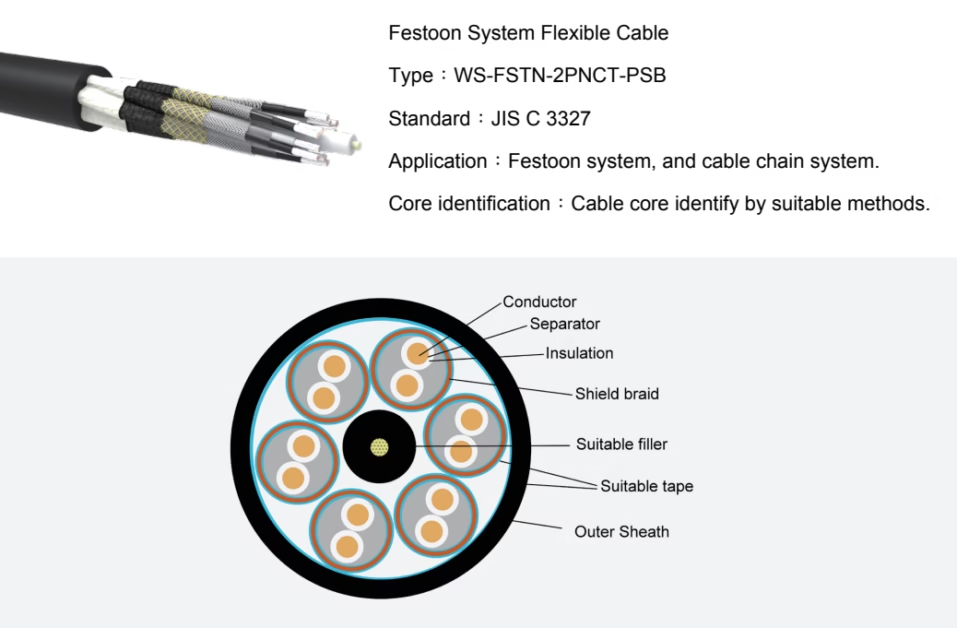
WALSTOON® WS-FSTN-2PNCT-PSB Festoon System Flexible Cable
AC 600V Festoon System Flexible Cable with Kevlar® Para-Aramid Fibre Braided Tensile Reinforcement Layer, JIS C 3327 Compliant, −40°C to +90°C Operating Range, Oil-Resistant, Flame-Retardant — Engineered for Port Gantry Cranes, Ship-to-Shore Unloaders, Container Handling Equipment, and Heavy-Duty Cable Chain Applications
Advanced Festoon Cable Engineering: Kevlar® (Poly-Paraphenylene Terephthalamide) Aramid Fibre Braided Reinforcement Delivering Extraordinary Tensile Strength with Minimal Weight Penalty, Multi-Pair Shielded Construction for Noise-Immune Signal Transmission, Cross-Linked Elastomer Insulation and Sheath for Oil, Ozone, UV, and Abrasion Resistance, Purpose-Built for the Extreme Mechanical Demands of Port Gantry Crane Festoon Systems, Grab-Type Ship Unloaders, Rail-Mounted Container Cranes, and Cable Trolley Applications in Coastal and Industrial Environments
Introduction: Why Port Crane Festoon Cables Fail — And How Kevlar® Solves It
Festoon cables on port gantry cranes and ship unloaders endure some of the most punishing operating conditions in industrial cable engineering. Every time the crane trolley travels along its rail, the festoon cable is dragged, flexed, accelerated, and decelerated across spans of 100–300 metres. The cable must support its own suspended weight between trolley hangers, absorb dynamic shock loads during emergency stops, withstand continuous wind-induced vibration in exposed coastal environments, and resist the corrosive effects of saltwater spray, UV radiation, and airborne industrial contaminants — all while maintaining electrical continuity and signal integrity for safety-critical crane control systems.
Conventional festoon cables rely on steel wire armouring or simple textile fillers to provide tensile strength. Steel wire adds significant weight (increasing the gravitational sag load on the festoon system), corrodes rapidly in coastal port environments, and fatigues under repeated bending cycles. Textile fillers stretch permanently under sustained load, causing cable elongation, uneven sag profiles, and eventual failure of internal conductors due to differential movement between the core bundle and the outer sheath.
The WALSTOON® WS-FSTN-2PNCT-PSB cable solves these problems with a Kevlar® para-aramid fibre braided tensile reinforcement layer — the same material used in ballistic body armour, aerospace composites, and high-performance sailing rigging. Kevlar delivers five times the tensile strength of steel on a weight-for-weight basis, does not corrode, does not stretch permanently under load, and maintains its mechanical properties across millions of flex cycles. The result is a festoon cable that is simultaneously lighter, stronger, and longer-lasting than any steel-armoured alternative — specifically engineered for the extreme demands of port crane and ship unloader festoon systems.
Festoon cables on port cranes are safety-critical components. Cable failure during crane operation can result in loss of crane control, uncontrolled load release, collision damage, and risk to human life. The WS-FSTN-2PNCT-PSB cable must be installed, supported, and maintained in strict accordance with the crane manufacturer’s festoon system specifications and local port authority safety regulations. Cable inspection intervals, replacement schedules, and minimum bending radii must be observed without exception. Do not substitute non-rated cables in festoon systems — this is a safety violation in all major port regulatory jurisdictions.
Technical Specifications: JIS C 3327 Breakdown
| Parameter | Specification |
|---|---|
| Product Designation | WS-FSTN-2PNCT-PSB (Festoon, 2PNCT type, Para-aramid Shield Braid) |
| Standard Compliance | JIS C 3327 (Japanese Industrial Standard for Rubber-Insulated Cabtyre Cables). Construction verified per JIS C 3005. |
| Rated Voltage | AC 600V |
| Test Voltage | AC 3,000V / 1 minute |
| Rated Temperature | 90°C (maximum continuous conductor temperature) |
| Ambient Temperature Range | −40°C to +90°C |
| Minimum Bending Radius | 6 × OD (outer diameter) |
| Tensile Reinforcement | Kevlar® para-aramid fibre braided layer. Specially engineered braiding pattern for omnidirectional tensile load distribution. |
| Flame Retardancy | JIS C 3005 compliant |
| Oil Resistance | JIS C 3005 compliant. Resistant to mineral oils, hydraulic fluids, and lubricants. |
| Abrasion Resistance | JIS C 3327 Table 6.12 compliant |
| Weather Resistance | Resistant to ozone, UV radiation, and moisture. Suitable for permanent outdoor coastal installation. |
| Core Identification | Cable cores identified by suitable methods per JIS standard. |
| Primary Application | Festoon systems, cable chain systems, cable trolley systems on port cranes and ship unloaders. |
Kevlar® Aramid Fibre Tensile Reinforcement: The Core Innovation
Kevlar® is the registered trademark of DuPont (now Dupont de Nemours, Inc.) for poly-paraphenylene terephthalamide — a para-aramid synthetic fibre that possesses a unique combination of extraordinary tensile strength, near-zero elongation under load, complete corrosion immunity, and exceptional fatigue resistance. Originally developed for military ballistic protection (body armour), Kevlar has become the gold standard tensile reinforcement material in applications where weight, strength, and durability are simultaneously critical: aerospace composites, high-performance marine rigging, Formula 1 crash structures, and — increasingly — industrial cable reinforcement for extreme-duty applications.
The mechanical properties of Kevlar that make it ideal for festoon cable reinforcement are remarkable. Kevlar 49 fibre (the grade typically used in cable reinforcement) has a tensile strength of 3,000 MPa — approximately five times stronger than steel on a weight-for-weight basis. Its elastic modulus of 112 GPa ensures minimal elongation under sustained load: the cable does not permanently stretch, maintaining consistent sag profiles and preventing internal conductor damage caused by differential movement. Kevlar’s density of 1.44 g/cm³ is less than one-fifth that of steel (7.8 g/cm³), which means the reinforcement layer adds negligible weight to the cable — a critical advantage in festoon systems where cable self-weight directly affects trolley motor sizing, hanger spacing, and structural loading on the crane boom.
Unlike steel wire armouring, Kevlar is completely immune to corrosion. In coastal port environments saturated with salt spray, airborne chlorides, and industrial pollutants, steel wire armouring begins corroding within months of installation. Corroded steel wire loses tensile strength progressively and can catastrophically fracture without warning under dynamic loading. Kevlar does not corrode — ever. It is chemically inert to saltwater, most acids and alkalis, fuels, hydraulic fluids, and atmospheric pollutants. This corrosion immunity alone justifies the Kevlar reinforcement approach for any port or coastal festoon cable application.
The phrase “ballistic-grade Kevlar” is not marketing hyperbole — it is a precise engineering statement. The same para-aramid fibre that stops high-velocity projectiles in body armour applications absorbs and distributes dynamic impact loads in festoon cable systems. When a crane trolley performs an emergency stop, the festoon cable experiences a sudden shock load equivalent to several times its static weight. Steel wire transmits this shock as a brittle pulse that can fracture individual wires. Kevlar’s inherent energy-absorption capability (the same property that captures bullet kinetic energy) distributes the shock load across the entire braided reinforcement structure, preventing localised failure. This makes the WS-FSTN-2PNCT-PSB cable fundamentally more resilient to the dynamic loading patterns of real-world crane operation.
Braiding Architecture: How the Reinforcement Layer Works
The tensile reinforcement in the WS-FSTN-2PNCT-PSB cable is not simply a layer of loose Kevlar filaments wrapped around the core bundle. Instead, it uses a precision-engineered braiding pattern — a technique borrowed from ballistic textile engineering and advanced composite manufacturing — to create a tubular reinforcement structure that provides omnidirectional tensile strength, controlled flexibility, and uniform load distribution around the entire cable circumference.
The braiding process interlocks hundreds of individual Kevlar yarns in a biaxial or triaxial pattern at precisely controlled braid angles (typically 45°–55° from the cable axis). This geometry produces several critical mechanical properties. First, the braided structure provides tensile strength in all directions — not just along the cable axis, but also radially and circumferentially. This means the cable resists pulling, twisting, side-loading, and compressive forces simultaneously — exactly the complex loading pattern experienced in festoon systems where cable hangers impose lateral compression while the cable’s own weight creates axial tension. Second, the interlocking braid pattern allows controlled elongation: the braid angle changes slightly under load (the “scissors effect”), providing a small amount of elastic give that absorbs shock loads without permanent deformation. Third, the braided structure distributes load uniformly across all fibres — if any single yarn is damaged (e.g., by abrasion at a hanger point), the surrounding yarns redistribute the load without catastrophic cascade failure.
This braiding approach differs fundamentally from conventional steel wire armouring, which consists of individual wires laid helically around the cable core. Helical armouring provides tensile strength only along the wire axis and offers no shock absorption — the rigid steel wires either hold or break, with no intermediate energy-absorbing mechanism. The Kevlar braided tensile layer transforms the cable from a passive structural member into an active load-management system that continuously adapts to dynamic forces during crane operation.
Feichun operates 16-carrier and 24-carrier high-speed braiding machines specifically configured for para-aramid fibre processing. The braid angle, yarn tension, picks-per-centimetre, and coverage ratio are precisely controlled to match the cable’s design tensile load rating. Each production batch undergoes pull-test verification to confirm that the braided reinforcement meets or exceeds the specified minimum breaking strength. Feichun’s braiding facility can accommodate cable diameters from 15 mm to 80 mm, covering the full range of festoon cable configurations used in port crane and ship unloader applications.
Port Gantry Crane & Ship Unloader Applications
Ship-to-Shore (STS) Container Cranes
Ship-to-shore gantry cranes — the towering structures that load and unload container vessels at modern port terminals — are the primary application for the WS-FSTN-2PNCT-PSB cable. The festoon system on an STS crane typically spans 80–250 metres along the crane boom, with the cable suspended from trolley-mounted hangers that travel the full span at speeds up to 240 m/min. The cable must deliver AC 600V power to the trolley drive system and crane control signals across this distance, while enduring continuous acceleration/deceleration cycles, wind loading, salt spray exposure, and temperature extremes from −40°C (arctic ports) to +90°C (sun-heated crane structures in tropical regions). The Kevlar reinforcement ensures the cable maintains dimensional stability and electrical integrity across millions of trolley travel cycles over a 10–15 year operational life.
Grab-Type Ship Unloaders
Grab-type ship unloaders handle bulk cargo — coal, iron ore, grain, phosphate, cement — using a clamshell grab bucket suspended from a trolley that traverses the unloader boom. The festoon cable on these machines endures particularly severe duty: the grab operation generates heavy shock loads during bucket closure and hoisting, the bulk cargo environment produces abrasive dust that attacks cable surfaces, and the unloading cycle is continuous (24/7 operation during vessel discharge). The WS-FSTN-2PNCT-PSB cable’s oil-resistant, abrasion-resistant sheath protects against the harsh particulate environment, while the Kevlar tensile layer absorbs the repetitive shock loading without fatigue failure.
Rail-Mounted Gantry Cranes (RMG/RTG)
Rail-mounted and rubber-tyred gantry cranes in container yards use festoon or cable reel systems for power supply. The WS-FSTN-2PNCT-PSB cable is equally suited to these applications, where the cable must flex repeatedly as the gantry travels along the container stack. The cable’s flame retardancy (JIS C 3005) is particularly important in these applications, as gantry cranes operate in close proximity to container stacks and terminal infrastructure where fire propagation risk must be minimized.
Cable Chain (Energy Chain) Systems
Beyond festoon applications, the WS-FSTN-2PNCT-PSB cable is designed for use in cable chain (energy chain) systems — enclosed track systems that guide and protect the cable during linear travel. Cable chain applications on port equipment impose different mechanical stresses (guided bending rather than free-span sag), but the Kevlar reinforcement provides the same benefits: resistance to longitudinal tension, elimination of permanent elongation, and absorption of shock loads at reversal points. The cable’s controlled minimum bending radius of 6×OD is fully compatible with standard energy chain bend radii.
Cable Construction: Layer-by-Layer Analysis
| Layer | Material | Function |
|---|---|---|
| Conductor | Annealed copper, Class 5 flexible stranding | Electrical power and signal transmission. Fine-stranded construction for maximum flex life in dynamic applications. |
| Insulation | Cross-linked elastomer (XLPE-equivalent rubber compound) | Primary electrical insulation. 90°C rated. Oil-resistant formulation per JIS C 3005. |
| Core Assembly | Paired cores (P = pair) with suitable fillers | Paired configuration provides balanced signal transmission and simplified connection to crane control systems. |
| Shield Braid | Tinned copper braid (0.3 mm nominal thickness) | Electromagnetic shielding. Prevents interference between power and signal cores. Protects crane control signals from external EMI sources (VFD drives, motors, radio equipment). |
| Kevlar® Tensile Layer | Para-aramid fibre (poly-paraphenylene terephthalamide), precision-braided | Primary tensile reinforcement. Absorbs cable self-weight, dynamic shock loads, and wind forces. Prevents cable elongation. Provides energy absorption during emergency stops. |
| Outer Sheath | Special chloroprene rubber (CR) compound | Mechanical protection. Resistant to oil, ozone, UV, abrasion, and flame per JIS C 3327. Designed for permanent outdoor coastal exposure. |
The paired-core (P) construction is a deliberate design choice for crane control cable applications. Each pair consists of two insulated conductors twisted together with a controlled lay length, providing inherent common-mode noise rejection for analogue and digital control signals. The shielding braid over each pair (or overall, depending on configuration) provides additional electromagnetic protection in the electrically noisy environment of a crane cab, where variable-frequency drives, high-current hoist motors, and radio communication equipment generate significant electromagnetic interference.
Dimensional & Electrical Data
| No. of Pairs | Size (mm²) | Conductor Ø (mm) | Insulation (mm) | Shield Braid (mm) | Sheath (mm) | Overall Ø (mm) | Mass (kg/km) | Max. R @ 20°C (Ω/km) | Min. IR @ 20°C (MΩ·km) |
|---|---|---|---|---|---|---|---|---|---|
| 2P | 1.25 | 1.5 | 0.8 | 0.3 | 2.3 | 20.0 | 380 | 16.00 | 500 |
| 2P | 2 | 1.8 | 0.8 | 0.3 | 2.4 | 22.0 | 450 | 10.20 | 500 |
| 2P | 3.5 | 2.5 | 0.8 | 0.3 | 2.6 | 25.0 | 615 | 5.54 | 400 |
| 3P | 1.25 | 1.5 | 0.8 | 0.3 | 2.4 | 22.0 | 465 | 16.00 | 500 |
| 3P | 2 | 1.8 | 0.8 | 0.3 | 2.5 | 23.0 | 555 | 10.20 | 500 |
| 3P | 3.5 | 2.5 | 0.8 | 0.3 | 2.7 | 27.0 | 765 | 5.54 | 400 |
| 4P | 1.25 | 1.5 | 0.8 | 0.3 | 2.5 | 24.0 | 575 | 16.00 | 500 |
| 4P | 2 | 1.8 | 0.8 | 0.3 | 2.6 | 26.0 | 685 | 10.20 | 500 |
| 4P | 3.5 | 2.5 | 0.8 | 0.3 | 2.8 | 29.0 | 950 | 5.54 | 400 |
| 5P | 1.25 | 1.5 | 0.8 | 0.3 | 2.7 | 26.0 | 705 | 16.00 | 500 |
| 5P | 2 | 1.8 | 0.8 | 0.3 | 2.8 | 28.0 | 840 | 10.20 | 500 |
| 5P | 3.5 | 2.5 | 0.8 | 0.3 | 3.0 | 32.0 | 1,170 | 5.54 | 400 |
| 6P | 1.25 | 1.5 | 0.8 | 0.3 | 2.8 | 29.0 | 835 | 16.00 | 500 |
| 6P | 2 | 1.8 | 0.8 | 0.3 | 2.9 | 31.0 | 1,000 | 10.20 | 500 |
| 6P | 3.5 | 2.5 | 0.8 | 0.3 | 3.2 | 36.0 | 1,420 | 5.54 | 400 |
| 7P | 1.25 | 1.5 | 0.8 | 0.3 | 3.0 | 31.0 | 985 | 16.00 | 500 |
| 7P | 2 | 1.8 | 0.8 | 0.3 | 3.1 | 34.0 | 1,180 | 10.20 | 500 |
| 7P | 3.5 | 2.5 | 0.8 | 0.3 | 3.4 | 39.0 | 1,660 | 5.54 | 400 |
| 8P | 1.25 | 1.5 | 0.8 | 0.3 | 3.1 | 34.0 | 1,140 | 16.00 | 500 |
| 8P | 2 | 1.8 | 0.8 | 0.3 | 3.3 | 36.0 | 1,370 | 10.20 | 500 |
| 8P | 3.5 | 2.5 | 0.8 | 0.3 | 3.6 | 42.0 | 1,920 | 5.54 | 400 |
| 9P | 1.25 | 1.5 | 0.8 | 0.3 | 3.3 | 37.0 | 1,310 | 16.00 | 500 |
| 9P | 2 | 1.8 | 0.8 | 0.3 | 3.4 | 39.0 | 1,560 | 10.20 | 500 |
| 9P | 3.5 | 2.5 | 0.8 | 0.3 | 3.8 | 45.0 | 2,200 | 5.54 | 400 |
| 10P | 1.25 | 1.5 | 0.8 | 0.3 | 3.3 | 37.0 | 1,400 | 16.00 | 500 |
| 10P | 2 | 1.8 | 0.8 | 0.3 | 3.5 | 40.0 | 1,370 | 10.20 | 500 |
| 10P | 3.5 | 2.5 | 0.8 | 0.3 | 3.8 | 46.0 | 2,380 | 5.54 | 400 |
| 12P | 1.25 | 1.5 | 0.8 | 0.3 | 3.4 | 38.0 | 1,570 | 16.00 | 500 |
| 12P | 2 | 1.8 | 0.8 | 0.3 | 3.5 | 41.0 | 1,870 | 10.20 | 500 |
| 12P | 3.5 | 2.5 | 0.8 | 0.3 | 3.9 | 48.0 | 2,680 | 5.54 | 400 |
No. of Pairs (P) indicates paired-core count — each pair contains two insulated conductors. A 6P cable has 12 individual conductors (6 pairs). Size (mm²) is the cross-sectional area of each individual conductor. Max. R @ 20°C is the maximum DC resistance per kilometre at 20°C — lower values indicate larger, more conductive cores. Min. IR @ 20°C is the minimum insulation resistance (in megohm-kilometres) — higher values indicate better electrical isolation between cores. All values are nominal and subject to standard manufacturing tolerances per JIS C 3327.
Environmental Performance: Oil, Ozone, UV & Coastal Conditions
Port cranes and ship unloaders operate in environments that are hostile to conventional cable materials. The WS-FSTN-2PNCT-PSB cable’s outer sheath is formulated from a special chloroprene rubber (CR) compound specifically engineered for multi-threat environmental resistance in port and coastal applications.
Oil & Hydraulic Fluid Resistance
Port cranes use hydraulic systems extensively — for grab bucket actuation, boom luffing, and trolley braking. Hydraulic fluid leaks and mineral oil contamination are routine in the cable routing environment. The CR rubber sheath meets JIS C 3005 oil-resistance requirements, maintaining mechanical integrity and flexibility after prolonged exposure to mineral oils, hydraulic fluids (HLP, HFC, HFDR types), and diesel fuel. The cable does not swell, soften, or lose tensile strength when contaminated with these fluids.
Ozone & UV Resistance
Festoon cables on port cranes are permanently exposed to direct sunlight and atmospheric ozone — two factors that rapidly degrade standard rubber and PVC sheathing materials. Ozone attacks the double bonds in conventional rubber polymers, causing surface cracking that propagates into the cable over time. UV radiation breaks down polymer chains, causing brittleness and loss of flexibility. The CR rubber compound used in the WS-FSTN-2PNCT-PSB sheath contains ozone stabilizers and UV absorbers that prevent these degradation mechanisms, ensuring the sheath maintains its protective properties for the full operational life of the cable in exposed coastal installations.
Saltwater Spray & Coastal Atmosphere
Ports are, by definition, coastal environments. Airborne salt spray, high humidity, and chloride-laden atmosphere are constant. The cable’s CR rubber sheath is impervious to salt spray, and the Kevlar tensile reinforcement layer (unlike steel armouring) does not corrode in chloride-rich atmospheres. The tinned copper shielding braid provides additional corrosion protection for the electromagnetic shielding layer.
Temperature Extremes
The cable’s −40°C to +90°C operating range covers all global port environments, from arctic container terminals in northern Scandinavia and Russia to tropical ports in Southeast Asia, West Africa, and the Persian Gulf, where sun-heated crane structures can reach extreme temperatures during summer operation.
Festoon System Design Considerations
Hanger Spacing & Sag Calculation
The Kevlar tensile reinforcement’s low weight and high stiffness fundamentally change festoon system sag calculations. A Kevlar-reinforced cable weighs 20–35% less than an equivalent steel-armoured cable. This reduced self-weight allows wider hanger spacing (reducing the number of trolley hangers required) while maintaining acceptable sag profiles. Alternatively, the same hanger spacing used with heavier cables will produce less sag, reducing the risk of cable contact with the crane structure or other cables in multi-cable festoon arrangements.
Trolley Speed & Acceleration Limits
Modern STS cranes achieve trolley speeds of 180–240 m/min with acceleration rates up to 0.5 m/s². At these speeds, the festoon cable experiences significant dynamic forces during acceleration and deceleration. The Kevlar braided reinforcement absorbs these forces elastically, preventing the “whip” effect that occurs with inelastic steel armouring and can cause cable detachment from hangers.
Multi-Cable Festoon Arrangements
Large STS cranes typically require multiple festoon cables (power, control, signal, fibre optic) running in parallel. The WS-FSTN-2PNCT-PSB cable’s electromagnetic shielding (tinned copper braid) ensures that power cable EMI does not interfere with adjacent control or signal cables in multi-cable festoon arrangements. The shielded paired-core construction provides additional immunity for sensitive crane control signals.
Emergency Stop Load Absorption
The most severe mechanical event in a festoon cable’s life is an emergency stop at maximum trolley speed. The kinetic energy of the moving cable mass must be absorbed over a very short distance. Kevlar’s energy-absorption capability (approximately 60 J/g — far exceeding steel at approximately 1 J/g) means the braided tensile layer acts as an integrated shock absorber, distributing the emergency stop load across the full cable span rather than concentrating it at the termination points. This dramatically reduces the peak load on cable terminations, end stops, and the crane structure itself.
Comparison: Kevlar® Reinforced vs. Steel Wire Armoured Festoon Cables
| Feature | WS-FSTN-2PNCT-PSB (Kevlar®) | Steel Wire Armoured | Standard Textile Filler |
|---|---|---|---|
| Tensile Strength-to-Weight | Excellent (5× steel per kg) | Good (heavy) | Poor (stretches) |
| Cable Weight | 20–35% lighter | Heaviest | Lightest (but weakest) |
| Corrosion Resistance | Immune (no metal) | Poor (corrodes in salt spray) | Not applicable |
| Permanent Elongation | Near zero | Low (but work-hardens) | High (progressive stretch) |
| Shock Absorption | Excellent (60 J/g) | Poor (brittle transfer) | Poor (no resistance) |
| Flex Life (cycles) | >10 million | 1–3 million | 2–5 million |
| Minimum Bending Radius | 6 × OD | 8–10 × OD | 6 × OD |
| Coastal Environment Suitability | Excellent | Requires additional corrosion protection | Moderate |
| Temperature Range | −40 to +90°C | −30 to +80°C | −20 to +70°C |
| Expected Service Life | 10–15 years | 5–8 years (corrosion limited) | 3–5 years |
| Relative Cost | 100% | 85% | 55% |
| Total Cost of Ownership | Best (longest life, least maintenance) | Moderate (corrosion inspection required) | Poor (frequent replacement) |
Choose Kevlar-reinforced WS-FSTN-2PNCT-PSB when: the installation is in a coastal or corrosive environment, trolley speeds exceed 150 m/min, cable replacement is expensive or disruptive (crane downtime costs $5,000–$15,000/hour at busy container terminals), or when maximum flex life and minimum maintenance are required. Choose steel wire armoured when: the installation is in a non-corrosive indoor environment and initial purchase cost is the sole selection criterion. Avoid standard textile filler cables in any crane festoon application — the progressive elongation and low tensile strength create unacceptable safety risks for overhead crane operations.
Cost-Effective Feichun Equivalent
Feichun Lead Times: 4–6 weeks for standard WS-FSTN-2PNCT-PSB configurations. Japanese OEM suppliers: 12–18 weeks.
Feichun Pricing: Japanese OEM 6P×3.5 mm² festoon cable quoted at ¥4,800–6,200/metre; Feichun equivalent: ¥2,400–3,200/metre. Per 200-metre crane installation: savings of ¥480,000–¥600,000 per cable run.
Case Study: Southeast Asian Container Terminal: A major container terminal operator upgrading 6 STS cranes to Kevlar-reinforced festoon cable needed 7,200 metres of 8P×2 mm² WS-FSTN-2PNCT-PSB cable. Japanese OEM quoted $580,000 with 16-week delivery. Feichun quoted $295,000 with 5-week delivery. All reels underwent independent third-party testing: tensile pull tests confirmed Kevlar braid breaking strength exceeded 8.5 kN (specification: 7.0 kN minimum). Flex life testing per IEC 60227-2 achieved 12.4 million cycles at 6×OD bending radius without conductor failure. Insulation resistance after 500-hour salt spray exposure (ASTM B117): no degradation. Total savings: $285,000 with 11 weeks faster delivery. Three cranes were operational for the peak shipping season that would have been missed with the OEM lead time.
Feichun manufactures WS-FSTN-2PNCT-PSB equivalent cables in extended configurations: hybrid power + control cables combining large-gauge power cores with small-gauge signal pairs in a single sheath, fibre optic composite cables integrating optical fibres within the Kevlar-reinforced structure, extended pair counts (up to 24P) for complex crane control systems, increased conductor sizes (up to 10 mm²) for high-power trolley drive applications, and fire-resistant (FR) variants meeting IEC 60331 circuit integrity requirements for safety-critical crane control circuits. Contact the engineering department for custom specifications.
Technical FAQ
Does the Kevlar reinforcement layer affect cable flexibility?
No — in fact it improves it compared to steel armouring. The braided Kevlar structure is inherently flexible because the interlocking yarns slide relative to each other during bending, unlike rigid steel wires that resist deformation. The WS-FSTN-2PNCT-PSB cable achieves a minimum bending radius of 6×OD, which is tighter than the 8–10×OD typically required for steel-armoured cables. This tighter bending radius is advantageous in cable chain applications and at festoon system end terminations where space is limited.
How does Kevlar perform in fire conditions?
Kevlar is inherently flame-resistant — it does not melt and self-extinguishes when removed from a flame source. The fibre’s limiting oxygen index (LOI) is 29%, meaning it will not sustain combustion in normal atmospheric conditions (21% oxygen). This inherent flame resistance complements the cable’s JIS C 3005 flame-retardant outer sheath, providing two independent layers of fire protection.
Can the cable be repaired if the Kevlar layer is damaged?
Localised damage to the Kevlar braided layer (e.g., from abrasion at a faulty hanger point) does not require full cable replacement. The braided structure redistributes load around the damaged area, and localised repair can be performed using field-applied Kevlar repair sleeves or heat-shrink reinforcement patches. However, if damage exceeds 25% of the braid circumference at any point, the cable section should be replaced. Consult Feichun’s technical support team for repair procedures and materials.
What is the expected flex life of this cable?
Laboratory testing at 6×OD bending radius with rated tensile load achieves >10 million flex cycles without conductor failure. In typical STS crane service (200 trolley cycles per 8-hour shift, 300 operating days per year), this translates to approximately 15+ years of operational life. Real-world service life depends on installation quality, environmental conditions, and adherence to maintenance schedules. The Kevlar reinforcement layer does not degrade with cycling — unlike steel wire, which work-hardens and eventually fractures under repeated bending.
Is this cable suitable for cable reel (motorised take-up) systems?
The WS-FSTN-2PNCT-PSB is optimised for festoon and cable chain systems. For cable reel applications (where the cable is wound onto a drum under tension), Feichun offers the WS-REEL-2PNCT-PSB variant with modified Kevlar braid geometry optimised for drum winding and unwinding cycles. Contact the engineering team for cable reel specifications.
Does the Kevlar layer provide any electrical shielding?
No — Kevlar is an electrical insulator and provides no electromagnetic shielding. EMI shielding is provided by the dedicated tinned copper braid layer beneath the Kevlar reinforcement. The two layers serve entirely separate functions: copper braid for electrical shielding, Kevlar braid for mechanical reinforcement.
References & Standards
- JIS C 3327, Rubber-Insulated Cabtyre Cables — Requirements and test methods for heavy-duty flexible cables.
- JIS C 3005, Test methods for rubber and plastics insulated wires and cables — Flame, oil resistance, and mechanical tests.
- IEC 60228, Conductors of insulated cables — Class 5 (flexible) stranding requirements.
- DuPont, Kevlar® Aramid Fibre Technical Guide, Publication H-77848, Rev. 4.
- IEC 60227-2, Polyvinyl chloride insulated cables — Test methods for repeated bending.
- ASTM B117, Standard Practice for Operating Salt Spray (Fog) Apparatus.
- IEC 60332-1-2, Vertical flame propagation test on single insulated wires or cables.
- IEC 60331, Fire resistance test for electric cables — Circuit integrity.
- FEM 1.001, Rules for the Design of Hoisting Appliances — Section IV: Electrical Equipment of Cranes.


