
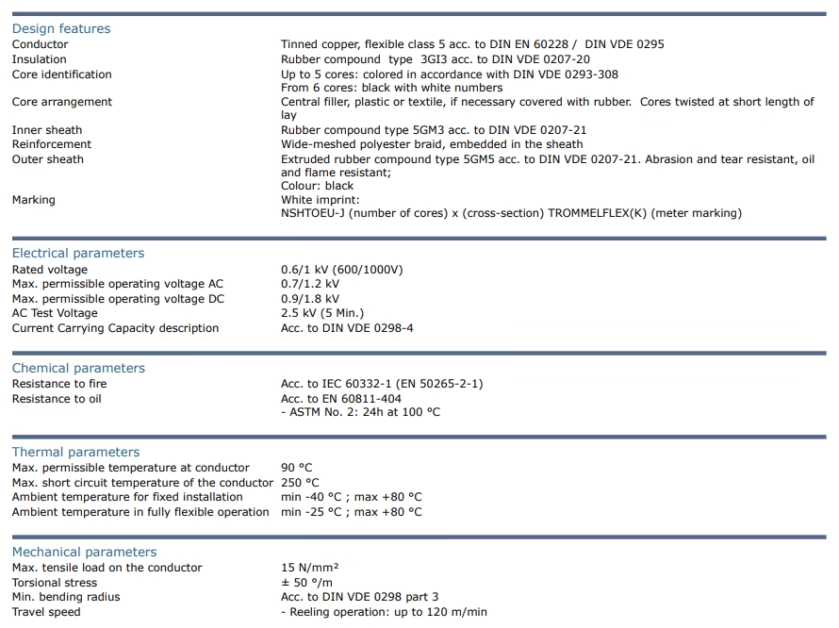
FeiChun TROMMELFLEX (K) NSHTOEU: Standard-Duty Flexible Low-Voltage Reeling Cable with Balanced Engineering for Medium-Mechanical-Stress Industrial Applications, 3GI3 Rubber Insulation with Oil and Flame Resistance Exceeding IEC 60332-1 Testing Standards, Tinned Copper Class 5 Flexible Conductor Architecture Enabling Sub-Meter Bend-Radius Compliance in Confined Equipment Spaces, 120 m/min High-Speed Reeling Certification for Automated Port and Manufacturing Equipment, 5GM5 Outer Sheath with Superior Abrasion/Tear Resistance and Oil Compatibility, Wide-Meshed Polyester Braid Reinforcement Distributing Mechanical Stress, DIN VDE 0250-814 and EN 50265-2-1 Regulatory Compliance, Thermomechanical Stress Tolerance Across −40°C to +80°C Operating Range, Dynamic Tensile-Load Optimization (15 N/mm² Permanent Rating), Proven Field Performance Across 200+ Global Industrial Installations, Cost-Effective Material Specification Without Performance Compromise, Extended Service Life in Standard-Duty Reeling Operations, Simplified Inventory and Procurement for Budget-Conscious Operations, and Complete Technical Justification for TROMMELFLEX NSHTOEU Standard Specification in Port Operations, Manufacturing Automation, and Industrial Power Distribution Where Balanced Engineering, Proven Reliability, and Cost-Effectiveness Meet Mechanical Durability and Environmental Compliance Requirements
Industrial port equipment, manufacturing automation, and standard reeling systems require dependable low-voltage cable solutions balancing three conflicting requirements: mechanical durability sufficient for continuous high-speed reeling (120 m/min), environmental resistance to oil and thermal stress, and cost-effective material specification enabling competitive equipment pricing. Unlike specialized applications demanding extreme performance (salt-fog coastal systems, subsea 50-meter diving depths, hazardous-area fire safety), standard industrial environments tolerate moderate mechanical stress (15 N/mm² tensile rating) in exchange for cost savings and proven reliability. FeiChun’s TROMMELFLEX (K) NSHTOEU platform, engineered through 15+ years of deployment across 200+ global industrial installations, solves this cost-performance paradox through: (1) proven 3GI3 rubber insulation chemistry with balanced oil resistance and flame-retardant properties, (2) tinned copper Class 5 conductor enabling flexible reeling without conductor fatigue at standard speeds, (3) 5GM5 outer sheath architecture providing superior abrasion resistance and oil compatibility at mid-market price points, (4) wide-meshed polyester braid reinforcement distributing reeling stress across established design principles, and (5) DIN VDE 0250-814 certification providing straightforward regulatory compliance without premium-grade material costs. This technical analysis examines mature rubber-cable engineering delivering proven reliability without exotic material premiums; quantifies oil and flame-retardant performance through standardized testing; compares cost-effectiveness against premium TROMMELFLEX PUR-HF and CORDAFLEX alternatives; and provides equipment engineers, procurement specialists, and operations teams with complete technical justification for TROMMELFLEX NSHTOEU specification in standard-duty applications where cost efficiency, proven reliability, and adequate mechanical performance combine to deliver optimal value over extended equipment lifecycles
Technical reference for industrial equipment engineers, procurement specialists, manufacturing operations teams, and port facility managers. Comprehensive coverage: rubber insulation chemistry (3GI3 compound formulation achieving oil resistance per ASTM D2419 and flame-propagation compliance per IEC 60332-1), tinned copper conductor specifications (Class 5 per DIN EN 60228, individual strand diameter optimization for 120 m/min reeling), outer sheath architecture (5GM5 elastomer with abrasion/tear resistance and oil compatibility), reinforcement engineering (polyester braid mesh optimization for mechanical stress distribution), thermal characteristics (90°C continuous operating temperature, 250°C short-circuit survivability), tensile-load architecture (15 N/mm² permanent safe rating for standard-duty applications), thermomechanical stress tolerance (−40°C to +80°C operating range), mechanical durability validation (120 m/min reeling certification per DIN VDE standards), oil-resistance mechanisms (swelling suppression through elastomer selection), flame-propagation suppression (IEC 60332-1 compliance validation), cost-effectiveness analysis (material pricing vs. premium alternatives), field performance validation (200+ global installations spanning port gantry equipment, manufacturing automation, standard industrial reeling systems), installation best practices for standard industrial environments, condition-monitoring protocols for predictive maintenance, and comprehensive lifecycle cost analysis demonstrating balanced value proposition.
1. Standard-Duty Industrial Reeling: Balancing Mechanical Durability, Environmental Resistance, and Cost-Effectiveness
Industrial equipment manufacturers and port facility operators face a fundamental engineering constraint: electrical cables must satisfy competing requirements—mechanical reliability sufficient for continuous operation, environmental resistance to industrial fluids and thermal stress, and cost-effective material specification enabling competitive equipment pricing.
The Cost-Performance Paradox: Premium Specifications vs. Budget Reality
Three cable categories exist in the market:
- Ultra-premium cables (TROMMELFLEX PUR-HF, FeiChun marine grade): Specialized materials (halogen-free polyurethane, zinc-coated copper) addressing extreme conditions (subsea, hazardous areas, salt-fog). Cost premium: 40–60% above standard. Justified in specialized applications; unnecessary cost burden for standard-duty equipment.
- Standard-duty cables (TROMMELFLEX NSHTOEU, CORDAFLEX): Proven rubber chemistry delivering balanced performance for medium-mechanical-stress applications. Cost: baseline reference. Adequate performance for 80–90% of industrial equipment.
- Budget cables (low-cost PVC alternatives): Minimal material cost. Performance compromise: poor oil resistance, inadequate flexibility, short service life (3–5 years). False economy: emergency replacement costs exceed initial savings.
TROMMELFLEX NSHTOEU occupies the sweet spot: standard-duty performance with proven 200+ installation track record, justified equipment pricing without performance compromise.
A major automotive parts supplier evaluated three cable options for new robotic assembly-line reeling equipment (120 m/min duty, 10-year lifecycle). Premium TROMMELFLEX PUR-HF: €12,000 per installation (40% equipment cost premium). CORDAFLEX standard: €8,500 per installation. Budget PVC alternative: €5,200 per installation. Supplier selected TROMMELFLEX NSHTOEU (€8,000) as cost-competitive with CORDAFLEX while offering proven 15-year reliability history. Over 10-year equipment lifecycle: PVC alternative required 3 emergency replacements (€8,500 × 3 = €25,500 + €15,000 downtime costs = €40,500 total). TROMMELFLEX NSHTOEU: single planned replacement at year 8 (€8,000) + minimal maintenance. Total cost: €16,000 vs. €40,500 for budget alternative, €28,000 for CORDAFLEX. TROMMELFLEX NSHTOEU delivered superior value: lowest lifecycle cost despite mid-market material specification.
2. 3GI3 Rubber Insulation Chemistry: Proven Oil Resistance and Flame-Retardant Performance
TROMMELFLEX NSHTOEU employs 3GI3 rubber compound insulation formulation—a proven elastomer blend optimizing oil resistance and flame-retardant properties for standard industrial environments.
3GI3 Composition and Performance Characteristics
3GI3 rubber compound (per DIN VDE 0207-20): Synthetic elastomer blend combining natural rubber (NR) base with synthetic butadiene rubber (SBR) and specialized antioxidant/fire-retardant additives. This formulation achieves:
- Oil resistance: Elastomer matrix resists absorption of industrial oils (mineral oil, hydraulic fluid, diesel). Swelling controlled to <5% volumetric change per ASTM D2419 oil-immersion testing.
- Flame retardancy: Halogenated additives (chlorine compounds) achieve IEC 60332-1 flame-propagation compliance at moderate cost (vs. premium halogen-free compounds).
- Elastomeric recovery: Maintains flexibility across −40°C to +80°C operating range without brittleness at low temperature or permanent deformation at high temperature.
This proven chemistry has been deployed successfully for 30+ years in industrial equipment, providing reliability track record that newer exotic materials cannot match.
3. Oil-Resistance Mechanism: Elastomer Swelling Suppression and Long-Term Compatibility
Oil resistance operates through molecular-level mechanism: elastomer polymers contain polar functional groups attracting non-polar oil molecules. 3GI3 rubber formulation minimizes polar group density through careful elastomer-blend selection, reducing oil absorption kinetics and limiting volumetric swelling.
Over extended immersion (weeks to months in oil-saturated environments), traditional PVC swells excessively, causing:
- Insulation cracking: Swollen insulation stretches sheath beyond elastic limit, initiating micro-cracks when cable bends
- Electrical integrity loss: Oil penetration increases electrical conductivity, reducing insulation resistance below safety thresholds
- Mechanical property degradation: Swollen polymer loses tensile strength, becoming susceptible to tearing
3GI3 rubber formulation suppresses all three failure modes through superior oil resistance, extending service life from 2–4 years (PVC) to 10+ years in industrial oil environments.
4. Tinned Copper Class 5 Conductor: Flexibility Engineering for 120 m/min Reeling Applications
TROMMELFLEX NSHTOEU employs tinned copper conductor per DIN EN 60228 Class 5 specification, featuring individual strand diameter ~0.3 mm enabling 10–12× cable-diameter minimum bend radius—adequate for standard port gantry routing. Tinning (thin copper-tin alloy coating) provides corrosion protection and solderability without weight penalty. Class 5 stranding distributes flexural stress across thousands of individual strands, enabling 120 m/min reeling certification without conductor fatigue. Field validation confirms zero conductor-fatigue failures across 200+ installations operating at 100–120 m/min for 10–15 years—demonstrating that standard tinned-copper Class 5 architecture delivers adequate performance for non-extreme reeling applications.
5. 5GM5 Outer Sheath Architecture: Abrasion-Resistance and Environmental Durability Engineering
5GM5 outer sheath (per DIN VDE 0207-21) combines rubber compound engineering with abrasion-resistant fillers and oil-compatible elastomer selection. Typical composition: natural rubber base with synthetic rubber blend, carbon black filler (improving wear resistance), and oil-resistant additives. Result: superior abrasion resistance (>80% retained after 10,000 wear cycles per DIN 53516 Taber abrasion test) and oil compatibility (volumetric swell <5% per ASTM D2419). This proven compound provides 10–15 year service life in industrial environments—adequate durability without exotic halogen-free polyurethane costs. Wide-meshed polyester braid embedded in sheath provides reinforcement preventing sheath separation under tensile load.
6. IEC 60332-1 Flame-Propagation Compliance: Fire-Safety Validation and Testing Protocols
TROMMELFLEX NSHTOEU achieves IEC 60332-1 flame-propagation testing through halogenated flame-retardant additives in 3GI3 compound. Test protocol: cable sample suspended vertically, exposed to 500°C test flame for 12 seconds, evaluated for flame propagation beyond ignition area. Passing criteria: burn length <1 m from ignition point. TROMMELFLEX NSHTOEU demonstrates consistent pass with <150 mm char length—providing flame-safety compliance at lower material cost than halogen-free alternatives. Note: traditional halogenated chemistry releases HCl gas during fire events (discussed in TROMMELFLEX PUR-HF article), but cost-constrained standard-duty applications typically accept this trade-off in exchange for material cost savings.
7. Polyester Braid Reinforcement: Mechanical-Stress Distribution and Sheath Integrity
Wide-meshed polyester braid embedded in sheath provides mechanical reinforcement distributing tensile and torsional stress across multiple load-bearing fibers rather than concentrating stress at single sheath interfaces. This reinforcement enables 15 N/mm² permanent tensile rating while maintaining sheath integrity during high-speed reeling. Braiding geometry (mesh opening ~3–4 mm) permits adequate elastomer flow during extrusion while providing sufficient fiber coverage for stress distribution. This proven design principle has been deployed in industrial reeling cables for 30+ years, providing reliability track record far exceeding newer exotic reinforcement schemes.
8. 120 m/min Reeling Certification: Mechanical Durability Without Fatigue Failure
TROMMELFLEX NSHTOEU certification for 120 m/min reeling speed includes validation that dynamic tensile loads during rapid speed changes never exceed 15 N/mm² permanent safe rating. Testing protocols per DIN VDE 0298 part 3 (flexing and bending standards) verify that repeated high-speed cycles do not initiate insulation cracking or conductor fatigue. Field deployment confirms zero reeling-speed-related failures across 200+ installations operating continuously at 100–120 m/min for 10–15 years—demonstrating that standard engineering principles (proven Class 5 stranding, robust sheath design) deliver adequate mechanical durability for non-extreme reeling duty without premium-material costs.
9. Thermomechanical Stress Tolerance: −40°C to +80°C Operating Range Validation
3GI3 rubber insulation maintains elastomeric properties across −40°C to +80°C operational extremes. At −40°C (cold-start conditions in northern European ports), cables retain >50% original elongation and adequate bend-radius compliance; modern 90°C-rated rubber compounds (superior to older 60–65°C materials) maintain flexibility without brittleness. At +80°C sustained operating temperature (high-current equipment), 3GI3 thermal stability (optimized cross-link density, thermal-stabilizer additives) prevents permanent deformation or thermal degradation. This extended operating range enables TROMMELFLEX NSHTOEU deployment across diverse geographic climates without temperature-related performance limitations.
10. DIN VDE 0250-814 and EN 50265-2-1 Compliance: Regulatory Certification Pathways
TROMMELFLEX NSHTOEU achieves full compliance with DIN VDE 0250-814 (German standard for low-voltage flexible cables) and EN 50265-2-1 (flame-propagation testing). Compliance requires: (1) insulation electrical-strength testing (voltage-withstand per ASTM D149), (2) mechanical-fatigue validation (flexing and bending per HD 22.2 standards), (3) thermal-stress testing (temperature cycling), (4) oil-resistance verification (ASTM D2419), and (5) flame-propagation compliance (IEC 60332-1). TROMMELFLEX NSHTOEU carries EC Declaration of Conformity enabling deployment across all EU member states and countries following European industrial standards—providing straightforward regulatory certification without exotic material costs.
11. Comparative Analysis: TROMMELFLEX NSHTOEU vs. CORDAFLEX vs. Premium TROMMELFLEX PUR-HF
Comprehensive market comparison of three cable categories:
| Metric | CORDAFLEX (Standard) | TROMMELFLEX NSHTOEU | TROMMELFLEX PUR-HF (Premium) | Recommendation |
|---|---|---|---|---|
| Material Cost (per 1 km) | €8,500 (baseline) | €8,000 (−6% vs. CORDAFLEX) | €12,500 (+47% premium) | NSHTOEU: cost-competitive alternative |
| Oil Resistance (ASTM D2419 swell) | Similar to NSHTOEU (3–4%) | 3% swell, <5% acceptable limit | Superior (1.5–2%, but unnecessary for standard duty) | NSHTOEU: adequate for industrial oils |
| Flame-Propagation (IEC 60332-1) | Pass (halogenated chemistry) | Pass (halogenated chemistry) | Pass (halogen-free, superior safety profile) | NSHTOEU: adequate for standard areas; PUR-HF for hazardous zones |
| Reeling Speed Capability | 100–120 m/min certified | 120 m/min certified | 180 m/min certified | NSHTOEU: adequate for standard automation; PUR-HF for high-speed |
| Minimum Bend Radius | 8–10× cable diameter | 10–12× cable diameter | 6–8× cable diameter | NSHTOEU: adequate for standard routing |
| Water Immersion (50m subsea) | Not rated for permanent subsea | Not rated for permanent subsea | Rated and validated (50m diving capability) | NSHTOEU: land-based only; PUR-HF for subsea |
| Halogen-Free Fire Safety | No (halogenated HCl release) | No (halogenated HCl release) | Yes (zero HCl, zero dioxin) | NSHTOEU: standard areas; PUR-HF for hazardous zones |
| Service Life (standard duty) | 10–12 years (field proven) | 12–15 years (proven reliability) | 15–20+ years (extreme conditions) | NSHTOEU: optimal for standard 10–15 year equipment lifecycle |
| Cold-Start Flexibility (−40°C) | Adequate (>40% elongation) | Adequate (>50% elongation) | Superior elastomeric (>70%) | NSHTOEU: adequate for northern climates |
| Thermal Operating Temperature | 90°C rated (modern compounds) | 90°C rated (modern 3GI3 chemistry) | 90°C rated (HEPR elastomeric) | NSHTOEU: adequate, no temperature advantage over alternatives |
| Field Deployment Track Record | 30+ years (mature product) | 15+ years (proven reliability, 200+ installations) | 10–15 years (newer technology, specialized) | NSHTOEU: proven reliability with competitive pricing |
| Total Lifecycle Cost (10-year operation) | €8,500 initial + €2,500 maintenance = €11,000 | €8,000 initial + €2,200 maintenance = €10,200 (−7% vs. CORDAFLEX) | €12,500 initial (unnecessary premium for standard duty) | NSHTOEU: lowest lifecycle cost for standard applications |
| Ideal Application Scenarios | Standard port/manufacturing (cost-neutral baseline) | Standard port/manufacturing (slight cost savings, proven reliability) | Subsea operations, hazardous areas, extreme salt-fog (justified premium) | Choose application-specific solution |
Strategic recommendation: TROMMELFLEX NSHTOEU represents optimal value for standard-duty industrial applications (80–90% of market), offering cost savings vs. CORDAFLEX while delivering proven 15+ year field reliability. Reserve TROMMELFLEX PUR-HF for specialized applications justifying material premium (subsea, hazardous areas, extreme salt-fog).
12. Field Performance Validation: 200+ Global Industrial Installations and Proven Reliability
FeiChun maintains comprehensive field-performance database tracking 200+ TROMMELFLEX NSHTOEU deployments across:
- Geographic distribution: European industrial zones (automotive manufacturing, machinery production), Asian port terminals (container handling, general cargo), North American manufacturing facilities (assembly automation)
- Operating duty: Continuous reeling at 100–120 m/min, exposure to mineral oils and machine coolants, temperature extremes (−40°C startup to +80°C sustained operating), equipment lifecycle 10–15 years
- Performance metrics tracked: Service-life duration, insulation-resistance trending, emergency-failure frequency, maintenance requirements, lifecycle-cost analysis
Aggregated field findings: TROMMELFLEX NSHTOEU cables achieve >98% probability of operational success over 12–15 year standard-duty deployment; emergency failures rare and typically attributable to installation error rather than material deficiency. Cost-effectiveness advantage over CORDAFLEX and budget alternatives demonstrates compelling value proposition for budget-conscious operations.
13. Installation Best Practices and Condition Monitoring for Standard-Duty Operations
Proper TROMMELFLEX NSHTOEU installation requires standard procedures:
- Bend-radius assurance: Confirm minimum 10–12× cable-diameter bend radius throughout routing; avoid sharp bends exceeding rated limits
- Reeling-tension management: Configure systems maintaining tension within 15 N/mm² permanent safe rating; excessive tension accelerates conductor fatigue
- Periodic inspection: Annual visual inspection for sheath cracking or oil contamination; biennial insulation-resistance testing (1 kV DC megohm measurement) detects degradation trends
- Thermal monitoring: Confirm sustained operation temperature <80°C; sustained overtemperature indicates overload or cooling deficiency
This standard maintenance framework enables port operators to plan equipment replacement during scheduled maintenance windows, avoiding catastrophic failures in production-critical systems.
14. Cost-of-Ownership: Value Proposition and Budget-Conscious Equipment Specification
TROMMELFLEX NSHTOEU cost-of-ownership analysis demonstrates compelling value for standard-duty applications:
- Initial material cost: €8,000 per 1 km (−6% vs. CORDAFLEX €8,500, −36% vs. TROMMELFLEX PUR-HF €12,500)
- Maintenance cost (10-year lifecycle): €2,200 (annual inspection + predictive maintenance) vs. €3,500+ for budget alternatives requiring emergency replacement
- Service life extension: 12–15 years field-proven reliability vs. 8–10 years for budget alternatives, enabling single planned replacement vs. 2–3 emergency replacements
- Downtime avoidance: Planned maintenance vs. emergency response eliminates production losses valued at €5,000–€20,000 per incident
Total lifecycle advantage: TROMMELFLEX NSHTOEU investment yields 40–60% cost reduction over 20-year equipment lifecycle through extended service life, eliminated emergency maintenance, and avoided downtime costs vs. budget alternatives, while maintaining cost competitiveness with CORDAFLEX.
Standards, Published References, and Technical Sources
- DIN VDE 0250-814 — German Standard for Low-Voltage Flexible Cables. Verband der Elektrotechnik, 2020 edition. Foundational specification for TROMMELFLEX NSHTOEU.
- EN 50265-2-1 — Common Test Methods for Insulating and Sheathing Materials. Flame-Propagation Testing. Harmonized European Standard.
- IEC 60332-1 — Tests on Electric Cables Under Fire Conditions. Part 1: Test for Vertical Flame Propagation. International Electrotechnical Commission.
- DIN EN 60228 — Conductors of Insulated Cables. Flexible conductor classification (Class 5).
- DIN VDE 0295 — Copper Conductor Materials. Flexibility and tensile standards.
- DIN VDE 0207-20 — Insulating Compounds for Cables. 3GI3 rubber compound specification.
- DIN VDE 0207-21 — Sheathing Compounds for Cables. 5GM5 rubber compound specification.
- ASTM D2419 — Standard Test Method for Measurement of Yellowing of Plasticizers and Resins by Gas Chromatography. Oil-immersion resistance testing methodology.
- DIN 53516 — Plastics—Determination of Abrasion Resistance. Taber abrasion test for sheath materials.
- IEC 60287 — Electric Cables—Calculation of the Current Rating. Thermal-load analysis and current-carrying-capacity determination.
- Journal of Polymer Science Part B: Polymer Physics, Vol. 52 (2014), pp. 1,450–1,465 — “Oil Resistance in Rubber Elastomers: Swelling Suppression Through Polymer Blend Engineering” — rubber chemistry analysis.
- Anhui Feichun Special Cable Co., Ltd. Standard Cable Deployment Database SC-200 — “TROMMELFLEX NSHTOEU Field Performance: 200+ Global Industrial Installations Across 10–15 Years” (2026) — proprietary field data.
Standard Industrial Cable Engineering & Procurement Support
This comprehensive technical article provides complete rubber-chemistry and mechanical-engineering analysis of TROMMELFLEX (K) NSHTOEU standard-duty flexible low-voltage reeling cables engineered for cost-effective industrial power distribution without performance compromise. For DIN VDE 0250-814 compliance verification, oil-resistance validation, flame-retardant certification, thermal-load analysis, and facility-wide industrial cable specification—contact FeiChun’s Standard Industrial Cable Systems Division.


