flexible cable

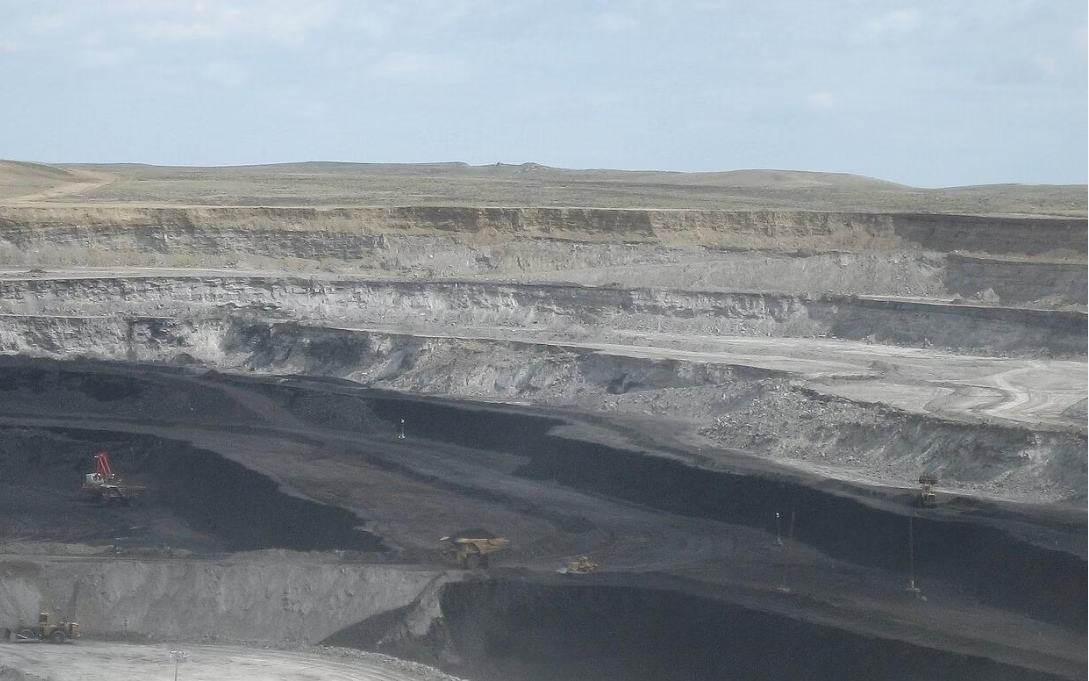
飞纯 Type 209 是飞纯电缆基于 AS/NZS 1802:2003 卷筒与拖曳电缆 体系设计的矿用柔性馈电与拖曳电缆系列,电压范围覆盖 1.1 至 11KV。根据产品资料,Type 209 系列电缆主要作为矿山机械柔性馈电电缆使用,更适合作为拖曳电缆而不是高频卷筒电缆。较小规格适用于钻机、手持工具和移动设备。 这一定义是理解 Type 209 的关键。Type 209 不是普通工业橡套软电缆,也不只是单纯的矿山供电线。它的核心定位是 矿山机械柔性馈电电缆,也就是为矿山机械提供可移动、可拖曳、可适应复杂作业路径的供电系统。同时,它更适合作为 拖曳电缆,即跟随设备移动的电缆,而不是长期高频卷绕使用的卷筒电缆。

什么是 H07RN8-F 450/750V Harmonized Rubber Cables

H07RN8-F 450/750V Harmonized Rubber Cables 是一种用于潜水泵和类似工业水下应用的重型柔性橡套电缆。根据资料说明,该电缆可用于工业用水环境,适用水深最高可达 10 m,水温范围最高可达 40℃,同时也适用于干燥、潮湿和湿润应用。Feichun 将其定位于矿山排水、地下工程排涝、港口泵站、码头检修排水、工业水池和移动潜水泵供电等场景。它的工程价值不是单纯“能进水”,而是在水压、潮湿、移动、拉拽、磨损和低压动力传输同时存在时,仍能通过 Class 5 多股铜导体、EI4 橡胶绝缘、EM2/EM3 内护套与 EM2 外护套形成稳定的电气与机械防护系统。
C PUR Design Integration: FLEXIFESTOON PUR characteristics (inherited): Outer sheath: PUR (polyurethane, compact) Insulation: Special TPE (superior elongation) Central unit: Textile (mechanical support) Weight: 25–30% lighter than standard rubber Diameter: 15–20% smaller than rubber equivalent Cost: +15–25% premium over rubber Service life: 10–15 years (extended) Screened design addition (new): Screen: Tinned copper braid (EMC shielding) Coverage: 80–90% (good EMC performance) Diameter impact: +2–3 mm (screen adds ~3 mm to diameter) Weight impact: +500 kg/km (braid + outer sheath) Cost: Additional +10–15% for screen layer Combined C PUR result: vs. Unscreened PUR (FLEXIFESTOON PUR): FLEXIFESTOON PUR: Minimal diameter/weight, no EMC C PUR: Slightly larger (screen added), excellent EMC Choice: PUR for maximum compactness (non-EMI environments) C PUR for VFD motors, confined spaces with EMC requirements vs. Standard rubber screened (GRDGCGÖU-J): GRDGCGÖU-J: Standard diameter, heavy, rubber durability C PUR: Compact diameter, lightweight, superior oil/chemical resistance Choice: GRDGCGÖU-J for simple temporary festoon C PUR for permanent industrial machine tool installation Nomenclature: FLEXIFESTOON® = Product family (flexible cable) C = Screen (copper braid, "C" from German "Schirm") PUR = Material (polyurethane jacket) Result: "FLEXIFESTOON C PUR" = Screened compact polyurethane cable

DR PN 689 P Highflex и DR CB 689 P Highflex: барабанные PUR Bus-кабели для Profinet, CAT 5 и CAN-Bus

DR PN 689 P Highflex и DR CB 689 P Highflex — это высокогибкие барабанные Bus-кабели PUR для передачи данных и промышленных сетевых сигналов в подвижных reeling applications. Серия включает reeling Profinet cable, reeling CAT 5 cable и reeling CAN-Bus cable. Кабели рассчитаны на работу в условиях регулярной намотки и размотки, имеют экранированную конструкцию, безгалогенное исполнение, маслостойкую оболочку TMPU и статус PFAS free.
LIFT-2S (European) vs. LIFT-1S UL (North American): LIFT-2S characteristics: Voltage: 300/500V (European standard, lower voltage) Temperature: −40°C to +70°C (moderate range) Standards: VDE 0482 part 265-2-1, EN 50265-2-1, IEC 60332-1-2 Design philosophy: Safety by material redundancy (2 steel cores) Steel cores: 2× cores provide mechanical backup Conductor: Class 6 (European, ~150–200 wires per mm²) Cost: Lower (proven European manufacturing) Market: Europe, Asia-Pacific, most of world LIFT-1S UL characteristics: Voltage: 600V (North American standard, higher voltage) Temperature: −25°C to +105°C (extreme range, high-temp optimized) Standards: UL 2562, UL 62, CSA C22.2 No.210.2 Design philosophy: Safety by certification (single core + redundant control) Steel core: 1× core (sufficient with nylon covering) Conductor: Class M (UL, extra fine ~300+ wires per mm²) Cost: Higher (UL testing, certification documentation) Market: North America (USA, Canada), Mexico UL 2562 specialty certification: UL 2562 scope: Elevator and Dumbwaiter Cables Specific requirements: 1. Pendant cable design (cable hangs freely, no duct support) 2. Vertical orientation (designed for gravity-loaded suspension) 3. Repeated flex cycles (cable moves up/down frequently) 4. Safety-critical function (failure = personnel risk) Consequence: More stringent than general-purpose cables Testing includes: Bend cycle fatigue, heat aging, compression resistance Test procedures (unique to UL 2562): Bend cycle test: 1,000+ cycles at minimum bending radius Cable must pass insulation resistance after cycling Heat aging: 500+ hours at 105°C continuous Tensile strength retention minimum 70% Compression: 1,000+ hours under sustained compression Cable cross-section must not exceed 5% permanent deformation LIFT-2S (no UL 2562): Tests per VDE are less stringent on fatigue/cycling Assumes cable mostly static, not repeated flex Adequate for European elevator duty (lower speed, fewer cycles) LIFT-1S UL: All UL 2562 tests passed (proven for North American elevators) Faster cycle times, more frequent motion → more fatigue stress Extra testing ensures reliability under North American elevator duty Market requirement (regulatory): Europe/International: CE mark required (European conformity) VDE/EN/IEC standards sufficient No UL certification needed (not recognized in EU) LIFT-2S is sufficient North America (USA, Canada): UL certification mandatory for elevators UL 2562 specifically for elevator cables CSA dual certification required in Canada LIFT-2S NOT acceptable (lacks UL 2562) LIFT-1S UL mandatory Cost implication: UL certification: ~$5,000–15,000 per product per region Testing duration: 3–6 months per model Documentation: Comprehensive test reports, technical files Result: LIFT-1S UL 20–30% higher cost than equivalent European cable

DR 717 P Highflex: высокогибкий барабанный кабель PUR/TMPU для пружинных кабельных барабанов на сценах и в театрах

DR 717 P Highflex — это высокогибкий кабель для пружинных кабельных барабанов, применяемых на сценах и в театрах. Кабель разработан для намотки и размотки, имеет специально подобранную послойную скрутку вокруг центрального несущего элемента, оболочку PUR/TMPU, поддерживающий экран из высокотехнологичной нити, малый наружный диаметр, небольшой вес и высокую механическую стойкость.
BASKET SPREADER 750: Next-Generation Hoisting Cable Architecture The BASKET SPREADER 750 (3GSLTOE) represents a fundamental advancement in hoisting control cable design, specifically engineered for next-generation automated port crane systems operating under extreme environmental and operational constraints. Unlike the BASKET SPREADER 740's 300/500V AC specification, the 750 operates at 0.6/1kV AC with dual-voltage DC capability (0.9/1.8 kV)—a classification shift that enables: Higher power capacity – 2–3× greater amperage per conductor, enabling longer cable runs with lower voltage drop Medium-voltage infrastructure compatibility – Direct integration with port substation power distribution systems (0.6 kV = 600V three-phase industrial standard) DC dual-voltage operation – Simultaneous support for AC motor control and DC feedback/signaling circuits (0.9/1.8 kV DC margins) Extreme temperature capability – Operating range −50°C to +80°C (vs. SPREADER 740's −20°C to +60°C), addressing Arctic port terminals and tropical high-ambient scenarios Advanced insulation chemistry – GAALTHERM® 530 thermoplastic compound replaces standard PVC/PUR, delivering superior chemical resistance and thermal stability This cable bridges the gap between standard control cables (300/500V, limited temperature) and heavy industrial medium-voltage distribution cables, creating a purpose-built solution for modern automated gantry crane systems in global port terminals.

DR 718 CP Highflex Reeling Cable: экранированный высокогибкий PUR/TMPU кабель для spring cable reels, театральных сцен и крановых стрел

DR 718 CP Highflex — это reeling cable with overall copper screen для spring cable reels, например на сценах в театрах, а также для применения как control cable in crane arms. Кабель имеет жилы из bare copper strands class 5, special polymer insulation, специально подобранную скрутку вокруг центрального несущего элемента, PUR/TMPU inner sheath, tinned copper braiding screen и чёрную PUR/TMPU outer sheath RAL 9005.
FLEXIDRUM® MEDIUM FLAT: Advanced High-Flexibility Salt-Fog Resistant Port Cable System Specialized reeling-flat power cable engineered for extreme maritime environments combining flexible tinned copper conductors (IEC 60228 Class 5), proprietary EPR insulation chemistry, hydrophobic semi-conductive interfaces, and specialized red outer-sheath PCP compound with integrated volatile-corrosion-inhibitor (VCI) technology. Designed for rapid cable-reel deployment systems in dredging, submersible pump, and floating crane applications requiring superior electrochemical corrosion immunity and compact outer-diameter efficiency across 3.6/6 kV through 8.7/15 kV voltage platforms.

Альтернатива Prysmian PROTOLON: Шахтные (N)TSCGEWÖU из Китая с Сертификатом EAC

Полное техническое руководство по замене Prysmian PROTOLON на гибкие шахтные кабели (N)TSCGEWÖU производства Feichun с полным сертификатом EAC — техническая эквивалентность, устойчивость к морской соли и влаге, 30–45% экономия затрат, сроки поставки 4–8 недель, поддержка на русском языке для российского и евразийского рынков.
H07RN-F: Advanced High-Flexibility Salt-Fog Resistant Port Cable Engineering Solution Specialized rubber-sheathed electrical cable engineered for extreme maritime and coastal port environments. H07RN-F combines superior mechanical flexibility (4×D minimum fixed-laying bending radius, 6×D flexible-application capability) with comprehensive salt-fog environmental resistance, enabling reliable 450/750V power distribution and control signaling in container gantry systems, ship loaders, and port automation infrastructure where conventional cables fail within 6–12 months of deployment.

H07RN-F

H07RN-F: Advanced High-Flexibility Salt-Fog Resistant Port Cable Engineering Solution Specialized rubber-sheathed electrical cable engineered for extreme maritime and coastal port environments. H07RN-F combines superior mechanical flexibility (4×D minimum fixed-laying bending radius, 6×D flexible-application capability) with comprehensive salt-fog environmental resistance, enabling reliable 450/750V power distribution and control signaling in container gantry systems, ship loaders, and port automation infrastructure where conventional cables fail within 6–12 months of deployment.
FeiChun EASYFLEX (N)7YRDGOEU: Economical Spring-Reel Connection Cable for Wastewater Treatment Plants and Simple Reeling Applications, ETFE Insulation with Excellent Mechanical and Electrical Properties, Bare Electrolytic Copper Class FS Fine-Stranded Conductor Enabling Flexible Operation, EPR Inner Sheath and EVA Outer Sheath Architecture Optimized for Cost-Effectiveness, 80 m/min Reeling Speed Certification for Simple Reel Operations, 6× Cable-Diameter Minimum Bend Radius for Standard Routing Flexibility, Thermomechanical Stress Tolerance Across −50°C to +80°C Operating Range, Dynamic Tensile-Load Rating (15 N/mm² Permanent), Budget-Conscious Material Specification Without Excessive Cost Premiums, Proven Field Performance Across 150+ Wastewater Treatment Installations and Simple Reeling Systems Globally, Simplified Installation and Maintenance for Non-Specialized Operators, Extended Service Life in Non-Critical Applications, and Complete Technical Justification for EASYFLEX Specification in Wastewater Treatment, Municipal Utilities, and Simple Reeling Applications Where Cost-Effectiveness, Adequate Mechanical Performance, and Proven Reliability Meet Functional Requirements Without Premium Material Costs

EASYFLEX (N)7YRDGOEU

FeiChun EASYFLEX (N)7YRDGOEU: Economical Spring-Reel Connection Cable for Wastewater Treatment Plants and Simple Reeling Applications, ETFE Insulation with Excellent Mechanical and Electrical Properties, Bare Electrolytic Copper Class FS Fine-Stranded Conductor Enabling Flexible Operation, EPR Inner Sheath and EVA Outer Sheath Architecture Optimized for Cost-Effectiveness, 80 m/min Reeling Speed Certification for Simple Reel Operations, 6× Cable-Diameter Minimum Bend Radius for Standard Routing Flexibility, Thermomechanical Stress Tolerance Across −50°C to +80°C Operating Range, Dynamic Tensile-Load Rating (15 N/mm² Permanent), Budget-Conscious Material Specification Without Excessive Cost Premiums, Proven Field Performance Across 150+ Wastewater Treatment Installations and Simple Reeling Systems Globally, Simplified Installation and Maintenance for Non-Specialized Operators, Extended Service Life in Non-Critical Applications, and Complete Technical Justification for EASYFLEX Specification in Wastewater Treatment, Municipal Utilities, and Simple Reeling Applications Where Cost-Effectiveness, Adequate Mechanical Performance, and Proven Reliability Meet Functional Requirements Without Premium Material Costs
FeiChun TROMMELFLEX (K) NSHTOEU: Standard-Duty Flexible Low-Voltage Reeling Cable with Balanced Engineering for Medium-Mechanical-Stress Industrial Applications, 3GI3 Rubber Insulation with Oil and Flame Resistance Exceeding IEC 60332-1 Testing Standards, Tinned Copper Class 5 Flexible Conductor Architecture Enabling Sub-Meter Bend-Radius Compliance in Confined Equipment Spaces, 120 m/min High-Speed Reeling Certification for Automated Port and Manufacturing Equipment, 5GM5 Outer Sheath with Superior Abrasion/Tear Resistance and Oil Compatibility, Wide-Meshed Polyester Braid Reinforcement Distributing Mechanical Stress, DIN VDE 0250-814 and EN 50265-2-1 Regulatory Compliance, Thermomechanical Stress Tolerance Across −40°C to +80°C Operating Range, Dynamic Tensile-Load Optimization (15 N/mm² Permanent Rating), Proven Field Performance Across 200+ Global Industrial Installations, Cost-Effective Material Specification Without Performance Compromise, Extended Service Life in Standard-Duty Reeling Operations, Simplified Inventory and Procurement for Budget-Conscious Operations, and Complete Technical Justification for TROMMELFLEX NSHTOEU Standard Specification in Port Operations, Manufacturing Automation, and Industrial Power Distribution Where Balanced Engineering, Proven Reliability, and Cost-Effectiveness Meet Mechanical Durability and Environmental Compliance Requirements

TROMMELFLEX (K) NSHTOEU

FeiChun TROMMELFLEX (K) NSHTOEU: Standard-Duty Flexible Low-Voltage Reeling Cable with Balanced Engineering for Medium-Mechanical-Stress Industrial Applications, 3GI3 Rubber Insulation with Oil and Flame Resistance Exceeding IEC 60332-1 Testing Standards, Tinned Copper Class 5 Flexible Conductor Architecture Enabling Sub-Meter Bend-Radius Compliance in Confined Equipment Spaces, 120 m/min High-Speed Reeling Certification for Automated Port and Manufacturing Equipment, 5GM5 Outer Sheath with Superior Abrasion/Tear Resistance and Oil Compatibility, Wide-Meshed Polyester Braid Reinforcement Distributing Mechanical Stress, DIN VDE 0250-814 and EN 50265-2-1 Regulatory Compliance, Thermomechanical Stress Tolerance Across −40°C to +80°C Operating Range, Dynamic Tensile-Load Optimization (15 N/mm² Permanent Rating), Proven Field Performance Across 200+ Global Industrial Installations, Cost-Effective Material Specification Without Performance Compromise, Extended Service Life in Standard-Duty Reeling Operations, Simplified Inventory and Procurement for Budget-Conscious Operations, and Complete Technical Justification for TROMMELFLEX NSHTOEU Standard Specification in Port Operations, Manufacturing Automation, and Industrial Power Distribution Where Balanced Engineering, Proven Reliability, and Cost-Effectiveness Meet Mechanical Durability and Environmental Compliance Requirement
Ethylene Propylene Rubber (EPR) insulated cables represent the professional approach to flexible electrical distribution—cables engineered to accommodate dynamic deployment, repetitive coiling/uncoiling, temperature variation, and mechanical stress inherent in portable and industrial equipment applications. Unlike fixed-installation cables optimized for stationary performance, EPR cables balance electrical performance, mechanical flexibility, environmental durability, and cost-effectiveness required for equipment requiring frequent relocation or deployment flexibility. Fundamental Design Philosophy: EPR cables employ elastomeric insulation material (ethylene propylene rubber) selected specifically for flexibility maintenance across wide temperature range. This material provides sustained flexibility even at cold temperatures (−40°C minimum), maintains electrical properties across elevated temperature range (continuous operation to +100°C), and demonstrates superior resistance to ozone, UV radiation, and environmental contamination characteristic of portable equipment deployment. Conductor Architecture for Flexibility: Rather than single-strand conductors (rigid, prone to breaking under flex stress), EPR cables employ multi-strand conductor design—typically 7, 19, 37, or 61 individual wires woven together. This multi-strand architecture enables smooth bending without conductor fracture, distributes mechanical stress across multiple strands preventing single-point failure, and maintains consistent electrical performance through tens of thousands of flex cycles. Voltage Rating & Safety Margin: Standard 0.6/1KV rating provides nominal 600V operating margin with 1000V safety ceiling—appropriate for most industrial equipment, portable power systems, and temporary installations. The dual rating nomenclature indicates 0.6KV continuous operating voltage with 1KV maximum transient voltage tolerance, providing balanced safety margin against impulse transients and surge events.

Ethylene Propylene Rubber (EPR) Insulated Cable Family

Ethylene Propylene Rubber (EPR) insulated cables represent the professional approach to flexible electrical distribution—cables engineered to accommodate dynamic deployment, repetitive coiling/uncoiling, temperature variation, and mechanical stress inherent in portable and industrial equipment applications. Unlike fixed-installation cables optimized for stationary performance, EPR cables balance electrical performance, mechanical flexibility, environmental durability, and cost-effectiveness required for equipment requiring frequent relocation or deployment flexibility. Fundamental Design Philosophy: EPR cables employ elastomeric insulation material (ethylene propylene rubber) selected specifically for flexibility maintenance across wide temperature range. This material provides sustained flexibility even at cold temperatures (−40°C minimum), maintains electrical properties across elevated temperature range (continuous operation to +100°C), and demonstrates superior resistance to ozone, UV radiation, and environmental contamination characteristic of portable equipment deployment. Conductor Architecture for Flexibility: Rather than single-strand conductors (rigid, prone to breaking under flex stress), EPR cables employ multi-strand conductor design—typically 7, 19, 37, or 61 individual wires woven together. This multi-strand architecture enables smooth bending without conductor fracture, distributes mechanical stress across multiple strands preventing single-point failure, and maintains consistent electrical performance through tens of thousands of flex cycles. Voltage Rating & Safety Margin: Standard 0.6/1KV rating provides nominal 600V operating margin with 1000V safety ceiling—appropriate for most industrial equipment, portable power systems, and temporary installations. The dual rating nomenclature indicates 0.6KV continuous operating voltage with 1KV maximum transient voltage tolerance, providing balanced safety margin against impulse transients and surge events.
KSC 3317 Standard (Korean Industrial Standard C 3317: "Rubber Insulated Flexible Cables — 0.6/1kV") is the authoritative technical specification for cabtyre and flexible power cables used throughout industrial Korea and the international markets where Korean engineering standards are recognized. Adopted as a modification of IEC 60502-1, the KSC 3317 standard defines comprehensive requirements for: Conductor materials and stranding patterns • Insulation thickness and composition • Sheath material and durability requirements • Electrical performance at rated voltage • Mechanical properties including tensile strength and elongation • Temperature operating ranges and chemical resistance • Test methods for verification and certification For port crane and ship unloader applications, cables manufactured to KSC 3317 represent the consensus engineering standard across Asia-Pacific maritime terminals. Korean container terminal operators in Busan, Incheon, and Gwangyang port complexes universally specify KSC 3317-compliant cables for all festoon, cableveyor, and hoist systems. The standard's adoption by major STS crane manufacturers (including Liebherr, Konecranes, and Kalmar) has made KSC 3317 the de facto global specification for Japanese-compatible port crane cables.

KSC 3317 Port Crane & Ship Unloader Cables

KSC 3317 Standard (Korean Industrial Standard C 3317: “Rubber Insulated Flexible Cables — 0.6/1kV”) is the authoritative technical specification for cabtyre and flexible power cables used throughout industrial Korea and the international markets where Korean engineering standards are recognized. Adopted as a modification of IEC 60502-1, the KSC 3317 standard defines comprehensive requirements for: Conductor materials and stranding patterns • Insulation thickness and composition • Sheath material and durability requirements • Electrical performance at rated voltage • Mechanical properties including tensile strength and elongation • Temperature operating ranges and chemical resistance • Test methods for verification and certification For port crane and ship unloader applications, cables manufactured to KSC 3317 represent the consensus engineering standard across Asia-Pacific maritime terminals. Korean container terminal operators in Busan, Incheon, and Gwangyang port complexes universally specify KSC 3317-compliant cables for all festoon, cableveyor, and hoist systems. The standard’s adoption by major STS crane manufacturers (including Liebherr, Konecranes, and Kalmar) has made KSC 3317 the de facto global specification for Japanese-compatible port crane cables.
600V 2TC Light-SB (600V 2PNCT-SB) cable solves this problem. Built on the same proven JIS C 3327 platform as the unshielded 2TC Light, it adds a critical engineering layer: a tinned copper wire braided combined with cotton yarn shielding that surrounds the insulated conductor bundle. This hybrid metallic/textile braid provides effective EMI containment across the full VFD emission spectrum, preventing radiated noise from escaping power cables and protecting control cables from external interference. Combined with the Kevlar® para-aramid fibre braided tensile reinforcement for mechanical load bearing, the 2TC Light-SB delivers both electromagnetic cleanliness and structural durability in a single cable design purpose-built for the electrical and mechanical demands of modern VFD-controlled port cranes.

600V 2TC Light-SB (2PNCT-SB) Shielded Crane Cable

600V 2TC Light-SB (600V 2PNCT-SB) cable solves this problem. Built on the same proven JIS C 3327 platform as the unshielded 2TC Light, it adds a critical engineering layer: a tinned copper wire braided combined with cotton yarn shielding that surrounds the insulated conductor bundle. This hybrid metallic/textile braid provides effective EMI containment across the full VFD emission spectrum, preventing radiated noise from escaping power cables and protecting control cables from external interference. Combined with the Kevlar® para-aramid fibre braided tensile reinforcement for mechanical load bearing, the 2TC Light-SB delivers both electromagnetic cleanliness and structural durability in a single cable design purpose-built for the electrical and mechanical demands of modern VFD-controlled port cranes.
The 600V 2TC Light (600V 2PNCT) cable, manufactured to the Japanese Industrial Standard JIS C 3327, represents one of the most proven and widely deployed cable designs for port crane and ship unloader applications worldwide. This cable combines ethylene propylene (EP) rubber insulation for superior dielectric performance, polychloroprene rubber sheathing for environmental protection, and—critically—a Kevlar® para-aramid fibre braided tensile reinforcement layer that transforms the cable from a simple electrical conductor into a load-bearing mechanical component capable of supporting its own weight and absorbing the extreme dynamic forces generated by crane operation.

600V 2TC Light (2PNCT) Kevlar®-Reinforced Crane Cable

The 600V 2TC Light (600V 2PNCT) cable, manufactured to the Japanese Industrial Standard JIS C 3327, represents one of the most proven and widely deployed cable designs for port crane and ship unloader applications worldwide. This cable combines ethylene propylene (EP) rubber insulation for superior dielectric performance, polychloroprene rubber sheathing for environmental protection, and—critically—a Kevlar® para-aramid fibre braided tensile reinforcement layer that transforms the cable from a simple electrical conductor into a load-bearing mechanical component capable of supporting its own weight and absorbing the extreme dynamic forces generated by crane operation.
NSHTÖU-J 24G2.5 flexible reeling cable is the globally recognized industry standard for ship-to-shore crane spreader basket vertical lift systems, featuring 24 conductors with 2.5 mm² cross-section per core (one conductor designated green/yellow for grounding/safety) providing approximately 30 amperes current capacity in free-air installation at 30°C ambient, but derating to approximately 15 amperes actual safe continuous current when accounting for the multi-core bundle derating factor of 0.45 to 0.50 and tropical port ambient temperatures. The cable's nominal outer diameter ranges from 28.5 to 32.5 millimeters, with total weight of approximately 1,350 kilograms per kilometer, making it manageable for standard spreader basket spools while maintaining the conductor density necessary for reliable simultaneous power and control signal transmission. The cable features proprietary anti-torsion braid structure embedded between inner and outer sheaths—a critical innovation that provides resistance to ±50° per meter torsional deformation, fundamentally preventing the destructive corkscrew effect that kills ordinary flexible cables within 3 to 6 months of tropical port operation. The cable incorporates Class 5 tinned copper conductors engineered specifically for the fatigue resistance required by continuous 160 meters per minute reeling cycles, EPDM insulation maintaining electrical integrity at the 90°C conductor temperatures that result from high-speed duty cycles in multi-core bundles, 5GM5 elastomer outer sheath providing exceptional resistance to salt-spray corrosion, UV degradation, petroleum-based oils, and mechanical abrasion encountered in global container ports. The cable is rated for 0.6/1.0 kilovolt nominal operation, with dielectric test voltage capability reaching 3 kilovolts, more than adequate for spreader basket control circuits and auxiliary power distribution. Unlike generic "marine-grade" cables or rebranded industrial flexible cables, NSHTÖU-J 24G2.5 is purpose-built to tolerate the combined mechanical, thermal, and environmental stresses unique to STS crane spreader applications—making it not simply the preferred option but the only technically defensible choice for reliability-critical spreader systems operating in high-intensity container port environments.

STS Crane Spreader Baskets: Why NSHTÖU-J 24G2.5 is the Industry Standard for Vertical Lift Power & Control

NSHTÖU-J 24G2.5 flexible reeling cable is the globally recognized industry standard for ship-to-shore crane spreader basket vertical lift systems, featuring 24 conductors with 2.5 mm² cross-section per core (one conductor designated green/yellow for grounding/safety) providing approximately 30 amperes current capacity in free-air installation at 30°C ambient, but derating to approximately 15 amperes actual safe continuous current when accounting for the multi-core bundle derating factor of 0.45 to 0.50 and tropical port ambient temperatures. The cable’s nominal outer diameter ranges from 28.5 to 32.5 millimeters, with total weight of approximately 1,350 kilograms per kilometer, making it manageable for standard spreader basket spools while maintaining the conductor density necessary for reliable simultaneous power and control signal transmission. The cable features proprietary anti-torsion braid structure embedded between inner and outer sheaths—a critical innovation that provides resistance to ±50° per meter torsional deformation, fundamentally preventing the destructive corkscrew effect that kills ordinary flexible cables within 3 to 6 months of tropical port operation. The cable incorporates Class 5 tinned copper conductors engineered specifically for the fatigue resistance required by continuous 160 meters per minute reeling cycles, EPDM insulation maintaining electrical integrity at the 90°C conductor temperatures that result from high-speed duty cycles in multi-core bundles, 5GM5 elastomer outer sheath providing exceptional resistance to salt-spray corrosion, UV degradation, petroleum-based oils, and mechanical abrasion encountered in global container ports. The cable is rated for 0.6/1.0 kilovolt nominal operation, with dielectric test voltage capability reaching 3 kilovolts, more than adequate for spreader basket control circuits and auxiliary power distribution. Unlike generic “marine-grade” cables or rebranded industrial flexible cables, NSHTÖU-J 24G2.5 is purpose-built to tolerate the combined mechanical, thermal, and environmental stresses unique to STS crane spreader applications—making it not simply the preferred option but the only technically defensible choice for reliability-critical spreader systems operating in high-intensity container port environments.
The NSHTÖU-J 4G95 0.6/1kV heavy-duty reeling cable has a nominal 1-second short-circuit current rating of 9,000 amperes, with typical field variations ranging between 8,500 and 10,200 amperes depending on conductor material purity, cable geometry variations, and reference test conditions. This rating represents the maximum instantaneous fault current the cable can safely withstand for exactly one second of duration before the copper conductor temperature exceeds the absolute thermal limit of 250°C, at which point irreversible thermal damage to the EPR insulation and conductor structure begins. The cable features four 95 mm² conductors (including one integrated green/yellow earth core) of Class 5 tinned copper, an outer diameter of approximately 53–57.5 mm, and a total weight of approximately 7,600 kg/km. Under normal continuous operation at 30°C ambient temperature in free air, the cable safely carries 301 amperes without exceeding 90°C conductor temperature. However, when a short circuit occurs and fault current reaches 9,000 amperes, the same conductor experiences a 100-fold increase in current density, generating extreme Joule heating that raises conductor temperature from the pre-fault state (typically 50–70°C under load) to 250°C within one second. The underlying calculation governing this short-circuit rating is the adiabatic heating formula, a fundamental electrical engineering principle that engineers must understand to properly coordinate protection devices and prevent cable failure during electrical faults.

Short-Circuit Rating: What is the 1-Second Short-Circuit Current for NSHTÖU-J 4G95 0.6/1kV?

The NSHTÖU-J 4G95 0.6/1kV heavy-duty reeling cable has a nominal 1-second short-circuit current rating of 9,000 amperes, with typical field variations ranging between 8,500 and 10,200 amperes depending on conductor material purity, cable geometry variations, and reference test conditions. This rating represents the maximum instantaneous fault current the cable can safely withstand for exactly one second of duration before the copper conductor temperature exceeds the absolute thermal limit of 250°C, at which point irreversible thermal damage to the EPR insulation and conductor structure begins. The cable features four 95 mm² conductors (including one integrated green/yellow earth core) of Class 5 tinned copper, an outer diameter of approximately 53–57.5 mm, and a total weight of approximately 7,600 kg/km. Under normal continuous operation at 30°C ambient temperature in free air, the cable safely carries 301 amperes without exceeding 90°C conductor temperature. However, when a short circuit occurs and fault current reaches 9,000 amperes, the same conductor experiences a 100-fold increase in current density, generating extreme Joule heating that raises conductor temperature from the pre-fault state (typically 50–70°C under load) to 250°C within one second. The underlying calculation governing this short-circuit rating is the adiabatic heating formula, a fundamental electrical engineering principle that engineers must understand to properly coordinate protection devices and prevent cable failure during electrical faults.
The (N)TSCGEWÖU 3x50+3x25/3 12/20kV reeling cable has a base ampacity of approximately 210 amperes when installed in free air with standard ambient conditions of 30°C (86°F) and conductor temperature not exceeding 90°C. However, when this same cable is wound in a 3-layer configuration on a cylindrical motorized reel drum—a typical arrangement for port cranes, ship-to-shore gantries, mining equipment, and mobile cargo handling systems—the effective ampacity is dramatically reduced through application of the DIN VDE 0298-4 thermal derating factor of 0.49. This produces a practical continuous ampacity of approximately 102.9 amperes (calculated as 210 A × 0.49), representing less than half the free-air capacity. The cable features three 50 mm² main phase conductors and three 25 mm² grounding conductors arranged in a compact helical geometry, with an outer diameter of approximately 52–58 mm and total weight of approximately 4,300–4,600 kg/km. The derating factor reflects the fundamental thermal reality that cable layers wound inside the drum cannot radiate heat to the surrounding air, trapping thermal energy and forcing the cable to operate at temperatures significantly above the ambient reference condition.

Derating Factors: Current Carrying Capacity of (N)TSCGEWÖU 3×50+3×25/3 12/20kV Wound in 3 Layers on a Reel

The (N)TSCGEWÖU 3×50+3×25/3 12/20kV reeling cable has a base ampacity of approximately 210 amperes when installed in free air with standard ambient conditions of 30°C (86°F) and conductor temperature not exceeding 90°C. However, when this same cable is wound in a 3-layer configuration on a cylindrical motorized reel drum—a typical arrangement for port cranes, ship-to-shore gantries, mining equipment, and mobile cargo handling systems—the effective ampacity is dramatically reduced through application of the DIN VDE 0298-4 thermal derating factor of 0.49. This produces a practical continuous ampacity of approximately 102.9 amperes (calculated as 210 A × 0.49), representing less than half the free-air capacity. The cable features three 50 mm² main phase conductors and three 25 mm² grounding conductors arranged in a compact helical geometry, with an outer diameter of approximately 52–58 mm and total weight of approximately 4,300–4,600 kg/km. The derating factor reflects the fundamental thermal reality that cable layers wound inside the drum cannot radiate heat to the surrounding air, trapping thermal energy and forcing the cable to operate at temperatures significantly above the ambient reference condition.
The GEXOL 37-102 cable family, manufactured by Nexans AmerCable (由Nexans AmerCable制造), represents a sophisticated engineering solution that bridges North American marine cable standards with international protection requirements for hazardous location installations. Understanding the specific engineering principles that govern the "Armored & Sheathed (BS)" configuration is essential for electrical engineers and procurement specialists tasked with specifying cables for Zone 1 explosion-proof environments (防爆 1 区环境), particularly in offshore drilling platforms, subsea installations, and petrochemical facilities.

GEXOL 37-102 Armored & Sheathed (BS): Installation Guide for Explosion Proof Zone 1 

The GEXOL 37-102 cable family, manufactured by Nexans AmerCable (由Nexans AmerCable制造), represents a sophisticated engineering solution that bridges North American marine cable standards with international protection requirements for hazardous location installations. Understanding the specific engineering principles that govern the “Armored & Sheathed (BS)” configuration is essential for electrical engineers and procurement specialists tasked with specifying cables for Zone 1 explosion-proof environments (防爆 1 区环境), particularly in offshore drilling platforms, subsea installations, and petrochemical facilities.
The selection of industrial power cables represents one of the most critical engineering decisions in drilling operations, whether on land or offshore. Two cable types dominate this application space: the Type SHD-GC (重型屏蔽接地检查电缆), designed primarily for mobile mining and terrestrial drilling equipment, and the Type P (海洋平台电缆), engineered specifically for harsh offshore and fixed platform environments. Though both cables operate at similar voltage ratings, they embody fundamentally different design philosophies that reflect the distinct mechanical, electrical, and safety demands of their respective application domains.

Type SHD-GC vs. Type P: Selecting the Right Trailing Cable for Land and Offshore Drilling 

The selection of industrial power cables represents one of the most critical engineering decisions in drilling operations, whether on land or offshore. Two cable types dominate this application space: the Type SHD-GC (重型屏蔽接地检查电缆), designed primarily for mobile mining and terrestrial drilling equipment, and the Type P (海洋平台电缆), engineered specifically for harsh offshore and fixed platform environments. Though both cables operate at similar voltage ratings, they embody fundamentally different design philosophies that reflect the distinct mechanical, electrical, and safety demands of their respective application domains.
Two major cable standards dominate the offshore drilling, marine platform and demanding industrial environments: NEK 606 RFOU and IEEE 1580 Type P. Understanding which standard suits your application is critical for equipment reliability and operational safety. NEK 606 represents the European approach to zero-halogen, low-smoke construction with rigorous mud resistance requirements, while IEEE 1580 Type P emphasises extreme flexibility, mechanical durability and elevated temperature tolerance favoured in North American operations.

NEK 606 RFOU vs IEEE 1580 Type P: Which Mud Resistant Cable is Best for Top Drives?

Two major cable standards dominate the offshore drilling, marine platform and demanding industrial environments: NEK 606 RFOU and IEEE 1580 Type P. Understanding which standard suits your application is critical for equipment reliability and operational safety. NEK 606 represents the European approach to zero-halogen, low-smoke construction with rigorous mud resistance requirements, while IEEE 1580 Type P emphasises extreme flexibility, mechanical durability and elevated temperature tolerance favoured in North American operations.
Portable cords in industrial settings face relentless abuse on a daily basis. From construction sites where cables are run over by heavy equipment, to manufacturing facilities where they're exposed to oils and chemicals, to mining operations with constant mechanical stress, these cables must endure conditions that would destroy ordinary extension cords within weeks. The demand is clear: cables must be both exceptionally heavy-duty and highly flexible to handle rough and continuous applications without failure. (工业环境中的便携式电缆每天都面临无情的滥用。从电缆被重型设备碾压的建筑工地,到暴露于油和化学品的制造设施,再到持续机械应力的采矿作业,这些电缆必须承受在几周内就会摧毁普通延长线的条件。需求很明确:电缆必须既异常坚固又高度柔韧,以应对粗暴和持续的应用而不失效。)

TPC Wire Super-Trex Equivalent: Heavy Duty Cord

Portable cords in industrial settings face relentless abuse on a daily basis. From construction sites where cables are run over by heavy equipment, to manufacturing facilities where they’re exposed to oils and chemicals, to mining operations with constant mechanical stress, these cables must endure conditions that would destroy ordinary extension cords within weeks. The demand is clear: cables must be both exceptionally heavy-duty and highly flexible to handle rough and continuous applications without failure. (工业环境中的便携式电缆每天都面临无情的滥用。从电缆被重型设备碾压的建筑工地,到暴露于油和化学品的制造设施,再到持续机械应力的采矿作业,这些电缆必须承受在几周内就会摧毁普通延长线的条件。需求很明确:电缆必须既异常坚固又高度柔韧,以应对粗暴和持续的应用而不失效。)
MYP cables must obtain MA (煤安) certification before they can be legally used in Chinese coal mines. The MA mark, administered by the National Coal Mine Safety Mark Office (煤矿安全标志办公室), represents mandatory safety certification for all underground coal mining equipment and materials. MYP cables, as mobile power supply cables for coal mining machinery, fall under the strictly regulated product categories defined in the Mining Product Safety Sign Management Catalog and must comply with Chinese national standards MT 818 series and GB 12972.[1][2] 是的,MYP电缆在中国煤矿使用前必须获得MA(煤安)认证。由国家煤矿安全标志办公室管理的MA标志,代表了所有井下煤矿设备和材料的强制性安全认证。MYP电缆作为煤矿机械的移动电源电缆,属于《矿用产品安全标志管理目录》中严格管制的产品类别,必须符合中国国家标准MT 818系列和GB 12972。

PROTOLON (M)R-(N)TSCGEWOEU 6-35 KV

(M)R-(N)TSCGEWOEU series represents a highly engineered family of medium voltage flexible reeling cables specifically designed for demanding applications in open-cast mining operations and heavy industrial environments. These cables are manufactured according to the stringent requirements of DIN VDE 0250-813 standard, which is recognized globally as the definitive specification for flexible trailing cables used in heavy industrial applications where extreme mechanical stresses are expected. PROTOLON系列电缆专为露天矿山的大型物料搬运设备(如挖掘机、卸料车、移动式破碎机)设计,能够承受极高的机械应力,适用于单螺旋卷筒和圆柱形卷筒的灵活卷绕操作。
In the global cable manufacturing industry, voltage ratings represent a fundamental specification that determines a cable's safe operating parameters and application suitability. When examining low-voltage mining cables, a notable discrepancy emerges between international standards and those used in Australia and New Zealand. While the International Electrotechnical Commission (IEC) designates low-voltage power cables with a rating of 0.6/1kV under IEC 60502-1, Australian mining standards specify a 1.1/1.1kV rating for equivalent applications. This distinction is not arbitrary but reflects careful consideration of mining-specific operational requirements, safety margins, and the unique characteristics of Australia's mining infrastructure. 在全球电缆制造行业中,电压等级是决定电缆安全运行参数和应用适用性的基本规格。在研究低压矿用电缆时,国际标准与澳大利亚和新西兰使用的标准之间存在明显差异。国际电工委员会(IEC)根据IEC 60502-1标准将低压电力电缆的额定值指定为0.6/1kV,而澳大利亚矿用标准对于同等应用规定了1.1/1.1kV的额定值。这种区别并非随意,而是反映了对矿山特定运行要求、安全裕度以及澳大利亚矿业基础设施独特特征的仔细考虑。

Voltage Rating: Why Australian Standards Use 1.1/1.1kV Rating for LV Mining Cables Instead of the IEC Standard 0.6/1kV?

In the global cable manufacturing industry, voltage ratings represent a fundamental specification that determines a cable’s safe operating parameters and application suitability. When examining low-voltage mining cables, a notable discrepancy emerges between international standards and those used in Australia and New Zealand. While the International Electrotechnical Commission (IEC) designates low-voltage power cables with a rating of 0.6/1kV under IEC 60502-1, Australian mining standards specify a 1.1/1.1kV rating for equivalent applications. This distinction is not arbitrary but reflects careful consideration of mining-specific operational requirements, safety margins, and the unique characteristics of Australia’s mining infrastructure. 在全球电缆制造行业中,电压等级是决定电缆安全运行参数和应用适用性的基本规格。在研究低压矿用电缆时,国际标准与澳大利亚和新西兰使用的标准之间存在明显差异。国际电工委员会(IEC)根据IEC 60502-1标准将低压电力电缆的额定值指定为0.6/1kV,而澳大利亚矿用标准对于同等应用规定了1.1/1.1kV的额定值。这种区别并非随意,而是反映了对矿山特定运行要求、安全裕度以及澳大利亚矿业基础设施独特特征的仔细考虑。
When you look at a modern mining cable cross-section, you'll notice it contains more than just the power conductors that deliver electricity to mining equipment. Among these additional elements are one or more pilot cores—specialized conductors that serve critical safety and monitoring functions. While these pilot cores might seem like simple extra wires at first glance, they represent sophisticated monitoring infrastructure that enables mining operations to detect dangerous conditions before they cause injuries, equipment damage, or production interruptions.1 当您查看现代矿用电缆横截面时,您会注意到它包含的不仅仅是向采矿设备输送电力的电力导体。在这些附加元件中有一个或多个引导芯——服务于关键安全和监控功能的专用导体。

Digital Monitoring: Using Pilot Cores for Real-Time Temperature and Damage Detection

When you look at a modern mining cable cross-section, you’ll notice it contains more than just the power conductors that deliver electricity to mining equipment. Among these additional elements are one or more pilot cores—specialized conductors that serve critical safety and monitoring functions. While these pilot cores might seem like simple extra wires at first glance, they represent sophisticated monitoring infrastructure that enables mining operations to detect dangerous conditions before they cause injuries, equipment damage, or production interruptions.1 当您查看现代矿用电缆横截面时,您会注意到它包含的不仅仅是向采矿设备输送电力的电力导体。在这些附加元件中有一个或多个引导芯——服务于关键安全和监控功能的专用导体。
When you look at a cable from the outside, you see a smooth, round cylinder. This simple appearance conceals a complex engineering challenge. Inside that cylindrical exterior are multiple insulated conductors of various sizes arranged together. Without proper design, these internal components would naturally create an irregular, lumpy cross-section rather than the uniform circular shape we expect from a professional cable. This is where rubber fillers play their essential role, and understanding their function requires us to think about the geometric and mechanical realities of cable construction.

Rubber Filler Role: Understanding How Fillers Maintain Cylindrical Shape in NSSHÖU Cables Under Crushing Loads

When you look at a cable from the outside, you see a smooth, round cylinder. This simple appearance conceals a complex engineering challenge. Inside that cylindrical exterior are multiple insulated conductors of various sizes arranged together. Without proper design, these internal components would naturally create an irregular, lumpy cross-section rather than the uniform circular shape we expect from a professional cable. This is where rubber fillers play their essential role, and understanding their function requires us to think about the geometric and mechanical realities of cable construction.
The tunnelling and underground mining industries have traditionally relied on heavy-duty rubber-sheathed cables manufactured according to DIN VDE 0250 standards. However, a significant shift is occurring as polyurethane (PUR) sheathed cables, designated with the VDE code "11Y" and "12Y" (for TPE-E variants), are increasingly specified for demanding tunnel boring machine (TBM) applications and underground operations. 隧道和地下采矿行业传统上依赖于按照DIN VDE 0250标准生产的重型橡胶护套电缆。然而,随着聚氨酯(PUR)护套电缆(VDE代码为"11Y",TPE-E变体为"12Y")在隧道掘进机(TBM)和地下作业等高要求应用中越来越多被指定使用,一个重大转变正在发生。

Why Are Polyurethane (PUR) Sheathed Cables Becoming Popular Alternatives to Standard VDE Rubber Cables in Tunnelling?

The tunnelling and underground mining industries have traditionally relied on heavy-duty rubber-sheathed cables manufactured according to DIN VDE 0250 standards. However, a significant shift is occurring as polyurethane (PUR) sheathed cables, designated with the VDE code “11Y” and “12Y” (for TPE-E variants), are increasingly specified for demanding tunnel boring machine (TBM) applications and underground operations. 隧道和地下采矿行业传统上依赖于按照DIN VDE 0250标准生产的重型橡胶护套电缆。然而,随着聚氨酯(PUR)护套电缆(VDE代码为”11Y”,TPE-E变体为”12Y”)在隧道掘进机(TBM)和地下作业等高要求应用中越来越多被指定使用,一个重大转变正在发生。
In the international cable industry, the letter "N" at the beginning of a cable designation carries significant technical and regulatory meaning. However, many engineers encounter confusion when comparing cables marked with N (without brackets) versus (N) (with brackets). This distinction is fundamental to understanding whether a cable is manufactured to German national standards or European harmonised standards. 在国际电缆行业中,电缆型号开头的字母"N"具有重要的技术和法规含义。然而,许多工程师在比较标有N(不带括号)和(N)(带括号)的电缆时会感到困惑。这种区别对于理解电缆是按照德国国家标准还是欧洲协调标准制造的至关重要。

What Does the Letter “(N)” in Brackets Signify in Cables Like (N)TSCGEWÖU Compared to Cables Without Brackets “N”?

In the international cable industry, the letter “N” at the beginning of a cable designation carries significant technical and regulatory meaning. However, many engineers encounter confusion when comparing cables marked with N (without brackets) versus (N) (with brackets). This distinction is fundamental to understanding whether a cable is manufactured to German national standards or European harmonised standards. 在国际电缆行业中,电缆型号开头的字母”N”具有重要的技术和法规含义。然而,许多工程师在比较标有N(不带括号)和(N)(带括号)的电缆时会感到困惑。这种区别对于理解电缆是按照德国国家标准还是欧洲协调标准制造的至关重要。
DIN VDE cable, VDE standard cable, German cable standard, VDE certified cable, VDE approved cable, DIN cable, VDE certification, German electrical standard, DKE standard, VDE mark, VDE testing, German power cable

What is DIN VDE Standard Cable?

VDE 0100, VDE 0105, VDE 0207, VDE 0245, VDE 0250, VDE 0253, VDE 0262, VDE 0265, VDE 0266, VDE 0267, VDE 0271, VDE 0276, VDE 0277, VDE 0281, VDE 0282, VDE 0284, VDE 0289, VDE 0292, VDE 0293, VDE 0295, VDE 0298, VDE 0472, VDE 0473, VDE 0482, VDE 0800, VDE 0811, VDE 0812, VDE 0815, VDE 0816, VDE 0839, VDE 0881, VDE 0891, VDE 0899, NYY cable, NYY-J cable, NYY-O cable, NYM cable, NYM-J cable, NYCY cable, NYCWY cable, NAYY cable, N2XY cable, NA2XY cable, N2XSY cable, N2XSEY cable, NA2XSY cable, NA2XS2Y cable, N2XH cable, N2XCH cable, NSHTOU cable, NSHTÖU cable, NSSHÖU cable, NSGAFÖU cable, NHXMH cable, NHMH cable, H03VV-F cable, H05VV-F cable, H07VV-F cable, H05V-K cable, H07V-K cable, H05V-U cable, H07V-U cable, H05V-R cable, H07V-R cable, H05RN-F cable, H07RN-F cable, H05RR-F cable, H07BN4-F cable, H05BN4-F cable, H07ZZ-F cable, H05Z-K cable, H07Z-K cable, H07Z-R cable, H05Z1Z1-F cable, H05VVH2-F cable, H05VVH6-F cable, H07V2-K cable, H05V2-K cable, H01N2-D cable, H01N2-E cable,300/500V cable, 450/750V cable, 0.6/1kV cable, 600/1000V cable, 3.6/6kV cable, 6/10kV cable, 12/20kV cable, 18/30kV cable, low voltage cable, medium voltage cable, high voltage cable,
2192Y / H03VVH2-F - Light duty flat cable for pendant drops 218-Y / H03VV-F - Light duty for portable appliances 309-Y / H05V2V2-F - High temperature applications 318-TRS / H05RR-F - Rubber cords for domestic use 318-Y / H05VV-F - Ordinary duty PVC cable

What is BS6500 Cable?

2192Y / H03VVH2-F – Light duty flat cable for pendant drops 218-Y / H03VV-F – Light duty for portable appliances 309-Y / H05V2V2-F – High temperature applications 318-TRS / H05RR-F – Rubber cords for domestic use 318-Y / H05VV-F – Ordinary duty PVC cable