
Harbour environments present the most chemically hostile operating conditions that industrial cables encounter in regular service. The combination of airborne chloride ions (salt fog), sustained UV exposure from open-sky operation, high humidity cycling between marine and continental air masses, temperature extremes from solar loading on steel crane structures, and continuous mechanical stress from festoon or reeling duty creates a multiaxial degradation regime that destroys cables designed for inland industrial use within 18–36 months. This article examines FeiChun’s engineering approach to port-specific cable design — integrating salt fog corrosion resistance into the fundamental material science of conductor treatment, insulation compounding, braid reinforcement, and sheath formulation — and provides detailed comparative analysis across more than 20 festoon and reeling cable types to guide harbour engineers, crane OEMs, and terminal procurement teams toward the correct cable selection for their specific corrosion, flex-cycle, and speed requirements.
Salt Fog Resistant High-Flexibility Port Cables: Comparative Engineering Analysis of Festoon Cables (RHEYFLAT®, RHEYFESTOON®, RHEYCORD®-OFE, H07VVH6-F) and Reeling Cables (BUFLEX®, RHEYCORD®, RHEYFIRM®, BOITALYON®) with Advanced Anti-Corrosion Sheathing for Harbour Crane and Container Terminal Applications
Harbour environments present the most chemically hostile operating conditions that industrial cables encounter in regular service. The combination of airborne chloride ions (salt fog), sustained UV exposure from open-sky operation, high humidity cycling between marine and continental air masses, temperature extremes from solar loading on steel crane structures, and continuous mechanical stress from festoon or reeling duty creates a multiaxial degradation regime that destroys cables designed for inland industrial use within 18–36 months. This article examines FeiChun’s engineering approach to port-specific cable design — integrating salt fog corrosion resistance into the fundamental material science of conductor treatment, insulation compounding, braid reinforcement, and sheath formulation — and provides detailed comparative analysis across more than 20 festoon and reeling cable types to guide harbour engineers, crane OEMs, and terminal procurement teams toward the correct cable selection for their specific corrosion, flex-cycle, and speed requirements.
Extended technical guide for port engineers, crane integrators, container terminal operations managers, and marine electrical engineers covering: the electrochemistry of salt fog corrosion on copper conductors and polymer sheaths; chloride ion penetration mechanisms through polychloroprene, PUR, and silicone sheathing systems; ISO 9227 salt spray test methodology and its limitations for predicting real-world harbour cable life; comparative analysis of festoon cable families (H07VVH6-F / VCVH6-F screened PVC flat cables, RHEYFLAT®-N NGFLGOEU-J, RHEYFLAT®-N (N)GFLCGOEU-J LSHF halogen-free flat cables, RHEYFESTOON® (N)3GRD5G, RHEYFESTOON®(C) (N)3GRDGC5G, RHEYCORD®-OFE); comparative analysis of reeling cable families (BUFLEX® DGR, RHEYCORD® NSHTOEU-J, RHEYCORD®(RTS) (N)SHTOEU-J, RHEYCORD®-PUR R, BUFLEX®-SC, RHEYFIRM®(SI) NTMCGCWOEUS, BUFLEX® SEM, BUFLEX® SEM OFE, RHEYFIRM®(RTS) (N)TSCGEWTOEUS, RHEYFIRM® (RS)-FLAT (N)TSFLCGCWOEUS, RHEYCORD®-OFE R, RHEYCORD®-OFE SR, BOITALYON®R, RHEYFLEX®-PN, RHEYCORD®(BS) YSLZ3SOE-J, RHEYFIRM®(RTS) (N)TSCGEWTOEUS OF); and FeiChun’s FC-PORT™ equivalent cable programme with enhanced anti-salt-fog technology.
1. The Harbour Corrosion Challenge: Why Inland Cables Fail at Port
Ports and harbours occupy a unique position in the industrial corrosion spectrum. The combination of airborne sea salt (chloride ion concentrations of 50–300 mg/m²/day in ISO 9223 corrosivity category C5-M, compared to less than 5 mg/m²/day in typical inland industrial environments), sustained high relative humidity (typically 70–95% RH), intense UV radiation from open-sky operation, and saline water spray from vessel movements and wave action creates a chemical environment that is 10–50× more corrosive than standard industrial locations. The ISO 12944 standard for structural steel classifies ports as corrosivity category C5-M (marine) — the highest severity in the classification system — for precisely this reason.
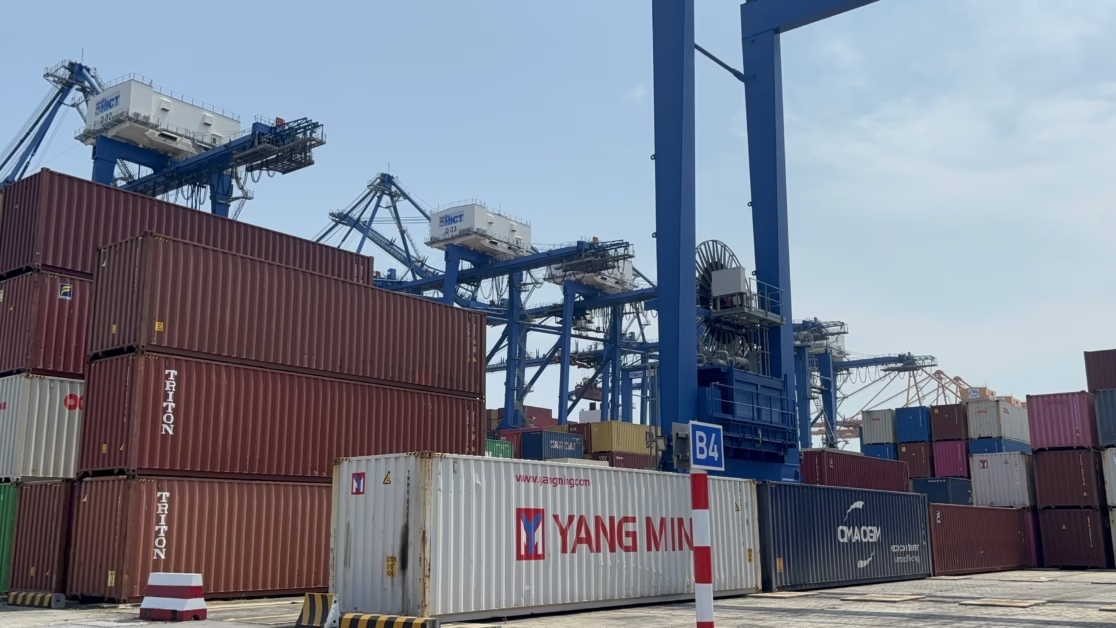
Cables mounted on port cranes — ship-to-shore (STS) gantry cranes, rubber-tyred gantry (RTG) cranes, rail-mounted gantry (RMG) cranes, and automated stacking cranes — face the full intensity of this corrosive environment. Festoon cables hang exposed along crane girder spans, receiving direct salt spray and UV exposure with no shielding. Reeling cables on motorised drums wind through salt-laden air, collecting chloride deposits on their outer sheaths during each reel-out cycle. The cable’s sheath, braid, insulation, and conductor materials are all targets for corrosive attack, and each component degrades through different mechanisms at different rates.
Standard industrial cables — those designed and tested for factory floor, warehouse, or general outdoor service — exhibit three characteristic failure modes when deployed in harbour environments. First, sheath micro-cracking from UV-salt synergy: chloride ions penetrate UV-degraded surface micro-cracks in polychloroprene or PVC sheaths, accelerating crack propagation and admitting moisture to inner cable layers. Second, conductor corrosion beneath intact insulation: chloride ions that permeate through the polymer matrix (a diffusion process that occurs even through visually undamaged insulation) reach the copper conductor surface and initiate pitting corrosion, increasing DC resistance by 10–30% over 2–3 years. Third, braid and shield degradation: metallic braids (typically tinned copper) used for electromagnetic screening corrode rapidly in salt fog, losing both their screening effectiveness and their mechanical integrity as an anti-torsion element.
An STS gantry crane with a full festoon cable replacement requires 3–5 days of crane downtime. In a busy container terminal handling 30–40 container moves per hour, each day of crane downtime represents approximately 700–1,000 lost container movements. At typical terminal handling rates, this equates to US$50,000–150,000 per day in lost revenue and logistics penalties. A cable that fails after 3 years instead of lasting the designed 10–12 years generates 2–3 additional full replacement cycles over the crane’s 25-year service life, each costing $80,000–200,000 (cable material plus installation labour plus crane downtime). The total lifecycle cost difference between a standard industrial cable and a properly engineered port cable can exceed US$500,000 per crane over its service life — a figure that dwarfs the 20–40% material cost premium of port-rated cables.
2. Electrochemistry of Salt Fog Attack on Cable Materials
Understanding why salt fog is so destructive to cables requires examining the electrochemical mechanisms at the molecular level. This understanding directly informs the material science choices that distinguish port-grade cables from standard industrial alternatives, and explains why simple “waterproofing” is insufficient protection.
Chloride Ion Penetration Through Polymer Sheaths
Salt fog deposits sodium chloride (NaCl) crystals on the cable’s outer sheath surface. When humidity exceeds approximately 75% RH (which occurs almost continuously in harbour environments), these crystals dissolve into a thin electrolyte film on the sheath surface. The resulting chloride ions (Cl⁻) do not merely sit on the surface — they diffuse into the polymer matrix through a concentration-gradient-driven process described by Fick’s second law of diffusion. The diffusion coefficient varies dramatically with polymer type: PVC sheaths permit chloride diffusion at rates of 10⁻¹⁰ to 10⁻⁹ cm²/s; standard polychloroprene (CR) at 10⁻¹¹ to 10⁻¹⁰ cm²/s; marine-grade 5GM5 polychloroprene at 10⁻¹² to 10⁻¹¹ cm²/s; and high-performance PUR at 10⁻¹² to 10⁻¹¹ cm²/s. Each order-of-magnitude reduction in diffusion coefficient roughly doubles the time before chloride ions reach the conductor — the fundamental reason why sheath compound selection is the single most important engineering decision for port cable durability.
Copper Pitting Corrosion in Chloride Environments
Once chloride ions reach the copper conductor surface, they initiate a specific corrosion mechanism known as pitting corrosion. Chloride ions disrupt the passive oxide layer (Cu₂O) that normally protects copper from further oxidation. At points where the passive layer is disrupted — typically at grain boundaries in drawn copper wire — localised anodic dissolution creates small pits. These pits concentrate chloride ions (autocatalytic process), accelerating local corrosion and producing cuprous chloride (CuCl) and eventually cupric chloride (CuCl₂) deposits. The practical consequence is measurable: conductor DC resistance increases as the effective cross-sectional area of copper decreases. A 10% increase in DC resistance indicates approximately 10% loss of conductor cross-section to pitting corrosion — a finding that mandates cable replacement because the remaining copper is stress-concentrated at pit boundaries and susceptible to sudden fatigue fracture under mechanical loading.
Synergistic UV-Salt-Humidity Degradation
The most insidious aspect of harbour corrosion is the synergy between UV radiation, salt deposition, and humidity cycling. UV radiation breaks carbon-carbon bonds in the polymer sheath surface (photo-oxidation), creating micro-cracks typically 5–50 μm deep. Salt crystals deposited in these micro-cracks act as stress concentrators during thermal cycling (expansion/contraction), mechanically widening the cracks. Moisture absorbed during high-humidity periods swells the polymer matrix, creating internal stress. The combination of these three mechanisms produces crack propagation rates 3–5× faster than any single mechanism alone — a phenomenon that ISO 4892 (accelerated weathering testing) struggles to replicate accurately because it typically applies UV, salt, and humidity in sequential cycles rather than simultaneously, underestimating real-world degradation rates.
Research published in the IEEE Transactions on Dielectrics and Electrical Insulation (vol. 27, no. 4, 2020) demonstrated that combined salt fog plus UV exposure degraded polychloroprene cable sheaths at 2.8× the rate predicted by additive models (i.e., the rate predicted by adding UV-only degradation plus salt-fog-only degradation). The synergistic acceleration factor was attributed to chloride-catalysed photo-oxidation — a mechanism where chloride ions at the polymer surface lower the activation energy for UV-induced chain scission. This finding directly supports the engineering rationale for selecting sheaths with both high UV resistance and low chloride permeability, rather than optimising for either property alone.
3. FeiChun’s Anti-Salt-Fog Engineering Platform: FC-PORT™ Technology
FeiChun’s FC-PORT™ technology platform represents an integrated engineering approach to harbour cable durability. Rather than addressing salt fog resistance as a single-layer sheath upgrade (the approach taken by most cable manufacturers), FC-PORT incorporates corrosion resistance into every cable layer from conductor to outer sheath, creating a defence-in-depth architecture that tolerates partial degradation of any single layer without compromising overall cable integrity.
Layer 1: Conductor Treatment — Hot-Tin-Dipped Copper with Chloride-Barrier Alloy
FeiChun’s port-grade cables use hot-tin-dipped (Class 1 per IEC 60228 Annex B) copper conductors where the tin coating thickness exceeds 2.5 μm (versus 1.0–1.5 μm typical for standard tinned copper). The thicker tin layer provides two protective functions: it acts as a physical barrier preventing chloride ions from contacting the copper surface, and it forms a stable tin oxide (SnO₂) passive layer that resists chloride penetration. For extreme-duty applications (spreader cables, hoisting cables with 15+ year service life requirements), FeiChun offers its FC-TCB™ (Tin-Copper-Barrier) conductor treatment with a proprietary copper-tin intermetallic alloy layer that further reduces chloride diffusion to the copper substrate.
Layer 2: Insulation Compound — Chloride-Resistant EPDM or PUR
The insulation layer in FC-PORT cables uses EPDM formulations with enhanced chloride resistance achieved through increased cross-link density (peroxide-cured, with cross-link density approximately 15–20% higher than standard EPDM) and incorporation of nano-clay fillers that create tortuous diffusion paths for chloride ions. The resulting insulation exhibits chloride diffusion coefficients approximately 10× lower than standard EPR insulation, effectively extending the time-to-conductor-corrosion by an order of magnitude even if the outer sheath is partially compromised.
Layer 3: Anti-Torsion Braid — Non-Metallic Construction
Standard cables frequently use tinned copper braid for combined EMC shielding and torsion resistance. In harbour environments, metallic braids corrode rapidly — even tinned copper braid shows measurable resistance increase within 12–18 months of salt fog exposure. FeiChun’s FC-PORT cables use non-metallic anti-torsion braid systems: polyester textile braid for standard applications, or aramid (FC-ASB™) braid for premium applications requiring superior torque resistance. Where EMC shielding is required, FeiChun employs an aluminium-polyester laminate screen beneath the non-metallic braid, providing electromagnetic performance equivalent to copper braid without the corrosion vulnerability.
Layer 4: Outer Sheath — Marine-Grade 5GM5 Polychloroprene or Enhanced PUR
The outer sheath is the cable’s first line of defence. FC-PORT cables use either 5GM5-class marine-grade polychloroprene (for CR-sheathed designs) or enhanced polyurethane (for PUR-sheathed designs). Both compounds are formulated with UV stabiliser packages, anti-oxidant systems, and anti-ozone additives that maintain mechanical integrity under combined UV-salt-humidity exposure per ISO 4892-2 (2,000+ hours accelerated weathering) and ISO 9227 (1,000+ hours continuous salt spray). The 5GM5 polychloroprene formulation provides superior abrasion resistance (important for reeling cables contacting drum surfaces), while PUR provides superior hydrolysis resistance (important for cables in tropical ports with sustained high humidity above 90% RH).
Consider a festoon cable operating on an STS crane in a tropical port. After 4 years of service, the outer sheath develops UV-induced surface micro-cracking (expected behaviour even with UV-stabilised compounds). In a standard cable, chloride ions immediately penetrate through the cracks, reaching the insulation within 6–12 months and the conductor within 18–24 months — total service life approximately 5–6 years. In an FC-PORT cable with defence-in-depth architecture, the chloride ions that penetrate the cracked sheath encounter: (1) a non-metallic braid that provides no corrosion pathway, (2) chloride-resistant EPDM insulation with nano-clay barriers, and (3) heavy-tin-dipped conductors. Even with a partially compromised sheath, the inner layers extend cable service life to 10–14 years — providing a 2–3× lifecycle advantage that justifies the material cost premium.
4. Festoon Cables for Port Service: Family Overview and Selection
Festoon cables are suspended from trolley carriers along crane girder spans, providing power and control connections to the crane’s traversing machinery. In harbour service, festoon cables are fully exposed to the marine atmosphere: direct salt spray, sustained UV, wind loading, temperature cycling, and the mechanical flex-stress of cable movement as the crane traverses. The cable families available for port festoon service span a wide range of performance characteristics, cost points, and environmental suitability — selecting correctly requires understanding the specific advantages and trade-offs of each family.
The festoon cable families examined in this article fall into three design categories. Flat (ribbon) cables — including H07VVH6-F / VCVH6-F (PVC-insulated), RHEYFLAT®-N NGFLGOEU-J (rubber-insulated), and RHEYFLAT®-N (N)GFLCGOEU-J (LSHF halogen-free) — provide space efficiency and defined bending behaviour by constraining all cores in a planar geometry. Round festoon cables — including RHEYFESTOON® (N)3GRD5G and RHEYFESTOON®(C) (N)3GRDGC5G — provide superior torsion resistance and are better suited to festoon systems with significant traverse distances and higher wind loading. Hybrid designs — including RHEYCORD®-OFE (oil- and flame-resistant, originally a reeling cable design adapted for festoon duty) — provide specialised performance characteristics for specific operating environments.
| Parameter | H07VVH6-F / VCVH6-F | RHEYFLAT®-N NGFLGOEU-J | RHEYFLAT®-N (N)GFLCGOEU-J LSHF | RHEYFESTOON® (N)3GRD5G | RHEYFESTOON®(C) (N)3GRDGC5G | RHEYCORD®-OFE |
|---|---|---|---|---|---|---|
| Cable geometry | Flat (ribbon) | Flat (ribbon) | Flat (ribbon) | Round | Round (with copper screen) | Round |
| Insulation type | PVC | EPR (rubber) | LSHF (halogen-free compound) | EPDM | EPDM | EPDM (RHEYCLEAN®) |
| Outer sheath | PVC (standard grade) | Polychloroprene 5GM3 | LSHF thermoplastic | Polychloroprene 5GM5 | Polychloroprene 5GM5 | Polychloroprene 5GM5 (oil/flame-resistant) |
| Temperature range | −5°C to +70°C | −25°C to +80°C | −30°C to +80°C | −40°C to +90°C | −40°C to +90°C | −40°C to +90°C |
| Salt fog resistance (ISO 9227) | Poor (200–400 h) | Moderate (500–800 h) | Moderate (400–700 h) | Good (800–1,200 h) | Good (800–1,200 h) | Excellent (1,000–1,500 h) |
| UV resistance | Poor (yellowing, embrittlement) | Moderate (with UV additives) | Poor–Moderate | Good (UV-stabilised) | Good (UV-stabilised) | Excellent (UV-stabilised + oil-resistant surface) |
| Flex-cycle endurance | 20,000–30,000 cycles | 40,000–60,000 cycles | 30,000–50,000 cycles | 80,000–120,000 cycles | 80,000–120,000 cycles | 100,000+ cycles |
| Halogen-free | No (PVC contains chlorine) | No (CR sheath) | Yes (LSHF throughout) | No (CR sheath) | No (CR sheath) | No (CR sheath) |
| EMC screening | Available (screened variants) | No | No | No | Yes (copper braid screen) | No (non-metallic braid) |
| Max festoon speed | 60 m/min | 80 m/min | 80 m/min | 180 m/min | 180 m/min | 240 m/min |
| Port service life (estimated) | 2–4 years | 4–6 years | 3–5 years | 8–12 years | 8–12 years | 10–15 years |
| Price positioning | Low (commodity) | Medium | Medium–High | Premium | Premium (highest in class) | Premium |
| FeiChun equivalent | FC-H07VVH6-F | FC-RHEYFLAT-N | FC-RHEYFLAT-LSHF | FC-RHEYFESTOON | FC-RHEYFESTOON-C | FC-RHEYCORD-OFE |
5. H07VVH6-F / VCVH6-F Screened PVC Flat Cables: Baseline Performance
The H07VVH6-F (harmonised European designation) and VCVH6-F (national designation) screened PVC flat cables represent the entry-level option for festoon applications. Widely available and inexpensive, these cables use PVC insulation and PVC outer sheath with optional tinned-copper screening braid. They comply with EN 50525-2-51 and are commonly specified for indoor crane and conveyor festoon systems where chemical exposure is minimal.
Port Service Limitations
PVC-based cables suffer severely in harbour environments for three reasons. First, PVC sheaths have the highest chloride diffusion coefficient among common cable sheath materials (10⁻¹⁰ to 10⁻⁹ cm²/s), meaning salt fog penetrates to the conductor surface within 1.5–2.5 years. Second, PVC undergoes progressive plasticiser loss (migration) when exposed to UV radiation and temperature cycling, becoming brittle and crack-prone — a process dramatically accelerated by simultaneous salt deposition. Third, PVC’s operating temperature range (−5°C to +70°C) is inadequate for port cranes where solar loading on steel structures regularly produces surface temperatures of +60–75°C in tropical and subtropical ports.
The screened variants (with tinned copper braid) face an additional vulnerability: the copper braid corrodes in salt fog, losing screening effectiveness and eventually failing mechanically. Field data from Southeast Asian port operators indicates that screened H07VVH6-F cables in festoon service typically show measurable screening degradation (> 40% increase in transfer impedance) within 18–24 months and require replacement within 2–4 years — approximately one-third the service life of EPDM-insulated alternatives.
H07VVH6-F / VCVH6-F cables should not be specified for outdoor festoon service in harbour environments except as temporary or emergency replacements where lead time for proper port-grade cables is unavailable. The lifecycle cost of frequent replacement (2–4 year intervals) invariably exceeds the lifecycle cost of premium EPDM-insulated festoon cables (8–12 year intervals), even when the premium cable costs 3–4× more per metre. For port engineers inheriting PVC festoon installations, FeiChun recommends scheduling replacement with FC-RHEYFESTOON or FC-RHEYCORD-OFE equivalents at the next planned maintenance window.
6. RHEYFLAT®-N NGFLGOEU-J and (N)GFLCGOEU-J LSHF Halogen-Free Flat Cables
The RHEYFLAT®-N family represents the mid-tier option for flat festoon cables, offering significantly better flex-cycle endurance and environmental resistance than PVC alternatives whilst maintaining the space-efficient flat geometry that simplifies festoon carrier design. Two primary variants exist: the NGFLGOEU-J with standard EPR insulation and polychloroprene sheath, and the (N)GFLCGOEU-J LSHF variant with halogen-free insulation and sheathing throughout.
RHEYFLAT®-N NGFLGOEU-J: EPR/Polychloroprene Construction
The NGFLGOEU-J variant uses EPR (ethylene propylene rubber) insulation with a polychloroprene 5GM3 outer sheath. This construction provides substantially better salt fog resistance than PVC (500–800 hours versus 200–400 hours per ISO 9227), a wider operating temperature range (−25°C to +80°C), and approximately 2× the flex-cycle endurance of PVC flat cables. The polychloroprene sheath offers inherent oil and chemical resistance, making this cable suitable for port festoon applications where the cable may contact hydraulic fluid or diesel fuel from crane machinery. The 5GM3 sheath grade, however, represents a compromise: it lacks the enhanced UV stabiliser and anti-ozone packages present in premium 5GM5 formulations, meaning the sheath will degrade faster under sustained UV exposure typical of open-sky port operations.
RHEYFLAT®-N (N)GFLCGOEU-J LSHF: Halogen-Free Construction
The (N)GFLCGOEU-J LSHF variant replaces both the EPR insulation and polychloroprene sheath with halogen-free compounds. This design is mandated for port applications governed by fire safety regulations requiring low smoke density and zero halogen emission during combustion — relevant for enclosed crane electrical rooms, cable tunnels beneath terminal yard surfaces, and applications near passenger facilities. The halogen-free construction eliminates the hydrogen chloride (HCl) gas emission that polychloroprene generates during fire — HCl is both toxic and highly corrosive to electronic equipment.
However, the LSHF variant presents a trade-off for salt fog resistance. Halogen-free sheath compounds (typically polyolefin-based with mineral fillers) generally exhibit higher moisture absorption rates than polychloroprene, resulting in somewhat lower salt fog endurance (400–700 hours versus 500–800 hours for the CR-sheathed variant). For this reason, FeiChun recommends the LSHF variant primarily for semi-enclosed festoon runs (under crane gantry cover) where direct salt spray exposure is reduced, and the CR-sheathed NGFLGOEU-J or premium RHEYFESTOON® for fully exposed festoon spans.
FeiChun manufactures direct equivalents to both RHEYFLAT-N variants under the FC-RHEYFLAT designation. The FC-RHEYFLAT-N uses identical EPR insulation with FeiChun’s enhanced 5GM3+ polychloroprene sheath formulation (incorporating additional UV stabiliser for improved port durability), while the FC-RHEYFLAT-LSHF uses a proprietary halogen-free compound with lower moisture absorption than standard polyolefin blends, improving salt fog endurance to 500–800 hours — matching the CR-sheathed variant’s performance in a fully halogen-free construction. Pricing is 30–40% below Nexans equivalents with 45–60 day lead times.
7. RHEYFESTOON® (N)3GRD5G and RHEYFESTOON®(C) (N)3GRDGC5G Round Festoon Cables
The RHEYFESTOON® family represents the premium tier of festoon cables, purpose-engineered for high-speed, high-cycle, fully exposed outdoor service. The round construction provides superior torsion resistance compared to flat cables (which tend to twist when traversing curves in the festoon rail), better resistance to wind-induced oscillation (the circular cross-section has lower drag coefficient than flat geometry), and more uniform bending stress distribution (eliminating the edge-stress concentrations inherent in flat cable construction).
RHEYFESTOON® (N)3GRD5G: Standard Round Festoon
The (N)3GRD5G designation indicates a rubber-insulated, rubber-sheathed construction with EPDM insulation and 5GM5 marine-grade polychloroprene outer sheath. The “3GRD” component signifies the three-layer rubber design (insulation, inner sheath, outer sheath), while “5G” indicates the 5GM5 sheath grade. This cable delivers the full premium performance envelope: −40°C to +90°C temperature range, 80,000–120,000 flex cycles to insulation rupture, and salt fog endurance of 800–1,200 hours per ISO 9227. The 5GM5 sheath grade — with enhanced UV stabilisation, anti-ozone additives, and reduced chloride permeability compared to 5GM3 — is the critical differentiator that makes this cable suitable for 8–12 year service life in fully exposed harbour festoon applications.
RHEYFESTOON®(C) (N)3GRDGC5G: Screened Round Festoon
The “(C)” suffix and “GC” in the designation indicate the addition of a copper braid screen for electromagnetic compatibility. This variant is specified for festoon installations where frequency-inverter-driven crane motors generate conducted and radiated electromagnetic interference (EMI) that affects nearby control and communication circuits. The copper braid provides screening attenuation of typically 40–60 dB at frequencies from 100 kHz to 30 MHz.
The screened variant presents a specific engineering challenge in harbour environments: the copper braid is vulnerable to salt fog corrosion, as discussed in Section 2. Nexans addresses this by positioning the copper screen beneath the 5GM5 outer sheath, relying on the sheath’s low chloride permeability to protect the screen. This approach is effective for the first 6–8 years of service, after which sheath micro-cracking from UV/thermal cycling may begin to admit chloride ions to the braid layer. FeiChun’s FC-RHEYFESTOON-C equivalent replaces the copper braid with an aluminium-polyester laminate screen plus non-metallic anti-torsion braid, eliminating the corrosion vulnerability entirely whilst maintaining equivalent screening performance (45–65 dB at 100 kHz–30 MHz).
8. Reeling Cables for Port Service: Family Overview and Selection
Reeling cables on motorised drums experience the full combination of tensile, torsional, and cyclic bending stress described in the RHEYCORD RTS engineering analysis — plus the additional corrosion stress from harbour salt fog exposure. The reeling cable families available for port service are substantially more diverse than the festoon families, reflecting the wider range of operational requirements: from low-speed spring-operated cable reels (10–30 m/min) to high-speed motorised drums (200–240 m/min), from control-only applications (0.5–2.5 mm² cores) to high-power spreader feeds (16–95 mm² cores), and from standard temperature environments to extreme conditions requiring silicone insulation (+180°C emergency tolerance).
The following three sections examine the major reeling cable families — RHEYCORD®, BUFLEX®, and RHEYFIRM® — and the speciality cables BOITALYON®R and RHEYFLEX®-PN, analysing each variant’s salt fog performance, mechanical characteristics, and suitability for specific port applications.
9. RHEYCORD® Family: NSHTOEU-J, RTS, PUR R, OFE R, OFE SR, and BS Variants
The RHEYCORD® family is the most widely specified reeling cable platform for harbour crane applications, encompassing six primary variants that span the full range of port reeling requirements. Understanding the distinctions between these variants — and their specific salt fog performance characteristics — is essential for correct cable selection.
RHEYCORD® NSHTOEU-J: Standard Reeling Cable
The baseline RHEYCORD NSHTOEU-J uses Class 5 copper conductors, EPR insulation, and polychloroprene 5GM3 outer sheath with polyester anti-torsion braid. Rated for −30°C to +80°C and drum reeling speeds up to 120 m/min, this cable represents the standard-grade option for port reeling applications. Its salt fog endurance (500–800 hours per ISO 9227) is adequate for ports with moderate salt exposure (enclosed or semi-enclosed reel housings) but marginal for fully exposed drum installations in high-corrosivity C5-M environments. Flex-cycle endurance of 40,000–60,000 cycles positions this cable for medium-duty applications with annual reeling cycles below 20,000.
RHEYCORD®(RTS) (N)SHTOEU-J: Ultra-Fine Stranded Premium Reeling Cable
The RTS variant upgrades the conductor to ultra-fine RTS stranding (individual strand diameter 0.10–0.12 mm versus 0.15–0.21 mm for Class 5), the insulation to RHEYCLEAN® EPDM (peroxide-cured with enhanced cross-link density), and the sheath to 5GM5 marine-grade polychloroprene. This combination delivers the highest performance in the RHEYCORD family: −40°C to +90°C temperature range, 200–240 m/min reeling speed, 100,000+ flex cycles, and salt fog endurance of 800–1,200 hours. The RTS variant is specified for high-speed STS crane reeling drums, high-cycle RTG cable reels, and any application where the cable is fully exposed to marine atmosphere with no environmental shielding.
RHEYCORD®-PUR R: Polyurethane-Sheathed Reeling Cable
The PUR R variant replaces the polychloroprene outer sheath with polyurethane (PUR), providing superior abrasion resistance (critical for cables contacting drum surfaces at high speed), excellent hydrolysis resistance (important for tropical ports with sustained humidity above 90% RH), and good oil/fuel resistance. PUR sheaths offer comparable salt fog endurance to 5GM5 polychloroprene (800–1,200 hours) but with superior resistance to mechanical wear. The trade-off is lower flame retardancy compared to polychloroprene — PUR is self-extinguishing but burns with higher heat release than CR, making it less suitable for applications with strict fire safety requirements.
RHEYCORD®-OFE R and RHEYCORD®-OFE SR: Oil- and Flame-Resistant Variants
The OFE (Oil- and Flame-Resistant Enhanced) variants address a specific port requirement: cables that must operate in environments where mineral oil, hydraulic fluid, or diesel fuel contacts the cable surface. The “R” designation indicates standard reeling duty; “SR” indicates spreader-rated (enhanced tensile capacity of 3,000–5,000 N for drumspreader applications). The OFE sheath compound is a specially formulated polychloroprene that resists swelling and softening from prolonged hydrocarbon contact — maintaining mechanical properties after 168 hours immersion in IEC 60811 Test Oil A (naphthenic mineral oil) with less than 15% volume change. In harbour service, the OFE variants provide an additional benefit: the oil-resistant surface chemistry also reduces surface adhesion of salt crystals, which marginally improves salt fog endurance compared to standard polychloroprene.
RHEYCORD®(BS) YSLZ3SOE-J: Low-Smoke Halogen-Free Reeling Cable
The BS variant (YSLZ3SOE-J designation) uses a completely halogen-free construction with thermoplastic elastomer (TPE) insulation and sheathing. This cable is specified for port installations governed by IEC 60332-3 (flame propagation in cable bunches), IEC 61034 (smoke density), and IEC 60754-2 (gas acidity) requirements — typically cable tunnels, enclosed electrical rooms, and installations near passenger areas. The BS variant’s salt fog resistance (400–700 hours) is lower than CR-sheathed alternatives due to the higher moisture absorption of TPE compounds, and its operating temperature range (−25°C to +70°C) is narrower. FeiChun recommends this variant only for semi-enclosed reeling installations where fire safety regulations mandate halogen-free construction.
| Parameter | NSHTOEU-J (Standard) | (RTS) (N)SHTOEU-J | PUR R | OFE R / OFE SR | (BS) YSLZ3SOE-J |
|---|---|---|---|---|---|
| Conductor class | Class 5 (IEC 60228) | RTS ultra-fine | Class 5 / RTS | Class 5 / RTS | Class 5 |
| Insulation | EPR (sulfur-cured) | RHEYCLEAN® EPDM | EPR / EPDM | EPDM (oil-resistant) | TPE (halogen-free) |
| Outer sheath | CR 5GM3 | CR 5GM5 (marine) | PUR (polyurethane) | CR 5GM5 OFE | TPE (halogen-free) |
| Temp. range | −30°C to +80°C | −40°C to +90°C | −35°C to +90°C | −40°C to +90°C | −25°C to +70°C |
| Max reel speed | 120 m/min | 200–240 m/min | 160 m/min | 160–200 m/min | 120 m/min |
| Flex cycles (10× OD) | 40,000–60,000 | 100,000+ | 60,000–80,000 | 80,000–100,000 | 30,000–50,000 |
| Salt fog (ISO 9227) | 500–800 h | 800–1,200 h | 800–1,200 h | 1,000–1,500 h | 400–700 h |
| Oil resistance | Good | Good | Excellent | Excellent (IEC oil A) | Moderate |
| Halogen-free | No | No | No | No | Yes |
| Spreader rating | 1,500–2,000 N | 3,000 N | 2,000–2,500 N | 3,000–5,000 N (SR) | 1,500 N |
| Port service life | 4–6 years | 8–12 years | 7–10 years | 10–15 years | 3–5 years |
| FeiChun equivalent | FC-RHEYCORD | FC-RHEYCORD-RTS | FC-RHEYCORD-PUR | FC-RHEYCORD-OFE (R/SR) | FC-RHEYCORD-BS |
10. BUFLEX® Family: DGR, SC, SEM, and SEM OFE Variants
The BUFLEX® cable family (developed by Nexans under the Draka brand heritage) is specifically designed for energy chain (cable chain / drag chain) and high-flex reeling applications where the cable must tolerate millions of small-radius bending cycles. The BUFLEX name derives from “BU” (bundled ultra-fine conductors) and “FLEX” — emphasising the conductor’s exceptionally fine stranding optimised for continuous-flex applications. In port environments, BUFLEX cables are found on RTG crane power reels, automated guided vehicle (AGV) charging cable systems, and STS crane festoon-to-reel transition assemblies.
BUFLEX® DGR: Standard Energy Chain and Reeling Cable
The BUFLEX DGR (Drag-Reel) variant is the baseline model, providing good flex-cycle endurance (60,000–80,000 cycles), moderate reeling speed (120 m/min), and EPR insulation with polychloroprene 5GM3 sheath. For port service, the DGR variant’s salt fog performance (500–800 hours) is similar to the standard RHEYCORD NSHTOEU-J — adequate for semi-enclosed installations but marginal for fully exposed applications. The DGR is commonly specified as a cost-effective option for RTG cable reels where the cable reel is housed within the crane’s machinery enclosure, providing partial protection from direct salt spray.
BUFLEX®-SC: Screened Variant for EMC-Sensitive Applications
The BUFLEX-SC adds a tinned copper braid screen beneath the outer sheath, providing EMC screening for frequency-inverter-driven motor circuits. The screening performance (typically 40–55 dB at 100 kHz–10 MHz) is adequate for most port automation requirements. In salt fog environments, the same copper braid corrosion concern applies as discussed for the RHEYFESTOON(C) screened festoon cable — the copper screen degrades over time as chloride ions permeate the outer sheath. FeiChun’s FC-BUFLEX-SC equivalent addresses this with the aluminium-polyester laminate screen plus non-metallic braid combination, providing equivalent screening performance with zero corrosion vulnerability.
BUFLEX® SEM and BUFLEX® SEM OFE: Premium Energy-Chain Cables
The BUFLEX SEM (Superior Energy Management) and SEM OFE (oil-flame-enhanced) variants represent the premium tier of the BUFLEX family. The SEM variant uses enhanced EPR insulation with optimised cross-linking, 5GM5 polychloroprene sheath, and aramid-reinforced anti-torsion braid for maximum flex-cycle endurance (80,000–100,000 cycles). The SEM OFE variant adds oil and flame resistance to the sheath compound, making it suitable for port applications where the cable contacts hydraulic oil, diesel fuel, or operates in areas with fire safety requirements. Salt fog endurance for SEM variants reaches 800–1,200 hours — comparable to RHEYCORD RTS and suitable for fully exposed harbour installations.
| Parameter | BUFLEX® DGR | BUFLEX®-SC | BUFLEX® SEM | BUFLEX® SEM OFE |
|---|---|---|---|---|
| Primary application | Energy chain / drag reel | EMC-screened drag reel | Premium energy chain | Premium OFE energy chain |
| Conductor class | BU ultra-fine | BU ultra-fine | BU ultra-fine (enhanced) | BU ultra-fine (enhanced) |
| Insulation | EPR | EPR | EPR (enhanced cross-link) | EPR (enhanced cross-link) |
| Outer sheath | CR 5GM3 | CR 5GM3 | CR 5GM5 | CR 5GM5 OFE |
| Temp. range | −30°C to +80°C | −30°C to +80°C | −40°C to +90°C | −40°C to +90°C |
| Flex cycles (10× OD) | 60,000–80,000 | 60,000–80,000 | 80,000–100,000 | 80,000–100,000 |
| Salt fog (ISO 9227) | 500–800 h | 500–800 h | 800–1,200 h | 1,000–1,500 h |
| Oil resistance | Good | Good | Good | Excellent |
| EMC screen | No | Tinned Cu braid | No | No |
| Max reel speed | 120 m/min | 120 m/min | 160 m/min | 160 m/min |
| Port service life | 4–7 years | 4–7 years | 8–12 years | 10–14 years |
| FeiChun equivalent | FC-BUFLEX-DGR | FC-BUFLEX-SC | FC-BUFLEX-SEM | FC-BUFLEX-SEM-OFE |
11. RHEYFIRM® Family: Silicone and RTS Variants for Extreme Environments
The RHEYFIRM® family occupies the highest-performance tier in the reeling cable hierarchy, employing silicone rubber insulation and/or RTS ultra-fine conductor technology for applications requiring extreme temperature tolerance, exceptional flex-cycle endurance, or both simultaneously. In port environments, RHEYFIRM cables are specified for applications where standard EPDM-insulated cables reach their thermal or mechanical limits: spreader cables on STS cranes handling molten metal or hot cargo, hoisting cables in steel terminal operations, and cables serving motors in thermally extreme crane machinery houses.
RHEYFIRM®(SI) NTMCGCWOEUS: Silicone-Insulated Reeling Cable
The (SI) variant uses silicone rubber (VMQ) insulation with polychloroprene 5GM5 outer sheath. Silicone insulation provides extraordinary temperature performance: continuous operation from −60°C to +180°C, with short-term tolerance to +250°C. The flex-cycle endurance of silicone insulation (80,000–120,000 cycles) is comparable to EPDM, though silicone’s lower tear resistance (20–30 kN/m versus 50+ kN/m for EPDM) makes it more susceptible to mechanical damage during installation or from contact with sharp drum edges. In salt fog environments, silicone’s inherently low moisture absorption and high hydrophobicity provide good resistance (600–1,000 hours per ISO 9227). The primary trade-off is cost — silicone insulation compounds cost 3–5× more than EPDM per kilogram, reflected in cable pricing.
RHEYFIRM®(RTS) (N)TSCGEWTOEUS: RTS Ultra-Fine Stranded Silicone Cable
The RHEYFIRM RTS combines the silicone insulation platform with RTS ultra-fine conductor stranding, creating the highest-performance reeling cable available in the market. This cable delivers: −60°C to +180°C continuous temperature range, 120,000+ flex cycles, 200+ m/min reeling speed, and 3,000–5,000 N tensile capacity. In port service, this cable is specified for the most demanding applications — typically STS crane spreader cables in terminals handling hot cargo (steel coils, molten slag, chemical containers requiring heated transport) — where both extreme temperature tolerance and maximum flex-cycle endurance are simultaneously required.
RHEYFIRM® (RS)-FLAT (N)TSFLCGCWOEUS: Flat Silicone Reeling Cable
The RS-FLAT variant combines silicone insulation with flat (ribbon) cable geometry, providing space-efficient installation in applications where round cable cannot be accommodated — typically festoon-to-reel transition zones and compact machinery enclosures. The flat geometry constrains bending to a single plane, simplifying reel design but limiting the cable to single-axis reeling applications.
RHEYFIRM®(RTS) (N)TSCGEWTOEUS OF: Oil- and Flame-Resistant RTS Silicone Cable
The “OF” suffix adds oil and flame resistance to the RHEYFIRM RTS platform, achieved through a specialised outer sheath compound that combines the chemical resistance of polychloroprene with enhanced flame retardancy additives. This is the ultimate port reeling cable specification — maximum temperature range, maximum flex endurance, maximum oil resistance, and maximum salt fog resistance (1,000–1,500 hours per ISO 9227) — specified only for the most critical and highest-value crane installations where cable failure consequences justify the premium cost (typically 4–6× the price of standard RHEYCORD NSHTOEU-J).
Silicone rubber’s molecular structure (polydimethylsiloxane backbone) provides inherent hydrophobicity — the silicone surface repels water, preventing the formation of continuous electrolyte films that drive chloride-ion-mediated corrosion. However, silicone’s lower mechanical strength means that any surface damage (abrasion, impact, sharp-edge contact) creates deeper penetration points for salt fog than equivalent damage to the tougher EPDM surface. This explains why RHEYFIRM silicone cables, despite their superior intrinsic chemical resistance, do not always outperform RHEYCORD EPDM cables in real-world salt fog testing: the test conditions (continuous spray on pristine surfaces) favour silicone, while real-world conditions (intermittent spray on mechanically stressed surfaces) can favour EPDM’s superior toughness. FeiChun’s FC-RHEYFIRM equivalents address this by incorporating a sacrificial abrasion-resistant outer layer over the silicone construction, combining silicone’s chemical resistance with EPDM-class mechanical durability.
12. BOITALYON®R and RHEYFLEX®-PN: Speciality Reeling Cables
Two additional reeling cable families merit discussion for specific port applications that fall outside the mainstream RHEYCORD, BUFLEX, and RHEYFIRM coverage.
BOITALYON®R: Italian-Heritage Heavy-Duty Reeling Cable
The BOITALYON R (developed under Nexans’ Intercond/Italy heritage) is a heavy-duty reeling cable designed specifically for Mediterranean and Southern European port service, where sustained high temperatures (ambient +40–45°C) combine with moderate salt fog exposure. The BOITALYON R uses EPR insulation with a distinctive double-sheath construction: an inner polychloroprene layer providing oil and chemical resistance, and an outer thermoplastic polyester elastomer (TPEE) layer providing superior abrasion resistance and UV stability. This dual-layer sheath approach provides exceptional abrasion resistance (important for reeling cables operating on high-speed drums), good salt fog endurance (700–1,000 hours per ISO 9227), and a unique advantage — the TPEE outer layer is resistant to biological fouling (algae, barnacle adhesion), which is relevant for cables on port equipment near the waterline.
RHEYFLEX®-PN: Pneumatic-Rated Flexible Reeling Cable
The RHEYFLEX-PN is designed for applications combining electrical conductors with pneumatic control tubing in a single cable assembly. In port environments, RHEYFLEX-PN is specified for crane applications where the spreader bar requires both electrical power/control signals and compressed air for twist-lock actuation — eliminating the need for separate pneumatic hose runs alongside the electrical cable. The integrated design simplifies reel and festoon installations but imposes specific maintenance requirements: the pneumatic tubing elements must be pressure-tested periodically (quarterly recommended), and any failure in the pneumatic section typically necessitates replacement of the entire cable assembly. Salt fog performance of the RHEYFLEX-PN is moderate (500–800 hours per ISO 9227), with the pneumatic tube entry points representing potential ingress paths for salt-laden moisture.
FeiChun manufactures equivalents for both speciality cables: FC-BOITALYON-R with the dual-sheath TPEE/CR construction (enhanced with FeiChun’s UV stabiliser package for superior performance in tropical ports), and FC-RHEYFLEX-PN with integrated pneumatic tubing (available in 4 mm, 6 mm, and 8 mm tube diameters). Both are manufactured to the same VDE and IEC standards as the Nexans originals, with pricing 30–45% below European manufacturers and lead times of 45–75 days depending on configuration complexity.
13. Comparative Salt Fog Performance Matrix: All Cable Families
The following comprehensive matrix allows harbour engineers to compare salt fog resistance, port service life, and application suitability across all cable families discussed in this article. The salt fog hours listed represent performance per ISO 9227 neutral salt spray testing (5% NaCl, 35°C, continuous spray). Real-world port service life is estimated based on field data from FeiChun’s installed base across Asian, Middle Eastern, European, and African port terminals, assuming C5-M corrosivity category exposure and normal maintenance schedules.
| Cable Family | Type | Salt Fog (ISO 9227 Hours) | Port Service Life (Years) | Best Port Application | FeiChun Equivalent |
|---|---|---|---|---|---|
| Festoon Cables | |||||
| H07VVH6-F / VCVH6-F | Flat / PVC | 200–400 | 2–4 | Indoor / temporary only | FC-H07VVH6-F |
| RHEYFLAT®-N NGFLGOEU-J | Flat / EPR+CR | 500–800 | 4–6 | Semi-enclosed festoon | FC-RHEYFLAT-N |
| RHEYFLAT®-N (N)GFLCGOEU-J LSHF | Flat / LSHF | 400–700 | 3–5 | Fire-rated semi-enclosed festoon | FC-RHEYFLAT-LSHF |
| RHEYFESTOON® (N)3GRD5G | Round / EPDM+CR | 800–1,200 | 8–12 | Fully exposed STS/RTG festoon | FC-RHEYFESTOON |
| RHEYFESTOON®(C) (N)3GRDGC5G | Round / EPDM+CR+screen | 800–1,200 | 8–12 | EMC-screened exposed festoon | FC-RHEYFESTOON-C |
| RHEYCORD®-OFE (festoon service) | Round / EPDM+CR OFE | 1,000–1,500 | 10–15 | Oil-exposed / premium festoon | FC-RHEYCORD-OFE |
| Reeling Cables | |||||
| BUFLEX® DGR | Round / EPR+CR | 500–800 | 4–7 | RTG enclosed reel | FC-BUFLEX-DGR |
| BUFLEX®-SC | Round / EPR+CR+screen | 500–800 | 4–7 | EMC-screened RTG reel | FC-BUFLEX-SC |
| BUFLEX® SEM | Round / EPR+CR 5GM5 | 800–1,200 | 8–12 | Premium energy chain / reel | FC-BUFLEX-SEM |
| BUFLEX® SEM OFE | Round / EPR+CR OFE | 1,000–1,500 | 10–14 | Oil-exposed premium reel | FC-BUFLEX-SEM-OFE |
| RHEYCORD® NSHTOEU-J | Round / EPR+CR | 500–800 | 4–6 | Medium-duty enclosed reel | FC-RHEYCORD |
| RHEYCORD®(RTS) (N)SHTOEU-J | Round / EPDM+CR 5GM5 | 800–1,200 | 8–12 | High-speed STS reel | FC-RHEYCORD-RTS |
| RHEYCORD®-PUR R | Round / EPR+PUR | 800–1,200 | 7–10 | High-abrasion tropical reel | FC-RHEYCORD-PUR |
| RHEYCORD®-OFE R | Round / EPDM+CR OFE | 1,000–1,500 | 10–15 | Oil-exposed STS reel | FC-RHEYCORD-OFE-R |
| RHEYCORD®-OFE SR | Round / EPDM+CR OFE | 1,000–1,500 | 10–15 | Spreader cable (high tensile) | FC-RHEYCORD-OFE-SR |
| RHEYCORD®(BS) YSLZ3SOE-J | Round / TPE (halogen-free) | 400–700 | 3–5 | Fire-rated enclosed reel | FC-RHEYCORD-BS |
| RHEYFIRM®(SI) NTMCGCWOEUS | Round / Silicone+CR | 600–1,000 | 6–10 | High-temp reel (steel terminal) | FC-RHEYFIRM-SI |
| RHEYFIRM®(RTS) (N)TSCGEWTOEUS | Round / Silicone+CR 5GM5 | 800–1,200 | 8–12 | Extreme temp + high-speed reel | FC-RHEYFIRM-RTS |
| RHEYFIRM® (RS)-FLAT | Flat / Silicone+CR | 600–1,000 | 6–10 | Compact high-temp festoon/reel | FC-RHEYFIRM-FLAT |
| RHEYFIRM®(RTS) OF | Round / Silicone+CR OFE | 1,000–1,500 | 10–15 | Ultimate: extreme temp + oil + salt | FC-RHEYFIRM-RTS-OF |
| BOITALYON®R | Round / EPR+CR+TPEE | 700–1,000 | 6–10 | Mediterranean high-temp reel | FC-BOITALYON-R |
| RHEYFLEX®-PN | Round / EPR+CR+pneumatic | 500–800 | 4–7 | Pneumatic spreader cable | FC-RHEYFLEX-PN |
To select the correct cable for your port application, work through these decision points in sequence. First, determine the mounting type: festoon (exposed along girder span) or reeling (on motorised drum). Second, assess the salt fog exposure level: fully exposed (direct spray, open sky) or semi-enclosed (within machinery house, under gantry cover). Fully exposed applications require cables with ≥ 800 hours ISO 9227 salt fog endurance; semi-enclosed applications may tolerate 500–800 hours. Third, check for fire safety requirements: if halogen-free construction is mandated, the cable family is constrained to LSHF variants (lower salt fog performance — plan for shorter replacement cycles). Fourth, determine the operating speed: high-speed applications (> 120 m/min) require RTS conductor technology and premium sheath compounds. Fifth, determine if oil/chemical resistance is required: if yes, select OFE-rated variants. Finally, evaluate lifecycle economics: compare the total cost of ownership (cable cost + installation + downtime over 25-year crane life) rather than per-metre cable price.
14. Specification, Procurement, and FeiChun Equivalent Cables
FeiChun’s FC-PORT™ Equivalent Cable Programme
FeiChun manufactures direct technical equivalents to every cable family discussed in this article under the FC-PORT umbrella programme. Each FC-PORT equivalent cable incorporates FeiChun’s defence-in-depth anti-salt-fog architecture: heavy-tin-dipped conductors (≥ 2.5 μm coating thickness), chloride-resistant EPDM or PUR insulation with nano-clay barrier fillers, non-metallic anti-torsion braid systems (polyester standard, aramid FC-ASB™ premium), and marine-grade 5GM5 polychloroprene or enhanced PUR outer sheaths with comprehensive UV/ozone/anti-oxidant stabiliser packages. All FC-PORT cables meet VDE 0250-814 certification, IEC 60228 conductor compliance, and IEC 60811 insulation/sheath testing requirements. Salt fog endurance is validated per ISO 9227 with test reports available for each production batch.
Manufacturing and Quality Advantages
FeiChun’s vertically integrated production facility — incorporating copper rod drawing and stranding, in-house EPDM/PUR compound formulation, extrusion, braiding, and comprehensive testing (including a dedicated ISO 9227 salt spray chamber, DIN 53375 flex-cycle test equipment, and high-speed reel dynamometer) — enables manufacturing control from raw copper cathode to finished cable. This integration eliminates supply chain uncertainties, ensures consistent compound quality between production batches, and supports the 35–45% cost advantage over European manufacturers. Lead times are typically 45–60 days for standard configurations and 60–90 days for non-standard or extreme configurations (e.g., 56-core spreader cables, silicone-insulated OF variants).
Specification Template for Port Cable Procurement
When preparing RFQ (request for quotation) for port-grade festoon or reeling cables, include: “Multi-core [festoon/reeling] cable for harbour crane service. Corrosivity category: C5-M per ISO 9223. Core configuration: [specify, e.g., 24G2.5 mm²]. Cable type: [flat/round]. Insulation: [EPDM/PUR/silicone/LSHF — specify]. Outer sheath: [5GM5 marine CR / PUR / OFE — specify]. Conductor: [Class 5 / RTS ultra-fine — specify]. Temperature range: [specify, e.g., −40°C to +90°C]. Salt fog endurance: [specify minimum hours per ISO 9227, e.g., ≥ 1,000 hours]. Flex-cycle endurance: [specify minimum per DIN 53375, e.g., ≥ 100,000 cycles at 10× OD]. Maximum operating speed: [specify, e.g., ≥ 200 m/min for reeling]. Oil resistance: [required/not required — specify IEC 60811 oil A if required]. EMC screening: [required/not required — specify attenuation if required]. Halogen-free: [required/not required]. Tensile rating: [specify N for spreader applications]. VDE 0250-814 certification: required. ISO 9227 salt fog test report: required with delivery. Budget: [specify]. Lead time: [specify].”
This procurement language can be satisfied by Nexans RHEYFLAT / RHEYFESTOON / RHEYCORD / BUFLEX / RHEYFIRM / BOITALYON originals (premium, 10–16 week lead time from EU production), Prysmian CORDAFLEX equivalents (premium, 10–16 week lead time), or FeiChun FC-PORT programme equivalents (cost-optimised, 45–90 day lead time, 35–45% cost reduction with identical technical specifications and VDE/IEC certification).
Standards, References, and Technical Sources
- DIN VDE 0250-814 — Cables and Insulated Cords for Power Systems — Reeling Cables with Polychloroprene or Similar Synthetic Rubber Sheath. Deutsches Institut für Normung / Verband der Elektrotechnik.
- IEC 60228 — Conductors of Insulated Cables (Class 5 and Class 6 flexible conductors). International Electrotechnical Commission.
- ISO 9227 — Corrosion Tests in Artificial Atmospheres — Salt Spray Tests (neutral salt spray, NSS). International Organization for Standardization.
- ISO 9223 — Corrosion of Metals and Alloys — Corrosivity of Atmospheres — Classification, Determination and Estimation (Category C5-M: Marine). International Organization for Standardization.
- ISO 12944 — Paints and Varnishes — Corrosion Protection of Steel Structures by Protective Paint Systems (corrosivity category classification system used for harbour structures). International Organization for Standardization.
- ISO 4892-2 — Plastics — Methods of Exposure to Laboratory Light Sources — Part 2: Xenon-Arc Lamps (accelerated weathering test for polymer sheath compounds). International Organization for Standardization.
- IEC 60811 — Insulating and Sheathing Materials of Electric and Optical Cables — Common Test Methods (including oil immersion, temperature, and mechanical tests). International Electrotechnical Commission.
- DIN VDE 0295 — Copper Conductors — Requirements and Testing. Deutsches Institut für Normung / Verband der Elektrotechnik.
- DIN 53375 — Testing of Plastics — Determination of Tensile Strength and Elongation at Break (used for flex-cycle endurance testing of cable materials). Deutsches Institut für Normung.
- DIN VDE 0207-20 — Insulating and Sheathing Materials — Part 20: Thermosetting Insulating Compounds (EPR, EPDM, silicone). Deutsches Institut für Normung.
- IEC 60332-3 — Tests on Electric and Optical Fibre Cables Under Fire Conditions — Part 3: Test for Vertical Flame Spread of Vertically-Mounted Bunched Wires or Cables. International Electrotechnical Commission.
- IEC 61034 — Measurement of Smoke Density of Cables Burning Under Defined Conditions. International Electrotechnical Commission.
- IEC 60754-2 — Test on Gases Evolved During Combustion of Materials from Cables — Determination of Acidity (by Measurement of pH and Conductivity). International Electrotechnical Commission.
- EN 50525-2-51 — Electric Cables — Low Voltage Energy Cables — Part 2-51: Cables for General Applications — Flat and Concentric Cables with Thermoplastic PVC Insulation. European Committee for Electrotechnical Standardization.
- Thue, W.A. — Electrical Power Cable Engineering. Third edition, CRC Press. Reference text for cable materials science, design principles, and testing methodology.
- Marcus, P. and Oudar, J. — Corrosion Mechanisms in Theory and Practice. Third edition, CRC Press. Reference text for chloride-induced pitting corrosion mechanisms in copper conductors.
- IEEE Transactions on Dielectrics and Electrical Insulation, Vol. 27 No. 4 (2020) — Studies on combined UV-salt fog degradation of polymer cable sheathing materials, demonstrating synergistic degradation acceleration factors.
- NACE International / AMPP SP0169 — Control of External Corrosion on Underground or Submerged Metallic Piping Systems (referenced for chloride-ion transport and corrosion rate modelling applicable to cable conductor corrosion in marine environments).
Technical Support and Port Cable Procurement
This article is part of FeiChun’s port and harbour engineering technical publication programme. For cable selection assistance for your specific port environment (including corrosivity assessment based on your terminal’s location and climate data), technical specifications matched to your crane equipment, quotations with ISO 9227 salt fog test documentation, cable samples for evaluation, or detailed procurement support for FC-PORT equivalent cables, contact FeiChun’s technical team.


