
FEICHUN INDUSTRIAL
NTMCWOEU Single Core Flexible Medium Voltage Cable
Model: NTMCWOEU
Precision-engineered single core cable systems optimized for switchgear installations and mobile transformer substation connectivity, featuring advanced EPR insulation technology and copper wire screening for maximum electrical performance.
🗺️ Global Standards & Regional Compliance Designations
The NTMCWOEU single core medium voltage cable maintains compliance across international electrical standards and regional certification frameworks:
Germany (DE)
VDE 0250-813 certified standard
European Union (EU)
HD 620 S2 harmonized document
United Kingdom (GB)
BS 6622 specification compliant
International (IEC)
IEC 60502-2 standard equivalent
North America (NEMA)
ICEA S-93-639 compatible
Australia/New Zealand
AS/NZS 1429.1 conforming
Japan (JIS)
JIS C 3605 equivalent rating
India (BIS)
IS 1554 Part 1 compliance
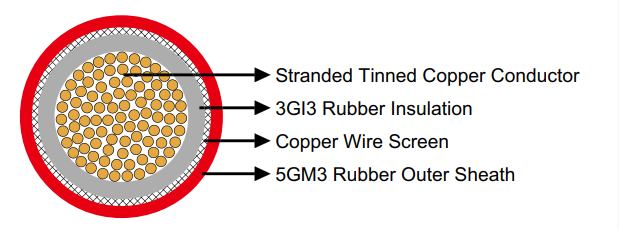
🔬 Advanced Construction Architecture & Material Composition
Conductor Assembly
Flexible stranded tinned copper, Class 5 flexibility per DIN VDE 0295 specification
Inner Semiconductive Layer
Specialized conductive rubber compound for field uniformity
Primary Insulation System
EPR (Ethylene Propylene Rubber) type 3GI3 compound
Outer Semiconductive Barrier
Special conductive rubber for stress control and screening
Metallic Screen Assembly
Spiral wound tinned copper wire construction
Protective Sheath Material
PCP (Polychloroprene) type 5GM3 compound
🏗️ Cross-Sectional Construction Layout
Stranded Tinned Copper Conductor (Class 5)
Special Conductive Rubber Inner Layer
EPR 3GI3 Primary Insulation
Special Conductive Rubber Outer Layer
Spiral Tinned Copper Wire Screen
PCP Type 5GM3 Protective Sheath
🎯 Performance Characteristics
EPR Insulation
Class 5 Flexibility
Copper Screening
PCP Sheath
VDE Certified
📊 Comprehensive Voltage Rating & Dimensional Specifications
⚡ 6/10kV Single Core Configuration Range
| Core Config | Cross Section | Insulation Thickness | Sheath Thickness | Overall Diameter | Weight per km |
|---|---|---|---|---|---|
| 1×16/16 | 16 mm² | 3.4 mm | 2.2 mm | 22.0 mm | 760 kg |
| 1×25/16 | 25 mm² | 3.4 mm | 2.2 mm | 23.5 mm | 910 kg |
| 1×35/16 | 35 mm² | 3.4 mm | 2.2 mm | 24.5 mm | 1040 kg |
| 1×50/16 | 50 mm² | 3.4 mm | 2.2 mm | 27.0 mm | 1260 kg |
| 1×70/16 | 70 mm² | 3.4 mm | 2.5 mm | 28.5 mm | 1530 kg |
| 1×95/16 | 95 mm² | 3.4 mm | 2.5 mm | 30.5 mm | 1770 kg |
| 1×120/16 | 120 mm² | 3.4 mm | 2.5 mm | 33.5 mm | 2180 kg |
| 1×150/25 | 150 mm² | 3.4 mm | 3.0 mm | 35.0 mm | 2550 kg |
| 1×185/25 | 185 mm² | 3.4 mm | 3.0 mm | 37.0 mm | 2900 kg |
| 1×240/25 | 240 mm² | 3.4 mm | 3.5 mm | 41.0 mm | 3590 kg |
| 1×300/25 | 300 mm² | 3.4 mm | 3.5 mm | 43.0 mm | 4280 kg |
| 1×400/35 | 400 mm² | 3.4 mm | 4.0 mm | 46.0 mm | 5120 kg |
| 1×500/35 | 500 mm² | 3.4 mm | 4.0 mm | 49.0 mm | 5950 kg |
| 1×630/35 | 630 mm² | 3.4 mm | 4.0 mm | 53.5 mm | 7860 kg |
⚡ 12/20kV Enhanced Insulation Configuration
| Core Config | Cross Section | Insulation Thickness | Sheath Thickness | Overall Diameter | Weight per km |
|---|---|---|---|---|---|
| 1×25/16 | 25 mm² | 5.5 mm | 2.5 mm | 28.0 mm | 1180 kg |
| 1×35/16 | 35 mm² | 5.5 mm | 2.5 mm | 29.5 mm | 1320 kg |
| 1×50/16 | 50 mm² | 5.5 mm | 2.5 mm | 31.5 mm | 1560 kg |
| 1×70/16 | 70 mm² | 5.5 mm | 3.0 mm | 34.0 mm | 1920 kg |
| 1×95/16 | 95 mm² | 5.5 mm | 3.0 mm | 36.0 mm | 2190 kg |
| 1×120/16 | 120 mm² | 5.5 mm | 3.0 mm | 38.0 mm | 2460 kg |
| 1×150/25 | 150 mm² | 5.5 mm | 3.5 mm | 40.0 mm | 2990 kg |
| 1×185/25 | 185 mm² | 5.5 mm | 3.5 mm | 42.0 mm | 3350 kg |
| 1×240/25 | 240 mm² | 5.5 mm | 3.5 mm | 45.0 mm | 3990 kg |
| 1×300/25 | 300 mm² | 5.5 mm | 3.5 mm | 48.0 mm | 4760 kg |
| 1×400/35 | 400 mm² | 5.5 mm | 4.0 mm | 52.0 mm | 6100 kg |
| 1×500/35 | 500 mm² | 5.5 mm | 4.0 mm | 56.0 mm | 7010 kg |
| 1×630/35 | 630 mm² | 5.5 mm | 4.0 mm | 60.0 mm | 8180 kg |
⚡ High Voltage Configurations: 14/25kV to 20/35kV
| Voltage Rating | Core Config | Cross Section | Insulation Thickness | Overall Diameter | Weight per km |
|---|---|---|---|---|---|
| 14/25kV | 1×25/16 | 25 mm² | 6.8 mm | 30.5 mm | 1300 kg |
| 14/25kV | 1×300/25 | 300 mm² | 6.8 mm | 49.0 mm | 4900 kg |
| 18/30kV | 1×50/16 | 50 mm² | 8.0 mm | 35.0 mm | 1870 kg |
| 20/35kV | 1×95/16 | 95 mm² | 9.5 mm | 44.0 mm | 2900 kg |
| 20/35kV | 1×150/25 | 150 mm² | 9.5 mm | 46.3 mm | 3600 kg |
| 20/35kV | 1×240/25 | 240 mm² | 9.5 mm | 51.7 mm | 5000 kg |
⚙️ Primary Applications & Installation Environments
Switchgear Interconnections
Primary and secondary connections within medium voltage switchgear assemblies, ring main units, and distribution panels
Mobile Transformer Substations
Flexible connections between mobile transformer units and overhead distribution lines for temporary power installations
Substation Equipment Links
Interconnection cables for disconnect switches, voltage transformers, and protective relay systems
Industrial Plant Distribution
Single core feeders for manufacturing facilities, chemical plants, and power generation auxiliary systems
Renewable Energy Connections
Wind farm collector systems, solar inverter connections, and energy storage system integration
Railway Electrification
Traction power distribution systems and railway substation connections requiring high flexibility
🔧 Installation Guidelines: NTMCWOEU cables are optimized for applications requiring superior electrical screening and flexibility. The spiral copper wire screen provides excellent electromagnetic shielding while maintaining mechanical flexibility for dynamic installations.
❓ Technical Support & Frequently Asked Questions
What distinguishes EPR insulation from traditional rubber compounds?
▼
EPR (Ethylene Propylene Rubber) type 3GI3 offers superior electrical properties including enhanced dielectric strength, improved aging resistance, and excellent thermal stability. Unlike conventional rubber compounds, EPR maintains consistent performance across wide temperature ranges and provides better resistance to electrical treeing and partial discharge phenomena.
How does the spiral copper wire screening enhance performance?
▼
The spiral-wound tinned copper wire screen provides excellent electromagnetic interference (EMI) shielding while maintaining cable flexibility. This construction method ensures uniform current distribution during fault conditions, enhances mechanical protection of the insulation system, and provides a reliable earth path for safety and protection coordination.
What are the advantages of PCP sheath material?
▼
PCP (Polychloroprene) type 5GM3 sheath provides exceptional resistance to oils, acids, alkalis, and weathering conditions. It maintains flexibility at low temperatures while offering superior flame retardancy and mechanical protection. The material’s self-extinguishing properties make it ideal for critical electrical installations.
Can these cables be used in wet or underground environments?
▼
While primarily designed for dry switchgear applications, the NTMCWOEU’s PCP sheath provides good moisture resistance. For permanent underground installations, additional protective measures such as conduits or cable ducts are recommended. The cable’s construction meets IP54 environmental protection standards for temporary outdoor use.
What installation bend radius requirements apply?
▼
The Class 5 flexible conductor construction allows for tight bend radii during installation. Minimum bend radius during installation is 6 times the overall cable diameter, while stationary installation requires 4 times the diameter. This flexibility is particularly advantageous in confined switchgear compartments and mobile transformer connections.


