
FEICHUN FIBER
Industrial Flexible Fibre Optic Cable
FLEXIBLE FIBER
Ultra-robust flexible fiber optic cable systems engineered for demanding industrial environments including materials handling equipment, conveyor systems, and hazardous area telecommunications requiring exceptional mechanical durability and reliable high-speed data transmission.
🌍 Global Telecommunications Standards & Certification Matrix
Our industrial flexible fiber optic cables comply with comprehensive international telecommunications and fiber optic standards:
Germany (DIN VDE)
DIN VDE 0888 certified compliance
International (ITU-T)
ITU-T G.652/G.651 fiber standards
European (IEC)
IEC 60793-2 fiber specification
American (TIA/EIA)
TIA/EIA-568 commercial standards
British (BS EN)
BS EN 187000 fiber cable standard
Telcordia (Bellcore)
GR-20-CORE generic requirements
Japanese (JIS)
JIS C 6835 optical fiber cable
Chinese (YD/T)
YD/T 901 optical cable standard
🔬 Advanced Fiber Optic Construction Technology
🌐 Multi-Core Fiber Architecture for Industrial Data Networks
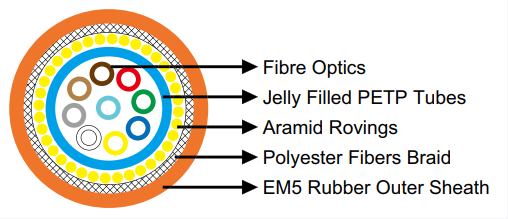
Our flexible fiber optic cables feature precision-engineered multi-core configurations supporting both single-mode and multimode transmission technologies. The jelly-filled PETP tube construction provides superior moisture protection while aramid strength members ensure exceptional tensile strength for dynamic industrial applications.
Optical Fiber Technology
Single-mode 9/125μm and multimode 50/125μm, 62.5/125μm configurations
Protection Tubes
PETP (Polyethylene Terephthalate) tubes filled with protective jelly compound
Strength Member System
Aramid rovings for superior tensile strength and flexibility
Protective Braiding
Polyester fiber braid for enhanced mechanical protection
Environmental Sheath
EM5 rubber compound for outdoor/indoor and hazardous environment use
Operating Conditions
Designed for high mechanical loads, no-reeling applications
🏗️ Layered Fiber Optic Construction Architecture
Central Fiber Optics (9/125, 50/125, 62.5/125μm)
PETP Protective Tubes with Jelly Filling
Aramid Rovings Strength Members
Polyester Fiber Protective Braid
EM5 Rubber Environmental Sheath
⚡ Advanced Performance Characteristics
Single/Multi Mode
Jelly Filled
Aramid Strength
EM5 Sheath
Hazard Rated
DIN VDE 0888
📊 Comprehensive Fiber Configuration Specifications
🔌 Complete Fiber Count & Type Configuration Matrix
| Fiber Configuration | Fiber Type | Core/Cladding | Min Diameter | Max Diameter | Weight per km |
|---|---|---|---|---|---|
| 1×12G50/125 | Multimode | 50/125 μm | 9.0 mm | 11.0 mm | 105 kg |
| 1×12G62.5/125 | Multimode | 62.5/125 μm | 9.0 mm | 11.0 mm | 105 kg |
| 1×12E9/125 | Single Mode | 9/125 μm | 9.0 mm | 11.0 mm | 105 kg |
| 1×18G50/125 | Multimode | 50/125 μm | 9.0 mm | 11.0 mm | 105 kg |
| 1×18G62.5/125 | Multimode | 62.5/125 μm | 9.0 mm | 11.0 mm | 105 kg |
| 1×18E9/125 | Single Mode | 9/125 μm | 9.0 mm | 11.0 mm | 105 kg |
| 1×24G50/125 | Multimode | 50/125 μm | 9.0 mm | 11.0 mm | 105 kg |
| 1×24G62.5/125 | Multimode | 62.5/125 μm | 9.0 mm | 11.0 mm | 105 kg |
| 1×24E9/125 | Single Mode | 9/125 μm | 9.0 mm | 11.0 mm | 105 kg |
📡 Fiber Type Performance Characteristics
Single Mode (9/125μm)
Long-distance transmission up to 100km, low attenuation, high bandwidth, ideal for backbone networks and long-haul communications
Multimode 50/125μm
High-bandwidth multimode for premises networks, supports Gigabit Ethernet and 10GbE applications up to 550m
Multimode 62.5/125μm
Legacy multimode standard, compatible with existing installations, suitable for shorter distance applications up to 275m
🏭 Industrial Applications & Deployment Scenarios
Materials Handling Equipment
Cranes, hoists, and mobile lifting equipment requiring flexible data transmission without cable reeling mechanisms
Conveyor Belt Systems
High-speed production lines, baggage handling systems, and automated sorting facilities with continuous cable movement
Hazardous Environment Networks
Petrochemical plants, explosive atmosphere zones, and corrosive industrial environments requiring intrinsic safety
Mining & Extraction Operations
Underground mining equipment, surface mining machinery, and remote monitoring systems in harsh conditions
Marine & Offshore Applications
Ship-to-shore communications, offshore platform networks, and marine vessel data transmission systems
Industrial Automation Networks
Robotic systems, automated production lines, and process control networks requiring high-reliability data transmission
🔧 Installation Note: This flexible fiber optic cable is specifically engineered for applications involving high mechanical loads and dynamic movement without the use of cable reeling systems. The aramid strength members and EM5 rubber sheath provide exceptional durability for continuous flexing operations.
❓ Technical Consultation & Application Guidance
What advantages does jelly-filled PETP tube construction provide?
▼
Jelly-filled PETP (Polyethylene Terephthalate) tubes provide exceptional moisture protection and fiber security. The jelly compound prevents water ingress, blocks moisture migration along the cable length, and cushions the delicate optical fibers during mechanical stress. PETP tubes offer superior chemical resistance, dimensional stability, and flexibility compared to traditional buffer tubes, making them ideal for harsh industrial environments.
How do aramid rovings enhance cable performance in dynamic applications?
▼
Aramid rovings provide exceptional tensile strength (up to 3000 MPa) while maintaining flexibility for dynamic applications. These synthetic fibers distribute mechanical stress uniformly across the cable, prevent fiber damage during installation and operation, and offer excellent fatigue resistance for continuous flexing applications. Aramid’s low creep characteristics ensure long-term dimensional stability under constant tension.
What environmental conditions can EM5 rubber sheath withstand?
▼
EM5 rubber compound offers exceptional environmental resistance including: temperature range from -40°C to +80°C, UV radiation stability for outdoor applications, chemical resistance to oils, acids, and alkalis, flame retardancy meeting industrial safety standards, and excellent ozone resistance. This makes it suitable for both indoor and outdoor installations, as well as hazardous environment applications requiring intrinsic safety.
Can this cable be used in applications without cable reeling systems?
▼
Yes, this cable is specifically designed for non-reeling applications where continuous cable movement and flexing occur. The combination of aramid strength members, polyester fiber braiding, and flexible EM5 sheath allows for repeated bending cycles without compromising fiber integrity. This makes it ideal for drag chain applications, mobile equipment connections, and installations where traditional reeling mechanisms are impractical or impossible.
What bandwidth capabilities do the different fiber types support?
▼
Single-mode 9/125μm fibers support virtually unlimited bandwidth for long-distance applications with typical attenuation of 0.36 dB/km at 1310nm. Multimode 50/125μm supports 10 Gigabit Ethernet up to 550m and provides 500 MHz·km bandwidth at 850nm. Multimode 62.5/125μm supports legacy applications with 160 MHz·km bandwidth at 850nm and is compatible with most existing network infrastructure.


