
DIN VDE 0250 Cable: How to Select the Right German Rubber, Flexible, Festoon and Reeling Family
“DIN VDE 0250 cable” is a useful search phrase, but it is not one universal cable. It points to a family of German cable standards and product designations covering special rubber-insulated single cores, flat flexible cable, NSSHÖU and NSHTÖU equipment cables, and trailing or reeling constructions such as (N)TSCGEWÖU. For a port engineer, mining engineer or export-buyer, the practical question is not whether a cable has the right-looking name. It is whether the exact construction can carry the load, survive the motion, control the fault path and arrive with evidence that matches the destination.
What does “DIN VDE 0250 cable” actually mean?
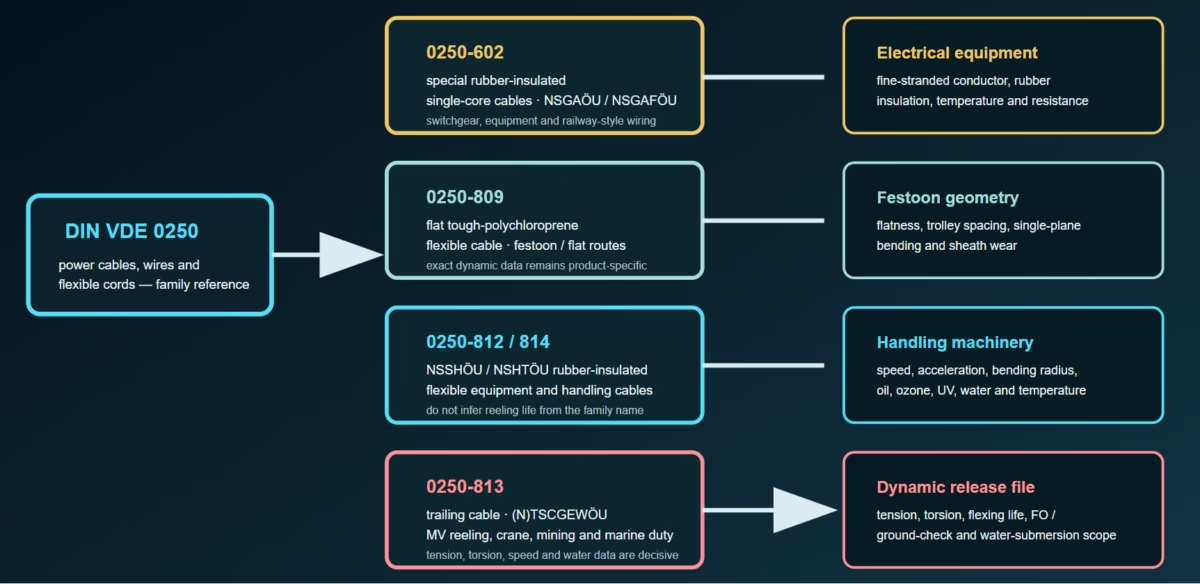
DIN VDE 0250 is best understood as a standards family and a market vocabulary. The historic general reference is not a single current cable product. The part number, cable designation, rated voltage, construction, installation duty and product evidence must be read together.
The distinction is important in export tenders. A buyer searching for DIN VDE 0250 cable may be looking for a fine-stranded NSGAFÖU single core in a switchboard, a flat rubber cable in a festoon trolley, an NSHTÖU handling cable, or a medium-voltage trailing cable with split earth and optical fibres for a ship-to-shore crane or mine conveyor. These cables can all be described as “VDE 0250” in informal correspondence, yet their electrical insulation, conductor class, geometry, bend radius, screen system and mechanical evidence are not interchangeable.
Official boundary. DIN Media lists the historic general DIN VDE 0250:1969-03 record as withdrawn, while specific parts are catalogued separately. That is why a professional specification should name the part and edition rather than write only “DIN VDE 0250”.
DIN VDE 0250 part-by-part: what the public records actually establish
The official records provide the safest starting point: the part title, publication date and catalogue status. Public cable pages then add application and construction examples. The two layers should not be mixed. A part title proves the standard route; it does not automatically prove a particular conductor class, rated voltage, travel speed, water depth, fire class or certificate.
| DIN VDE 0250 route | Catalogue status / type | Typical cable family | Engineering use | Selection boundary | Evidence level |
|---|---|---|---|---|---|
| 0250-602:1985-03 | Current in DIN Media catalogue | Special rubber-insulated single-core cable; NSGAÖU / NSGAFÖU are common market names | Switchgear, equipment wiring, railway-style and industrial single-core routes | The exact voltage, conductor class, sheath and bend radius come from the product schedule | Official part scope + public product comparators |
| 0250-809:1985-05 | Current in DIN Media catalogue | Flat ordinary tough-polychloroprene-sheathed flexible cable | Flat festoon and single-plane handling systems when the product is released for that duty | The part title does not set a universal travel speed or flexing life | Official part scope |
| 0250-812:1985-05 | Current in DIN Media catalogue | Rubber-insulated flexible cable NSSHÖU | Flexible equipment, handling and industrial power applications | Confirm voltage, conductor construction, temperature and dynamic limits | Official part scope |
| 0250-813:1985-05 | Current in DIN Media catalogue | Trailing cable / Leitungstrosse; market families include (N)TSCGEWÖU and related designs | Crane, mine, marine and heavy handling reeling systems | Tension, torsion, speed, water, split earth and optical-fibre options are product-specific | Official part scope + product-family data |
| 0250-814:1985-02 | Current in DIN Media catalogue | Rubber-insulated flexible cable NSHTÖU | Heavy-duty equipment and handling cables where the selected product permits | Do not infer a reel application from NSHTÖU alone | Official part scope |
| V 0250-10:2026-01 | Pre-standard | Guide for assigning reaction-to-fire classes | Fire-class assignment methodology and project documentation | It is not a blanket fire approval for every DIN VDE 0250 cable | Official DIN Media pre-standard record |
| Historical 0250 references | Some withdrawn or replaced | Older catalogue wording may point to a successor part or a different national / harmonised route | Legacy plant, tenders and replacement work | Always verify the current edition and replacement note before quotation | Official status record |
Part 602. DIN Media describes DIN VDE 0250-602:1985-03 as special rubber-insulated single-core cables. Public product data for NSGAÖU / NSGAFÖU families commonly shows tinned copper, EPR-type insulation and a rubber oversheath, with NSGAFÖU used for fine-stranded flexible wiring. Those are useful construction comparators; the exact voltage, current, bend radius and sheath compound must be taken from the selected product schedule.
Part 809. The official title is a flat ordinary tough-polychloroprene-sheathed flexible cable. It is therefore a natural route to investigate for flat festoon systems, but the part title alone does not release trolley spacing, speed, permissible sag, dynamic radius or cycle life.
Parts 812 and 814. DIN Media identifies the NSSHÖU and NSHTÖU rubber-insulated flexible cable routes. In a project file they should be treated as candidate families for flexible equipment and handling cables; the actual machine duty still decides whether the chosen product is suitable for a reel, festoon, hoist, vertical drop or occasional movement.
Part 813. This is the trailing-cable route. Public `(N)TSKCGEWÖU` product information describes crane, hoist, conveyor, open-pit and underground-mining applications, with optional fibre optics and dynamic requirements such as torsion and tensile stress. Those figures belong to that product-family example, not to every cable bearing a 0250-813 reference.
Fire-class update. DIN VDE V 0250-10:2026-01 is listed by DIN Media as a pre-standard guide for assigning reaction-to-fire classes. It should not be converted into a blanket B2ca, Cca, Dca or Eca claim for a cable until the exact construction has the required classification evidence. DIN VDE V 0250-10:2026-01 record
The official part records used for this map are: 0250-602, 0250-809, 0250-812, 0250-813 and 0250-814. Public construction comparators include a trailing-cable data page, an NSGAFÖU product page and a rubber-insulated NSGAÖU / NSGAFÖU schedule.
Construction: why two “VDE 0250” cables can behave completely differently
In dynamic cable engineering, the construction is a mechanical system as much as an electrical one. Conductor stranding, insulation modulus, core lay, separators, earth arrangement, screen coverage and oversheath compound determine how bending and torque move through the cable. A strong rubber sheath cannot repair a poor core geometry; a large copper section cannot compensate for an unsuitable bend radius.
| Layer / feature | Typical content | Why it matters | Engineering control |
|---|---|---|---|
| Conductor | Bare, tinned or otherwise specified copper; Class 1, 2 or fine-stranded Class 5 depending on family | Controls resistance, fatigue life, OD, mass, voltage drop and termination | Never infer Class 5 from the word ‘flexible’; check IEC 60228 / product drawing |
| Insulation | Rubber, EPR or a family-specific compound such as 3GI3 | Electrical insulation, temperature capability and repeated flexing behavior | Compound designation and wall thickness are product-specific |
| Core lay-up | Parallel flat cores, layered round assembly, cradle separator or special filler | Controls bending plane, torsion transmission, pressure distribution and OD | A flat festoon cable and round reeling cable do not share the same mechanical model |
| Earth / ground-check | Protective earth, split earth, pilot or ground-check conductor when specified | Fault protection, monitoring and machine-control logic | The suffix and conductor count must be checked against the electrical schematic |
| Screen / braid | Tinned copper braid, semiconductive layer, copper screen or optical-fibre structure as specified | EMC, electric-field control, monitoring or data transmission | A screen is not automatically a mechanical armour or CPC |
| Inner / outer sheath | PCP, neoprene, EPR, PUR, LSZH or other approved rubber compound | Abrasion, cut, oil, ozone, UV, water, fire and atmospheric resistance | Resistance claims require the selected compound and test evidence |
Fine-stranded conductor
Class 5 conductors reduce bending stiffness and distribute strain over many wires. The trade-off is that the finished cable may have different resistance, compaction, mass and termination requirements from a Class 2 equivalent.
Rubber / EPR insulation
Rubber and EPR compounds are selected for flexibility, temperature and environmental duty. “Rubber” is not a single material specification; compound designation, wall thickness and test evidence matter.
Split earth and ground-check
Trailing cables may carry a split earth, pilot or ground-check element. This supports machine protection and monitoring, but it changes the cross-section, balance, termination and fatigue model.
Screen versus armour
A copper braid or semiconductive layer can control electromagnetic or electric-field behavior. It is not automatically a mechanical armour layer or a protective-conductor path.
| Designation clue | Safe first reading | Why it is not enough | What to verify |
|---|---|---|---|
| J / O in familiar cable designations | J commonly indicates a green/yellow protective conductor; O commonly indicates no protective conductor | Useful for simple harmonised cable names, but complex VDE reeling constructions may use split earth, pilot or ground-check conductors | Read the conductor schedule and drawing |
| N / national designation | Often appears in German national cable names | It identifies a designation route, not every performance characteristic | Confirm the referenced DIN VDE part |
| S / G / T / C / E / W / Ö / U sequences | Treat as a construction-family shorthand | The meaning and order are not safe to reconstruct from memory across all product families | Use the manufacturer’s designation key |
| F / fine-stranded wording | May appear in the commercial family name for fine-wire conductors | Conductor class, plating and resistance still require documentary confirmation | IEC 60228 / product data |
| 3 × 35 + 3 × 6 or 3 + 3 layouts | Three phase cores plus split earth / auxiliary earth arrangement | The earth section and mechanical centreline can change the dynamic behavior | Electrical schematic and cross-section |
| FO / pilot / ground-check | Additional data or monitoring elements integrated into the cable | These elements impose their own bend, crush, tensile and termination limits | Optical and electrical sub-schedules |
J / O caution. For simple German or harmonised cable designations, J commonly indicates a green/yellow protective conductor and O commonly indicates no protective conductor. Complex VDE reeling constructions may use split earth, pilot or ground-check conductors, so the conductor schedule and drawing always override a memory-based suffix interpretation.
Where each family fits: fixed wiring, festoon, cranes, mining and reeling
A useful selection conversation starts with the machine, not the catalogue name. Ask whether the cable is fixed, dragged, festooned, reeled, suspended, twisted between planes, submerged or exposed to a particular contaminant. Then choose the standard route and construction that can be documented for that duty.
| Application | Candidate family route | Typical location | Parameters to close | Main mistake |
|---|---|---|---|---|
| Fixed equipment wiring | 0250-602 / selected NSGAÖU or NSGAFÖU route | Dry industrial panels, devices, railway or equipment wiring | Voltage, conductor class, ambient temperature, bend radius and termination | Do not silently upgrade a fixed single-core to reeling duty |
| Flat festoon | 0250-809 / flat rubber family | Indoor cranes, trolleys and single-plane travel | Flatness, trolley spacing, travel speed, sag and dynamic radius | A round trailing cable may be electrically suitable but mechanically wrong |
| Flexible handling | 0250-812 / 0250-814 candidate | Hoists, material handling and moving industrial equipment | Continuous flexing, temperature, oil, ozone, UV, impact and support geometry | Exact product data controls whether reel or festoon use is allowed |
| MV trailing / reeling | 0250-813 / (N)TSCGEWÖU-type family | Port cranes, ship unloaders, mining conveyors, stacker-reclaimers and hoists | U₀/U, semiconductive screens, earth arrangement, tension, torsion, speed and water | Use product-specific dynamic evidence; standard number alone is not enough |
| MV + data | 0250-813 product with FO option | Crane monitoring, position feedback, CCTV or control networks | Fibre type, bend radius, crush, torsion, splice method and EMC separation | FO availability is a construction option, not an automatic family property |
| Submersible / wet duty | Only a product explicitly released for the water duty | Dredging, submerged hoists, wet mines and marine handling | Radial / longitudinal water blocking, hydrostatic pressure, sheath, connectors and sealing | Rubber sheath alone does not prove permanent submersion |
For port and container-terminal projects, the important boundary is between a fixed feeder and a moving crane cable. An RTG/RMG, ship-to-shore crane, ship unloader or conveyor can combine high current, repeated take-up, acceleration, salt air, UV, oil, impact and water. The cable may also carry ground-check, control or optical-fibre circuits. Those requirements should be written into the technical schedule instead of hidden behind “DIN VDE 0250 cable”.
For mining, add mud, abrasive dust, water pressure, dynamic pulling, impact, temperature swings and fault-monitoring requirements. A trailing cable for a mine conveyor or hoist is a machine component. Its permissible tension and bending path should be checked in the same design review as the drum, guide rollers, clamps, termination and protection system.
Dynamic selection: bending radius is only the first mechanical number
Engineers often ask for the minimum bending radius first because it is easy to print in a schedule. In a real reel or festoon, the cable sees a combination of curvature, axial tension, lateral pressure, torsion and temperature. The most damaging location is frequently the transition between the drum and guide, the entry to a trolley, the first unsupported drop or a point where the cable is forced to change plane.
One public `(N)TSKCGEWÖU` product-family description gives an example of high-duty reeling with torsional and tensile requirements. That is useful evidence that dynamic parameters belong in the data sheet, but it is not permission to transfer those numbers to another manufacturer’s cable or to a different construction. Feichun’s released drawing must carry its own values after the machine duty, size and materials are fixed.
Do not promote a fixed cable by adjective. NSGAÖU, NSSHÖU or NSHTÖU can be flexible in handling, while a dedicated `(N)TSCGEWÖU` trailing cable is engineered for a different dynamic envelope. A “rubber cable” label is not a reeling qualification.
Electrical and thermal design: flexible does not mean electrically free
The electrical design still requires the same discipline as a fixed power circuit. Conductor class affects resistance; core arrangement affects inductance and field balance; screens and earth conductors affect fault paths; installation temperature and grouping affect ampacity. In MV trailing cables, semiconductive screens, metallic screens, split earth and accessories must be designed as one system.
| Design item | What to calculate or specify | Why the shortcut fails | Release evidence |
|---|---|---|---|
| Rated voltage U₀/U | Phase-to-earth and phase-to-phase network voltage; use the complete designation | Do not combine a low-voltage accessory or screen with an MV cable without approval | Exact family and product drawing |
| Current and voltage drop | Conductor resistance, installation method, load profile, power factor and length | A flexible fine-stranded cable can have a different OD and resistance from a rigid equivalent | Manufacturer schedule + installation calculation |
| Bending radius | Fixed, dynamic, festoon, reeling or optical-fibre radius as stated for the selected product | The smallest bend often occurs at the reel flange, guide, trolley or transition point | Product-specific drawing and machine geometry |
| Speed / acceleration | Travel speed, cycles per hour, acceleration and braking profile | Peak acceleration can govern conductor fatigue and sheath migration even when average speed is low | Machine duty cycle |
| Tension / torsion | Cable weight, suspended length, pulling force, torque and multiplane rotation | A cable can tolerate bending but fail when torsion is added between planes | Dynamic mechanical release data |
| Environment | Oil, ozone, UV, salt mist, mud, water, chemicals, cold and heat | Choose the sheath for the actual contaminant and temperature, not only the nominal IP rating | Compound data + project environment |
| Fire / certification | Flame, smoke, halogen, CPR, ATEX, IECEx and destination documents as applicable | These are separate evidence streams; DIN VDE family naming does not create blanket certification | Product-specific certificates and declarations |
For an industrial reel, current rating should be checked in both the wound and paid-out condition. Drum layers, heat dissipation, ambient temperature, mutual heating, cable spacing and duty cycle can change the thermal result. A cable that is acceptable on an open tray may require derating when tightly wound or enclosed in a machine.
For a flexible copper cable, do not ignore the termination. Fine strands, tinned conductors, ferrules, lugs, glands, screen bonds and split-earth terminations may have different preparation rules from a rigid Class 2 distribution cable. The approved installation instruction should identify the compatible accessories and tightening method.
Testing, fire performance and certificate scope
A professional DIN VDE 0250 file has at least three evidence layers: the standard route, the product construction and the application release. The same logic applies when a buyer asks for VDE, CE, UKCA, EAC, ATEX or IECEx. A logo or family name is not a substitute for a certificate whose scope covers the actual cable design, voltage, size range, destination and intended installation.
| Evidence layer | Minimum question | Engineering purpose | Document |
|---|---|---|---|
| Standard identity | Exact DIN VDE part, edition, product designation and construction code | Avoids treating a historical or adjacent part as the current requirement | Standard record + approved drawing |
| Electrical routine tests | Continuity, conductor resistance, insulation / dielectric tests and screen / earth checks as applicable | Shows the manufactured length meets the released electrical design | Routine test report |
| Mechanical / environmental | Bend, tensile, abrasion, oil, ozone, UV, water, cold and heat tests where specified | Matches the machine and site rather than relying on a sheath adjective | Type / sample evidence |
| Fire performance | Flame, smoke, halogen and corrosivity requirements only when specified for the construction | A pre-standard guide or a family name is not the same as a product classification | Classification report / declaration |
| Dynamic validation | Reeling, festoon, torsion, acceleration, cycle count and temperature profile | Necessary for port, mining and handling machinery | Machine-specific test or validated product family |
| Certificates | ATEX, IECEx, VDE, CE, UKCA, EAC and Russian Fire Safety Certificate only where applicable | Confirms destination and product scope | Certificate number, scope and technical file |
Conductor evidence
Confirm copper material, plating where specified, conductor class, resistance and dimensional consistency. IEC 60228 is a useful conductor reference, but the complete cable standard and product schedule still apply.
Sheath evidence
Oil, ozone, UV, abrasion, cold, heat and water performance belong to the selected compound and test plan. A black rubber sheath does not automatically prove all of these properties.
Fire evidence
Flame propagation, smoke density, halogen-free behavior, corrosivity and CPR reaction-to-fire class are different statements. Request the exact test or classification document when the project needs it.
Dynamic evidence
For reeling and trailing duty, request the mechanical envelope, cycle or flexing validation, torsion and tensile limits, and the conditions under which the data was obtained.
Technical references for test vocabulary include IEC 60228 conductor classes, IEC 60332-1-2 flame propagation, and IEC 60811 cable test methods. These links support the engineering terminology; the applicable DIN VDE product part and destination regulations control the final test plan.
Feichun DIN VDE 0250 capability: independent design, complete documentation
Feichun Cable can manufacture independently engineered, functionally equivalent products for DIN VDE 0250 project requirements, including rubber-insulated flexible cables, flat festoon constructions, heavy-duty handling cables and trailing / reeling designs. The correct replacement strategy is to reproduce the required electrical, thermal, mechanical, environmental and documentary performance through an independent construction and test plan—without copying another manufacturer’s proprietary drawing or claiming to be the original branded product.
| File section | Information to release | Rule |
|---|---|---|
| Family and part | DIN VDE 0250-602 / 809 / 812 / 813 / 814 or other verified route | Record the exact edition and replacement status |
| Electrical schedule | U₀/U, core count, cross-section, conductor class, resistance, current and voltage-drop data | No missing values hidden behind a family name |
| Mechanical schedule | OD, mass, fixed/dynamic bend radius, speed, acceleration, tensile and torsional limits | TBC until the selected machine duty is released |
| Construction drawing | Conductor, insulation, filler, earth, screen / FO, inner sheath and oversheath | Independent Feichun geometry; no copied proprietary drawing |
| Environment and fire | Oil, ozone, UV, water, corrosion, flame, smoke, halogen and temperature scope | Claim only what the selected compound and test file support |
| Inspection and certificates | Routine tests, marking, packing, traceability and destination conformity package | Certificate scope must match the actual product and market |
Engineered for maximum safety in demanding environments, our cable systems comply with global standards including ATEX, IECEx, VDE, CE, UKCA, EAC, and the Russian Fire Safety Certificate. The exact certificate scope is matched to the cable construction, voltage, destination, installation and conformity route. These certifications are not presented as blanket approval for every DIN VDE 0250 family or every custom size.
For a port or mining replacement, Feichun can work from the available legacy marking, cross-section, drum label, machine interface and required performance. Unknown values remain TBC until the approved drawing, material schedule, test plan and destination documentation are complete. That discipline is what keeps a functionally equivalent cable technically defensible.
Procurement wording that stays accurate: “DIN VDE 0250-[part], [exact cable designation], U₀/U [value], [cores and cross-section], [fixed / festoon / reeling duty], with product-specific construction drawing, mechanical data, routine tests and destination certificate scope.”
Public source audit: DIN VDE 0250 historical record; DIN VDE 0250-602; DIN VDE 0250-809; DIN VDE 0250-812; DIN VDE 0250-813; DIN VDE 0250-814; DIN VDE V 0250-10; public DIN VDE 0250 family overview; public trailing-cable example; public NSGAFÖU example.
FAQ: DIN VDE 0250 cable questions from export buyers and engineers
These are the questions that normally appear when a legacy marking, German catalogue name or crane cable requirement enters an international tender.
Is DIN VDE 0250 one cable standard?
No. It is a family reference. The part number—such as 602, 809, 812, 813 or 814—must be named, together with the exact cable construction and edition.
What is DIN VDE 0250-602 used for?
It is the special rubber-insulated single-core route. NSGAÖU and NSGAFÖU are common market families associated with it, but voltage, conductor class, sheath and bend data remain product-specific.
Which part is associated with trailing cable?
DIN VDE 0250-813 is the trailing-cable route. Product families such as (N)TSCGEWÖU may be used for crane, mining, marine and reeling duty, subject to their own dynamic data.
Is NSHTÖU automatically a reel cable?
No. NSHTÖU is a named flexible cable route under 0250-814. A reel application must be supported by the selected product’s radius, speed, tension, torsion, temperature and flexing evidence.
Can DIN VDE 0250 cable be used on a port crane?
Some 0250-813 trailing constructions are designed for crane and marine handling, but a fixed or general flexible cable must not be assumed suitable. Define the crane’s movement envelope and select the dynamic product accordingly.
What does J or O mean?
In simple cable names, J commonly indicates a protective conductor and O commonly indicates no protective conductor. Complex reeling cables may use split earth, pilot or ground-check cores, so the conductor schedule controls.
Does VDE in the name mean VDE certification?
No. The designation can identify a German standard route. Certification must be demonstrated for the exact cable, construction, voltage, size range and market.
Does a rubber sheath prove oil, UV or water resistance?
No. Those are compound- and test-specific properties. Check the product data for the exact exposure, temperature and immersion or water-blocking requirement.
Can a DIN VDE 0250 cable include fibre optics?
Some trailing and reeling constructions provide FO options. The fibre type, bend radius, tensile limit, crush protection and termination must be scheduled separately from the power cores.
Can Feichun manufacture a replacement?
Yes. Feichun can manufacture an independent functional equivalent with its own drawing, materials, tests, marking, traceability and applicable certificate scope, avoiding the need to copy another manufacturer’s proprietary design.
FAQ configuration checklist DIN VDE part: [602 / 809 / 812 / 813 / 814 / verified alternative] Cable designation: [exact legacy marking or required construction] Rated voltage U₀/U: [value] · cores / cross-section: [value] Conductor: [copper / class / plating] · earth / pilot / FO: [value] Duty: [fixed / festoon / reel / trailing / multiplane torsion / submerged] Machine: [crane / trolley / hoist / conveyor / mining / marine / plant] Radius / speed / cycles / tension / torsion: [values] Environment: [oil / ozone / UV / salt / mud / water / temperature / fire] Required evidence: [drawing / routine tests / dynamic data / certificates]
The open fields are deliberate. They prevent a familiar German cable name from hiding the one parameter that decides whether the cable will survive the machine.


[…] [5] Feichun Cable 官方技术内容:飞纯公开资料列出 DIN VDE 0250 动态/矿用柔性电缆、reeling/festoon/drag-chain 应用,并说明其认证体系覆盖 ATEX、IECEx、VDE、CE、UKCA、EAC 与俄罗斯消防认证;同一页面也提示具体证书范围需与电缆结构、电压、目的地和合规路线匹配。 Feichun — DIN VDE 0250 Cable Selection […]