
(N)TSCGEWOEU-LED 3.6/6 kV: A Self-Powered Illuminated Trailing Cable for Shovels, Draglines, and Extreme-Cold Open-Pit Mining Operations
A long-form engineering page built for people who actually specify mining cables. Not just buyers. Not just marketers. Real project teams. The kind of teams that care about trailing duty, torsion, cold-start reliability, live-cable visibility, abrasion, current capacity, and the ugly truth of what happens when a shovel cable disappears into dust, snow, darkness, or bench clutter. Based on the uploaded FeiChun technical data sheet and presented in the same editorial-technical style as the reference HTML page.
Summary: (N)TSCGEWOEU-LED is a 3.6/6 (7.2) kV illuminated MV trailing cable for shovels and draglines, based on DIN VDE 0250-813, with GOST-R certification, Class 5 tinned copper conductors, EPR insulation, FC-EMH™ self-powered LED harvesting, FC-ASB™ stress-relief braid, and a translucent FR-TPU FC-TPU™ X-Series sheath formulated for flexibility down to −50 °C.
Why a glowing shovel cable matters more than most people think
On paper, a trailing cable is just a power cable. In the field, it is something else entirely. It is a moving asset, a safety boundary, a visibility problem, a maintenance item, and very often the silent cause of expensive downtime. Large electric shovels and draglines do not operate in neat, indoor conditions. They work in mud, coal dust, blasted rock, fog, snow, twilight, and night shift conditions where cable routes become hard to see and even harder to protect.
That is where the logic of the (N)TSCGEWOEU-LED gets strong. The uploaded technical sheet describes it as a 3.6/6 kV MV power supply cable for large mobile equipment in mines, designed for trailing and reeling applications, with integrated self-powered LED illumination and no need for an external DC supply. The result is simple, visual, and operationally useful: the energised cable becomes visible across its route, helping crews see where the live cable actually is before they cross it, move around it, isolate it, or accidentally abuse it. That core positioning comes directly from the product sheet itself. fileciteturn1file0
This product is not selling “LED for the sake of LED.” It is selling visibility as a safety and uptime feature. That is a much better engineering story. It links directly to route awareness, live-cable indication, LOTO discipline, and better cable handling in low-visibility mines.
Construction breakdown: what is inside the cable
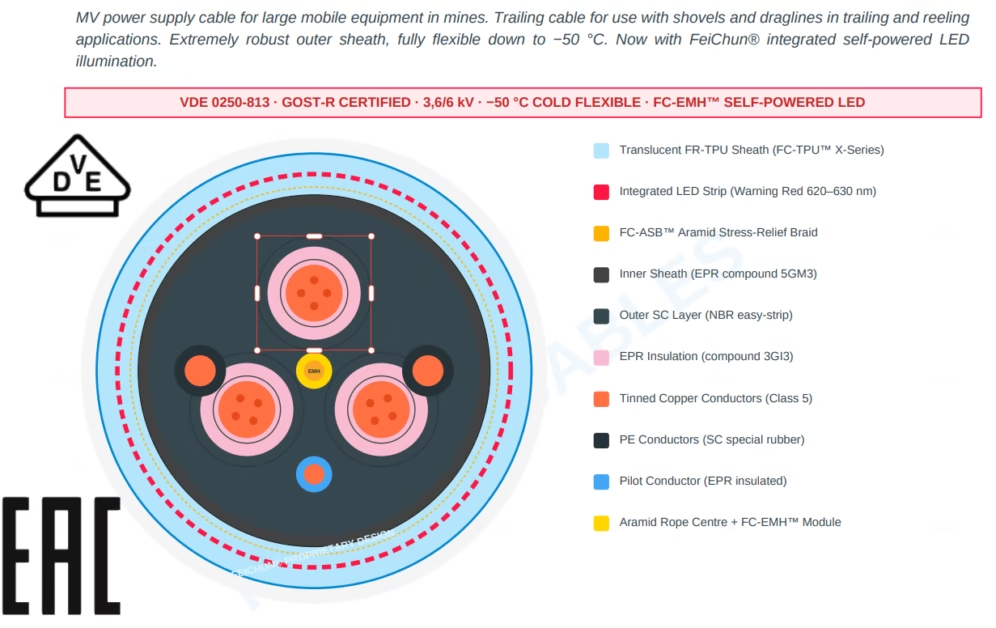
The structure is one of the strongest parts of this product story because the uploaded PDF gives enough detail to build a serious technical page, not just a brochure page. The conductor system uses finely stranded, tinned Class 5 copper. The main insulation is EPR compound 3GI3. The design includes an inner semi-conductive layer, an outer semi-conductive NBR easy-strip layer, semi-conductive special rubber PE conductors, and an EPR insulated pilot conductor. All cores are laid around a conductive central support element with an aramid rope centre. An inner sheath of EPR compound 5GM3 surrounds the laid-up assembly. Above that, the LED system is protected by an FC-ASB™ aramid stress-relief braid, then finished with a translucent flame-retardant TPU outer sheath under FeiChun’s FC-TPU™ X-Series formulation. fileciteturn1file0turn1file1
That stack-up matters because it tells engineers two things right away. First, this is not a cosmetic add-on. Second, the lighting feature has been integrated into a proper mining cable architecture rather than taped onto a standard trailing cable as an accessory.
| Layer | Material / System | Operational Meaning |
|---|---|---|
| Conductors | Tinned copper, Class 5 | High flexibility and corrosion resistance for mobile mining duty. |
| Insulation | EPR, compound 3GI3 | Stable dielectric performance under MV trailing service. |
| SC layers | Inner SC EPR + outer SC NBR easy-strip | Field control plus easier preparation during termination work. |
| Pilot | Tinned copper, EPR insulated | Supports mining control and monitoring architecture. |
| Centre support | Aramid rope centre | Mechanical backbone for tensile and dynamic service. |
| Energy module | FC-EMH™ induction harvesting | Self-powered LED operation without external DC. |
| LED strip | Warning red, 620–630 nm | Full-length live-cable visibility in harsh field conditions. |
| Outer sheath | Translucent FR-TPU FC-TPU™ X-Series | Light transmission plus abrasion and low-temperature flexibility. |
FC-EMH™ self-powered LED architecture and why plug-and-play matters
The self-powered concept is the emotional centre of the page because it removes the thing most customers hate: extra complexity. The PDF explains that the LED system uses an electromagnetic induction pickup coil wound around the aramid centre support. It also states galvanic isolation between the LED circuit and the 6 kV conductors, and makes the positioning very direct: no external DC supply, no switchgear modification, and direct drop-in replacement. fileciteturn1file5
That is more than a nice feature. It changes the procurement conversation. A buyer no longer needs to evaluate a cable plus a separate power kit plus retrofit labour plus a control cabinet revision. Instead, the product can be pitched as a faster upgrade path for fleets that already know this cable family and simply want better route visibility and live-cable indication.
Use the phrase disconnect → connect → energise → glow. It is already aligned with the source material, and it communicates the retrofit logic in one line. It sounds simple because the value is simple.
Extreme-cold performance: −50 °C is not a decorative number
Many cable pages throw around cold-temperature claims. Serious buyers notice when the page does not explain what the number actually changes. Here, the PDF gives a much better base. It states ambient fixed service from −50 °C to +80 °C and ambient flexible service from −50 °C to +60 °C. It also ties this cold performance to the FC-EMH™ X-variant with cold-rated capacitors and LDO regulators, plus a cold-flex translucent FR-TPU outer sheath that maintains translucency at extreme sub-zero temperatures. fileciteturn1file1turn1file5
That combination is what makes the story credible. It is not only the cable body that stays flexible. The LED system itself is also described as able to start reliably in severe winter mining conditions. For any mine in Siberia, Kazakhstan, Mongolia, Canada, or the far north of Europe, that matters. A glowing cable that stops glowing in the cold is not really an illuminated cable. This one is positioned to avoid that trap.
Cold-region engineers often search by application pain, not by part number. That is why phrases like extreme-cold shovel cable, −50 °C dragline trailing cable, and live illuminated mining cable for Arctic operations are commercially useful page language.
Dimensional range and selection table
The uploaded data sheet lists 13 standard constructions, from 3×16 mm² up to 3×300 mm². That is wide enough to build a proper selection table and target a large group of search queries from people who search by printed marking or familiar cross-section pattern. The document also states that the listed diameters and weights already include the LED system, and that total weight is about 10–14% above the standard version. fileciteturn1file1turn1file3
| Construction | Part No. | Cable Ø min / max mm | Weight kg/km | LED Power |
|---|---|---|---|---|
| 3×16+2×10+1×10 | FC-TSCG-LED-016A | 44.5 / 49.0 | 2545 | FC-EMH™ |
| 3×16+2×16+1×16 | FC-TSCG-LED-016B | 44.0 / 48.5 | 2766 | FC-EMH™ |
| 3×25+2×16+1×16 | FC-TSCG-LED-025 | 47.5 / 52.0 | 3125 | FC-EMH™ |
| 3×35+2×16+1×16 | FC-TSCG-LED-035 | 51.0 / 55.0 | 3674 | FC-EMH™ |
| 3×50+2×16+1×16 | FC-TSCG-LED-050 | 54.0 / 58.5 | 4368 | FC-EMH™ |
| 3×70+2×25+1×16 | FC-TSCG-LED-070 | 60.0 / 65.0 | 5622 | FC-EMH™ |
| 3×95+2×25+1×16 | FC-TSCG-LED-095 | 64.0 / 69.0 | 6563 | FC-EMH™ |
| 3×95+3×50/3 | FC-TSCG-LED-095T | 64.0 / 69.0 | 6496 | FC-EMH™ |
| 3×120+2×35+1×16 | FC-TSCG-LED-120 | 71.5 / 76.5 | 8299 | FC-EMH™ |
| 3×150+2×35+1×16 | FC-TSCG-LED-150 | 76.0 / 80.0 | 9471 | FC-EMH™ |
| 3×185+2×50+1×16 | FC-TSCG-LED-185 | 79.5 / 84.5 | 11150 | FC-EMH™ |
| 3×240+2×70+1×16 | FC-TSCG-LED-240 | 87.5 / 92.5 | 14132 | FC-EMH™ |
| 3×300+2×95+1×16 | FC-TSCG-LED-300 | 91.5 / 97.0 | 16884 | FC-EMH™ |
Electrical and mechanical performance for engineers
Good SEO pages in industrial markets need real numbers. Otherwise engineers bounce. The product sheet gives enough performance data to hold the page together. Maximum tensile values range from 1,200 N for the smallest constructions up to 22,500 N for the 3×300 mm² version. Current capacity rises from about 99 A to 620 A, with the sheet noting that current ratings follow VDE 0298-4, Table 15, surface at 30 °C. Capacitance, inductance, and conductor resistance are also listed. fileciteturn1file3
| Construction | Max Tensile N | Capacitance nF/km | Inductance mH/km | Resistance at 20 °C Ω/km | Current Capacity A |
|---|---|---|---|---|---|
| 3×25+2×16+1×16 | 1875 | 230 | 0.36 | 0.795 | 131 |
| 3×50+2×16+1×16 | 3750 | 290 | 0.32 | 0.393 | 202 |
| 3×70+2×25+1×16 | 5250 | 340 | 0.30 | 0.277 | 250 |
| 3×95+2×25+1×16 | 7125 | 370 | 0.29 | 0.210 | 301 |
| 3×150+2×35+1×16 | 11250 | 440 | 0.27 | 0.132 | 404 |
| 3×240+2×70+1×16 | 18000 | 540 | 0.26 | 0.0817 | 540 |
| 3×300+2×95+1×16 | 22500 | 780 | 0.24 | 0.0654 | 620 |
The source sheet also lists bending radii of 6×D fixed, 10×D flexible, and 20×D for S-type duty, along with torsional capability of ±100°/m and conductor temperature of 90 °C with 250 °C short-circuit rating for 5 seconds. These details are exactly the kind of numbers a mining EPC or electrical team expects on a serious cable page. fileciteturn1file1
Where this cable fits best in real mining operations
The web page should not stop at “shovel and dragline.” It should explain the operating scene. This product makes the most sense where mines need a combination of medium-voltage trailing duty, dynamic movement, cold-region flexibility, and fast visual route recognition. That includes large electric rope shovels, draglines with long trailing runs, and open-pit assets working in early morning darkness, snowstorm conditions, dusty sunset shifts, and winter bench operations where conventional cable visibility drops badly.
The source PDF itself highlights key benefits such as extreme cold LED illumination, plug-and-play shovel and dragline integration, cable route visibility in harsh conditions, live cable indication, and a maintenance-free four-layer FC-SPM™ surge protection architecture using magnetic saturation, TVS diodes, Zener/LDO regulation, and resettable PTC protection. fileciteturn1file4turn1file5
This page follows the uploaded FeiChun data sheet closely. It is written as a strong technical-marketing asset, but buyers should still verify final project compatibility, local approval requirements, and termination practice against the latest project specification and site rules before procurement.
SEO FAQ for procurement teams, engineers, and mining planners
Is (N)TSCGEWOEU-LED a standard trailing cable or a special custom product?
It is presented as a standardised product family based on DIN VDE 0250-813 with 13 standard constructions from 3×16 mm² to 3×300 mm², rather than a one-off prototype. fileciteturn1file1turn1file4
Does the LED system need a separate power supply?
No. The source document explicitly positions it as self-powered through FC-EMH™, with no external DC supply required. fileciteturn1file0turn1file5
What mining regions is this cable page best suited to target?
From an SEO angle, this page is especially relevant for searches tied to cold and Eurasian mining regions because the product sheet combines VDE 0250-813, GOST-R/-K/-B certification, and −50 °C flexibility. That combination is commercially attractive for Russia-adjacent, Kazakhstan, CIS, and other cold-region mining search traffic. fileciteturn1file1turn1file5
Why does the outer sheath matter so much on this page?
Because the sheath is doing two jobs at once. It must survive mining abuse and still pass light visibly. The uploaded sheet frames the translucent FR-TPU FC-TPU™ X-Series as a core differentiator, not an afterthought. fileciteturn1file0turn1file4
References
- FeiChun Special Cables, FC-TDS-TSCGEWOEU-LED-2026-C893C30F Rev. A2, March 2026. Source PDF used for construction, dimensional, electrical, and benefits data.
- VDE Verlag — DIN VDE 0250-813 trailing cable standard listing.
- IEC 60228:2023 — Conductors of insulated cables.
- IEC 60332-1-2:2025 — Test for vertical flame propagation for a single insulated wire or cable.


