
0.6/1 kV Expert-Grade Low Voltage Reeling Cable — 30 N/mm² Maximum Conductor Tensile, Tinned Copper Class “FS” Exceptionally Fine Stranded, EPR 3GI3 Insulation, Rubber 5GM5 Inner and Outer Sheath System, 5×OD Moving Bending Radius (Tightest in the CORDAFLEX Family), Polyester Braid ±50°/m Torsion Protection, Fzp Permanent Tensile Rating, 240 m/min, DIN VDE 0250-814, VDE Certified — The Premium Reeling Cable for High and Very High Mechanical Loads in Port Crane, STS, RTG, E-RTG and Heavy Industrial Applications
The CORDAFLEX XPRT Combines Everything Premium: 30 N/mm² Tensile Matches the Legendary CORDAFLEX (SMK), EPR 3GI3 Insulation Provides Explicit DIN VDE Compound Traceability, 5GM5 Rubber Provides the Highest-Grade Inner Sheath, 5×OD Moving Bend Is the Tightest Published Bend Radius of Any Standard CORDAFLEX Variant — And the Fzp “Permanent Tensile” Rating Confirms Continuous Operation Under Maximum Tensile, Not Just During Installation
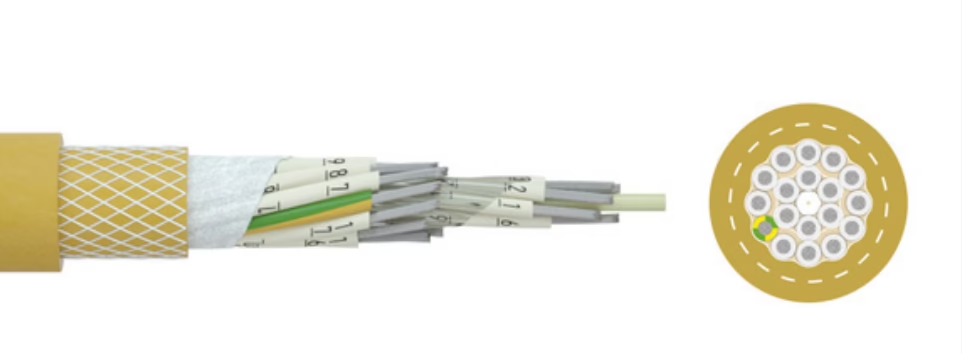
CORDAFLEX XPRT (N)SHTOEU
0.6/1 kV Expert-Grade Low Voltage Reeling Cable — 30 N/mm² Maximum Conductor Tensile, Tinned Copper Class “FS” Exceptionally Fine Stranded, EPR 3GI3 Insulation, Rubber 5GM5 Inner and Outer Sheath System, 5×OD Moving Bending Radius (Tightest in the CORDAFLEX Family), Polyester Braid ±50°/m Torsion Protection, Fzp Permanent Tensile Rating, 240 m/min, DIN VDE 0250-814, VDE Certified — The Premium Reeling Cable for High and Very High Mechanical Loads in Port Crane, STS, RTG, E-RTG and Heavy Industrial Applications
The CORDAFLEX XPRT Combines Everything Premium: 30 N/mm² Tensile Matches the Legendary CORDAFLEX (SMK), EPR 3GI3 Insulation Provides Explicit DIN VDE Compound Traceability, 5GM5 Rubber Provides the Highest-Grade Inner Sheath, 5×OD Moving Bend Is the Tightest Published Bend Radius of Any Standard CORDAFLEX Variant — And the Fzp “Permanent Tensile” Rating Confirms Continuous Operation Under Maximum Tensile, Not Just During Installation
Introduction: What Makes the CORDAFLEX XPRT “Expert-Grade”
The CORDAFLEX XPRT (N)SHTOEU is the newest addition to the Klaus Faber / Prysmian low voltage reeling cable portfolio — a cable engineered for high and very high mechanical loads in port crane, container handling, and heavy industrial reeling operations. Designated “XPRT” (Expert), this cable represents a distinct engineering philosophy: every material in the cable’s construction is explicitly specified to the highest DIN VDE compound grade, every parameter is pushed to its mechanical maximum, and the tensile rating uses the Fzp “permanent tensile” designation — confirming that the cable’s maximum tensile applies not just during installation but during continuous operational reeling.
The CORDAFLEX XPRT shares the 30 N/mm² conductor tensile and tinned copper Class “FS” conductor with the legendary CORDAFLEX (SMK) — but diverges in three critical areas: it specifies EPR 3GI3 insulation (the highest standard EPR grade per DIN VDE 0207-20, providing full compound traceability), uses rubber 5GM5 for both inner and outer sheath (the highest PCP-based rubber grade per DIN VDE 0207-21), and achieves a 5×OD moving bending radius — one grade tighter than the CORDAFLEX (SMK)’s 6×OD, making it the tightest moving bend radius in the standard CORDAFLEX product family.
Full Technical Specification
| Parameter | Specification | Engineering Significance |
|---|---|---|
| Standard | DIN VDE 0250-814 (with ref. to) | German national standard for crane and reeling cables |
| Voltage Uo/U / Test | 0.6/1 kV (max 3-phase: 1.2 kV). Test: 3.5 kV | Standard LV reeling voltage class |
| Conductor Material | Tinned copper | Corrosion immunity in salt-spray and marine environments |
| Conductor Construction | Class “FS” = exceptionally fine stranded | Maximum flexibility; individual wire Ø ≤ 0.05 mm |
| Insulation | Rubber (EPR) 3GI3 ★ | Highest standard EPR grade per DIN VDE 0207-20 |
| Inner Sheath | Rubber 5GM5 ★ | Highest PCP-based rubber grade per DIN VDE 0207-21 |
| Torsion Protection | Polyester braid | Vulcanised bond between sheaths for torsion resistance |
| Torsion | ±50°/m | Standard CORDAFLEX torsion allowance |
| Outer Sheath | Rubber (PCP) 5GM5. Yellow. | Abrasion and tear resistant; highest PCP compound grade |
| Flame Retardant | VDE 0482-332-1-2 / IEC 60332-1-2 | Single vertical flame test compliance |
| UV Resistant | Yes | Unrestricted outdoor installation |
| Oil Resistant | Yes | Hydraulic oil, lubricant, and fuel contact rated |
| Ozone Resistant | Yes | Critical for outdoor and industrial atmospheres |
| Water Resistant | Yes | Full immersion rated |
| Outdoor Use | Yes | Unrestricted indoor and outdoor application |
| Max. Conductor Temperature | 90°C | Continuous operation thermal limit |
| Short-Circuit Temperature | 250°C | Maximum fault-condition conductor temperature |
| Temperature Range (Fixed) | −50°C to +80°C | Arctic-rated for fixed installation |
| Temperature Range (Moving) | −35°C to +80°C | Cold-climate operational flexibility |
| Bending Radius (Fixed) | 4×OD | Standard fixed installation minimum |
| Bending Radius (Moving) ★ | 5×OD | Tightest moving bend in the CORDAFLEX family |
| Conductor Tensile ★ | 30 N/mm² | Absolute highest — matches CORDAFLEX (SMK) |
| Tensile Designation | Fzp = permanent tensile ★ | Continuous operation rating, not installation-only |
| Operating Speed | 240 m/min | Maximum reeling speed for high-cycle operations |
| Core Identification | White with black numbers + green-yellow PE | High-contrast identification for easy termination |
The CORDAFLEX XPRT differs from the CORDAFLEX (SMK) in three critical technical specifications: (1) EPR 3GI3 insulation — explicitly specified to DIN VDE 0207-20 compound grade, providing full material traceability (the SMK datasheet omits insulation designation); (2) 5GM5 rubber inner sheath — the highest PCP compound grade per DIN VDE 0207-21 (the SMK uses a cross-linked rubber blend without explicit VDE compound designation); (3) 5×OD moving bending radius — one grade tighter than the SMK’s 6×OD, enabling operation on smaller-diameter sheaves and reels. These differences make the XPRT the preferred choice when complete DIN VDE compound traceability and tighter bending performance are required.
Available Configuration
| Part No. | Configuration | Rl [Ω/km] | Ibl [A] | Ø [mm] | Fzp [N] | Cu [kg/km] | G [kg/km] |
|---|---|---|---|---|---|---|---|
| 055116 | 04×16 YE | 1.24 | 99 | 26.7 | 1,920 | 645 | 1,289 |
The Klaus Faber datasheet (Issue 04/02/2026) currently lists a single published configuration: 04×16. This indicates the CORDAFLEX XPRT is a newly introduced product line with additional configurations expected. The CORDAFLEX (SMK) product family — which shares the same 30 N/mm² / tinned FS architecture — offers 38 configurations from 04×1.5 to 3×240+3×120/3. Feichun can manufacture XPRT-equivalent cables in any configuration matching the SMK range. Contact our engineering team for custom configurations and dimensional verification.
Fzp Verification: The permanent tensile force Fzp for the 04×16 configuration can be verified: 30 N/mm² × (4 × 16 mm²) = 30 × 64 = 1,920 N — exactly matching the datasheet value. This confirms the 30 N/mm² is applied to the total copper cross-section under Fzp (permanent) conditions.
Conductor Resistance Verification: The resistance of 1.24 Ω/km for 16 mm² confirms tinned copper — IEC 60228 specifies a maximum of 1.24 Ω/km for Class 5/FS tinned copper at 16 mm². Bare copper at the same cross-section would measure 1.21 Ω/km maximum. The ~2.5% increase in resistance is the characteristic signature of tin coating on fine-stranded conductors.
Weight Analysis: The cable weight of 1,289 kg/km for a 04×16 cable at 26.7 mm OD compares directly with the CORDAFLEX (SMK) 04×16 (Part 051536) at 1,315 kg/km and 26.7 mm OD — confirming dimensional compatibility while achieving a 26 kg/km weight reduction (approximately 2%) through the optimised 5GM5 rubber compound system.
30 N/mm² and Fzp: Permanent Tensile for Continuous Operation
The CORDAFLEX XPRT achieves 30 N/mm² maximum tensile strength at the conductor — the same absolute highest value as the CORDAFLEX (SMK) and double the 15 N/mm² of the standard TROMMELFLEX (K). However, the XPRT’s tensile designation is Fzp — “permanent tensile” rather than the SMK’s Fzv (“tensile during installation”). This distinction is critical for cable specification engineers.
Fzp (permanent) means the cable is rated to sustain the maximum tensile force continuously during normal reeling operation — not just during the initial installation pull. In practical terms, this allows the CORDAFLEX XPRT to be specified for applications where the cable remains under sustained tensile load throughout its operational cycle, such as long-travel crane reeling where the cable hangs from the drum at full extension, or high-speed reeling applications where dynamic tensile forces approach the cable’s rated maximum. The Fzp designation provides additional engineering confidence that the cable’s mechanical life will not be compromised by sustained tensile loading within the rated envelope.
For comparison, the Cordaflex (SMK)-V vertical reeling variant uses Fzd (dynamic tensile) for its configurations, while the standard Cordaflex SMRT uses both Fzp and Fzd depending on the configuration. The CORDAFLEX XPRT’s consistent use of Fzp across its product line simplifies engineering specification and eliminates ambiguity about operational tensile limits.
EPR 3GI3 Insulation: Full DIN VDE Compound Traceability
The CORDAFLEX XPRT explicitly specifies EPR (Ethylene Propylene Rubber) 3GI3 insulation — the highest standard EPR compound grade defined in DIN VDE 0207-20. The “3GI3” designation provides complete compound traceability: “3G” indicates rubber compound group 3G (EPR-based), “I” indicates insulation application, and “3” indicates the highest performance sub-grade within that group. This compound provides excellent dielectric properties, outstanding flexibility at low temperatures (maintaining insulation integrity down to −50°C in fixed installation), and superior long-term ageing resistance at the continuous 90°C conductor temperature rating.
This explicit compound specification is a unique differentiator. The CORDAFLEX (SMK) datasheet omits the insulation compound designation entirely — suggesting a proprietary Prysmian compound that may not correspond to a standard DIN VDE material code. The CORDAFLEX XPRT’s explicit 3GI3 specification gives procurement engineers, quality inspectors, and certification auditors a clear DIN VDE standard to verify against, simplifying incoming inspection and ensuring that replacement cables from alternative manufacturers (including Feichun) can be verified to the identical compound specification.
5GM5 Rubber System: The Highest DIN VDE Sheath Grade
Both the inner sheath and outer sheath of the CORDAFLEX XPRT are specified as rubber 5GM5 — the highest polychloroprene (PCP) based compound grade per DIN VDE 0207-21. The “5GM5” designation indicates: “5G” = rubber compound group 5G (PCP-based), “M” = sheath (Mantel) application, and “5” = the highest performance sub-grade. This compound delivers maximum abrasion resistance, tear propagation resistance, oil resistance (per EN 60811-404), ozone resistance (per DIN EN 60811-2-1), and UV resistance for unrestricted outdoor service.
The use of 5GM5 for both inner and outer sheath is notable. Many competitor cables use a lower-grade compound (such as 5GM3) for the inner sheath to reduce cost, reserving the premium 5GM5 grade only for the outer sheath where abrasion resistance is most critical. The CORDAFLEX XPRT specifies 5GM5 throughout — providing the same premium mechanical protection on the inner surface (where the polyester torsion braid is vulcanised between sheaths) as on the outer surface (where the cable contacts drum flanges, guide rollers, and sheaves). This dual-5GM5 construction contributes directly to the cable’s industry-leading 5×OD moving bending radius.
5×OD Moving Bend: The Tightest in the CORDAFLEX Family
The CORDAFLEX XPRT achieves a 5×OD moving bending radius — meaning the cable can be repeatedly bent around a sheave or roller with a diameter of just 5 times the cable’s outer diameter during continuous reeling operation. For the 04×16 configuration at 26.7 mm OD, this translates to a minimum moving bend radius of just 133.5 mm (or a sheave diameter of 267 mm). This is the tightest published moving bend radius of any standard CORDAFLEX variant and represents a significant engineering advantage.
| Cable | Moving Bend | For 26.7 mm OD Cable | Advantage |
|---|---|---|---|
| CORDAFLEX XPRT ★ | 5×OD | 133.5 mm radius | Tightest — reference |
| CORDAFLEX (SMK) | 6×OD | 160.2 mm radius | +20% larger minimum |
| CORDAFLEX SMRT | 6×OD | 160.2 mm radius | +20% larger minimum |
| TROMMELFLEX (K) | 6×D | 160.2 mm radius | +20% larger minimum |
This tighter bending radius enables the CORDAFLEX XPRT to be installed on smaller-diameter reels and sheaves — reducing the physical footprint of the cable reel assembly on the crane structure. On STS and RTG cranes where space is at a premium, the ability to use a 20% smaller sheave diameter can be the difference between a feasible cable routing and a design compromise. It also enables more compact cable guide systems and reduces the bending fatigue amplitude per cycle, potentially extending cable mechanical life.
CORDAFLEX XPRT vs. CORDAFLEX (SMK): Side-by-Side Comparison
| Parameter | CORDAFLEX XPRT | CORDAFLEX (SMK) | Winner |
|---|---|---|---|
| Conductor Tensile | 30 N/mm² | 30 N/mm² | Tie |
| Conductor | Tinned Cu, Class FS | Tinned Cu, Class FS | Tie |
| Insulation | EPR 3GI3 (explicit) | Not specified | XPRT — traceability |
| Inner Sheath | Rubber 5GM5 | Cross-linked rubber blend | XPRT — DIN VDE grade |
| Outer Sheath | Rubber (PCP) 5GM5 | Rubber (PCP) | XPRT — explicit grade |
| Moving Bend | 5×OD | 6×OD | XPRT — 20% tighter |
| Tensile Designation | Fzp (permanent) | Fzv (installation) | XPRT — continuous rated |
| Speed | 240 m/min | 240 m/min | Tie |
| Temperature Range | −50°C to +80°C (fixed) | −50°C to +80°C (fixed) | Tie |
| Short-Circuit | 250°C | 250°C | Tie |
| Mining Certified | Not listed | VDE 0168/0118 | SMK — mining rated |
| Configurations | 1 published (expanding) | 38 published | SMK — broader range |
| Additional Tests | Not listed | Reversed + Roller + Torsion | SMK — triple tested |
| Certification | VDE | VDE + EAC | SMK — dual cert |
Choose CORDAFLEX XPRT when: you need complete DIN VDE compound traceability for incoming inspection, your reel or sheave design requires the tightest possible bending radius, or you need Fzp permanent tensile rating for sustained-load applications. Choose CORDAFLEX (SMK) when: you need mining certification (VDE 0168/0118), you need a broader range of configurations, or you need triple mechanical test documentation (reversed bending + roller bending + torsional stress).
Application: High and Very High Mechanical Load Reeling
The CORDAFLEX XPRT is engineered for motorised drum reeling operations where the cable is subjected to high and very high mechanical loads — including sustained tensile forces, repeated bending cycles over sheaves and guide rollers, and torsional stresses from drum rotation. Typical applications include STS (Ship-to-Shore) container cranes, RTG (Rubber Tyred Gantry) cranes, E-RTG (Electrified RTG) cranes, RMG (Rail Mounted Gantry) cranes, and heavy industrial reeling systems for steel mills, automotive plants, and shipyards.
The cable’s 240 m/min operating speed matches the highest reeling speed in the CORDAFLEX family, supporting modern high-throughput port crane operations where rapid trolley and gantry travel is required. The −35°C moving temperature rating enables year-round operation in cold-climate ports (Northern Europe, Scandinavia, Russia, Canada, Northern China) without cable stiffening or jacket cracking. The PCP-based yellow outer sheath provides the abrasion resistance, oil resistance, and UV resistance needed for multi-year outdoor service in the harshest port and industrial environments.
The cable’s environmental resistance — flame retardancy per IEC 60332-1-2, oil resistance per EN 60811-404, ozone resistance, UV resistance, and full water resistance — ensures compliance with port authority and industrial safety requirements worldwide. The yellow colour coding identifies the cable as a reeling cable per industry convention, preventing confusion with static installation cables during maintenance operations.
Cost-Effective Alternative from Feichun
Feichun Lead Times: Standard 04×16 configuration: 4–6 weeks (stock available). Custom XPRT-equivalent configurations (any size from 04×1.5 to 3×240+3×120/3): 8–12 weeks. European OEM equivalent: 16–24 weeks.
Real Scenario: A European container terminal operator required 04×16 reeling cables for 6 E-RTG cranes — 1,800 metres total — plus a strategic spare inventory of 600 metres. Klaus Faber quoted €43,200 with 18-week delivery. Feichun quoted €22,800 with 5-week delivery using FC-FLX™ Class FS tinned Tongling copper conductors, EPR 3GI3 insulation, and dual-5GM5 rubber sheath system. Conductor resistance measured at 1.21 Ω/km (below the 1.24 Ω/km maximum), confirming premium tinned copper quality. Bending radius verified at 5×OD per DIN VDE 0250-814 protocol. Total savings: €20,400 (47%) with 13 weeks earlier delivery — enabling the E-RTG electrification project to be completed before the peak shipping season.
Technical FAQ
How does EPR 3GI3 compare to the CORDAFLEX (SMK)’s insulation? The CORDAFLEX (SMK) datasheet does not specify its insulation compound — it may be a proprietary Prysmian formulation. The XPRT’s explicit 3GI3 designation means any manufacturer can verify insulation compliance against DIN VDE 0207-20. EPR 3GI3 provides excellent dielectric strength (typically > 10 kV/mm), low dielectric loss, outstanding flexibility, and long-term thermal stability at 90°C continuous operation. Feichun’s XPRT equivalent uses an EPR compound verified to 3GI3 specifications with third-party testing certification available.
Why is the weight 1,289 kg/km vs. 1,315 kg/km for the SMK 04×16? The 26 kg/km (2%) weight reduction reflects the XPRT’s optimised 5GM5 compound formulation — the explicit DIN VDE compound grade allows tighter manufacturing tolerances on sheath wall thickness while maintaining full mechanical performance. Less material waste per kilometre translates to both lower cable weight (beneficial for crane structural loading) and lower raw material consumption (contributing to the cost advantage).
Can Feichun manufacture XPRT-equivalent cables in configurations beyond 04×16? Yes. The CORDAFLEX XPRT’s construction — tinned copper Class FS, EPR 3GI3, 5GM5 dual sheath, polyester torsion braid — can be manufactured by Feichun in any configuration from 04×1.5 to 3×240+3×120/3, including multi-core power, multi-core control, and hybrid power+screened control configurations. All configurations maintain the 30 N/mm² tensile, 5×OD moving bend, and Fzp permanent tensile rating. Contact our engineering team with your Faber part number or configuration requirement for dimensional and performance verification.
What does “DIN VDE 0250-814 (with ref. to)” mean? The “(with ref. to)” notation indicates that the cable is designed with reference to the DIN VDE 0250-814 standard rather than fully listed under it. This is standard practice for premium reeling cables that exceed the baseline requirements of VDE 0250-814 — the cable meets or exceeds all requirements of the standard but may include additional features (such as the 5×OD bending radius or Fzp tensile designation) that are not explicitly covered by the standard’s scope. The VDE certification mark on the cable confirms independent verification of compliance.
Is the CORDAFLEX XPRT suitable for mining applications? The current Klaus Faber datasheet does not include mining certification per VDE 0168/0118 for the CORDAFLEX XPRT. For mining applications requiring explicit VDE 0168/0118 compliance, the CORDAFLEX (SMK) remains the appropriate choice. However, the XPRT’s premium construction (tinned FS, 5GM5 dual sheath, PCP-based flame retardancy) meets or exceeds the material requirements for mining cables — Feichun can provide mining-compliant equivalents with appropriate testing and documentation upon request.
References
- Klaus Faber AG, CORDAFLEX XPRT (N)SHTOEU — Product Data Sheet, dbl_cordaflef_xprt_n_shtoeu.pdf, Issue 04/02/2026.
- Klaus Faber AG, PRYSMIAN CORDAFLEX® (SMK) (N)SHTOEU — Product Data Sheet, dbl_nshtoeu_smk.pdf, Issue 04/02/2026.
- Prysmian Group, Low Voltage Reeling Cables — CORDAFLEX / TROMMELFLEX. prysmian.com
- DIN VDE 0250-814: Cables for Cranes and Lifting Appliances — Reeling Cables.
- DIN VDE 0207-20: Rubber Compound Types for Insulation — EPR Compounds (3GI Series).
- DIN VDE 0207-21: Rubber Compound Types for Sheaths — PCP Compounds (5GM Series).
- IEC 60228: Conductors of Insulated Cables — Class 5 and Class 6 (FS) Flexible Conductors.
- IEC 60332-1-2 / VDE 0482-332-1-2: Tests on Electric and Optical Fibre Cables Under Fire Conditions.
- EN 60811-404 / DIN VDE 0473-811-404: Test Methods for Insulation and Sheaths — Oil Resistance.
- FeiChun, Crane Reeling Cables — VDE Engineering & 5GM5 Compound. feichuncables.com


