Cranes and Material Handling Cable

BASKET SPREADER 740 (YSLTOE) is engineered specifically for hoisting and control applications where mechanical flexibility and electrical reliability must coexist in marine environments. Unlike load-bearing structural cables (which prioritize tensile strength), control cables emphasize: Conductor flexibility – Repeated bending over pulleys without mechanical fatigue Insulation integrity – Voltage breakdown resistance under salt-fog corrosion Mechanical damping – Rope-like flexibility to drape naturally in spreader bar frames Environmental barrier – Outer sheath blocks salt, moisture, and UV penetration Core Design Elements: Component Material Specification Function Port Environment Benefit Conductor Flexible red copper Class 6 (IEC 60228) Carries 300/500V power; enables bending flexibility High purity copper resists galvanic corrosion Insulation PVC type YI2 (IEC 60811) Electrical isolation; voltage breakdown resistance (2 kV test) PVC with marine additives prevents salt-induced tracking Central Unit Aramide yarns (Kevlar™ equivalent) Mechanical load-bearing backup; structural integrity Aramide resists moisture & salt; absorbs vibration stress Outer Sheath PUR type 11YM1 (DIN 73377) Environmental barrier; UV/ozone/moisture protection Superior salt-fog resistance; 20+ year marine lifespan

YSLTOE

BASKET SPREADER 740 (YSLTOE) is engineered specifically for hoisting and control applications where mechanical flexibility and electrical reliability must coexist in marine environments. Unlike load-bearing structural cables (which prioritize tensile strength), control cables emphasize: Conductor flexibility – Repeated bending over pulleys without mechanical fatigue Insulation integrity – Voltage breakdown resistance under salt-fog corrosion Mechanical damping – Rope-like flexibility to drape naturally in spreader bar frames Environmental barrier – Outer sheath blocks salt, moisture, and UV penetration Core Design Elements: Component Material Specification Function Port Environment Benefit Conductor Flexible red copper Class 6 (IEC 60228) Carries 300/500V power; enables bending flexibility High purity copper resists galvanic corrosion Insulation PVC type YI2 (IEC 60811) Electrical isolation; voltage breakdown resistance (2 kV test) PVC with marine additives prevents salt-induced tracking Central Unit Aramide yarns (Kevlar™ equivalent) Mechanical load-bearing backup; structural integrity Aramide resists moisture & salt; absorbs vibration stress Outer Sheath PUR type 11YM1 (DIN 73377) Environmental barrier; UV/ozone/moisture protection Superior salt-fog resistance; 20+ year marine lifespan
Spreader Bar Cable Application: What is a spreader bar? Container crane context: Gantry crane positioned at dock Overhead hoist mechanism: Winch + trolley system Spreader bar: Attachment point below hoist Function: Grips container corners, distributes load, tilts container for placement Spreader bar structure: Framework: Steel tubes/beams forming rectangular frame Lifting points: 4 corner attachment rings (one per container corner) Electrical system: Motor-driven locks, position sensors, lighting Cables: Power supply for motors + control signals for locking mechanism Cable location (spreader bar): Vertical run (primary): From crane hoist (top) down 20–40 m to spreader bar (bottom) Function: Supply power for: - Corner lock solenoids (release container locks) - Position feedback sensors (confirm locks engaged) - Optional: Spreader bar lighting (visibility during operation) Simultaneous function: Act as partial mechanical support (share load with main hoist cable) Horizontal distribution (on spreader bar): From entry point distributed across spreader frame Supply all four corner lock motors Branching: May split into smaller branches (4× circuits to corners) Mechanical load: Cable must withstand: Static tension: Weight of container payload (20–40 tons distributed) Dynamic loads: Jerking during load acceleration, swinging in wind Thermal: Tropical port environment, direct sun, saltwater spray Abrasion: Rubbing against spreader frame during operation Cable design philosophy: Dual function (unique): Electrical function: Deliver 300/500V power for locking system Mechanical function: Share load-bearing (not primary structure, but support role) Different from: Pure electrical cables (festoon, lifting): Electrical function only Pure mechanical ropes: Mechanical function only BASKET SPREADER 730: Both functions integrated Speed specification rationale: 160 m/min (relatively slow): Container crane cycle time: ~45–60 seconds per lift Descent distance: 20–40 m Descent speed: 20–40 m ÷ 45–60 sec = 0.33–0.9 m/s = 20–54 m/min Average speed: ~30 m/min (loading) + 20 m/min (discharge) = 25 m/min 160 m/min specification: 6–8× safety margin on speed Design: Allows for fast emergency ascent if needed Why not higher speed? Mechanical load constraint: Heavy cable (4000 N = ~400 kg equivalent) Inertia: Accelerating 400 kg + spreader bar + container inertia takes time Structural: Crane frame limits acceleration rates (safety interlocks) Result: 160 m/min is practical maximum for loaded spreader bar

BASKET SPREADER 730

Spreader Bar Cable Application: What is a spreader bar? Container crane context: Gantry crane positioned at dock Overhead hoist mechanism: Winch + trolley system Spreader bar: Attachment point below hoist Function: Grips container corners, distributes load, tilts container for placement Spreader bar structure: Framework: Steel tubes/beams forming rectangular frame Lifting points: 4 corner attachment rings (one per container corner) Electrical system: Motor-driven locks, position sensors, lighting Cables: Power supply for motors + control signals for locking mechanism Cable location (spreader bar): Vertical run (primary): From crane hoist (top) down 20–40 m to spreader bar (bottom) Function: Supply power for: – Corner lock solenoids (release container locks) – Position feedback sensors (confirm locks engaged) – Optional: Spreader bar lighting (visibility during operation) Simultaneous function: Act as partial mechanical support (share load with main hoist cable) Horizontal distribution (on spreader bar): From entry point distributed across spreader frame Supply all four corner lock motors Branching: May split into smaller branches (4× circuits to corners) Mechanical load: Cable must withstand: Static tension: Weight of container payload (20–40 tons distributed) Dynamic loads: Jerking during load acceleration, swinging in wind Thermal: Tropical port environment, direct sun, saltwater spray Abrasion: Rubbing against spreader frame during operation Cable design philosophy: Dual function (unique): Electrical function: Deliver 300/500V power for locking system Mechanical function: Share load-bearing (not primary structure, but support role) Different from: Pure electrical cables (festoon, lifting): Electrical function only Pure mechanical ropes: Mechanical function only BASKET SPREADER 730: Both functions integrated Speed specification rationale: 160 m/min (relatively slow): Container crane cycle time: ~45–60 seconds per lift Descent distance: 20–40 m Descent speed: 20–40 m ÷ 45–60 sec = 0.33–0.9 m/s = 20–54 m/min Average speed: ~30 m/min (loading) + 20 m/min (discharge) = 25 m/min 160 m/min specification: 6–8× safety margin on speed Design: Allows for fast emergency ascent if needed Why not higher speed? Mechanical load constraint: Heavy cable (4000 N = ~400 kg equivalent) Inertia: Accelerating 400 kg + spreader bar + container inertia takes time Structural: Crane frame limits acceleration rates (safety interlocks) Result: 160 m/min is practical maximum for loaded spreader bar
Design Comparison (LIFT-1S UL vs. LIFT-2S UL): LIFT-1S UL: Temperature: 105°C (highest rating) Steel cores: 1 (single mechanical support) Redundancy philosophy: Electrical backup (dual control circuits) Yellow sheath: No (black) Insulation: PVC only (100% pure) Mylar wrap: No Size example (8G1.5): ~21.5 mm OD Cost: Higher (premium 105°C formulation) Best for: High-temperature machine rooms, non-HVAC spaces LIFT-2S UL: Temperature: 90°C (moderate rating) Steel cores: 2 (dual mechanical support) Redundancy philosophy: Mechanical backup (if one core fails, other works) Yellow sheath: Yes (RAL 1021, safety identification) Insulation: PVC/Nylon hybrid (enhanced protection) Mylar wrap: Yes (additional conductor protection) Size example (8G1.5): ~22.7 mm OD (slightly larger due to dual cores) Cost: Moderate (balanced design) Best for: Standard elevator duty, mechanical redundancy required Philosophy difference: LIFT-1S UL approach: "Design the cable to never overheat" - Optimize for high temperature (105°C possible) - Single mechanical core (simpler, lighter) - Control circuit provides electrical safety backup - Assumes: Machine room temperature controlled (or naturally cool) - Risk: If machine room exceeds 90°C ambient, marginal safety LIFT-2S UL approach: "Design for mechanical redundancy + moderate conditions" - Accept standard 90°C temperature (sufficient for most installations) - Dual mechanical cores (if one damaged/broken, other maintains function) - Better long-term reliability (don't rely on control circuit for mechanical failure) - Assumes: Some machines rooms may exceed 80°C, but not 90°C - Benefit: Fail-safe mechanical backup (independent of electrical system) Application selection: Choose LIFT-1S UL if: ✓ Machine room is non-air-conditioned, exposed to sun ✓ Building has no climate control in elevator shaft ✓ Located in tropical climate with extreme heat ✓ Temperature analysis shows >85°C sustained possible ✓ Willing to pay premium for 105°C rating Choose LIFT-2S UL if: ✓ Standard commercial elevator in air-conditioned building ✓ Mechanical redundancy more important than temperature headroom ✓ Budget-conscious (LIFT-2S UL lower cost than LIFT-1S UL) ✓ Temperature typically

LIFT-2S UL

Design Comparison (LIFT-1S UL vs. LIFT-2S UL): LIFT-1S UL: Temperature: 105°C (highest rating) Steel cores: 1 (single mechanical support) Redundancy philosophy: Electrical backup (dual control circuits) Yellow sheath: No (black) Insulation: PVC only (100% pure) Mylar wrap: No Size example (8G1.5): ~21.5 mm OD Cost: Higher (premium 105°C formulation) Best for: High-temperature machine rooms, non-HVAC spaces LIFT-2S UL: Temperature: 90°C (moderate rating) Steel cores: 2 (dual mechanical support) Redundancy philosophy: Mechanical backup (if one core fails, other works) Yellow sheath: Yes (RAL 1021, safety identification) Insulation: PVC/Nylon hybrid (enhanced protection) Mylar wrap: Yes (additional conductor protection) Size example (8G1.5): ~22.7 mm OD (slightly larger due to dual cores) Cost: Moderate (balanced design) Best for: Standard elevator duty, mechanical redundancy required Philosophy difference: LIFT-1S UL approach: “Design the cable to never overheat” – Optimize for high temperature (105°C possible) – Single mechanical core (simpler, lighter) – Control circuit provides electrical safety backup – Assumes: Machine room temperature controlled (or naturally cool) – Risk: If machine room exceeds 90°C ambient, marginal safety LIFT-2S UL approach: “Design for mechanical redundancy + moderate conditions” – Accept standard 90°C temperature (sufficient for most installations) – Dual mechanical cores (if one damaged/broken, other maintains function) – Better long-term reliability (don’t rely on control circuit for mechanical failure) – Assumes: Some machines rooms may exceed 80°C, but not 90°C – Benefit: Fail-safe mechanical backup (independent of electrical system) Application selection: Choose LIFT-1S UL if: ✓ Machine room is non-air-conditioned, exposed to sun ✓ Building has no climate control in elevator shaft ✓ Located in tropical climate with extreme heat ✓ Temperature analysis shows >85°C sustained possible ✓ Willing to pay premium for 105°C rating Choose LIFT-2S UL if: ✓ Standard commercial elevator in air-conditioned building ✓ Mechanical redundancy more important than temperature headroom ✓ Budget-conscious (LIFT-2S UL lower cost than LIFT-1S UL) ✓ Temperature typically
LIFT-2S (European) vs. LIFT-1S UL (North American): LIFT-2S characteristics: Voltage: 300/500V (European standard, lower voltage) Temperature: −40°C to +70°C (moderate range) Standards: VDE 0482 part 265-2-1, EN 50265-2-1, IEC 60332-1-2 Design philosophy: Safety by material redundancy (2 steel cores) Steel cores: 2× cores provide mechanical backup Conductor: Class 6 (European, ~150–200 wires per mm²) Cost: Lower (proven European manufacturing) Market: Europe, Asia-Pacific, most of world LIFT-1S UL characteristics: Voltage: 600V (North American standard, higher voltage) Temperature: −25°C to +105°C (extreme range, high-temp optimized) Standards: UL 2562, UL 62, CSA C22.2 No.210.2 Design philosophy: Safety by certification (single core + redundant control) Steel core: 1× core (sufficient with nylon covering) Conductor: Class M (UL, extra fine ~300+ wires per mm²) Cost: Higher (UL testing, certification documentation) Market: North America (USA, Canada), Mexico UL 2562 specialty certification: UL 2562 scope: Elevator and Dumbwaiter Cables Specific requirements: 1. Pendant cable design (cable hangs freely, no duct support) 2. Vertical orientation (designed for gravity-loaded suspension) 3. Repeated flex cycles (cable moves up/down frequently) 4. Safety-critical function (failure = personnel risk) Consequence: More stringent than general-purpose cables Testing includes: Bend cycle fatigue, heat aging, compression resistance Test procedures (unique to UL 2562): Bend cycle test: 1,000+ cycles at minimum bending radius Cable must pass insulation resistance after cycling Heat aging: 500+ hours at 105°C continuous Tensile strength retention minimum 70% Compression: 1,000+ hours under sustained compression Cable cross-section must not exceed 5% permanent deformation LIFT-2S (no UL 2562): Tests per VDE are less stringent on fatigue/cycling Assumes cable mostly static, not repeated flex Adequate for European elevator duty (lower speed, fewer cycles) LIFT-1S UL: All UL 2562 tests passed (proven for North American elevators) Faster cycle times, more frequent motion → more fatigue stress Extra testing ensures reliability under North American elevator duty Market requirement (regulatory): Europe/International: CE mark required (European conformity) VDE/EN/IEC standards sufficient No UL certification needed (not recognized in EU) LIFT-2S is sufficient North America (USA, Canada): UL certification mandatory for elevators UL 2562 specifically for elevator cables CSA dual certification required in Canada LIFT-2S NOT acceptable (lacks UL 2562) LIFT-1S UL mandatory Cost implication: UL certification: ~$5,000–15,000 per product per region Testing duration: 3–6 months per model Documentation: Comprehensive test reports, technical files Result: LIFT-1S UL 20–30% higher cost than equivalent European cable

LIFT- 1S UL

LIFT-2S (European) vs. LIFT-1S UL (North American): LIFT-2S characteristics: Voltage: 300/500V (European standard, lower voltage) Temperature: −40°C to +70°C (moderate range) Standards: VDE 0482 part 265-2-1, EN 50265-2-1, IEC 60332-1-2 Design philosophy: Safety by material redundancy (2 steel cores) Steel cores: 2× cores provide mechanical backup Conductor: Class 6 (European, ~150–200 wires per mm²) Cost: Lower (proven European manufacturing) Market: Europe, Asia-Pacific, most of world LIFT-1S UL characteristics: Voltage: 600V (North American standard, higher voltage) Temperature: −25°C to +105°C (extreme range, high-temp optimized) Standards: UL 2562, UL 62, CSA C22.2 No.210.2 Design philosophy: Safety by certification (single core + redundant control) Steel core: 1× core (sufficient with nylon covering) Conductor: Class M (UL, extra fine ~300+ wires per mm²) Cost: Higher (UL testing, certification documentation) Market: North America (USA, Canada), Mexico UL 2562 specialty certification: UL 2562 scope: Elevator and Dumbwaiter Cables Specific requirements: 1. Pendant cable design (cable hangs freely, no duct support) 2. Vertical orientation (designed for gravity-loaded suspension) 3. Repeated flex cycles (cable moves up/down frequently) 4. Safety-critical function (failure = personnel risk) Consequence: More stringent than general-purpose cables Testing includes: Bend cycle fatigue, heat aging, compression resistance Test procedures (unique to UL 2562): Bend cycle test: 1,000+ cycles at minimum bending radius Cable must pass insulation resistance after cycling Heat aging: 500+ hours at 105°C continuous Tensile strength retention minimum 70% Compression: 1,000+ hours under sustained compression Cable cross-section must not exceed 5% permanent deformation LIFT-2S (no UL 2562): Tests per VDE are less stringent on fatigue/cycling Assumes cable mostly static, not repeated flex Adequate for European elevator duty (lower speed, fewer cycles) LIFT-1S UL: All UL 2562 tests passed (proven for North American elevators) Faster cycle times, more frequent motion → more fatigue stress Extra testing ensures reliability under North American elevator duty Market requirement (regulatory): Europe/International: CE mark required (European conformity) VDE/EN/IEC standards sufficient No UL certification needed (not recognized in EU) LIFT-2S is sufficient North America (USA, Canada): UL certification mandatory for elevators UL 2562 specifically for elevator cables CSA dual certification required in Canada LIFT-2S NOT acceptable (lacks UL 2562) LIFT-1S UL mandatory Cost implication: UL certification: ~$5,000–15,000 per product per region Testing duration: 3–6 months per model Documentation: Comprehensive test reports, technical files Result: LIFT-1S UL 20–30% higher cost than equivalent European cable
Lifting Cable vs. Festoon Cable: Festoon cable (FLEXIFESTOON series): Primary stress: Repeated bending at 4–6×D radius Speed: 60–240 m/min continuous reeling Bending cycles/year: 10–100 million cycles Insulation: Soft, highly flexible (TPE, EPR) Material: Rubber or PUR outer sheath (elastic) Design goal: Maximize fatigue life under bending Service life: 5–15 years (fatigue-limited) Cost: Moderate (commodity materials) LIFT-2S lifting cable: Primary stress: Sustained vertical tensile load Speed: Static (or very slow vertical movement) Bending cycles/year:

LIFT-2S

Lifting Cable vs. Festoon Cable: Festoon cable (FLEXIFESTOON series): Primary stress: Repeated bending at 4–6×D radius Speed: 60–240 m/min continuous reeling Bending cycles/year: 10–100 million cycles Insulation: Soft, highly flexible (TPE, EPR) Material: Rubber or PUR outer sheath (elastic) Design goal: Maximize fatigue life under bending Service life: 5–15 years (fatigue-limited) Cost: Moderate (commodity materials) LIFT-2S lifting cable: Primary stress: Sustained vertical tensile load Speed: Static (or very slow vertical movement) Bending cycles/year:
EMC Performance Classification: EMC rating scale (VDE/EN standards): Basic: No shielding (part 813 unscreened) Fair: Partial coverage, 30–40 mm spacing in braid Good: 80–90% coverage, 95% coverage, all gaps 30 dB attenuation @ 500 kHz: >40 dB attenuation @ 5 MHz: >35 dB attenuation (typical peak range) Expected: Tinned copper braid achieves 35–50 dB across frequency range Immunity to external interference: Motor variable frequency drive (VFD) nearby: VFD RF emission: Typically 50–200 mV/m at cable distance Unshielded cable susceptibility: 100–500 mV induced noise Shielded cable (good EMC): 1–10 mV induced noise (50–100× reduction) Consequence: VFD-driven crane motor doesn't interfere with control signals No false triggering of safety systems Data integrity in digital control systems maintained Radiated immunity testing (per EN 61000-4-3): Test standard: Cable exposed to RF field 50 MHz–1 GHz Test field strength: 10 V/m typical Acceptance: No malfunction, signal corruption

FLEXIFESTOON® (N)GRDGCGÖU-J

EMC Performance Classification: EMC rating scale (VDE/EN standards): Basic: No shielding (part 813 unscreened) Fair: Partial coverage, 30–40 mm spacing in braid Good: 80–90% coverage, 95% coverage, all gaps 30 dB attenuation @ 500 kHz: >40 dB attenuation @ 5 MHz: >35 dB attenuation (typical peak range) Expected: Tinned copper braid achieves 35–50 dB across frequency range Immunity to external interference: Motor variable frequency drive (VFD) nearby: VFD RF emission: Typically 50–200 mV/m at cable distance Unshielded cable susceptibility: 100–500 mV induced noise Shielded cable (good EMC): 1–10 mV induced noise (50–100× reduction) Consequence: VFD-driven crane motor doesn’t interfere with control signals No false triggering of safety systems Data integrity in digital control systems maintained Radiated immunity testing (per EN 61000-4-3): Test standard: Cable exposed to RF field 50 MHz–1 GHz Test field strength: 10 V/m typical Acceptance: No malfunction, signal corruption
DLO Cable Classification: DLO designation meaning: DLO = Deep Level Operations (primary interpretation) Alternative: Diesel Locomotive Overhead (secondary) Context: Used extensively in South African and Australian deep mines where locomotive-hauled trains move ore underground Power supply: 2000V AC fed overhead to locomotive pantograph Deep Level Operations (mining context): Depth: >2,000 meters (6,500+ feet) below surface Pressure: 200+ atmospheres (extreme hydrostatic) Temperature: Geothermal heating to +35–40°C at depth (before cooling) Moisture: 100% relative humidity (saturated conditions) Chemical exposure: Sulfides, nitrates, acidic water Cable requirement: Must withstand extreme environmental stress DLO 2000V: Engineered specifically for these conditions 2000V voltage class significance: Why 2000V (not 1000V or 10kV)? - 1000V: Insufficient for long underground raceways (voltage drop) - 2000V: Sweet spot for deep mine distribution (good efficiency) - 10kV: Overkill for mobile equipment, insulation too thick Power efficiency at depth: P_loss = I²R per kilometer of cable run At 2000V, current = P / (2000 × √3) = 70–80% lower than 240V Over 5 km underground run: Voltage drop acceptable Voltage stress on insulation: Peak voltage (AC peak): 2000 × √2 / 1.414 ≈ 2.8 kV peak Test voltage: 4 kV (1.4× peak, safety margin) Partial discharge inception voltage (PDIV): >5 kV (safe margin) Single-core requirement: Mining locomotives: Three single-core cables run overhead in catenary Reason: Parallel path allows independent cable routing Mechanical advantage: Individual cables can flex, bend independently Installation: Easier to handle than 3-core bundle underground Application: One cable per phase (L1, L2, L3) + neutral if needed Typical setup: 3 × 2000V DLO cables for 3-phase power to locomotive

FLEXIFESTOON® DLO

DLO Cable Classification: DLO designation meaning: DLO = Deep Level Operations (primary interpretation) Alternative: Diesel Locomotive Overhead (secondary) Context: Used extensively in South African and Australian deep mines where locomotive-hauled trains move ore underground Power supply: 2000V AC fed overhead to locomotive pantograph Deep Level Operations (mining context): Depth: >2,000 meters (6,500+ feet) below surface Pressure: 200+ atmospheres (extreme hydrostatic) Temperature: Geothermal heating to +35–40°C at depth (before cooling) Moisture: 100% relative humidity (saturated conditions) Chemical exposure: Sulfides, nitrates, acidic water Cable requirement: Must withstand extreme environmental stress DLO 2000V: Engineered specifically for these conditions 2000V voltage class significance: Why 2000V (not 1000V or 10kV)? – 1000V: Insufficient for long underground raceways (voltage drop) – 2000V: Sweet spot for deep mine distribution (good efficiency) – 10kV: Overkill for mobile equipment, insulation too thick Power efficiency at depth: P_loss = I²R per kilometer of cable run At 2000V, current = P / (2000 × √3) = 70–80% lower than 240V Over 5 km underground run: Voltage drop acceptable Voltage stress on insulation: Peak voltage (AC peak): 2000 × √2 / 1.414 ≈ 2.8 kV peak Test voltage: 4 kV (1.4× peak, safety margin) Partial discharge inception voltage (PDIV): >5 kV (safe margin) Single-core requirement: Mining locomotives: Three single-core cables run overhead in catenary Reason: Parallel path allows independent cable routing Mechanical advantage: Individual cables can flex, bend independently Installation: Easier to handle than 3-core bundle underground Application: One cable per phase (L1, L2, L3) + neutral if needed Typical setup: 3 × 2000V DLO cables for 3-phase power to locomotive
H07BN4-F HAR Nomenclature Breakdown (per CEI 20-20/20-19): H = Harmonized standard designation (IEC 60227 compliance) Indicates cable meets international safety standards Full compatibility with European electrical regulations 07 = Voltage designation (Uo/U = 450/750V) 07 = 450/750V nominal voltage class (other classes: 03 = 300/500V, 04 = 400/690V) Testing: 3 kV test voltage (10 times nominal) B = Special feature (Flexible/Benign environment) B typically indicates bare or flexible conductor design (Standard = no letter designation) N = Rubber type designation N = Normally-proportioned sheath thickness (S = Slim/reduced, T = Thick/reinforced) For H07BN4-F: N = Standard thickness for 450/750V industrial use Insulation thickness: 1.2 mm per DIN VDE 0282 Sheath thickness: 1.0–1.5 mm per DIN VDE 0293 4 = Number of principal tests/features Typically indicates: (1) Temperature range, (2) Insulation type, (3) Sheath composition, (4) Mechanical properties certification F = Flexibility designation F = Fully flexible (can be wound on reels) (Other: S = Service-cord, C = Cable) H07BN4-F can be: Coiled on reel: Yes (reelable) Bent radius: Down to 4×D (normal use) to 2×D (close to terminal) Repeated winding: Yes (drum rating available) Continuous flexing: Yes (up to 50+ million cycles per EN 50266) HAR = Harmonics-compatible technology designation HAR = High-frequency harmonic and transient rated Specifically designed for: - VFD (variable frequency drive) motor circuits (up to 20 kHz switching) - Welding equipment (high current transients, multi-frequency content) - Industrial power electronics environments (distorted waveforms) HAR testing per EN 50334: Transient overvoltage withstand: 3× nominal voltage, sustained Harmonic content up to 50th harmonic: Fully rated Dv/dt immunity: >3 kV/µs (fast switching events) Comparison: Standard vs. HAR designation Standard H07BN4-F (without HAR): Frequency: Single 50/60 Hz only Total harmonic distortion (THD) limit: 20% acceptable (VFD typical) Transient immunity: Enhanced (3+ kV nominal test) Suitable for: VFD motors, welding, power electronics Cost: +8–12% premium over standard Application advantage: Single cable type serves both conventional and VFD circuits

FLEXIFESTOON® H07BN4-F

H07BN4-F HAR Nomenclature Breakdown (per CEI 20-20/20-19): H = Harmonized standard designation (IEC 60227 compliance) Indicates cable meets international safety standards Full compatibility with European electrical regulations 07 = Voltage designation (Uo/U = 450/750V) 07 = 450/750V nominal voltage class (other classes: 03 = 300/500V, 04 = 400/690V) Testing: 3 kV test voltage (10 times nominal) B = Special feature (Flexible/Benign environment) B typically indicates bare or flexible conductor design (Standard = no letter designation) N = Rubber type designation N = Normally-proportioned sheath thickness (S = Slim/reduced, T = Thick/reinforced) For H07BN4-F: N = Standard thickness for 450/750V industrial use Insulation thickness: 1.2 mm per DIN VDE 0282 Sheath thickness: 1.0–1.5 mm per DIN VDE 0293 4 = Number of principal tests/features Typically indicates: (1) Temperature range, (2) Insulation type, (3) Sheath composition, (4) Mechanical properties certification F = Flexibility designation F = Fully flexible (can be wound on reels) (Other: S = Service-cord, C = Cable) H07BN4-F can be: Coiled on reel: Yes (reelable) Bent radius: Down to 4×D (normal use) to 2×D (close to terminal) Repeated winding: Yes (drum rating available) Continuous flexing: Yes (up to 50+ million cycles per EN 50266) HAR = Harmonics-compatible technology designation HAR = High-frequency harmonic and transient rated Specifically designed for: – VFD (variable frequency drive) motor circuits (up to 20 kHz switching) – Welding equipment (high current transients, multi-frequency content) – Industrial power electronics environments (distorted waveforms) HAR testing per EN 50334: Transient overvoltage withstand: 3× nominal voltage, sustained Harmonic content up to 50th harmonic: Fully rated Dv/dt immunity: >3 kV/µs (fast switching events) Comparison: Standard vs. HAR designation Standard H07BN4-F (without HAR): Frequency: Single 50/60 Hz only Total harmonic distortion (THD) limit: 20% acceptable (VFD typical) Transient immunity: Enhanced (3+ kV nominal test) Suitable for: VFD motors, welding, power electronics Cost: +8–12% premium over standard Application advantage: Single cable type serves both conventional and VFD circuits
FLEXIFESTOON® SEOOW YELLOW represents FeiChun's entry into the low-voltage festoon and temporary power market. The nomenclature requires careful explanation to distinguish this product from the high-voltage FLEXIDRUM series: FLEXIFESTOON Product Nomenclature: FLEXIFESTOON® = Product family name Flex = Flexible (emphasis on bending & handling) Festoon = Strung overhead in continuous runs (typical festoon lighting application) SEOOW = Industry-standard designation S = Service cord (temporary, not permanent installation) E = Elastomer jacket (flexible sheath) OO = Oil-resistant conductor insulation (TPE qualifies as oil-resistant) W = Weather-resistant sheath (water, ozone, UV resistant) SEOOW is defined in: UL 62 (Standard for Flexible Cords and Cables) CSA 22.2 No. 49 (Canadian equivalent) NFPA 70 National Electrical Code (NEC) Article 400 YELLOW designation: Color: RAL 1021 (traffic yellow, high visibility) Safety significance: Yellow cords attract attention in job sites Practical purpose: Easy to identify, prevent trips/entanglement Contrast with FLEXIDRUM series: FLEXIDRUM (High-Voltage MV Cable): Voltage: 3.6 kV to 20/35 kV (power distribution) Temperature: −40 to +80°C (standard industrial) Application: Mobile mining/tunneling equipment (capital-intensive) Size: Large diameter, heavy (3–12 kg/km) FLEXIFESTOON (Low-Voltage Service Cord): Voltage: 600V (light/power temporary use) Temperature: −60 to +105°C (extreme environmental range) Application: Festoon lighting, temporary site power, outdoor events Size: Small diameter, lightweight (0.05–0.3 kg/m) Cost: Consumer/contractor-grade (not specialty industrial)

FLEXIFESTOON® SEOOW YELLOW

FLEXIFESTOON® SEOOW YELLOW represents FeiChun’s entry into the low-voltage festoon and temporary power market. The nomenclature requires careful explanation to distinguish this product from the high-voltage FLEXIDRUM series: FLEXIFESTOON Product Nomenclature: FLEXIFESTOON® = Product family name Flex = Flexible (emphasis on bending & handling) Festoon = Strung overhead in continuous runs (typical festoon lighting application) SEOOW = Industry-standard designation S = Service cord (temporary, not permanent installation) E = Elastomer jacket (flexible sheath) OO = Oil-resistant conductor insulation (TPE qualifies as oil-resistant) W = Weather-resistant sheath (water, ozone, UV resistant) SEOOW is defined in: UL 62 (Standard for Flexible Cords and Cables) CSA 22.2 No. 49 (Canadian equivalent) NFPA 70 National Electrical Code (NEC) Article 400 YELLOW designation: Color: RAL 1021 (traffic yellow, high visibility) Safety significance: Yellow cords attract attention in job sites Practical purpose: Easy to identify, prevent trips/entanglement Contrast with FLEXIDRUM series: FLEXIDRUM (High-Voltage MV Cable): Voltage: 3.6 kV to 20/35 kV (power distribution) Temperature: −40 to +80°C (standard industrial) Application: Mobile mining/tunneling equipment (capital-intensive) Size: Large diameter, heavy (3–12 kg/km) FLEXIFESTOON (Low-Voltage Service Cord): Voltage: 600V (light/power temporary use) Temperature: −60 to +105°C (extreme environmental range) Application: Festoon lighting, temporary site power, outdoor events Size: Small diameter, lightweight (0.05–0.3 kg/m) Cost: Consumer/contractor-grade (not specialty industrial)
H07RN-F: Advanced High-Flexibility Salt-Fog Resistant Port Cable Engineering Solution Specialized rubber-sheathed electrical cable engineered for extreme maritime and coastal port environments. H07RN-F combines superior mechanical flexibility (4×D minimum fixed-laying bending radius, 6×D flexible-application capability) with comprehensive salt-fog environmental resistance, enabling reliable 450/750V power distribution and control signaling in container gantry systems, ship loaders, and port automation infrastructure where conventional cables fail within 6–12 months of deployment.

H07RN-F

H07RN-F: Advanced High-Flexibility Salt-Fog Resistant Port Cable Engineering Solution Specialized rubber-sheathed electrical cable engineered for extreme maritime and coastal port environments. H07RN-F combines superior mechanical flexibility (4×D minimum fixed-laying bending radius, 6×D flexible-application capability) with comprehensive salt-fog environmental resistance, enabling reliable 450/750V power distribution and control signaling in container gantry systems, ship loaders, and port automation infrastructure where conventional cables fail within 6–12 months of deployment.
FLEXIFESTOON® PV-FLAT UL: High-Flexibility Salt-Fog Resistant Flat Festoon Cable for Port Operations, Marine Equipment, and Harbor Automation Systems Feichun's FLEXIFESTOON® PV-FLAT UL establishes a new performance paradigm for port-duty electrical infrastructure by combining three critical engineering requirements into unified cable architecture: extreme mechanical flexibility enabling 5×D minimum bending radius and 120 m/min festoon deployment on container gantries and ship loaders; comprehensive salt-fog environmental resistance through specialized PVC compound formulation with enhanced corrosion inhibitors surviving ASTM B117 salt-spray testing protocols characteristic of extreme coastal and offshore environments; and verified 600V/2000V dual-voltage certification (UL 1581, CSA approved) supporting both power distribution and precision automation signal transmission across the world's most demanding port and maritime cargo-handling operations.

FLEXIFESTOON® PV-FLAT UL

FLEXIFESTOON® PV-FLAT UL: High-Flexibility Salt-Fog Resistant Flat Festoon Cable for Port Operations, Marine Equipment, and Harbor Automation Systems Feichun’s FLEXIFESTOON® PV-FLAT UL establishes a new performance paradigm for port-duty electrical infrastructure by combining three critical engineering requirements into unified cable architecture: extreme mechanical flexibility enabling 5×D minimum bending radius and 120 m/min festoon deployment on container gantries and ship loaders; comprehensive salt-fog environmental resistance through specialized PVC compound formulation with enhanced corrosion inhibitors surviving ASTM B117 salt-spray testing protocols characteristic of extreme coastal and offshore environments; and verified 600V/2000V dual-voltage certification (UL 1581, CSA approved) supporting both power distribution and precision automation signal transmission across the world’s most demanding port and maritime cargo-handling operations.
FLEXIFESTOON® PV-FLAT CY (VCVH6-F): Advanced High-Flexibility Flat Cable with Superior Anti-Salt Fog Protection for Port Equipment and Festoon Cargo-Handling Systems Professional-grade parallel-core flat cable engineered for aggressive marine environments. Features flexible red copper Class 5 conductors, PVC TI2 insulation, 10×D bending radius, UV/ozone/chemical resistance, and comprehensive salt-fog protection for automated port infrastructure, ship-to-shore cranes, cargo-handling equipment, and festoon systems operating at deployment velocities up to 120 m/min across high-corrosion maritime zones.

FLEXIFESTOON® PV-FLAT CY (VCVH6-F)

FLEXIFESTOON® PV-FLAT CY (VCVH6-F): Advanced High-Flexibility Flat Cable with Superior Anti-Salt Fog Protection for Port Equipment and Festoon Cargo-Handling Systems Professional-grade parallel-core flat cable engineered for aggressive marine environments. Features flexible red copper Class 5 conductors, PVC TI2 insulation, 10×D bending radius, UV/ozone/chemical resistance, and comprehensive salt-fog protection for automated port infrastructure, ship-to-shore cranes, cargo-handling equipment, and festoon systems operating at deployment velocities up to 120 m/min across high-corrosion maritime zones.
FLEXIFESTOON® PV-FLAT H07VVH6-F: Advanced 450/750V Photovoltaic Flat Cable for Utility-Scale Solar Farms, Rooftop Arrays, Tracking Systems, and Space-Vehicle Solar Panel Integration Feichun's revolutionary FLEXIFESTOON® PV-FLAT H07VVH6-F photovoltaic cable delivers comprehensive solar system integration solution: ultra-high-flexibility parallel-core flat architecture enabling direct solar-panel-to-combiner-box interconnection without intermediate junction losses, 450/750V system voltage optimization for modern photovoltaic installations, 80 Mrad radiation hardening enabling space-grade solar panel array deployment, and RoHS/CE environmental compliance supporting global renewable-energy infrastructure transition.

FLEXIFESTOON® PV-FLAT (H07VVH6-F)

FLEXIFESTOON® PV-FLAT H07VVH6-F: Advanced 450/750V Photovoltaic Flat Cable for Utility-Scale Solar Farms, Rooftop Arrays, Tracking Systems, and Space-Vehicle Solar Panel Integration Feichun’s revolutionary FLEXIFESTOON® PV-FLAT H07VVH6-F photovoltaic cable delivers comprehensive solar system integration solution: ultra-high-flexibility parallel-core flat architecture enabling direct solar-panel-to-combiner-box interconnection without intermediate junction losses, 450/750V system voltage optimization for modern photovoltaic installations, 80 Mrad radiation hardening enabling space-grade solar panel array deployment, and RoHS/CE environmental compliance supporting global renewable-energy infrastructure transition.
FLEXIFESTOON® SPECIAL NE-FLAT CY: Advanced Screened High-Temperature Flat Cable for Thermal Industrial Control with Simultaneous Electromagnetic Immunity and Extreme Temperature Resilience Feichun's breakthrough FLEXIFESTOON® SPECIAL NE-FLAT CY screened high-temperature cable consolidates two critical engineering challenges into single optimized platform: extreme thermal resilience (+135°C continuous flexible operation via GAALTHERM® 533 insulation) combined with comprehensive electromagnetic shielding (tinned copper braid protecting signal integrity in high-EMI thermal environments), halogen-free safety compliance, 50 Mrad radiation hardening, and ultra-flexible parallel-core architecture enabling deployment in the world's most thermally and electromagnetically demanding industrial control applications—VFD-driven steel mill systems, petrochemical reactor control, concentrated solar power thermal management, and next-generation energy infrastructure.

FLEXIFESTOON® SPECIAL NE-FLAT CY

FLEXIFESTOON® SPECIAL NE-FLAT CY: Advanced Screened High-Temperature Flat Cable for Thermal Industrial Control with Simultaneous Electromagnetic Immunity and Extreme Temperature Resilience Feichun’s breakthrough FLEXIFESTOON® SPECIAL NE-FLAT CY screened high-temperature cable consolidates two critical engineering challenges into single optimized platform: extreme thermal resilience (+135°C continuous flexible operation via GAALTHERM® 533 insulation) combined with comprehensive electromagnetic shielding (tinned copper braid protecting signal integrity in high-EMI thermal environments), halogen-free safety compliance, 50 Mrad radiation hardening, and ultra-flexible parallel-core architecture enabling deployment in the world’s most thermally and electromagnetically demanding industrial control applications—VFD-driven steel mill systems, petrochemical reactor control, concentrated solar power thermal management, and next-generation energy infrastructure.
FLEXIFESTOON® SPECIAL NE-FLAT: Advanced High-Temperature Flat Cable for Steel Mills, Petrochemical Plants, Renewable Energy Systems, and Extreme-Environment Industrial Control Feichun's revolutionary FLEXIFESTOON® SPECIAL NE-FLAT high-temperature cable platform delivers extreme thermal resilience (+135°C continuous flexible application with GAALTHERM® 533 insulation, or +90°C with XLPE), combined with halogen-free environmental compliance, 50 Mrad radiation hardening, and ultra-flexible parallel-core architecture enabling deployment in the world's most thermally demanding industrial environments—steel production, petrochemical processing, renewable energy infrastructure, and advanced thermal management systems.

FLEXIFESTOON® SPECIAL NE-FLAT

FLEXIFESTOON® SPECIAL NE-FLAT: Advanced High-Temperature Flat Cable for Steel Mills, Petrochemical Plants, Renewable Energy Systems, and Extreme-Environment Industrial Control Feichun’s revolutionary FLEXIFESTOON® SPECIAL NE-FLAT high-temperature cable platform delivers extreme thermal resilience (+135°C continuous flexible application with GAALTHERM® 533 insulation, or +90°C with XLPE), combined with halogen-free environmental compliance, 50 Mrad radiation hardening, and ultra-flexible parallel-core architecture enabling deployment in the world’s most thermally demanding industrial environments—steel production, petrochemical processing, renewable energy infrastructure, and advanced thermal management systems.
FLEXIFESTOON® NE FLAT M(StD)HÖU-J/O UL: Advanced UL-Certified Screened Flat Cable for Medical Devices, Industrial Control, and Radiation-Hardened Applications Feichun's FLEXIFESTOON® NE FLAT M(StD)HÖU-J/O UL represents the highest standard in certified industrial control cables: comprehensive electromagnetic shielding (tinned copper + aluminum tape), UL-listed safety certification (AWM Style 4540, FT-1 600V), radiation hardening to 50 Mrad, and dual-pair twisted-core architecture engineered for medical equipment, aerospace systems, and mission-critical industrial control applications requiring uncompromising reliability standards. 1. Executive Overview: UL-Certified Reliability Standards for Mission-Critical Applications Global medical device manufacturers, aerospace system integrators, and industrial automation specialists face unprecedented reliability requirements. Patient safety regulations (FDA 510(k), CE-Mark MDR), aerospace qualification standards (AS9100, MIL-DTL specifications), and nuclear facility protocols mandate cable systems meeting multiple independent certification frameworks: electrical safety (UL 1581 listing), electromagnetic compatibility (EMI shielding effectiveness), radiation immunity (up to 50 Mrad exposure), and mechanical reliability across extreme environmental conditions (-40°C to +90°C operational bandwidth). FLEXIFESTOON® NE FLAT M(StD)HÖU-J/O UL consolidates these demanding requirements into a single optimized platform combining UL safety approval, comprehensive electromagnetic shielding architecture, demonstrated 50 Mrad radiation hardening, and mechanical flexibility enabling deployment in compact aerospace/medical equipment installations requiring minimal installation footprint.

M(StD)HÖU-J/O

FLEXIFESTOON® NE FLAT M(StD)HÖU-J/O UL: Advanced UL-Certified Screened Flat Cable for Medical Devices, Industrial Control, and Radiation-Hardened Applications Feichun’s FLEXIFESTOON® NE FLAT M(StD)HÖU-J/O UL represents the highest standard in certified industrial control cables: comprehensive electromagnetic shielding (tinned copper + aluminum tape), UL-listed safety certification (AWM Style 4540, FT-1 600V), radiation hardening to 50 Mrad, and dual-pair twisted-core architecture engineered for medical equipment, aerospace systems, and mission-critical industrial control applications requiring uncompromising reliability standards. 1. Executive Overview: UL-Certified Reliability Standards for Mission-Critical Applications Global medical device manufacturers, aerospace system integrators, and industrial automation specialists face unprecedented reliability requirements. Patient safety regulations (FDA 510(k), CE-Mark MDR), aerospace qualification standards (AS9100, MIL-DTL specifications), and nuclear facility protocols mandate cable systems meeting multiple independent certification frameworks: electrical safety (UL 1581 listing), electromagnetic compatibility (EMI shielding effectiveness), radiation immunity (up to 50 Mrad exposure), and mechanical reliability across extreme environmental conditions (-40°C to +90°C operational bandwidth). FLEXIFESTOON® NE FLAT M(StD)HÖU-J/O UL consolidates these demanding requirements into a single optimized platform combining UL safety approval, comprehensive electromagnetic shielding architecture, demonstrated 50 Mrad radiation hardening, and mechanical flexibility enabling deployment in compact aerospace/medical equipment installations requiring minimal installation footprint.
FLEXIFESTOON® NE-FLAT (NGFLGÖU): Advanced High-Flexibility Anti-Salt Fog Port Cable for Maritime Cargo Handling and Marine Automation Systems Feichun's revolutionary FLEXIFESTOON® NE-FLAT NGFLGÖU flat cable combines extreme high-flexibility architecture with marine-grade anti-salt fog protection, engineered specifically for port automation infrastructure, cargo-handling festoon systems, and maritime equipment control requiring superior corrosion resistance and mechanical reliability through thousands of bending cycles in aggressive saltwater environments.

FLAT (NGFLGÖU) UL Reeling Cable

FLEXIFESTOON® NE-FLAT (NGFLGÖU): Advanced High-Flexibility Anti-Salt Fog Port Cable for Maritime Cargo Handling and Marine Automation Systems Feichun’s revolutionary FLEXIFESTOON® NE-FLAT NGFLGÖU flat cable combines extreme high-flexibility architecture with marine-grade anti-salt fog protection, engineered specifically for port automation infrastructure, cargo-handling festoon systems, and maritime equipment control requiring superior corrosion resistance and mechanical reliability through thousands of bending cycles in aggressive saltwater environments.
FLEXIFESTOON® NE-FLAT CY (N)GFLCGÖU: Advanced Screened EMI-Protected Flat Cable for Industrial Automation, Festoon Systems, and Electromagnetic Noise Immunity Applications 0.6/1 kV Screened Control Cable | Tinned Copper Braid EMI/RFI Shielding | EPR Rubber Insulation | Parallel Core Stranding | 180 m/min Festoon Deployment | High-Flexibility Architecture

FLEXIFESTOON® NE-FLAT CY (N)GFLCGÖU

FLEXIFESTOON® NE-FLAT CY (N)GFLCGÖU: Advanced Screened EMI-Protected Flat Cable for Industrial Automation, Festoon Systems, and Electromagnetic Noise Immunity Applications 0.6/1 kV Screened Control Cable | Tinned Copper Braid EMI/RFI Shielding | EPR Rubber Insulation | Parallel Core Stranding | 180 m/min Festoon Deployment | High-Flexibility Architecture
FLEXIFESTOON® NE-FLAT NGFLGÖU-J: Advanced Salt-Fog Resistant High-Flexibility Port Cable for Harbor Engineering and Coastal Equipment Systems Comprehensive technical resource detailing Feichun's proprietary salt-fog resistant port cable technology engineered for maritime harbor environments, coastal loading equipment, and container terminal automation systems. Advanced EPR rubber insulation chemistry combined with enhanced corrosion protection architecture delivers superior electrical performance under aggressive saltwater exposure conditions, maintaining mechanical flexibility (10× bending radius compliance) across extended operating temperature ranges (-40°C to +80°C) while eliminating performance degradation characteristic of standard industrial cables in marine environments.

(N)GFLGÖU-J

FLEXIFESTOON® NE-FLAT NGFLGÖU-J: Advanced Salt-Fog Resistant High-Flexibility Port Cable for Harbor Engineering and Coastal Equipment Systems Comprehensive technical resource detailing Feichun’s proprietary salt-fog resistant port cable technology engineered for maritime harbor environments, coastal loading equipment, and container terminal automation systems. Advanced EPR rubber insulation chemistry combined with enhanced corrosion protection architecture delivers superior electrical performance under aggressive saltwater exposure conditions, maintaining mechanical flexibility (10× bending radius compliance) across extended operating temperature ranges (-40°C to +80°C) while eliminating performance degradation characteristic of standard industrial cables in marine environments.
FLEXIFESTOON® HF-FLAT CY: Advanced Screened Halogen-Free Flat Cable System for Industrial Automation, Variable Frequency Drives, and EMI-Critical Control Systems 0.6/1 kV Shielded Power and Control Cable | Red Copper Braid EMI/RFI Protection | Electromagnetic Signal Integrity | Low Smoke Emission | Nuclear Plant Certified Electromagnetic Shielding Halogen-Free Extended Temperature Signal Integrity Modern industrial automation environments are under siege from electromagnetic interference (EMI). Variable frequency drives (VFDs), inverters, switched-mode power supplies, and wireless control systems generate broadband electromagnetic noise creating a hostile environment for signal integrity and cable performance. Conventional unshielded festoon cables, adequate for simple motor-contactor systems, fail catastrophically when deployed in VFD-driven installations—electromagnetic coupling generates false signals, nuisance equipment trips, and progressive insulation degradation. Feichun's FLEXIFESTOON® HF-FLAT CY introduces revolutionary screened flat cable architecture combining comprehensive red copper braid electromagnetic shielding, halogen-free safety chemistry, and parallel core stranding optimized for electromagnetic signal protection in industrial automation systems. This technical examination explores electromagnetic interference mechanisms, shielding design principles, VFD compatibility architecture, and operational deployment advantages of the industry's most comprehensive EMI-protected flat festoon cable platform.

FLEXIFESTOON® HF-FLAT CY

FLEXIFESTOON® HF-FLAT CY: Advanced Screened Halogen-Free Flat Cable System for Industrial Automation, Variable Frequency Drives, and EMI-Critical Control Systems 0.6/1 kV Shielded Power and Control Cable | Red Copper Braid EMI/RFI Protection | Electromagnetic Signal Integrity | Low Smoke Emission | Nuclear Plant Certified Electromagnetic Shielding Halogen-Free Extended Temperature Signal Integrity Modern industrial automation environments are under siege from electromagnetic interference (EMI). Variable frequency drives (VFDs), inverters, switched-mode power supplies, and wireless control systems generate broadband electromagnetic noise creating a hostile environment for signal integrity and cable performance. Conventional unshielded festoon cables, adequate for simple motor-contactor systems, fail catastrophically when deployed in VFD-driven installations—electromagnetic coupling generates false signals, nuisance equipment trips, and progressive insulation degradation. Feichun’s FLEXIFESTOON® HF-FLAT CY introduces revolutionary screened flat cable architecture combining comprehensive red copper braid electromagnetic shielding, halogen-free safety chemistry, and parallel core stranding optimized for electromagnetic signal protection in industrial automation systems. This technical examination explores electromagnetic interference mechanisms, shielding design principles, VFD compatibility architecture, and operational deployment advantages of the industry’s most comprehensive EMI-protected flat festoon cable platform.
FLEXIFESTOON® HF-FLAT: Advanced Halogen-Free Flat Cable System for Industrial Cranes, Material Handling Equipment, and Festoon Track Applications 0.6/1 kV Power and Control Cable | Parallel Stranding Architecture | Low Smoke Emission | Nuclear Plant Certified | Flexible Deployment Halogen-Free Design Low Smoke Emission Extended Temperature Flat Configuration Industrial material handling environments present a paradox: equipment must operate continuously under mechanical stress while meeting increasingly stringent safety and environmental regulations. Conventional PVC-based festoon cables, the industry standard for overhead cranes and monorail systems, release highly corrosive and toxic gases during thermal incidents—a critical safety liability in confined spaces (enclosed factories, underground mining operations, nuclear facilities). Feichun's FLEXIFESTOON® HF-FLAT introduces a revolutionary flat cable architecture combining halogen-free polymer chemistry, parallel core stranding for superior mechanical flexibility, and low-smoke-emission technology specifically optimized for material handling applications where safety margins cannot be compromised. This technical examination explores the advanced material science, mechanical engineering principles, regulatory compliance framework, and operational deployment advantages of the industry's most flexible and safety-optimized festoon cable platform.

FLEXIFESTOON® HF-FLAT

FLEXIFESTOON® HF-FLAT: Advanced Halogen-Free Flat Cable System for Industrial Cranes, Material Handling Equipment, and Festoon Track Applications 0.6/1 kV Power and Control Cable | Parallel Stranding Architecture | Low Smoke Emission | Nuclear Plant Certified | Flexible Deployment Halogen-Free Design Low Smoke Emission Extended Temperature Flat Configuration Industrial material handling environments present a paradox: equipment must operate continuously under mechanical stress while meeting increasingly stringent safety and environmental regulations. Conventional PVC-based festoon cables, the industry standard for overhead cranes and monorail systems, release highly corrosive and toxic gases during thermal incidents—a critical safety liability in confined spaces (enclosed factories, underground mining operations, nuclear facilities). Feichun’s FLEXIFESTOON® HF-FLAT introduces a revolutionary flat cable architecture combining halogen-free polymer chemistry, parallel core stranding for superior mechanical flexibility, and low-smoke-emission technology specifically optimized for material handling applications where safety margins cannot be compromised. This technical examination explores the advanced material science, mechanical engineering principles, regulatory compliance framework, and operational deployment advantages of the industry’s most flexible and safety-optimized festoon cable platform.
FLEXIDRUM® MARINE-FLEX: Ultra-Flexible Salt-Fog Resistant Cable System for Port Operations and Coastal Infrastructure Advanced Fiber Optic Technology for Extreme Maritime Environments | Enhanced Corrosion Immunity | Flexible Deployment | Halogen-Free Design Salt-Fog Resistant Ultra-Flexible Marine-Grade Halogen-Free Coastal port infrastructure operates in one of the most aggressive electrochemical environments on Earth. Chloride ion concentration, combined with atmospheric oxygen and moisture, creates synergistic corrosion mechanisms that degrade conventional cables within 18–36 months. Feichun's FLEXIDRUM® MARINE-FLEX represents a fundamental advancement in cable durability architecture: proprietary halogen-free PUR outer sheath formulation incorporating nanoscale corrosion inhibitor particles, enhanced aramide yarn central protection units, and fiber-optic core designs optimized for maritime communication and control systems. This technical examination explores the specialized material science, testing validation, competitive performance analysis, and deployment economics of the industry's most corrosion-resistant ultra-flexible cable platform for container terminals, port automation systems, coastal wind farms, and maritime vessel integration.

FLEXIDRUM® FIBER 780

FLEXIDRUM® MARINE-FLEX: Ultra-Flexible Salt-Fog Resistant Cable System for Port Operations and Coastal Infrastructure Advanced Fiber Optic Technology for Extreme Maritime Environments | Enhanced Corrosion Immunity | Flexible Deployment | Halogen-Free Design Salt-Fog Resistant Ultra-Flexible Marine-Grade Halogen-Free Coastal port infrastructure operates in one of the most aggressive electrochemical environments on Earth. Chloride ion concentration, combined with atmospheric oxygen and moisture, creates synergistic corrosion mechanisms that degrade conventional cables within 18–36 months. Feichun’s FLEXIDRUM® MARINE-FLEX represents a fundamental advancement in cable durability architecture: proprietary halogen-free PUR outer sheath formulation incorporating nanoscale corrosion inhibitor particles, enhanced aramide yarn central protection units, and fiber-optic core designs optimized for maritime communication and control systems. This technical examination explores the specialized material science, testing validation, competitive performance analysis, and deployment economics of the industry’s most corrosion-resistant ultra-flexible cable platform for container terminals, port automation systems, coastal wind farms, and maritime vessel integration.
FLEXIDRUM® MEDIUM PLUS (N)TSCGEWÖU: Revolutionary Ultra-High-Speed Extended-Voltage Hybrid Power-Signal-Optical Cable for Next-Generation Mega-Port Automation, Offshore Mobile Lifting, and Advanced Forced-Guidance Systems Breakthrough next-generation hybrid electrical-optical cable engineered for the extreme-speed, extended-voltage, and real-time-telemetry requirements of modern mega-port gantry cranes, offshore mobile lifting platforms, and next-generation automated container-handling infrastructure. FLEXIDRUM® MEDIUM PLUS combines Class 5 ultra-flexible red copper conductors, EPR type 3GI3 thermoplastic rubber insulation, integrated 12–24 fiber-optic elements, advanced anti-twisting synthetic yarn reinforcement, and specialized salt-fog-resistant PCP outer sheath to deliver unified electrical power-signal-optical distribution at unprecedented 300 m/min maximum deployment speed (highest industry capability) across extended voltage range 3.6 kV to 18/30 kV, with proven reliability across −35 to +80°C operational envelope and comprehensive DIN VDE / EN / IEC marine and port automation certification.

FLEXIDRUM® MEDIUM PLUS (N)TSCGEWÖU OPTICAL FIBER

FLEXIDRUM® MEDIUM PLUS (N)TSCGEWÖU: Revolutionary Ultra-High-Speed Extended-Voltage Hybrid Power-Signal-Optical Cable for Next-Generation Mega-Port Automation, Offshore Mobile Lifting, and Advanced Forced-Guidance Systems Breakthrough next-generation hybrid electrical-optical cable engineered for the extreme-speed, extended-voltage, and real-time-telemetry requirements of modern mega-port gantry cranes, offshore mobile lifting platforms, and next-generation automated container-handling infrastructure. FLEXIDRUM® MEDIUM PLUS combines Class 5 ultra-flexible red copper conductors, EPR type 3GI3 thermoplastic rubber insulation, integrated 12–24 fiber-optic elements, advanced anti-twisting synthetic yarn reinforcement, and specialized salt-fog-resistant PCP outer sheath to deliver unified electrical power-signal-optical distribution at unprecedented 300 m/min maximum deployment speed (highest industry capability) across extended voltage range 3.6 kV to 18/30 kV, with proven reliability across −35 to +80°C operational envelope and comprehensive DIN VDE / EN / IEC marine and port automation certification.
Tunnel Boring Machine Cable FLEXIDRUM® MEDIUM R 901 Single-Core High-Voltage Cable for Underground Tunneling Applications ⚡ Voltage: 8.7/15 kV to 12/20 kV 🔴 Screen: Red copper braid 🌡️ Temp: −50 to +80°C (extreme) ⚙️ Application: TBM tunneling machines Nominal Voltage 8.7/15 kV Up to 12/20 kV available Conductor Type Single-Core 1×25 to 1×150 mm² (red copper) Screen Red Copper Braid Conductive, corrosion-resistant grounding Max Speed 60 m/min Moderate-speed reel dragging Operating Temp −50 to +80°C Flexible: −30°C (thermal shielding) Tensile Strength ≤20 N/mm² Designed for tunnel flexibility

FLEXIDRUM® MEDIUM R 901

Tunnel Boring Machine Cable FLEXIDRUM® MEDIUM R 901 Single-Core High-Voltage Cable for Underground Tunneling Applications ⚡ Voltage: 8.7/15 kV to 12/20 kV 🔴 Screen: Red copper braid 🌡️ Temp: −50 to +80°C (extreme) ⚙️ Application: TBM tunneling machines Nominal Voltage 8.7/15 kV Up to 12/20 kV available Conductor Type Single-Core 1×25 to 1×150 mm² (red copper) Screen Red Copper Braid Conductive, corrosion-resistant grounding Max Speed 60 m/min Moderate-speed reel dragging Operating Temp −50 to +80°C Flexible: −30°C (thermal shielding) Tensile Strength ≤20 N/mm² Designed for tunnel flexibility
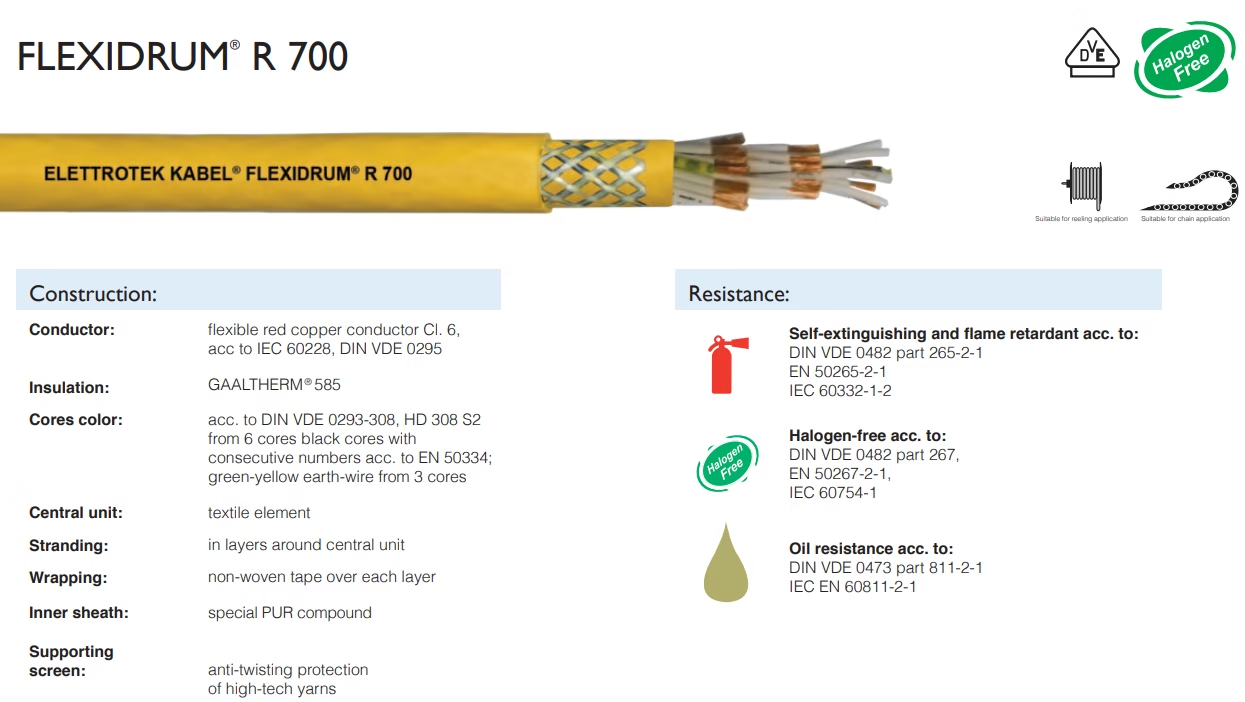
FLEXIDRUM® R 703: Advanced High-Temperature Industrial Multi-Core Cable for Extreme-Heat Heavy Equipment and Vertical Lifting Systems Engineered for the most demanding industrial thermal environments, the FLEXIDRUM® R 703 delivers breakthrough high-temperature performance with continuous operation capability to +120°C. Combining Class 5 flexible red copper conductor, advanced GAALTHERM® 585 thermoplastic elastomer insulation with extreme thermal resilience, aramide yarn anti-twisting reinforcement, and specialized PUR outer sheath formulation—meeting all fire-safety and halogen-free standards while maintaining electrical performance across the widest thermal envelope (−40 to +120°C) available in industrial cable engineering.

FLEXIDRUM® R 703

FLEXIDRUM® R 703: Advanced High-Temperature Industrial Multi-Core Cable for Extreme-Heat Heavy Equipment and Vertical Lifting Systems Engineered for the most demanding industrial thermal environments, the FLEXIDRUM® R 703 delivers breakthrough high-temperature performance with continuous operation capability to +120°C. Combining Class 5 flexible red copper conductor, advanced GAALTHERM® 585 thermoplastic elastomer insulation with extreme thermal resilience, aramide yarn anti-twisting reinforcement, and specialized PUR outer sheath formulation—meeting all fire-safety and halogen-free standards while maintaining electrical performance across the widest thermal envelope (−40 to +120°C) available in industrial cable engineering.
FLEXIDRUM® R 702: Advanced Salt-Spray Resistant Multi-Core Cable for Maritime Port Infrastructure and Container Handling Systems Engineered for extreme corrosive marine environments, the FLEXIDRUM® R 702 delivers proven salt-fog resistance combined with Class 5 flexible conductor technology, GAALTHERM® 630 thermoplastic insulation, and advanced anti-twisting textile reinforcement. Designed for automated container spreader bars, vertical lifting platforms, and offshore equipment exposed to continuous salt-spray cycles—meeting DIN VDE, EN, and IEC standards with reduced weight and diameter for enhanced installation flexibility in modern port automation infrastructure.

FLEXIDRUM® R 702

FLEXIDRUM® R 702: Advanced Salt-Spray Resistant Multi-Core Cable for Maritime Port Infrastructure and Container Handling Systems Engineered for extreme corrosive marine environments, the FLEXIDRUM® R 702 delivers proven salt-fog resistance combined with Class 5 flexible conductor technology, GAALTHERM® 630 thermoplastic insulation, and advanced anti-twisting textile reinforcement. Designed for automated container spreader bars, vertical lifting platforms, and offshore equipment exposed to continuous salt-spray cycles—meeting DIN VDE, EN, and IEC standards with reduced weight and diameter for enhanced installation flexibility in modern port automation infrastructure.
FLEXIDRUM® R 502: Advanced Heavy-Duty Industrial Cable with PUR Polyurethane Sheath and GAALTHERM® 530 Insulation for Motor Hoist, Transport Systems, and High-Mechanical-Stress Farm Equipment Engineered for extreme mechanical stress and industrial machinery applications, FLEXIDRUM® R 502 combines flexible Class 5 tinned or red copper conductor, GAALTHERM® 530 thermoplastic insulation, optional anti-twisting textile reinforcement, and advanced polyurethane (PUR) outer sheath to deliver unmatched durability in demanding heavy-duty environments. Rated for 180 m/min maximum speed (with anti-twisting protection), −40 to +90°C temperature stability, and superior UV/chemical/oil resistance across 3–42 core configurations (0.5–10 mm² cross-section range and specialized multi-core power configurations), this robust cable solution provides comprehensive protection against mechanical fatigue, thermal cycling, environmental degradation, and rapid-deployment stress for motor reel hoists, transport systems, movable motors, agricultural equipment, and specialized heavy-machinery infrastructure.

FLEXIDRUM® R 502

FLEXIDRUM® R 502: Advanced Heavy-Duty Industrial Cable with PUR Polyurethane Sheath and GAALTHERM® 530 Insulation for Motor Hoist, Transport Systems, and High-Mechanical-Stress Farm Equipment Engineered for extreme mechanical stress and industrial machinery applications, FLEXIDRUM® R 502 combines flexible Class 5 tinned or red copper conductor, GAALTHERM® 530 thermoplastic insulation, optional anti-twisting textile reinforcement, and advanced polyurethane (PUR) outer sheath to deliver unmatched durability in demanding heavy-duty environments. Rated for 180 m/min maximum speed (with anti-twisting protection), −40 to +90°C temperature stability, and superior UV/chemical/oil resistance across 3–42 core configurations (0.5–10 mm² cross-section range and specialized multi-core power configurations), this robust cable solution provides comprehensive protection against mechanical fatigue, thermal cycling, environmental degradation, and rapid-deployment stress for motor reel hoists, transport systems, movable motors, agricultural equipment, and specialized heavy-machinery infrastructure.
FLEXIDRUM® NSHTÖU (V): High-Flexibility Salt-Spray-Resistant Festoon Cable for Dynamic Port Terminal Applications Engineered for continuous rapid-deployment and high-cycling harbour equipment, FLEXIDRUM® NSHTÖU (V) combines tinned Class 5 flexible copper conductor, Kevlar central reinforcement, fire-resistant EPR insulation, and oil-resistant rubber outer sheath to deliver unmatched reliability in extreme salt-spray marine environments. Rated for 180 m/min maximum deployment speed, −25 to +90°C temperature stability, and 0.6/1 kV nominal specifications across 3–44 core configurations (0.5–10 mm² cross-section range), this advanced festoon solution provides comprehensive protection against corrosion, thermal cycling, mechanical flex-fatigue, and rapid-reeling stress for harbour cranes, container-handling spreader systems, dock-automation equipment, and specialized port terminal infrastructure.

NSHTÖU (V)

FLEXIDRUM® NSHTÖU (V): High-Flexibility Salt-Spray-Resistant Festoon Cable for Dynamic Port Terminal Applications Engineered for continuous rapid-deployment and high-cycling harbour equipment, FLEXIDRUM® NSHTÖU (V) combines tinned Class 5 flexible copper conductor, Kevlar central reinforcement, fire-resistant EPR insulation, and oil-resistant rubber outer sheath to deliver unmatched reliability in extreme salt-spray marine environments. Rated for 180 m/min maximum deployment speed, −25 to +90°C temperature stability, and 0.6/1 kV nominal specifications across 3–44 core configurations (0.5–10 mm² cross-section range), this advanced festoon solution provides comprehensive protection against corrosion, thermal cycling, mechanical flex-fatigue, and rapid-reeling stress for harbour cranes, container-handling spreader systems, dock-automation equipment, and specialized port terminal infrastructure.
GAALFLEX® SAFE CY: Shielded Intrinsically Safe Multi-Core Control Cable for Hazardous Area Measurement Systems (300/500 V Nominal, 3 kV Test Voltage per DIN EN 60079-14, −40 to +80°C Extreme Temperature Envelope, Class 5 Flexible Red Bare Copper per IEC 60228 and DIN VDE 0295, Tinned Copper Braid Electromagnetic Interference Screen with Optimized Capacitance

GAALFLEX® SAFE CY Lean

GAALFLEX® SAFE CY: Shielded Intrinsically Safe Multi-Core Control Cable for Hazardous Area Measurement Systems (300/500 V Nominal, 3 kV Test Voltage per DIN EN 60079-14, −40 to +80°C Extreme Temperature Envelope, Class 5 Flexible Red Bare Copper per IEC 60228 and DIN VDE 0295, Tinned Copper Braid Electromagnetic Interference Screen with Optimized Capacitance
GAALFLEX® VFD 600 XLPE/PVC: 600 V Low Voltage PWM Frequency Converter Motor Cable—Comprehensive Polymer Science, Electrical Engineering and Cost–Performance Analysis XLPE insulation (1–3% gel content) and PVC sheath cost-optimization strategy for North American low-voltage industrial markets; trade-off analysis versus halogen-free alternatives (LSZH, CPE, TPE); PWM inverter electromagnetic environment (1–5 kHz switching, 0.4–2 kV/μs voltage ramps, harmonic spectrum to 10 kHz, common-mode voltage transients); copper conductor skin-effect AC resistance elevation (65% increase at 5 kHz requiring 15–20% thermal derating for continuous duty); XLPE dielectric properties (frequency-dependent εᵣ, tan δ exponential growth, PDIV ~10–12 kV with 17× safety margin); PVC flame-retardancy chemistry (halogenated radical scavenging, VW-1/IEEE 1202/ICEA T-29-520 vertical propagation testing); three-phase red-copper conductors (ASTM B-3/B-8) with three-conductor earth-return grounding architecture; corrugated copper-tape screening (RFI/EMI suppression Class A/B); temperature range −40°C flexible to +90°C continuous; sixteen SKU configurations (16 AWG to 500 MCM); North American standards ecosystem (UL 44/1277, NEMA WC 57, IEEE 1202, ICEA T-29-520); MSHA approval for coal/mineral hazardous areas; life-cycle cost analysis and downtime economics; complete engineering dataset: 46+ performance tables, 19 chemical/electrical equations, 13 worked calculations.

GAALFLEX® VFD 600

GAALFLEX® VFD 600 XLPE/PVC: 600 V Low Voltage PWM Frequency Converter Motor Cable—Comprehensive Polymer Science, Electrical Engineering and Cost–Performance Analysis XLPE insulation (1–3% gel content) and PVC sheath cost-optimization strategy for North American low-voltage industrial markets; trade-off analysis versus halogen-free alternatives (LSZH, CPE, TPE); PWM inverter electromagnetic environment (1–5 kHz switching, 0.4–2 kV/μs voltage ramps, harmonic spectrum to 10 kHz, common-mode voltage transients); copper conductor skin-effect AC resistance elevation (65% increase at 5 kHz requiring 15–20% thermal derating for continuous duty); XLPE dielectric properties (frequency-dependent εᵣ, tan δ exponential growth, PDIV ~10–12 kV with 17× safety margin); PVC flame-retardancy chemistry (halogenated radical scavenging, VW-1/IEEE 1202/ICEA T-29-520 vertical propagation testing); three-phase red-copper conductors (ASTM B-3/B-8) with three-conductor earth-return grounding architecture; corrugated copper-tape screening (RFI/EMI suppression Class A/B); temperature range −40°C flexible to +90°C continuous; sixteen SKU configurations (16 AWG to 500 MCM); North American standards ecosystem (UL 44/1277, NEMA WC 57, IEEE 1202, ICEA T-29-520); MSHA approval for coal/mineral hazardous areas; life-cycle cost analysis and downtime economics; complete engineering dataset: 46+ performance tables, 19 chemical/electrical equations, 13 worked calculations.