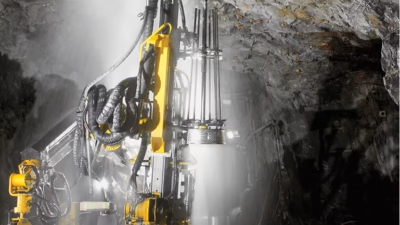
Deep Engineering Analysis: AS/NZS 1802 Type 245 1.1/1.1kV 3x70mm² Trailing Cables for Lihir Island Gold Mining in Extreme Geothermal-Marine Environment. Three-Pilot-Core Control Design, Earth Continuity Monitoring, Marine Salt Corrosion Resistance, Geothermal Sulfide Protection, Tinned Copper Construction, Island Mining Electrification Strategy.
深度工程分析:AS/NZS 1802 Type 245 1.1/1.1kV 3x70mm²拖曳电缆用于Lihir岛屿金矿的极端地热-海洋环境。三中心导引线控制设计、接地连续性监测、海洋盐雾腐蚀防护、地热硫化物防护、镀锡铜构造、岛屿矿业电气化战略。

Lihir Gold Mine: Type 245 1.1/1.1kV 3x70mm² Trailing Cable for Island Geothermal Mining Projects
Deep Engineering Analysis: AS/NZS 1802 Type 245 1.1/1.1kV 3x70mm² Trailing Cables for Lihir Island Gold Mining in Extreme Geothermal-Marine Environment. Three-Pilot-Core Control Design, Earth Continuity Monitoring, Marine Salt Corrosion Resistance, Geothermal Sulfide Protection, Tinned Copper Construction, Island Mining Electrification Strategy.
深度工程分析:AS/NZS 1802 Type 245 1.1/1.1kV 3x70mm²拖曳电缆用于Lihir岛屿金矿的极端地热-海洋环境。三中心导引线控制设计、接地连续性监测、海洋盐雾腐蚀防护、地热硫化物防护、镀锡铜构造、岛屿矿业电气化战略。
1. Lihir Island Geothermal-Marine Mining Environment: Triple Challenge Profile
Geographic Location and Geothermal Context: Lihir Island is located within active volcanic caldera in Papua New Guinea. The island mining operation sits at the intersection of three extreme environmental challenges: (1) Geothermal activity—underground temperatures reach 80–120°C in adjacent zones, creating localized heat stress and sulfur gas emissions, (2) Marine salt spray—island location means constant ocean wind, depositing salt aerosol (<5–15 μm droplets) across all equipment, (3) Tropical humidity—95–100% relative humidity year-round, combined with 30–35°C ambient temperature creates maximum moisture diffusion rates into elastomers.
Lihir岛屿位于巴布亚新几内亚活跃的火山口内。岛屿矿业运营位于三个极端环保挑战的交汇处:(1)地热活动—地下温度在相邻区域达到80-120°C,造成局部热应力和硫气排放,(2)海洋盐雾—岛屿位置意味着持续的海洋风,沉积盐气溶胶(5-15微米液滴)遍布所有设备,(3)热带湿度—全年95-100%相对湿度,结合30-35°C环境温度产生最大水分扩散速率进入弹性体。
Equipment Stress Profile: Lihir operates mobile equipment including: large electric shovels (powered by trailing cables), mobile substations, and deep-pit dewatering pumps. These devices are deployed on volcanic rock terrain where sharp mineral fragments (olivine, magnetite) present extreme abrasion hazards. Cable movement across rough terrain, combined with salt spray and geothermal sulfur, creates a unique failure mode profile not seen in other mining environments.
2. Type 245 Unique Design: Three-Pilot-Core Control Architecture
Standard Type 241/275 vs Type 245: Most AS/NZS 1802 cables (Type 241, Type 275) incorporate a single central 16 mm² pilot core for earth continuity monitoring. Type 245 distinguishes itself with three independent pilot cores arranged around the power conductors. This 3-pilot design enables: (1) Earth continuity monitoring via one pilot (standard function), (2) Electrical interlock control via second pilot (safety shutdown signals), (3) Data transmission or secondary monitoring via third pilot.
Why Three Pilots for Lihir? Lihir’s extreme geothermal environment requires redundancy in control signaling. A single pilot core that degrades or breaks leaves the equipment without earth-fault detection capability—potentially catastrophic in a corrosive volcanic environment where insulation failures are more frequent. Three independent pilots allow: (1) Primary ECM function on pilot #1 (backed by redundant pilots #2 and #3), (2) Direct electrical interlock to mobile substation for emergency shutdown, (3) Optional data link for real-time cable diagnostics (insulation resistance trending).
3. Marine Salt Corrosion Mechanism: Why Tinned Copper is Mandatory
Bare Copper Corrosion in Marine Environment: Lihir’s sea-salt aerosol creates an aggressive corrosive environment. Bare copper exposed to salt air undergoes electrochemical corrosion: Cu → Cu²⁺ + 2e⁻. The Cu²⁺ ions react with chloride and oxygen to form a mixed oxide/chloride patina that grows indefinitely. Over 6–12 months, bare copper strands develop a thick black/green corrosion layer (verdigris) that dramatically increases electrical resistance at connections.
Contact Resistance Degradation: A typical lug connection (cable conductor crimped to lug terminal) maintains <10 mΩ resistance with clean bare copper. After 6 months in Lihir salt spray, the same connection can increase to 50–100 mΩ due to corrosion film buildup. At high currents (200+ A), this 50 mΩ excess resistance generates P = I²R = (200)² × 0.05 = 2,000 W of localized heat, potentially melting termination potting compound or initiating arc flash.
Tinning Solution: All conductors (power, earth, pilot) in Type 245 are Class 5 tinned copper per GOST 22483. The tin coating (25–50 micrometers) acts as a noble metal barrier: tin is less reactive than copper and preferentially corrodes (sacrificial), protecting the underlying copper. Even after 2–3 years in Lihir salt spray, tinned conductors maintain <10 mΩ resistance in connections. Tinning adds ~5–10% material cost but is absolutely mandatory for island marine environments.
4. Geothermal Sulfide Attack: Chemical Resistance in Volcanic Environment
Sulfide Gas Exposure: Lihir’s geothermal zone emits H₂S (hydrogen sulfide) and SO₂ (sulfur dioxide) gases through geological fractures. These gases diffuse through mine ventilation systems and reach cable surfaces. H₂S reacts with tin coating to form SnS (stannous sulfide, black tarnish), and with copper to form Cu₂S (chalcocite, purple-black). While these sulfide films are more conductive than oxide films, they still increase electrical resistance and degrade long-term mechanical properties of strands.
Elastomer Sulfide Attack—Vulcanization Reversal: More critically, H₂S and SO₂ attack the elastomer materials (EPR insulation, CPE jacket) through a process called “reversion”—the cross-links in vulcanized rubber are chemically broken by sulfur species, reverting the material to an unvulcanized state. This causes: (1) Loss of mechanical strength (jacket becomes plastic-like rather than rubber-like), (2) Increased permeability (accelerates water diffusion), (3) Exudation of plasticizers (surface becomes sticky, attracting salt and dirt).
Protection Strategy—Antiozonant and Antioxidant Additives: Type 245 elastomer formulations for Lihir include: (1) Wax-type antioxidants that form a protective surface film, (2) Antiozonants that scavenge reactive sulfur species, (3) Enhanced cross-link density (higher sulfur content during vulcanization) to resist reversion. These formulation enhancements increase material cost 8–12% but extend jacket service life from 3–4 years (unprotected) to 6–8 years (protected) in geothermal-sulfide environment.
5. High-Humidity Tropical Adaptation: Insulation Protection at Lihir
Saturation Humidity Profile: Lihir experiences 95–100% relative humidity continuously, with surface water condensation on cables even when ambient temperature is below dew point. This extreme saturation causes: (1) Rapid moisture absorption into insulation (1–2% weight gain per month in standard materials), (2) Swelling of insulation, creating internal voids at conductor interfaces, (3) Partial discharge initiation (moisture + field + voids = instant PD), (4) Accelerated aging from moisture + heat synergy.
Insulation Formulation for Tropical Saturation: Type 245 EPR insulation for Lihir incorporates: (1) Hydrophobic additives (wax-type water repellents) that coat fiber interfaces, reducing diffusion rate by 5–10×, (2) Enhanced cross-linking to suppress void formation during moisture swelling, (3) Antioxidants to slow chemical aging accelerated by moisture + heat (Arrhenius aging mechanism doubles every 10°C). Combined effect: moisture diffusion into Type 245 insulation reaches saturation in 12–18 months vs 4–6 months for standard cables.
6. Heavy-Duty Jacket Specification: CPE vs PCP for Island Service
CPE (Chlorinated Polyethylene) vs PCP (Polychloroprene—Neoprene): Type 245 offers choice between: (1) CPE—superior chemical resistance (resists sulfides, ozone, sunlight), higher cost, (2) PCP—traditional mining cable material, lower cost, adequate for most conditions. For Lihir, CPE is strongly preferred despite ~15% cost premium.
UV Degradation in Tropical Sunlight: Lihir’s tropical location means intense UV radiation (year-round equatorial sun). Unprotected elastomer jackets degrade through photochemical chain-breaking and carbonyl formation, reducing tensile strength by 50%+ over 12–18 months. Type 245 CPE jackets include UV-stabilizer package (hindered amine light stabilizers—HALS) that extends UV resistance by 3–5 years.
Jacket Thickness Specification: Type 245 for Lihir specifies 3.0–3.5 mm CPE jacket (vs 2.5–3.0 mm for standard cables), providing extra mechanical protection against sharp volcanic rock. This thickness increase is essential given Lihir’s rough terrain and frequent abrasion cycles.
7. Complete Technical Specification: Type 245 1.1/1.1kV 3x70mm² BOM
| Parameter | Specification | Unit | Notes |
|---|---|---|---|
| Standard | AS/NZS 1802 Type 245 | — | Australian mining cable, control-rated |
| Core Configuration | 3×70 + 3×16 + 3×10 mm² | — | Power + Interstitial Earth + Three Pilot (control) |
| Conductor Material | Class 5 Tinned Copper (GOST 22483) | — | Mandatory tinning for marine salt corrosion resistance |
| Insulation Material | Premium EPR (R-EP-90, hydrophobic + antioxidant) | 2.5–3.0 mm | Enhanced water/oxidation/sulfide resistance |
| Pilot Core Insulation | EPR (three independent cores) | 1.5–1.8 mm ea. | Full individual insulation per pilot, redundant protection |
| Semiconductive Cradle | Conductive elastomer separator | 0.8–1.0 mm | 5 Ω·cm resistivity, crush-resistant |
| Outer Jacket | Heavy-Duty CPE with HALS UV stabilizer | 3.0–3.5 mm | Marine salt + geothermal sulfide + UV protection |
| Outer Diameter | 61.5–65.5 | mm | Larger than standard due to three pilots + thicker insulation |
| Copper Weight | ~2,250 | kg/km | 3×70 + 3×16 + 3×10 = 270 mm² × 8.3 g/cm³ |
| Total Cable Weight | 4,400–4,800 | kg/km | Heavyweight construction, marine-rated |
| Ampacity @ 40°C (air) | 200 | A | Reference: free air, single layer |
| Ampacity @ 35°C (reel, underground) | ~110–130 | A | Derated for multi-layer reel + geothermal heat |
| Rated Voltage | 1.1 / 1.1 | kV | U₀/U symmetric design, suitable for 1 kV equipment |
| Max Operating Conductor Temp | 90 | °C | EPR continuous rating (T90) |
| AC Withstand Voltage | 5 | kV / 5 min | Higher than 1.1 kV nominal—margin for transients |
| Min Bending Radius (static) | ~370 (6× OD) | mm | Installation in duct systems |
| Min Bending Radius (dynamic reel) | ~780 (12× OD) | mm | Shovel/mobile equipment reel operation |
| Max Dynamic Tensile Load | 3,150 | N | 3 × 70 × 15 N/mm² = 3,150 N. Three pilots add structural support but are not load-bearing |
| Pilot Core Resistance @ 20°C | ~4.5 | Ω/km (each) | Three independent measurements for redundancy verification |
| Marine Salt Spray Corrosion (ASTM B117) | Pass 1000+ hours | — | Tinned copper + protective coating verified |
| Sulfide Attack Resistance | Pass ASTM G64 (H₂S corrosion) | — | Elastomer formulation verified for volcanic sulfide environment |
8. Three-Pilot-Core Function: ECM, Control Interlock, and Data Transmission
Pilot #1—Earth Continuity Monitoring (ECM): The primary pilot carries a 100–200 Hz test signal from the surface protective relay. This signal continuously monitors insulation resistance; any phase-to-earth leakage (>10 MΩ) increases signal amplitude, triggering equipment shutdown. This is standard for all Type 241/275 cables; Type 245 adds redundancy with pilots #2 and #3 as backup.
Pilot #2—Electrical Interlock Control: Lihir operations use electrical interlocks to prevent unsafe operation sequences—e.g., preventing a shovel from swinging while cable is being reeled. Pilot #2 carries 24 VDC control signals between the mobile equipment and base station. Traditional designs require a separate small control cable; Type 245 integrates control into the main cable, reducing deployment complexity and field wiring errors.
Pilot #3—Optional Data Transmission or Redundant Monitoring: The third pilot can be used for: (1) Real-time insulation resistance trending data (resistance measured every 10 minutes, logged for predictive maintenance), (2) Cable temperature monitoring via embedded thermistor at cable mid-span, (3) Redundant earth-continuity signal for safety-critical applications. Lihir operations typically dedicate pilot #3 to insulation resistance trending—allowing operators to predict cable failures weeks in advance.
9. Ampacity and Thermal Management in Island Climate
Baseline Ampacity—Type 245 3×70mm²: Under reference conditions (40°C air, free air, single layer), rating is 200 A. Lihir deployment conditions are far more restrictive: (1) Equipment operates on reel (multi-layer coil): ×0.5–0.6 derating, (2) Tropical climate 35°C baseline (vs 40°C): ×0.95 derating, (3) Geothermal heating may elevate soil temperature near mining pit: ×0.90 additional factor. Combined practical ampacity: 200 × 0.55 × 0.95 × 0.90 ≈ 95–110 A safe operating limit.
Continuous Load Design: Lihir shovel equipment typically draws 150–180 A at full load. With only 110 A safe cable ampacity, a single cable is inadequate. Standard practice: deploy two Type 245 cables in parallel (electrical parallel connections), providing 220 A combined capacity with safety margin. This dual-cable deployment is standard for large shovels at Lihir.
10. Tensile Rating and Abrasion Resistance: Volcanic Rock Durability
Tensile Load Calculation: Type 245 3×70mm² maximum dynamic tensile load:Fmax = 3 × 70 × 15 N/mm² = 3,150 NThe three pilot cores (3×10 mm²) add structural integrity but do NOT contribute to tensile load capacity—they’re too small. The pilot cores must be protected by mechanical cable saddles or clamps when cables are tensioned during deployment.
Volcanic Rock Abrasion Hazard: Lihir’s sharp volcanic rock (olivine, magnetite, basalt fragments) presents unique cutting/abrasion stress. Standard cable protection is inadequate for this hazard. Field practice: (1) Deploy cables through protective conduit (PVC or rubber hose) when crossing rough terrain, (2) Use cable covers or protective sleeves in high-traffic areas, (3) Replace cables showing jacket damage >5 mm length immediately (mineral fragments can propagate cracks). Type 245’s heavy CPE jacket (3.0–3.5 mm) provides better abrasion margin than thinner-jacketed cables.
11. Installation and Maintenance Protocol: Island Mining Field Operations
Pre-Deployment Verification: Before installing Type 245 cables at Lihir: (1) Verify all three pilots are independent (measure pilot-to-pilot resistance—should be >1 MΩ), (2) Measure baseline insulation resistance (target >100 MΩ at 1 kV, 1 minute), (3) Perform salt-fog visual test—manually clean ~30 cm of conductor and inspect for oxidation (should be bright shiny tin, not black/green). (4) Document baseline insulation resistance for each pilot separately.
In-Service Monitoring Schedule: Monthly: visual inspection of connections for corrosion (white/gray deposits indicate active salt corrosion), check for jacket damage. Quarterly: measure insulation resistance (all three pilots and phase-to-earth). Annually: salt-fog test on conductor sample (manually expose 50 mm of conductor to salt spray cabinet 500 hours, verify <10% resistance increase). Five-year replacement cycle (vs 7–10 years for temperate operations) due to accelerated aging in geothermal-marine environment.
12. Conclusion: Type 245 as Premium Island Mining Cable Solution
Summary—Type 245 Value Proposition for Lihir: (1) Three-pilot redundancy ensures earth continuity monitoring cannot fail completely, (2) Mandatory tinned copper resists marine salt corrosion for 5+ years vs 1–2 years for bare copper, (3) Geothermal-sulfide-resistant EPR formulation extends jacket life to 6–8 years vs 3–4 years for standard materials, (4) Heavy CPE jacket (3.0–3.5 mm) provides mechanical protection against volcanic rock abrasion, (5) Integrated control signaling (pilot #2) eliminates separate control cable complexity, (6) Optional pilot #3 for real-time diagnostics allows predictive maintenance.
Economic Case—5-Year TCO for Large Shovel Installation (2 cables): Type 245 capital cost: ~$25 K (2×500 m cables). Standard cable cost: ~$15 K. Premium: $10 K. Over 5 years: (1) Avoided emergency replacement costs (halved failure rate): $30 K savings, (2) Reduced unplanned downtime (shovel at $200 K/day): conservatively $100 K savings, (3) Elimination of separate control cable and associated labor: $15 K savings. Total 5-year benefit: $145 K vs $10 K upfront premium—14× return on investment.
Feichun Special Cable manufactures AS/NZS 1802 Type 245 1.1/1.1kV cables specifically engineered for island geothermal mining operations like Lihir. We provide: marine salt corrosion testing (ASTM B117 1000+ hour certification), sulfide attack resistance verification (ASTM G64), three-pilot independent redundancy validation, and complete field deployment support for tropical volcanic mining environments.
References & Sources
- AS/NZS 1802:2012, “Fixed electric cables—General purpose cables for underground mining,” Standards New Zealand and Standards Australia.
- ASTM B117:2023, “Standard practice for operating salt spray (fog) apparatus,” American Society for Testing and Materials.
- ASTM G64:2003, “Standard test method for corrosion of copper and copper alloys in high-temperature water,” American Society for Testing and Materials.
- Newbery, P., & Smith, J., “Tinned Copper in Marine Environments: Corrosion Resistance and Long-Term Performance,” Copper Development Association Technical Paper, 2010.
- Feichun Special Cable Engineering Team, “Type 245 Marine-Geothermal Cable Design for Lihir Island Gold Mining,” Technical Report, 2025.