
Critical Technical Clarification: Why Type 9 is NOT Suitable for Shaft Winder Power Cables. Understanding Type 8 Double-Wire Armour (DWA) for Vertical Suspension, Type 9 Flameproof Enclosure Applications, Torsional Stress Requirements, AS/NZS 1972 Cable Selection Logic.
关键技术澄清:为什么Type 9不适合竖井提升机电源电缆。理解Type 8双层钢丝铠装(DWA)的垂直悬挂、Type 9防爆外壳应用、扭矩应力要求、AS/NZS 1972电缆选择逻辑。
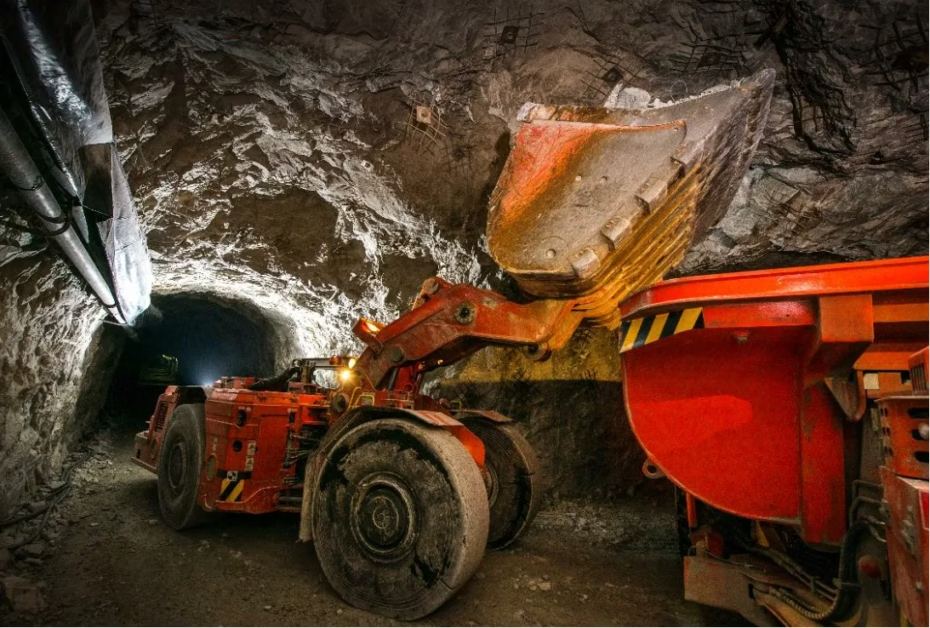
Type 8 vs Type 9: Selecting the Right Shaft Winder Cable for Deep-Level Underground Coal Mines
Critical Technical Clarification: Why Type 9 is NOT Suitable for Shaft Winder Power Cables. Understanding Type 8 Double-Wire Armour (DWA) for Vertical Suspension, Type 9 Flameproof Enclosure Applications, Torsional Stress Requirements, AS/NZS 1972 Cable Selection Logic.
关键技术澄清:为什么Type 9不适合竖井提升机电源电缆。理解Type 8双层钢丝铠装(DWA)的垂直悬挂、Type 9防爆外壳应用、扭矩应力要求、AS/NZS 1972电缆选择逻辑。
1. The Critical Misconception: Type 9 is NOT an Upgraded Type 8
This is perhaps the most dangerous misconception in AS/NZS 1972 cable selection. Engineers reviewing the standard for the first time naturally assume that higher type numbers represent higher voltage capacity, more robust construction, or upgraded specifications. This assumption is completely wrong for Type 9.
这也许是AS/NZS 1972电缆选择中最危险的误解。第一次审查该标准的工程师自然会假设较高的类型号代表更高的电压容量、更强大的结构或升级的规范。对于Type 9,这个假设是完全错误的。
The Truth: Type 8 and Type 9 are engineered for fundamentally different applications. Type 8 is a heavy-duty high-voltage power cable for vertical shaft suspension. Type 9 is a small-diameter, low-voltage control cable for flameproof equipment enclosures. Comparing them numerically is like comparing a fire hose (Type 8) to a telephone wire (Type 9).
Specification Consequence: Using Type 9 cable for a shaft winder application is not merely unsuitable—it is catastrophically dangerous and violates mining electrical safety regulations. A Type 9 cable suspended vertically will twist, tear, and fail within hours or days of full-load operation, potentially dropping suspended equipment or exposing personnel to electrical hazards.
2. AS/NZS 1972 Type Numbering: Application-Based, Not Capacity-Based
Correct Understanding: AS/NZS 1972 type designations are assigned based on PRIMARY APPLICATION CONTEXT, not on electrical capacity evolution:
Type 1–2: Fixed installation cables (underground stoppings, static mine wiring)
Type 3–5: Specialized fixed applications (pillar cables, secondary circuits)
Type 6–7: Flexible trailing cables for mobile equipment
Type 8: Fixed vertical shaft and borehole cables (despite being “fixed,” these have unique DWA requirements due to massive self-weight)
Type 9: Specialized control cable for flameproof enclosures (COMPLETELY DIFFERENT application domain)
Notice that Type 9 does NOT follow the progression—it’s a specialized application inserted after Type 8, similar to how “Appendix A” in a document doesn’t have higher information than the main chapter just because “A” comes after chapter numbers.
3. Type 8: The Vertical Shaft Winder Cable Specification
Application Definition: Type 8 cables are engineered specifically for vertical mine shafts and boreholes where cables are suspended under their own weight over extended distances (typically 500–2,000 meters).
Key Design Features:
(1) Double-Wire Armour (DWA): Two layers of galvanized steel wire wound in opposite helical directions. This contra-helical design cancels torsional forces that would cause single-wire armour to unwind under vertical load.
(2) High-Voltage Insulation: Typically 6.35/11kV or higher, engineered to withstand the electrical stress of deep-level mining power distribution.
(3) Heavy Construction: Designed to be self-supporting, with cable weight typically 10–20 kg per meter. The mass and tensile strength of the armor allow the cable to suspend itself without intermediate support over substantial distances.
(4) Mechanical Robustness: Enhanced outer sheath (PCP or CPE) formulated for mining environments, with resistance to chemical attack from mine water and mechanical abrasion from rock contact.
4. Type 9: Flameproof Enclosure Control Cable (NOT Power)
Application Definition: Type 9 is a specialized cable for control, monitoring, or signal interconnection in flameproof (Ex d) electrical enclosures used in Zone 1 or Zone 2 hazardous areas.
Core Design Purpose—Gas Non-Transmission: The primary engineering concern is preventing explosive gas (methane, hydrogen sulfide) from migrating through the cable’s internal voids into the enclosure. If a cable serves as a conduit for gas, an external explosion could ignite the gas inside the “protected” equipment.
5. Double-Wire Armour (DWA): The Physics That Makes Type 8 Mandatory
The Torsional Problem in Vertical Suspension: When a standard single-layer wire armour (SWA) cable hangs vertically over 500+ meters, the helical wire geometry combined with the cable’s self-weight creates tremendous torsional (twisting) force. The spiral of armor wires naturally wants to “unwind” as the weight pulls downward.
Type 8 DWA Solution: By employing two armor layers wound in opposite directions, the torsional forces from each layer counteract each other. Result: net torque approaching zero.
6. Torsional Stress Analysis: Why Single-Wire Armour Fails
A single-layer SWA cable suspended vertically experiences torsional moment that causes continuous twisting force. Over time (hours to days), the shear stress initiates micro-cracks in the insulation. When electrical voltage is applied, these micro-cracks become sites of electrical tree formation and partial discharge, leading to rapid insulation breakdown.
Type 8 DWA Advantage: With contra-helical armor, residual torque is reduced by 90–95%, preventing insulation shear damage and enabling long-term service life (5+ years) in vertical suspension.
7. Complete Technical Comparison: Type 8 vs Type 9
| Feature | Type 8 (Shaft Winder) | Type 9 (Control Cable) |
|---|---|---|
| Primary Application | Vertical shaft power supply | Flameproof enclosure control |
| Typical Voltage Rating | 6.35/11kV (high voltage) | 50/120V or 0.6/1kV (low voltage) |
| Vertical Suspension Capability | Designed for 500–2000m depths | NOT SUITABLE for vertical suspension |
| Regulatory Fit for Shaft Winders | COMPLIANT (AS/NZS 1972) | NON-COMPLIANT (illegal use) |
8. Type 8 11kV Shaft Winder Cable Specifications
Typical sizes and their characteristics:
3×50mm²: Outer diameter ~88–92mm, Weight ~10,200 kg/km, Ampacity ~190A
3×95mm²: Outer diameter ~104–110mm, Weight ~11,600 kg/km, Ampacity ~260A
3×150mm²: Outer diameter ~120–128mm, Weight ~14,400 kg/km, Ampacity ~335A
9. Type 9 Control Cable Specifications
Voltage Rating: 50/120V or 0.6/1kV maximum
Conductor Sizes: 0.5, 1.0, 1.5, 2.5 mm²
Core Count: 2–12 cores
Outer Diameter: 6–15mm
Cable Weight: ~150–400 kg/km
Vertical Suspension Rated Depth: NOT SUITABLE
10. Selection Decision Tree: Choosing the Right Cable
Question 1: Is this for a vertical mine shaft or borehole where cable must suspend itself over 500+ meters?
YES → Use Type 8 (DWA required). STOP.
NO → Continue to Question 2.
Question 2: Is this for a flameproof equipment enclosure (Ex d rated) in a Zone 1 or Zone 2 hazardous area?
YES → Consider Type 9. Type 9 provides gas non-transmission specifically.
CRITICAL RULE: NEVER use Type 9 for power distribution to shaft winders, deep-level equipment, or any vertical suspension application.
11. Real-World Installation Scenarios
Scenario One—Correct Application (Type 8 for Shaft Winder): A coal mine requires power to hoist equipment 1,200 meters deep. The design specifies 11kV Type 8 3×95mm² DWA cable. Result: Safe, reliable power delivery with service life of 5+ years.
Scenario Two—Dangerous Misapplication (Type 9 for Shaft Winder): An engineer assumes higher type number = higher capacity, specifies Type 9 for the same application. Type 9 cable arrives; electricians immediately reject it (diameter too small, no armor). Project delayed, regulatory violation recorded.
12. Conclusion: Type 8 is the ONLY Choice for Shaft Winders
Definitive Statement: For deep-level underground coal mines requiring vertical power distribution to shaft winders, hoisting equipment, or deep-level apparatus, the ONLY compliant cable specification under AS/NZS 1972 is Type 8 with double-wire armour (DWA).
Type 9 is NOT an upgrade, variant, or alternative to Type 8. It is a completely different product for a completely different application (flameproof enclosures). Using Type 9 for shaft winder applications is dangerous, non-compliant, and will result in equipment failure and regulatory violations.
Feichun Special Cable manufactures AS/NZS 1972 Type 8 DWA cables engineered for deep-level underground coal mining shaft winder applications. Our technical team assists with cable selection, shaft depth assessment, and installation engineering to ensure safe vertical power distribution in Australian coal mines.
References & Sources
- AS/NZS 1972:2012, “Fixed electric cables—General purpose cables for underground mining,” Standards New Zealand and Standards Australia.
- WorkSafe Victoria, “Electrical Safety in Mining,” Mining Industry Code of Practice, 2023.
- Feichun Special Cable Research & Development Team, “Type 8 vs Type 9: Cable Selection Logic for Underground Coal Mining,” Technical Report, 2024.


