
A Comprehensive Technical Analysis of Material Composition, Performance Characteristics, and Application Selection Criteria
(N)TMCGCWOEU vs (N)TMCGCW11Y: Understanding the Differences in High-Flexibility Crane Cable Reels for Mining Applications
A Comprehensive Technical Analysis of Material Composition, Performance Characteristics, and Application Selection Criteria
Anhui Feichun Special Cable Co., Ltd. (安徽飞纯特种电缆有限公司) specializes in manufacturing premium-grade mining cables engineered for the most demanding industrial applications. Our (N)TMCGCWOEU and (N)TMCGCW11Y cable series represent cutting-edge solutions for crane cable reel systems in mining, port facilities, and heavy industrial operations.
International Sales: +86 13855123218
Executive Summary
In the demanding environment of mining operations, selecting the appropriate cable for crane reel systems is critical for operational safety, equipment longevity, and cost efficiency. The choice between (N)TMCGCWOEU and (N)TMCGCW11Y cables primarily hinges on the sheathing material composition, with each offering distinct advantages tailored to specific operating conditions. Both cable types are engineered as screened single-core medium voltage solutions conforming to the rigorous standards established by DIN VDE 0250-813, which has gained global recognition as the definitive standard for flexible reeling cables in demanding applications.
Understanding the fundamental material science behind these cable designations is essential for informed procurement decisions. The designation system used in European cable standards provides critical information about construction and performance characteristics, enabling engineers to match cable specifications with application requirements effectively.
Material Composition: The Critical Distinction
(N)TMCGCWOEU: Thermoset Elastomeric Sheath Technology
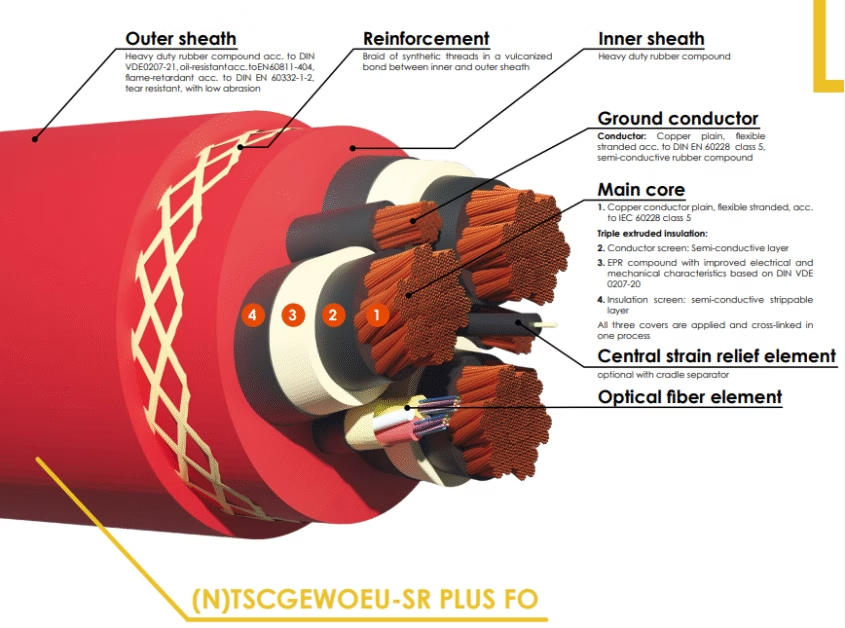
The (N)TMCGCWOEU cable features a thermoset elastomeric rubber sheath, specifically employing materials such as chloroprene rubber (Polychloroprene – PCP) or chlorinated polyethylene (CPE). According to research on polymeric materials for cable insulation and sheathing, thermoset compounds are characterized by their retention of physical properties over wide operating temperature ranges, forming irreversible chemical bonds during the curing process that enhance long-term stability.
Key Material Properties of WOEU Sheath:
- Excellent resistance to extreme temperatures ranging from -40°C to +90°C for mobile installations
- Superior chemical resistance to oils, greases, and industrial solvents commonly encountered in mining environments
- Exceptional mechanical durability against abrasion, tearing, and impact damage
- Enhanced weather resistance including protection against UV radiation, ozone, and moisture
- Flame-retardant properties meeting international safety standards
(N)TMCGCW11Y: Thermoplastic Polyurethane Innovation
The (N)TMCGCW11Y cable incorporates a thermoplastic polyurethane (PUR) sheath, designated as “11Y” in the VDE coding system. As documented by specialized cable manufacturers, polyurethane represents a thermoplastic elastomer (TPE) that exhibits rubber-like mechanical characteristics at certain temperatures while maintaining the processability advantages of thermoplastic materials. This unique combination has made PUR increasingly important in the cable industry for applications demanding superior flexibility and mechanical resilience.
Key Material Properties of 11Y (PUR) Sheath:
- Exceptional flexibility maintained across a broad temperature range of -40°C to +125°C
- Outstanding notch resistance and tear strength, significantly reducing risk of mechanical failure
- Superior abrasion resistance compared to conventional rubber compounds
- Excellent anti-kink properties, making it ideal for frequent reeling and unreeling applications
- Enhanced oil and chemical resistance, particularly important in hydraulic system proximity
- Halogen-free composition ensuring minimal toxic gas emission during fire scenarios
- Recyclable material contributing to environmental sustainability objectives
Material Science Insight: According to comparative studies on cable jacket materials, PUR sheath materials demonstrate notch resistance and flexibility even at low temperatures, though they may exhibit increased rubber-like behavior at high temperatures, potentially leading to higher abrasion within cable chains compared to other materials. This characteristic necessitates careful application assessment when selecting between WOEU and 11Y variants.
Comprehensive Technical Specifications
| Specification Parameter | (N)TMCGCWOEU | (N)TMCGCW11Y |
|---|---|---|
| Applicable Standard | DIN VDE 0250-813 (Trailing Cable for Power Installation) | |
| Rated Voltage (U₀/U) | 3.6/6 kV to 18/30 kV | |
| Construction Type | Screened single-core medium voltage cable | |
| Conductor Material | Annealed flexible stranded tin-plated copper to IEC 60228 Class 6 | |
| Insulation Material | Ethylene-Propylene Rubber (EPR) Type 3GI3 per DIN VDE 0207-20 | |
| Screening System | Extruded semi-conductive layers (max. resistivity 200 Ω·m) | |
| Outer Sheath Material | Thermoset elastomeric compound (Chloroprene/CPE) Type 5GM3/5GM5 | Thermoplastic Polyurethane (PUR) – VDE Type 11Y |
| Operating Temperature Range | -25°C to +90°C (mobile) / -40°C to +80°C (fixed) | -40°C to +125°C |
| Minimum Bending Radius | 8D to 12D (D = outer diameter) | 6D to 8D (superior flexibility) |
| Maximum Reeling Speed | Up to 120 m/min | Up to 240 m/min (high-performance variant) |
| Flame Resistance | DIN EN/IEC 60332-1-2 | Self-extinguishing, halogen-free flame resistance |
| Oil Resistance | DIN EN/IEC 60811-404 compliant | Enhanced oil and coolant resistance |
| UV/Weather Resistance | Excellent (suitable for outdoor use) | Good (some discoloration possible without performance impact) |
Reference: Technical specifications compiled from industry standard cable catalogs and manufacturer technical datasheets.
Primary Application Purposes
Both (N)TMCGCWOEU and (N)TMCGCW11Y cables are specifically engineered for demanding applications where conventional fixed-installation cables prove inadequate. According to industry analysis of reel cables for mining equipment, these specialized cables serve critical power transmission functions in environments requiring constant movement, exposure to harsh conditions, and resistance to mechanical stress.
Short-Length Flexible Connections
These cables excel in applications requiring frequent connection and disconnection where space constraints demand minimal bending radius. Typical installations include switchgear cubicle interconnections, mobile transformer substation connections, and electrical distribution panel feeds within confined spaces. The enhanced flexibility of both cable types allows for installation in tight quarters while maintaining electrical performance and mechanical integrity.
Cable Reel Systems for Heavy Mobile Equipment
The primary application domain encompasses motorized cable reel systems used in open-cast mining operations, where cables must withstand continuous winding and unwinding cycles. These systems power large material handling equipment including bucket-wheel excavators, draglines, mobile crushers, conveyor systems, and stacker-reclaimers. Research from mining equipment manufacturers indicates that proper cable selection for reel applications directly impacts equipment uptime and maintenance costs.
Port and Maritime Crane Operations
Both cable variants are extensively deployed in port machinery crane cable applications, including ship-to-shore (STS) cranes, rubber-tired gantry (RTG) cranes, rail-mounted gantry (RMG) cranes, and automated stacking cranes (ASC). According to specialized crane cable manufacturers, modern high-speed container handling cranes operating at speeds up to 300 meters per minute require cables with exceptional flexibility and torsional resistance to prevent premature failure.
Offshore Power Systems and Energy Chains
These cables serve offshore platform applications, shore power connection systems for container vessels, and energy chain installations on various industrial equipment. The demanding marine environment, characterized by salt spray, moisture, and temperature fluctuations, requires the robust protection provided by both WOEU and 11Y sheathing systems.
Comparative Advantages Analysis
(N)TMCGCWOEU Advantages
Superior Chemical Resistance: The thermoset elastomeric sheath provides exceptional resistance to aggressive chemicals, including strong acids, alkalis, and petroleum-based solvents frequently encountered in mining and industrial environments.
Enhanced UV Stability: Extended outdoor exposure causes minimal degradation, maintaining sheath integrity even after years of direct sunlight exposure without protective covering.
Cost-Effectiveness: Generally lower material costs and well-established manufacturing processes result in competitive pricing for standard applications.
Proven Reliability: Decades of field performance data demonstrate consistent reliability in traditional mining and material handling applications.
(N)TMCGCW11Y Advantages
Superior Flexibility: Thermoplastic polyurethane provides significantly better flexibility, particularly at low temperatures, enabling tighter bending radii and reduced installation space requirements.
Enhanced Mechanical Properties: According to comparative material studies, PUR sheathing demonstrates superior tear resistance, notch resistance, and abrasion resistance compared to conventional rubber compounds, extending cable service life in high-wear applications.
Higher Operating Speed Capability: The anti-kink properties and flexibility enable higher reeling speeds (up to 240 m/min in specialized configurations), critical for modern high-speed crane operations.
Environmental Advantages: Halogen-free composition produces significantly less toxic smoke during fire events, important for underground mining applications and enclosed spaces. Additionally, thermoplastic nature enables recycling at end of service life.
Extended Temperature Range: Maintains flexibility and mechanical properties at temperatures up to 125°C, providing greater operational safety margin in high-temperature applications.
Standards Compliance and Certification
Compliance with recognized international standards is fundamental to ensuring cable safety, reliability, and interoperability across diverse industrial applications. Both (N)TMCGCWOEU and (N)TMCGCW11Y cables manufactured by Feichun are engineered to meet or exceed the following regulatory frameworks:
Primary Standards
- DIN VDE 0250-813: The definitive German standard for trailing cables used in power installations. As noted by international cable standards authorities, Germany remains the only country with special design regulations for flexible electrical cables covering cranes and material handling equipment, establishing DIN VDE 0250 as the globally recognized benchmark for tough rubber-sheathed flexible reeling cables.
- HD 620 S2: Harmonized European standard for distribution cables with rated voltages up to 0.6/1 kV, ensuring compatibility across European Union member states.
- IEC 60228: International standard for conductor construction, ensuring appropriate stranding class for flexible applications (typically Class 5 or Class 6 conductors).
- DIN VDE 0207: Standards for insulating and sheathing compounds, specifying material properties including EPR insulation (Part 20) and thermosetting sheath compounds (Part 21).
Safety and Performance Testing
- Fire Performance (DIN EN/IEC 60332-1-2): Single vertical wire or cable flame test ensuring cables do not propagate flame when subjected to specified ignition source.
- Oil Resistance (DIN EN/IEC 60811-404): Testing protocol verifying sheath material resistance to mineral oils and synthetic lubricants common in industrial environments.
- Mechanical Testing (DIN VDE 0295): Current-carrying capacity calculations and derating factors for various installation conditions.
- Environmental Testing (DIN VDE 0298-4): Comprehensive assessment of cable performance under environmental stresses including temperature cycling, humidity exposure, and chemical contact.
- Electrical Testing (DIN VDE 0250-813): AC voltage testing protocols specific to rated voltage levels, typically 2.5 times rated voltage for 5 minutes for medium voltage cables.
Regional and Industry-Specific Certifications
Depending on deployment location and industry sector, additional certifications may be required or recommended. For Latin American mining operations, compliance with local mining safety regulations is essential. Similarly, installations in Chinese-speaking regions must align with applicable national standards including GB/T standards for mining equipment.
Safety Thresholds and Operating Parameters
Understanding and adhering to manufacturer-specified safety thresholds is critical for preventing cable failure, equipment damage, and personnel injury. The following parameters establish safe operating envelopes for these cable types:
Current Carrying Capacity
Current ratings are calculated according to DIN VDE 0298-4 methodology, considering ambient temperature, installation method, grouping factors, and thermal resistivity of surrounding materials. For a typical 3×50 mm² cable configuration operating at 30°C ambient temperature in free air, the continuous current capacity approximates 140-160 amperes for single-core cables. However, actual current capacity must be derated based on specific installation conditions including cable grouping, burial depth (if applicable), and sustained maximum conductor temperature (typically 90°C for EPR insulation).
Voltage Withstand Limits
Medium voltage cables undergo rigorous dielectric testing to verify insulation integrity. Standard AC voltage test values per DIN VDE 0250-813 require withstanding 2.5 × U₀ for duration of 5 minutes without breakdown, where U₀ represents the phase-to-ground voltage. For a 6/10 kV cable, this translates to a test voltage of 15 kV. Additional partial discharge testing may be performed to detect insulation defects that could lead to premature failure.
Mechanical Stress Limitations
- Minimum Bending Radius: Never exceed minimum bending radius specifications during installation or operation. For TMCGCWOEU cables, maintain minimum 12D bending radius during installation and 8D during operation. TMCGCW11Y cables permit tighter radii (installation 8D, operation 6D) due to superior flexibility.
- Tensile Loading: Maximum pulling tension during installation must not exceed 50 N/mm² of conductor cross-sectional area. For dynamic applications involving vertical lifting, additional strength members (Kevlar or steel wire armoring) may be incorporated into cable design.
- Torsional Stress: Cable reel applications generate both tensile and torsional stress. Spiral reel configurations typically induce less torsion than cylindrical reels, though proper cable layout design is essential regardless of reel type.
- Impact Resistance: Both cable types withstand moderate impact loading, though repeated severe impacts can compromise sheath integrity over time. Regular visual inspection should identify surface damage before internal conductor damage occurs.
Critical Safety Warning
Never operate cables beyond their specified voltage rating, current capacity, or temperature limits. Exceeding these parameters can result in insulation breakdown, fire hazard, or catastrophic equipment failure. Always consult manufacturer specifications and perform regular condition monitoring in high-stress applications.
Installation Precautions and Best Practices
Proper installation technique directly impacts cable service life and system reliability. The following guidelines, compiled from industry best practices and manufacturer recommendations, should be strictly observed:
Pre-Installation Inspection
Before installation, thoroughly inspect cable drums for transit damage, verify cable marking corresponds to specifications ordered, and ensure storage conditions have not compromised cable properties. Cables should be stored in covered areas protected from direct sunlight, with drum ends sealed to prevent moisture ingress. Storage temperature should remain within manufacturer specifications, typically -25°C to +55°C.
Handling During Installation
- Use appropriate cable handling equipment including drum jacks, rollers, and pulling grips designed for cable diameter and weight.
- Never drop cables or allow them to kink during unreeling. Maintain minimum bending radius throughout installation process.
- When pulling cables, apply pulling force to conductor(s) using appropriate cable socks or grips. Never pull on outer sheath alone.
- Monitor pulling tension continuously. If tension exceeds safe limits, reassess installation path and consider intermediate pulling points.
- For low ambient temperature installations (below 0°C), pre-warm cables to increase flexibility and reduce risk of sheath cracking.
Cable Reel System Configuration
Proper reel system design is essential for optimizing cable performance. According to motor-driven cable reel manufacturers, critical design parameters include reel diameter (minimum 25D for elastomeric sheath cables, 20D for PUR sheath cables), groove geometry, cable layering pattern, and synchronization between reel speed and equipment travel speed.
For single-layer spooling applications, cable should be wound in a uniform helical pattern without overlapping. Multi-layer applications require careful attention to groove design and layer transition to prevent cable crushing or deformation. Spring-loaded or motor-driven systems must provide consistent tension throughout the cable length to prevent slack development.
Electrical Termination
Medium voltage cable terminations require specialized techniques and materials to maintain electrical integrity. Shield termination is particularly critical, as improper grounding can lead to dangerous voltage stress concentrations. Use manufacturer-approved termination kits designed specifically for screened single-core cables. Ensure termination is performed in dry conditions by trained personnel following documented procedures.
Grounding and Bonding
Single-core cables generate significant magnetic fields during operation. Proper grounding practices are essential to prevent induced voltages and circulating currents that can cause overheating. Typically, cable screens should be bonded and grounded at one end for short cable runs, with special bonding arrangements required for longer installations to prevent dangerous induced voltages.
Installation Critical Points
Failure to maintain minimum bending radius during installation can cause permanent conductor deformation or insulation damage not immediately visible. Always use proper bending radius guides and never force cables into tighter bends. When installing in cable carriers or reeling systems, verify compatibility between cable outer diameter, weight per meter, and carrier/reel specifications.
Common Problems and Troubleshooting
Understanding typical failure modes enables predictive maintenance and early intervention to prevent catastrophic failures. The following section addresses frequently encountered issues in reeling cable applications:
Premature Sheath Wear or Cracking
Symptoms: Visible surface cracks, abrasion patterns, or localized thinning of outer sheath. May be accompanied by discoloration or texture changes.
Root Causes: Excessive bending stress (radius below minimum specification), contamination with incompatible chemicals, UV degradation (particularly for PUR cables without UV stabilizers), or operation beyond temperature limits. For reeling applications, improper drum groove geometry or debris accumulation in grooves can accelerate wear.
Solutions: Verify installation adheres to minimum bending radius. Implement regular cleaning protocols to remove accumulated debris from cable surfaces and reel grooves. For cables exhibiting UV damage, consider adding protective coverings or relocating cables away from direct sunlight exposure. If chemical exposure is suspected, identify contaminant and verify compatibility with sheath material specifications.
Conductor Breakage or Strand Failure
Symptoms: Intermittent electrical continuity, increased resistance, or complete circuit open. May be difficult to detect until advanced stage.
Root Causes: Repetitive flexing beyond cable flex life rating, excessive tensile stress during operation or installation, torsional stress from improper reel configuration, or vibration-induced fatigue. According to research on crane cable performance, internal component movement during high-speed reeling (above 300 m/min) can cause conductor strand breakage if cable construction is not optimized for the application.
Solutions: Perform time-domain reflectometry (TDR) testing to locate fault position. Replace damaged cable section or entire cable depending on failure severity. Reassess reel system design to minimize torsional stress, ensure proper cable layering, and verify actual operating cycles do not exceed manufacturer flex life specifications. Consider upgrading to cable with higher strand count or specialized lay construction for severe-duty applications.
Insulation Degradation and Partial Discharge
Symptoms: Gradual increase in leakage current, corona discharge (visible in darkness or detectable with corona camera), ozone smell near cable, or eventual insulation breakdown and fault.
Root Causes: Moisture ingress through damaged sheath or improperly sealed terminations, contamination of insulation surface with conductive materials, mechanical damage to insulation during installation, or voids within insulation from manufacturing defects.
Solutions: Implement regular partial discharge testing using ultrasonic detectors or electrical measurement techniques. Early detection enables preventive replacement before catastrophic failure. Ensure all terminations are properly sealed and regularly inspected. For moisture-related issues, verify cable end seals are intact and consider adding additional protective measures in high-humidity environments.
Overheating During Operation
Symptoms: Cable surface temperature exceeding expected values, thermal degradation of sheath material, or thermal shutdown of protected circuits.
Root Causes: Operating current exceeding cable rating, inadequate heat dissipation due to cable bundling or containment, poor electrical connections at terminations creating high-resistance joints, or harmonic currents in power systems increasing effective heating.
Solutions: Verify actual operating current against cable rating with appropriate derating factors applied. Use thermal imaging to identify hot spots indicating poor connections or localized damage. Improve ventilation around cables or reduce grouping to enhance heat dissipation. For harmonic-rich applications, consider upsizing cable or implementing harmonic filtering.
Cable Twisting and Corkscrew Formation
Symptoms: Cable develops helical twist along length, particularly problematic in vertical reeling applications where cable may form loops or knots in collector basket systems.
Root Causes: Improper cable construction for application (insufficient torque balance in cable design), incompatible reel type (cylindrical reels generate more torsion than spiral reels), or excessive reeling speed without proper tension control.
Solutions: Replace with cable specifically designed for high-torsion applications, incorporating central strength members and balanced lay construction. Optimize reel system parameters including tension control and speed ramping. For spreader cable applications on container cranes, ensure cable weight is sufficient to maintain downward force in gravity-fed baskets, preventing loop formation.
Preventive Maintenance Recommendations: Establish routine inspection schedule including visual examination monthly, thermographic survey quarterly, and comprehensive electrical testing annually. Maintain detailed records of cable service history to identify degradation trends and optimize replacement scheduling. Early detection and intervention typically prevent minor issues from escalating to costly failures.
Selection Guidelines: Choosing Between TMCGCWOEU and TMCGCW11Y
The decision between (N)TMCGCWOEU and (N)TMCGCW11Y cable types should be driven by careful analysis of application-specific requirements, operating environment, and life-cycle cost considerations:
Select (N)TMCGCWOEU When:
- Application involves frequent exposure to aggressive chemicals, particularly those that may degrade polyurethane (certain esters and glycol-based compounds)
- Extended outdoor installation under direct sunlight without protective covering is required
- Budget constraints prioritize initial cost over life-cycle optimization
- Operating environment includes high UV exposure or ozone concentrations
- Application specifications explicitly mandate thermoset elastomeric materials
- Standard flexibility requirements are adequate for installation and operation
Select (N)TMCGCW11Y When:
- Application demands superior flexibility, particularly in confined spaces with tight bending radius constraints
- High-speed reeling operations (above 150 m/min) require anti-kink properties
- Low-temperature operation (below -25°C) is anticipated
- Exceptional abrasion resistance and mechanical toughness are critical
- Installation environment includes enclosed spaces where halogen-free materials are preferred or mandated
- Life-cycle cost analysis favors longer service life despite higher initial investment
- Application involves frequent oil or coolant exposure
- Environmental sustainability goals prioritize recyclable materials
For complex applications involving multiple challenging conditions, consult with Feichun’s technical team to conduct detailed application engineering analysis. Custom cable designs incorporating hybrid sheath systems or specialized compound formulations may provide optimal performance for unique requirements.
FEICHUN Mining Cables – Tailored to Your Needs
Anhui Feichun Special Cable Co., Ltd. offers comprehensive technical support, custom cable design services, and rapid delivery to mining operations worldwide. Our engineering team provides application analysis, installation guidance, and ongoing technical support to ensure optimal cable system performance.
International Sales: +86 13855123218
Technical Inquiries: [email protected]
Sales Department: [email protected]
Conclusion
The choice between (N)TMCGCWOEU and (N)TMCGCW11Y cables represents a strategic decision with significant implications for operational safety, equipment reliability, and long-term cost efficiency. While both cable types conform to the rigorous DIN VDE 0250-813 standard and provide excellent performance in demanding mining and industrial applications, the fundamental difference in sheath material composition creates distinct performance profiles suited to different operating conditions.
The (N)TMCGCWOEU with its thermoset elastomeric sheath excels in applications requiring robust chemical resistance, UV stability, and proven reliability at a competitive price point. Conversely, the (N)TMCGCW11Y with thermoplastic polyurethane sheath delivers superior flexibility, enhanced mechanical properties, and environmental advantages that justify premium pricing in high-performance applications.
By carefully evaluating application requirements against the comparative advantages outlined in this analysis, engineers and procurement specialists can make informed decisions that optimize both immediate operational needs and long-term value. Feichun’s commitment to manufacturing excellence, comprehensive technical support, and customer-focused service ensures that whether you select TMCGCWOEU or TMCGCW11Y, you receive a cable solution engineered for success in the world’s most demanding industrial environments.


