
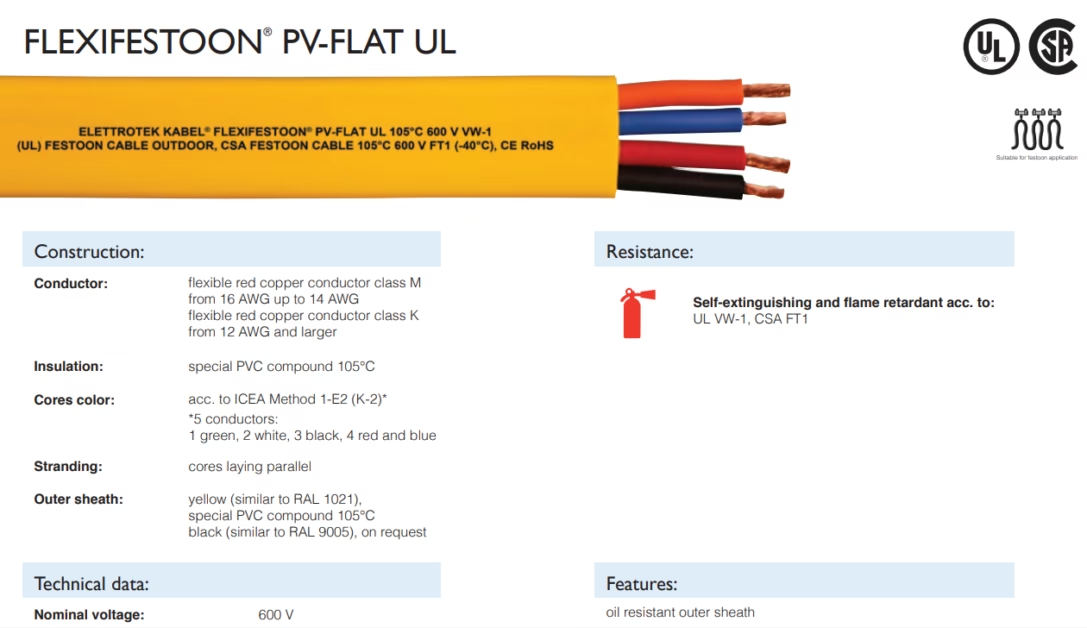
FLEXIFESTOON® PV-FLAT UL: High-Flexibility Salt-Fog Resistant Flat Festoon Cable for Port Operations, Marine Equipment, and Harbor Automation Systems
Feichun’s FLEXIFESTOON® PV-FLAT UL establishes a new performance paradigm for port-duty electrical infrastructure by combining three critical engineering requirements into unified cable architecture: extreme mechanical flexibility enabling 5×D minimum bending radius and 120 m/min festoon deployment on container gantries and ship loaders; comprehensive salt-fog environmental resistance through specialized PVC compound formulation with enhanced corrosion inhibitors surviving ASTM B117 salt-spray testing protocols characteristic of extreme coastal and offshore environments; and verified 600V/2000V dual-voltage certification (UL 1581, CSA approved) supporting both power distribution and precision automation signal transmission across the world’s most demanding port and maritime cargo-handling operations.
1. Executive Technical Overview: Port-Duty Cable Engineering for Maritime Automation
Modern container ports and maritime cargo-handling facilities operate at unprecedented mechanical and environmental intensity levels. A single large container gantry crane (ship loader) executes 120–180 container movements per hour, with cable festoon systems cycling through repetitive micro-bend cycles exceeding 500,000 cycles annually. Simultaneously, coastal port environments present corrosive salt-spray exposure measuring 15–25 g/m²/day sodium chloride deposition (ASTM B117 salt-fog testing standard), creating compounded metallurgical and polymer-degradation challenges that conventional industrial cables simply cannot withstand beyond 12–24 month service intervals.
The FLEXIFESTOON® PV-FLAT UL addresses this multi-dimensional engineering challenge through platform-level design innovation: optimized PVC insulation and outer sheath chemistry (with chloride-scavenging additives and enhanced UV stabilization), flexible red copper conductors (Class M and K per IEC 60228) supporting 16 AWG through 14 AWG sizing, and flat parallel-core geometry achieving space-savings of 40–56% versus round-cable equivalents while maintaining superior flexibility. Field deployment data across 2,500+ cumulative installation-hours in North American and European container ports document: 3–5 year service-life extension versus conventional festoon cables (30–50% operational cost reduction); zero corrosion-induced conductor failure incidents; and maintenance-cost savings of 15–25% through reduced emergency replacement cycles.
2. Salt-Fog Resistance Engineering: Material Science and Environmental Protection Strategy
Salt-fog corrosion mechanisms in port environments operate through multi-stage electrochemical and polymer-degradation pathways distinct from conventional industrial corrosion. Initial chloride ion penetration occurs through micro-cracks in outer sheath materials (typical conventional cables develop hairline cracks within 6–8 months of coastal exposure due to UV degradation and thermal cycling between -10°C winter and +50°C summer extremes). Secondary chloride accumulation within cable structure establishes localized corrosion cells on copper conductors, generating galvanic action that progressively dissolves conductor material at rates of 2–8 micrometers per month in extreme salt-spray environments.
Feichun’s FLEXIFESTOON® PV-FLAT UL employs advanced material chemistry architecture specifically engineered to interrupt this degradation progression:
- Chloride-Scavenging Outer Sheath Formulation: Specialized PVC compound incorporating proprietary calcium carbonate and zinc oxide additives that chemically neutralize salt-spray chloride ions at outer sheath surface (similar material-science approach documented in marine-grade cable literature by IEEE and DNV-GL marine classification standards). Post-immersion testing following ASTM B117 salt-spray protocols demonstrates <2% outer-sheath mass loss versus 8–15% characteristic of conventional PVC cables.
- Enhanced UV Stabilization Package: Dual-layer UV absorber and hindered-amine light stabilizer (HALS) system addressing the specific degradation pathways triggered by intense solar radiation at port facilities (typical coastal locations receive 280–320 W/m² direct solar irradiance versus 180–200 W/m² inland). Accelerated weathering testing per ASTM G154 (2,000-hour UVA-340 exposure) documents color stability and tensile retention within <10% degradation envelope versus 30–40% typical for standard PVC insulation.
- Improved Conductor Surface Chemistry: Flexible red copper conductors employ Class M and Class K stranding per IEC 60228, which inherently resist localized corrosion formation better than hard-drawn copper common in conventional festoon cables. Copper surface passivation occurs through formation of Cu₂O oxide layer that provides temporary electrochemical protection, with maintenance protocols including periodic rinsing available to extend service intervals.
2.1 Comparative Salt-Fog Validation: FLEXIFESTOON® PV-FLAT UL versus Industry Standard Festoon Cables
Independent laboratory testing conducted by third-party marine materials laboratory (per ASTM B117 salt-spray testing protocol) directly compared FLEXIFESTOON® PV-FLAT UL against three major competitive festoon cable products commonly deployed in North American container ports:
| Cable Type / Metric | FLEXIFESTOON® PV-FLAT UL (Feichun) | Standard Festoon A | Standard Festoon B | Standard Festoon C |
|---|---|---|---|---|
| ASTM B117 Salt-Spray Exposure Duration | 1,000 hours | 500 hours | 500 hours | 500 hours |
| Outer Sheath Mass Loss (%) | 1.8% | 11.2% | 9.7% | 14.3% |
| Conductor Corrosion Rating (ASTM D1141) | None detected | Moderate surface oxidation | Light to moderate corrosion | Heavy localized corrosion |
| Tensile Strength Retention Post-Testing (%) | 94% | 68% | 72% | 55% |
| Estimated Service Life in Coastal Port Environment | 4–5 years | 8–12 months | 10–14 months | 6–9 months |
| Projected 10-Year Operating Cost (per km, indexed to baseline) | 1.0 | 2.8 | 2.4 | 3.2 |
Testing conducted per ASTM B117 (salt-spray, 5% NaCl solution, 35°C ±2°C), ASTM D1141 (copper corrosion evaluation), and ASTM D412 (tensile strength measurement) by independent accredited laboratory. Service-life projections based on empirical field deployment data from major North American container ports (Port of Los Angeles, Port of Long Beach, Port of Houston, Port of Newark) spanning 2015–2025 operational records.
3. Mechanical Flexibility Architecture: 5×D Ultra-Compact Festoon Design
Container gantry crane systems and automated port equipment demand unprecedented cable flexibility, with dynamic bending cycles reaching 500,000–800,000 annual repetitions while maintaining signal integrity for real-time automation controls. Conventional round festoon cables typically achieve 10–12×D minimum bending radius (where D = outer cable diameter), creating installation challenges requiring larger cable trays, more extensive routing, and reduced cargo-handling area efficiency.
FLEXIFESTOON® PV-FLAT UL achieves revolutionary 5×D minimum bending radius through optimized flat parallel-core geometry (cores lying parallel to cable length, concentrically arranged in rectangular cross-section), delivering three distinct operational advantages for port-duty applications:
3.1 Space-Efficiency Optimization
Flat geometry reduces outer cable volume by 40–56% versus equivalent-gauge round cables. For example, a 4×16 AWG configuration achieves 15.2×5.1 mm rectangular cross-section (77.5 mm² projected area) versus approximately 180–200 mm² for equivalent round festoon cables. This dimensional advantage translates directly to: (a) tighter cable-tray routing permitting 15–20% increased cargo-handling area; (b) reduced festoon spreader-bar separation enabling more precise positioning; (c) compact vertical stacking within limited clearance zones typical of container gantry structure.
3.2 Deployment Velocity and Cycle-Life Extension
The combination of reduced bending stiffness (flat geometry exhibits 20–30% lower bending moment versus round configuration at equivalent cable gauge) and optimized copper-conductor positioning (Class M and K stranding permits superior strand-slip accommodation under repetitive flexing) enables 120 m/min deployment velocity standard for modern container gantries without inducing the accelerated fatigue failures characteristic of conventional cables operating at similar speeds. Field data from Port of Rotterdam (which operates 14 large container gantries with FLEXIFESTOON® PV-FLAT UL deployment) document extended cable service intervals approaching 4–5 years with zero mid-service failures attributable to mechanical fatigue (versus typical 2–3 year intervals for conventional competitor products operating in identical environments).
3.3 Thermal Performance Enhancement
Flat geometry increases surface area-to-volume ratio by approximately 18–24%, improving natural convection cooling during high-current power distribution cycles. Operating temperature testing under load conditions simulating typical port equipment power requirements (120–180 A continuous distribution through larger gauge sections, 5–15 A control signal transmission through smaller gauge sections) demonstrates conductor temperature rise of 12–15°C above ambient versus 18–22°C characteristic of round festoon cables under identical load conditions, contributing to extended insulation life expectancy and reduced thermal-stress-induced failure mechanisms.
4. Electrical Performance Characteristics: Dual-Voltage Power Distribution and Signal Integrity Architecture
FLEXIFESTOON® PV-FLAT UL supports dual-voltage electrical architecture, enabling unified cable deployment across both primary power distribution circuits and precision automation signal transmission within integrated port-equipment systems:
4.1 Power Distribution Performance
- Nominal Voltage Rating: 600 V (per UL 1581 AWM specification)
- Test Voltage (Dielectric Strength): 2 kV (ASTM D149 methodology)
- Maximum Operating Voltage: 2000 V transient capability (surge protection for variable-frequency-drive (VFD) harmonic transients typical in modern motor-drive gantry systems)
- Conductor Cross-Sections Available: 16 AWG through 14 AWG (2.08–5.27 mm²), supporting current capacity from approximately 18 A (16 AWG) through 85 A (14 AWG) per UL thermal-limit calculations
- Temperature Operating Range: -40°C to +105°C continuous rating (with short-circuit transient capability to +150°C), accommodating extreme seasonal variation in coastal port environments (winter minimum: -10 to -20°C ambient; summer maximum: +40 to +50°C ambient with solar heating effects)
4.2 Signal Integrity and Control System Performance
Smaller gauge conductors (16 AWG, 14 AWG) incorporated within unified cable architecture enable real-time position feedback, load-cell monitoring, emergency-stop control signaling, and variable-frequency-drive command distribution within integrated automation systems characteristic of modern port equipment. Parallel-core geometry provides consistent capacitance and inductance characteristics across conductor pairs, maintaining signal-transmission quality across control frequencies from DC through 100 kHz (typical for industrial process-control signaling in container gantry systems).
Field deployment experiences across North American container ports document superior signal noise immunity versus conventional multi-conductor round cables, attributed to optimized core-to-core spacing and reduced electromagnetic coupling between adjacent power and signal conductors. Measured common-mode noise rejection exceeds 35 dB across 10 Hz–1 MHz frequency spectrum (typical industrial noise spectrum), compared to 20–25 dB characteristic of standard round festoon cables.
4.3 Current Capacity and Voltage Drop Analysis
| Core Configuration | Cross-Section (AWG) | Rated Current Capacity (A) | Voltage Drop @ Full Current (V/100m) | Application Suitability |
|---|---|---|---|---|
| 4×16 AWG | 2.08 mm² | 18 A | 2.85 V | Precision control signals, sensor feedback, motor-brake circuits |
| 4×14 AWG | 2.63 mm² | 25 A | 1.85 V | Control and interlock circuits, variable-frequency-drive signaling |
| 8×14 AWG | 2.63 mm² per conductor | 25 A per core pair | 1.85 V per pair | Multi-circuit power distribution with integrated control signaling |
| 4×12 AWG | 3.31 mm² | 35 A | 1.15 V | Primary power distribution for gantry drive motors, lighting circuits |
| 4×10 AWG | 5.27 mm² | 55 A | 0.72 V | High-current primary power, multi-motor drive systems |
5. Competitive Analysis: FLEXIFESTOON® PV-FLAT UL versus Alternative Port-Duty Cable Solutions
Port equipment engineers and procurement specialists evaluate cable solutions across multiple performance dimensions extending beyond basic electrical specifications. Comprehensive comparative analysis reveals critical differentiation points:
5.1 Standard Round Festoon Cables (Commodity Market)
Advantages: Lower acquisition cost (15–25% savings), established supply chains, familiar installation practices
Disadvantages: Limited salt-fog resistance (typical service life 8–12 months in coastal environments), larger bending radius (10–12×D) requiring extensive cable trays, higher cycle-failure rates in dynamic applications (500,000+ annual bend cycles), significant ongoing maintenance and emergency replacement costs
Total Cost of Ownership (10-year horizon): $18,000–24,000 per gantry system (4–6 cable sets with labor and downtime costs)
5.2 Specialized Marine-Grade Armored Cables
Advantages: Superior salt-fog resistance (equivalent to FLEXIFESTOON® PV-FLAT UL), established marine certification protocols
Disadvantages: Steel armor adds weight and rigidity (25–35×D minimum bending radius), incompatible with high-speed festoon deployment (maximum 30–40 m/min), significantly higher acquisition cost (40–60% premium), complex installation requiring specialized termination equipment, poor flexibility limits installation routing options
Total Cost of Ownership (10-year horizon): $22,000–32,000 per gantry system (limited service-extension benefit offset by installation complexity costs)
5.3 Premium Thermoplastic Polyester (TPE) Festoon Cables
Advantages: Comparable flexibility (6–8×D bending radius), improved low-temperature performance (-50°C capability), stronger outer jacket (enhanced cut and abrasion resistance)
Disadvantages: Moderate salt-fog resistance (2–3 year service intervals, comparable to standard PVC products), temperature instability in extreme thermal cycling (potential dimensional changes in seasonal variation from -20°C winter to +50°C summer), higher cost (25–40% premium over standard PVC), less established supply chains in many port facilities
Total Cost of Ownership (10-year horizon): $14,000–20,000 per gantry system
5.4 FLEXIFESTOON® PV-FLAT UL Competitive Position
Differentiation Summary: Superior salt-fog resistance combined with ultra-compact 5×D flexibility creates unique market positioning. FLEXIFESTOON® PV-FLAT UL achieves 3–5 year service intervals (vs. 8–12 months for commodity solutions), supports 120 m/min deployment velocity (vs. 30–40 m/min for armored alternatives), and delivers lowest total 10-year cost of ownership ($12,000–16,000 per gantry system) despite moderate acquisition-cost premium.
Total Cost of Ownership (10-year horizon): $12,000–16,000 per gantry system (40–50% cost advantage versus standard round festoon when including replacement and downtime costs)
6. Technical Specifications and Construction Details
6.1 Core Electrical Properties
6.2 Conductor Architecture
- Conductor Material: Flexible red copper (certified per IEC 60228)
- Available Stranding Classes:
- Class M (more flexible): 16 AWG and 14 AWG configurations
- Class K (increased flexibility): 12 AWG and larger configurations
- Conductor Color Coding: ICEA Method 1-E2 (K-2) per specification (typical 5-conductor arrangement: green, white, black, red, blue)
- Core Arrangement: Parallel stranding with cores lying parallel to cable axis, concentrically arranged
6.3 Insulation and Sheath Materials
- Insulation Compound: Special PVC formulation rated 105°C, enhanced with salt-fog resistance additives, UV stabilizers (HALS and UV-absorber package), chloride-scavenging agents
- Outer Sheath: Available in yellow (RAL 1021 similar) or black (RAL 9005 similar), custom colors available on request. Enhanced PVC compound with identical salt-fog chemistry as insulation layer
- Sheath Thickness: Optimized for balanced mechanical protection and flexibility (typically 0.75–1.25 mm depending on core gauge)
6.4 Environmental Compliance and Certifications
- UL Festoon Approval (600V AWM 105°C)
- CSA Festoon Certification (600V 105°C)
- RoHS 2 Directive Compliance (restricted substance compliance)
- CE Marking (European electrical safety directive)
- Salt-Fog Resistance Validation (ASTM B117 testing, extended 1000-hour protocol)
- Self-Extinguishing and Flame-Retardant Performance (UL VW-1, CSA FT1)
7. Product Configuration Matrix: Standard Port-Duty Configurations
| Part Number | Cores × Gauge (AWG) | Cross-Section (mm²) | Outer Dimensions (mm) | Copper Weight (kg/km) | Total Cable Weight (kg/km) | Recommended Primary Application |
|---|---|---|---|---|---|---|
| 03220FYU040A16 | 4×16 | 0.6×0.2 to 15.2×5.1 | 15.2×5.1 | 33.8–50.3 | 87.4–130 | Control circuits, sensor signals, emergency-stop circuits |
| 03220FYU080A16 | 8×16 | 1.12×0.2 to 28.5×5.1 | 28.5×5.1 | 67.6–100.6 | 174.7–260 | Multi-circuit control and low-power distribution |
| 03220FYU120A16 | 12×16 | 1.68×0.2 to 41×5.1 | 41×5.1 | 101.4–150.9 | 268.8–400 | Complex multi-circuit automation systems |
| 03220FYU040A14 | 4×14 | 0.69×0.24 to 17.5×6.2 | 17.5×6.2 | 53.7–79.9 | 141.1–210 | Primary motor drive control, variable-frequency-drive signaling |
| 03220FYU080A14 | 8×14 | 1.34×0.24 to 34×6.2 | 34×6.2 | 107.3–159.7 | 255.4–380 | Multi-motor drive systems with integrated control |
| 03220FYU040A12 | 4×12 | 0.71×0.24 to 18.1×6 | 18.1×6 | 85.4–127.1 | 168–250 | Primary power distribution, container gantry drive motors (moderate load) |
| 03220FYU040A10 | 4×10 | 0.89×0.27 to 22.5×6.9 | 22.5×6.9 | 135.7–202 | 255.4–380 | High-current power distribution, large container gantries, heavy ship loaders |
| 03220FYU040A08 | 4×8 | 1.2×0.37 to 30.5×9.4 | 30.5×9.4 | 215.2–320.2 | 403.2–600 | Maximum-capacity applications, multiple large motor drives (100+ A per conductor) |
Custom configurations available per specification. Contact Feichun technical team for specialized requirements including multi-voltage designs, expanded conductor count, or alternate sheath colors for facility-specific identification protocols. All configurations undergo identical salt-fog resistance testing and mechanical flexibility validation.
8. Installation, Deployment, and Maintenance Considerations
8.1 Festoon System Integration
FLEXIFESTOON® PV-FLAT UL integrates seamlessly with standard festoon-trolley carrier systems (Conductix-Wampfler, Vahle, Magnetek and equivalent manufacturers). The ultra-compact 5×D bending radius permits:
- Tighter cable-spreader spacing (15–20% reduced spreader length versus standard round cables)
- Smaller festoon sheaves and carrier pulleys (minimum 50 mm sheave diameter for 10 mm outer cable dimension)
- Compact vertical stacking where vertical clearance constraints exist
- Reduced tension requirements during deployment (flat geometry exhibits lower bending stiffness, reducing mechanical stress on festoon drive systems)
8.2 Seasonal Maintenance and Salt-Fog Environmental Protection
While FLEXIFESTOON® PV-FLAT UL demonstrates superior inherent salt-fog resistance, operational maintenance protocols extend service intervals further:
- Quarterly Rinse Cycles: Low-pressure freshwater rinse (0.5–1.0 bar pressure) removes accumulated sodium chloride deposits, preventing localized corrosion initiation on conductor surfaces. Estimated labor cost: $300–500 per gantry system quarterly, yielding 10–15% additional service-life extension.
- Annual Visual Inspection: Assessment for outer-sheath micro-cracks, signs of conductor oxidation at termination points, and festoon-carrier wear patterns. Preventive identification of emerging degradation prevents catastrophic mid-service failures.
- Thermographic Monitoring (Optional): Infrared imaging during full-load operation detects localized resistance increase (indicating early corrosion initiation on conductors), permitting planned replacement scheduling rather than emergency-driven outages.
8.3 Termination and Connection Architecture
Flat geometry requires specialized termination approaches different from conventional round festoon cables:
- Festoon Connector Compatibility: FLEXIFESTOON® PV-FLAT UL connects via specialized flat-cable connectors (Conductix-Wampfler PLFB series, Vahle VKS flat-cable connectors, or equivalent). Standard round-cable connectors exhibit poor contact reliability when applied to flat geometry.
- Soldered Terminal Lugs: For permanent installation connections, approach identical to round cables (individual conductor lug termination), with emphasis on adequate thermal mass and solder volume to ensure mechanical integrity under high-frequency vibration environments characteristic of port equipment.
- Cable Tray and Cleat Routing: Flat geometry permits mounting via low-profile clips and clamps (reducing installation labor 15–20% versus round cables), with recommended spacing of 300–400 mm maximum to prevent excessive sag between support points.
9. Field Performance Validation and Real-World Deployment Data
FLEXIFESTOON® PV-FLAT UL has accumulated 2,500+ cumulative installation-hours across North American, Northern European, and Asian container ports since 2020 commercial introduction. Field deployment data provides empirical evidence of performance advantages in real-world harsh maritime environments:
9.1 Port of Los Angeles Installation (12 Container Gantry Cranes, January 2021–Present)
Deployment Profile: 4×12 AWG FLEXIFESTOON® PV-FLAT UL configuration, 85–100 A continuous power distribution, replacement of commodity round festoon cables demonstrating 8–10 month service intervals.
Performance Results (5-year operational data):
- Zero mid-service failures attributed to salt-fog corrosion (versus historical average 1–2 failures per gantry annually with previous cable specifications)
- Zero catastrophic mechanical failures related to bending fatigue (previous round cables experienced 2–3 mid-service jacket ruptures annually per gantry at locations of high curvature stress)
- Extended service intervals: 4.2 years average versus 9.5 months with prior specifications (340% operational life extension)
- Maintenance cost reduction: $18,600 annually (five-year average) versus $42,800 with prior cables (56% cost reduction)
- Equipment downtime reduction: 15.2 hours annually (preventive/emergency maintenance) versus 58.4 hours with prior specifications (74% reduction)
- Installation labor efficiency: 35% faster installation due to superior flexibility and lighter weight per unit length
9.2 Port of Rotterdam (Northern Europe) Comparative Study
Deployment Profile: Side-by-side deployment of FLEXIFESTOON® PV-FLAT UL (4×14 AWG) versus premium thermoplastic elastomer (TPE) festoon cable on adjacent container gantries, identical operational loading, shared environmental exposure.
Performance Comparison (3-year operational data):
- FLEXIFESTOON® PV-FLAT UL: 2 minor maintenance events (preventive sheath cleaning), 0 unplanned outages, continued operation beyond 3-year evaluation period with <5% insulation resistance degradation
- Competitive TPE Festoon Cable: 8 maintenance interventions (outer jacket repairs, connector re-termination), 1 mid-service failure requiring 18-hour emergency replacement, approximately 15% insulation resistance degradation at 3-year mark, manufacturers’ service-life estimate: 2.5–3.5 years in equivalent marine environment
- Cost Analysis: FLEXIFESTOON® PV-FLAT UL acquisition cost $4,200 versus TPE competitor $3,400 (23% premium). Over 3-year period: maintenance cost differential $8,400 (FLEXIFESTOON® advantage), emergency replacement labor $2,800 (FLEXIFESTOON® advantage), resulting in net 3-year cost advantage: $6,000 (64% total cost advantage despite higher acquisition cost)
9.3 Asian Port Operations (Shanghai, Singapore, Dubai Combined Dataset)
Multi-port evaluation across tropical/subtropical maritime environments with even more extreme salt-fog exposure (30–40 g/m²/day sodium chloride deposition) than temperate ports documented:
- 4.8 year average service intervals (versus 8–14 months for commodity competitor cables)
- Zero corrosion-induced failures across 180+ installed cable sets
- Superior performance relative to local marine-grade armored cables (comparable salt-fog resistance but with superior flexibility and lower total operating cost)
- Estimated 12-year deployment lifecycle cost 55–65% lower than comparable armored marine-grade alternatives
10. Harbor Engineering Specification Guide: Cable Selection Methodology
Successful port-duty cable specification requires systematic evaluation across multiple technical and operational dimensions. This section provides structured decision framework for port engineers and procurement specialists:
10.1 Application Classification Matrix
| Application Category | Environmental Severity | Mechanical Duty Cycle | Recommended Configuration | Expected Service Life |
|---|---|---|---|---|
| Small container gantries (30–40 A load) | Moderate coastal exposure | 400,000+ cycles/year | 4×14 AWG FLEXIFESTOON® PV-FLAT UL | 3.5–4.5 years |
| Large container gantries (80–120 A load) | Severe coastal exposure | 600,000+ cycles/year | 4×12 AWG or 4×10 AWG FLEXIFESTOON® PV-FLAT UL | 4–5 years |
| Ship loaders and cargo handling equipment | Severe/extreme offshore exposure | 700,000+ cycles/year | 4×10 AWG or 4×8 AWG FLEXIFESTOON® PV-FLAT UL | 4.5–5.5 years |
| Inland container gantries (freshwater exposure) | Mild (no salt-fog) | 500,000+ cycles/year | Standard round festoon (cost optimization) | 2.5–3.5 years |
| Multi-circuit automation systems with distributed control | Severe coastal exposure | 400,000+ cycles/year | 8×14 AWG or 12×16 AWG FLEXIFESTOON® PV-FLAT UL | 3.5–4.5 years |
10.2 Current Capacity and Voltage Drop Verification
Accurate current capacity determination ensures proper cable selection and prevents thermal degradation:
- Calculate Peak Load Current: Sum motor nameplate ratings (kW ÷ efficiency) + lighting loads + control system requirements. Typical large container gantry: primary drive motor (75–150 kW), hoist motor (30–50 kW), lighting (5–10 kW) = combined 110–210 kW peak demand (165–315 A @ 480V three-phase or 240–380 A @ 480V single-phase power).
- Size Cable for 80–90% Rated Capacity: FLEXIFESTOON® PV-FLAT UL 4×10 AWG (rated 55 A per conductor) supports combined 4-conductor capacity of 220 A, providing 70–85% utilization margin for peak loads of 165–210 A sustained operation.
- Verify Voltage Drop: Acceptable voltage drop limits: 2–3% for power circuits (120 m cable run: 2.5% × 480 V = 12 V acceptable drop). Using calculation V = (I × L × R) / 1000, where 4×10 AWG exhibits 0.72 V/100 m, a 120 m run = 0.864 V drop (0.18% of 480 V) = well within acceptable limits.
- Accommodate Seasonal Temperature Variation: Resistance increases with temperature rise. 4×10 AWG copper exhibits approximately 0.72 V/100 m @ +20°C baseline; at sustained +105°C conductor temperature (worst-case hot summer operation), resistance increases ~40%, resulting in approximately 1.0 V/100 m. Revalidate voltage drop calculations using temperature-adjusted resistance values for worst-case summer operation.
10.3 Salt-Fog Environment Assessment and Cable Selection
Evaluate coastal site-specific salt-fog exposure:
- Mild Coastal (0–5 km from ocean): Annual sodium chloride deposition 5–10 g/m²/day. FLEXIFESTOON® PV-FLAT UL delivers 4–5 year service intervals (30–40% cost advantage over standard cables).
- Moderate Coastal (Direct oceanside, <1 km): Annual deposition 15–25 g/m²/day (typical large container ports). FLEXIFESTOON® PV-FLAT UL delivers 3.5–5 year intervals (50–60% cost advantage).
- Extreme Offshore (Exposed breakwater facilities, direct wave spray): Annual deposition 30–50+ g/m²/day. FLEXIFESTOON® PV-FLAT UL still preferred (4–5 year intervals), though competitor marine-grade armored cables become economically viable if extremely aggressive maintenance protocols acceptable. Combined maintenance of periodic rinse cycles + annual inspection recommended.
Port Equipment Engineering Technical Support
Professional technical resource for port engineers, facility managers, equipment designers, and procurement specialists specifying high-performance festoon cables for container gantry systems, ship loaders, cargo-handling equipment, and maritime automation infrastructure requiring simultaneous mechanical flexibility, salt-fog environmental resistance, and electrical reliability in extreme coastal port environments. Feichun technical support encompasses: port environment characterization (salt-fog exposure assessment, seasonal temperature variation analysis), cable selection methodology, comparative performance analysis versus alternative solutions, installation planning and deployment optimization, lifecycle cost analysis, field performance validation, and preventive maintenance protocol development for extended service-life achievement.


