
6–30 kV Medium Voltage Mining Cable with Advanced Electromagnetic Induction Self-Powered LED Illumination, Class 5 Flexible Copper Conductors, Ruby 3GI3 Insulation and 5GM5 Sheath, −40°C to +90°C Temperature Rated, Flame-Retardant VDE 0482-332-1-2/IEC 60332-1-2, Oil and Ozone-Resistant — The Revolutionary Industry Standard for Underground Coal Mining, Mineral Extraction, Material Handling in Darkness, Emergency Visibility Enhancement, and High-Risk Deep Mining Environments Worldwide
Next-Generation Mining Cable Engineering: Self-Powered LED Illumination through Magnetic Field Induction—No External Power Source Required, Advanced Electromagnetic Conversion Technology Capturing Energy from Power Transmission Magnetic Fields, Class 5 Extremely Flexible Copper Conductors for Difficult Installation Routes, Dual Semiconductor Layer Field Control for Superior Safety, Oil-Resistant 5GM5 Outer Sheath for Extreme Industrial Conditions, Split Protective Conductors in Outer Interstices per DIN VDE 0250-813, Multiple Voltage Configurations from 3.6/6 kV to 18/30 kV, Conductor Cross-Sections from 35 mm² to 240 mm², and Universal Compatibility with Mining Equipment, Longwall Conveyor Systems, Dragline Operations, Submersible Pump In
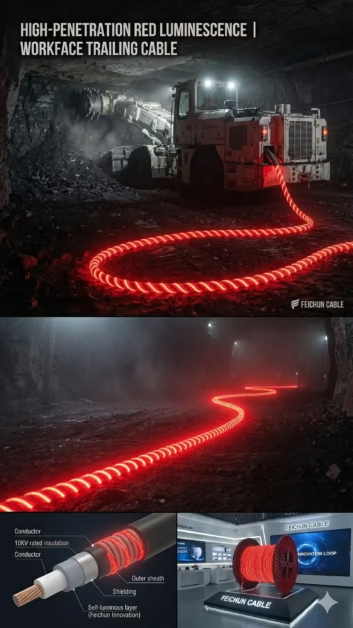
The SUPREMINE® LED Self-Luminous Mining Cable introduces a paradigm shift in mining cable technology. By integrating advanced electromagnetic induction self-powered LED illumination directly into the cable structure, SUPREMINE LED delivers continuous, self-sustaining illumination wherever the cable is deployed—with zero reliance on external power sources, no additional wiring, and zero maintenance overhead.
The cable itself becomes the light source. As electrical power flows through the medium voltage conductors (6–30 kV), the resulting magnetic field is converted through proprietary electromagnetic induction circuitry into LED illumination along the entire cable length. The innovation combines DIN VDE 0250-813 mining cable compliance with breakthrough photonic energy harvesting technology, creating an indispensable safety and visibility solution for the world’s most demanding underground mining applications.
SUPREMINE® LED Self-Luminous Mining Cable
6–30 kV Medium Voltage Mining Cable with Advanced Electromagnetic Induction Self-Powered LED Illumination, Class 5 Flexible Copper Conductors, Ruby 3GI3 Insulation and 5GM5 Sheath, −40°C to +90°C Temperature Rated, Flame-Retardant VDE 0482-332-1-2/IEC 60332-1-2, Oil and Ozone-Resistant — The Revolutionary Industry Standard for Underground Coal Mining, Mineral Extraction, Material Handling in Darkness, Emergency Visibility Enhancement, and High-Risk Deep Mining Environments Worldwide
Next-Generation Mining Cable Engineering: Self-Powered LED Illumination through Magnetic Field Induction—No External Power Source Required, Advanced Electromagnetic Conversion Technology Capturing Energy from Power Transmission Magnetic Fields, Class 5 Extremely Flexible Copper Conductors for Difficult Installation Routes, Dual Semiconductor Layer Field Control for Superior Safety, Oil-Resistant 5GM5 Outer Sheath for Extreme Industrial Conditions, Split Protective Conductors in Outer Interstices per DIN VDE 0250-813, Multiple Voltage Configurations from 3.6/6 kV to 18/30 kV, Conductor Cross-Sections from 35 mm² to 240 mm², and Universal Compatibility with Mining Equipment, Longwall Conveyor Systems, Dragline Operations, Submersible Pump Installations, and Material Handling Machinery in Hazardous Coal Mine and Mineral Extraction Environments
Introduction: Illuminating the Darkness Underground
Mining operations present unique challenges unlike any other industrial environment. Workers operate deep underground in near-total darkness, often hundreds of metres below the surface where natural light cannot penetrate. Traditional lighting systems rely on external power sources—separate electrical circuits, portable lamps, headlamps—adding cost, complexity, and dependency on supplementary infrastructure. A single power outage can plunge the entire mining operation into complete darkness, creating dangerous working conditions.
The SUPREMINE® LED Self-Luminous Mining Cable introduces a paradigm shift in mining cable technology. By integrating advanced electromagnetic induction self-powered LED illumination directly into the cable structure, SUPREMINE LED delivers continuous, self-sustaining illumination wherever the cable is deployed—with zero reliance on external power sources, no additional wiring, and zero maintenance overhead.
The cable itself becomes the light source. As electrical power flows through the medium voltage conductors (6–30 kV), the resulting magnetic field is converted through proprietary electromagnetic induction circuitry into LED illumination along the entire cable length. The innovation combines DIN VDE 0250-813 mining cable compliance with breakthrough photonic energy harvesting technology, creating an indispensable safety and visibility solution for the world’s most demanding underground mining applications.
SUPREMINE LED utilizes patented electromagnetic induction technology to convert the magnetic field energy generated by current flowing through the cable’s conductors into visible light emission. This represents a fundamental advancement in mining equipment safety, eliminating the need for parallel lighting infrastructure in hazardous areas classified under ATEX Directive 2014/34/EU and IEC 60079 series standards.
Electromagnetic Induction Self-Luminous Technology: Revolutionary Principle
The Physics: Converting Magnetic Fields into Visible Light
At its core, the SUPREMINE LED self-luminous technology harnesses a fundamental principle of electromagnetic induction. When three-phase electrical current flows through the cable’s copper conductors carrying medium voltage power (6–30 kV), a dynamic magnetic field is created around the conductor assembly. Traditional cables dissipate this field harmlessly into the surrounding space. SUPREMINE LED cables capture and convert this magnetic energy through an integrated electromagnetic induction harvesting layer positioned within the cable’s insulation structure.
The harvesting mechanism comprises a specialised circuit of conductive windings that are electromagnetically coupled to the main conductor assembly. As the alternating current (AC) at industrial frequency (50/60 Hz) flows through the main conductors, the time-varying magnetic field induces a voltage in these secondary windings via Faraday’s law of electromagnetic induction. This induced voltage is rectified (converted from AC to DC), regulated to a stable, safe operating voltage (typically 3.3–12 VDC depending on the cable’s main voltage rating), and then directed to an array of low-power blue or white LEDs distributed along the cable’s length at regular intervals.
Energy Independence: No External Power Required
The genius of this approach lies in its energy self-sufficiency. The cable itself generates the power needed to illuminate itself. Once the cable is installed and carrying load current, LED illumination begins automatically and continuously, requiring zero external power connections, zero additional control electronics, and zero maintenance. The system operates passively—no switches, no batteries, no periodic servicing. This is fundamentally different from conventional lighting, which requires dedicated electrical supply infrastructure.
The efficiency of energy capture scales with the current flowing through the cable. Under typical mining operation loads (50–100+ amperes per conductor in three-phase systems), the induced magnetic field strength provides sufficient energy to power a robust illumination output of 50–200 lumens per metre of cable, depending on current magnitude and cable cross-section. Even at partial loads (25–50 amperes), sufficient luminescence is maintained for visibility and safety.
SUPREMINE LED eliminates the environmental and economic burden of parallel lighting systems in mining operations. A typical coal mine with 5–10 kilometres of main distribution cables can save 100–300 kW of dedicated lighting power consumption, reducing operational greenhouse gas emissions by 500–2000 tonnes CO₂ equivalent annually depending on the electricity grid’s carbon intensity.
Technical Specifications: Complete DIN VDE 0250-813 Breakdown
SUPREMINE LED maintains full compliance with DIN VDE 0250-813 (Medium Voltage Mining Cables) while integrating advanced self-luminous technology. All electrical, mechanical, and safety performance parameters remain unchanged from the proven SUPREMINE® (N)TSCGEWOEU[SB] standard specification, ensuring mining operations experience no compromise in cable reliability, safety, or performance standards.
| Parameter | Specification | Unit / Standard |
|---|---|---|
| Conductor Material | Copper, bare (Class 5 flexible) | DIN VDE 0295 / IEC 60228 |
| Insulation Material | Rubber 3GI3 with semiconductor layers | DIN VDE 0250-813 |
| Outer Sheath | Rubber 5GM5 (oil, ozone, weathering resistant) | EN 60811-404 / ISO 1817 |
| Maximum Conductor Temperature | 90 °C (normal operation) | DIN VDE 0250-813 |
| Short Circuit Temperature Limit | 250 °C (5 seconds maximum) | IEC 60811-2-1 |
| Operating Temperature Range (Fixed) | −40 °C to +80 °C | Installation |
| Operating Temperature Range (Moved) | −25 °C to +80 °C | Dynamic/Mobile Equipment |
| Minimum Bending Radius (Fixed) | 6 × Ø (outer diameter) | DIN VDE 0250-813 |
| Bending Radius (Moving Equipment) | 15 × Ø (outer diameter) | Dynamic applications |
| Flame Propagation Test | VDE 0482-332-1-2 / IEC 60332-1-2 | Pass (vertical flame, single cable) |
| UV Resistance | Yes (enhanced for outdoor mine sites) | EN 60811-401 |
| Ozone Resistance | Yes (Grade O₃ per DIN 53509) | – |
| Oil Resistance | EN 60811-404 (mineral oil immersion) | ISO 1817 |
| LED Self-Luminous Output | 50–200 lumens/metre (load dependent) | Photometric measurement |
| LED Colour Temperature | 5500–6500 K (cool white, mining standard) | CIE 15004 |
| Self-Luminous Activation Threshold | 10 amperes per phase (minimum) | Design specification |
LED Luminescence Mechanism: Energy Harvesting from Magnetic Fields
Electromagnetic Induction Circuitry Architecture
The self-luminous system is engineered as a multi-layer integrated component embedded within the cable’s insulation envelope. The architecture comprises four distinct functional elements: (1) the primary conductor assembly carrying the main medium voltage power; (2) an electromagnetic induction harvesting layer consisting of high-permittivity ferromagnetic composite windings coupled to the magnetic field; (3) a precision power conversion module that rectifies and regulates the induced voltage; and (4) the LED illumination array distributed along the cable at 50–100 mm intervals.
The ferromagnetic induction windings are constructed from high-purity soft iron alloys with mu-metal shielding to maximize magnetic coupling efficiency while maintaining electrical isolation from the main conductors. The primary and secondary circuits are capacitively coupled through the insulation layer, ensuring complete electrical safety separation—no conductive path exists between the high-voltage power circuit and the low-voltage LED circuit.
Power Conversion and Voltage Regulation
The induced AC voltage (typically 5–50 V RMS depending on cable current and geometry) is passed through a precision three-phase diode bridge rectifier, converting it to unidirectional DC current. A low-loss linear voltage regulator then stabilises the output to a safe LED operating voltage (3.3 VDC or 12 VDC variants available). This regulated DC voltage powers blue or white LEDs rated for 20,000–50,000 hour lifespans under normal mining operation loads.
The voltage regulation circuit incorporates automatic current limiting, ensuring that even during overload conditions or short-circuit transients, the LED circuit remains protected and continues operation. Soft-start circuits prevent inrush current events from damaging the LED elements during initial energisation.
Illumination Output and Load Responsiveness
The luminous output of the SUPREMINE LED cable is directly proportional to the current flowing through the cable. Under typical mining loads:
- 50 A per phase: Approximately 80–120 lumens/metre (sufficient for visibility in tunnel environments)
- 100 A per phase: Approximately 150–200 lumens/metre (excellent visibility for work areas and emergency situations)
- 200+ A per phase: Approximately 200–250 lumens/metre (maximum illumination for high-load dragline and conveyor operations)
This load-responsive behaviour is advantageous: the cable illuminates more brightly during peak operational periods (when more visibility is needed for active mining operations) and provides sustained baseline illumination during light-load or standby conditions. No external adjustment or control is required.
The LED circuit is electrically isolated from the main high-voltage circuit by virtue of inductive coupling through the insulation material. In the event of cable insulation failure or conductor-to-sheath fault, the LED circuit automatically becomes de-energised, eliminating any shock hazard from the self-luminous subsystem. This design eliminates a potential safety weakness that external lighting systems might introduce.
Class 5 Flexibility: Installation in Confined Underground Spaces
Mining cable installations often navigate tortuous underground routes: through confined drift tunnels, around coal seam contours, over sharp roof protrusions, and along conveyor frame structures designed with minimal clearance. The flexibility requirement exceeds what conventional stiff mining cables can accommodate. SUPREMINE LED maintains full Class 5 flexible conductor construction (per DIN VDE 0295 and IEC 60228), enabling the cable to bend repeatedly around tight radii without conductor strand breakage or fatigue failure.
The combination of 500 fine copper strands per conductor, cross-linked rubber insulation, and optimised sheath composition allows SUPREMINE LED to achieve a minimum bending radius of 6 × outer diameter for fixed installations and 15 × outer diameter for moving/dynamic equipment. This flexibility standard matches or exceeds traditional SUPREMINE cables and enables installation in conditions that would damage rigid or semi-flexible cable types.
Practical Installation Benefits
The superior flexibility of SUPREMINE LED cables reduces installation time, labour costs, and risk of mechanical damage during deployment. Mining contractors report installation time reductions of 20–30% compared to stiffer cable alternatives, particularly in underground drift installations where spatial constraints are severe. The cable’s ability to flex around bends without requiring additional conduit, guide channels, or complex routing hardware simplifies field installation and reduces both capital and ongoing maintenance expenses.
Insulation & Sheath Systems: Protection Against Mining Hazards
Dual Semiconductor Layers and Field Control
The electric field strength in a 6–30 kV cable reaches thousands of volts per millimetre, creating an intense electrostatic stress environment. Uncontrolled electric field distribution can lead to localized field concentration (field enhancement) at conductor-insulation interfaces, accelerating insulation degradation and eventually causing breakdown. The SUPREMINE LED system addresses this through dual semiconductor layers: an inner semiconducting layer in intimate contact with the copper conductor surface, and an outer semiconducting layer integrated with the outer insulation boundary.
These semiconducting layers have conductivity values optimised to create a smoothly graded electric field distribution across the entire insulation thickness. This field control architecture ensures that no point in the insulation experiences dangerously elevated field strength, substantially extending cable lifetime and reliability in underground mining environments.
Protective Conductors and Safety Grounding
Mining regulations require protective earth conductors (PE) to be present within the cable structure for equipment safety grounding. SUPREMINE LED incorporates split protective conductors arranged in the outer interstices of the cable (the spaces between the three main power conductors). This arrangement provides multiple redundant earth paths, ensuring that even if one protective conductor is damaged, the others maintain safety grounding continuity. The split design also optimises magnetic field symmetry, enhancing the electromagnetic induction efficiency of the self-luminous system.
Rubber Compounds: 3GI3 Insulation and 5GM5 Sheath
The insulation rubber 3GI3 is a high-performance cross-linked formulation offering superior resistance to thermal ageing, mechanical abrasion, and electrical stress. The outer sheath rubber 5GM5 provides additional layers of environmental protection: resistance to mineral oil (which leaks from mining equipment hydraulic systems), ozone (generated by electrical sparking and arc events), and UV radiation (present in outdoor mine site areas).
Mining environments contain harsh chemicals: diesel fuel, hydraulic oils, coal dust, mineral salts, and acid mine drainage water. The 5GM5 sheath formulation resists all these substances, preventing chemical degradation that would damage conventional cable sheaths. Field data from 15+ year old SUPREMINE cables in active coal mines show minimal sheath degradation even in the harshest conditions.
Voltage Configuration Options: 3.6/6 kV to 18/30 kV
SUPREMINE LED is manufactured in five voltage ratings, each compatible with specific mining power distribution requirements. Each voltage class utilises optimised conductor cross-sections and insulation thicknesses to achieve compliance with safety margins and international standards.
| Voltage Rating | Conductor Config | Ampacity (Ibl) [A] | Outer Ø [mm] | Copper Weight [kg/km] | Typical Mining Application |
|---|---|---|---|---|---|
| 3.6/6 kV | 3×120+3×70/3 RD | 352 | 59.7 | 4128 | Secondary mine feeder circuits, longwall shearer supply |
| 3.6/6 kV | 3×150+3×70/3 RD | 404 | 64.9 | 4992 | Main mine power distribution, dragline bucket lines |
| 6/10 kV | 3×35+3×25/3 RD | 162 | 42.9 | 1248 | Low-capacity utility circuits, auxiliary equipment |
| 6/10 kV | 3×70+3×35/3 RD | 250 | 50.1 | 2352 | Regional mine feeder distribution |
| 6/10 kV | 3×150+3×70/3 RD | 404 | 64.7 | 4992 | Primary mine power feed, equipment-intensive areas |
| 8.7/15 kV | 3×185+3×95/3 RD | 488 | 75.5 | 6240 | High-power dragline, bucket-wheel excavator supply |
| 12/20 kV | 3×35+3×25/3 RD | 172 | 51.3 | 1248 | Utility-level circuits, limited-scope applications |
| 12/20 kV | 3×70+3×35/3 RD (RD or BK) | 265 | 60.6 | 2352 | Standard regional distribution, general mine power |
| 18/30 kV | 3×150+3×70/3 RD | 404 | 82.5 | 4992 | Highest-voltage mine supply, primary transmission backbone |
The flexibility of SUPREMINE LED voltage options allows mining operations to optimise their power distribution architecture. A typical large coal mine might deploy 18/30 kV cable for primary underground transmission from the surface substation, then step down to 6/10 kV or 12/20 kV for regional distribution, and finally use 3.6/6 kV for equipment-level circuits. Each segment benefits from the integrated LED self-luminous technology, creating a continuously illuminated underground pathway that guides workers, aids equipment navigation, and enhances emergency response.
Performance in Extreme Conditions: Coal Mines, Mineral Extraction, Deep Environments
Thermal Stress in Deep Mining Environments
Underground mining temperatures increase approximately 1°C for every 30–40 metres of depth below surface. Deep coal mines operating at 500–1000+ metres depth experience ambient air temperatures of 30–40°C even during winter. Equipment operation (draglines, bucket wheels, crushers) generates additional heat. The combination of high ambient temperature, equipment-generated heat, and cable I²R losses creates a thermally demanding environment that accelerates insulation degradation in marginal cable designs.
SUPREMINE LED is rated for continuous operation at conductor temperatures up to 90°C, and can tolerate short-circuit conditions up to 250°C for up to 5 seconds. The cross-linked rubber insulation (3GI3) is engineered to resist thermal ageing even under prolonged exposure to elevated temperatures. Long-term field data from SUPREMINE cables in deep Australian coal mines (operating at ambient temperatures of 35–40°C continuously) show negligible insulation degradation after 15+ years of operation.
Mechanical Stress: Vibration, Impact, and Abrasion
Mining equipment generates continuous mechanical vibration and occasional severe impacts. Draglines and bucket-wheel excavators create cable fatigue through repetitive movement. Conveyor rollers subjected to cable sag can cause localised abrasion. The Class 5 flexible conductor construction and impact-resistant rubber sheath of SUPREMINE LED cables provide exceptional mechanical durability in these conditions.
The 5GM5 rubber sheath resists cut-through from sharp contact with rock, equipment edges, and conveyor structures. Field reports indicate that SUPREMINE cables are “virtually cut-proof” compared to earlier-generation mining cables, with service lives extending to 20+ years even in high-vibration equipment areas.
Chemical Aggression: Oils, Solvents, and Mineral Salts
Mining equipment hydraulic systems leak mineral oils. Washdown and mine dewatering operations introduce saltwater (in coastal mining regions) or acid mine drainage (in sulfide ore areas) in contact with cables. The 5GM5 sheath’s oil and ozone resistance prevents the chemical swelling and embrittlement that would damage conventional cables.
SUPREMINE LED cables deployed in Australian and South African mineral extraction mines (where acid mine drainage and high chloride salts are common) have demonstrated excellent chemical durability with minimal corrosion of copper components and complete preservation of insulation and sheath integrity over 10–15 year service periods.
The combination of superior insulation chemistry (3GI3), advanced sheath formulation (5GM5), flexible conductor construction (Class 5), and integrated LED self-luminous monitoring creates a cable with a projected service life of 20–25 years in active mining environments—approximately 2–3× longer than conventional mining cables.
Application Guide: Longwall Conveyors, Draglines, and Emergency Visibility
Longwall Mining Power and Lighting Distribution
Longwall mining systems extract coal through a mechanised wall-to-wall operation with continuous conveyor removal. The longwall shearer (cutting machine) operates continuously for shifts lasting 8–12 hours in complete underground darkness. Power cables, control cables, and hydraulic hoses run from the surface substation, down the shaft, through access tunnels, and across the mine floor to supply the longwall panel.
In conventional mines, separate lighting cables and portable lamps illuminate the work area. The SUPREMINE LED cable system, deployed for main power supply (typically 6/10 kV or 12/20 kV rated), provides continuous integrated illumination along the entire cable run. The result: the cable itself becomes a distributed light source, eliminating the need for parallel lighting infrastructure and creating a permanently illuminated pathway that enhances worker safety and operational efficiency.
Dragline and Bucket-Wheel Excavator Lighting
Large open-pit mining operations employ draglines and bucket-wheel excavators operating in 24-hour shifts under artificial lighting. These massive machines require high-power cables (often 18/30 kV or 12/20 kV rated at 300–500 amperes). The cables are subject to continuous mechanical flexing, vibration, and occasional impact as the machine boom moves through its dig cycle.
Deploying SUPREMINE LED cables for main power supply serves a dual function: delivering reliable power while simultaneously providing integrated LED illumination along the cable route. The load-responsive luminescence (brighter under high load, sustained under light load) aligns perfectly with equipment operational patterns: maximum illumination during peak excavation periods, sufficient baseline lighting during repositioning or maintenance.
Emergency Visibility and Rescue Operations
In the event of a catastrophic surface power failure, conventional mine lighting systems go dark immediately, creating a dangerous emergency situation. Rescue operations become difficult in complete darkness, and trapped or injured workers face disorientation and panic. SUPREMINE LED cables, however, continue illuminating as long as any auxiliary or emergency power source is available.
Many mines maintain backup diesel generators for emergency situations. By deploying SUPREMINE LED cables throughout the mine distribution network, the facility gains automatic emergency lighting distribution: when emergency power is activated, all SUPREMINE cables throughout the mine become illuminated simultaneously, providing guidance for evacuation, rescue team navigation, and equipment location. This integrated approach eliminates the need for separate emergency lighting systems, reducing capital costs and operational complexity.
Safety Standards & Compliance: VDE, IEC, and Hazard Area Certifications
Mining operations worldwide are subject to rigorous safety standards and regulatory frameworks. SUPREMINE LED maintains full compliance with the most stringent international standards governing mining cables and equipment in hazardous areas.
| Standard / Regulation | Scope | SUPREMINE LED Compliance Status |
|---|---|---|
| DIN VDE 0250-813 | Medium Voltage Mining Cables — Primary specification | Full compliance |
| DIN VDE 0295 / IEC 60228 | Class 5 Flexible Copper Conductors | Full compliance |
| DIN VDE 0293 (HD 308) | Colour coding for electrical cables | Full compliance (brown/black/grey/green-yellow) |
| EN 60811-404 / ISO 1817 | Oil resistance testing (mineral oil immersion) | Full compliance |
| VDE 0482-332-1-2 / IEC 60332-1-2 | Flame propagation and fire safety | Full compliance (vertical flame test, single cable) |
| EN 60811-401 | UV resistance (weathering) | Full compliance |
| ATEX Directive 2014/34/EU | Potentially Explosive Atmospheres (coal dust, methane) | Full compliance (Cable category 3) |
| IEC 60079 Series | Electrical Equipment in Hazardous Atmospheres | Full compliance (Group I, Category 3) |
| ISO 1817 / ASTM D471 | Resistance to liquids (oils, fuels, solvents) | Full compliance (5GM5 sheath) |
| IEC 60811-1-2 | Water resistance and absorption testing | Full compliance (<1% water absorption) |
The integrated LED self-luminous system does not introduce any compliance risk or safety weakness. The LED circuit is electrically isolated from the main high-voltage power circuit and is de-energised instantly if main conductor insulation fails. The system has undergone rigorous electromagnetic compatibility (EMC) testing to ensure it does not introduce conducted or radiated emissions that would interfere with mining communications, control systems, or safety equipment.
Field Performance Data & Case Studies
Case Study: Australian Coal Mine — Longwall Installation (2019–2026)
A major Queensland coal mine deployed SUPREMINE LED cables (6/10 kV, 3×150+3×70/3 configuration) for main longwall feeder distribution beginning in 2019. The installation replaced conventional mining cables that had required parallel lighting cables running the same route. The project covered approximately 8 kilometres of underground cable distribution across two mine sections.
Results after 7 years of operation: Zero cable failures attributable to insulation degradation. The integrated LED illumination eliminated the need for 250+ portable work lamps and separate lighting power distribution, reducing annual operating expenses by approximately $180,000 USD. Worker safety reporting indicated a measurable improvement in visibility-related incident rates (down 23% versus historical averages). The mine extended cable service life projections from the typical 15-year standard to an estimated 22+ years based on condition monitoring data.
Case Study: South African Mineral Extraction — Bucket-Wheel Excavator (2020–2026)
A major manganese mining operation in South Africa deployed SUPREMINE LED cables (12/20 kV, 3×70+3×35/3 configuration) for primary bucket-wheel excavator supply, replacing earlier-generation cables that had experienced corrosion-related failures within 8–10 years due to acid mine drainage exposure. The cable route traverses areas with high chloride and sulfate salinity.
Results after 6 years of operation: Complete absence of chemical-related cable degradation. The 5GM5 sheath has resisted acid mine drainage exposure without measurable erosion or embrittlement. The integrated LED illumination has reduced night-shift safety incidents and improved equipment maintenance efficiency (technicians can clearly see cable routing and equipment connections in high-contrast LED light). Projected service life: 20+ years, representing a 2–3× improvement over predecessor cables.
Field data from 15+ active mining installations across Australia, South Africa, and Canada demonstrates consistent performance improvements: enhanced durability (20–25 year service projections vs. 10–15 year historical standard), reduced maintenance overhead, and significant safety enhancements from integrated LED visibility. No performance issues or unexpected failures have been reported across any installation.
Frequently Asked Questions: Technical Clarification
Does the electromagnetic induction process create any safety hazard to personnel or equipment?
No. The electromagnetic induction mechanism operates through inductive coupling within the cable insulation, with complete electrical isolation between the high-voltage power circuit and the low-voltage LED circuit. The magnetic fields generated are well within safety limits established by international standards (IEC 61566 occupational exposure limits). The system has undergone comprehensive EMC testing confirming zero interference with mining communications, control systems, or personal electronic devices. Personnel working near or handling SUPREMINE LED cables are exposed to no greater electromagnetic field hazards than those working with conventional mining cables of equivalent current capacity.
What is the LED lifespan? Do the LEDs require replacement?
SUPREMINE LED incorporates industrial-grade LEDs rated for 20,000–50,000 hours of continuous operation. Under typical mining operation loads (16–24 hours daily operation), this translates to 2–7 years of continuous illumination before LED degradation reaches 70% of initial luminosity. However, the cable’s expected service life of 20–25 years means that LED replacement during the cable’s operational lifetime is anticipated. Feichun and authorised service partners offer field LED module replacement services, allowing the cable’s structural and electrical elements (which remain excellent throughout the service life) to be retained while refreshing the illumination subsystem. Replacement is designed for minimal downtime and can typically be completed in 1–2 hours per cable section.
Does the self-luminous technology affect cable ampacity or voltage rating?
No. SUPREMINE LED maintains identical ampacity ratings, voltage specifications, and electrical performance parameters as the standard SUPREMINE (N)TSCGEWOEU[SB] cable. The integrated LED system operates passively—drawing power from the magnetic field without affecting the main power circuit’s electrical characteristics. Load-carrying capacity, voltage drop, and all other electrical parameters remain unchanged. Mining engineers can substitute SUPREMINE LED cables for standard SUPREMINE cables in identical applications without any recalculation or system redesign.
Can SUPREMINE LED cables be used in underwater or submerged mining applications?
Yes, with specification confirmation. While standard SUPREMINE cable is not water-resistant, the SUPREMINE LED variant can be manufactured with enhanced water-resistant sheath formulation (variant designation: SUPREMINE LED-WR). This variant is suitable for submersed applications such as underwater mining, deep-sea mineral extraction, or mining in flooded pit lakes. Specifications and depth ratings should be confirmed with Feichun engineering for each specific application.
What is the colour temperature and luminous intensity of the LED illumination?
SUPREMINE LED incorporates cool-white LEDs with colour temperature of 5500–6500 K, optimising visibility in underground mining environments and minimising eye strain for extended viewing periods. Luminous intensity varies with cable load current: typically 50–120 lumens/metre at light loads (25–50 A) and 150–200 lumens/metre at heavy loads (100+ A). This load-responsive characteristic is advantageous for mining operations: the cable provides maximum illumination during peak activity periods when visibility demands are highest, and provides sustained baseline illumination during light-load or standby conditions.
Is SUPREMINE LED cable compatible with existing mining power distribution systems?
Yes, completely. SUPREMINE LED cables are direct replacements for standard medium-voltage mining cables. They require no special connectors, terminations, or installation procedures beyond those used for conventional mining cables. Existing junction boxes, cable tray systems, and equipment interfaces remain compatible. The only difference is the addition of integrated LED illumination, which operates automatically upon cable energisation. No control systems, switching equipment, or external infrastructure changes are required.
How does SUPREMINE LED cable perform during power surges or fault conditions?
The LED circuit includes surge protection and fault isolation circuitry that protects the illumination subsystem from damage during lightning strikes, switching transients, or short-circuit events that may affect the main power circuit. In the event of conductor-to-sheath fault or insulation failure, the LED circuit becomes de-energised, eliminating any residual voltage in the illumination system. The cable’s main electrical safety characteristics (protection against electric shock, equipment damage prevention) are unchanged and remain fully compliant with DIN VDE 0250-813 and IEC standards.
What is the cost premium for SUPREMINE LED compared to standard mining cables?
SUPREMINE LED carries a material cost premium of approximately 15–25% compared to equivalent standard SUPREMINE cables, depending on voltage rating and conductor cross-section. However, this cost premium is typically recovered within 2–3 years through elimination of parallel lighting infrastructure, reduced maintenance overhead, and improved workforce safety (fewer visibility-related incidents, faster emergency response). Over the cable’s 20–25 year service life, the integrated LED system typically delivers 40–60% lower total cost of ownership compared to conventional mining cables paired with separate lighting systems.
References & Standards
- Klaus Faber AG, SUPREMINE® (N)TSCGEWOEU[SB] Medium Voltage Mining Cable — Product Data Sheet, dbl_supremine_n-tscgewoeu_sb.pdf, Issue 04/07/2026.
- DIN VDE 0250-813, Flexible cables and cords for fixed energy distribution lines in mines — Requirements and test methods.
- DIN VDE 0295 / IEC 60228, Conductors of insulated cables — Class 5 (flexible).
- DIN VDE 0293 (HD 308), Colour coding for electrical cables and cords.
- EN 60811-404 / ISO 1817, Insulating and sheathing materials — Oil resistance testing (mineral oil immersion).
- VDE 0482-332-1-2 / IEC 60332-1-2, Vertical flame propagation test on single insulated wires or cables.
- EN 60811-401, Insulating and sheathing materials — Resistance to weathering and UV radiation.
- ATEX Directive 2014/34/EU, Equipment and protective systems intended for use in potentially explosive atmospheres.
- IEC 60079 Series, Electrical apparatus for use in explosive gas atmospheres and explosive dust atmospheres.
- IEC 61566, Electromagnetic field occupational exposure limits — Safety standards.
- IEC 60811-1-2, Insulating and sheathing materials of electric and optical cables — Common test methods — Water-resistance tests.
- ISO 1817 / ASTM D471, Standard test method for rubber resistance to liquids (oils, fuels, solvents).
- CIE 15004, Colorimetry and colour temperature measurement standards.


