
BS 5467 XLPE SWA PVC Cable: A Practical Engineering Guide for Fixed Installations
When a project asks for “BS 5467 XLPE SWA PVC cable”, the useful answer is not a generic catalogue sentence. The designer must establish the voltage, core arrangement, conductor, XLPE thermal boundary, PVC fire/environmental behavior, armour system, installation method and termination. This guide explains the decision points that determine whether the cable will work in a plant, building, utility compound, buried route or industrial distribution system.
What does “BS 5467 XLPE SWA PVC cable” actually mean?
In engineering shorthand, the phrase normally points to a thermosetting XLPE-insulated, PVC-bedded, galvanised steel-wire-armoured and PVC-oversheathed cable for fixed installation. The standard is broader than the shorthand: it covers both 600/1000 V and 1900/3300 V rated cables, and the single-core AC arrangement is normally treated with non-magnetic aluminium wire armour rather than steel wire armour.
The distinction matters because SWA is a multicore market description, not a universal armour choice. A three-core 0.6/1 kV power cable, a five-core submain, a 37-core auxiliary cable and a single-core AC feeder may all be searched under the same BS 5467 phrase while requiring different armour, dimensions, glands, current ratings and fault calculations.
Source boundary. The public BSI BS 5467:2016 record describes the rated-voltage scope and fixed-installation application. BASEC’s cable catalogue identifies BS 5467 as armoured power cable with PVC sheathing. Market construction shorthand is cross-checked against Eland’s BS 5467 engineering page.
BS 5467 scope, voltage designation and thermal limits
BS 5467:2016 is a product standard for thermosetting insulated, armoured and oversheathed cables used in fixed installations in industrial areas, buildings and similar applications. It is not a generic approval for every XLPE armoured cable. The cable must match the standard’s construction and test requirements, the selected voltage table and the exact conductor/core arrangement.
| Field | BS 5467 boundary | What an engineer should do | Evidence |
|---|---|---|---|
| Standard reference | BS 5467:2016; check current corrigendum and project edition | Thermosetting-insulated, armoured and oversheathed cables for fixed installations | BSI scope |
| Rated voltage | 600/1000 V (0.6/1 kV) | Main low-voltage route for armoured power and auxiliary cables | BSI scope |
| Higher rated voltage | 1900/3300 V (1.9/3.3 kV) | A less common BS 5467 route; construction and available core arrangements must be confirmed | BSI scope |
| Conductor temperature | 90 °C maximum sustained | The insulation system is designed for this limit; accessories and installation may impose lower limits | BSI scope |
| Short-circuit temperature | 250 °C maximum for up to 5 s | Fault duration, conductor size, armour and protective device still require a system calculation | BSI scope |
| Armour shorthand | SWA for multicore; AWA for single-core AC routes | Do not turn the market shorthand “XLPE SWA PVC” into a single-core steel-armour design without checking induced currents | engineering reading |
| Installation | Fixed installations in industrial areas, buildings and similar applications | Direct burial, ducts, tray and free air can be suitable when the installation method is designed and derated | public guidance |
| Fire boundary | PVC-sheathed armoured cable | BS 5467 is not the LSZH equivalent; use BS 6724 when low smoke and corrosive-gas emission is required | standard comparison |
Referenced test family. The BS 5467 technical framework references conductor requirements under BS EN 60228, electrical and non-electrical low-voltage cable tests under BS EN 50395 and BS EN 50396, steel-wire coating under BS EN 10244-2, and single-cable flame propagation under BS EN 60332-1-2. The exact routine, sample and type-test schedule still belongs to the selected product and certificate file.
The two voltage designations are easy to confuse in international documents. 600/1000 V is commonly written as 0.6/1 kV; 1900/3300 V is commonly written as 1.9/3.3 kV. They are not interchangeable labels. The higher rated cable can involve different insulation dimensions, clearances, accessories and installation assumptions.
BS 5467 should also not be confused with BS 6724. The latter is the low-smoke, low-corrosive-gas armoured route. If a project specifies LSZH, smoke density, halogen-free or corrosive-gas requirements, the PVC construction must not be relabelled to satisfy the requirement; a different material system and product evidence are needed.
Construction of CU/XLPE/PVC/SWA/PVC — layer-by-layer
A reliable quotation uses the construction code as a starting point and then releases the actual dimensions and tests. In a conventional multicore power cable, the armour is outside the PVC bedding and underneath the PVC oversheath. There is normally no medium-voltage conductor screen in this LV construction; adding one, removing one or changing the bedding changes the product and its evidence.
| Layer | Component | Typical engineering content | Primary function |
|---|---|---|---|
| 1 | Copper conductor | Stranded Class 2 is the normal power-cable configuration; conductor resistance and cross-section are product-specific | Carries load current and contributes to voltage drop and short-circuit withstand |
| 2 | XLPE insulation | Thermosetting insulation; 90 °C sustained conductor boundary under the standard | Electrical insulation, temperature capability and dimensional stability |
| 3 | Filler / laid-up core assembly | Core arrangement, filler and tape details follow the exact design | Maintains geometry and supports bedding; do not infer OD without the drawing |
| 4 | PVC bedding | Separating layer between insulated cores and armour | Protects the insulation during armouring and supports the armour layer |
| 5 | Galvanized steel wire armour | SWA for multicore cable; wire size, coverage and resistance are controlled by the selected table and product file | Mechanical protection, pulling assistance and possible CPC path when verified |
| 6 | PVC outer sheath | Type and thickness are product-specific; the standard PVC route is not automatically LSZH | Environmental barrier; confirm UV, oil, water, chemical and fire claims separately |
Why XLPE is selected
XLPE is a crosslinked thermosetting insulation. Compared with a 70 °C PVC insulation basis, its 90 °C sustained limit can provide more thermal headroom, but only when the complete installation and connected equipment are suitable for it.
Why SWA is valuable
Steel wires protect a fixed cable against many mechanical impacts and can assist pulling and protective bonding. They do not make the cable immune to crushing, corrosion, chemicals or bad installation practice.
Why PVC remains common
PVC provides a cost-effective, established oversheath for general industrial and building work. If smoke and corrosive-gas emission under fire is a project constraint, move to the relevant LSZH construction.
Why the conductor matters
Conductor class, shape, resistance and cross-section change the cable diameter, mass, voltage drop, current rating, short-circuit capability and termination. “35 mm² SWA” is not a complete technical description.
Single-core rule. For AC single-core circuits, the normal non-magnetic armour route is Cu/XLPE/PVC/AWA/PVC. Using steel armour around single-core AC conductors can create induced-current and heating problems unless the complete arrangement is specifically engineered.
BS 5467 compared with BS 6724, BS 6622 and IEC 60502-1
For export projects, the most expensive mistake is often a material or voltage mismatch hidden behind a familiar cable name. BASEC lists BS 5467 among low-voltage power-distribution cables, while BS 6622 is a medium-voltage PVC-sheathed family and BS 6724 is the low-smoke, halogen-free armoured route. BASEC’s standard families
| Route | Voltage | Typical scope | Where it fits | Main caution |
|---|---|---|---|---|
| BS 5467 · Cu/XLPE/PVC/SWA/PVC | 0.6/1 kV | 2–5 core power and auxiliary multicore families | Fixed LV distribution where PVC sheath is acceptable | Not a dynamic reeling or festoon qualification |
| BS 5467 · Cu/XLPE/PVC/AWA/PVC | 0.6/1 kV | Single-core AC route using non-magnetic armour | Single-core circuits where armour-induced current must be controlled | AWA is not interchangeable with SWA by name alone |
| BS 5467 · higher-voltage route | 1.9/3.3 kV | Single-core or three-core families as specified | Industrial networks requiring the higher rated voltage | Check insulation thickness, termination and exact table |
| BS 6724 · XLPE/LSZH/SWA/LSZH | 0.6/1 kV and 1.9/3.3 kV | Armoured PVC-free / low-smoke construction | Buildings and projects with smoke and corrosive-gas limits | A fire-performance choice, not a direct material substitute for PVC |
| BS 6622 · XLPE/PVC/SWA/PVC | Medium voltage up to 33 kV | Armoured MV cable family | MV distribution and industrial networks | Do not use a BS 5467 LV claim for an MV design |
| IEC 60502-1 route | LV range | International LV power cable construction | Projects specified to IEC rather than the British standard | IEC compliance does not automatically establish BS 5467 approval |
The comparison is functional, not a permission to substitute one standard for another. An IEC 60502-1 cable may be a technically sensible international alternative where the project specifies IEC, but it should be offered as an IEC construction with its own drawing and test evidence—not as an unexplained BS 5467 claim.
Current rating, voltage drop and fault duty: the numbers engineers actually check
There is no honest universal ampacity for “BS 5467 XLPE SWA PVC cable”. The current-carrying capacity depends on the conductor size, number of loaded cores, arrangement, ambient or ground conditions, grouping, thermal resistivity, depth, ducting and permitted conductor temperature. For UK installations, use the current BS 7671 edition applicable to the project; BSI lists BS 7671:2018+A4:2026 as the current edition at the date of this article.
| Design item | Calculation basis | Variables that change the answer |
|---|---|---|
| Continuous current | Use the selected standard / manufacturer rating for the exact core size and installation reference method | Ambient temperature, grouping, soil, depth, duct, thermal insulation, phase arrangement and load profile |
| Voltage drop | Use R and X at the relevant operating condition; check the complete circuit length and power factor | Motor starting, long buried runs, parallel cables, armour arrangement and terminal limits |
| Short circuit | Verify conductor and armour withstand for the protective-device clearing time | I²t, conductor material, cross-section, initial temperature, armour CPC path and fault duration |
| Earth fault loop | Treat SWA as a possible CPC only after resistance, continuity and fault-current checks | Glands, earth tags, bonding, joints and the destination electrical code |
| Mechanical installation | Release the product minimum bend radius and pulling limits from the exact drawing | Cold handling, sidewall pressure, drum direction, gland entry, crushing and unsupported spans |
IET guidance for cables buried in ground explains why direct burial and buried ducting need a different reference method and correction factors for ground temperature, soil thermal resistivity, depth and spacing. In practical design, also check voltage drop during motor starting, earth-loop impedance, protective-device disconnection time and the thermal capability of the SWA path.
What to request in a size schedule. For every core size, request nominal outer diameter, approximate mass, conductor DC resistance at 20 °C, armour resistance, current ratings for the stated installation methods, voltage-drop data, short-circuit conductor and armour withstand, minimum bend radius and the exact source of the derating assumptions.
Installation routes, mechanical limits and failure prevention
BS 5467 is a fixed-installation cable. The word “armoured” does not mean “flexible”. The cable can be routed on tray, ladder, clipped surface, in free air, in a buried duct or directly in suitable free-draining ground when the design, bending, pulling, depth, thermal and environmental conditions are satisfied. It should not be selected for continuous reeling, festoon travel, torsion or mining-trailing duty simply because the sheath is strong.
Before pulling
- Confirm cable drum orientation and pulling direction.
- Measure route bends, entry radii, supports and gland space.
- Keep the cable within the released bend radius and pulling limit.
- Protect the PVC sheath from sharp edges and dragging damage.
- Check the cable is suitable for the actual temperature and chemical exposure.
For buried routes
- Confirm free-draining soil, depth, thermal resistivity and separation.
- Use the duct’s internal diameter and fill condition in the design.
- Account for the transition from buried to air-installed cable.
- Protect against rocks, settlement, water accumulation and third-party damage.
- Recalculate the rating rather than using a tray value.
For outdoor plant
- Verify the actual UV, water, oil, solvent and corrosion environment.
- Use compatible glands, cleats, saddles and support hardware.
- Prevent standing water at vertical entries and low points.
- Do not assume PVC is LSZH or chemical-proof.
- Record the marking and drum traceability before installation.
| Real-world request | Unsafe shortcut | Experienced engineering response |
|---|---|---|
| Customer says “BS 5467 SWA PVC” | Assume 0.6/1 kV and quote a familiar size | Confirm voltage, cores, conductor, installation method, environment, CPR/fire requirement and destination |
| Single-core AC circuit | Use steel wire armour because the name says SWA | Move to the non-magnetic AWA route or obtain an engineered justification for the armour arrangement |
| Cable is buried | Copy the air or tray ampacity | Calculate the buried/ducted installation with soil thermal resistivity, depth and grouping factors |
| Cable enters switchgear | Choose a gland by nominal cable size only | Match actual OD, bedding diameter, armour dimensions, sealing, earth continuity and enclosure requirements |
| Project asks for B2ca / LSZH | Print a fire class beside BS 5467 | Use the appropriate fire-performance construction and product-specific classification evidence |
| Cable moves repeatedly | Treat XLPE 90 °C as proof of flexibility | Select a dedicated flexible, festoon, reeling or trailing cable with a dynamic-life specification |
Published BS 5467 market guidance describes indoor, outdoor, underground and ducted applications, but the phrase “suitable” still depends on the actual product and installation. The armour provides mechanical protection; it is not a substitute for a corrosion, rodent, termite, fire or dynamic-duty specification.
Glands, armour bonding and commissioning
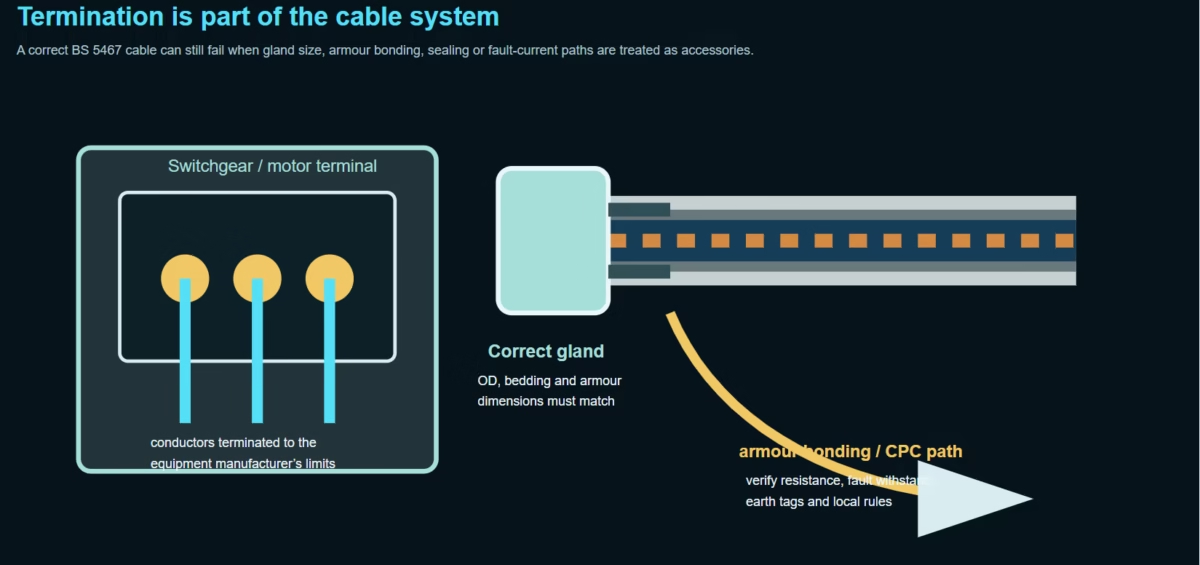
The cable ends are part of the electrical system. A gland selected from a nominal cross-section can be wrong if the released outer diameter, bedding diameter or armour wire range differs. For an SWA installation, the termination must also preserve armour continuity, sealing and the intended protective-conductor path.
Gland selection
Match the actual outer diameter, bedding diameter, armour dimensions, enclosure type, sealing requirement and environmental exposure. Record the approved gland family with the cable drawing.
Armour as CPC
Do not assume SWA is automatically an adequate CPC. Check armour resistance, prospective fault current, disconnection time, earth tags, bonding and joint continuity under the local installation rules.
Single-core AC
Use the non-magnetic armour solution and a termination arrangement that controls induced currents. Keep the phases arranged and supported exactly as the design requires.
Commissioning tests
At minimum, verify conductor continuity, insulation resistance, phase identification, armour continuity where used, termination torque and visual sheath condition. The project test plan may require more.
Field lesson. Many apparent cable failures are really termination failures: a gland cuts the sheath, the armour is not bonded, the cable is forced below its bend radius, or a high-temperature conductor rating is connected to equipment rated only for 70 °C terminals.
Feichun BS 5467 capability: independent construction, complete evidence
Feichun Cable can manufacture an independently engineered, functionally equivalent BS 5467 XLPE/SWA/PVC cable for export projects, industrial distribution, plant infrastructure and fixed power systems. The product is developed from the required voltage, core arrangement, conductor size, installation method, environment and destination documentation—not from copying another manufacturer’s proprietary part number or drawing.
| File section | Information to release | Status rule |
|---|---|---|
| Identity | Feichun product number, standard edition, construction code and destination market | TBC until the released drawing is approved |
| Electrical | U₀/U, cores, cross-section, conductor class, DC resistance, current rating basis and voltage drop | TBC by size and installation method |
| Thermal | 90 °C sustained / 250 °C short-circuit boundary; accessory and ambient limits | Confirm against equipment and national installation rules |
| Mechanical | SWA or AWA, armour resistance, OD, mass, minimum bend radius, pulling and gland data | Do not copy another manufacturer’s dimensions |
| Fire / environment | PVC or LSZH, flame test, smoke, corrosivity, UV, oil, water and chemical scope | Only claim the tests included in the product file |
| Documentation | Routine tests, sample/type evidence, marking, packing, inspection plan and certificates | Certificate scope must match the exact cable |
For export buyers, Feichun’s advantage is certificate coordination across the product file. Engineered for maximum safety in demanding environments, our cable systems comply with global standards including ATEX, IECEx, VDE, CE, UKCA, EAC, and the Russian Fire Safety Certificate. The exact certificate scope must be matched to the actual BS 5467 construction, market, installation and conformity route; no certificate should be presented as blanket approval for every cable family.
Independent-equivalent position. Feichun can reproduce the required electrical and mechanical performance through its own construction, materials, testing, marking and traceability. That is the correct approach for a replacement or alternative supply: functional equivalence supported by evidence, with no claim that the cable is the original branded product.
Public technical references used in this article: BSI BS 5467:2016; BSI BS 6724 current scope; BASEC cable standards catalogue; BASEC BS 5467 certification example; Eland BS 5467 construction reference; Eland LV armoured cable overview; BSI BS 7671 current edition; IET buried-cable rating guidance; IET XLPE SWA rating guidance.
FAQ: BS 5467 XLPE SWA PVC cable questions
These are the questions that usually appear in international enquiries, plant upgrades, tender clarifications and replacement projects.
Is BS 5467 only a 0.6/1 kV cable?
No. The standard also includes the 1.9/3.3 kV rated route. The voltage, insulation dimensions, core arrangement and accessories must be shown in the exact product file.
Does “SWA” apply to single-core AC cable?
Normally no. Single-core AC cables generally use non-magnetic AWA to avoid armour-induced current and heating. Confirm the circuit arrangement before accepting a SWA wording.
Is BS 5467 XLPE/SWA/PVC the same as BS 6724?
No. BS 5467 is the PVC-sheathed armoured route. BS 6724 is the low-smoke, low-corrosive-gas route. They require different material and fire-performance evidence.
Can BS 5467 cable be buried directly?
It can be suitable for direct burial in appropriate free-draining ground when the product and installation design allow it. Calculate the buried rating and protect the cable from mechanical and environmental damage.
What is the current rating of 4-core 35 mm²?
There is no single answer without installation method, ambient, grouping, soil or duct conditions and the permitted conductor temperature. Request the exact manufacturer schedule or perform the installation calculation.
Can it be used on a crane reel or festoon?
Not on the BS 5467 name alone. Reeling and festoon cables need a dynamic-duty design, flexing life, bend radius, tensile limits and application-specific validation.
Does PVC mean the cable is LSZH or B2ca?
No. PVC and LSZH are different sheath systems, and CPR classes are product-specific. Ask for the exact classification report and conformity documents.
Is BS 5467 automatically fire resistant?
No. The standard’s basic flame-propagation reference is not the same as circuit integrity or LSZH performance. If the project needs fire survival, smoke control or circuit integrity, specify the relevant cable construction and test evidence separately.
Can Feichun manufacture a replacement?
Yes. Feichun can produce an independently engineered functional equivalent with its own drawing, dimensions, tests, marking, traceability and applicable certificate scope.
FAQ configuration checklist Legacy / requested wording: [BS 5467 XLPE SWA PVC] Rated voltage U₀/U: [0.6/1 kV or 1.9/3.3 kV] Conductor: [copper / confirmed alternative] · cores: [number] · cross-section: [mm²] Construction: [CU/XLPE/PVC/SWA/PVC or CU/XLPE/PVC/AWA/PVC] Installation: [tray / air / buried duct / direct burial / building / plant] Environment: [UV / oil / water / chemical / corrosion / fire-performance requirement] Required data: OD, mass, resistance, current rating basis, voltage drop, bend radius, short-circuit conductor and armour withstand, marking, tests and destination certificates
The open fields are deliberate. They stop a familiar standard name from hiding an unverified size, rating, armour arrangement or certificate claim.


