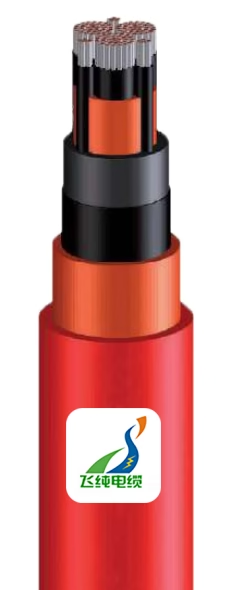
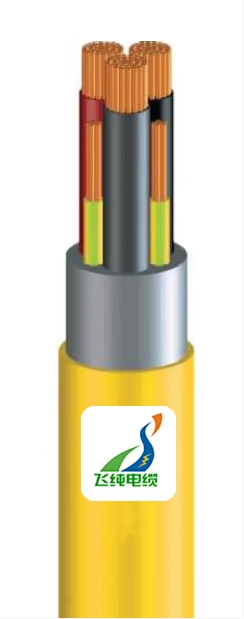
XLPE Insulated Cable

SWA Cable Architecture & Engineering Design Strategy Purpose & Application Scope: Steel Wire Armored (SWA) cables represent the engineering solution for power distribution where mechanical protection, fire safety, and environmental resistance create absolute requirements. Unlike conventional cables relying solely on conduit or external protection, SWA cables integrate mechanical armoring as an integral structural component, offering permanent protection against physical damage, burrowing animals, excavation equipment, and external mechanical stress. Core Engineering Philosophy: SWA cable design employs multi-layer engineering architecture combining XLPE insulation excellence with steel wire mechanical protection and halogen-free outer sheathing. This integrated approach eliminates the need for external conduit in most underground, outdoor, and hazardous-area applications—reducing installation cost, complexity, and maintenance requirements while providing superior long-term reliability. Market Position & Regulatory Compliance: SWA cables comply with IEC 60502-1 international standards and equivalent national specifications including KS C specifications. These cables specifically address the requirements of the EN 50288 and equivalent standards covering cables with protective conductors and armored configurations. The combination of XLPE insulation with halogen-free sheathing provides automatic compliance with fire safety codes adopted across Europe, Asia, and industrial facilities worldwide where smoke emission and toxic fume generation create liability concerns.

0.6/1kV XLPE Insulated Halogen-Free Steel Wire Armored Cable

SWA Cable Architecture & Engineering Design Strategy Purpose & Application Scope: Steel Wire Armored (SWA) cables represent the engineering solution for power distribution where mechanical protection, fire safety, and environmental resistance create absolute requirements. Unlike conventional cables relying solely on conduit or external protection, SWA cables integrate mechanical armoring as an integral structural component, offering permanent protection against physical damage, burrowing animals, excavation equipment, and external mechanical stress. Core Engineering Philosophy: SWA cable design employs multi-layer engineering architecture combining XLPE insulation excellence with steel wire mechanical protection and halogen-free outer sheathing. This integrated approach eliminates the need for external conduit in most underground, outdoor, and hazardous-area applications—reducing installation cost, complexity, and maintenance requirements while providing superior long-term reliability. Market Position & Regulatory Compliance: SWA cables comply with IEC 60502-1 international standards and equivalent national specifications including KS C specifications. These cables specifically address the requirements of the EN 50288 and equivalent standards covering cables with protective conductors and armored configurations. The combination of XLPE insulation with halogen-free sheathing provides automatic compliance with fire safety codes adopted across Europe, Asia, and industrial facilities worldwide where smoke emission and toxic fume generation create liability concerns.
PVC Linear Chain Architecture—Structural Vulnerability: Polyvinyl chloride (PVC) consists of linear polymer backbone: −[CH₂−CHCl]−n−, where each carbon-chlorine bond (C−Cl) is polar. PVC chosen historically for cables due to: (1) easy extrusion (processing temp ~200°C), (2) inherent flame retardancy (chlorine atoms suppress combustion), (3) low cost. However, linear structure has critical weakness: polymer chains held together only by van der Waals forces + few covalent cross-links (vs XLPE which is heavily cross-linked via peroxide or electron beam). Consequence: thermal energy at elevated temperature (60–80°C) causes thermal motion to exceed van der Waals bond energy, enabling chain slip + bond breakage. Thermal Oxidation Cascade—Free Radical Chain Reaction: At 70°C (GOST PVC design limit in mines): (1) Heat causes C−H bond scission (bond dissociation energy ~350 kJ/mol), generating alkyl radicals R•, (2) R• + O₂ (from air + moisture) → peroxyl radical ROO•, (3) ROO• + polymer chain → hydroxyl group −OH + new radical, (4) Repeat step 3 creates chain reaction (one broken bond triggers cascade), (5) Net result: polymer backbone breaks into smaller fragments (molecular weight drops), material becomes brittle. Oxidation rate: approximately ∝ exp(E_a/RT) per Arrhenius law, so 10°C increase ~2–3× oxidation rate.

КШВЭБбШв-6 kV Material Science Deep-Dive: PVC vs XLPE Thermal Aging & Lifespan Physics

PVC Linear Chain Architecture—Structural Vulnerability: Polyvinyl chloride (PVC) consists of linear polymer backbone: −[CH₂−CHCl]−n−, where each carbon-chlorine bond (C−Cl) is polar. PVC chosen historically for cables due to: (1) easy extrusion (processing temp ~200°C), (2) inherent flame retardancy (chlorine atoms suppress combustion), (3) low cost. However, linear structure has critical weakness: polymer chains held together only by van der Waals forces + few covalent cross-links (vs XLPE which is heavily cross-linked via peroxide or electron beam). Consequence: thermal energy at elevated temperature (60–80°C) causes thermal motion to exceed van der Waals bond energy, enabling chain slip + bond breakage. Thermal Oxidation Cascade—Free Radical Chain Reaction: At 70°C (GOST PVC design limit in mines): (1) Heat causes C−H bond scission (bond dissociation energy ~350 kJ/mol), generating alkyl radicals R•, (2) R• + O₂ (from air + moisture) → peroxyl radical ROO•, (3) ROO• + polymer chain → hydroxyl group −OH + new radical, (4) Repeat step 3 creates chain reaction (one broken bond triggers cascade), (5) Net result: polymer backbone breaks into smaller fragments (molecular weight drops), material becomes brittle. Oxidation rate: approximately ∝ exp(E_a/RT) per Arrhenius law, so 10°C increase ~2–3× oxidation rate.
Translating Russian GOST Cable Code—Letter-by-Letter Breakdown: КШВЭБбШв-6 each letter carries specific technical meaning: (1) К (Кабель) = Cable, (2) Ш (Шахтный) = Mine-rated (specifically designed for underground mining environments with enhanced flame-retardant properties per GOST 5151), (3) В (В-изоляция) = PVC (polyvinyl chloride) insulation, (4) Э (Экран) = Screened (copper or copper-nickel screening layer for electromagnetic shielding), (5) Бб (Броня Бронированная) = Armored (specifically double-layer—Бб indicates dual protective layer), (6) Шв (Шланг Виниловый) = PVC outer sheath (vinyl hose protective jacket). Result: КШВЭБбШв-6 = Mine-rated, PVC-insulated, screened, double-armor protected, PVC-sheathed 6 kV cable. The "6" denotes 6 kV rated voltage (single-phase or 3-phase phase-to-ground). 翻译俄标GOST电缆代码—逐字分解:КШВЭБбШв-6各字母承载特定技术含义:(1)К(Кабель)=电缆、(2)Ш(Шахтный)=矿用(特别为地下矿井环境设计、GOST 5151阻燃增强)、(3)В(В-изоляция)=PVC聚氯乙烯绝缘、(4)Э(Экран)=屏蔽(铜或铜镍屏蔽层)、(5)Бб(Броня Бронированная)=铠装(双层—Бб指双保护层)、(6)Шв(Шланг Виниловый)=PVC外护套。结果:КШВЭБбШв-6=矿用、PVC绝缘、屏蔽、双铠装、PVC护套6 kV电缆。"6"表示6 kV额定电压。

КШВЭБбШв-6 kV Drop-in Replacement: IEC 60502-2 N2XSEYBY Armored Underground Cable

Translating Russian GOST Cable Code—Letter-by-Letter Breakdown: КШВЭБбШв-6 each letter carries specific technical meaning: (1) К (Кабель) = Cable, (2) Ш (Шахтный) = Mine-rated (specifically designed for underground mining environments with enhanced flame-retardant properties per GOST 5151), (3) В (В-изоляция) = PVC (polyvinyl chloride) insulation, (4) Э (Экран) = Screened (copper or copper-nickel screening layer for electromagnetic shielding), (5) Бб (Броня Бронированная) = Armored (specifically double-layer—Бб indicates dual protective layer), (6) Шв (Шланг Виниловый) = PVC outer sheath (vinyl hose protective jacket). Result: КШВЭБбШв-6 = Mine-rated, PVC-insulated, screened, double-armor protected, PVC-sheathed 6 kV cable. The “6” denotes 6 kV rated voltage (single-phase or 3-phase phase-to-ground). 翻译俄标GOST电缆代码—逐字分解:КШВЭБбШв-6各字母承载特定技术含义:(1)К(Кабель)=电缆、(2)Ш(Шахтный)=矿用(特别为地下矿井环境设计、GOST 5151阻燃增强)、(3)В(В-изоляция)=PVC聚氯乙烯绝缘、(4)Э(Экран)=屏蔽(铜或铜镍屏蔽层)、(5)Бб(Броня Бронированная)=铠装(双层—Бб指双保护层)、(6)Шв(Шланг Виниловый)=PVC外护套。结果:КШВЭБбШв-6=矿用、PVC绝缘、屏蔽、双铠装、PVC护套6 kV电缆。”6″表示6 kV额定电压。
The cable selection debate between premium branded products like Nexans Olex Versolex and generic alternatives such as Type 441 cables represents a critical decision point for electrical contractors, mining operators, and industrial facility managers. This technical analysis examines whether the higher initial investment in Versolex flexible cables delivers measurable value through extended service life, reduced maintenance costs, and superior operational reliability. Both cable types serve different primary markets—Versolex targets commercial and industrial flexible power applications compliant with AS/NZS 5000.1, while Type 441 cables are specifically engineered for harsh mining environments under AS/NZS 2802 standards. 在Nexans Olex Versolex等高端品牌产品与Type 441等通用电缆之间的选择,对电气承包商、矿业运营商和工业设施管理人员来说是一个关键决策点。本技术分析探讨了对Versolex柔性电缆的更高初始投资是否通过延长使用寿命、降低维护成本和卓越的运行可靠性提供可衡量的价值。两种电缆类型服务于不同的主要市场——Versolex针对符合AS/NZS 5000.1标准的商业和工业柔性电力应用,而Type 441电缆专门为AS/NZS 2802标准下的恶劣矿业环境设计。

Nexans Olex Versolex vs. Generic Type 441: Is the Premium Price Justified by Longer Service Life?

The cable selection debate between premium branded products like Nexans Olex Versolex and generic alternatives such as Type 441 cables represents a critical decision point for electrical contractors, mining operators, and industrial facility managers. This technical analysis examines whether the higher initial investment in Versolex flexible cables delivers measurable value through extended service life, reduced maintenance costs, and superior operational reliability. Both cable types serve different primary markets—Versolex targets commercial and industrial flexible power applications compliant with AS/NZS 5000.1, while Type 441 cables are specifically engineered for harsh mining environments under AS/NZS 2802 standards. 在Nexans Olex Versolex等高端品牌产品与Type 441等通用电缆之间的选择,对电气承包商、矿业运营商和工业设施管理人员来说是一个关键决策点。本技术分析探讨了对Versolex柔性电缆的更高初始投资是否通过延长使用寿命、降低维护成本和卓越的运行可靠性提供可衡量的价值。两种电缆类型服务于不同的主要市场——Versolex针对符合AS/NZS 5000.1标准的商业和工业柔性电力应用,而Type 441电缆专门为AS/NZS 2802标准下的恶劣矿业环境设计。
Overland conveyor systems represent critical infrastructure for bulk material handling across mining, quarrying, and heavy industrial operations. When these systems extend beyond 5 kilometers, the selection of appropriate power distribution cables becomes a paramount engineering decision that directly impacts operational reliability, maintenance costs, and system longevity. According to industry standards published by the International Electrotechnical Commission, power cables for such applications must meet rigorous mechanical and electrical performance criteria to withstand the demanding operational environment. This technical analysis examines two primary cable architectures utilized in extended overland conveyor applications: armoured cables and flexible cables. Each design philosophy addresses specific operational requirements, with armoured configurations prioritizing mechanical protection for fixed installations, while flexible designs accommodate dynamic loading and continuous motion requirements. The selection between these cable types fundamentally depends on installation methodology, environmental conditions, mechanical stress profiles, and long-term operational economics.

Overland Conveyor Systems: Armoured vs. Flexible Cables for 5km+ Power Distribution

Overland conveyor systems represent critical infrastructure for bulk material handling across mining, quarrying, and heavy industrial operations. When these systems extend beyond 5 kilometers, the selection of appropriate power distribution cables becomes a paramount engineering decision that directly impacts operational reliability, maintenance costs, and system longevity. According to industry standards published by the International Electrotechnical Commission, power cables for such applications must meet rigorous mechanical and electrical performance criteria to withstand the demanding operational environment. This technical analysis examines two primary cable architectures utilized in extended overland conveyor applications: armoured cables and flexible cables. Each design philosophy addresses specific operational requirements, with armoured configurations prioritizing mechanical protection for fixed installations, while flexible designs accommodate dynamic loading and continuous motion requirements. The selection between these cable types fundamentally depends on installation methodology, environmental conditions, mechanical stress profiles, and long-term operational economics.
To appreciate the ingenious engineering behind Type 440 cable design, we must first understand the mechanical challenges that mining cables face in their demanding service environment. Imagine a heavy-duty power cable trailing behind a massive dragline excavator as it moves across an open-pit mine. This cable must deliver reliable electrical power while simultaneously withstanding crushing forces when the excavator's tracks pass over it, resisting abrasion from sharp rock surfaces, and maintaining flexibility through countless cycles of bending and twisting movements. 要理解Type 440电缆设计背后的巧妙工程,我们必须首先了解矿用电缆在苛刻服务环境中面临的机械挑战。想象一根重型电力电缆拖在大型拉铲挖掘机后面,当它在露天矿中移动时,这根电缆必须提供可靠的电力,同时承受挖掘机履带经过时的压碎力、抵抗尖锐岩石表面的磨损,并在无数次弯曲和扭转运动中保持柔韧性。

TROMMELFLEX-M-PUR BRAIDED D2X11Y 1 KV

TROMMELFLEX-M-PUR represents a specialized category of flexible low voltage reeling cables engineered specifically for the demanding conditions of underground mining and tunneling operations. This cable features optimized dimensions and a flame-retardant, halogen-free polyurethane outer sheath, making it ideal for power supply to mobile underground equipment including drilling machines, Load-Haul-Dump (LHD) loaders, and scoops that operate under frequently changing dynamic loads during reeling operations. TROMMELFLEX-M-PUR电缆是专为地下采矿和隧道作业的苛刻条件而设计的特种柔性低压卷筒电缆。该电缆具有优化的尺寸设计和阻燃、无卤聚氨酯外护套,特别适合为钻机、装载-运输-卸载(LHD)装载机和铲运机等移动地下设备提供电力,这些设备在卷绕操作中承受频繁变化的动态负载。
The Pilbara region of Western Australia represents one of the world's most thermally challenging environments for electrical infrastructure. With ambient temperatures regularly exceeding 50°C during summer months and recorded extremes reaching 50.7°C, proper cable ampacity derating is critical for safe and reliable mining operations. This technical guide provides comprehensive methods for calculating current-carrying capacity adjustments for Type 440 cables operating under these extreme conditions, following Australian Standards AS/NZS 3008 and international standard IEC 60287.

Pilbara Heat: Calculating Ampacity Derating for Type 440 Cables in 50°C+ Ambient Temperatures

The Pilbara region of Western Australia represents one of the world’s most thermally challenging environments for electrical infrastructure. With ambient temperatures regularly exceeding 50°C during summer months and recorded extremes reaching 50.7°C, proper cable ampacity derating is critical for safe and reliable mining operations. This technical guide provides comprehensive methods for calculating current-carrying capacity adjustments for Type 440 cables operating under these extreme conditions, following Australian Standards AS/NZS 3008 and international standard IEC 60287.
(N)TSKCGEWÖU specifications. This protective layer serves multiple critical functions within the cable assembly, with mechanical stress redistribution being among its most important roles. According to research published by Sibelco, the bedding compound is defined as the material applied around insulated conductors to maintain their position and provide bedding for protective armoring.[1] This layer functions as an intermediary component positioned between the laid-up cores and the metallic armor, creating what cable engineers describe as a separation sheath that fundamentally alters how mechanical forces are distributed throughout the cable structure.

Inner Sheath Function: Mechanical Stress Redistribution in (N)TSKCGEWÖU Cables

(N)TSKCGEWÖU specifications. This protective layer serves multiple critical functions within the cable assembly, with mechanical stress redistribution being among its most important roles. According to research published by Sibelco, the bedding compound is defined as the material applied around insulated conductors to maintain their position and provide bedding for protective armoring.[1] This layer functions as an intermediary component positioned between the laid-up cores and the metallic armor, creating what cable engineers describe as a separation sheath that fundamentally alters how mechanical forces are distributed throughout the cable structure.
NSSHKCGEOEU (Schräm-TENAX®-VE) — это специализированный кабель для угольных комбайнов с уникальной системой обнаружения повреждений от раздавливания. Кабель соответствует стандартам DIN VDE 0250, часть 812 и DIN VDE 0472, часть 818 («Поведение при сжимающей нагрузке»), что гарантирует обнаружение повреждений от раздавливания как замыканий на землю с максимальной надёжностью. Инновационная конструкция с центральным разделителем-корзиной из проводящей резины и распределённым заземляющим проводником обеспечивает превосходную защиту при экстремальных механических нагрузках, характерных для работы угольных комбайнов.

How do EMC-compliant VDE cables like (N)2XCCY differ structurally from standard screened mining cables like (N)TSCGEWÖU?

The distinction between EMC-compliant distribution cables such as the N2XCCY series manufactured according to DIN VDE 0276-620 standards and heavy-duty mining cables like the NTSCGEWÖU series designed per DIN VDE 0250-813 specifications reveals how cable construction must adapt to specific electromagnetic environments and mechanical demands. Understanding these structural differences provides essential insight for engineers specifying cables in installations where electromagnetic interference control is paramount alongside mechanical reliability.
How do you select conductor size for high-current tunnelling equipment and cable reels?

كيفية اختيار مقاس الموصل لمعدات الأنفاق عالية التيار وبكرات الكابلات؟

Selecting the correct conductor size for cables used in tunnel boring equipment and cable reels is critical for ensuring safety and operational efficiency. These cables are subjected to extreme conditions including high currents, mechanical stress, and elevated temperatures. According to International Electrotechnical Commission (IEC) standards, conductor selection must consider ampacity, voltage drop, short-circuit capacity, and environmental factors.
Overheating and insulation damage are among the most dangerous problems facing underground mining cables, potentially leading to catastrophic fires, costly production interruptions, and serious worker injuries. According to U.S. Mine Safety and Health Administration (MSHA) statistics, electrical cable failures are a leading cause of fires in underground mines, with over 200 incidents annually related to cable overheating. Mining cables face harsh operating conditions including high ambient temperatures (40-50°C), high humidity (>90% RH), continuously varying loads, and mechanical stress from pulling and bending. Maintaining cable integrity requires an integrated system of monitoring and preventive maintenance according to IEC 60502, IEEE 400.2, and NETA MTS standards. The thermal degradation of EPR and XLPE insulation follows the Arrhenius equation, where every 10°C increase above rated temperature approximately halves the insulation's service life. Understanding the root causes of overheating and implementing systematic diagnostic procedures is essential for preventing failures and ensuring safe, reliable power distribution in underground mining operations.

كيف يمكنك استكشاف أعطال السخونة الزائدة وتلف العزل في كابلات التعدين تحت الأرض؟

mining cable overheating, insulation damage, cable troubleshooting, partial discharge test, insulation resistance, thermal imaging, VLF testing, IEEE 400.2, IEC 60270, MSHA cable, underground mining, fault diagnosis, preventive maintenance, hot spot detection, electrical treeing, كابلات التعدين, 礦用電纜故障, infrared thermography, megger test, polarization index
Abrasion resistance and tear strength are among the most critical mechanical properties to evaluate when selecting tunnelling cables and tunnel boring machine (TBM) cables. These cables are exposed to extremely harsh conditions including continuous friction with rocks and debris, repeated dynamic movement, and high mechanical stress, requiring sheath materials with superior abrasion and tear resistance. According to international testing standards such as ISO 34-1 for tear strength and DIN 53516 for abrasion resistance, proper assessment ensures that cables will perform reliably throughout their service life in demanding underground environments. The selection of appropriate sheath materials—whether TPU (Thermoplastic Polyurethane), PUR (Polyurethane Rubber), CPE (Chlorinated Polyethylene), or EPR (Ethylene Propylene Rubber)—directly impacts cable longevity, safety, and operational efficiency.

كيف تُقيّم مقاومة التآكل وقوة التمزق لاختيار كابلات الأنفاق؟

TPU cable sheath, thermoplastic polyurethane cable, PUR cable jacket, polyurethane rubber sheath, CPE cable jacket, chlorinated polyethylene sheath, EPR insulation cable, EPDM rubber cable, neoprene cable sheath, chloroprene rubber cable, XLPE insulated cable, rubber sheathed flexible cable, halogen free cable sheath, LSZH mining cable
Wind turbines stand tall on the landscape both onshore and offshore, harnessing natural resources to generate renewable energy. The cables used in these installations must be specifically engineered to handle unique mechanical and environmental challenges. Unlike standard industrial cables, wind turbine cables must withstand continuous torsional stress caused by the rotation of the nacelle and rotor blades, which can apply twisting forces up to ±180° per meter over millions of cycles during the turbine's 20-25 year operational lifespan. Our comprehensive range includes power cables rated from 600V to 6kV for tower, nacelle, and rotor applications, as well as control and automation cables essential for safe operation and real-time monitoring of energy production systems.

What is Wind Farm and Wind Turbine Cables?

NTSCGEWÖW 6kV cable, NTSCGEWOW 6kV torsion cable, torsion LSZH 3kV cable, torsion loop screened 1kV cable, torsion resistant LSZH cable, torsion PVC 600V cable, NA2XH 0.6/1kV cable, NA2XH 1.8/3kV cable, aluminum EPR XLEVA cable, aluminum HEPR PO cable, LiYY cable, LiHH cable, LiHCH cable, Veriflex SY cable, Veriflex CY cable, Veriflex YY cable, YSLYSY control cable, YSLCY control cable, YSLY control cable, HSLH cable, HSLCH cable, HSLHCH cable
PE cable, polyethylene cable, XLPE cable, medium voltage cable, N2XS2Y, NA2XS2Y, N2XS(F)2Y, N2XS(FL)2Y, BS 6622 cable, MDPE cable, HDPE cable, 6/10kV cable, 12/20kV cable, 18/30kV cable, underground cable, direct burial cable, duct grade cable, IEC 60502, VDE 0276, copper conductor cable, aluminium cable, waterblock cable, UV resistant cable, Cat 6 PE cable, Cat 5E external cable, oil resistant cable, industrial power cable, railway cable, mining cable, petrochemical cable, 聚乙烯电缆, 中压电缆, PE電纜, cable de polietileno, cable XLPE, outdoor power cable, MV cable manufacturer, Anhui Feichun cable, 安徽飞纯电缆, special cable manufacturer China

What is PE Cable?

N2XS2Y cable, NA2XS2Y cable, N2XS(F)2Y cable, N2XS(FL)2Y cable, NA2XS(F)2Y cable, NA2XS(FL)2Y cable, NY2Y cable, NAY2Y cable, BS 6622 cable, A2XS(F)2Y cable, A2XS(FL)2Y cable, PE cable, polyethylenMDPE cable, HDPE cable, XLPE insulated cable, PE sheathed cable, polyethylene insulation cable, cross-linked polyethylene cable, thermoplastic cable sheathe cable, XLPE cable, medium voltage cable, power cable, outdoor cable, underground cable, MV cable specifications
The Veriflex range encompasses control cables (SY, CY, YY series), fieldbus cables (Profibus DP/PA, DeviceNet), and Industrial Ethernet cables (Profinet, PUR Ethernet). Available in both PVC and LSZH (Low Smoke Zero Halogen) variants, the portfolio addresses diverse installation environments from standard industrial settings to fire-sensitive locations requiring enhanced safety performance.

What is Veriflex Cable?

Veriflex CY PVC YSLCY, Veriflex SY PVC YSLYSY, Veriflex YY PVC YSLY, Veriflex YY LSZH HSLH, Veriflex CY LSZH HSLCH, Veriflex Screened Bedded LSZH HSLHCH, Veriflex YSLYCY 1kV cable, Veriflex Control PUR-JZ, Veriflex 2XSL(st)CH LSZH, Veriflex DeviceNet Thick FRNC-LSZH, Veriflex DeviceNet Thin LSZH, Veriflex Profibus DP FC L2/FIP PVC, Veriflex Profibus DP FC L2/FIP LSZH, Veriflex Profibus PA PVC, Veriflex Profibus PA FRNC-LSZH, Veriflex Profinet Type A, Veriflex PUR Industrial Ethernet, Veriflex Interface BUS Cable
DNV (Det Norske Veritas) is an international accredited registrar and classification society headquartered in Høvik, Norway. As one of the world's leading classification societies, DNV provides certification, verification, and risk management services for the maritime, oil & gas, renewable energy, and other industries. DNV approved cables are electrical cables that have been tested, verified, and certified by DNV to meet stringent safety, quality, and performance standards for use in marine and offshore applications.

What is DNV Approved Cable?

offshore platform cable, drilling platform cable, oil rig cable, FPSO cable, jackup rig cable, semi-submersible cable, drillship cable, offshore wind farm cable, wind turbine cable, subsea cable, underwater cable, shipboard wiring cable, ship electrical cable, naval vessel cable, cruise ship cable, ferry cable, offshore substation cable, offshore power distribution, marine electrical installation
DIN VDE cable, VDE standard cable, German cable standard, VDE certified cable, VDE approved cable, DIN cable, VDE certification, German electrical standard, DKE standard, VDE mark, VDE testing, German power cable

What is DIN VDE Standard Cable?

VDE 0100, VDE 0105, VDE 0207, VDE 0245, VDE 0250, VDE 0253, VDE 0262, VDE 0265, VDE 0266, VDE 0267, VDE 0271, VDE 0276, VDE 0277, VDE 0281, VDE 0282, VDE 0284, VDE 0289, VDE 0292, VDE 0293, VDE 0295, VDE 0298, VDE 0472, VDE 0473, VDE 0482, VDE 0800, VDE 0811, VDE 0812, VDE 0815, VDE 0816, VDE 0839, VDE 0881, VDE 0891, VDE 0899, NYY cable, NYY-J cable, NYY-O cable, NYM cable, NYM-J cable, NYCY cable, NYCWY cable, NAYY cable, N2XY cable, NA2XY cable, N2XSY cable, N2XSEY cable, NA2XSY cable, NA2XS2Y cable, N2XH cable, N2XCH cable, NSHTOU cable, NSHTÖU cable, NSSHÖU cable, NSGAFÖU cable, NHXMH cable, NHMH cable, H03VV-F cable, H05VV-F cable, H07VV-F cable, H05V-K cable, H07V-K cable, H05V-U cable, H07V-U cable, H05V-R cable, H07V-R cable, H05RN-F cable, H07RN-F cable, H05RR-F cable, H07BN4-F cable, H05BN4-F cable, H07ZZ-F cable, H05Z-K cable, H07Z-K cable, H07Z-R cable, H05Z1Z1-F cable, H05VVH2-F cable, H05VVH6-F cable, H07V2-K cable, H05V2-K cable, H01N2-D cable, H01N2-E cable,300/500V cable, 450/750V cable, 0.6/1kV cable, 600/1000V cable, 3.6/6kV cable, 6/10kV cable, 12/20kV cable, 18/30kV cable, low voltage cable, medium voltage cable, high voltage cable,
High-performance polyurethane sheathed flexible power cables for mining and tunneling applications. Available in two variants: standard version without anti-twisting protection (TUNNELFLEX-PUR) and enhanced version with synthetic mesh anti-twisting protection (TUNNELFLEX-R/PUR).

What is TUNNELFLEX-PUR&TUNNELFLEX-R/PUR 0.6/1kV Cable?

TUNNELFLEX-PUR and TUNNELFLEX-R/PUR are specialized 0.6/1kV flexible power cables engineered for mining and tunneling applications. These cables provide reliable power supply to mobile equipment operating in harsh underground environments where there is a high risk of mechanical damage. The TUNNELFLEX cable series is suitable for applications where it is deflected in one plane only, with a maximum operating speed of 60 m/min.
FG7ORPu-TUNNELFLEX is a specialized 0.6/1kV flexible power cable engineered specifically for mining and tunneling applications. This cable provides reliable power supply to mobile equipment operating in harsh underground environments where there is a high risk of mechanical damage. The TUNNELFLEX cable is suitable for applications where it is deflected in one plane only, with a maximum operating speed of 60 m/min.

What is FG7ORPu-TUNNELFLEX 0.6/1kV Cable?

FG7ORPu-TUNNELFLEX is a specialized 0.6/1kV flexible power cable engineered specifically for mining and tunneling applications. This cable provides reliable power supply to mobile equipment operating in harsh underground environments where there is a high risk of mechanical damage. The TUNNELFLEX cable is suitable for applications where it is deflected in one plane only, with a maximum operating speed of 60 m/min.
British Standard BS8436 specifies requirements for multicore electric cables with low emissions of smoke and corrosive gases when subjected to fire. The standard covers 2-core, 3-core, and 4-core cables with an uninsulated full-size circuit protective conductor of tinned annealed copper and metallic screening. These cables are specifically designed for use in building voids, partitions and walls where there is a risk of damage or penetration from nails, screw fixings, and similar fasteners.

What is BS8436 Standard Cable?

British Standard BS8436 specifies requirements for multicore electric cables with low emissions of smoke and corrosive gases when subjected to fire. The standard covers 2-core, 3-core, and 4-core cables with an uninsulated full-size circuit protective conductor of tinned annealed copper and metallic screening. These cables are specifically designed for use in building voids, partitions and walls where there is a risk of damage or penetration from nails, screw fixings, and similar fasteners.
British Standard BS7870 Part 3 covers low voltage cables used for the provision of an electricity supply from a distribution main. These cables are manufactured in accordance with BS7870 Parts 3.11, 3.12, 3.20, and 3.22 for use by distribution and generation utilities. They are generally buried underground to connect individual houses or commercial properties to the grid by transmission, distribution, and power generation networks.

What is BS7870 Part 3 Cable?

BS7870 Part 3 cable, BS7870-3.11, BS7870-3.12, BS7870-3.21, BS7870-3.22, BS7870-3.40, BS7870-3.50, XLPE insulated cable, concentric cable, split concentric cable, waveform cable, 0.6/1kV cable, low voltage cable, PVC sheath cable, LSZH cable, low smoke zero halogen, copper conductor cable, aluminium conductor cable, underground distribution cable, service entrance cable, British Standard cable, UK power cable, CNE cable, combined neutral earth, utility distribution cable, BS7671 compliant, IEC 60228, Class 2 conductor, Class 1 conductor, residential power cable, commercial distribution, TN-S system, TN-C-S PME system, fixed installation cable, three-phase cable, single core cable, multi-core cable, power generation cable, transmission distribution cable, BS7870電纜, 低壓配電電纜, XLPE絕緣電纜, 同心電纜, 分裂同心電纜, 低煙無鹵電纜, 英國標準電纜, Anhui Feichun cable, Feichun Special Cable, 安徽飛純電纜
BS6622 is the British Standard specification for single-core and multicore cables with extruded cross-linked polyethylene (XLPE) insulation for rated voltages from 6.35/11kV up to 19/33kV. These medium voltage (MV) cables are specifically designed for power distribution networks, underground installations, and cable ducting applications. The standard ensures consistent quality, safety, and performance across all compliant products.

What is BS6622 Cable?

BS6622 cable specification, BS6622 cable datasheet, BS6622 cable price, BS6622 cable manufacturer, BS6622 cable supplier China, 19/33kV XLPE cable, 33kV armoured cable, medium voltage cable for underground, BS6622 three core cable, BS6622 single core cable, XLPE/PVC/SWA/PVC cable, BS6622 cable dimensions, BS6622 cable weight per meter, BS6622 cable current carrying capacity,BS6622電纜, 中壓電纜, 交聯聚乙烯電纜, XLPE電纜, 鎧裝電纜, 鋼絲鎧裝電纜, 鋁絲鎧裝電纜, 地下電纜, 直埋電纜, 配電電纜, 11kV電纜, 33kV電纜, 中壓配電電纜, 特種電纜, 電力電纜
British Standard BS7870-4.10 specifies requirements for medium voltage (MV) polymeric insulated cables manufactured specifically for use by distribution and generation utility industry sectors. These single core cables are designed for primary power distribution, connecting sub-mains to local networks where the final connection occurs. They form the foundation of electricity supply from distribution mains worldwide.

What is BS7870-4.10 Cable?

BS7870-4.10電纜, BS7870電纜, 中壓電纜, MV電纜, 11kV電纜, 33kV電纜, 22kV電纜, XLPE電纜, 配電電纜, 公用事業電纜, DNO電纜, 一次配電電纜, 單芯中壓電纜, 聚合物絕緣電纜, 電力配電電纜, 電網電纜, 地下電纜, MDPE護套電纜, LSZH中壓電纜, 銅中壓電纜, 鋁中壓電纜, 三芯絞合電纜, 無鎧裝中壓電纜, 屏蔽中壓電纜 BS7870-4.10, BS7870 cable, medium voltage cable, MV cable, 11kV cable, 33kV cable, 22kV cable, XLPE cable, distribution cable, utility cable, DNO cable, primary distribution cable, single core MV cable, polymeric insulated cable, power distribution cable, grid cable, underground cable, MDPE sheath cable
Wind turbine medium voltage cables serve as the critical power transmission lifeline connecting wind turbine generators to step-up transformers and grid infrastructure. These cables must withstand extreme operational conditions including continuous mechanical stress from nacelle rotation, temperature fluctuations from -40°C to +90°C, and exposure to moisture in both onshore and offshore environments.

Wind Turbine Medium Voltage XLPE Power Cables12/20 (24) kV — Longitudinally & Radially Sealed

12/20 (24) kV XLPE-insulated cables manufactured by Anhui Feichun Special Cable Co., Ltd. feature longitudinal and radial water-blocking technology, ensuring reliable performance throughout the cable’s 30+ year design life. The cross-linked polyethylene (XLPE) insulation provides superior dielectric properties compared to traditional PVC, enabling higher operating temperatures and improved current-carrying capacity.
Variable Speed Drive Cable with Copper Tape Screening for Superior Electromagnetic Compatibility in Industrial Motor Control Applications

What is VAROLEX® VSD/EMC 3C+3E Cable?

The VAROLEX® VSD/EMC cable represents a specialized engineering solution designed specifically for variable speed drive (VSD) applications where electromagnetic compatibility (EMC) is a critical operational requirement. Manufactured by Anhui Feichun Special Cable Co., Ltd (安徽飞纯特种电缆有限公司), this cable incorporates a symmetrical 3C+3E (three core plus three earth) configuration with copper tape screening to effectively mitigate electromagnetic interference (EMI) emissions that are inherent to modern pulse-width modulation (PWM) drive systems.