crane power cable

PNCT-R high-voltage reel cables represent an advanced evolution in portable power distribution—engineered specifically for container cranes, ship unloaders, cargo handling systems, and bulk terminal equipment where electrical power must be delivered dynamically through mechanically spooled cable reels. Unlike stationary cable installations with fixed routing and stress patterns, reel-deployed cables experience continuous repetitive flex-cycling, abrupt acceleration/deceleration forces, and environmental exposure across multiple geographic locations and climate conditions. Fundamental Design Challenge: Traditional high-voltage cables designed for fixed installations fail catastrophically when deployed on mechanical reels. The repetitive flex-cycling—where individual cable cross-sections bend and straighten thousands of times per shift—creates progressive internal stress concentration and insulation degradation. External mechanical stresses from reel spooling, retraction, equipment vibration, and wind loading accelerate conductor separation and sheath cracking. Standard copper braiding provides insufficient tensile support for repeated dynamic loads. Engineering Solution — Kevlar-Reinforced Architecture: PNCT-R cables integrate specialized Kevlar aramid fiber reinforcement layers—a material system engineered to absorb mechanical stress and prevent internal conductor displacement during dynamic cycling. Rather than relying solely on copper or aluminum tensile components, Kevlar fibers provide sustained tensile support through tens of thousands of flex cycles, maintaining conductor geometry integrity and preventing the progressive insulation failure characteristic of standard high-voltage cables deployed on reels. Feichun engineers have developed proprietary Kevlar weaving methodologies that integrate the reinforcement material within the cable architecture—not as external wrapping (which adds excessive weight), but as strategically positioned internal tensile layers coordinated with specialized sheath formulations. This integrated architecture enables PNCT-R cables to withstand 2+ million repetitive flex cycles at full operational stress without performance degradation.
PNCT-R High-Voltage Reel Cable Family

PNCT-R high-voltage reel cables represent an advanced evolution in portable power distribution—engineered specifically for container cranes, ship unloaders, cargo handling systems, and bulk terminal equipment where electrical power must be delivered dynamically through mechanically spooled cable reels. Unlike stationary cable installations with fixed routing and stress patterns, reel-deployed cables experience continuous repetitive flex-cycling, abrupt acceleration/deceleration forces, and environmental exposure across multiple geographic locations and climate conditions. Fundamental Design Challenge: Traditional high-voltage cables designed for fixed installations fail catastrophically when deployed on mechanical reels. The repetitive flex-cycling—where individual cable cross-sections bend and straighten thousands of times per shift—creates progressive internal stress concentration and insulation degradation. External mechanical stresses from reel spooling, retraction, equipment vibration, and wind loading accelerate conductor separation and sheath cracking. Standard copper braiding provides insufficient tensile support for repeated dynamic loads. Engineering Solution — Kevlar-Reinforced Architecture: PNCT-R cables integrate specialized Kevlar aramid fiber reinforcement layers—a material system engineered to absorb mechanical stress and prevent internal conductor displacement during dynamic cycling. Rather than relying solely on copper or aluminum tensile components, Kevlar fibers provide sustained tensile support through tens of thousands of flex cycles, maintaining conductor geometry integrity and preventing the progressive insulation failure characteristic of standard high-voltage cables deployed on reels. Feichun engineers have developed proprietary Kevlar weaving methodologies that integrate the reinforcement material within the cable architecture—not as external wrapping (which adds excessive weight), but as strategically positioned internal tensile layers coordinated with specialized sheath formulations. This integrated architecture enables PNCT-R cables to withstand 2+ million repetitive flex cycles at full operational stress without performance degradation.
Complete Technical Guide to 0.6/1kV Low Voltage Reeling Cables for Industrial Automation and Port Equipment. Comprehensive Material Comparison: Polychloroprene Rubber (NSHTÖU / 5GM5) vs. Polyurethane (PUR) Jacket Systems. VDE 0250-814 and VDE 0250-818 Standards Framework, Anti-Torsion Engineering for Transfer Cars and Grab Buckets, EPR 3GI3 Insulation Systems, Environmental Resilience Analysis, Real-World Application Decision Logic, and Factory-Direct Procurement Strategy for STS Cranes, RTG Systems, and Automated Material Handling Equipment.

Low Voltage Reeling Cable Selection Guide: 0.6/1kV Rubber vs. Polyurethane Engineering and Application Decision Framework

Complete Technical Guide to 0.6/1kV Low Voltage Reeling Cables for Industrial Automation and Port Equipment. Comprehensive Material Comparison: Polychloroprene Rubber (NSHTÖU / 5GM5) vs. Polyurethane (PUR) Jacket Systems. VDE 0250-814 and VDE 0250-818 Standards Framework, Anti-Torsion Engineering for Transfer Cars and Grab Buckets, EPR 3GI3 Insulation Systems, Environmental Resilience Analysis, Real-World Application Decision Logic, and Factory-Direct Procurement Strategy for STS Cranes, RTG Systems, and Automated Material Handling Equipment.
To understand reeling cables and why the ÖLFLEX CRANE NSHTÖU design is fundamentally different from standard control or power cables, let me start with a basic distinction about how cables experience mechanical stress. When we discussed drag chain cables in previous technical guides, we focused on cables that bend repeatedly in a predictable path—the cable enters the chain at one end, navigates tight curves, and exits the other end. The stress is primarily bending stress, and the cable's design is optimized for flexing along a fixed path millions of times. Reeling cables experience a completely different mechanical environment. A reeling cable is wound around a rotating drum, and as the drum rotates, the cable either winds onto the drum (spooling) or unwinds from the drum (unreeling). This seemingly simple mechanical action creates a unique set of stresses that standard cables cannot tolerate. First, imagine the cable as it winds onto a rotating drum. The first wrap of cable lies directly against the drum surface. The second wrap lies on top of the first wrap. The third wrap lies on top of the second wrap. This layering continues until the drum is completely spooled. Now here is the critical insight: cables on the outer layers of a spooled drum experience completely different mechanical stress than cables on the inner layers. A cable on the inner layer, wrapped tightly against the drum, experiences primarily circumferential compression and bending. A cable on the outer layer, wrapped loosely over all the inner layers, experiences tension (pulling force) as the drum rotates. More importantly, as the outer-layer cable unwinds, it must rotate to accommodate the unwinding motion. This rotation creates torsional stress—twisting forces that attempt to rotate the cable around its central axis. Standard control cables or drag chain cables are not engineered to tolerate torsional stress. They fail when subjected to this twisting motion, typically through a mechanism called the corkscrew effect where the cable's multi-conductor core separates and twists relative to the outer sheath. The ÖLFLEX CRANE NSHTÖU cable is specifically engineered to prevent this failure through sophisticated mechanical design including a supporting braid with Aramid fibers that maintains conductor bundle cohesion even during intense torsional stress. This is why the distinction between standard cables and specialized reeling cables is not merely academic—it is the difference between equipment that functions reliably for years versus equipment that experiences cable failure every few months.

Spreader Basket Standard: Equivalent to LAPP ÖLFLEX CRANE NSHTÖU 30G1.5 Reeling Cable

To understand reeling cables and why the ÖLFLEX CRANE NSHTÖU design is fundamentally different from standard control or power cables, let me start with a basic distinction about how cables experience mechanical stress. When we discussed drag chain cables in previous technical guides, we focused on cables that bend repeatedly in a predictable path—the cable enters the chain at one end, navigates tight curves, and exits the other end. The stress is primarily bending stress, and the cable’s design is optimized for flexing along a fixed path millions of times. Reeling cables experience a completely different mechanical environment. A reeling cable is wound around a rotating drum, and as the drum rotates, the cable either winds onto the drum (spooling) or unwinds from the drum (unreeling). This seemingly simple mechanical action creates a unique set of stresses that standard cables cannot tolerate. First, imagine the cable as it winds onto a rotating drum. The first wrap of cable lies directly against the drum surface. The second wrap lies on top of the first wrap. The third wrap lies on top of the second wrap. This layering continues until the drum is completely spooled. Now here is the critical insight: cables on the outer layers of a spooled drum experience completely different mechanical stress than cables on the inner layers. A cable on the inner layer, wrapped tightly against the drum, experiences primarily circumferential compression and bending. A cable on the outer layer, wrapped loosely over all the inner layers, experiences tension (pulling force) as the drum rotates. More importantly, as the outer-layer cable unwinds, it must rotate to accommodate the unwinding motion. This rotation creates torsional stress—twisting forces that attempt to rotate the cable around its central axis. Standard control cables or drag chain cables are not engineered to tolerate torsional stress. They fail when subjected to this twisting motion, typically through a mechanism called the corkscrew effect where the cable’s multi-conductor core separates and twists relative to the outer sheath. The ÖLFLEX CRANE NSHTÖU cable is specifically engineered to prevent this failure through sophisticated mechanical design including a supporting braid with Aramid fibers that maintains conductor bundle cohesion even during intense torsional stress. This is why the distinction between standard cables and specialized reeling cables is not merely academic—it is the difference between equipment that functions reliably for years versus equipment that experiences cable failure every few months.
The Type W 4/C 2/0 AWG 2000V cable features a heavy-duty thermoset CPE (chlorinated polyethylene) jacket that is specifically formulated with UV stabilizers and ozone-resistant additives, providing robust protection against continuous direct sunlight and high ozone concentrations found in desert port environments. The cable is rated to withstand prolonged outdoor exposure in desert conditions, typically maintaining 80 to 90 percent of its physical properties after 5 to 10 years of continuous unshaded sunlight exposure, compared to standard elastomeric jackets that degrade to 50 to 70 percent property retention under identical conditions. The nominal outer diameter of this cable is 46.8 to 49.1 mm (1.845 to 1.935 inches), with approximate weight of 4,390 to 5,133 kg per kilometer. The cable features 259-strand rope-lay copper conductors (2/0 AWG per core), four 67.4 mm² cores, EPDM insulation rated for 90°C conductor temperature, and current carrying capacity of 237 amperes (based on 30°C ambient, 90°C conductor temperature). However, the critical distinction that separates viable long-term desert service from premature field failures lies in understanding the difference between a cable jacket that merely resists UV degradation and a comprehensively designed system where all exposed components—including terminal connections, stripped insulation, and mechanical attachment points—receive appropriate protection from direct sunlight. In actual desert port applications, failures are as frequently caused by UV damage at unprotected termination points as by jacket degradation itself, making installation and maintenance procedures as important as material selection. For typical desert port power systems, RTG (rubber-tired gantry) crane power leads, shore-to-ship power cables, and fixed deck-mounted power distribution systems operating in Middle Eastern, North African, and Australian port environments, the Type W 4/C 2/0 AWG cable with standard CPE jacket provides reliable field-proven performance when properly installed and maintained, but premium UV-resistant cable variants should be considered for applications where service life extension beyond 7 to 10 years is critical or where inspection and maintenance infrastructure is limited.

UV & Ozone Resistance of Type W 4/C 2/0 AWG 2000V: Is the CPE Jacket Durable Enough for Constant Direct Sunlight in Desert Ports?

The Type W 4/C 2/0 AWG 2000V cable features a heavy-duty thermoset CPE (chlorinated polyethylene) jacket that is specifically formulated with UV stabilizers and ozone-resistant additives, providing robust protection against continuous direct sunlight and high ozone concentrations found in desert port environments. The cable is rated to withstand prolonged outdoor exposure in desert conditions, typically maintaining 80 to 90 percent of its physical properties after 5 to 10 years of continuous unshaded sunlight exposure, compared to standard elastomeric jackets that degrade to 50 to 70 percent property retention under identical conditions. The nominal outer diameter of this cable is 46.8 to 49.1 mm (1.845 to 1.935 inches), with approximate weight of 4,390 to 5,133 kg per kilometer. The cable features 259-strand rope-lay copper conductors (2/0 AWG per core), four 67.4 mm² cores, EPDM insulation rated for 90°C conductor temperature, and current carrying capacity of 237 amperes (based on 30°C ambient, 90°C conductor temperature). However, the critical distinction that separates viable long-term desert service from premature field failures lies in understanding the difference between a cable jacket that merely resists UV degradation and a comprehensively designed system where all exposed components—including terminal connections, stripped insulation, and mechanical attachment points—receive appropriate protection from direct sunlight. In actual desert port applications, failures are as frequently caused by UV damage at unprotected termination points as by jacket degradation itself, making installation and maintenance procedures as important as material selection. For typical desert port power systems, RTG (rubber-tired gantry) crane power leads, shore-to-ship power cables, and fixed deck-mounted power distribution systems operating in Middle Eastern, North African, and Australian port environments, the Type W 4/C 2/0 AWG cable with standard CPE jacket provides reliable field-proven performance when properly installed and maintained, but premium UV-resistant cable variants should be considered for applications where service life extension beyond 7 to 10 years is critical or where inspection and maintenance infrastructure is limited.
The 1-second short-circuit current rating for an NSHTÖU-J 4G95 0.6/1kV low-voltage heavy-duty reeling cable is approximately 8,500 to 10,200 amperes when the cable is new and at reference condition (20°C conductor temperature, single conductor in free air, no mechanical stress or aging degradation).

Short-Circuit Rating: What is the 1-second short-circuit current for NSHTÖU-J 4G95 0.6/1kV heavy-duty reeling cable? 

The 1-second short-circuit current rating for an NSHTÖU-J 4G95 0.6/1kV low-voltage heavy-duty reeling cable is approximately 8,500 to 10,200 amperes when the cable is new and at reference condition (20°C conductor temperature, single conductor in free air, no mechanical stress or aging degradation).
(N)TSKCGEWÖU 3x150+3x25/3 3.6/6kV cable with split three-part earth conductor is approximately 65 mm (2.56 inches), with a standard tolerance window of ±3.0 mm producing a permissible range of 62.0–68.0 mm. The inner jacket (the intermediate protective layer between the insulation and outer sheath) typically has a nominal thickness of approximately 0.8–1.0 mm, contributing to overall diameter build-up but not typically measured as a separate "inner diameter" in engineering specifications because the inner jacket is not a defined outer boundary—it is a layer embedded within the cable structure. The outer jacket (the final thermosetting rubber compound layer) has a nominal thickness of approximately 2.5–3.0 mm, providing the cable's mechanical interface with the environment. The approximate total weight of this cable is 8,200 kg/km (5,510 lbs/1000 ft), with copper content approximately 4,560 kg/km. It features three 150 mm² Class 5 tinned copper main phase conductors, three strategically distributed 25/3 mm² split earth conductors for electromagnetic symmetry, a 3GI3 high-dielectric EPR insulation system rated for continuous 90°C operation, an anti-torsion braid reinforcement layer, and a 5GM5 thermosetting halogen-free outer sheath providing extreme abrasion and tear resistance.

What is the Inner and Outer Jacket Diameter of (N)TSKCGEWÖU 3×150+3×25/3 3.6/6kV Splittable Earth Cable?

(N)TSKCGEWÖU 3×150+3×25/3 3.6/6kV cable with split three-part earth conductor is approximately 65 mm (2.56 inches), with a standard tolerance window of ±3.0 mm producing a permissible range of 62.0–68.0 mm. The inner jacket (the intermediate protective layer between the insulation and outer sheath) typically has a nominal thickness of approximately 0.8–1.0 mm, contributing to overall diameter build-up but not typically measured as a separate “inner diameter” in engineering specifications because the inner jacket is not a defined outer boundary—it is a layer embedded within the cable structure. The outer jacket (the final thermosetting rubber compound layer) has a nominal thickness of approximately 2.5–3.0 mm, providing the cable’s mechanical interface with the environment. The approximate total weight of this cable is 8,200 kg/km (5,510 lbs/1000 ft), with copper content approximately 4,560 kg/km. It features three 150 mm² Class 5 tinned copper main phase conductors, three strategically distributed 25/3 mm² split earth conductors for electromagnetic symmetry, a 3GI3 high-dielectric EPR insulation system rated for continuous 90°C operation, an anti-torsion braid reinforcement layer, and a 5GM5 thermosetting halogen-free outer sheath providing extreme abrasion and tear resistance.
The nominal width of a (N)TSFLCGEWÖU 4x120 0.6/1kV shielded flat trailing cable is approximately 91 mm (3.58 inches), with a tolerance window of ±3.5 mm producing a permissible range of 87.5–94.5 mm. The nominal thickness is approximately 27.5 mm (1.08 inches), with a tolerance window of ±1.5 mm producing a permissible range of 26.0–29.0 mm. The approximate total weight of this cable is 8,200 kg/km (5,500 lbs/1000 ft), with copper weight approximately 5,250 kg/km. It features four 120 mm² main power conductors rated for 321 amperes continuous operation at 30°C ambient, supplemented by individual copper braid shielding on each conductor for electromagnetic compatibility (EMC) with variable-frequency drives and other sensitive equipment. The distinction between width and thickness for flat cables differs fundamentally from round cable specifications because flat cables do not have a single outer diameter. Instead, engineers must manage two dimensions simultaneously, and these dimensions directly determine whether the cable will fit into festoon track systems, contact shoe assemblies, and guidance rail configurations commonly deployed in overhead crane systems and automated material handling equipment.

What is the Width and Thickness of (N)TSFLCGEWÖU 4×120 0.6/1kV Shielded Flat Cable?

The nominal width of a (N)TSFLCGEWÖU 4×120 0.6/1kV shielded flat trailing cable is approximately 91 mm (3.58 inches), with a tolerance window of ±3.5 mm producing a permissible range of 87.5–94.5 mm. The nominal thickness is approximately 27.5 mm (1.08 inches), with a tolerance window of ±1.5 mm producing a permissible range of 26.0–29.0 mm. The approximate total weight of this cable is 8,200 kg/km (5,500 lbs/1000 ft), with copper weight approximately 5,250 kg/km. It features four 120 mm² main power conductors rated for 321 amperes continuous operation at 30°C ambient, supplemented by individual copper braid shielding on each conductor for electromagnetic compatibility (EMC) with variable-frequency drives and other sensitive equipment. The distinction between width and thickness for flat cables differs fundamentally from round cable specifications because flat cables do not have a single outer diameter. Instead, engineers must manage two dimensions simultaneously, and these dimensions directly determine whether the cable will fit into festoon track systems, contact shoe assemblies, and guidance rail configurations commonly deployed in overhead crane systems and automated material handling equipment.
Nexans RHEYFIRM (RS) 12/20kV is a premium-tier medium-voltage reeling cable specifically engineered for high-speed, high-stress port machinery and industrial heavy-load applications. The cable's design reflects Nexans' deep expertise in marine and dockside equipment, incorporating proprietary RHEYCLEAN insulation chemistry and reinforced anti-torsion braid architecture that together enable reliable operation in environments where cable flexing occurs thousands of times per day at speeds exceeding 200 meters per minute. However, RHEYFIRM cables command premium pricing that reflects both their proven field performance and Nexans' brand positioning. For procurement teams managing large cable quantities, facing extended supply lead times, or constrained by budget limitations, the search for a functionally equivalent alternative is not a search for a compromise. Rather, it is a systematic evaluation of competing engineering approaches that achieve the same electrical safety, mechanical durability, and environmental resilience through different manufacturing philosophies. This guide addresses the practical reality that excellent medium-voltage reeling cables are manufactured by multiple established European and global suppliers. Helukabel (Germany), SAB Kabel (Germany), Prysmian (Italy/France), Feichun (China), and other manufacturers produce cables that meet or exceed RHEYFIRM's performance specifications while offering cost savings between 15–35%, faster regional delivery, or better availability for Asia-Pacific projects.

Cost-Effective Replacement for Nexans RHEYFIRM (RS) 3×50+3×25/3 12/20kV

Nexans RHEYFIRM (RS) 12/20kV is a premium-tier medium-voltage reeling cable specifically engineered for high-speed, high-stress port machinery and industrial heavy-load applications. The cable’s design reflects Nexans’ deep expertise in marine and dockside equipment, incorporating proprietary RHEYCLEAN insulation chemistry and reinforced anti-torsion braid architecture that together enable reliable operation in environments where cable flexing occurs thousands of times per day at speeds exceeding 200 meters per minute. However, RHEYFIRM cables command premium pricing that reflects both their proven field performance and Nexans’ brand positioning. For procurement teams managing large cable quantities, facing extended supply lead times, or constrained by budget limitations, the search for a functionally equivalent alternative is not a search for a compromise. Rather, it is a systematic evaluation of competing engineering approaches that achieve the same electrical safety, mechanical durability, and environmental resilience through different manufacturing philosophies. This guide addresses the practical reality that excellent medium-voltage reeling cables are manufactured by multiple established European and global suppliers. Helukabel (Germany), SAB Kabel (Germany), Prysmian (Italy/France), Feichun (China), and other manufacturers produce cables that meet or exceed RHEYFIRM’s performance specifications while offering cost savings between 15–35%, faster regional delivery, or better availability for Asia-Pacific projects.
The selection of appropriate trailing cables for surface mining draglines represents a critical engineering decision that directly impacts operational efficiency, safety, and total cost of ownership. Dragline excavators, among the largest mobile land machines in operation, require specialized heavy-duty trailing cables capable of delivering high-voltage power (typically 2 kV to 35 kV) while withstanding extreme mechanical stresses including constant flexing, crushing forces, abrasion, and environmental exposure to ultraviolet radiation, temperature extremes, and moisture. This technical analysis examines the comparative merits of Nexans AmerCable's Tiger Brand premium mold-cured cables versus generic Type SHD-GC alternatives, focusing specifically on the critical importance of jacket construction technology in determining long-term performance and reliability in surface mining dragline applications.

Nexans AmerCable Tiger Brand vs. Type SHD-GC: Finding a Compatible Mold-Cured Jacket Cable for Surface Mining Draglines

The selection of appropriate trailing cables for surface mining draglines represents a critical engineering decision that directly impacts operational efficiency, safety, and total cost of ownership. Dragline excavators, among the largest mobile land machines in operation, require specialized heavy-duty trailing cables capable of delivering high-voltage power (typically 2 kV to 35 kV) while withstanding extreme mechanical stresses including constant flexing, crushing forces, abrasion, and environmental exposure to ultraviolet radiation, temperature extremes, and moisture. This technical analysis examines the comparative merits of Nexans AmerCable’s Tiger Brand premium mold-cured cables versus generic Type SHD-GC alternatives, focusing specifically on the critical importance of jacket construction technology in determining long-term performance and reliability in surface mining dragline applications.
RHEYFIRM® cable series, developed by Nexans, represents the industry benchmark for high-voltage reeling cables in demanding crane and material handling applications. Within this series, the distinction between splittable earth configurations (designated with "S" variants) and standard configurations using the (N)TSKCGEWÖU designation has significant technical and operational implications. This analysis examines whether generic splittable earth reeling cables can serve as direct replacements for Nexans' proprietary "S" series cables.

RHEYFIRM® (S) Splittable vs. Standard (N)TSKCGEWÖU: Can Generic Splittable Earth Reeling Cables Replace Nexans “S” Series?

RHEYFIRM® cable series, developed by Nexans, represents the industry benchmark for high-voltage reeling cables in demanding crane and material handling applications. Within this series, the distinction between splittable earth configurations (designated with “S” variants) and standard configurations using the (N)TSKCGEWÖU designation has significant technical and operational implications. This analysis examines whether generic splittable earth reeling cables can serve as direct replacements for Nexans’ proprietary “S” series cables.
Indoor overhead cranes, gantry cranes, and material handling systems require specialized flat cables that can withstand constant flexing, bending, and mechanical stress while delivering reliable power and control signals. Unlike round cables, flat cables offer distinct advantages in space-constrained festoon systems: they allow for smaller bending radii, enable more compact stacking in cable carriers, and reduce wind resistance in moving applications. The choice between branded products like Lapp ÖLFLEX CRANE and VDE-designated generic alternatives such as (N)TSFLCGEWÖU or NGFLGÖU cables significantly impacts both initial costs and long-term operational reliability. (室内桥式起重机、龙门起重机和物料搬运系统需要专用扁平电缆,能够承受持续的弯曲、曲折和机械应力,同时提供可靠的电力和控制信号。与圆形电缆不同,扁平电缆在空间受限的滑触线系统中具有明显优势:它们允许更小的弯曲半径,能够在电缆拖链中更紧凑地堆叠,并减少移动应用中的风阻。在Lapp ÖLFLEX CRANE等品牌产品和(N)TSFLCGEWÖU或NGFLGÖU电缆等VDE指定的通用替代品之间进行选择,会显著影响初始成本和长期运营可靠性。) The German VDE (Verband der Elektrotechnik) standards provide a comprehensive framework for cable designation and performance requirements. Cables manufactured according to VDE 0250 standards for festoon and crane applications must meet stringent mechanical, electrical, and environmental specifications. Understanding the designation codes and how they compare to proprietary products is essential for making informed purchasing decisions. (德国VDE(德国电气工程师协会)标准为电缆指定和性能要求提供了全面的框架。根据VDE 0250标准制造的滑触线和起重机应用电缆必须满足严格的机械、电气和环境规格。了解指定代码以及它们与专有产品的比较对于做出明智的采购决策至关重要。)

Lapp ÖLFLEX CRANE vs. (N)TSFLCGEWÖU 

Indoor overhead cranes, gantry cranes, and material handling systems require specialized flat cables that can withstand constant flexing, bending, and mechanical stress while delivering reliable power and control signals. Unlike round cables, flat cables offer distinct advantages in space-constrained festoon systems: they allow for smaller bending radii, enable more compact stacking in cable carriers, and reduce wind resistance in moving applications. The choice between branded products like Lapp ÖLFLEX CRANE and VDE-designated generic alternatives such as (N)TSFLCGEWÖU or NGFLGÖU cables significantly impacts both initial costs and long-term operational reliability. (室内桥式起重机、龙门起重机和物料搬运系统需要专用扁平电缆,能够承受持续的弯曲、曲折和机械应力,同时提供可靠的电力和控制信号。与圆形电缆不同,扁平电缆在空间受限的滑触线系统中具有明显优势:它们允许更小的弯曲半径,能够在电缆拖链中更紧凑地堆叠,并减少移动应用中的风阻。在Lapp ÖLFLEX CRANE等品牌产品和(N)TSFLCGEWÖU或NGFLGÖU电缆等VDE指定的通用替代品之间进行选择,会显著影响初始成本和长期运营可靠性。) The German VDE (Verband der Elektrotechnik) standards provide a comprehensive framework for cable designation and performance requirements. Cables manufactured according to VDE 0250 standards for festoon and crane applications must meet stringent mechanical, electrical, and environmental specifications. Understanding the designation codes and how they compare to proprietary products is essential for making informed purchasing decisions. (德国VDE(德国电气工程师协会)标准为电缆指定和性能要求提供了全面的框架。根据VDE 0250标准制造的滑触线和起重机应用电缆必须满足严格的机械、电气和环境规格。了解指定代码以及它们与专有产品的比较对于做出明智的采购决策至关重要。)
Festoon systems are critical components in industrial applications where power, control, and data cables must travel with moving equipment such as overhead cranes, gantry cranes, automated storage and retrieval systems (AS/RS), and material handling equipment. The selection of appropriate flat cables for these systems directly impacts operational reliability, maintenance costs, and system longevity.

Draka Buflex vs. (N)TSFLCGEWÖU: Which Flat Cable is Best for Festoon Systems?

Festoon systems are critical components in industrial applications where power, control, and data cables must travel with moving equipment such as overhead cranes, gantry cranes, automated storage and retrieval systems (AS/RS), and material handling equipment. The selection of appropriate flat cables for these systems directly impacts operational reliability, maintenance costs, and system longevity.
Cable crushing represents one of the most insidious and costly failure modes in reeling cable systems for container handling cranes, mobile equipment, and industrial material handling applications. When we speak of cable crushing in the context of drum winding systems, we are describing a progressive mechanical failure that occurs when cables wound onto a drum at high tension are later compressed by additional cable layers wound at even higher tension. This creates a compound crushing effect where the inner layers experience compressive forces far exceeding what the cable construction was designed to withstand. Understanding how to prevent this failure mode through proper tension management is essential for ensuring reliable, long-term operation of (N)TSKCGEWÖU cables in demanding crane applications. 电缆挤压代表了集装箱处理起重机、移动设备和工业物料搬运应用中卷筒电缆系统最隐蔽且代价最高的故障模式之一。

What is the Correct Tension Formulation to Prevent “Cable Crushing” on a Monospiral Drum for (N)TSKCGEWÖU?

Cable crushing represents one of the most insidious and costly failure modes in reeling cable systems for container handling cranes, mobile equipment, and industrial material handling applications. When we speak of cable crushing in the context of drum winding systems, we are describing a progressive mechanical failure that occurs when cables wound onto a drum at high tension are later compressed by additional cable layers wound at even higher tension. This creates a compound crushing effect where the inner layers experience compressive forces far exceeding what the cable construction was designed to withstand. Understanding how to prevent this failure mode through proper tension management is essential for ensuring reliable, long-term operation of (N)TSKCGEWÖU cables in demanding crane applications. 电缆挤压代表了集装箱处理起重机、移动设备和工业物料搬运应用中卷筒电缆系统最隐蔽且代价最高的故障模式之一。
In international and German VDE standards (specifically VDE 0250), the voltage rating of a cable is not a single value but a set of three parameters. For example, a 6/10 (12) kV rating defines the electrical limits under different operating conditions. 在国际和德国 VDE 标准(特别是 VDE 0250)中,电缆的额定电压不是单一数值,而是一组三个参数。例如,6/10 (12) kV 额定值定义了不同运行条件下的电气极限。

What is the significance of the voltage rating notation Uo/U (Um) (e.g., 6/10 (12) kV) in VDE 0250 specifications?

In international and German VDE standards (specifically VDE 0250), the voltage rating of a cable is not a single value but a set of three parameters. For example, a 6/10 (12) kV rating defines the electrical limits under different operating conditions. 在国际和德国 VDE 标准(特别是 VDE 0250)中,电缆的额定电压不是单一数值,而是一组三个参数。例如,6/10 (12) kV 额定值定义了不同运行条件下的电气极限。
NTSCGEWÖU and NTMCGEWÖU cables represent critical technical solutions for powering mobile machinery in mining, heavy industry, and material handling environments. Both cable types are manufactured according to the German DIN VDE 0250 standard, which is globally recognized as the definitive benchmark for tough rubber-sheathed flexible cables designed for cranes and material handling equipment. The fundamental distinction lies in their sheath construction: the "S" in NTSCGEWÖU indicates a double rubber sheath (Schwer = heavy-duty) providing enhanced mechanical protection for reeling applications, while "M" in NTMCGEWÖU denotes a single sheath with single-core design optimized for short-length medium voltage connections. According to industry specifications, Germany remains the only country to have issued special design regulations for flexible electrical cables covering cranes and material handling equipment, making DIN VDE 0250 the ultimate international standard for these demanding applications.

كيف تختار بين NTSCGEWÖU و NTMCGEWÖU للآلات المتحركة؟

NTSCGEWÖU and NTMCGEWÖU cables represent critical technical solutions for powering mobile machinery in mining, heavy industry, and material handling environments. Both cable types are manufactured according to the German DIN VDE 0250 standard, which is globally recognized as the definitive benchmark for tough rubber-sheathed flexible cables designed for cranes and material handling equipment. The fundamental distinction lies in their sheath construction: the “S” in NTSCGEWÖU indicates a double rubber sheath (Schwer = heavy-duty) providing enhanced mechanical protection for reeling applications, while “M” in NTMCGEWÖU denotes a single sheath with single-core design optimized for short-length medium voltage connections. According to industry specifications, Germany remains the only country to have issued special design regulations for flexible electrical cables covering cranes and material handling equipment, making DIN VDE 0250 the ultimate international standard for these demanding applications.
SINGLE CORE represents an advanced low smoke zero halogen (LSZH) power cable engineered by Anhui Feichun Special Cable Co., Ltd. for demanding industrial applications where fire safety, thermal performance, and electrical reliability are paramount. This cable series is manufactured in full compliance with Australian and New Zealand standards

What is ENVIROLEX® 110°C  SINGLE CORE?

SINGLE CORE cable is specifically engineered for applications requiring enhanced thermal performance and superior fire safety characteristics. The 110°C continuous operating temperature rating provides a significant thermal margin compared to standard 90°C rated cables, allowing for higher current density and more compact installations.
VERSOLEX® 90°C Multicore is a premium-grade flexible power cable engineered for demanding commercial and industrial applications. Featuring multicore flexible copper conductors rated at 0.6/1kV, this cable utilizes X-90 (cross-linked polyethylene) insulation combined with TPE-90 (thermoplastic elastomer) sheathing, manufactured in compliance with AS/NZS 3191 and AS/NZS 5000.1 standards where applicable.

What is VERSOLEX® 90°C MULTICORE Cable?

VERSOLEX® cable series represents a specialized category of flexible power cables specifically designed to withstand the mechanical stresses inherent in commercial and industrial installations. As documented in technical specifications from major cable manufacturers, this cable family delivers robust performance characteristics that make it suitable for applications requiring frequent flexing, resistance to environmental stressors, and reliable power transmission at elevated operating temperatures up to 90°C.
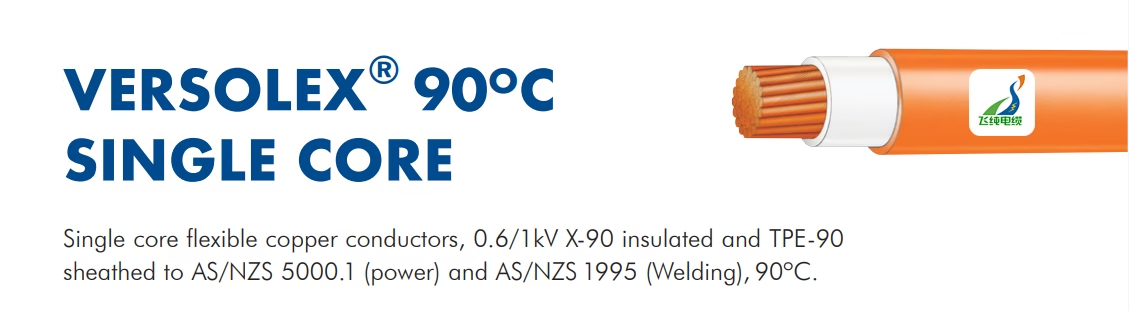
VERSOLEX 90OC, single core flexible cable, AS/NZS 5000.1, AS/NZS 1995, X-90 insulation, TPE-90 sheath, welding cable, 0.6/1kV cable, industrial power cable, flexible copper conductor, 90°C rated cable

What is VERSOLEX® 90°C Single Core Cable?

The VERSOLEX® 90OC Single Core cable represents a premium-grade flexible power cable engineered specifically for demanding industrial applications where exceptional flexibility, thermal endurance, and electrical performance are critical requirements. This specialized cable features single core flexible copper conductors rated at 0.6/1kV, utilizing X-90 (XLPE) insulation combined with TPE-90 (Thermoplastic Elastomer) sheathing to achieve superior performance characteristics across a broad range of operating conditions.
BS 6622 cable, XLPE insulation, AWA armour, SWA cable, medium voltage cable, 11kV cable, 33kV power cable, underground cable, direct burial cable

What is BS 7870-4.10 TRIPLEX Cable?

BS 7870-4.10 TRIPLEX cable represents a specialized category of medium voltage power distribution cables designed specifically for utility and industrial applications. According to the British Standards Institution, BS 7870-4.10 specifies requirements for distribution cables with extruded insulation rated from 11 kV to 33 kV. The TRIPLEX formation consists of three single-core cables laid together, providing a more efficient installation solution compared to individually pulled single-core cables.
N2XS(FL)H cable, medium voltage cable, XLPE insulated cable, IEC 60502-2, LSZH cable, waterblocking cable, 12/20kV power cable, Feichun Cable, CPR compliant cable

What is N2XS(FL)H Medium Voltage Power Cable?

N2XS(FL)H cable designation represents a sophisticated medium voltage power distribution cable engineered for demanding industrial and infrastructure applications. This cable type combines cross-linked polyethylene (XLPE) insulation with a Low Smoke Zero Halogen (LSZH) outer sheath and incorporates dual-layer waterblocking technology, making it suitable for both internal and external installations where fire safety and environmental protection are paramount.
heavy-duty rubber cables represent a critical category for applications requiring exceptional mechanical strength, flexibility, and environmental resistance. This comprehensive technical guide examines three closely related cable types that dominate international markets for portable power transmission: the Chinese standard GB/T 5013 YC (Heavy-Duty General Rubber Cable) rated at 450/750V, the enhanced YCW variant with oil and weather resistance, and the European harmonized H07RN-F cable that serves as the international equivalent.

GB/T 5013 YC & YCW Heavy-Duty Rubber Cables and H07RN-F: Comprehensive Technical Analysis

heavy-duty rubber cables represent a critical category for applications requiring exceptional mechanical strength, flexibility, and environmental resistance. This comprehensive technical guide examines three closely related cable types that dominate international markets for portable power transmission: the Chinese standard GB/T 5013 YC (Heavy-Duty General Rubber Cable) rated at 450/750V, the enhanced YCW variant with oil and weather resistance, and the European harmonized H07RN-F cable that serves as the international equivalent.
PROTOLON(M) F(N)TSCGEWOEU Cable

What is PROTOLON(M) F(N)TSCGEWOEU Cable?

PROTOLON(M) F(N)TSCGEWOEU represents a premium series of medium voltage trailing cables specifically engineered for demanding industrial applications. These cables feature advanced EPR (Ethylene Propylene Rubber) insulation technology, delivering exceptional performance in voltage ranges from 3.6/6 kV to 20/35 kV. The PROTOLON compound provides superior electrical insulation properties and mechanical resilience compared to standard EPR formulations.
600V 3TC-RB (600V 3PNCT) Crane Cable Class 3 600V Ethylene Propylene Rubber-Insulated Polychloroprene Rubber Sheath Cable

600V 3TC-RB (600V 3PNCT) Crane Cable

The 600V 3TC-RB cable, also known as 600V 3PNCT, represents a specialized class of flexible power cables engineered specifically for demanding industrial applications. This cable system is designed for mobile machinery operations where continuous flexing, environmental resistance, and electrical reliability are paramount. The designation “3TC-RB” indicates a Class 3 stranded conductor configuration with ethylene propylene rubber insulation and polychloroprene rubber sheath construction.
The 600V 2TC-RB crane cable represents a specialized category of rubber-insulated flexible cables engineered specifically for mobile machinery applications in demanding industrial environments. The designation "2TC-RB" identifies this as a Class 2 conductor construction featuring tin-coated copper strands, ethylene propylene rubber (EPR) insulation, and a robust polychloroprene rubber (also known as neoprene) outer sheath.

What is 600V 2TC-RB Crane Cable?

The 600V 2TC-RB crane cable represents a specialized category of rubber-insulated flexible cables engineered specifically for mobile machinery applications in demanding industrial environments. The designation “2TC-RB” identifies this as a Class 2 conductor construction featuring tin-coated copper strands, ethylene propylene rubber (EPR) insulation, and a robust polychloroprene rubber (also known as neoprene) outer sheath.
Class 3 6600V Ethylene Propylene Rubber Insulated Polychloroprene Rubber Sheath Cable - JIS C 4353 Standard

What is 6600V 3PNCT Crane Cable? 

The 6600V 3PNCT crane cable represents a specialized class of high-voltage power cables specifically engineered for demanding industrial applications where continuous flexing, high mechanical stress, and environmental exposure are constant operational realities. This cable designation indicates a Class 3 flexible conductor construction rated for 6600 volts AC, featuring ethylene propylene rubber insulation and a polychloroprene rubber outer sheath, manufactured in accordance with the rigorous requirements of JIS C 4353 Japanese Industrial Standard.
FEICHUN Reeling cable

What is RELCT (MV) Reeling Cables for Container Cranes?

RELCT (MV) reeling cables serve a critical function in container crane electrification systems. Specifically, these cables are deployed to deliver electrical power from fixed power supply systems to the rotating reel mechanisms and traveling components of container handling cranes. The cable must accommodate continuous mechanical stressing from repetitive coiling and uncoiling operations while maintaining electrical integrity and safety performance.