To understand reeling cables and why the ÖLFLEX CRANE NSHTÖU design is fundamentally different from standard control or power cables, let me start with a basic distinction about how cables experience mechanical stress. When we discussed drag chain cables in previous technical guides, we focused on cables that bend repeatedly in a predictable path—the cable enters the chain at one end, navigates tight curves, and exits the other end. The stress is primarily bending stress, and the cable’s design is optimized for flexing along a fixed path millions of times. Reeling cables experience a completely different mechanical environment. A reeling cable is wound around a rotating drum, and as the drum rotates, the cable either winds onto the drum (spooling) or unwinds from the drum (unreeling). This seemingly simple mechanical action creates a unique set of stresses that standard cables cannot tolerate. First, imagine the cable as it winds onto a rotating drum. The first wrap of cable lies directly against the drum surface. The second wrap lies on top of the first wrap. The third wrap lies on top of the second wrap. This layering continues until the drum is completely spooled. Now here is the critical insight: cables on the outer layers of a spooled drum experience completely different mechanical stress than cables on the inner layers. A cable on the inner layer, wrapped tightly against the drum, experiences primarily circumferential compression and bending. A cable on the outer layer, wrapped loosely over all the inner layers, experiences tension (pulling force) as the drum rotates. More importantly, as the outer-layer cable unwinds, it must rotate to accommodate the unwinding motion. This rotation creates torsional stress—twisting forces that attempt to rotate the cable around its central axis. Standard control cables or drag chain cables are not engineered to tolerate torsional stress. They fail when subjected to this twisting motion, typically through a mechanism called the corkscrew effect where the cable’s multi-conductor core separates and twists relative to the outer sheath. The ÖLFLEX CRANE NSHTÖU cable is specifically engineered to prevent this failure through sophisticated mechanical design including a supporting braid with Aramid fibers that maintains conductor bundle cohesion even during intense torsional stress. This is why the distinction between standard cables and specialized reeling cables is not merely academic—it is the difference between equipment that functions reliably for years versus equipment that experiences cable failure every few months.
The nominal outer diameter (OD) of a Lapp ÖLFLEX CLASSIC 110 CY 12G1.5 shielded multi-conductor control cable is approximately 14.8 millimeters (0.583 inches). This specification represents a 12-core cable where each core has a nominal cross-section of 1.5 square millimeters, with one of those cores designated as a green-yellow (dual-color) protective earth/ground conductor in compliance with VDE 0293-334 color coding standards. The cable contains a high-coverage tinned copper braid shield surrounding the insulated conductors, providing exceptional electromagnetic interference (EMC) mitigation with a transfer impedance specification of maximum 250 Ω/km at 30 MHz. The total copper weight (conductor mass) is approximately 280 kilograms per kilometer, while the complete cable (including PVC insulation, outer sheath, and metallic shield) weighs approximately 393 kilograms per kilometer. This cable is designed specifically for control and signal applications in industrial automation environments where electrical noise immunity and mechanical reliability are critical performance requirements.
Australia’s mining industry operates under some of the world’s most demanding conditions, requiring specialised electrical infrastructure that meets rigorous safety and performance standards. As the largest supplier of medium voltage cables in Australia, Nexans Olex has an extensive range of cables from 3.8/6.6kV to 19/33kV manufactured in Victoria to Australian Standard AS/NZS 1429.1. This technical guide examines both fixed installation XLPE cables and flexible Type 275 mining cables for applications in underground and surface mining operations.
澳大利亚采矿业在全球最严苛的条件下运营,需要符合严格安全和性能标准的专业电气基础设施。本技术指南对比分析固定安装XLPE电缆与柔性Type 275矿用电缆在地下及露天采矿中的应用。
Indoor overhead cranes, gantry cranes, and material handling systems require specialized flat cables that can withstand constant flexing, bending, and mechanical stress while delivering reliable power and control signals. Unlike round cables, flat cables offer distinct advantages in space-constrained festoon systems: they allow for smaller bending radii, enable more compact stacking in cable carriers, and reduce wind resistance in moving applications. The choice between branded products like Lapp ÖLFLEX CRANE and VDE-designated generic alternatives such as (N)TSFLCGEWÖU or NGFLGÖU cables significantly impacts both initial costs and long-term operational reliability. (室内桥式起重机、龙门起重机和物料搬运系统需要专用扁平电缆,能够承受持续的弯曲、曲折和机械应力,同时提供可靠的电力和控制信号。与圆形电缆不同,扁平电缆在空间受限的滑触线系统中具有明显优势:它们允许更小的弯曲半径,能够在电缆拖链中更紧凑地堆叠,并减少移动应用中的风阻。在Lapp ÖLFLEX CRANE等品牌产品和(N)TSFLCGEWÖU或NGFLGÖU电缆等VDE指定的通用替代品之间进行选择,会显著影响初始成本和长期运营可靠性。)
The German VDE (Verband der Elektrotechnik) standards provide a comprehensive framework for cable designation and performance requirements. Cables manufactured according to VDE 0250 standards for festoon and crane applications must meet stringent mechanical, electrical, and environmental specifications. Understanding the designation codes and how they compare to proprietary products is essential for making informed purchasing decisions. (德国VDE(德国电气工程师协会)标准为电缆指定和性能要求提供了全面的框架。根据VDE 0250标准制造的滑触线和起重机应用电缆必须满足严格的机械、电气和环境规格。了解指定代码以及它们与专有产品的比较对于做出明智的采购决策至关重要。)
These cables serve as power supply or connection cables for large material handling machines, such as excavators in opencast mines, subjected to extremely high mechanical stresses where abrasion and chaffing stresses are expected in trailing operation. 这些电缆用作大型物料搬运机械(如露天矿山挖掘机)的电源或连接电缆,在拖曳作业中承受极高的机械应力、磨损和摩擦应力。
TUNNELFLEX-PUR HF represents a specialized category of halogen-free flexible power cables engineered for mobile equipment operating in mining and tunnelling environments where high mechanical damage risk is inherent. This cable variant, manufactured without antitwisting protection elements, is optimally designed for applications where cable deflection occurs predominantly in a single plane, eliminating the need for complex anti-torsion structures while maintaining robust mechanical performance and safety characteristics critical to underground operations.
该电缆为无卤柔性电力电缆,专为存在高机械损伤风险的采矿和隧道移动设备供电而设计。由于没有抗扭保护,适用于仅在单一平面内偏转的应用场合,最大运行速度为60米/分钟。
In the demanding world of surface mining operations, dragline excavators and mobile material handling equipment rely on high-voltage flexible cables to deliver continuous electrical power as these massive machines traverse mining sites. The choice between Type 450 and Type 455 cables manufactured to AS/NZS 2802:2000 standards represents a critical engineering decision that directly impacts equipment reliability, operational costs, and cable service life. Both cable types are designed for voltage ratings from 3.3 kilovolts to 33 kilovolts, with operational temperatures spanning from negative 25 degrees Celsius to positive 90 degrees Celsius, making them suitable for the diverse environmental conditions encountered in Australian mining operations
Type 409 cables represent a specialized category of flexible mining cables designed specifically for demanding applications in material handling equipment, surface mining operations, and industrial environments. These cables are manufactured according to the Australian and New Zealand Standard AS/NZS 2802:2000, which establishes rigorous requirements for reeling and trailing cables used in mining and general industrial applications outside underground coal mining environments. (409型电缆是专为物料搬运设备、露天采矿作业和工业环境中的高要求应用而设计的一类特种柔性矿用电缆。这些电缆按照澳大利亚和新西兰标准AS/NZS 2802:2000制造,该标准对用于煤矿井下以外的采矿和一般工业应用的卷筒电缆和拖曳电缆制定了严格要求。)
Before we dive into the technical differences between Type 241 and Type 260 cables, let’s take a moment to understand shuttle cars themselves and why cable selection matters so much for these critical mining vehicles. Think of shuttle cars as the workhorses of underground coal mining operations. These are large, heavy-duty battery-electric or trailing-cable powered vehicles designed to transport coal from the continuous miner working at the coal face to either feeder breakers, mine cars, or belt conveyor systems located some distance away. The shuttle car essentially acts as a mobile bridge between the mining equipment that’s actively cutting coal and the permanent conveying infrastructure that will carry that coal to the surface.
在深入了解241型和260型电缆之间的技术差异之前,让我们花点时间了解穿梭车本身,以及为什么电缆选择对这些关键采矿车辆如此重要。可以将穿梭车视为地下煤矿作业的主力。这些是大型重型电池电动或拖缆供电车辆,设计用于将煤炭从在煤层工作面工作的连续采煤机运输到位于一定距离外的给料破碎机、矿车或带式输送机系统。穿梭车本质上充当正在切割煤炭的采矿设备与将煤炭运送到地面的永久输送基础设施之间的移动桥梁。
For a 500-meter length of Type 440 11kV mining cable, the required shipping drum dimensions are fundamentally determined by the cable’s minimum bend radius and physical dimensions. Based on industry standards from AS/NZS 2802:2000 and IEC 60502-2, proper drum sizing ensures cable integrity during transportation and prevents damage to the cable’s internal structure, particularly the semiconductive screens and EPR insulation critical for medium voltage applications.
对于500米长的Type 440 11kV矿用电缆,所需的运输卷筒尺寸主要由电缆的最小弯曲半径和物理尺寸决定。根据AS/NZS 2802:2000和IEC 60502-2的行业标准,正确的卷筒尺寸可确保运输过程中的电缆完整性,并防止损坏电缆的内部结构,特别是对中压应用至关重要的半导体屏蔽层和EPR绝缘层。
The short answer is yes, damaged Type 441 reeling cables can be spliced underground using resin joint kits that comply with AS/NZS 1747 standards, provided specific conditions are met and proper procedures are followed. However, understanding when, why, and how such repairs should be performed requires examining the cable construction, applicable standards, and field repair methodologies that govern mining cable maintenance practices across Australia, New Zealand, and similar international mining operations.
To understand why Type 450-FO composite cables represent such a significant advancement for stacker-reclaimer applications, we first need to appreciate what makes these cables different from traditional power or communication cables. Think of a Type 450-FO composite cable as a sophisticated integration of two fundamentally different technologies working together in harmony within a single protective structure. The designation “450-FO” tells us important information about this cable’s design: the “450” typically indicates the voltage rating in volts for the power conductors, while “FO” stands for Fiber Optic, signaling that optical fibers are integrated within the same cable assembly alongside the copper power conductors.
要理解为什么Type 450-FO复合电缆代表了堆取料机应用的重大进步,我们首先需要了解是什么使这些电缆与传统的电力或通信电缆不同。将Type 450-FO复合电缆想象为两种根本不同技术的复杂集成,在单个保护结构内和谐地协同工作。”450-FO”名称告诉我们有关这种电缆设计的重要信息:”450″通常表示电力导体的额定电压(以伏特为单位),而”FO”代表光纤,表示光纤与铜电力导体一起集成在同一电缆组件中。
cable selection directly impacts equipment reliability, operational safety, and cost efficiency. While Diesel Locomotive Cable (DLO) and Type W cables share similar voltage ratings and environmental resistance, their fundamental design philosophies serve distinctly different operational requirements. This technical analysis examines why DLO cable, despite its robust construction and premium materials, is frequently rejected for dynamic mining applications involving continuous movement equipment such as shuttle cars, draglines, and continuous miners.
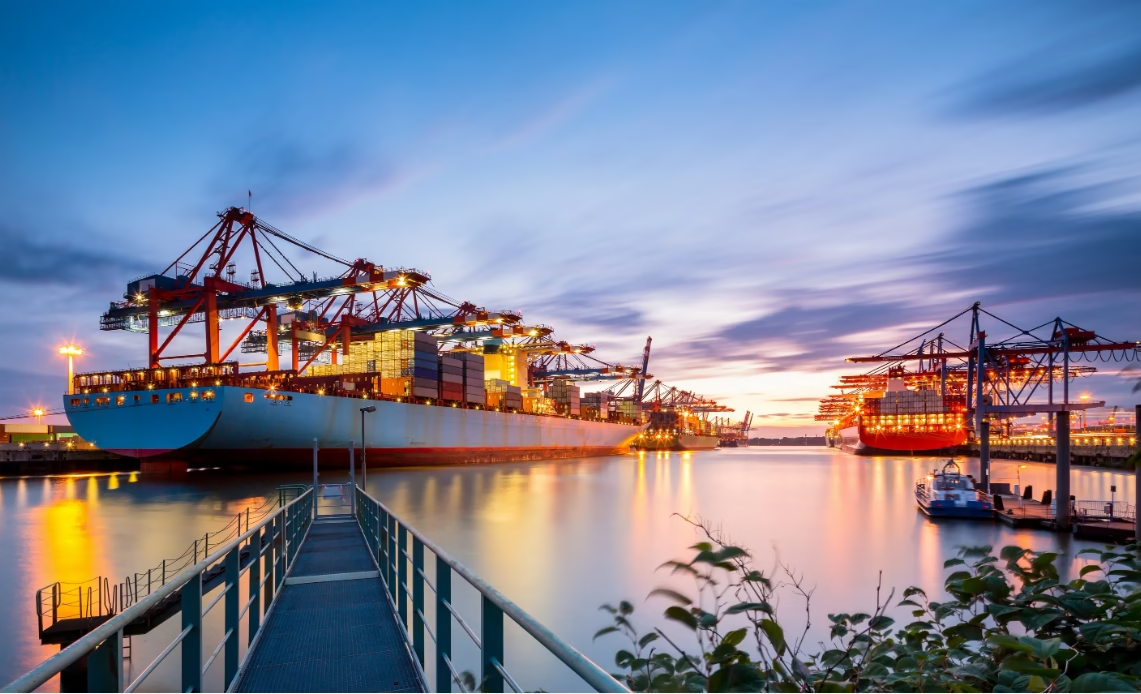
In the demanding world of port cranes, mining hoists, and heavy industrial material handling systems, the selection of reeling cables represents far more than a simple procurement decision. These specialized cables must survive hundreds of thousands of winding and unwinding cycles while suspended under their own considerable weight, sometimes extending hundreds of meters into vertical shafts or across vast horizontal spans. The difference between a standard reeling cable and one optimized for monospiral drum applications can determine whether equipment operates reliably for a decade or experiences premature failure requiring costly downtime and replacement.
NTSCGEWÖU and NTMCGEWÖU cables represent critical technical solutions for powering mobile machinery in mining, heavy industry, and material handling environments. Both cable types are manufactured according to the German DIN VDE 0250 standard, which is globally recognized as the definitive benchmark for tough rubber-sheathed flexible cables designed for cranes and material handling equipment. The fundamental distinction lies in their sheath construction: the “S” in NTSCGEWÖU indicates a double rubber sheath (Schwer = heavy-duty) providing enhanced mechanical protection for reeling applications, while “M” in NTMCGEWÖU denotes a single sheath with single-core design optimized for short-length medium voltage connections. According to industry specifications, Germany remains the only country to have issued special design regulations for flexible electrical cables covering cranes and material handling equipment, making DIN VDE 0250 the ultimate international standard for these demanding applications.
Кабель H07RN-F / A07RN-F имеет сложную многослойную конструкцию, разработанную для максимальной долговечности и электрических характеристик. Проводник состоит из тонкоскрученных медных проволок (лужёных для сечений до 10мм²), соответствующих требованиям гибкости класса 5 по IEC 60228. Изоляционный слой выполнен из этиленпропиленовой резиновой смеси класса EI4 — в частности, наша запатентованная формула TENAX®-O — обеспечивает исключительную озоностойкость, УФ-стабильность и устраняет необходимость дополнительной защиты жил в точках подключения.
SANS 1520 cable, SABS 1520 cable, South Africa mining cable, flexible trailing cable, mining trailing cable, SANS Type 41 cable, SANS Type 61 cable, SANS Type 63 cable, SANS Type 66 cable, SANS Type 611 cable, SANS Type 622 cable, SANS Type 633 cable
CONTROL 600 cable, PVC control cable, flexible control cable, multi-conductor control cable, IEC 60228 Class 5, DIN VDE 0281, UL AWM 2587, 600V control cable, 450/750V cable, industrial control cable, machine tool cable, IEC 60228, DIN VDE 0295, DIN VDE 0281, UL 1581, CSA AWM, HD 21.1, HD 21.2, EN 50334, EN 50265-2-1, IEC 60332-1-2, IEC 60332-3C, DIN EN 50290-2-22, VDE 0819-102,UL AWM 2587, UL AWM Style 2587, AWM style 21179, AWM style 21216, 90°C 600V cable, 105°C cable, CSA AWM I/II A/B, UL recognized cable, cUL listed cable