IEC 60502-1

(N)GRDGÖU-J Nomenclature (VDE 0250 part 813): (N) = Nominal voltage prefix (0.6/1 kV implicit in designation) G = Gummiert (rubber-insulated) R = Rubber outer sheath D = Dynamisch (dynamic/flexing application) G = Gummiert inner sheath (intermediate layer) Ö = German standard designation (ö indicates European origin) U = Unarmoured (no metal sheath) J = Jacked (multi-sheath design: intermediate + outer) Full meaning: Rubber-insulated, rubber-sheathed, dynamic-rated, multi-sheath construction, unarmoured festoon cable VDE 0250 part 813 scope: Published by: VDE (Verband der Elektrotechnik, German standards body) Applies to: Flexible cables for crane installations (particularly festoon systems) Coverage: Voltage, temperature, mechanical properties, installation methods Festoon-specific requirements: - High bending flexibility (4×D minimum typical) - Fast rewind capability (240+ m/min rated speed) - Sustained torsion tolerance (±25°/1m continuous) - Extended temperature range (−50 to +80°C) - UV/ozone/moisture resistance (outdoor exposure) Alternate designations (similar cables): IEC 60811-1-1: International equivalent (less specific) DIN VDE 0298 part 3: German mechanical property standard DIN VDE 0482-265-2-1: German flame test standard EN 50265-2-1: European flame test equivalent GRDGÖU-J advantage: Combines all standards into single VDE designation Procurement simplified for European buyers

Что такое ÖLFLEX® POWER LV (N)YY: низковольтный силовой кабель 0.6/1 kV для распределения питания, освещения и промышленных цепей

ÖLFLEX® POWER LV (N)YY — это неармированный низковольтный силовой кабель 0.6/1 kV с конструкцией PVC/PVC, предназначенный для главного распределения электроэнергии, цепей освещения, силовых и контрольных цепей, а также электропитания телекоммуникационного оборудования в жилых, коммерческих и промышленных объектах. В предоставленных технических данных кабель основан на IEC 60502-1, имеет медные жилы Class 1 или Class 2 по IEC 60228, ПВХ-изоляцию, ПВХ-оболочку, огнезадерживающее исполнение по IEC 60332-1-2, наружную оболочку с УФ-стойкостью для применения вне помещений, минимальный радиус изгиба 8 × наружный диаметр при фиксированной прокладке и температурный диапазон -20°C до +70°C.
EMC Performance Classification: EMC rating scale (VDE/EN standards): Basic: No shielding (part 813 unscreened) Fair: Partial coverage, 30–40 mm spacing in braid Good: 80–90% coverage, 95% coverage, all gaps 30 dB attenuation @ 500 kHz: >40 dB attenuation @ 5 MHz: >35 dB attenuation (typical peak range) Expected: Tinned copper braid achieves 35–50 dB across frequency range Immunity to external interference: Motor variable frequency drive (VFD) nearby: VFD RF emission: Typically 50–200 mV/m at cable distance Unshielded cable susceptibility: 100–500 mV induced noise Shielded cable (good EMC): 1–10 mV induced noise (50–100× reduction) Consequence: VFD-driven crane motor doesn't interfere with control signals No false triggering of safety systems Data integrity in digital control systems maintained Radiated immunity testing (per EN 61000-4-3): Test standard: Cable exposed to RF field 50 MHz–1 GHz Test field strength: 10 V/m typical Acceptance: No malfunction, signal corruption

ÖLFLEX® POWER LV (N)YYRY: техническая статья о бронированном низковольтном силовом кабеле 0.6/1 kV

ÖLFLEX® POWER LV (N)YYRY — это низковольтный силовой кабель 0.6/1 kV с бронированной конструкцией PVC/PVC/SWA/PVC. Он предназначен для главного распределения электроэнергии, цепей освещения, силовых и контрольных цепей, телекоммуникационного питания, а также для прокладки непосредственно в земле, в воздухе или в кабельных каналах.
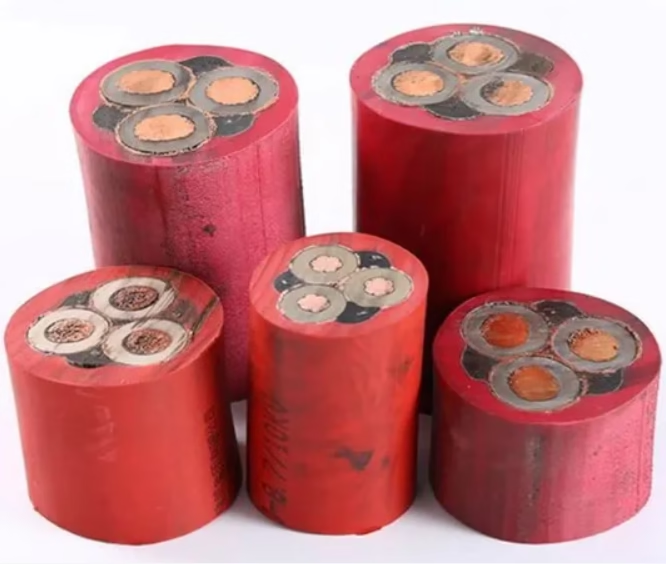
FLEXIDRUM® MEDIUM FLAT: Advanced High-Flexibility Salt-Fog Resistant Port Cable System Specialized reeling-flat power cable engineered for extreme maritime environments combining flexible tinned copper conductors (IEC 60228 Class 5), proprietary EPR insulation chemistry, hydrophobic semi-conductive interfaces, and specialized red outer-sheath PCP compound with integrated volatile-corrosion-inhibitor (VCI) technology. Designed for rapid cable-reel deployment systems in dredging, submersible pump, and floating crane applications requiring superior electrochemical corrosion immunity and compact outer-diameter efficiency across 3.6/6 kV through 8.7/15 kV voltage platforms.

Альтернатива Prysmian PROTOLON: Шахтные (N)TSCGEWÖU из Китая с Сертификатом EAC

Полное техническое руководство по замене Prysmian PROTOLON на гибкие шахтные кабели (N)TSCGEWÖU производства Feichun с полным сертификатом EAC — техническая эквивалентность, устойчивость к морской соли и влаге, 30–45% экономия затрат, сроки поставки 4–8 недель, поддержка на русском языке для российского и евразийского рынков.
FLEXIDRUM® MEDIUM RS (N)TSCGEWÖU:高柔性盐雾防护港口电缆 专业级高柔性盐雾防护电源电缆,专为恶劣海洋环境设计。采用最小12×D鼓面弯曲半径、超强盐雾腐蚀防护、UV/臭氧/湿度防护,跨越3.6/6kV至12/20kV完整电压平台。专用于挖泥船、海洋泵站和港口设备,15年+服役期验证。 港口电缆技术革新:恶劣海洋环境的专业防腐蚀工程 传统电源电缆部署在盐雾海洋环境中会遭遇加速退化机制:卤化物诱导的铜导体电化学腐蚀、渗透水通过外护套微裂纹、光化学紫外线降解聚合物基质、臭氧氧化聚合物交链脆化。标准FLEXIDRUM®电缆(非专化聚合物护套)在持续港口运行的7-10年内经历~35-50%的机械抗张强度损失,导致提前更换周期和港口设备运行中的意外维护中断。 FLEXIDRUM® MEDIUM RS (N)TSCGEWÖU代表材料化学和护套架构的突破性进展,整合:(1)专化PCP外护套化合物,具有专有防盐雾化学物质(氯化钠渗透防护比标准PCP配方高2倍,符合IEC测试规程),(2)先进多层半导电屏障界面,具有疏水分子结构,防止锡铜导体上的电化学腐蚀途径,(3)集成UV/臭氧吸收添加剂,在15年以上服务周期内减少聚合物链断裂退化约60%,(4)优化柔性架构,支持12×D鼓面部署半径(相比常规专化电缆的15×D及更高),对需要跨地理分布港口设施频繁再部署的移动挖泥设备至关重要。

Замена Nexans PANZERFLEX в России: Аналоги по ГОСТ и ТР ТС

Полное техническое руководство по замене европейских барабанных кабелей Nexans PANZERFLEX на производство Feichun — соответствие российским стандартам ГОСТ и техническим регламентам ТР ТС, сокращение сроков поставки на 50–65%, экономия затрат 30–40% от цен европейских поставщиков, логистическая гибкость и долгосрочное партнерство с российскими горнодобывающими операциями.
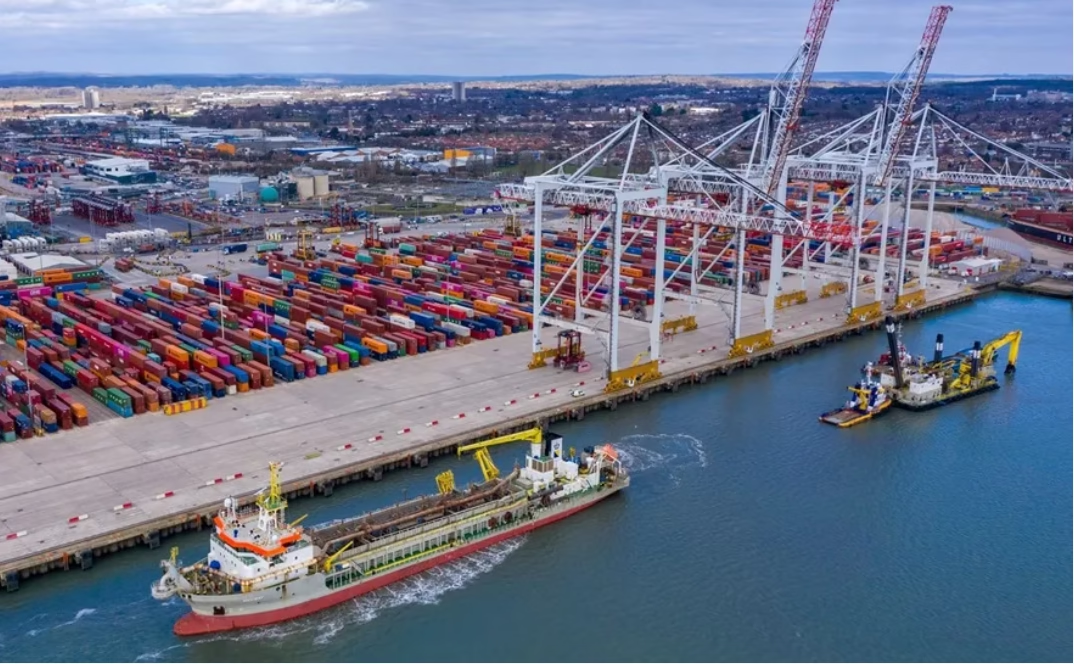
Prysmian PROTOLON is a dedicated reeling cable product family manufactured specifically for ship-to-shore (STS) container cranes, rubber-tyred gantry (RTG) equipment, and fixed portal gantry cranes operating in port environments. The PROTOLON designation encompasses multiple voltage ratings and sheath variants optimized for the unique demands of container port operations: extreme torsional loading from reel wind/unwind cycles, exposure to saline spray and salt-laden atmospheres, exposure to direct ultraviolet radiation in open-air port environments, and continuous mechanical flexing over thousands of reel cycles. The cable is manufactured to IEC 60502-1 standards (identical to mining reeling cables) but with additional performance requirements specified in ISO 3384 (compression set limits), ASTM B117 (1000-hour salt fog resistance), and IEC 60811-2-2 (UV aging resistance). These additional requirements reflect the marine environment's specific hazards: salt fog causes accelerated outer sheath degradation in non-marine-optimized cables, and UV radiation polymerizes and hardens outer sheath materials, reducing flexibility and increasing brittleness over 5–8 year service periods.

Prysmian PROTOLON Reeling Cable Alternative for Port Authorities

Prysmian PROTOLON is a dedicated reeling cable product family manufactured specifically for ship-to-shore (STS) container cranes, rubber-tyred gantry (RTG) equipment, and fixed portal gantry cranes operating in port environments. The PROTOLON designation encompasses multiple voltage ratings and sheath variants optimized for the unique demands of container port operations: extreme torsional loading from reel wind/unwind cycles, exposure to saline spray and salt-laden atmospheres, exposure to direct ultraviolet radiation in open-air port environments, and continuous mechanical flexing over thousands of reel cycles. The cable is manufactured to IEC 60502-1 standards (identical to mining reeling cables) but with additional performance requirements specified in ISO 3384 (compression set limits), ASTM B117 (1000-hour salt fog resistance), and IEC 60811-2-2 (UV aging resistance). These additional requirements reflect the marine environment’s specific hazards: salt fog causes accelerated outer sheath degradation in non-marine-optimized cables, and UV radiation polymerizes and hardens outer sheath materials, reducing flexibility and increasing brittleness over 5–8 year service periods.
Nexans PANZERFLEX is the commercial product designation for high-flexibility mining reeling cables manufactured to German (VDE 0250-813) and international (IEC 60502-1) specifications. The product line is aimed specifically at European and Latin American underground mining operations, where it commands the market leadership position for continuous miner, shearer, and shuttle car drag cables. PANZERFLEX is not a single cable specification but rather a family of products: PANZERFLEX-R for rubber-insulated designs, PANZERFLEX-P for PUR-sheathed designs, and variants distinguished by voltage rating (0.6/1 kV, 1.8/3 kV) and core configuration. (N)TSCGEWÖU is the German VDE cable designation that describes the same functional class: a 0.6/1 kV, Class 5 flexible copper conductor, EPR insulation, unarmoured cable suitable for mobile mining equipment. The "(N)" prefix indicates "new" or "current" specification, distinguishing it from obsolete predecessors. This designation is widely used in German, Austrian, and Central European mining specifications, particularly in coal mining where German equipment vendors historically dominated the market. Technically, PANZERFLEX and (N)TSCGEWÖU are designed to satisfy identical functional requirements and electrical performance levels. Both must pass IEC 60502-1 qualification testing, both are specified for 0.6/1 kV operation, both support Class 5 conductor architecture for maximum torsional flexibility, and both employ EPR insulation for mining durability. The designations differ only in nomenclature: one is a commercial product name from a multinational manufacturer, the other is a German standards designation used in technical specifications and procurement documents.

Nexans PANZERFLEX vs. (N)TSCGEWÖU: A Comprehensive Equivalent Guide

Nexans PANZERFLEX is the commercial product designation for high-flexibility mining reeling cables manufactured to German (VDE 0250-813) and international (IEC 60502-1) specifications. The product line is aimed specifically at European and Latin American underground mining operations, where it commands the market leadership position for continuous miner, shearer, and shuttle car drag cables. PANZERFLEX is not a single cable specification but rather a family of products: PANZERFLEX-R for rubber-insulated designs, PANZERFLEX-P for PUR-sheathed designs, and variants distinguished by voltage rating (0.6/1 kV, 1.8/3 kV) and core configuration. (N)TSCGEWÖU is the German VDE cable designation that describes the same functional class: a 0.6/1 kV, Class 5 flexible copper conductor, EPR insulation, unarmoured cable suitable for mobile mining equipment. The “(N)” prefix indicates “new” or “current” specification, distinguishing it from obsolete predecessors. This designation is widely used in German, Austrian, and Central European mining specifications, particularly in coal mining where German equipment vendors historically dominated the market. Technically, PANZERFLEX and (N)TSCGEWÖU are designed to satisfy identical functional requirements and electrical performance levels. Both must pass IEC 60502-1 qualification testing, both are specified for 0.6/1 kV operation, both support Class 5 conductor architecture for maximum torsional flexibility, and both employ EPR insulation for mining durability. The designations differ only in nomenclature: one is a commercial product name from a multinational manufacturer, the other is a German standards designation used in technical specifications and procurement documents.
UNE 22511, published and maintained by AENOR (Asociación Española de Normalización y Certificación), is the definitive Spanish standard for heavy-duty power cables connecting underground mobile mining equipment to fixed electrical distribution networks. Operating as a specialized overlay on IEC 60502-1, it extends that base standard's electrical requirements with stringent mechanical, safety, and flame-retardancy requirements specific to enclosed underground environments. Despite its Spanish origin, UNE 22511 enjoys adoption across the major Spanish-speaking mining economies: Chile, Peru, Colombia, Bolivia, and Mexico, where AENOR-certified cables are accepted by national mining safety regulators as the primary qualification pathway for underground mobile equipment power supply cables.

UNE 22511

UNE 22511, published and maintained by AENOR (Asociación Española de Normalización y Certificación), is the definitive Spanish standard for heavy-duty power cables connecting underground mobile mining equipment to fixed electrical distribution networks. Operating as a specialized overlay on IEC 60502-1, it extends that base standard’s electrical requirements with stringent mechanical, safety, and flame-retardancy requirements specific to enclosed underground environments. Despite its Spanish origin, UNE 22511 enjoys adoption across the major Spanish-speaking mining economies: Chile, Peru, Colombia, Bolivia, and Mexico, where AENOR-certified cables are accepted by national mining safety regulators as the primary qualification pathway for underground mobile equipment power supply cables.
UNE 22511 Design Philosophy: Ultimate Flexibility for Underground Mobile Equipment Within the taxonomy of mining cables, the distinction between the UNE 22511 and UNE 22512 standards represents a fundamental divergence in design philosophy — not merely a difference in specification parameters. Understanding this divergence is essential for engineers procuring replacement cables for underground coal mines in Spain, Chile, Colombia, and other markets operating under the AENOR (Asociación Española de Normalización y Certificación) regulatory framework. The UNE 22511 standard governs cables for flexible connection of mobile underground mining machinery — the specific class of heavy-duty cable designed for equipment that moves continuously during operation: continuous miners, longwall shearers, shuttle cars, and cable reel systems. The engineering DNA of a UNE 22511 cable can be summarized in a single phrase: engineered for mechanical endurance, not for static installation security. This philosophy manifests in every structural element of the cable: the conductor class, the insulation compound, the earth core arrangement, the absence of metallic armor, and the sheath compound selection. Each element is chosen not to maximize any single parameter but to achieve an optimal balance of torsional resilience, bending flexibility, and sheath durability under the combined mechanical loading of continuous dragging, occasional running-over by shuttle car wheels, and periodic full-tension pulling by cable reel drum systems.

UNE 22511

UNE 22511 Design Philosophy: Ultimate Flexibility for Underground Mobile Equipment Within the taxonomy of mining cables, the distinction between the UNE 22511 and UNE 22512 standards represents a fundamental divergence in design philosophy — not merely a difference in specification parameters. Understanding this divergence is essential for engineers procuring replacement cables for underground coal mines in Spain, Chile, Colombia, and other markets operating under the AENOR (Asociación Española de Normalización y Certificación) regulatory framework. The UNE 22511 standard governs cables for flexible connection of mobile underground mining machinery — the specific class of heavy-duty cable designed for equipment that moves continuously during operation: continuous miners, longwall shearers, shuttle cars, and cable reel systems. The engineering DNA of a UNE 22511 cable can be summarized in a single phrase: engineered for mechanical endurance, not for static installation security. This philosophy manifests in every structural element of the cable: the conductor class, the insulation compound, the earth core arrangement, the absence of metallic armor, and the sheath compound selection. Each element is chosen not to maximize any single parameter but to achieve an optimal balance of torsional resilience, bending flexibility, and sheath durability under the combined mechanical loading of continuous dragging, occasional running-over by shuttle car wheels, and periodic full-tension pulling by cable reel drum systems.
Feichun FLEXIFESTOON® NE-FLAT Marine-Grade High-Flexibility Anti-Salt-Mist Control Cables: Integrated Electrochemical Corrosion Resistance & Harbor-Optimized Polymer Engineering (0.6/1 kV, EPR Type 3GI3 Insulation, PCP 5GM3 Rubber Sheath, Class 6 Flexible Copper, Seawater-Resistant, Oil-Resistant, 180+ m/min Speed, Port Crane & Offshore Festoon Systems): Comprehensive Technical Analysis Integrating Polymer Chemistry, Electrochemical Degradation Mechanisms, Marine Environmental Stress & Mechanical Fatigue Engineering Harbor and offshore equipment subjected to continuous salt-mist exposure faces a unique material degradation challenge: simultaneous electrochemical corrosion of copper conductors, chloride-accelerated polymer matrix embrittlement, and UV-photooxidative surface degradation occurring in parallel across cable service life. Conventional PVC-jacketed cables suffer chloride-induced copper verde (basic copper sulfate formation, reducing conductivity by 15–45% within 3–5 years in salt-spray environments per ASTM B117); conventional XLPE compounds exhibit modulus increase > 80% and elongation loss > 60% under combined salt-fog / UV exposure, eliminating festoon flexibility. FLEXIFESTOON® NE-FLAT marine-grade control cables resolve this dual-degradation profile through integrated engineering combining ethylene propylene rubber (EPR) type 3GI3 insulation with cross-linked intermediate matrix stability, polyolefin-based PCP 5GM3 rubber sheath formulation containing UV-stabilizer packages and chloride-sequestering additives (2–4 wt% zinc-oxide plus hindered-amine light stabilizers, HALS), Class 6 ultra-flexible bare annealed copper conductors engineered for 180+ m/min festoon trolley speed, and proprietary mineral-filled surface passivation layers—delivering simultaneous electrochemical corrosion immunity exceeding ASTM G85-A5 salt-fog protocol (2000 h without copper surface discoloration), oil-resistance per DIN VDE 0473, modulus retention ≥ 75% under combined accelerated environmental stress (salt-fog + 1000 h UV exposure at 150 W/m² spectral irradiance), and festoon fatigue life ≥ 5 × 10⁶ cycles at 7.5× outer diameter bend radius in corrosive marine atmosphere.

FLEXIFESTOON® NE-FLAT (N)GFLGÖU-J

Feichun FLEXIFESTOON® NE-FLAT Marine-Grade High-Flexibility Anti-Salt-Mist Control Cables: Integrated Electrochemical Corrosion Resistance & Harbor-Optimized Polymer Engineering (0.6/1 kV, EPR Type 3GI3 Insulation, PCP 5GM3 Rubber Sheath, Class 6 Flexible Copper, Seawater-Resistant, Oil-Resistant, 180+ m/min Speed, Port Crane & Offshore Festoon Systems): Comprehensive Technical Analysis Integrating Polymer Chemistry, Electrochemical Degradation Mechanisms, Marine Environmental Stress & Mechanical Fatigue Engineering Harbor and offshore equipment subjected to continuous salt-mist exposure faces a unique material degradation challenge: simultaneous electrochemical corrosion of copper conductors, chloride-accelerated polymer matrix embrittlement, and UV-photooxidative surface degradation occurring in parallel across cable service life. Conventional PVC-jacketed cables suffer chloride-induced copper verde (basic copper sulfate formation, reducing conductivity by 15–45% within 3–5 years in salt-spray environments per ASTM B117); conventional XLPE compounds exhibit modulus increase > 80% and elongation loss > 60% under combined salt-fog / UV exposure, eliminating festoon flexibility. FLEXIFESTOON® NE-FLAT marine-grade control cables resolve this dual-degradation profile through integrated engineering combining ethylene propylene rubber (EPR) type 3GI3 insulation with cross-linked intermediate matrix stability, polyolefin-based PCP 5GM3 rubber sheath formulation containing UV-stabilizer packages and chloride-sequestering additives (2–4 wt% zinc-oxide plus hindered-amine light stabilizers, HALS), Class 6 ultra-flexible bare annealed copper conductors engineered for 180+ m/min festoon trolley speed, and proprietary mineral-filled surface passivation layers—delivering simultaneous electrochemical corrosion immunity exceeding ASTM G85-A5 salt-fog protocol (2000 h without copper surface discoloration), oil-resistance per DIN VDE 0473, modulus retention ≥ 75% under combined accelerated environmental stress (salt-fog + 1000 h UV exposure at 150 W/m² spectral irradiance), and festoon fatigue life ≥ 5 × 10⁶ cycles at 7.5× outer diameter bend radius in corrosive marine atmosphere.
Extended technical guide for harbour electrical engineers, crane OEMs, and terminal procurement teams comparing polychloroprene-based reeling cable platforms for tropical marine service. Covers: the (N)SHTOEU-J designation decoded element-by-element; the (RTS) torsion-stabilised architecture and its polyester-braid hygroscopic vulnerability; standard 5GM3/5GM5 polychloroprene compound limitations versus FC-CSR™ enhanced chemistry in synergistic UV–ozone–salt-fog attack; multi-layer drum winding mechanics and inter-layer compression stress; earth conductor (J) corrosion vulnerability at termination interfaces; Class 5 vs. Class 6 conductor stranding for high-cycle reeling fatigue; standard tin vs. FC-TCB™ intermetallic coating at slip-ring contacts; ISO 9227 and IEC 60068-2-52 comparative salt-fog testing; and practical specification, procurement, and 25-year lifetime cost analysis for port operators selecting between standard-grade and marine-enhanced polychloroprene reeling cable platforms.

FC-HFX-REEL™ Ultra-High-Flex Anti-Salt-Fog Motorised Reeling Cable vs. RHEYCORD®(RTS) (N)SHTOEU-J: Standard Polychloroprene Compound Limitations in Tropical C5-M Service, (RTS) Torsion-Stabilised Architecture Deconstruction, Multi-Layer Drum Winding Stress Analysis, Earth-Conductor (J) Engineering, Slip-Ring Corrosion Science, and Comprehensive Field Performance Comparison from Asia-Pacific Port Drum-Reeling Operations

Extended technical guide for harbour electrical engineers, crane OEMs, and terminal procurement teams comparing polychloroprene-based reeling cable platforms for tropical marine service. Covers: the (N)SHTOEU-J designation decoded element-by-element; the (RTS) torsion-stabilised architecture and its polyester-braid hygroscopic vulnerability; standard 5GM3/5GM5 polychloroprene compound limitations versus FC-CSR™ enhanced chemistry in synergistic UV–ozone–salt-fog attack; multi-layer drum winding mechanics and inter-layer compression stress; earth conductor (J) corrosion vulnerability at termination interfaces; Class 5 vs. Class 6 conductor stranding for high-cycle reeling fatigue; standard tin vs. FC-TCB™ intermetallic coating at slip-ring contacts; ISO 9227 and IEC 60068-2-52 comparative salt-fog testing; and practical specification, procurement, and 25-year lifetime cost analysis for port operators selecting between standard-grade and marine-enhanced polychloroprene reeling cable platforms.
Extended technical guide for mining engineers, port equipment designers, electrical system integrators, and heavy-equipment OEMs. Covers: the physics of mechanical fatigue in high-speed reeling systems; BUFLEX® SC conductor architecture (IEC 60228 Class 5 ultra-fine stranding, lay-angle optimisation for bending compliance); EPR insulation design with semi-conductive field-control layers for efficient 1.8–24 kV electric-field distribution; copper-braid electromagnetic shielding and its interaction with high-current conduction; signature red PUR jacket chemistry (abrasion resistance, tear strength, UV stability, oil resistance); mechanical performance specifications (minimum bend radius, tensile load capacity, cyclic-flexure endurance); thermal management in continuous high-current operation (current rating derating as function of ambient temperature and installation method); comparative analysis of single-core vs. multi-core approaches; environmental durability (arctic cold, tropical heat, mine dust, coastal salt-fog); and practical specification and procurement frameworks for mining and port operator deployment.

BUFLEX® SC Single-Core Medium-Voltage Ultra-Flexible Reeling Cable: Complete Engineering Analysis, Advanced Conductor Architecture, EPR Insulation with Electrostatic Field Control, PUR Jacket Superior Abrasion & Tear Resistance, Mechanical Fatigue Engineering, Extreme Environment Durability, and Comprehensive Comparative Evaluation Against Multi-Core Industrial Cable Alternatives for Mining and Heavy Port Equipment

Extended technical guide for mining engineers, port equipment designers, electrical system integrators, and heavy-equipment OEMs. Covers: the physics of mechanical fatigue in high-speed reeling systems; BUFLEX® SC conductor architecture (IEC 60228 Class 5 ultra-fine stranding, lay-angle optimisation for bending compliance); EPR insulation design with semi-conductive field-control layers for efficient 1.8–24 kV electric-field distribution; copper-braid electromagnetic shielding and its interaction with high-current conduction; signature red PUR jacket chemistry (abrasion resistance, tear strength, UV stability, oil resistance); mechanical performance specifications (minimum bend radius, tensile load capacity, cyclic-flexure endurance); thermal management in continuous high-current operation (current rating derating as function of ambient temperature and installation method); comparative analysis of single-core vs. multi-core approaches; environmental durability (arctic cold, tropical heat, mine dust, coastal salt-fog); and practical specification and procurement frameworks for mining and port operator deployment.
SWA Cable Architecture & Engineering Design Strategy Purpose & Application Scope: Steel Wire Armored (SWA) cables represent the engineering solution for power distribution where mechanical protection, fire safety, and environmental resistance create absolute requirements. Unlike conventional cables relying solely on conduit or external protection, SWA cables integrate mechanical armoring as an integral structural component, offering permanent protection against physical damage, burrowing animals, excavation equipment, and external mechanical stress. Core Engineering Philosophy: SWA cable design employs multi-layer engineering architecture combining XLPE insulation excellence with steel wire mechanical protection and halogen-free outer sheathing. This integrated approach eliminates the need for external conduit in most underground, outdoor, and hazardous-area applications—reducing installation cost, complexity, and maintenance requirements while providing superior long-term reliability. Market Position & Regulatory Compliance: SWA cables comply with IEC 60502-1 international standards and equivalent national specifications including KS C specifications. These cables specifically address the requirements of the EN 50288 and equivalent standards covering cables with protective conductors and armored configurations. The combination of XLPE insulation with halogen-free sheathing provides automatic compliance with fire safety codes adopted across Europe, Asia, and industrial facilities worldwide where smoke emission and toxic fume generation create liability concerns.

0.6/1kV XLPE Insulated Halogen-Free Steel Wire Armored Cable

SWA Cable Architecture & Engineering Design Strategy Purpose & Application Scope: Steel Wire Armored (SWA) cables represent the engineering solution for power distribution where mechanical protection, fire safety, and environmental resistance create absolute requirements. Unlike conventional cables relying solely on conduit or external protection, SWA cables integrate mechanical armoring as an integral structural component, offering permanent protection against physical damage, burrowing animals, excavation equipment, and external mechanical stress. Core Engineering Philosophy: SWA cable design employs multi-layer engineering architecture combining XLPE insulation excellence with steel wire mechanical protection and halogen-free outer sheathing. This integrated approach eliminates the need for external conduit in most underground, outdoor, and hazardous-area applications—reducing installation cost, complexity, and maintenance requirements while providing superior long-term reliability. Market Position & Regulatory Compliance: SWA cables comply with IEC 60502-1 international standards and equivalent national specifications including KS C specifications. These cables specifically address the requirements of the EN 50288 and equivalent standards covering cables with protective conductors and armored configurations. The combination of XLPE insulation with halogen-free sheathing provides automatic compliance with fire safety codes adopted across Europe, Asia, and industrial facilities worldwide where smoke emission and toxic fume generation create liability concerns.
FC-PNCT-R and FC-PNCT(S)-R reinforced festoon cables represent the premium tier of overhead power distribution technology, engineered for next-generation crane systems demanding superior electrical performance, extended service life, electromagnetic compatibility, and multi-circuit power distribution capabilities. Reinforced festoon cables incorporate a fundamentally different architecture compared to standard festoon cables—adding mechanical reinforcement (braid-tape structure), overall electromagnetic shielding (in the shielded variant), and optimized multi-core configurations supporting independent circuit distribution. These enhancements address the operational requirements of modern automated port equipment, VFD-driven crane systems, and advanced cargo handling machinery. Key Design Innovations: • Integrated Reinforcement Layer: A tape-braid composite structure carrying a portion of mechanical stress, extending insulation life and reducing temperature rise during operation • Overall Screen Shielding: Tinned copper braid surrounding the entire cable assembly (in FC-PNCT(S)-R variant) providing complete electromagnetic protection • Multi-Core Architecture: 3–30 independent conductor cores enabling single-cable distribution for complex equipment with multiple independent motor systems • Size Flexibility: Three conductor size options (1.5, 2.5, 4.0) scaled to specific application requirements and current demands These innovations enable reinforced festoon cables to deliver 7–10 year service intervals in demanding applications—approximately 40–60% longer than standard festoon cables. For terminal operators prioritizing equipment reliability and minimizing replacement downtime, the premium investment in reinforced cables delivers outstanding value.

FC-PNCT-R/FC-PNCT(S)-R Reinforced Festoon Cables

FC-PNCT-R and FC-PNCT(S)-R reinforced festoon cables represent the premium tier of overhead power distribution technology, engineered for next-generation crane systems demanding superior electrical performance, extended service life, electromagnetic compatibility, and multi-circuit power distribution capabilities. Reinforced festoon cables incorporate a fundamentally different architecture compared to standard festoon cables—adding mechanical reinforcement (braid-tape structure), overall electromagnetic shielding (in the shielded variant), and optimized multi-core configurations supporting independent circuit distribution. These enhancements address the operational requirements of modern automated port equipment, VFD-driven crane systems, and advanced cargo handling machinery. Key Design Innovations: • Integrated Reinforcement Layer: A tape-braid composite structure carrying a portion of mechanical stress, extending insulation life and reducing temperature rise during operation • Overall Screen Shielding: Tinned copper braid surrounding the entire cable assembly (in FC-PNCT(S)-R variant) providing complete electromagnetic protection • Multi-Core Architecture: 3–30 independent conductor cores enabling single-cable distribution for complex equipment with multiple independent motor systems • Size Flexibility: Three conductor size options (1.5, 2.5, 4.0) scaled to specific application requirements and current demands These innovations enable reinforced festoon cables to deliver 7–10 year service intervals in demanding applications—approximately 40–60% longer than standard festoon cables. For terminal operators prioritizing equipment reliability and minimizing replacement downtime, the premium investment in reinforced cables delivers outstanding value.
Festoon cables (also called curtain cables or loop cables) are specialized power distribution cables designed for overhead, suspended installations where the cable hangs in loops from fixed support points while a moving trolley or crane pulls the cable along beneath it. The term "festoon" derives from the architectural practice of hanging decorative swags between fixed points—a metaphor that accurately describes how these cables are installed in crane systems. FC-PNCT festoon cables serve as the primary power supply for overhead equipment including container cranes, gantry cranes, overhead bridge cranes, and related port equipment. The cable hangs in a series of gentle loops from fixed hanger points spaced approximately 5–10 meters apart. As the crane moves along the runway, the moving trolley pulls the cable along with it, creating a smooth, coordinated motion that maintains electrical contact between fixed shore power and the moving equipment. Festoon cables experience fundamentally different stresses compared to reel-mounted high-tension cables: • Repetitive bending cycles as the cable forms and reforms loops—but at a slower rate than reel cables • Lower tensile stress because the cable hangs relatively stationary between support points • Environmental exposure to saltwater spray, UV radiation, and thermal cycling—same as reel cables • Gentle, predictable bending geometry with consistent bend radii determined by hanger spacing • Lower operational temperature due to reduced mechanical stress and typically lower current demands These differences necessitate a distinctly different cable design optimized specifically for festoon applications. Festoon cables prioritize superior bending flexibility, excellent environmental resistance, and long-term durability under repetitive but gentle mechanical stress.

FC-PNCT Korean Standard Festoon Cables

Festoon cables (also called curtain cables or loop cables) are specialized power distribution cables designed for overhead, suspended installations where the cable hangs in loops from fixed support points while a moving trolley or crane pulls the cable along beneath it. The term “festoon” derives from the architectural practice of hanging decorative swags between fixed points—a metaphor that accurately describes how these cables are installed in crane systems. FC-PNCT festoon cables serve as the primary power supply for overhead equipment including container cranes, gantry cranes, overhead bridge cranes, and related port equipment. The cable hangs in a series of gentle loops from fixed hanger points spaced approximately 5–10 meters apart. As the crane moves along the runway, the moving trolley pulls the cable along with it, creating a smooth, coordinated motion that maintains electrical contact between fixed shore power and the moving equipment. Festoon cables experience fundamentally different stresses compared to reel-mounted high-tension cables: • Repetitive bending cycles as the cable forms and reforms loops—but at a slower rate than reel cables • Lower tensile stress because the cable hangs relatively stationary between support points • Environmental exposure to saltwater spray, UV radiation, and thermal cycling—same as reel cables • Gentle, predictable bending geometry with consistent bend radii determined by hanger spacing • Lower operational temperature due to reduced mechanical stress and typically lower current demands These differences necessitate a distinctly different cable design optimized specifically for festoon applications. Festoon cables prioritize superior bending flexibility, excellent environmental resistance, and long-term durability under repetitive but gentle mechanical stress.
HT-PNCT cable family represents a comprehensive, professional ecosystem of high-tension power distribution cables engineered to serve the complete spectrum of port equipment applications. Rather than a single cable type, HT-PNCT encompasses a carefully developed family of variants, each optimized for specific application requirements, electrical loads, environmental conditions, and operational constraints. The family architecture is organized around five core cable types: 1. HT-PNCT-RF — Reinforced Festoon variant with large conductor sizes (240–300 sq mm) and flexible sheath options (1.5, 2.5, 4.0 mm). Optimized for extended-span festoon applications with demanding tensile and environmental requirements. 2. HT-PNCT (Standard) — Non-shielded multi-core configuration (3–30 conductor cores) with optimized conductor size and sheath thickness combinations. Base specification for equipment without sensitive electronics or electromagnetic sensitivity. 3. HT-PNCT(S) — Shielded variant of standard cable featuring tinned copper braid shield. Engineered for equipment with variable frequency drive (VFD) motors, crane controls, and sensitive automation electronics requiring electromagnetic interference (EMI) attenuation. 4. HT-PNCT-R — Reinforced non-shielded variant with enhanced mechanical strength and extended tensile capacity. For applications requiring maximum tensile strength without electromagnetic protection needs. 5. HT-PNCT(S)-R — Premium reinforced-shielded variant combining maximum tensile strength with full electromagnetic protection. For next-generation high-power equipment with VFD systems and extreme service life requirements. This family structure enables terminal operators to select the optimal cable for each specific application—balancing performance, cost, environmental requirements, and operational constraints. The shared engineering platform across family members ensures interoperability and simplifies spare cable management.

Complete HT-PNCT High Tension Cable Family

HT-PNCT cable family represents a comprehensive, professional ecosystem of high-tension power distribution cables engineered to serve the complete spectrum of port equipment applications. Rather than a single cable type, HT-PNCT encompasses a carefully developed family of variants, each optimized for specific application requirements, electrical loads, environmental conditions, and operational constraints. The family architecture is organized around five core cable types: 1. HT-PNCT-RF — Reinforced Festoon variant with large conductor sizes (240–300 sq mm) and flexible sheath options (1.5, 2.5, 4.0 mm). Optimized for extended-span festoon applications with demanding tensile and environmental requirements. 2. HT-PNCT (Standard) — Non-shielded multi-core configuration (3–30 conductor cores) with optimized conductor size and sheath thickness combinations. Base specification for equipment without sensitive electronics or electromagnetic sensitivity. 3. HT-PNCT(S) — Shielded variant of standard cable featuring tinned copper braid shield. Engineered for equipment with variable frequency drive (VFD) motors, crane controls, and sensitive automation electronics requiring electromagnetic interference (EMI) attenuation. 4. HT-PNCT-R — Reinforced non-shielded variant with enhanced mechanical strength and extended tensile capacity. For applications requiring maximum tensile strength without electromagnetic protection needs. 5. HT-PNCT(S)-R — Premium reinforced-shielded variant combining maximum tensile strength with full electromagnetic protection. For next-generation high-power equipment with VFD systems and extreme service life requirements. This family structure enables terminal operators to select the optimal cable for each specific application—balancing performance, cost, environmental requirements, and operational constraints. The shared engineering platform across family members ensures interoperability and simplifies spare cable management.
HT-PNCT-F cable, Korean standard cable, high tension cable, port equipment cable, festoon-reel cable, unloader cable, stacker cable, reclaimer cable, gantry crane cable, tape braid reinforcement, 0.6/1KV cable, KSC 3317, IEC 60502-1, tape reinforcement, braid reinforcement, cable architecture, layer structure, synthetic tape, polyester tape, polypropylene tape, braid layer, glass-fiber reinforced nylon, hybrid reinforcement, tape-braid hybrid, load-carrying mechanism, copper conductor, Class 2 stranding, EP rubber insulation, chloroprene sheath, outer diameter, cable weight, conductor resistance, insulation resistance, test voltage, dielectric strength, tensile strength, flex-cycle endurance, impact resistance, bending flexibility, reelability, environmental durability, saltwater resistance, UV resistance, thermal cycling, flame retardance, operational temperature, 3-core configuration, 4-core configuration, conductor size range, ship unloader, gantry crane, stacker reclaimer, mobile harbour crane, conveyor drive system, reel preparation, minimum bend radius, cable winding, slip ring termination, preventive maintenance, insulation resistance test, quality assurance, electrical testing, mechanical testing, reinforcement layer testing, environmental testing, reel-specific testing, ASTM B117, IEC 60811, ISO 12947, IEC 60331-1, Feichun HT-PNCT-F, HT-PNCT-F-S shielded, HT-PNCT-F-EX enhanced braid, HT-PNCT-F-SX full premium, VFD cable, EMI shielding, port terminal, Busan port, Korean Industrial Standard, festoon power supply, reel-mounted equipment

HT-PNCT-F Korean Standard High Tension Cables

HT-PNCT-F cable, Korean standard cable, high tension cable, port equipment cable, festoon-reel cable, unloader cable, stacker cable, reclaimer cable, gantry crane cable, tape braid reinforcement, 0.6/1KV cable, KSC 3317, IEC 60502-1, tape reinforcement, braid reinforcement, cable architecture, layer structure, synthetic tape, polyester tape, polypropylene tape, braid layer, glass-fiber reinforced nylon, hybrid reinforcement, tape-braid hybrid, load-carrying mechanism, copper conductor, Class 2 stranding, EP rubber insulation, chloroprene sheath, outer diameter, cable weight, conductor resistance, insulation resistance, test voltage, dielectric strength, tensile strength, flex-cycle endurance, impact resistance, bending flexibility, reelability, environmental durability, saltwater resistance, UV resistance, thermal cycling, flame retardance, operational temperature, 3-core configuration, 4-core configuration, conductor size range, ship unloader, gantry crane, stacker reclaimer, mobile harbour crane, conveyor drive system, reel preparation, minimum bend radius, cable winding, slip ring termination, preventive maintenance, insulation resistance test, quality assurance, electrical testing, mechanical testing, reinforcement layer testing, environmental testing, reel-specific testing, ASTM B117, IEC 60811, ISO 12947, IEC 60331-1, Feichun HT-PNCT-F, HT-PNCT-F-S shielded, HT-PNCT-F-EX enhanced braid, HT-PNCT-F-SX full premium, VFD cable, EMI shielding, port terminal, Busan port, Korean Industrial Standard, festoon power supply, reel-mounted equipment
Japanese Standard High Tension (HT) cables with Kevlar® reinforcement represent the pinnacle of specialized power distribution technology for demanding marine port applications. Engineered to conform to Japanese Industrial Standards (JIS C 3317, JIS C 3350), these cables incorporate integrated aramid reinforced layers that dramatically enhance tensile strength while maintaining the flexibility required for reel-mounted equipment operation. The term "high tension" in Japanese maritime engineering refers specifically to the mechanical tension and longitudinal stress experienced by cables subjected to extreme operational demands—including extended unsupported spans, repetitive reel cycling, heavy dynamic loading, and sustained exposure to marine environments. Unlike standard port cables, Japanese Standard HT cables with Kevlar® reinforcement are engineered for applications where: • Unsupported cable spans exceed 40–60 meters between ship and shore equipment or between reel stations • Combined electrical load and mechanical tension create dual stress conditions requiring advanced material science • Long service life expectancy (7–10+ years) justifies premium reinforcement material investment • Environmental exposure to saltwater aerosol, UV radiation, and thermal cycling demands superior polymer formulation • High-availability terminal operations cannot tolerate premature cable failure and operational downtime The integration of Kevlar® aramid reinforcement layers represents a fundamental departure from conventional cable design. Rather than relying solely on rubber insulation and polymer sheathing to provide mechanical strength, Kevlar-reinforced cables employ a specialized tension layer that carries a portion of the cable's weight and operational stress, thereby reducing stress on the insulation and extending overall cable service life by 40–60% compared to unreinforced designs.

Japanese Standard High Tension Cables with Kevlar® Reinforcement

Japanese Standard High Tension (HT) cables with Kevlar® reinforcement represent the pinnacle of specialized power distribution technology for demanding marine port applications. Engineered to conform to Japanese Industrial Standards (JIS C 3317, JIS C 3350), these cables incorporate integrated aramid reinforced layers that dramatically enhance tensile strength while maintaining the flexibility required for reel-mounted equipment operation. The term “high tension” in Japanese maritime engineering refers specifically to the mechanical tension and longitudinal stress experienced by cables subjected to extreme operational demands—including extended unsupported spans, repetitive reel cycling, heavy dynamic loading, and sustained exposure to marine environments. Unlike standard port cables, Japanese Standard HT cables with Kevlar® reinforcement are engineered for applications where: • Unsupported cable spans exceed 40–60 meters between ship and shore equipment or between reel stations • Combined electrical load and mechanical tension create dual stress conditions requiring advanced material science • Long service life expectancy (7–10+ years) justifies premium reinforcement material investment • Environmental exposure to saltwater aerosol, UV radiation, and thermal cycling demands superior polymer formulation • High-availability terminal operations cannot tolerate premature cable failure and operational downtime The integration of Kevlar® aramid reinforcement layers represents a fundamental departure from conventional cable design. Rather than relying solely on rubber insulation and polymer sheathing to provide mechanical strength, Kevlar-reinforced cables employ a specialized tension layer that carries a portion of the cable’s weight and operational stress, thereby reducing stress on the insulation and extending overall cable service life by 40–60% compared to unreinforced designs.
High Tension (HT) cables are specialized power distribution cables designed for reel-mounted applications in port equipment—primarily unloaders, stackers, reclaimers, and gantry cranes. The term "high tension" does not refer to electrical voltage (HT cables are 0.6/1 kV, standard port equipment voltage); instead, it refers to the mechanical tension and stress that these cables experience when wound on reels and unwound during equipment operation. HT-PNCT cables serve as the primary power supply line running from the equipment's fixed power source (shore power or generator) to the reel-mounted slip ring assembly on moving equipment. During operation, these cables are repeatedly wound onto and unwound from rotating reels, experiencing: • Tensile stress from the cable's own weight as it hangs from the reel to the equipment • Bending stress each time the cable wraps around the reel drum • Mechanical abrasion from friction against the reel surface and cable guides • Environmental exposure to saltwater spray, UV radiation, and thermal cycling Standard festoon cables (like FC-PNCT) are optimized for relatively stationary installations. HT-PNCT cables are engineered specifically for reel-wound, dynamic applications where these mechanical stresses dominate the cable's service life.

HT-PNCT High Tension Cables

High Tension (HT) cables are specialized power distribution cables designed for reel-mounted applications in port equipment—primarily unloaders, stackers, reclaimers, and gantry cranes. The term “high tension” does not refer to electrical voltage (HT cables are 0.6/1 kV, standard port equipment voltage); instead, it refers to the mechanical tension and stress that these cables experience when wound on reels and unwound during equipment operation. HT-PNCT cables serve as the primary power supply line running from the equipment’s fixed power source (shore power or generator) to the reel-mounted slip ring assembly on moving equipment. During operation, these cables are repeatedly wound onto and unwound from rotating reels, experiencing: • Tensile stress from the cable’s own weight as it hangs from the reel to the equipment • Bending stress each time the cable wraps around the reel drum • Mechanical abrasion from friction against the reel surface and cable guides • Environmental exposure to saltwater spray, UV radiation, and thermal cycling Standard festoon cables (like FC-PNCT) are optimized for relatively stationary installations. HT-PNCT cables are engineered specifically for reel-wound, dynamic applications where these mechanical stresses dominate the cable’s service life.
KSC 3317 Standard (Korean Industrial Standard C 3317: "Rubber Insulated Flexible Cables — 0.6/1kV") is the authoritative technical specification for cabtyre and flexible power cables used throughout industrial Korea and the international markets where Korean engineering standards are recognized. Adopted as a modification of IEC 60502-1, the KSC 3317 standard defines comprehensive requirements for: Conductor materials and stranding patterns • Insulation thickness and composition • Sheath material and durability requirements • Electrical performance at rated voltage • Mechanical properties including tensile strength and elongation • Temperature operating ranges and chemical resistance • Test methods for verification and certification For port crane and ship unloader applications, cables manufactured to KSC 3317 represent the consensus engineering standard across Asia-Pacific maritime terminals. Korean container terminal operators in Busan, Incheon, and Gwangyang port complexes universally specify KSC 3317-compliant cables for all festoon, cableveyor, and hoist systems. The standard's adoption by major STS crane manufacturers (including Liebherr, Konecranes, and Kalmar) has made KSC 3317 the de facto global specification for Japanese-compatible port crane cables.

KSC 3317 Port Crane & Ship Unloader Cables

KSC 3317 Standard (Korean Industrial Standard C 3317: “Rubber Insulated Flexible Cables — 0.6/1kV”) is the authoritative technical specification for cabtyre and flexible power cables used throughout industrial Korea and the international markets where Korean engineering standards are recognized. Adopted as a modification of IEC 60502-1, the KSC 3317 standard defines comprehensive requirements for: Conductor materials and stranding patterns • Insulation thickness and composition • Sheath material and durability requirements • Electrical performance at rated voltage • Mechanical properties including tensile strength and elongation • Temperature operating ranges and chemical resistance • Test methods for verification and certification For port crane and ship unloader applications, cables manufactured to KSC 3317 represent the consensus engineering standard across Asia-Pacific maritime terminals. Korean container terminal operators in Busan, Incheon, and Gwangyang port complexes universally specify KSC 3317-compliant cables for all festoon, cableveyor, and hoist systems. The standard’s adoption by major STS crane manufacturers (including Liebherr, Konecranes, and Kalmar) has made KSC 3317 the de facto global specification for Japanese-compatible port crane cables.
Cavotec SA, headquartered in Lugano, Switzerland, is a globally recognized engineering company specializing in connection and electrification solutions for ports, airports, mining, and industrial applications. Their motorized cable reel systems are installed on thousands of cranes, ship-to-shore equipment, and material handling systems worldwide, making cable compatibility a critical consideration for maintenance and replacement operations.

Compatible Cables for Cavotec Motorized Reels: Diameter Tolerance & Weight Guide

Cavotec SA, headquartered in Lugano, Switzerland, is a globally recognized engineering company specializing in connection and electrification solutions for ports, airports, mining, and industrial applications. Their motorized cable reel systems are installed on thousands of cranes, ship-to-shore equipment, and material handling systems worldwide, making cable compatibility a critical consideration for maintenance and replacement operations.
Determining the appropriate cable size for the main reel power supply of a Sandvik DD421 Development Jumbo requires a comprehensive analysis of the equipment's electrical power requirements, operational characteristics, and the specific technical parameters of German mining cable standards. The Sandvik DD421 is a two-boom electro-hydraulic development drill designed for fast and accurate drilling in tunneling and drifting operations covering cross-sectional areas from eight to sixty square meters. Understanding the relationship between this equipment's power consumption profile and the current-carrying capacity of (N)TSCGEWÖU medium-voltage trailing cables is essential for ensuring safe, reliable, and efficient operation in demanding underground mining environments.

Sandvik DD421: Which (N)TSCGEWÖU Cable Size is Suitable for the Main Reel of a Sandvik DD421 Development Jumbo?

Determining the appropriate cable size for the main reel power supply of a Sandvik DD421 Development Jumbo requires a comprehensive analysis of the equipment’s electrical power requirements, operational characteristics, and the specific technical parameters of German mining cable standards. The Sandvik DD421 is a two-boom electro-hydraulic development drill designed for fast and accurate drilling in tunneling and drifting operations covering cross-sectional areas from eight to sixty square meters. Understanding the relationship between this equipment’s power consumption profile and the current-carrying capacity of (N)TSCGEWÖU medium-voltage trailing cables is essential for ensuring safe, reliable, and efficient operation in demanding underground mining environments.
In the global cable manufacturing industry, voltage ratings represent a fundamental specification that determines a cable's safe operating parameters and application suitability. When examining low-voltage mining cables, a notable discrepancy emerges between international standards and those used in Australia and New Zealand. While the International Electrotechnical Commission (IEC) designates low-voltage power cables with a rating of 0.6/1kV under IEC 60502-1, Australian mining standards specify a 1.1/1.1kV rating for equivalent applications. This distinction is not arbitrary but reflects careful consideration of mining-specific operational requirements, safety margins, and the unique characteristics of Australia's mining infrastructure. 在全球电缆制造行业中,电压等级是决定电缆安全运行参数和应用适用性的基本规格。在研究低压矿用电缆时,国际标准与澳大利亚和新西兰使用的标准之间存在明显差异。国际电工委员会(IEC)根据IEC 60502-1标准将低压电力电缆的额定值指定为0.6/1kV,而澳大利亚矿用标准对于同等应用规定了1.1/1.1kV的额定值。这种区别并非随意,而是反映了对矿山特定运行要求、安全裕度以及澳大利亚矿业基础设施独特特征的仔细考虑。

Voltage Rating: Why Australian Standards Use 1.1/1.1kV Rating for LV Mining Cables Instead of the IEC Standard 0.6/1kV?

In the global cable manufacturing industry, voltage ratings represent a fundamental specification that determines a cable’s safe operating parameters and application suitability. When examining low-voltage mining cables, a notable discrepancy emerges between international standards and those used in Australia and New Zealand. While the International Electrotechnical Commission (IEC) designates low-voltage power cables with a rating of 0.6/1kV under IEC 60502-1, Australian mining standards specify a 1.1/1.1kV rating for equivalent applications. This distinction is not arbitrary but reflects careful consideration of mining-specific operational requirements, safety margins, and the unique characteristics of Australia’s mining infrastructure. 在全球电缆制造行业中,电压等级是决定电缆安全运行参数和应用适用性的基本规格。在研究低压矿用电缆时,国际标准与澳大利亚和新西兰使用的标准之间存在明显差异。国际电工委员会(IEC)根据IEC 60502-1标准将低压电力电缆的额定值指定为0.6/1kV,而澳大利亚矿用标准对于同等应用规定了1.1/1.1kV的额定值。这种区别并非随意,而是反映了对矿山特定运行要求、安全裕度以及澳大利亚矿业基础设施独特特征的仔细考虑。
When you look at a cable from the outside, you see a smooth, round cylinder. This simple appearance conceals a complex engineering challenge. Inside that cylindrical exterior are multiple insulated conductors of various sizes arranged together. Without proper design, these internal components would naturally create an irregular, lumpy cross-section rather than the uniform circular shape we expect from a professional cable. This is where rubber fillers play their essential role, and understanding their function requires us to think about the geometric and mechanical realities of cable construction.

Rubber Filler Role: Understanding How Fillers Maintain Cylindrical Shape in NSSHÖU Cables Under Crushing Loads

When you look at a cable from the outside, you see a smooth, round cylinder. This simple appearance conceals a complex engineering challenge. Inside that cylindrical exterior are multiple insulated conductors of various sizes arranged together. Without proper design, these internal components would naturally create an irregular, lumpy cross-section rather than the uniform circular shape we expect from a professional cable. This is where rubber fillers play their essential role, and understanding their function requires us to think about the geometric and mechanical realities of cable construction.
(N)TSKCGEWÖU specifications. This protective layer serves multiple critical functions within the cable assembly, with mechanical stress redistribution being among its most important roles. According to research published by Sibelco, the bedding compound is defined as the material applied around insulated conductors to maintain their position and provide bedding for protective armoring.[1] This layer functions as an intermediary component positioned between the laid-up cores and the metallic armor, creating what cable engineers describe as a separation sheath that fundamentally alters how mechanical forces are distributed throughout the cable structure.

Inner Sheath Function: Mechanical Stress Redistribution in (N)TSKCGEWÖU Cables

(N)TSKCGEWÖU specifications. This protective layer serves multiple critical functions within the cable assembly, with mechanical stress redistribution being among its most important roles. According to research published by Sibelco, the bedding compound is defined as the material applied around insulated conductors to maintain their position and provide bedding for protective armoring.[1] This layer functions as an intermediary component positioned between the laid-up cores and the metallic armor, creating what cable engineers describe as a separation sheath that fundamentally alters how mechanical forces are distributed throughout the cable structure.
Mining and drilling cables are among the most critical components in underground operations and oil/gas fields. According to IEEE 525 and IEC 60502-1 standards, proper installation can extend cable life by up to 40%. Statistics from the Mine Safety and Health Administration (MSHA) indicate that approximately 60-70% of cable failures result from installation errors and improper handling.

ما هي أخطاء التركيب الشائعة التي تقلل من عمر كابلات التعدين والحفر؟

mining cable, mining cable installation, mining cable failure, drilling cable, ESP cable, electric submersible pump cable, underground mining cable, trailing cable, SHD-GC mining cable, Type W portable cable, mining power cable, coal mine cable, rubber sheathed mining cable, flexible mining cable, armored mining cable, mining cable bend radius, cable installation mistakes, cable life extension, mining cable maintenance, mining electrical cable
Overheating and insulation damage are among the most dangerous problems facing underground mining cables, potentially leading to catastrophic fires, costly production interruptions, and serious worker injuries. According to U.S. Mine Safety and Health Administration (MSHA) statistics, electrical cable failures are a leading cause of fires in underground mines, with over 200 incidents annually related to cable overheating. Mining cables face harsh operating conditions including high ambient temperatures (40-50°C), high humidity (>90% RH), continuously varying loads, and mechanical stress from pulling and bending. Maintaining cable integrity requires an integrated system of monitoring and preventive maintenance according to IEC 60502, IEEE 400.2, and NETA MTS standards. The thermal degradation of EPR and XLPE insulation follows the Arrhenius equation, where every 10°C increase above rated temperature approximately halves the insulation's service life. Understanding the root causes of overheating and implementing systematic diagnostic procedures is essential for preventing failures and ensuring safe, reliable power distribution in underground mining operations.

كيف يمكنك استكشاف أعطال السخونة الزائدة وتلف العزل في كابلات التعدين تحت الأرض؟

mining cable overheating, insulation damage, cable troubleshooting, partial discharge test, insulation resistance, thermal imaging, VLF testing, IEEE 400.2, IEC 60270, MSHA cable, underground mining, fault diagnosis, preventive maintenance, hot spot detection, electrical treeing, كابلات التعدين, 礦用電纜故障, infrared thermography, megger test, polarization index
Abrasion resistance and tear strength are among the most critical mechanical properties to evaluate when selecting tunnelling cables and tunnel boring machine (TBM) cables. These cables are exposed to extremely harsh conditions including continuous friction with rocks and debris, repeated dynamic movement, and high mechanical stress, requiring sheath materials with superior abrasion and tear resistance. According to international testing standards such as ISO 34-1 for tear strength and DIN 53516 for abrasion resistance, proper assessment ensures that cables will perform reliably throughout their service life in demanding underground environments. The selection of appropriate sheath materials—whether TPU (Thermoplastic Polyurethane), PUR (Polyurethane Rubber), CPE (Chlorinated Polyethylene), or EPR (Ethylene Propylene Rubber)—directly impacts cable longevity, safety, and operational efficiency.

كيف تُقيّم مقاومة التآكل وقوة التمزق لاختيار كابلات الأنفاق؟

TPU cable sheath, thermoplastic polyurethane cable, PUR cable jacket, polyurethane rubber sheath, CPE cable jacket, chlorinated polyethylene sheath, EPR insulation cable, EPDM rubber cable, neoprene cable sheath, chloroprene rubber cable, XLPE insulated cable, rubber sheathed flexible cable, halogen free cable sheath, LSZH mining cable
Кабели марки КОГРВЭШ предназначены для присоединения шахтного бурильного электроинструмента на номинальное переменное напряжение 660В частоты 50 Гц с изолированной нейтралью. Кабели могут эксплуатироваться в подземных помещениях и шахтах с повышенной влажностью воздуха, в которых возможно длительное наличие воды или частая конденсация влаги. Электропроводящие экраны по изоляции жил обеспечивают опережающее отключение системы электроснабжения при повреждении кабеля, предупреждая возможный взрыв метана в шахтах.

КОГРВЭШ & КОГРВЭШ-Т

КОГРВЭШ, КОГРВЭШ-Т, KOGRVESH, KOGRVESH-T, кабель КОГРВЭШ, кабель КОГРВЭШ-Т, шахтный буровой кабель, mining drill cable, drilling equipment cable, гибкий шахтный кабель КОГРВЭШ, экранированный буровой кабель, шахтный электроинструмент кабель, 矿用钻机电缆, 礦用鑽機電纜, КОГРВЭШ 3×1.5, КОГРВЭШ 3×2.5, КОГРВЭШ 3×4, КОГРВЭШ 3×6
Кабель силовой шахтный и экскаваторный необходим для подключения горнодобывающего оборудования, экскаваторов и другого землеройного оборудования, электроинструментов, а также для проведения горных взрывных работ. Шахтные кабели используют для всех типов шахт: угольные, соляные, сланцевые, а также подходят для открытых карьерных разработок. Кабели эксплуатируются на напряжении переменного тока 660, 1140, 6000 В.

What is Кабель для шахт?

КГЭШ, КГЭШ-1140, КГЭ, КГЭ-6, КГЭ-Т, КГЭ-ХЛ, КГЭ-ХЛ-6, КГЭС, КГЭТ, КГВШ, КГРШ, КШВГТ, ЭВБВ, ЭВБВ-6, ЭВТ-1140, ЭВТ-6000, кабель КГЭШ, кабель КГЭ, кабель ЭВБВ, шахтный кабель КГЭШ, экскаваторный кабель, mining cable KGESH, excavator cable KGE, KGESH cable, KGE cable, EVBV cable
Кабели марки КГЭШ предназначены для присоединения угольных комбайнов, передвижных машин и механизмов при подземных горных работах к электрическим сетям на номинальное напряжение переменного тока до 1140 В частотой 50 Гц на основных жилах и до 220 В на вспомогательной жиле. Кабели могут эксплуатироваться в подземных помещениях и шахтах с повышенной влажностью воздуха, в которых возможно длительное наличие воды или частая конденсация влаги.

Кабель КГЭШ 3х4+1х2,5+3х1,5, 1 кВ

КГЭШ, КГЭШ 3х4+1х2.5+3х1.5, КГЭШ 1кВ, кабель КГЭШ, КГЭШ cable, mining cable КГЭШ, KGESH cable, KGESH 3×4, flexible mining cable КГЭШ, shielded mining cable, экранированный кабель КГЭШ, гибкий шахтный кабель, 矿用电缆КГЭШ, 礦用電纜КГЭШ, КГЭШ 3х4 цена, КГЭШ характеристики
Solar cables (also known as photovoltaic or PV cables) are specialized cables designed to interconnect the various components of photovoltaic power generation systems. These cables cover the full range of connections from solar panels to combiner boxes, inverters, transformers, and ultimately to local grid substations. Manufactured in accordance with EN 50618 (the current European harmonised standard, designated H1Z2Z2-K), modern solar cables are engineered to withstand severe environmental conditions including extreme UV exposure, wide temperature variations, moisture, and mechanical stress over an anticipated service life of approximately 25 years.

What are Solar Cables?

solar cable、PV cable、H1Z2Z2-K、EN 50618、NAYY cable、photovoltaic cable、TUV solar cable、aluminium solar cable、N2XY cable、N2XH cable、NA2XY cable、RZ1-K cable、NA2XH cable、NA2X2Y cable、NA2XSY cable、RZ1-K AS cable
Armoured cables, commonly referred to as SWA (Steel Wire Armoured) or AWA (Aluminium Wire Armoured) cables, are robust power cables designed with metallic armour protection for demanding installation environments. The armour provides mechanical protection where physical stress could damage the cable, such as direct burial underground, outdoor installations, or industrial environments. These cables are manufactured in accordance with British, European, and International standards including BS 5467, BS 6724, BS 6622, BS 7835, and IEC 60502.

What are Armoured Cables SWA & AWA?

SWA cable, AWA cable, armoured cable, steel wire armoured, aluminium wire armoured, BS 5467, BS 6724, BS 6622, BS 7835, IEC 60502, BASEC approved, XLPE cable, LSZH cable, underground cable, 0.6/1kV, 11kV cable, 33kV cable, N2XRY, NYFGBY, power cable, industrial cable, direct burial, 鎧裝電纜, 鋼絲鎧裝, cable blindado