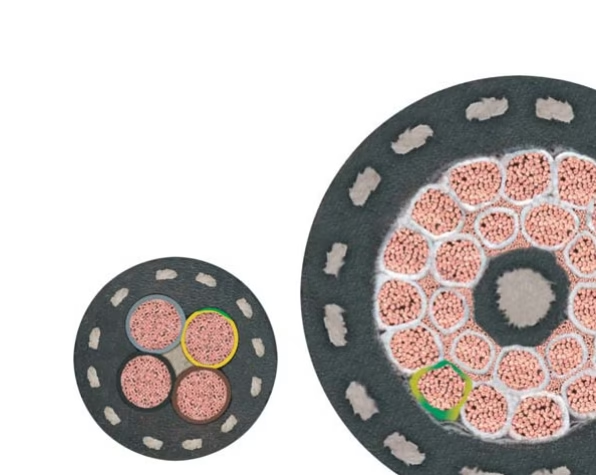
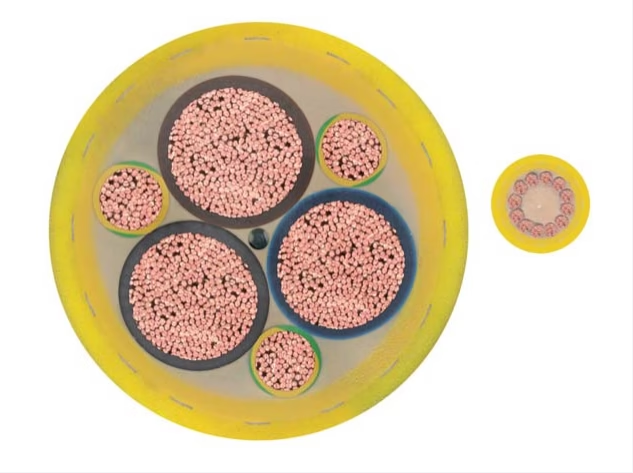
Flat Reeling Cable

飞纯 Type 245 是基于 AS/NZS 1802:2003 卷筒与拖曳电缆 标准体系设计的矿用非常柔性长壁采煤机电缆,电压范围覆盖 1.1 至 6.6KV。根据产品资料,该电缆主要用作长壁采煤机电缆,也可用于连续采煤机和长壁外围电缆。 Type 245 的关键结构特征是 三根中央可伸长 Pilot / 控制芯线。这三根中央 Pilot 芯线可用于 接地连续性监测 和 控制回路。对于长壁采煤机来说,电缆不仅要传输动力电能,还要承担设备控制、保护联锁、接地连续性确认和移动工况下的安全监测任务。

O que é o PANZERFLAT-ELX: Análise de Engenharia Aprofundada do Cabo de Carretel Chato de Potência (e Dados) de Média Tensão, Com ou Sem Fibra Óptica Integrada

O PANZERFLAT-ELX é a variante chata (flat) do cabo de carretel de média tensão para mineração e movimentação de granéis. Ele conserva toda a engenharia de potência da linha — cobre estanhado classe 5, isolação HEPR micro-filtrada, controle de campo por blindagens semicondutoras e bainha de PCP vermelho — mas adota uma decisão geométrica que define todo o seu caráter: os núcleos são dispostos lado a lado, em paralelo, formando um cabo plano que flexiona em um único plano. Cada núcleo de fase recebe sua própria blindagem metálica de trança de cobre estanhado, e um módulo de fibra óptica pode, opcionalmente, ocupar o centro do conjunto. É o cabo para sistemas de carretel cujo movimento é confinado a uma direção, com aceleração média, enrolando em monospiral de camada única.
UNE 22511 — formally titled "Cables flexibles para minería subterránea con tensiones de 1,8/3 kV con aislamiento de caucho, sin armadura" (Flexible cables for underground mining, 1.8/3 kV, rubber-insulated, unarmoured) — is the definitive Spanish standard for heavy-duty power cables connecting underground mobile mining equipment to fixed electrical distribution networks. Published and maintained by AENOR (Asociación Española de Normalización y Certificación), it operates as a specialized overlay on IEC 60502-1, extending that base standard's electrical requirements with the stringent mechanical, safety, and flame-retardancy requirements specific to enclosed underground environments. Despite its Spanish origin, UNE 22511 enjoys a geographic reach far exceeding Iberia. The standard has been adopted — formally or by reference — across the major Spanish-speaking mining economies: Chile, Peru, Colombia, Bolivia, and Mexico, where AENOR-certified cables are accepted by national mining safety regulators as the primary qualification pathway for underground mobile equipment power supply cables. In Chile alone, UNE 22511 cables are installed across dozens of operations including major copper and coal mines. The standard's engineering DNA can be described in a single imperative: extreme dynamic flexibility combined with superior resistance to combined torsional and bending fatigue. This is not merely a performance aspiration — it is a structural requirement that shapes every material choice and geometric decision in the cable's construction. The logic proceeds as follows: Underground mobile equipment (continuous miners, shearers, shuttle cars) moves continuously and repeatedly during operation, dragging its power cable behind it or winding and unwinding it from a cable reel. This motion imposes cyclic bending, axial tension, and torsional loads on the cable simultaneously — a multi-axis fatigue regime of a severity not encountered in any other industrial cable application. Standard fixed-installation cables, even those classified as "flexible," are not designed for this loading regime and will fail in fatigue within weeks to months when installed in drag duty. Therefore, every structural element of a UNE 22511 cable — conductor wire diameter, insulation compound, earth core geometry, armour exclusion, sheath specification — is selected to maximize multi-axis fatigue endurance, not any single performance parameter. ⛏ The Founding Engineering Principle UNE 22511 is an unarmoured drag cable standard. The deliberate absence of any metallic armour — which might superficially seem to reduce robustness — is in fact the defining engineering choice that makes the standard viable. Steel wire or tape armour in a continuously torsionally-loaded cable acts as a progressive-failure torsional spring: each twist cycle accumulates irreversible plastic strain in the armour wires, leading to wire fractures within 10,000–30,000 cycles. For a shuttle car cable experiencing 80,000+ torsional cycles per year, armour represents not additional protection but a built-in scheduled failure mechanism. The UNE 22511 design eliminates this failure mode at source.

Что такое PANZERFLAT-ELX from 3,6/6 to 12/20 kV: глубокий инженерный обзор плоского гибкого H.V. reeling cable для Mining / Bulk Material Handling

PANZERFLAT-ELX — это высокогибкий плоский кабель среднего и высокого напряжения для барабанных систем, мобильных машин и перегрузочного оборудования. Он объединяет силовую функцию, механическую стойкость к растяжению и истиранию, стабильную работу при частом изгибе в одной плоскости, а при необходимости — интегрированный оптический канал передачи данных.
FeiChun FLEXIDRUM® MEDIUM FLAT Revolutionary Hybrid Power & Data Transmission Cables: Next-Generation Flat-Profile Reeling Design with Integrated Optical Fiber Infrastructure (3.6–8.7/15 kV, Compact 50% Space Reduction vs. Round Cables, 6-Fiber Optical Integration at 62.5/125 Microns, Forced Guidance Multi-Level Deflection Support, -50°C Extreme Cold Capability): Comprehensive Technical Analysis of Revolutionary Flat Ribbon Cable Architecture Enabling Simultaneous Power Transmission & Fiber Optic Data Transport in Ultra-Compact Space-Efficient Design, Integrated Optical Fiber Supporting High-Speed Data Communication (1–10 Gbps Capabilities) Alongside Standard Electrical Power Distribution, Flat Form Factor Enabling 50% Space Reduction Compared to Equivalent Round Cables Revolutionizing Equipment Design Constraints, Compact Reeling Architecture Supporting Advanced Forced-Guidance Systems with Multi-Level Deflection, Tinned Copper Durability Ensuring Long-Term Reliability in Challenging Reeling Environments, Extreme Cold (-50°C) Tolerance Supporting Arctic Equipment Operations, Multiple Configuration Variants (Power-Only, Power+Single-Fiber, Power+6-Fiber+4E) Addressing Complete Spectrum of Next-Generation Equipment Requirements, and Strategic Next-Generation Systems Engineering Enabling Hybrid Infrastructure Convergence of Electrical Power & Optical Data in Single Integrated Cable System Next-generation equipment systems increasingly require simultaneous electrical power transmission and high-speed data communication requiring traditional separate cable infrastructure (power cable + data cable) consuming substantial space and increasing equipment complexity: dual cable systems (power + separate data) double space requirements, increase equipment footprint, complicate cable routing through forced-guidance systems, increase installation cost and maintenance complexity. Hybrid power+data integration eliminates dual-cable architecture enabling single integrated solution providing both power and communication infrastructure simultaneously. FeiChun's FLEXIDRUM® MEDIUM FLAT revolutionary cables address next-generation infrastructure requirements through flat ribbon form factor providing 50% space reduction versus equivalent round cables, integrated optical fiber enabling high-speed data communication (1–10 Gbps), hybrid power+data architecture eliminating dual-cable complexity, compact reeling compatibility enabling advanced forced-guidance systems, tinned copper durability ensuring long-term reliability, extreme cold (-50°C) operation supporting arctic infrastructure, multiple variant configurations addressing complete equipment spectrum.

FLEXIDRUM® MEDIUM FLAT (N)TSFLCGCWOEUS

FeiChun FLEXIDRUM® MEDIUM FLAT Revolutionary Hybrid Power & Data Transmission Cables: Next-Generation Flat-Profile Reeling Design with Integrated Optical Fiber Infrastructure (3.6–8.7/15 kV, Compact 50% Space Reduction vs. Round Cables, 6-Fiber Optical Integration at 62.5/125 Microns, Forced Guidance Multi-Level Deflection Support, -50°C Extreme Cold Capability): Comprehensive Technical Analysis of Revolutionary Flat Ribbon Cable Architecture Enabling Simultaneous Power Transmission & Fiber Optic Data Transport in Ultra-Compact Space-Efficient Design, Integrated Optical Fiber Supporting High-Speed Data Communication (1–10 Gbps Capabilities) Alongside Standard Electrical Power Distribution, Flat Form Factor Enabling 50% Space Reduction Compared to Equivalent Round Cables Revolutionizing Equipment Design Constraints, Compact Reeling Architecture Supporting Advanced Forced-Guidance Systems with Multi-Level Deflection, Tinned Copper Durability Ensuring Long-Term Reliability in Challenging Reeling Environments, Extreme Cold (-50°C) Tolerance Supporting Arctic Equipment Operations, Multiple Configuration Variants (Power-Only, Power+Single-Fiber, Power+6-Fiber+4E) Addressing Complete Spectrum of Next-Generation Equipment Requirements, and Strategic Next-Generation Systems Engineering Enabling Hybrid Infrastructure Convergence of Electrical Power & Optical Data in Single Integrated Cable System Next-generation equipment systems increasingly require simultaneous electrical power transmission and high-speed data communication requiring traditional separate cable infrastructure (power cable + data cable) consuming substantial space and increasing equipment complexity: dual cable systems (power + separate data) double space requirements, increase equipment footprint, complicate cable routing through forced-guidance systems, increase installation cost and maintenance complexity. Hybrid power+data integration eliminates dual-cable architecture enabling single integrated solution providing both power and communication infrastructure simultaneously. FeiChun’s FLEXIDRUM® MEDIUM FLAT revolutionary cables address next-generation infrastructure requirements through flat ribbon form factor providing 50% space reduction versus equivalent round cables, integrated optical fiber enabling high-speed data communication (1–10 Gbps), hybrid power+data architecture eliminating dual-cable complexity, compact reeling compatibility enabling advanced forced-guidance systems, tinned copper durability ensuring long-term reliability, extreme cold (-50°C) operation supporting arctic infrastructure, multiple variant configurations addressing complete equipment spectrum.
The nominal width of a (N)TSFLCGEWÖU 4x120 0.6/1kV shielded flat trailing cable is approximately 91 mm (3.58 inches), with a tolerance window of ±3.5 mm producing a permissible range of 87.5–94.5 mm. The nominal thickness is approximately 27.5 mm (1.08 inches), with a tolerance window of ±1.5 mm producing a permissible range of 26.0–29.0 mm. The approximate total weight of this cable is 8,200 kg/km (5,500 lbs/1000 ft), with copper weight approximately 5,250 kg/km. It features four 120 mm² main power conductors rated for 321 amperes continuous operation at 30°C ambient, supplemented by individual copper braid shielding on each conductor for electromagnetic compatibility (EMC) with variable-frequency drives and other sensitive equipment. The distinction between width and thickness for flat cables differs fundamentally from round cable specifications because flat cables do not have a single outer diameter. Instead, engineers must manage two dimensions simultaneously, and these dimensions directly determine whether the cable will fit into festoon track systems, contact shoe assemblies, and guidance rail configurations commonly deployed in overhead crane systems and automated material handling equipment.

What is the Width and Thickness of (N)TSFLCGEWÖU 4×120 0.6/1kV Shielded Flat Cable?

The nominal width of a (N)TSFLCGEWÖU 4×120 0.6/1kV shielded flat trailing cable is approximately 91 mm (3.58 inches), with a tolerance window of ±3.5 mm producing a permissible range of 87.5–94.5 mm. The nominal thickness is approximately 27.5 mm (1.08 inches), with a tolerance window of ±1.5 mm producing a permissible range of 26.0–29.0 mm. The approximate total weight of this cable is 8,200 kg/km (5,500 lbs/1000 ft), with copper weight approximately 5,250 kg/km. It features four 120 mm² main power conductors rated for 321 amperes continuous operation at 30°C ambient, supplemented by individual copper braid shielding on each conductor for electromagnetic compatibility (EMC) with variable-frequency drives and other sensitive equipment. The distinction between width and thickness for flat cables differs fundamentally from round cable specifications because flat cables do not have a single outer diameter. Instead, engineers must manage two dimensions simultaneously, and these dimensions directly determine whether the cable will fit into festoon track systems, contact shoe assemblies, and guidance rail configurations commonly deployed in overhead crane systems and automated material handling equipment.
Gantry crane systems operating in ports, shipyards, and container terminals demand cables capable of withstanding extreme mechanical stresses, including high tensile forces and continuous torsional movements. The selection of appropriate reeling cables directly impacts operational efficiency, maintenance costs, and safety standards in material handling operations. This comprehensive technical analysis compares two leading cable solutions manufactured to German DIN VDE 0250 standards: the Nexans RHEYFIRM® (RS) flat cable series and the (N)TSCGEWÖU medium-voltage cable family. 龙门起重机系统在港口、造船厂和集装箱码头运行时,需要能够承受极端机械应力的电缆,包括高拉力和持续的扭转运动。适当选择卷筒电缆直接影响物料搬运作业中的运营效率、维护成本和安全标准。本综合技术分析比较了两种按德国DIN VDE 0250标准制造的领先电缆解决方案:Nexans RHEYFIRM®(RS)扁电缆系列和(N)TSCGEWÖU中压电缆系列。

Nexans RHEYFIRM® (RS) vs. (N)TSCGEWÖU: A Detailed Comparison of Tensile Strength and Torsion Resistance for Gantry Cranes

Gantry crane systems operating in ports, shipyards, and container terminals demand cables capable of withstanding extreme mechanical stresses, including high tensile forces and continuous torsional movements. The selection of appropriate reeling cables directly impacts operational efficiency, maintenance costs, and safety standards in material handling operations. This comprehensive technical analysis compares two leading cable solutions manufactured to German DIN VDE 0250 standards: the Nexans RHEYFIRM® (RS) flat cable series and the (N)TSCGEWÖU medium-voltage cable family. 龙门起重机系统在港口、造船厂和集装箱码头运行时,需要能够承受极端机械应力的电缆,包括高拉力和持续的扭转运动。适当选择卷筒电缆直接影响物料搬运作业中的运营效率、维护成本和安全标准。本综合技术分析比较了两种按德国DIN VDE 0250标准制造的领先电缆解决方案:Nexans RHEYFIRM®(RS)扁电缆系列和(N)TSCGEWÖU中压电缆系列。
Mining operations worldwide face a critical procurement decision when selecting medium voltage reeling and trailing cables for mobile equipment such as excavators, draglines, and continuous miners. The choice between premium brand-name cables like PROTOLON and generic alternatives conforming to the same NTSCGEWÖU specification represents a significant investment decision with long-term operational and safety implications.

PROTOLON (Proprietary) vs. Generic NTSCGEWÖU: Is the Premium Price for Brand-Name Mining Cables Justified?

Mining operations worldwide face a critical procurement decision when selecting medium voltage reeling and trailing cables for mobile equipment such as excavators, draglines, and continuous miners. The choice between premium brand-name cables like PROTOLON and generic alternatives conforming to the same NTSCGEWÖU specification represents a significant investment decision with long-term operational and safety implications.
What is H05GG-F Cable?

What is H05GG-F Cable?

H05GG-F cable represents a specialized advancement in flexible cable engineering, specifically designed to address the thermal challenges inherent in modern domestic appliances and portable equipment. Unlike conventional flexible cables limited to 60°C or 90°C operating temperatures, the H05GG-F cable delivers reliable electrical performance in elevated temperature environments reaching 110°C, positioning it as the essential solution for heat-generating appliances and industrial hand tools. This cable designation, standardized under European harmonized specifications EN 50525-2-21, incorporates sophisticated material science innovations that enable sustained operation under thermal conditions that would rapidly degrade traditional cable insulation systems.
R-(N)TSCGEWOEU

What is R-(N)TSCGEWOEU Protolon (M)-R Cable W-9 High Voltage Round Reeling Cable?

The R-(N)TSCGEWOEU cable, marketed under the Protolon (M)-R and W-9 brand designations, represents the pinnacle of medium to high voltage reeling cable technology for extreme industrial applications. This sophisticated cable system is specifically engineered for fast-moving container cranes, heavy mining equipment, stackers, reclaimers, and ship unloaders where conventional medium voltage cables would fail.
The 12YHRDT11YH cable, also marketed under brand names such as Trommelflex PUR-HF, Semoflex Drum, and RXP-8, represents a specialized class of highly flexible round reeling cables engineered specifically for demanding cable reel applications. These premium polyurethane (PUR) jacketed cables are designed to withstand extreme mechanical stresses, including continuous flexing, high torsional loads, and rapid acceleration forces encountered in industrial crane systems, hoisting equipment, and automated material handling operations.

What is a 12YHRDT11YH Trommelflex PUR-HF Cable?

The 12YHRDT11YH cable, also marketed under brand names such as Trommelflex PUR-HF, Semoflex Drum, and RXP-8, represents a specialized class of highly flexible round reeling cables engineered specifically for demanding cable reel applications. These premium polyurethane (PUR) jacketed cables are designed to withstand extreme mechanical stresses, including continuous flexing, high torsional loads, and rapid acceleration forces encountered in industrial crane systems, hoisting equipment, and automated material handling operations.
Zihao.yang@feichuncables

Understanding the 12YRDT11Y11Y Cable

The 12YRDT11Y11Y cable, also known as the R-7 PUR round reeling cable, represents a specialized engineering solution for cable reel systems in demanding industrial environments. Distinguished by its distinctive yellow outer sheath and advanced construction featuring a supportive mesh vulcanized between inner and outer sheaths, this cable delivers exceptional torsional rigidity essential for both spring-driven and motorized cable reels used in crane systems, hoisting equipment, and material handling applications.
Reeling & Trailing Cables for Cranes & Mining — Feichun Special Cable Blogs

DIN VDE 0250 vs BS 6708-6116 BCS 295: Comprehensive Mining Cable Standards Comparison

Mining operations worldwide demand electrical cables that can withstand extreme conditions, mechanical stress, and potentially explosive atmospheres. Two primary international standards govern flexible mining cable specifications: the German DIN VDE 0250 and the British BS 6708 series (including BS 6116 and BCS 295 specifications). Understanding the differences and correspondences between these standards is crucial for mining engineers, procurement specialists, and electrical contractors working on international projects. This comprehensive guide analyzes both standards to help you make informed decisions about cable selection for mining applications.
Reeling & Trailing Cables for Cranes & Mining — Feichun Special Cable Blogs

What Are the Differences Between the Various Cable Types in International Standards?

International mining operations require specialized cables complying with diverse regional standards including European VDE, British BS, Australian AS/NZS, and International IEC specifications. This comprehensive technical guide examines the critical differences between major international standard mining cable types, covering construction specifications, material requirements, compliance frameworks, electrical characteristics, safety requirements, and optimal applications across global mining operations in Europe, Australia, Asia, Africa, and South America.
VDE 0250

DIN VDE 0250

DIN VDE 0250
DIN-VDE-0250-812

DIN VDE 0250 Part 812 NSSHÖU Rubber Insulated Flexible Cables

DIN VDE 0250 p.812 superseded VDE 0250/03.69 §812 with a transition period ending October 31, 1985. This standard eliminated the 6kV rated voltage construction and established the current NSSHÖU specifications as an independent standard within the DIN VDE 0250 series.