control cable

LIFT-2S (European) vs. LIFT-1S UL (North American): LIFT-2S characteristics: Voltage: 300/500V (European standard, lower voltage) Temperature: −40°C to +70°C (moderate range) Standards: VDE 0482 part 265-2-1, EN 50265-2-1, IEC 60332-1-2 Design philosophy: Safety by material redundancy (2 steel cores) Steel cores: 2× cores provide mechanical backup Conductor: Class 6 (European, ~150–200 wires per mm²) Cost: Lower (proven European manufacturing) Market: Europe, Asia-Pacific, most of world LIFT-1S UL characteristics: Voltage: 600V (North American standard, higher voltage) Temperature: −25°C to +105°C (extreme range, high-temp optimized) Standards: UL 2562, UL 62, CSA C22.2 No.210.2 Design philosophy: Safety by certification (single core + redundant control) Steel core: 1× core (sufficient with nylon covering) Conductor: Class M (UL, extra fine ~300+ wires per mm²) Cost: Higher (UL testing, certification documentation) Market: North America (USA, Canada), Mexico UL 2562 specialty certification: UL 2562 scope: Elevator and Dumbwaiter Cables Specific requirements: 1. Pendant cable design (cable hangs freely, no duct support) 2. Vertical orientation (designed for gravity-loaded suspension) 3. Repeated flex cycles (cable moves up/down frequently) 4. Safety-critical function (failure = personnel risk) Consequence: More stringent than general-purpose cables Testing includes: Bend cycle fatigue, heat aging, compression resistance Test procedures (unique to UL 2562): Bend cycle test: 1,000+ cycles at minimum bending radius Cable must pass insulation resistance after cycling Heat aging: 500+ hours at 105°C continuous Tensile strength retention minimum 70% Compression: 1,000+ hours under sustained compression Cable cross-section must not exceed 5% permanent deformation LIFT-2S (no UL 2562): Tests per VDE are less stringent on fatigue/cycling Assumes cable mostly static, not repeated flex Adequate for European elevator duty (lower speed, fewer cycles) LIFT-1S UL: All UL 2562 tests passed (proven for North American elevators) Faster cycle times, more frequent motion → more fatigue stress Extra testing ensures reliability under North American elevator duty Market requirement (regulatory): Europe/International: CE mark required (European conformity) VDE/EN/IEC standards sufficient No UL certification needed (not recognized in EU) LIFT-2S is sufficient North America (USA, Canada): UL certification mandatory for elevators UL 2562 specifically for elevator cables CSA dual certification required in Canada LIFT-2S NOT acceptable (lacks UL 2562) LIFT-1S UL mandatory Cost implication: UL certification: ~$5,000–15,000 per product per region Testing duration: 3–6 months per model Documentation: Comprehensive test reports, technical files Result: LIFT-1S UL 20–30% higher cost than equivalent European cable

DR 717 P Highflex: высокогибкий барабанный кабель PUR/TMPU для пружинных кабельных барабанов на сценах и в театрах

DR 717 P Highflex — это высокогибкий кабель для пружинных кабельных барабанов, применяемых на сценах и в театрах. Кабель разработан для намотки и размотки, имеет специально подобранную послойную скрутку вокруг центрального несущего элемента, оболочку PUR/TMPU, поддерживающий экран из высокотехнологичной нити, малый наружный диаметр, небольшой вес и высокую механическую стойкость.
BASKET SPREADER 750: Next-Generation Hoisting Cable Architecture The BASKET SPREADER 750 (3GSLTOE) represents a fundamental advancement in hoisting control cable design, specifically engineered for next-generation automated port crane systems operating under extreme environmental and operational constraints. Unlike the BASKET SPREADER 740's 300/500V AC specification, the 750 operates at 0.6/1kV AC with dual-voltage DC capability (0.9/1.8 kV)—a classification shift that enables: Higher power capacity – 2–3× greater amperage per conductor, enabling longer cable runs with lower voltage drop Medium-voltage infrastructure compatibility – Direct integration with port substation power distribution systems (0.6 kV = 600V three-phase industrial standard) DC dual-voltage operation – Simultaneous support for AC motor control and DC feedback/signaling circuits (0.9/1.8 kV DC margins) Extreme temperature capability – Operating range −50°C to +80°C (vs. SPREADER 740's −20°C to +60°C), addressing Arctic port terminals and tropical high-ambient scenarios Advanced insulation chemistry – GAALTHERM® 530 thermoplastic compound replaces standard PVC/PUR, delivering superior chemical resistance and thermal stability This cable bridges the gap between standard control cables (300/500V, limited temperature) and heavy industrial medium-voltage distribution cables, creating a purpose-built solution for modern automated gantry crane systems in global port terminals.

DR 718 CP Highflex Reeling Cable: экранированный высокогибкий PUR/TMPU кабель для spring cable reels, театральных сцен и крановых стрел

DR 718 CP Highflex — это reeling cable with overall copper screen для spring cable reels, например на сценах в театрах, а также для применения как control cable in crane arms. Кабель имеет жилы из bare copper strands class 5, special polymer insulation, специально подобранную скрутку вокруг центрального несущего элемента, PUR/TMPU inner sheath, tinned copper braiding screen и чёрную PUR/TMPU outer sheath RAL 9005.
What Are UNE 22560 and UNE 22561? Scope, Definitions, and Core Purpose The UNE 22560 and UNE 22561 standards represent the final and often most underestimated element of the Spanish and Latin American underground mining cable ecosystem. Where UNE 22511 and UNE 22512 govern the power distribution cables that energize mining equipment, the 22560 and 22561 standards govern the signal, control, and interlock cables that command and protect that equipment. These are the "nervous system" cables of a mine — the communication network that tells a continuous miner when to advance and when to halt, that triggers emergency stops, that monitors hoisting rope tension on shaft equipment, that controls conveyor sequencing, and that enables the protective interlocking that prevents a piece of equipment from operating unless all safety preconditions are met. UNE 22560 formally defines flexible multi-core cables for underground mining with voltage ratings up to 500 V or 0.6/1 kV, with no metallic armour protection — designed for installation within equipment enclosures, along protected cable trays in main gate roads, or in areas where mechanical damage risk is minimal. UNE 22561 is its armoured sister standard, incorporating steel wire braid or steel tape protection, specified for installation in rough terrain areas where mechanical damage from rock fall, equipment collision, or floor contact is a credible risk. Both standards mandate that the cable be designed as a multi-core concentric stranded bundle — not the parallel-laid three or four conductors common in power cables, but rather seven, twelve, nineteen, or more individually insulated cores twisted concentrically around a central axis, allowing compact packaging of numerous independent control circuits within a single cable jacket. The distinction between these standards is not merely mechanical armour presence or absence. Control cables are tested against an entirely different set of safety criteria than power cables because their failure mode is fundamentally different. A power cable failure results in loss of energy to equipment — dangerous but localized. A control cable failure can disable the interlock system that prevents a continuous miner from advancing into unsafe ground, or can disable the emergency stop circuit that should halt a conveyor if a worker falls into it. A control cable fire, burning in a tightly bundled cable tray with other control cables, must not spread flame between cables because control cables are typically routed in shared ducts and cable carriers where one cable's ignition could cascade to adjacent circuits. Therefore, control cables are tested for bundle flame propagation (EN 60332-3) rather than single-cable flame propagation tests — a more stringent requirement that demands careful attention to outer sheath formulation and cable spacing in bundle installation.

Что такое PANZERFLEX-L 0,6/1 kV – Instrumentation and Control: инженерный обзор гибкого кабеля управления для Mining, Reeling и Festoon Systems

PANZERFLEX-L 0,6/1 kV – Instrumentation and Control — это многожильный гибкий кабель для цепей управления, приборных линий, вспомогательного питания и сигнализации на подвижных частях машин, горнодобывающего оборудования и material handling systems. Он предназначен для кабельных барабанов и festoon systems, где кабель постоянно изгибается, частично скручивается, ускоряется и работает под механическим натяжением. Его ключевые признаки — лужёная медная жила class 5 IEC 60228, HEPR crushproof insulation, короткая скрутка ≤7,5× диаметра укладки, чёрные жилы с печатной нумерацией, опциональная зелёно-жёлтая жила, полихлоропреновые оболочки и антискручивающие синтетические нити между внутренней и наружной оболочкой.
GAALFLEX® VFD NYCWY: 600V/1000V European Standard Power Cable with Concentric Copper Conductor Shielding, Underground Direct-Burial Installation Capability, Frequency Converter Integration, Control Impulse & Test Data Transmission, 2–4 Cores, 10–240 mm² Solid/Stranded Red Copper, PVC DIV4 Insulation, Corrugated Copper Wire + Tape Screening, Self-Extinguishing Flame-Retardant, DIN VDE 0276/IEC 60502 Compliance, Utility Substation & Subscriber Network Deployment | European Underground Utility VFD Power Cable UL-certified European standard 600V/1000V underground direct-burial power cable with unique concentric copper conductor shielding combining solid or stranded red copper with PVC DIV4 insulation, corrugated copper wire + tape concentric shielding, and professional utility-grade grounding continuity—addressing underground direct-burial specification (subscriber networks, power stations), dual-voltage power distribution (600V/1000V), frequency converter system integration, control signal and test data transmission, utility substation infrastructure, and comprehensive European underground power distribution infrastructure simultaneously.

What is TROMMELFLEX PUR-HF D12Y11YU11Y: An In-Depth Engineering Analysis of the Halogen-Free PUR Low Voltage Reeling Cable

TROMMELFLEX PUR-HF D12Y11YU11Y-J/O is a flexible 0.6/1 kV low voltage reeling cable for high mechanical stress applications. Its engineering value is not only the voltage rating, but the combination of class 5 flexible plain copper conductors, halogen-free polyester-based insulation, a central textile carrier unit, short-length core lay, PUR inner sheath, open support braiding and black halogen-free flame-retardant polyurethane outer sheath. For port cranes, ship loaders, festoon systems, mobile machines and wet outdoor cable routes, the design targets a rare performance window: 25 N/mm² tensile load, ±50°/m torsional stress, 6×D minimum bending radius, 90°C conductor operation and permanent use in water up to 50 m diving depth.
FLEXIFESTOON® HF-FLAT: Advanced Halogen-Free Flat Cable System for Industrial Cranes, Material Handling Equipment, and Festoon Track Applications 0.6/1 kV Power and Control Cable | Parallel Stranding Architecture | Low Smoke Emission | Nuclear Plant Certified | Flexible Deployment Halogen-Free Design Low Smoke Emission Extended Temperature Flat Configuration Industrial material handling environments present a paradox: equipment must operate continuously under mechanical stress while meeting increasingly stringent safety and environmental regulations. Conventional PVC-based festoon cables, the industry standard for overhead cranes and monorail systems, release highly corrosive and toxic gases during thermal incidents—a critical safety liability in confined spaces (enclosed factories, underground mining operations, nuclear facilities). Feichun's FLEXIFESTOON® HF-FLAT introduces a revolutionary flat cable architecture combining halogen-free polymer chemistry, parallel core stranding for superior mechanical flexibility, and low-smoke-emission technology specifically optimized for material handling applications where safety margins cannot be compromised. This technical examination explores the advanced material science, mechanical engineering principles, regulatory compliance framework, and operational deployment advantages of the industry's most flexible and safety-optimized festoon cable platform.

FLEXIFESTOON® HF-FLAT

FLEXIFESTOON® HF-FLAT: Advanced Halogen-Free Flat Cable System for Industrial Cranes, Material Handling Equipment, and Festoon Track Applications 0.6/1 kV Power and Control Cable | Parallel Stranding Architecture | Low Smoke Emission | Nuclear Plant Certified | Flexible Deployment Halogen-Free Design Low Smoke Emission Extended Temperature Flat Configuration Industrial material handling environments present a paradox: equipment must operate continuously under mechanical stress while meeting increasingly stringent safety and environmental regulations. Conventional PVC-based festoon cables, the industry standard for overhead cranes and monorail systems, release highly corrosive and toxic gases during thermal incidents—a critical safety liability in confined spaces (enclosed factories, underground mining operations, nuclear facilities). Feichun’s FLEXIFESTOON® HF-FLAT introduces a revolutionary flat cable architecture combining halogen-free polymer chemistry, parallel core stranding for superior mechanical flexibility, and low-smoke-emission technology specifically optimized for material handling applications where safety margins cannot be compromised. This technical examination explores the advanced material science, mechanical engineering principles, regulatory compliance framework, and operational deployment advantages of the industry’s most flexible and safety-optimized festoon cable platform.
Multi-Purpose Industrial Cable FLEXIDRUM® SPECIAL R 702 Highly Flexible, Customizable Cable for Heavy Appliances & Vertical Use ⚡ Voltage: 0.6/1 kV OR 300/500 V 🔧 Speed: 120 m/min max 🎯 Configurations: 40+ SKUs, fully customizable 🌡️ Temperature: −50 to +90°C Nominal Voltage 0.6/1 kV OR 300/500 V (customer selection) Test Voltage 4 kV / 2 kV Depending on voltage class Max Speed 120 m/min Moderate-speed reeling applications Operating Temp −50 to +90°C Fixed & flexible laying (highest in class) Bending Radius 3×d to 7.5×D Depends on application mode & cable size Configurations 40+ Power, control, signal, fiber-optic integration

FLEXIDRUM® SPECIAL R 702

Multi-Purpose Industrial Cable FLEXIDRUM® SPECIAL R 702 Highly Flexible, Customizable Cable for Heavy Appliances & Vertical Use ⚡ Voltage: 0.6/1 kV OR 300/500 V 🔧 Speed: 120 m/min max 🎯 Configurations: 40+ SKUs, fully customizable 🌡️ Temperature: −50 to +90°C Nominal Voltage 0.6/1 kV OR 300/500 V (customer selection) Test Voltage 4 kV / 2 kV Depending on voltage class Max Speed 120 m/min Moderate-speed reeling applications Operating Temp −50 to +90°C Fixed & flexible laying (highest in class) Bending Radius 3×d to 7.5×D Depends on application mode & cable size Configurations 40+ Power, control, signal, fiber-optic integration
GAALFLEX® Complete 53-Product Cable Selection Guide: Deep Comparison Across 7 Product Families for Industrial, Marine, Mining, Automation, and VFD Applications A comprehensive engineering reference comparing all 53 GAALFLEX® cable products across voltage rating, insulation technology, shielding architecture, temperature range, certification standards, application environment, and core configuration — enabling engineers to select the optimal cable for any industrial scenario from a single unified portfolio.

Deep Comparison Across 7 Cables Families for Industrial, Marine, Mining, Automation, and VFD Applications

GAALFLEX® Complete 53-Product Cable Selection Guide: Deep Comparison Across 7 Product Families for Industrial, Marine, Mining, Automation, and VFD Applications A comprehensive engineering reference comparing all 53 GAALFLEX® cable products across voltage rating, insulation technology, shielding architecture, temperature range, certification standards, application environment, and core configuration — enabling engineers to select the optimal cable for any industrial scenario from a single unified portfolio.
GAALFLEX® CONTROL H05V2-K / H07V2-K: Advanced UL/CSA-Certified PVC Single-Conductor Industrial Control Cable (H05V2-K: 300/500 V DIN VDE / 600 V UL/CSA, H07V2-K: 450/750 V DIN VDE / 600 V UL/CSA, 2.5 kV Test Voltage per DIN VDE 0281 part 2, −20 to +90°C Fixed Laying / −5 to +90°C Flexible Application (DIN VDE), up to +105°C (UL/CSA Continuous Operation and Transient Short-Circuit Events), Class 5 Flexible Tinned Copper Conductor per IEC 60228 and DIN VDE 0295, PVC Type TI3 Black Outer Sheath (RAL 9005 Equivalent), AWM Style 1015 (105°C / 600 V), AWM Style 1569 (105°C / 300 V), AWM Style 1007 (80°C / 300 V), CSA Type TEW (105°C / 600 V and 80°C / 300 V variants), Dual-Standard Certification: DIN VDE 0482-265-2-1 / EN 50265-2-1 / IEC 60332-1-2 (European Harmonization) Plus UL 1581 UL VW-1 / CSA FT1 (North American UL/CSA Compliance), Flame Retardant and Self-Extinguishing, 4×D Minimum Bending Radius for Compact Panel Routing (Smallest Footprint in Class), NFPA 79 2018 Edition Compatibility for Electrical Safety and Color Coding, Green/Yellow Protective Earth per NFPA 79, Single-Core Architecture with 0.5 mm² to 120 mm² Cross-Section Range, 15+ Standardized SKU Configurations, Optional Flexible Conductor On Request, Harmonized per European Standards, RoHS and CE Certification with Optional CSA/UL On Request): Comprehensive Advanced North American Industrial Control & Renewable Energy Cable Architecture Analysis Integrating PVC Polymer Chemistry, Tinned Copper Conductor Metallurgy, UL/CSA Certification Pathways, Compact Bending-Radius Engineering, NFPA 79 Electrical Safety Architecture, North American Renewable Energy Integration, AWM Style Standardization, Industrial Control Panel Specification, and Next-Generation Dual-Standard (European + North American) Electrical Distribution

GAALFLEX® CONTROL-H05V2-K & H07V2-K

GAALFLEX® CONTROL H05V2-K / H07V2-K: Advanced UL/CSA-Certified PVC Single-Conductor Industrial Control Cable (H05V2-K: 300/500 V DIN VDE / 600 V UL/CSA, H07V2-K: 450/750 V DIN VDE / 600 V UL/CSA, 2.5 kV Test Voltage per DIN VDE 0281 part 2, −20 to +90°C Fixed Laying / −5 to +90°C Flexible Application (DIN VDE), up to +105°C (UL/CSA Continuous Operation and Transient Short-Circuit Events), Class 5 Flexible Tinned Copper Conductor per IEC 60228 and DIN VDE 0295, PVC Type TI3 Black Outer Sheath (RAL 9005 Equivalent), AWM Style 1015 (105°C / 600 V), AWM Style 1569 (105°C / 300 V), AWM Style 1007 (80°C / 300 V), CSA Type TEW (105°C / 600 V and 80°C / 300 V variants), Dual-Standard Certification: DIN VDE 0482-265-2-1 / EN 50265-2-1 / IEC 60332-1-2 (European Harmonization) Plus UL 1581 UL VW-1 / CSA FT1 (North American UL/CSA Compliance), Flame Retardant and Self-Extinguishing, 4×D Minimum Bending Radius for Compact Panel Routing (Smallest Footprint in Class), NFPA 79 2018 Edition Compatibility for Electrical Safety and Color Coding, Green/Yellow Protective Earth per NFPA 79, Single-Core Architecture with 0.5 mm² to 120 mm² Cross-Section Range, 15+ Standardized SKU Configurations, Optional Flexible Conductor On Request, Harmonized per European Standards, RoHS and CE Certification with Optional CSA/UL On Request): Comprehensive Advanced North American Industrial Control & Renewable Energy Cable Architecture Analysis Integrating PVC Polymer Chemistry, Tinned Copper Conductor Metallurgy, UL/CSA Certification Pathways, Compact Bending-Radius Engineering, NFPA 79 Electrical Safety Architecture, North American Renewable Energy Integration, AWM Style Standardization, Industrial Control Panel Specification, and Next-Generation Dual-Standard (European + North American) Electrical Distribution
GAALFLEX® CONTROL H05Z-K / H07Z-K: Advanced Halogen-Free XLPO Single-Conductor Industrial Control Cable (H05Z-K: 300/500 V Nominal, H07Z-K: 450/750 V Nominal, 2 kV / 2.5 kV Test Voltage per DIN VDE 0281 part 2 and HD 21.2, −40 to +90°C Bidirectional Extreme Temperature Envelope, Class 5 Flexible Red Bare Copper Conductor per IEC 60228 and DIN VDE 0295, XLPO Type EI5 Cross-Linked Polyolefin Outer Sheath with Black RAL 9005 Coloration, Zero Halogenated Decomposition Products per DIN VDE 0482 part 267-2 / EN 50267-2-1 / IEC 60754-1, Flame Retardant and Self-Extinguishing per DIN VDE 0482 part 332-1-2 / IEC 60332-1-2, Low Optical Smoke Density per IEC 61034-1-2, Harmonized per DIN VDE 0282-9, RoHS and CE Certified, 8×D Minimum Bending Radius for Compact Routing, Single-Core Architecture with 0.5 mm² to 240 mm² Cross-Section Range, 15+ Standardized SKU Configurations, Optional Color Variants Available, Engineered for Industrial Control Panels, PLC/SCADA Wiring, Renewable Energy DC Distribution, Marine Electrical Systems, Aerospace Equipment, Safety-Critical Machinery Control, and Zero-Halogen Fire-Safety-Mandated Environments): Comprehensive Advanced Industrial Control & Renewable Energy Cable Architecture Analysis Integrating Cross-Linked Polyolefin Polymer Chemistry, Halogenation-Free Flame Retardancy Mechanics, Zero-Smoke Thermal Decomposition Engineering, Thermal Stability & UV Resistance, Class 5 Ultra-Flexible Conductor Mechanics, Industrial Control Panel Integration, Renewable Energy DC Bus Routing, Marine Safety-Critical Cable Specification, Aerospace Harness Architecture, and Next-Generation Fire-Safety-Compliant Electrical Distribution for Zero-Halogen Mandated Environments

GAALFLEX® CONTROL H05Z-K & H07Z-K

GAALFLEX® CONTROL H05Z-K / H07Z-K: Advanced Halogen-Free XLPO Single-Conductor Industrial Control Cable (H05Z-K: 300/500 V Nominal, H07Z-K: 450/750 V Nominal, 2 kV / 2.5 kV Test Voltage per DIN VDE 0281 part 2 and HD 21.2, −40 to +90°C Bidirectional Extreme Temperature Envelope, Class 5 Flexible Red Bare Copper Conductor per IEC 60228 and DIN VDE 0295, XLPO Type EI5 Cross-Linked Polyolefin Outer Sheath with Black RAL 9005 Coloration, Zero Halogenated Decomposition Products per DIN VDE 0482 part 267-2 / EN 50267-2-1 / IEC 60754-1, Flame Retardant and Self-Extinguishing per DIN VDE 0482 part 332-1-2 / IEC 60332-1-2, Low Optical Smoke Density per IEC 61034-1-2, Harmonized per DIN VDE 0282-9, RoHS and CE Certified, 8×D Minimum Bending Radius for Compact Routing, Single-Core Architecture with 0.5 mm² to 240 mm² Cross-Section Range, 15+ Standardized SKU Configurations, Optional Color Variants Available, Engineered for Industrial Control Panels, PLC/SCADA Wiring, Renewable Energy DC Distribution, Marine Electrical Systems, Aerospace Equipment, Safety-Critical Machinery Control, and Zero-Halogen Fire-Safety-Mandated Environments): Comprehensive Advanced Industrial Control & Renewable Energy Cable Architecture Analysis Integrating Cross-Linked Polyolefin Polymer Chemistry, Halogenation-Free Flame Retardancy Mechanics, Zero-Smoke Thermal Decomposition Engineering, Thermal Stability & UV Resistance, Class 5 Ultra-Flexible Conductor Mechanics, Industrial Control Panel Integration, Renewable Energy DC Bus Routing, Marine Safety-Critical Cable Specification, Aerospace Harness Architecture, and Next-Generation Fire-Safety-Compliant Electrical Distribution for Zero-Halogen Mandated Environments
The ÖLFLEX CLASSIC 115 CY 4G1.5 cable represents a precision-engineered control cable where every dimensional and electrical specification has been optimized through extensive testing and field validation across diverse industrial applications. The 8.2-millimeter outer diameter establishes the space requirements for cable routing in panel layouts, cable trays, and conduit systems. To understand this specification in practical terms, consider that 8.2 millimeters is approximately the width of a standard pencil—this compact size enables routing through narrow spaces between equipment, through small penetrations in enclosure walls, and through dense cable bundles where space is precious. The 4G1.5 designation specifies that the cable contains four conductors, each with a 1.5 square millimeter cross-sectional area, meaning each conductor is composed of fine copper wire strands twisted together in a flexible Class 5 stranding pattern. One of these four conductors is the distinctive green-yellow (dual-color) protective earth/ground conductor, while the other three are typically color-coded according to VDE 0293-308 standards (often black, brown, and grey for three-phase applications, or black, brown, and blue for single-phase applications). The current carrying capacity is approximately 18 amperes under standard conditions (30°C ambient air temperature, cables routed in free air rather than enclosed in conduit or cable trays), establishing the maximum safe electrical load for any single conductor. The voltage rating of 300/500V classifies this as a control-voltage cable rather than a high-voltage power cable, appropriate for control circuits, instrumentation systems, and signaling applications rather than main power distribution.

VDE Cross-Reference: Drop-in Alternative for ÖLFLEX CLASSIC 115 CY 4G1.5 VDE 0250

The ÖLFLEX CLASSIC 115 CY 4G1.5 cable represents a precision-engineered control cable where every dimensional and electrical specification has been optimized through extensive testing and field validation across diverse industrial applications. The 8.2-millimeter outer diameter establishes the space requirements for cable routing in panel layouts, cable trays, and conduit systems. To understand this specification in practical terms, consider that 8.2 millimeters is approximately the width of a standard pencil—this compact size enables routing through narrow spaces between equipment, through small penetrations in enclosure walls, and through dense cable bundles where space is precious. The 4G1.5 designation specifies that the cable contains four conductors, each with a 1.5 square millimeter cross-sectional area, meaning each conductor is composed of fine copper wire strands twisted together in a flexible Class 5 stranding pattern. One of these four conductors is the distinctive green-yellow (dual-color) protective earth/ground conductor, while the other three are typically color-coded according to VDE 0293-308 standards (often black, brown, and grey for three-phase applications, or black, brown, and blue for single-phase applications). The current carrying capacity is approximately 18 amperes under standard conditions (30°C ambient air temperature, cables routed in free air rather than enclosed in conduit or cable trays), establishing the maximum safe electrical load for any single conductor. The voltage rating of 300/500V classifies this as a control-voltage cable rather than a high-voltage power cable, appropriate for control circuits, instrumentation systems, and signaling applications rather than main power distribution.
The selection of industrial power cables represents one of the most critical engineering decisions in drilling operations, whether on land or offshore. Two cable types dominate this application space: the Type SHD-GC (重型屏蔽接地检查电缆), designed primarily for mobile mining and terrestrial drilling equipment, and the Type P (海洋平台电缆), engineered specifically for harsh offshore and fixed platform environments. Though both cables operate at similar voltage ratings, they embody fundamentally different design philosophies that reflect the distinct mechanical, electrical, and safety demands of their respective application domains.

Type SHD-GC vs. Type P: Selecting the Right Trailing Cable for Land and Offshore Drilling 

The selection of industrial power cables represents one of the most critical engineering decisions in drilling operations, whether on land or offshore. Two cable types dominate this application space: the Type SHD-GC (重型屏蔽接地检查电缆), designed primarily for mobile mining and terrestrial drilling equipment, and the Type P (海洋平台电缆), engineered specifically for harsh offshore and fixed platform environments. Though both cables operate at similar voltage ratings, they embody fundamentally different design philosophies that reflect the distinct mechanical, electrical, and safety demands of their respective application domains.
TSCGECEWÖU, NTSCGECEWÖU, TSKCGECWOEU, TSCGEWOEU, NSSHOEU, NTSCGEWOEU-CH, German mining cable, DIN cable, VDE cable, German cable standard, coal cutter cable CH, festoon cable FN, trailing cable W, screened cable designation, EPR mining cable

Joy Global (Komatsu) 7LS Longwall Shearer: (N)TSCGECEWÖU Drag Chain Cable Robustness Analysis

TSCGECEWÖU, NTSCGECEWÖU, TSKCGECWOEU, TSCGEWOEU, NSSHOEU, NTSCGEWOEU-CH, German mining cable, DIN cable, VDE cable, German cable standard, coal cutter cable CH, festoon cable FN, trailing cable W, screened cable designation, EPR mining cable
As mining operations become increasingly automated, the reliable transmission of control signals and sensor data has become critical to operational safety and efficiency. Modern mining automation systems integrate programmable logic controllers, variable frequency drives, instrumentation sensors, and digital communication networks that must function reliably in electrically hostile underground environments. The electromagnetic interference generated by high-power mining equipment poses a significant threat to these sensitive systems, making proper cable shielding essential for signal integrity and system reliability.1 随着采矿作业变得越来越自动化,控制信号和传感器数据的可靠传输对运营安全和效率变得至关重要。现代采矿自动化系统集成了可编程逻辑控制器、变频驱动器、仪表传感器和数字通信网络,这些必须在电气恶劣的地下环境中可靠运行。

(N)TSCGECEWÖU: Individual Copper Screening for Sensitive Mining Automation Equipment

As mining operations become increasingly automated, the reliable transmission of control signals and sensor data has become critical to operational safety and efficiency. Modern mining automation systems integrate programmable logic controllers, variable frequency drives, instrumentation sensors, and digital communication networks that must function reliably in electrically hostile underground environments. The electromagnetic interference generated by high-power mining equipment poses a significant threat to these sensitive systems, making proper cable shielding essential for signal integrity and system reliability.1 随着采矿作业变得越来越自动化,控制信号和传感器数据的可靠传输对运营安全和效率变得至关重要。现代采矿自动化系统集成了可编程逻辑控制器、变频驱动器、仪表传感器和数字通信网络,这些必须在电气恶劣的地下环境中可靠运行。
When you look at a cable from the outside, you see a smooth, round cylinder. This simple appearance conceals a complex engineering challenge. Inside that cylindrical exterior are multiple insulated conductors of various sizes arranged together. Without proper design, these internal components would naturally create an irregular, lumpy cross-section rather than the uniform circular shape we expect from a professional cable. This is where rubber fillers play their essential role, and understanding their function requires us to think about the geometric and mechanical realities of cable construction.

Rubber Filler Role: Understanding How Fillers Maintain Cylindrical Shape in NSSHÖU Cables Under Crushing Loads

When you look at a cable from the outside, you see a smooth, round cylinder. This simple appearance conceals a complex engineering challenge. Inside that cylindrical exterior are multiple insulated conductors of various sizes arranged together. Without proper design, these internal components would naturally create an irregular, lumpy cross-section rather than the uniform circular shape we expect from a professional cable. This is where rubber fillers play their essential role, and understanding their function requires us to think about the geometric and mechanical realities of cable construction.
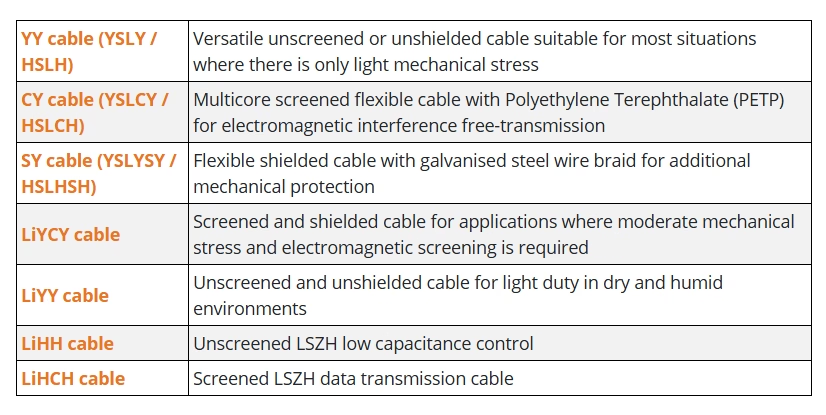
The Veriflex range encompasses control cables (SY, CY, YY series), fieldbus cables (Profibus DP/PA, DeviceNet), and Industrial Ethernet cables (Profinet, PUR Ethernet). Available in both PVC and LSZH (Low Smoke Zero Halogen) variants, the portfolio addresses diverse installation environments from standard industrial settings to fire-sensitive locations requiring enhanced safety performance.

What is Veriflex Cable?

Veriflex CY PVC YSLCY, Veriflex SY PVC YSLYSY, Veriflex YY PVC YSLY, Veriflex YY LSZH HSLH, Veriflex CY LSZH HSLCH, Veriflex Screened Bedded LSZH HSLHCH, Veriflex YSLYCY 1kV cable, Veriflex Control PUR-JZ, Veriflex 2XSL(st)CH LSZH, Veriflex DeviceNet Thick FRNC-LSZH, Veriflex DeviceNet Thin LSZH, Veriflex Profibus DP FC L2/FIP PVC, Veriflex Profibus DP FC L2/FIP LSZH, Veriflex Profibus PA PVC, Veriflex Profibus PA FRNC-LSZH, Veriflex Profinet Type A, Veriflex PUR Industrial Ethernet, Veriflex Interface BUS Cable
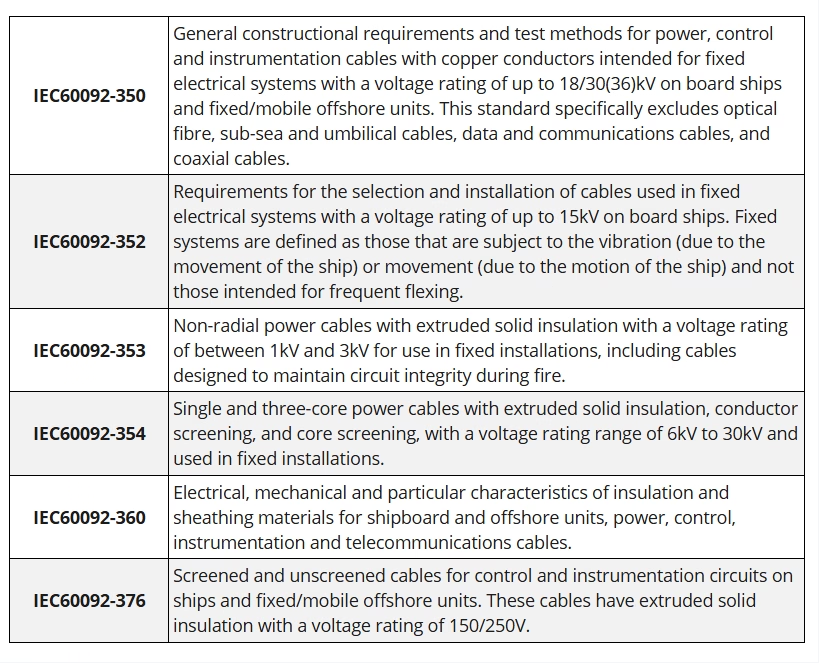
IEC 60092 is the international standard for electrical installations in ships and fixed/mobile marine applications. Ship wiring is covered by various national standards such as BS 6883 (British) and NEK 606 (Norwegian), and subject to third-party accreditations including Lloyd's Register, DNV (Det Norske Veritas), and ABS (American Bureau of Shipping). As an international standard, IEC 60092 covers power and instrumentation cables for use on ships and in mobile marine environments.

What is IEC 60092 Cable?

IEC 60092 cable, marine cable, shipboard cable, offshore cable, BS 6883 cable, NEK 606 cable, BFOU cable, RFOU cable, 657TQ cable, 658TQ cable, fire resistant marine cable, flame retardant cable, ship wiring, offshore platform cable, Lloyd’s Register approved, DNV certified, halogen free cable, LSZH marine cable, MUD resistant cable, IEC 60092-353, IEC 60092-354, IEC 60092-376, SW4 cable, EPR insulated, TCWB armoured, instrumentation cable, control cable, emergency power cable, oil rig cable, Feichun cable
EN 50288-7 instrumentation cables are multi-element metallic cables used in analogue and digital communication and control applications. Manufactured in accordance with European Standard EN 50288 (British Standard BS EN 50288), these cables are widely used in processing plants such as those found in the petrochemical industry due to their ability to withstand electromagnetic interference (EMI). They are specifically designed for the transmission of signals in instrumentation, control, and communication applications, commonly available in 300V and 500V voltage ratings.

What is EN 50288-7 Cable?

EN 50288-7 cable, BS EN 50288-7, instrumentation cable, control cable, RE-2X(st)H cable, RE-2X(st)Y cable, RE-2Y(st)Y cable, PiMF cable, TiMF cable, screened cable, petrochemical cable, XLPE instrumentation cable, LSZH instrumentation cable
DIN VDE 0812 is a German national standard issued in 1988 that contains specifications for equipment wires and stranded equipment wires used within telecommunications and data processing systems. The standard covers flexible, multi-conductor cables designed for electronic control system connections, voice frequency transmission, and signal communications in fixed installations. These cables represent popular European alternatives to American-style data and control cables, featuring cores twisted into pairs to reduce crosstalk and electromagnetic interference.

What is DIN VDE 0812 Cable?

DIN VDE 0812 cables are designed for electronic control system connections, voice frequency transmission, and signal communications in fixed installations. They are widely used across various industries where reliable data and signal transmission is required in environments requiring flexibility and compact cable routing.
FESTOONFLEX-LX 0,6/1 kV is a premium instrumentation and control cable engineered for mining operations and bulk material handling applications. This cable is specifically designed for festoon systems and connecting movable parts of machine tools where fast movement, strong acceleration, and frequent bending during operation are critical requirements.

FESTOONFLEX-LX 0,6/1 kV Instrumentation & Control Cable

FESTOONFLEX-LX, FESTOONFLEX-LX 0.6/1kV, instrumentation cable, control cable, mining control cable, festoon cable, IEC 60228 Class 5, DIN VDE 0298, screened pairs cable, EPR insulation, polychloroprene sheath, UV resistant cable, oil resistant cable, crushproof cable, 90°C rated cable, -30°C low temperature, mining equipment cable, crane control cable, conveyor instrumentation, bulk material handling, high flex cable, torsion resistant cable, EMI shielded cable, 80% screen coverage, 4G control cable, 5G control cable, multi-core cable, Anhui Feichun cable, 礦用控制電纜, 儀表電纜, 懸掛電纜, 屏蔽對電纜, 特種電纜
CEI 20-27 CENELEC HD361 Cable

What is CEI 20-27 CENELEC HD361 Cable?

CEI 20-27 CENELEC HD361 represents a standardized cable designation system developed by the European Committee for Electrotechnical Standardisation (CENELEC) to provide uniform identification and classification of harmonized power cables and cords across European markets. This systematic coding methodology enables engineers, procurement specialists, and electrical contractors to precisely identify cable specifications including voltage ratings, insulation materials, conductor types, and sheathing compounds through a structured alphanumeric designation format.